
Review · CYCLING TOURS
Appian Way, Catacombs and Aqueducts Park Tour with Top E-Bike
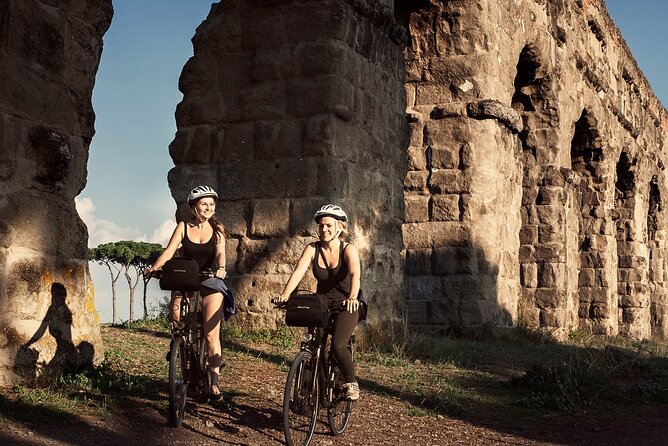
The best surprise here is how quickly Rome changes. You leave the city through the ancient Porta San Sebastiano, then pedal onto old stone roads, past sheep-filled fields, imperial ruins, underground tombs, and giant aqueducts. An electric-assist bike lets you cover roughly 17 miles without turning the day into an endurance test.
I like two things in particular: the route reaches places that are awkward to connect on foot, and the small groups, capped at 10 people, give guides such as Arina, Claudia, Fabio, Bita, and Stefan room to explain what you are seeing. The bikes are well suited to anyone who can ride competently, not just regular cyclists.
The catch is that this is still a real bike ride. About 40 percent takes place on city streets, and some sections are narrow, rough, or shared with traffic and pedestrians. If you are nervous on a bike, have back or neck problems, or dislike riding close behind a group, this may not be your ideal Rome outing.
In This Review
- Key points to know before you book
- Why the Appian Way works so well by e-bike
- Leaving Rome through Porta San Sebastiano
- The ancient road into Appian Way Park
- Choosing between four and six hours
- Catacombs of San Callisto and San Sebastiano
- Imperial ruins at the Circus of Maxentius
- Cecilia Metella and the Appian Way’s grand tombs
- The Villa dei Quintili on the six-hour route
- Aqueducts Park and the open countryside
- Ending near the Baths of Caracalla
- Guides, group size, and the pace of the ride
- Who will enjoy this Rome tour most
- Is $102.79 a fair price?
- Final verdict: should you book it?
- FAQ
- Where does the tour begin and end?
- How long is the experience?
- How far do you ride?
- Is the tour suitable for beginners?
- Are helmets provided?
- Are children allowed to participate?
- Are food and drinks included?
- What happens on Wednesdays?
Key points to know before you book
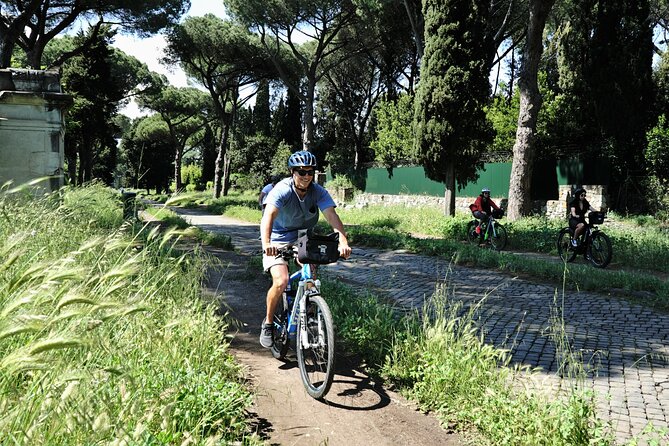
- You cover a huge stretch of ancient Rome: The route links the Appian Way, catacombs, imperial ruins, aqueducts, and open parkland in one outing.
- The six-hour option offers much more: It adds a guided catacomb visit, Villa dei Quintili, and the Baths of Caracalla.
- The e-bike reduces effort, not responsibility: You still need balance, braking skills, and confidence on uneven paths and city streets.
- The most scenic riding is off-road: Around 60 percent of the route runs through parks with no traffic.
- Weekdays may feel easier: Sundays can bring heavier crowds of walkers and local cyclists on the Appian Way and at the aqueducts.
- Bring water and plan a food stop: A bottle is provided, but food and drinks are not included.
Why the Appian Way works so well by e-bike
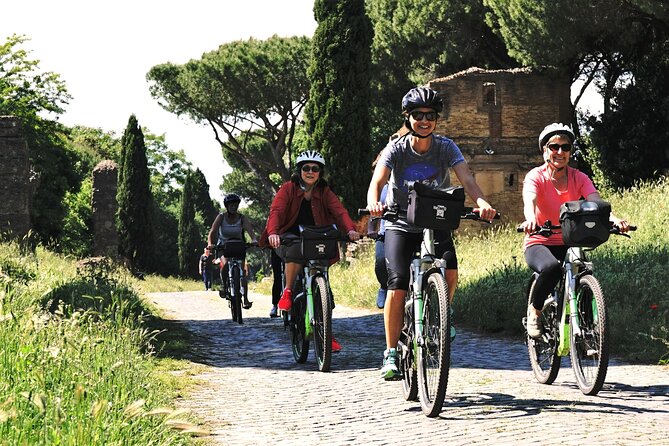
Rome’s ancient center is easy to reach on foot, but the Appian Way and Aqueducts Park sit beyond the usual Colosseum and Vatican circuit. Seeing both by public transportation and walking takes planning, and attempting the full route on a standard bicycle can leave you worn out before the best sights appear.
The e-bike solves the biggest practical problem: distance. You ride about 27 kilometers, with roughly 60 percent of the route away from traffic. The motor helps on longer stretches and makes the outing workable for people in average shape, including families with older children and adults who do not ride often.
You should not mistake electric assistance for a chauffeur service. You control the bike, watch the road, keep your distance, and manage narrow paths. The tour is rated intermediate, and that is a fair description. The route is manageable for a competent cyclist, but it is not a good first-ever bike ride.
The company supplies a top-quality e-bike with anti-puncture tires, a helmet, a front bag, and a biodegradable water bottle. Helmets are mandatory. The equipment has a weight limit of 300 pounds, or 136 kilograms.
More Bike Tours in Rome
- Rome EBike Tour: Appian Way, Catacombs & Roman Aqueducts
★ 5.0 · 1,766 reviews - Rome: Top Highlights & Hidden Gems Tour by Cannondale E-Bike
★ 4.9 · 1,760 reviews - Rome: Appian Way, Catacombs, & Roman Aqueducts E-bike Tour
★ 4.9 · 1,421 reviews
Leaving Rome through Porta San Sebastiano
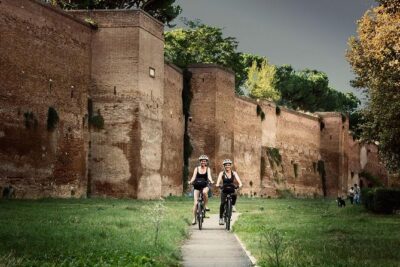
The meeting point is at Via Labicana 49, in central Rome, and the ride heads toward Porta San Sebastiano. Passing through this gate in the third-century Aurelian Walls gives the day a fitting opening: you are not simply being driven to an archaeological park, you are leaving the modern city by bicycle through its ancient defenses.
The stop itself is brief, about 10 minutes, but it sets up the story of Rome’s southern approach. Your guide leads the group through selected city streets, with traffic unavoidable in places. The routes are planned to limit exposure, and the remaining park sections have no traffic, but you should stay alert during the urban connections.
This is also where your comfort on the bike matters most. A recent rider described the tour as an excellent way to reach distant sights but cautioned that narrow bike paths and city traffic are not suitable for a novice. That advice is worth taking seriously.
The ancient road into Appian Way Park
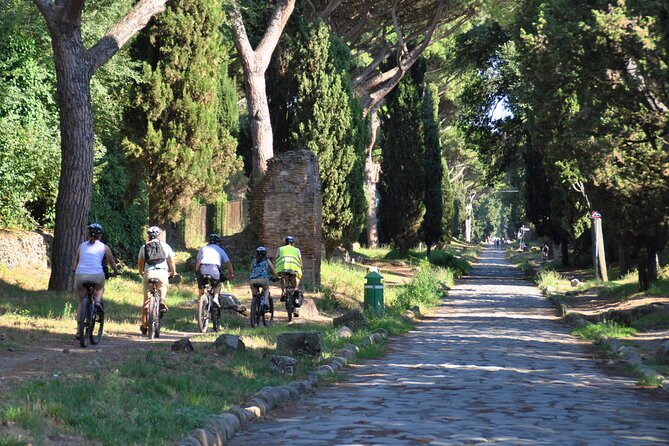
The Appian Way begins almost anonymously, as a Roman street among the modern city. Then the setting opens up. Ancient paving, grassy fields, ruins, and low hills give the route a quieter feel than central Rome, even though you are still close to the capital.
The initial Appian Way portion is listed at about 15 minutes, but the road forms the backbone of a much longer ride. You are not stopping at one isolated monument. You are following a historic route through a broad archaeological park, with the guide pointing out the remains and explaining how the road connected Rome with southern Italy.
The surface can be bumpy. Several riders found the scenery beautiful but warned that rough ground could bother anyone with neck or back issues. Take the warning literally: this is not a smooth cycle path. The e-bike makes pedaling easier, but it does not remove jolts from uneven stones.
If photographs are important to you, note that stopping opportunities may feel limited. One family enjoyed the ride with teenagers but wished for more photo pauses because taking pictures while moving through narrow sections was uncomfortable. Keep your phone tucked away until the group stops.
Choosing between four and six hours
The four-hour tour is the shorter way to see the main character of the area. It includes the Appian Way, a pause near the Catacombs of San Callisto, the Circus of Maxentius, the Tomb of Cecilia Metella, the Aqueducts Park, and the open fields around the route.
The six-hour tour is the better choice if you have room in your schedule. It adds a 45-minute guided visit inside the catacombs, the Villa dei Quintili and Santa Maria Nova complex, and a view of the Baths of Caracalla. Those additions make the longer outing feel like a fuller archaeological tour rather than simply an extended ride.
The schedule is not identical every day. On Wednesdays, the route changes and can run 30 minutes longer. The four-hour outing may last about four and a half hours, while the six-hour version may take six and a half. On Wednesdays, the longer tour visits the Catacombs of San Sebastiano instead of San Callisto.
The catacombs are closed on Easter Sunday, April 5, 2026, so the six-hour tour does not operate that day. The route is also expected to run 30 minutes longer from January 14 through February 11, 2026.
More E-Bike Tours in Rome
- Rome City Small Group Bike Tour with quality Cannondale EBike
★ 5.0 · 1,380 reviews - Rome by Night – Ebike Small Group Tour – Food and Wine (Option)
★ 5.0 · 1,275 reviews - Rome:Appian Way E-bike Tour with Catacombs, Aqueducts & Food
★ 4.9 · 1,210 reviews - Rome: E-Bike Night Tour with Food and Wine Tasting
★ 4.9 · 1,131 reviews
Catacombs of San Callisto and San Sebastiano
On the four-hour option, the catacombs receive only a short pause. You can contemplate the scale of the underground burial grounds, described as the resting place of roughly half a million people, but you do not get the full guided interior visit included with the longer tour.
That difference is the strongest reason to pay for six hours. The guided visit lasts about 45 minutes and takes you into the second-century catacombs, where the underground corridors and burial spaces add a darker, more personal side to Rome’s ancient story.
The catacomb visit is not for everyone. Underground passages can feel confined, and the group joins the regular guided visit at the site. If you dislike enclosed spaces, the four-hour version may be more comfortable, since it gives you an outside pause rather than the full interior tour.
On Wednesdays, you visit San Sebastiano instead of San Callisto. Both are part of the same broad Appian Way story, but you should choose your day with that change in mind if one site matters to you.
Imperial ruins at the Circus of Maxentius
The Circus of Maxentius is a compact stop, listed at about five minutes, but it brings the imperial period into view. The complex included a villa, a mausoleum, and a circus used for chariot racing in the fourth century.
Do not expect a long archaeological walk here. The value is in seeing the remains as part of the wider Appian Way setting. Your guide helps connect the fragments: this was not merely a road lined with tombs, but an imperial zone with grand estates and ceremonial buildings.
The short timing also reflects the nature of a bike tour. You see many sites across a large area instead of spending an hour at every ruin. If you want extended time inside each monument, a walking or private archaeological tour may suit you better.
Cecilia Metella and the Appian Way’s grand tombs
The Mausoleum of Cecilia Metella is one of the largest and best-preserved structures along the road. This first-century funerary monument was built for a young woman from a patrician family, a reminder that the Appian Way served as a showcase for elite Roman tombs as well as a transport route.
The stop lasts about five minutes, so treat it as a pointed introduction rather than a full museum visit. You will see the monument, hear its place in the road’s story, and continue toward the park’s other remains.
I like this rhythm because the day never gets stuck in one building. You keep moving through the countryside and encounter the monuments in context. The tradeoff is that you need another visit if you want detailed architectural study or interior access.
The Villa dei Quintili on the six-hour route
The six-hour ride adds the Villa dei Quintili and Santa Maria Nova complex. This sprawling second-century private villa belonged to two of the wealthiest brothers of the Roman imperial period.
The site expands your sense of how the Roman elite lived beyond the city center. After seeing roads, tombs, and public waterworks, you encounter a private estate on a much larger scale. Like the Circus of Maxentius, it is a short listed stop, so the guide’s explanation is central to understanding what you are seeing.
For history-focused visitors, this addition helps justify the extra two hours. Families may also appreciate the variety. The route alternates between riding, brief explanations, open space, and major ruins, which can hold attention better than a long sequence of indoor rooms.
Aqueducts Park and the open countryside
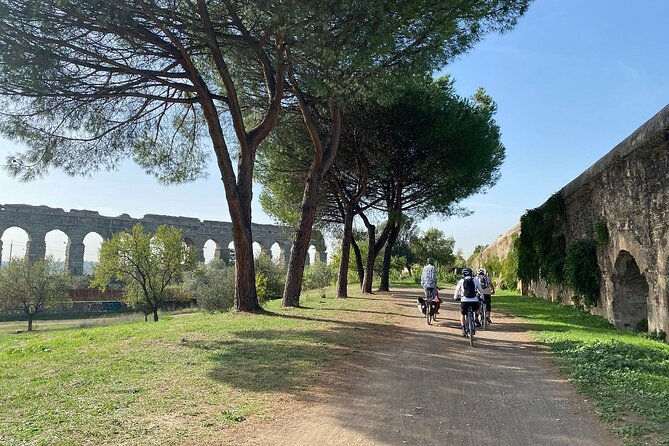
The Aqueducts Park is the visual high point for many people. Colossal arches cross the open fields, revealing the scale of the underground and above-ground water system that supplied ancient Rome.
This is where the city feels far away. Sheep graze in the surrounding valleys and hills, and the broad views create a striking contrast with Rome’s crowded center. The park section is largely free of traffic, giving you more room to appreciate the scenery and listen to the guide.
The route offers a few opportunities to buy food or drinks, and you can eat during a suitable break. Nothing is included beyond the provided water bottle, so do not assume lunch is part of the price. If you want a picnic-style pause near the aqueducts, plan to purchase supplies along the way.
Crowds can affect this portion. On Sundays, local walkers and cyclists may fill parts of the Appian Way and Aqueducts Park. That can make riding more stressful, particularly on narrow paths. I would choose a weekday if your schedule allows.
Ending near the Baths of Caracalla
The six-hour tour finishes its major sightseeing with a view of the Baths of Caracalla. You see the enormous thermal complex from a favorable vantage point and hear why public baths mattered so much to Roman social life.
Again, this is a viewing stop rather than a long indoor visit. The payoff is scale. After riding past aqueducts that carried water into Rome, you see one of the monumental public places that depended on that supply.
The four-hour route does not include the Baths of Caracalla or Villa dei Quintili. If those sites interest you, choose the longer option rather than hoping to add them later during the ride.
Guides, group size, and the pace of the ride
The guide can make or break a route with this many moving parts. The tour uses local guides, and the strongest experiences described by riders came from guides who mixed historical detail with practical care on the road.
Names praised in individual experiences include Arina, Claudia, Fabio, Bita, Stefan, Lorenzo, Han, David, Ali, Christian, Francesca, Khalid, and Zak. The consistent pattern is clear: you should expect an active guide who explains monuments along the way, answers questions, and keeps the group together.
The maximum group size is 10. That is small enough for direct contact with the guide, but it does not guarantee a private-feeling ride. One concern raised about a six-hour outing was a very slow pace and tight spacing between bikes. Group riding requires patience, especially where traffic, pedestrians, and rough paths meet.
The e-bike motor may not work hard on every section. On flat stretches, some riders found the assistance barely necessary. That is not a fault for everyone, since the point is to reduce fatigue rather than remove all pedaling, but do not book this expecting a fast cycling workout.
Who will enjoy this Rome tour most
I would recommend it to you if you have at least one extra day in Rome, want a break from indoor museums, and can ride a bike with confidence. It is especially good for families with older children and teenagers. Children aged 9 and up may ride an appropriately sized e-bike, while children aged 5 to 8 can use a child extension.
The tour is less suitable for young children in a seat or extension because the route becomes difficult with extra weight and less control. It is also a poor match for anyone who is not self-confident on a bike, has significant back or neck problems, or wants a relaxed sightseeing day with no traffic at all.
The company requires at least four participants for the tour to operate and limits each group to 10. If the minimum is not reached, the activity may be canceled after confirmation, with an alternative or full refund offered.
Is $102.79 a fair price?
At $102.79 per person, this is not the cheapest way to see the Appian Way. You are paying for the bike, helmet, guide, water bottle, route planning, and the ability to connect several distant sites in one half-day or full-day outing.
The value improves with the six-hour option. A guided catacomb visit alone adds real substance, and Villa dei Quintili and the Baths of Caracalla give the longer ride a fuller range of ancient sites. If you have only a short time in Rome, the four-hour version covers the main outdoor highlights without taking your whole day.
You could rent an e-bike independently, but then you would need to plan the route, manage city connections, find the parks, and arrange catacomb entry yourself. The guided tour is worth the premium if you value interpretation and road support. It is less worthwhile if you prefer to ride at your own pace and stop whenever you like.
Free cancellation is available up to 24 hours before the start time. Cancellations or changes inside that window are not refunded or accepted.
Final verdict: should you book it?
Book this tour if you want to see a less familiar side of Rome and enjoy active sightseeing. The Appian Way, catacombs, and aqueducts form a strong combination, and the e-bike makes the distance realistic for a reasonably fit adult.
I would choose the six-hour version for a first visit to the archaeological park, especially if you have more than a day or two in Rome. Choose a weekday if possible, wear practical clothing, expect bumps and some traffic, and bring money for food or drinks.
Skip it if you are uncomfortable balancing a bike, need a smooth ride, or prefer long, unhurried visits inside monuments. For the right cyclist, though, this is a memorable way to trade Rome’s crowded center for ancient roads, open fields, and aqueduct arches.
FAQ
Where does the tour begin and end?
The tour begins at Via Labicana 49, 00184 Rome. It ends back at the same meeting point.
How long is the experience?
You can choose a tour lasting about four or six hours. On Wednesdays, each option may run 30 minutes longer because of a route change. The tour may also be 30 minutes longer from January 14 through February 11, 2026.
How far do you ride?
The route covers approximately 17 miles, or 27 kilometers. About 60 percent of the riding takes place off-road in parks.
Is the tour suitable for beginners?
The difficulty is intermediate, and the activity is not recommended if you lack confidence on a bike. Some city traffic, narrow paths, and bumpy surfaces are part of the route.
Are helmets provided?
Yes. A helmet is included and must be worn during the tour.
Are children allowed to participate?
Children aged 5 to 8 can use a child extension, while children aged 9 and above can ride an appropriately sized e-bike independently. The route is difficult with a child seat or extension attached.
Are food and drinks included?
No. The tour includes a biodegradable water bottle, but food and other drinks are not included. There are a few places along the route where you can buy refreshments.
What happens on Wednesdays?
The route changes on Wednesdays. The four-hour tour does not include the San Callisto catacombs, and the six-hour tour visits the Catacombs of San Sebastiano instead. The tour may last up to 30 minutes longer.
More E-Bikes in Rome
- Rome: Appian Way E-Bike Tour Catacombs, Aqueducts & Picnic
★ 4.6 · 727 reviews - Rome: Appian Way & Catacomb Sunset E-bike Tour with Aperitif
★ 4.5 · 682 reviews - Appian Way & Aqueducts small group e-bike tour(catacombs & food)
★ 5.0 · 531 reviews - Rome:Appian Way E-bike Tour, Catacombs, Aqueducts & Transfer
★ 4.9 · 404 reviews
Recently reviewed around Rome
- Ancient Rome at Twilight Walking Tour★ 5.0 · 276 reviews
- Domus Aurea Guided Tour: The Golden House of Nero★ 4.5 · 199 reviews
- Early Vatican Museums & Sistine Chapel Small Group Tour★ 4.5 · 314 reviews
- Early Vatican Museums Tour: The Best of the Sistine Chapel★ 4.5 · 900 reviews
- Jewish Ghetto & Piazza Navona: Food, Wine & Sightseeing Rome Tour★ 5.0 · 460 reviews
- 3 Days in Sorrento, Capri & Pompeii: la Dolce Vita★ 4.0 · 595 reviews
- Tivoli Villas Full Day Trip From Rome with Lunch★ 4.0 · 443 reviews
- Cook With Us in Rome: A Hands-On Cooking Experience 09:20AM class★ 5.0 · 234 reviews
Cycling Tours, compared.
Rome EBike Tour: Appian Way, Catacombs & Roman Aqueducts
Read our review →
Top Highlights & Hidden Gems Tour by Cannondale E-Bike
Read our review →
Appian Way, Catacombs, & Roman Aqueducts E-bike Tour
Read our review →
Rome City Small Group Bike Tour with quality Cannondale EBike
Read our review →
Tuscany Bike Tours Through the Chianti Hills with Wine Tasting
Read our review →
Rome by Night – Ebike Small Group Tour – Food and Wine (Option)
Read our review →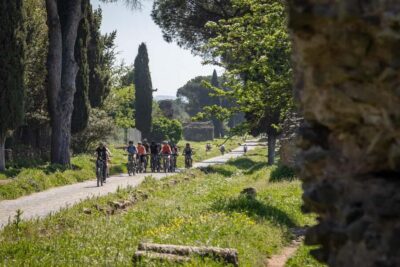
Appian Way E-bike Tour with Catacombs, Aqueducts & Food
Read our review →
Browse the lists this tour appears in