
Review · CYCLING TOURS
Florence: The Original City Bike Tour with a Guide
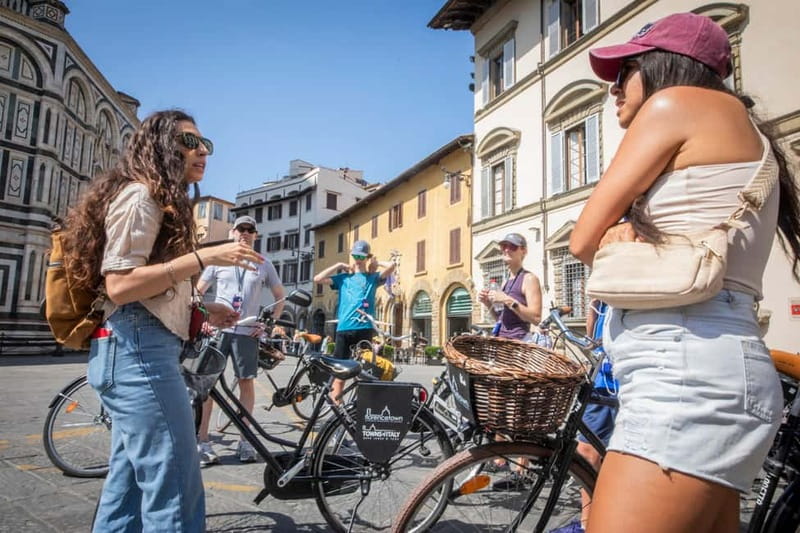
Florence is compact, crowded, and packed with sights. A bicycle lets you cover far more ground than a walking tour, while still slipping into lanes and squares that tour buses cannot reach. This two-hour ride on a classic Graziella bike takes you from the Duomo to the Arno and back, with regular stops for stories and photos.
I like the way the route stays mostly flat and easy, and I like the local touch. Guides such as Lorenzo, Thomas, Sara, Gloria, and Greta have earned praise for mixing Florentine history with useful food and sightseeing tips. The main catch is traffic and crowds: cycling through busy pedestrian streets and over uneven stone can feel tense, especially in summer heat.
In This Review
- Key points to know before you book
- Why a bicycle works so well in central Florence
- Starting beside the Arno at Via dei Vagellai
- Piazza della Repubblica and Piazza Strozzi
- The Duomo and Santa Maria Novella
- From the artisan district to Palazzo Pitti
- Ponte Vecchio and the Uffizi area
- Piazza della Signoria and Santa Croce
- What the guides add to the ride
- Is the ride really easy?
- Family options and age considerations
- What the $30 price includes
- Rain, timing, and practical planning
- Who should book the Florence bike tour?
- FAQ
- Where does the Florence bike tour start?
- Where does the tour end?
- How long does the bike tour last?
- Which languages are available?
- Are bikes and helmets included?
- Does the tour enter the Duomo, Uffizi, or other monuments?
- What happens if it rains?
- Can children join the tour?
Key points to know before you book
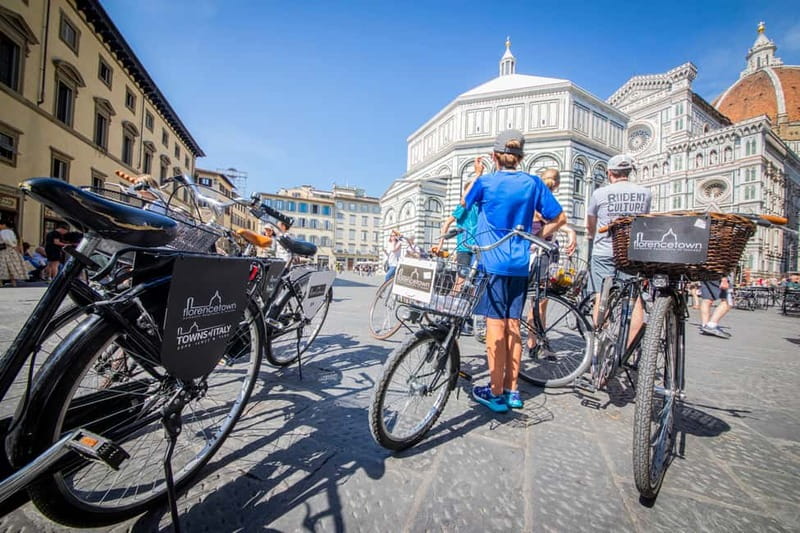
- Classic Florentine bicycles: You ride a vintage-style Italian Graziella, with helmets included.
- Major sights in two hours: The route covers the Duomo, Santa Maria Novella, Ponte Vecchio, Uffizi Square, Santa Croce, and more.
- Flat, beginner-friendly route: The ride is designed for easy cycling, though city traffic and cobbles require care.
- Local guides with personality: English and Spanish tours are led by licensed guides who add history, stories, and practical advice.
- Good family options: Child seats, trailers, and tandem bikes make the tour workable for several age groups.
- Weather backup: The tour runs in rain or sun, but bad weather can turn it into a walking tour.
Why a bicycle works so well in central Florence
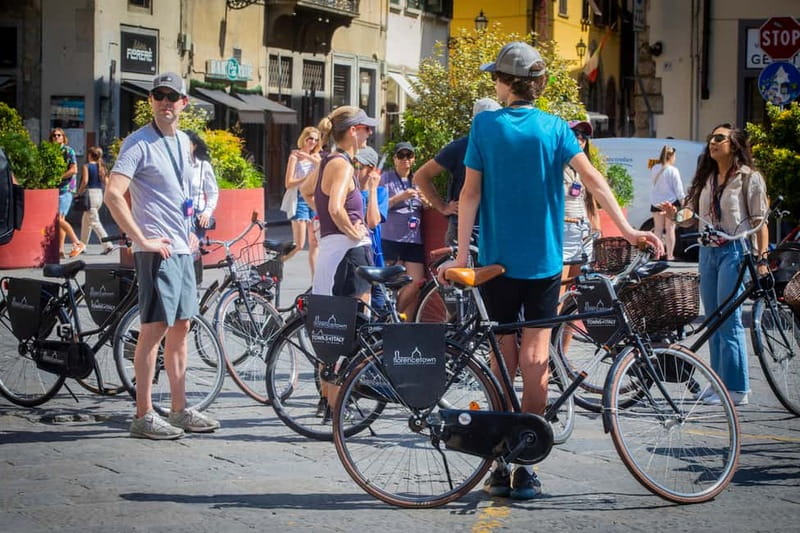
Florence’s historic center is small enough to walk, but it can take time to cross. You stop often, dodge crowds, and sometimes retrace your steps. A bike gives you a broader first look at the city without committing to a long walking route.
This is not a high-speed ride. The guide leads at an easy pace and keeps the route on flat ground. You cycle through pedestrian-friendly streets, narrow lanes, and historic districts, then stop while the guide explains what you are seeing.
That rhythm is the real strength of the tour. You get the setting of an outdoor sightseeing walk, but you can move between neighborhoods quickly. It is especially useful on your first day, when you want to understand how Florence fits together before choosing which museums and churches deserve your deeper attention.
The bikes are classic Graziellas, the practical Italian folding-style bicycles associated with everyday city riding. They are not sports bikes, and that is a plus here. You sit upright, handle the bike easily, and ride at a relaxed pace rather than trying to compete with traffic.
More Bike Tours in Florence
- Tuscany Bike Tours Through the Chianti Hills with Wine Tasting
★ 5.0 · 1,300 reviews - Florence: E-Bike Tour with Michelangelo Square
★ 4.5 · 1,035 reviews - Florence: 2-Hour Guided Sightseeing Bike Tour
★ 4.5 · 1,004 reviews
Starting beside the Arno at Via dei Vagellai
From March 2025, the meeting point is Via dei Vagellai 22r, at the corner with Piazza Mentana, opposite the Arno River. That change matters, so check your booking details carefully instead of relying on an older address.
The activity ends back at the same meeting point. The location near the river puts you close to the historic center and makes the route feel connected from the start. You are not being driven in from the edge of town. You begin right in Florence’s central web of streets.
Allow enough time to arrive. The group rides together, and a late start can make the first few minutes stressful. One participant arrived 30 minutes late and still received the full experience, but that should not be treated as a guarantee.
At the start, the guide provides your bike and helmet. The guide also checks the fit and explains how the group will move through the streets. This preparation is important because the route includes crowds, crossings, and rougher paving.
Piazza della Repubblica and Piazza Strozzi
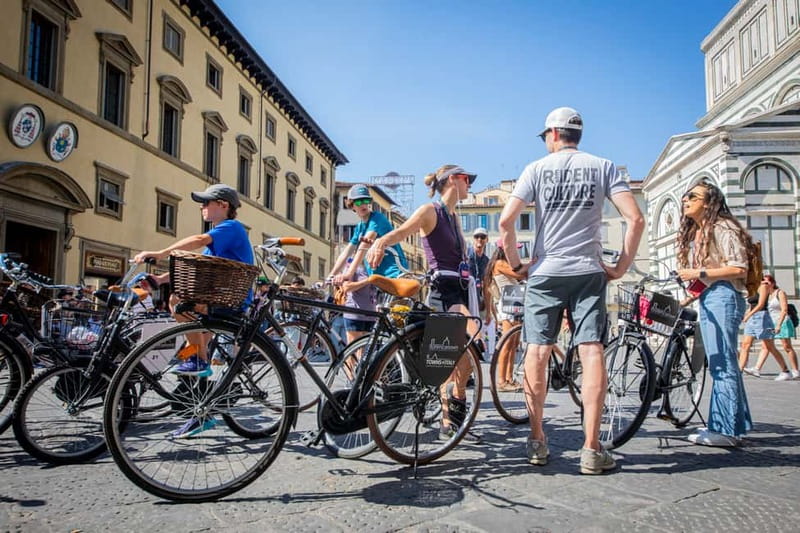
The first central squares give you a quick sense of Florence’s public life and changing architecture. Piazza della Repubblica is a broad, lively meeting place built over an older part of the city. It is a useful contrast to the narrow lanes you will ride through later.
Nearby Piazza Strozzi has a more Renaissance feel, with the Palazzo Strozzi anchoring the square. Your guide uses stops like this to connect buildings, families, politics, and art rather than simply naming the landmarks.
These early stops are also good for getting comfortable on the bike. The group is still settling into its pace, and you have time to watch how the guide signals turns and handles crossings. You should expect to ride carefully rather than glide uninterrupted through the center.
The Duomo and Santa Maria Novella
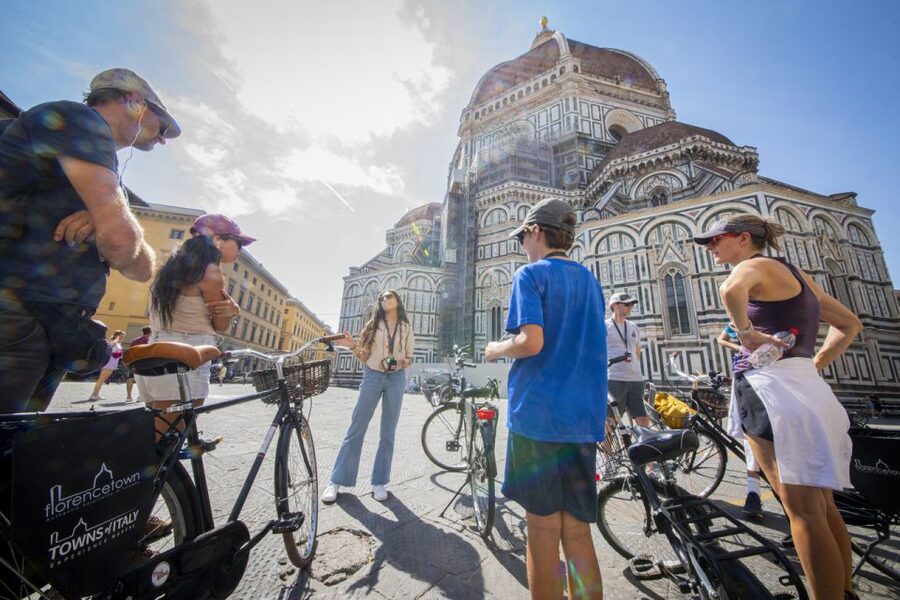
The Duomo is the visual center of Florence, with Brunelleschi’s famous dome dominating the skyline. You see the cathedral complex from outside and hear about its place in the city’s artistic and civic story.
Santa Maria Novella offers a different view of Florentine architecture. Its striped marble facade is one of the city’s most recognizable sights, and its position near the railway station makes it a practical landmark for finding your way around town.
The tour does not include entry to the cathedral, museums, or other monuments. That limitation is clear but important. You get an introduction and photo stops, not an interior visit or a detailed art lecture inside the buildings.
I would use this tour to decide what deserves a return visit. If the Duomo or Santa Maria Novella catches your attention, schedule a separate ticketed visit for another time. Trying to combine interior sightseeing with the bike route would defeat the point of the two-hour ride.
More City Tours in Florence
- City Sightseeing Florence Hop-On Hop-Off Bus Tour
★ 3.5 · 1,894 reviews - Florence: Eco-Friendly Golf Cart City Tour with Audio Guide
★ 4.6 · 1,094 reviews - Florence in a Day: Michelangelo’s David, Uffizi and Guided City Walking Tour
★ 4.5 · 1,048 reviews - Florence in a Day: David, Cathedral & City Highlights Guided Tour
★ 4.5 · 947 reviews
From the artisan district to Palazzo Pitti
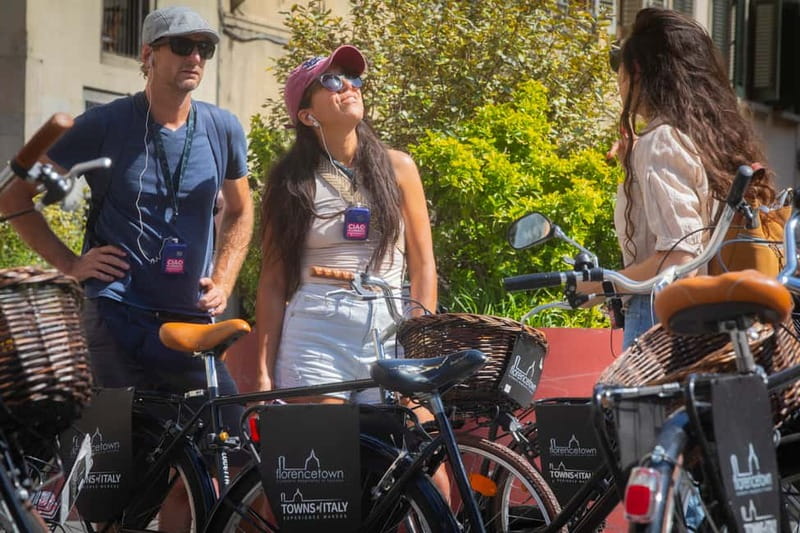
The route continues toward the artisan district and Palazzo Pitti, crossing into a part of Florence with a more local, workshop-centered character. The exact streets can change, especially under current city traffic rules, but the aim is to show you more than the standard postcard stops.
Palazzo Pitti gives the ride a strong architectural marker on the south side of the Arno. You see how the city changes as you move away from the cathedral area, and the guide can point out details that are easy to miss from a taxi or tour bus.
This section is valuable if you have only seen Florence from the main pedestrian routes. It gives you a wider sense of the city’s neighborhoods and connects the grand palaces with ordinary streets, small lanes, and working areas.
Do not expect a quiet country cycle. Florence is still Florence. You may need to slow down, walk the bike for short stretches, or wait for people to clear a passage. The guide’s job is part historian and part traffic organizer here.
Ponte Vecchio and the Uffizi area
Ponte Vecchio is one of Florence’s essential sights, and seeing it by bike gives you a quick route to the river and the oldest central crossing. The bridge itself is crowded, so you should not expect to pedal freely across it. The value is in reaching the viewpoint, hearing the story, and getting your photo.
The nearby Uffizi area provides another major stop. The museum’s exterior and surrounding square place you at the heart of Florence’s art district, even though museum admission is not part of this experience.
This is a good example of how the tour handles famous places. You receive context and orientation, then continue. If you want to study Botticelli, Michelangelo, or the Medici collections, plan a separate museum visit. The bike ride gives you the city’s framework, not a substitute for its museums.
The streets around the river and Uffizi can be crowded. Several participants found it harder to hear at times because of the number of people nearby. Stay close to the guide, listen during the stops, and do not assume that every explanation will be easy to catch while riding.
Piazza della Signoria and Santa Croce
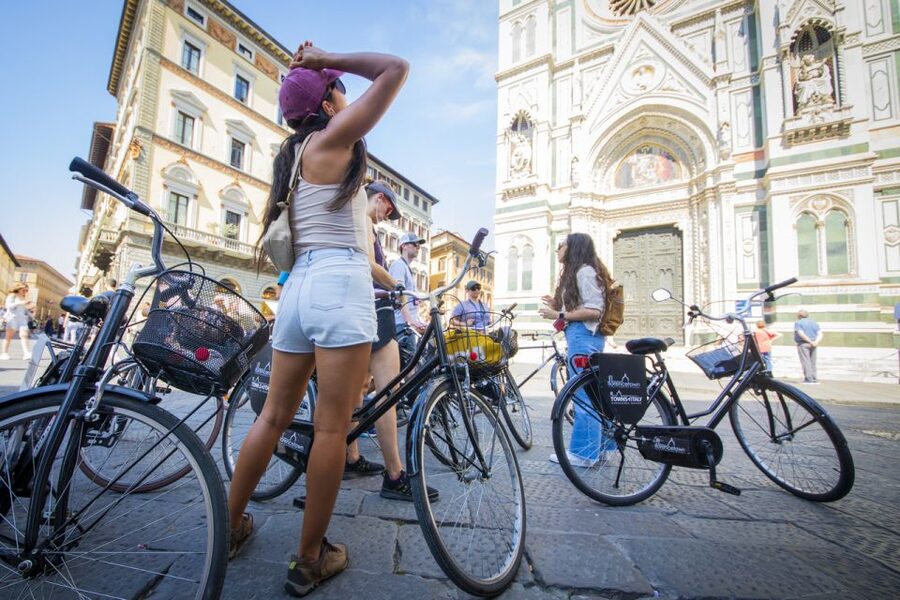
Piazza della Signoria is Florence’s political center, lined with major sculpture and grand civic buildings. It is a strong place to pause because the square makes the connection between public power, art, and city life easy to understand.
Santa Croce adds another important piece of Florence’s story. The basilica and its square are tied to major figures in Italian culture, and the area has a broad, open feel after the tighter streets around the Uffizi.
Your guide may choose a shaded spot away from the thickest crowd for the explanation. That is more comfortable and often makes it easier to hear. You can then return to the main sight for photographs.
The route may change from the one described here. The operator notes that the itinerary can be modified, particularly under the two-hour format introduced from March 2025. Think of the listed stops as the tour’s main themes rather than a promise that every street will be followed in a fixed order.
What the guides add to the ride
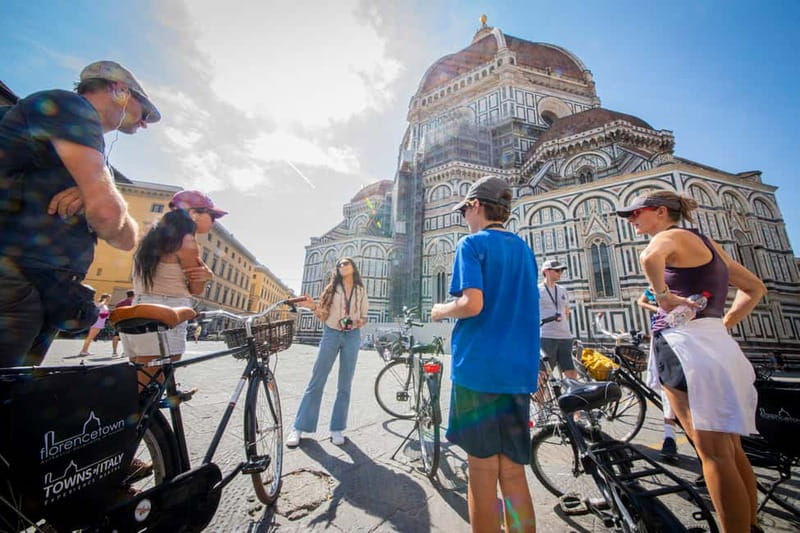
The guide makes or breaks a city bike tour, and this one places strong emphasis on local, licensed guides. The best guides do more than recite dates. They help you understand why a square looks the way it does and point out places you might want to visit later.
Lorenzo is repeatedly singled out for clear English, humor, local knowledge, and useful suggestions. He has recommended places such as the model train museum, and his relaxed manner suits families and first-time visitors. Thomas is described as a Florence native who knew the streets and history especially well.
Other praised guides include Sara, Gloria, Greta, Giacinta, and Martzia. Sara is known for a light, funny approach, while Greta is noted for strong English and a solid grasp of Florentine history. Gloria has been praised for explaining details carefully and allowing time for a closer look.
You cannot request a particular guide with certainty from the information available. Still, the range of guide styles is encouraging. The tour seems designed to be informative without becoming stiff, with room for questions about food, architecture, and what to do next.
Is the ride really easy?
For most reasonably comfortable cyclists, the route should feel manageable. It stays on flat ground, and the bikes are intended for city riding rather than athletic performance. Several participants found the ride easy even on warm days.
The bigger challenge is the setting, not the distance. Florence’s stone streets can be bumpy, and busy pedestrian areas require patience. One person had trouble keeping the tour’s earphones in place over cobbled streets, while others found it hard to hear in heavy crowds.
Safety is taken seriously. Guides keep the group together, help with road crossings, and watch traffic. Even so, you need to pay attention. This is not a protected cycle path, and nervous riders may prefer a walking tour.
Heat is another factor. A warm afternoon can feel tiring when you are riding in the open city center. Bring water, wear light clothing, and consider an earlier or later starting time if availability allows. The guide may offer water and rain ponchos, but you should not depend on that for all weather needs.
Family options and age considerations
The tour offers regular adult bikes, child seats for ages 0 to 5, bike trailers for ages 6 to 8, and tandem bikes for an adult with a rider age 9 or older. That gives families more flexibility than a standard walking tour.
A child seat or trailer changes the ride’s feel. You will need to be extra alert at crossings and in crowded lanes, but the flat route helps. Ask about the equipment when booking so the operator can prepare the right setup.
The experience is not suitable for pregnant women or people with mobility impairments. It also may not suit a child who dislikes crowds, noise, or uneven surfaces. Families with older children who can follow street instructions should find the format more engaging than a long sequence of walking stops.
What the $30 price includes
At $30 per person, the tour is a fair-value introduction to Florence. You receive the bicycle, helmet, live guide, insurance coverage, and several planned stops. A private guide would cost far more, while a self-guided rental would not give you the historical context or a tested route.
The value depends on how you use the two hours. If you want detailed museum visits, this is not the right purchase. If you want to see the city’s main structure, learn where the sights are, and gather ideas for the rest of your stay, the price is sensible.
Food is not included. The tour no longer includes gelato tasting from March 2025, although older versions of the experience ended with gelato and some guides may still suggest a good place to try afterward. Bring a snack if you need one, and plan your own gelato stop.
Free cancellation is available up to 24 hours before the start for a full refund. You can also reserve and pay later, which is useful when your Florence schedule is still shifting.
Rain, timing, and practical planning
The tour runs in rain or sun. If the weather is bad, it changes to a walking tour rather than simply disappearing, so wear shoes suitable for both options.
The current duration is two hours, and starting times depend on availability. A two-hour format works well as an arrival-day activity or a first full morning in Florence. It gives you orientation without consuming the day you might want for the Uffizi, Accademia, or Duomo interior.
The tour is offered in English and Spanish. You should choose the language in which you can follow spoken explanations easily, since some stops take place in noisy public spaces.
I would not schedule this immediately before a museum reservation unless you leave a generous buffer. Crowds, crossings, and the return ride can make the finish less exact than a private car transfer.
Who should book the Florence bike tour?
I would book this if you want a lively first look at Florence, enjoy easy cycling, and prefer local stories to a set of silent photo stops. It is especially useful for first-time visitors, families with suitable bike equipment, and anyone who finds a full walking tour tiring.
I would choose something else if you dislike riding near pedestrians, need step-free access, or want to spend serious time inside monuments and museums. A walking tour may also be better if you want to stop often and study details at a slower pace.
For $30, the strongest reason to book is coverage. You see the Duomo, Santa Maria Novella, Piazza della Repubblica, Piazza Strozzi, Palazzo Pitti, Ponte Vecchio, the Uffizi area, Piazza della Signoria, and Santa Croce in one compact outing. Just accept that traffic, heat, cobbles, and a changing itinerary are part of the deal.
FAQ
Where does the Florence bike tour start?
From March 2025, it starts at Via dei Vagellai 22r, at the corner with Piazza Mentana, opposite the Arno River.
Where does the tour end?
The activity ends back at the meeting point.
How long does the bike tour last?
The current tour duration is two hours. Starting times depend on availability.
Which languages are available?
The live guide is available in English or Spanish.
Are bikes and helmets included?
Yes. The tour includes the bike rental and a helmet.
Does the tour enter the Duomo, Uffizi, or other monuments?
No. Entry to monuments and museums is not included. The tour visits exterior areas and provides historical explanations and photo stops.
What happens if it rains?
The tour runs in all weather. In bad weather, it changes to a walking tour.
Can children join the tour?
Yes. Child seats are available for ages 0 to 5, bike trailers for ages 6 to 8, and tandem bikes for an adult with a rider age 9 or older.
Recently reviewed around Florence
- Walking Food Tour of Florence with Tastings and Wine★ 5.0 · 518 reviews
- Florence Sunset Food Tour with Wine & Dine at a Tuscan farmhouse★ 5.0 · 194 reviews
- Wine Experience In Chianti Hills from Florence★ 4.5 · 195 reviews
- Uffizi Gallery Timed Entry Admission Tickets★ 4.0 · 392 reviews
- Val d’Orcia Brunello Wine Tour with Montalcino and Montepulciano★ 4.5 · 359 reviews
- Wine Tasting Experience in Ponte Vecchio: Best Tuscany selection!★ 5.0 · 197 reviews
- Uffizi Gallery Small Group Tour with Guide★ 4.5 · 879 reviews
- Early Access Guided Uffizi Gallery Tour Skip-the-Line Small Group★ 4.5 · 707 reviews
Cycling Tours, compared.
Rome EBike Tour: Appian Way, Catacombs & Roman Aqueducts
Read our review →
Top Highlights & Hidden Gems Tour by Cannondale E-Bike
Read our review →
Appian Way, Catacombs, & Roman Aqueducts E-bike Tour
Read our review →
Rome City Small Group Bike Tour with quality Cannondale EBike
Read our review →
Tuscany Bike Tours Through the Chianti Hills with Wine Tasting
Read our review →
Rome by Night – Ebike Small Group Tour – Food and Wine (Option)
Read our review →
Appian Way E-bike Tour with Catacombs, Aqueducts & Food
Read our review →
Browse the lists this tour appears in