
Review · GOLF CART TOURS
Rome by Golf Cart Private Tour: Beyond the Landmarks
Rome by golf cart is a smart answer to Rome’s biggest problem: the sights are spread across hills, busy roads, and winding lanes, yet you rarely want to spend the whole day walking between them. A private guide and a street-legal cart let you cover a lot of ground, from the Colosseum and Circus Maximus to the Aventine Keyhole and Janiculum Hill.
I like two things especially. First, you can shape the route around your interests, rather than follow a fixed checklist. Second, the cart gets you close to places that are tiring to reach on foot, which matters if you have limited mobility or only a short stay. Guides such as Francesca, Gabriel, Giulio, Eugene, and Angelo are often praised for lively storytelling and personal service.
The main consideration is simple: this is an exterior sightseeing tour, not an admission tour. You will see the Colosseum, Pantheon, Vatican area, and other landmarks from outside, but entry tickets are not included. A three-hour tour can show you a great deal, but it cannot give every major site the time it deserves.
In This Review
- Key points at a glance
- Why a golf cart works so well in Rome
- Building your route with the guide
- Ancient Rome: the Colosseum, Circus Maximus, and Constantine’s Arch
- Aventine Hill and Rome’s best framed views
- Rome’s squares, fountains, and churches
- Trastevere, the Jewish Ghetto, and Teatro di Marcello
- Villa Borghese, the Caelian Hill, and quieter Rome
- What the guides add
- Choosing between two hours and a full day
- Practical details before you book
- Is Rome by golf cart right for you?
- FAQ
- Where does the tour start?
- Where can the tour finish?
- Is this a private tour?
- How long does the tour last?
- Is the tour offered in English?
- Does the tour enter the Colosseum or Vatican Museums?
- Is hotel pickup available everywhere in Rome?
- How many people fit in the golf cart?
- What happens if it rains?
Key points at a glance
- A private six-seat cart: Your group travels with its own English-speaking driver-guide, usually in a covered cart with seat belts and side protection.
- A flexible Rome route: Choose from major monuments, grand squares, churches, hilltop views, fountains, and neighborhoods.
- Excellent first-day orientation: The tour gives you a useful sense of Rome’s layout before you return to the sites you want to enter.
- Strong access for tired feet: The cart cuts down long walks between the historic center, Aventine Hill, Janiculum Hill, and Villa Borghese.
- Full-day value: The longest option includes a lunch break and allows a slower, more detailed route.
- Outside views only: Colosseum, Vatican Museums, Roman Forum, Pantheon, and other ticketed sites require separate plans and tickets.
Why a golf cart works so well in Rome
Rome is not hard to explore because its sights are difficult to find. It is hard because the gaps between them add up. One visit may take you from the Colosseum to Piazza Navona, then uphill to the Orange Garden, across the river to Trastevere, and up again to the Janiculum. Those walks are pleasant in small doses, but they can consume much of your day.
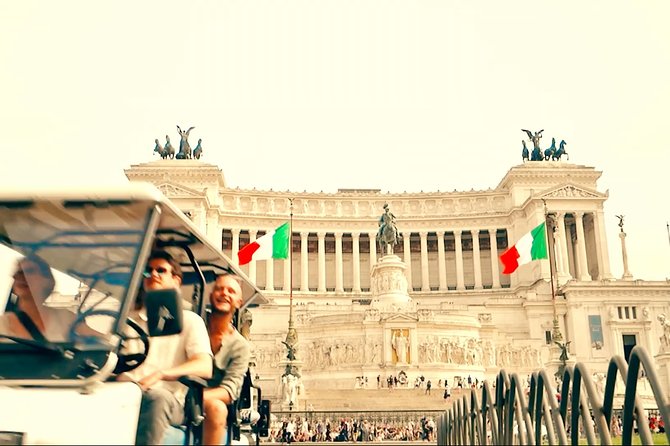
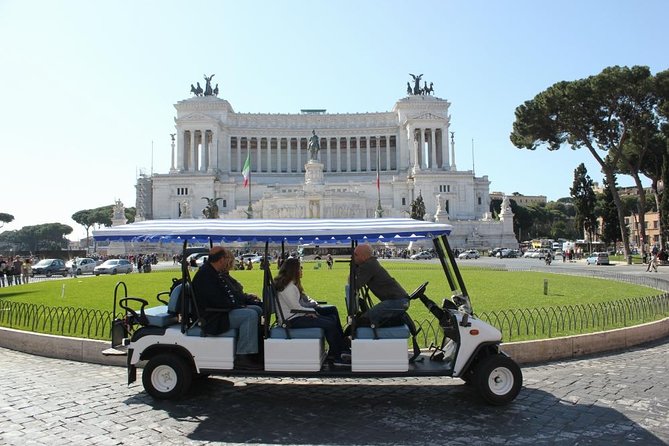
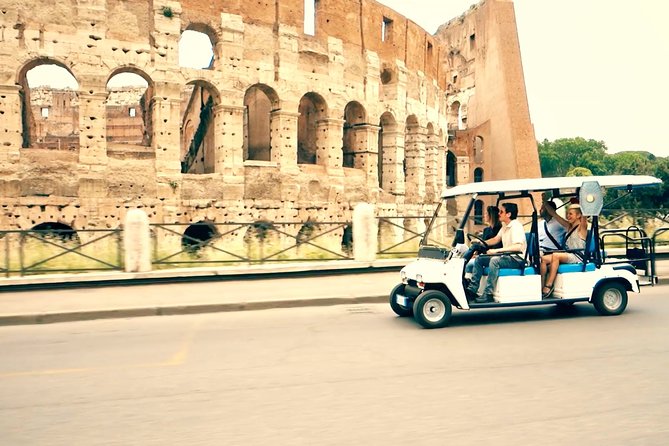
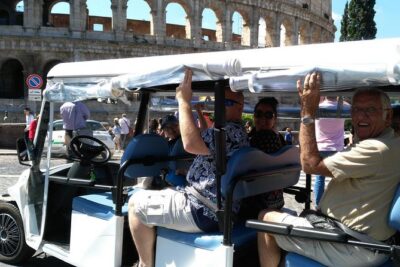
The cart changes the rhythm. You can sit back while your guide handles Rome’s traffic and points out details along the way. The vehicle is street-legal, covered, and fitted with seat belts. Most carts hold six people, with four forward-facing seats, including the driver’s position, and two seats facing backward.
This is not a speed tour in the usual sense. Traffic still affects the route, and stops are short at many sights. The advantage is that you can reach more parts of central Rome without wearing yourself out. You also get a moving introduction to the city, with streets and districts linking together instead of appearing as isolated stops on a map.
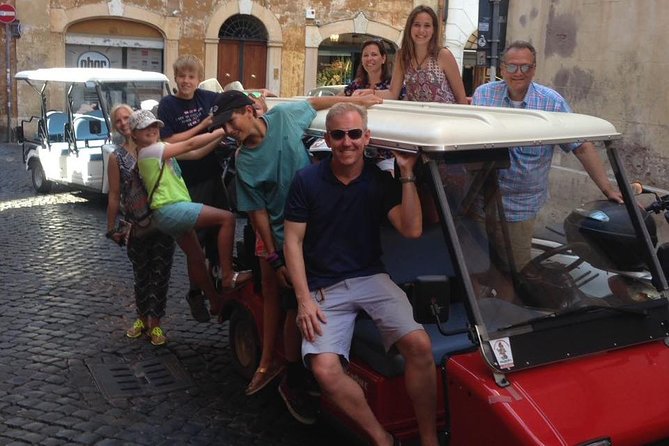
The private format matters. At the start, you tell the guide what you care about and what you have already seen. A history fan might ask for ancient monuments. A first-time visitor might favor the main squares and fountains. Someone returning to Rome could request churches, viewpoints, or less familiar neighborhoods.
More Rome trips worth a second look
- Early Morning Vatican, Sistine, St. Peter’s Semi or Private Tour
★ 5.0 · 3,779 reviews - Rome on a Golf Cart Semi-Private Tour Max 6 with Private Option
★ 5.0 · 2,502 reviews - Rome Private Arrival Transfer: Fiumicino Airport to Hotel in Rome
★ 4.5 · 2,492 reviews
Building your route with the guide
The long list of possible stops is best treated as a menu, not a promise. A three-hour outing cannot properly include all 20 listed areas and monuments. Your guide will calculate a workable route based on your interests, traffic, and available time.
That flexibility is one of the strongest reasons to choose a private tour. Guides have adjusted routes for people who had already visited the Colosseum, for families wanting major landmarks, and for travelers looking for quieter corners. You can also ask for extra photo stops or skip places that do not interest you.
For a first visit, I would choose a mix of ancient Rome, one hilltop view, one grand square, and one or two unusual stops. For example, the Colosseum, Circus Maximus, Aventine Hill, Piazza Navona, and the Church of Sant’Ignazio make a good introduction. A longer tour can add Janiculum Hill, Trastevere, the Jewish Ghetto, and Villa Borghese.
The meeting point is Rolling Rome’s office at Piazza del Gesù 47 if you do not arrange pickup. Hotel pickup and drop-off are available within central Rome when you provide the correct address at least 24 hours ahead. The tour can also finish at your hotel, elsewhere in the historic center, or back at the office.
Ancient Rome: the Colosseum, Circus Maximus, and Constantine’s Arch
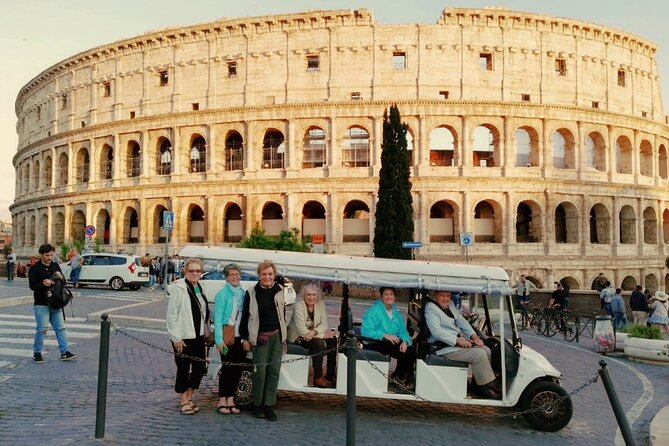
The Colosseum is usually the visual anchor. Your stop is about 15 minutes, enough for exterior views, photos, and an explanation of the arena’s role in Roman public life. You will not go inside, and admission is not included.
That limitation is important. If you plan to tour the Colosseum and Roman Forum, book those tickets separately and allow a different block of time. The golf cart tour works best as a way to understand the setting and decide what deserves a closer visit.
Nearby Circus Maximus gives you a different sense of scale. The ancient chariot-racing ground is now an open green stretch between the Aventine and Palatine hills. You can look across the broad space and imagine the crowd that once filled it. The stop is brief, but the guide’s explanation helps connect it to the dense ruins nearby.
The route may also include the Arch of Constantine, one of Rome’s surviving victory arches. It is a useful stop for understanding how Roman monuments reused older carvings and how Constantine’s reign changed the course of the empire. This is the sort of context that can be easy to miss when you are simply walking past on the way to the Colosseum.
San Pietro in Vincoli offers a quieter ancient-and-artistic pause. The church houses Michelangelo’s Moses, a famous statue of the biblical lawgiver holding the Ten Commandments. Ten minutes is enough to see the work, but art lovers may wish to return later for more time inside.
Aventine Hill and Rome’s best framed views
The Aventine is one of the tour’s most rewarding areas because it combines quiet streets, elevated views, and a famous optical trick. At the Knights of Malta Keyhole, you look through a small opening in a gate and see a carefully framed view toward St. Peter’s dome.
The stop is free, but there may be a wait at popular times. The guide can explain the unusual setting and the tiny sovereign territory behind the gate. This is a good example of why the cart adds value: the Aventine is not far from central sights, but its uphill position makes it less convenient to reach during a packed walking day.
The Orange Garden, or Giardino degli Aranci, gives you a wider view across Rome’s rooftops. It is a short stop on the listed route, yet the view can be one of the most memorable moments of the outing. You can see the city spread below rather than study another monument at street level.
If you enjoy viewpoints, ask to include Janiculum Hill. The Fontana dell’Acqua Paola, known as Il Fontanone, marks the end of an aqueduct restored under Pope Paul V. The fountain overlooks Trastevere and makes a quick photo stop. The nearby Garibaldi Monument adds a modern national story, focused on the unification of Italy. If the timing is right, arriving by noon may let you hear the hill’s famous cannon.
A different way to spend the day, same part of Italy:
- Vatican: Museums & Sistine Chapel Entrance Ticket
★ 4.5 · 144,003 reviews - Vatican Museums & Sistine Chapel Tour with Optional Basilica
★ 4.3 · 67,413 reviews - Colosseum, Roman Forum & Palatine Guided Tour
★ 4.7 · 63,148 reviews - Vatican Museums, Sistine Chapel & St Peter’s Basilica Guided Tour
★ 4.5 · 39,149 reviews
Rome’s squares, fountains, and churches
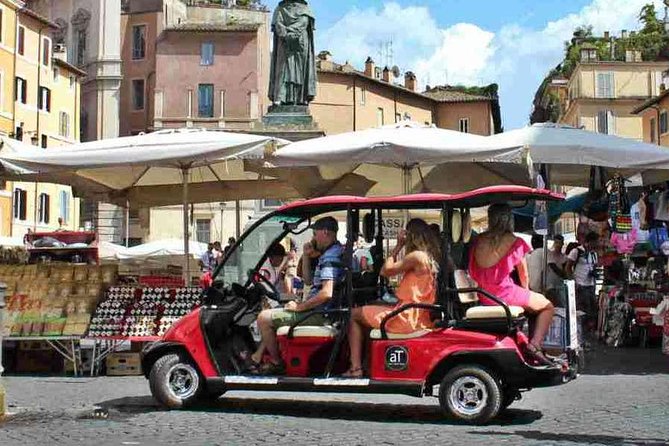
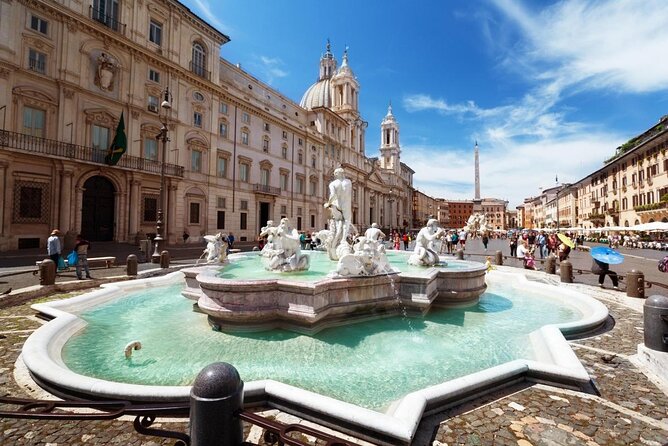
Piazza Navona is one of the city’s essential public spaces. Its long oval shape follows the footprint of the ancient Stadium of Domitian, while Bernini’s Fountain of the Four Rivers dominates the center. A ten-minute stop gives you the basic story and time to look around, but the square rewards a return visit for a drink, a meal, or a slower walk.
The Fountain of the Four Rivers is also the setting for the famous Bernini and Borromini rivalry. Your guide can point out the figures representing four great rivers and explain the stories attached to the fountain. Do not expect an art lecture at museum length, but you should come away with more than a quick photograph.
The Church of Sant’Ignazio di Loyola is one of the tour’s best surprises. Its interior uses painted perspective to create the illusion of a dome, even though the church does not have a real one over the crossing. Several people who took this tour singled out the church as a must-see, with one comparing its ceiling favorably to the Sistine Chapel.
The Spanish Steps offer a more familiar scene. Their sweeping flights, curves, terraces, and views are a fine example of Roman Baroque design. The stop is short, and the steps can be crowded, so think of it as a look and photo opportunity rather than a peaceful rest.
Piazza Venezia brings you into the loud center of modern Rome, with layers of political and imperial history around it. Trajan’s Column nearby is a particularly good guide stop. Its carved spiral tells the story of Trajan’s Dacian wars, though the details are hard to see from the ground. The guide makes the monument easier to read.
Trastevere, the Jewish Ghetto, and Teatro di Marcello
A golf cart is useful in Trastevere because the pleasure is in moving through its narrow lanes. This former fishing district is now known for bars, restaurants, and evening life, but its alleys remain enjoyable during the day. The cart can show you the character of the area without requiring a long cross-town walk.
The Jewish Ghetto provides a more serious historical layer. Rome’s Jewish community is one of the oldest continuously existing Jewish communities in the world, and the neighborhood carries centuries of religious and civic history. Expect a short orientation rather than a dedicated walking tour. If this subject matters to you, ask the guide for more time or plan a separate visit.
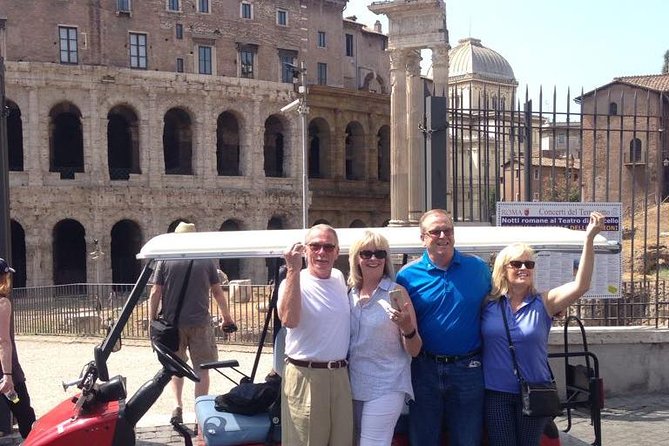
The Teatro di Marcello is an especially useful stop for architecture fans. It predates the Colosseum and reveals how Roman buildings changed over time. Part of the structure is privately owned today, giving the monument an unusual mix of ancient stone and later domestic use.
The Mouth of Truth is another quick stop, though admission is not included. You can place your hand inside the carved marble face and hear the medieval lie-detector legend. It is a playful moment, but the line and entry arrangements can affect how much time you have.
Villa Borghese, the Caelian Hill, and quieter Rome
Villa Borghese offers a break from the traffic and stone of the center. The route may pass through the park and along the Pincian Hill, with views toward Piazza del Popolo, St. Peter’s, and the historic center. The listed stop is about 15 minutes, so it is not a museum visit or a full park walk.
If you want to visit the Borghese Gallery, you need a separate timed ticket and a longer stop than this tour provides. The cart can help you understand where the park sits, but it does not replace a proper gallery visit.
The Caelian Hill is another good choice for repeat visitors and history fans. Possible sights include the Church of Saints John and Paul, remains linked to the Temple of Hadrian, and Villa Celimontana. With a listed visit of about 20 minutes, this area allows a little more breathing room than the quick fountain stops.
These quieter locations are where a private guide can make the day feel personal. You can ask to spend less time on the standard photo stops and more time in places that match your interests. The guide may also point out courtyards, churches, coffee stops, or streets that you would not have chosen from a standard sightseeing map.
What the guides add
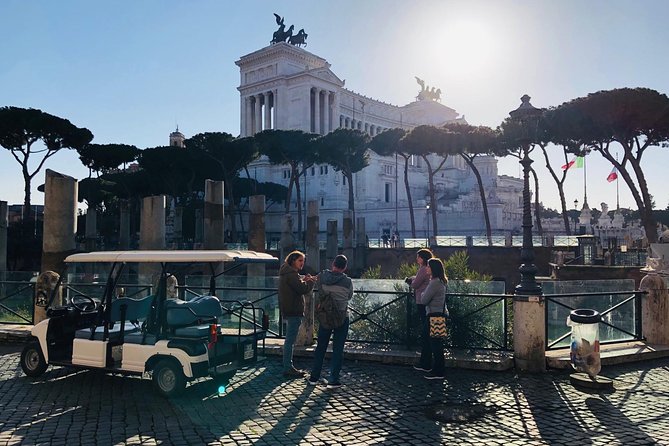
The cart gets you around, but the guide determines the quality of the experience. The strongest part of this tour is the live narration while you move between stops. Guides have been praised for clear English, humor, patience, and the ability to explain buildings, monuments, myths, and political history in a way that stays interesting.
Several guide names appear repeatedly in the experience details: Francesca, Gabriel, Giulio, Eugene, Angelo, Oscar, Julio, Luca, Beatrice, and Alessandro. You cannot assume a particular guide will be available, but the names give you an idea of the staff members who have led memorable outings.
Francesca is especially associated with carefully tailored routes and full-day outings. Gabriel is described as passionate about Rome and good at making lesser-known stops feel important. Giulio and Eugene are noted for strong city overviews, while Angelo is praised for historical and mythological stories.
A useful tip is to tell the guide what you have already visited before the cart leaves. One of the best uses of the private format is avoiding repeat stops and shifting that time toward churches, viewpoints, or neighborhoods you would otherwise miss.
Choosing between two hours and a full day
The experience can last roughly two to seven hours, depending on the package you book. A two-hour tour is best for a quick orientation or a focused route. You might choose the ancient center, the main squares, or the hilltop viewpoints, but not all three in a meaningful way.
A three-hour tour is the popular middle ground. It can cover six or seven sights if the route is efficient, with short stops and narration between them. This works well on your first day, especially if you want a map in your head before visiting the Colosseum, Vatican Museums, or Pantheon on your own.
The full-day option gives the tour room to breathe. Lunch is included, and you can combine major landmarks with less familiar churches, Trastevere, Janiculum Hill, Villa Borghese, and the Caelian Hill. If you are tired from several days of walking, the full day may feel far more comfortable than trying to cover the same area on foot.
At $180.67 per person, the price is significant. It makes the most sense for couples, families, or friends who value a private route and a guide’s attention. The value improves when the cart replaces several taxis, helps a group see more in a short stay, or allows someone with difficulty walking to take part.
For a solo visitor, the cost is harder to justify unless time or mobility is the main concern. For a larger private group, ask about multiple carts. The company can operate several vehicles with their own guides and keep them together at stops.
Practical details before you book
Hotel pickup is limited to central Rome. If your address is outside the city center, you will need to meet at Piazza del Gesù 47. Provide the hotel name and full address when booking if you want pickup.
The tour runs in rain or shine. The carts have rain covers, but comfortable clothing and sensible shoes still matter because you will get out at the stops. Service animals are allowed, and the tour is near public transportation.
Most people can take part, but tell the operator about mobility needs in advance. Each cart can hold only one baby seat for safety, and the seat must go in the middle beside a parent. The private setting is helpful for families because the pace and route can be discussed directly with the guide.
Free cancellation is available up to 24 hours before the start time. Changes made inside that window are not accepted, and poor weather may lead to a new date or a full refund.
Is Rome by golf cart right for you?
I would book this tour early in a Rome visit, especially if you have three hours or more. It gives you a practical sense of the city, helps you choose where to spend your independent time, and reduces the physical strain of crossing Rome’s hills and traffic.
Choose it if you want a private route, have limited time, are traveling with older relatives, or prefer stories and local context over a rigid audio guide. The full-day option is the better value if you want major sights plus churches, viewpoints, and neighborhoods.
Skip it if your main goal is to enter the Colosseum, Roman Forum, Vatican Museums, or Pantheon during the same outing. This tour shows you the outside of those places. You will need separate tickets and visits for the interiors, but as a first look at Rome, the cart is an efficient and unusually personal way to get oriented.
FAQ
Where does the tour start?
It can start at your central Rome hotel if you provide an accurate address and request pickup. Otherwise, it starts at Rolling Rome’s office at Piazza del Gesù 47.
Where can the tour finish?
The tour can finish at your starting hotel, elsewhere within Rome’s historic center, or at the Rolling Rome office.
Is this a private tour?
Yes. Only your group participates in the activity.
How long does the tour last?
Tour options range from about two to seven hours. A full-day option is available and includes a lunch break.
Is the tour offered in English?
Yes. An English-speaking driver-guide is included.
Does the tour enter the Colosseum or Vatican Museums?
No. The tour is for sightseeing and exterior views. Entry to the Colosseum, Roman Forum, Vatican Museums, Pantheon, and other ticketed sites is not included.
Is hotel pickup available everywhere in Rome?
No. Pickup is offered only within central Rome. If your hotel is outside the city center, contact the operator or meet at Piazza del Gesù 47.
How many people fit in the golf cart?
Most tours use a six-seat golf cart. Four seats face forward, including the driver’s position, and two face backward.
What happens if it rains?
The tour operates in rain or shine, and the carts have rain covers. If the experience is canceled because of poor weather, you can choose another date or receive a full refund.
Recently reviewed around Rome
- Ancient Rome at Twilight Walking Tour★ 5.0 · 276 reviews
- Domus Aurea Guided Tour: The Golden House of Nero★ 4.5 · 199 reviews
- Early Vatican Museums & Sistine Chapel Small Group Tour★ 4.5 · 314 reviews
- Early Vatican Museums Tour: The Best of the Sistine Chapel★ 4.5 · 900 reviews
- Tivoli Villas Full Day Trip From Rome with Lunch★ 4.0 · 443 reviews
- Jewish Ghetto & Piazza Navona: Food, Wine & Sightseeing Rome Tour★ 5.0 · 460 reviews
- 3 Days in Sorrento, Capri & Pompeii: la Dolce Vita★ 4.0 · 595 reviews
- Cook With Us in Rome: A Hands-On Cooking Experience 09:20AM class★ 5.0 · 234 reviews
Golf Cart Tours, compared.
Rome on a Golf Cart Semi-Private Tour Max 6 with Private Option
Read our review →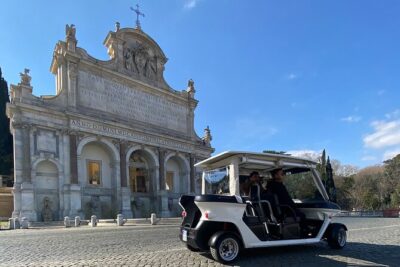
Golf Cart Tour to Fiesole Roman Theatre and Museum
Read our review →
Eco-Friendly Golf Cart City Tour with Audio Guide
Read our review →
Private/Group 4 Hours Golf Cart SightseeingTour
Read our review →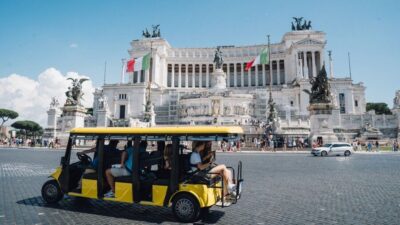
City Highlights Golf Cart Tour with Local Guide
Read our review →Browse the lists this tour appears in