
Review · MUSEUMS
Rome: Capitoline Museums and Centrale Montemartini Tickets
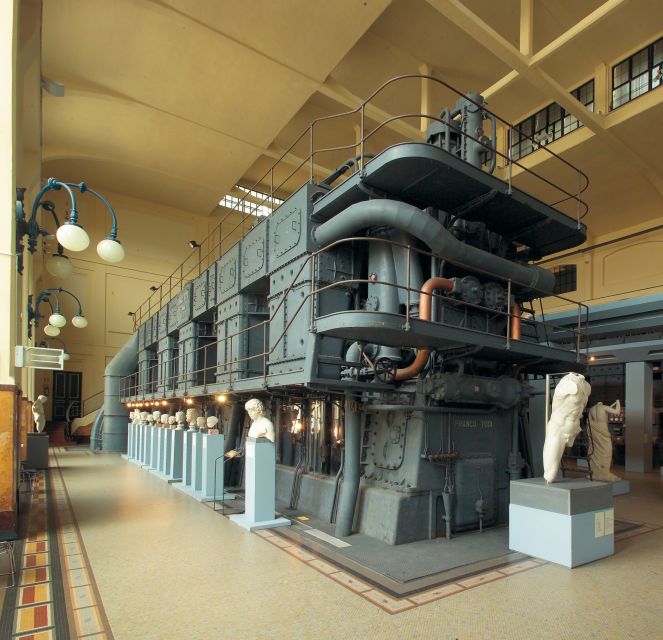
The most striking part of this experience is the contrast between Rome’s grandest ancient art and its old industrial past. At the Capitoline Museums, you can see the famous she-wolf, ancient sculpture, and Forum views from Michelangelo’s hilltop setting. Add Centrale Montemartini, and Roman statues share space with turbines and machinery in a former power station.
I like two things right away: the Capitoline Museums sit in one of Rome’s most handsome public spaces, and the optional second museum gives you a completely different setting for ancient art. I also like the practical touches, including free lockers for larger backpacks and the smartphone city app.
The main drawback is simple but important: Centrale Montemartini is not next door. It is about 10 minutes away by car or 30 minutes by public transportation, and you must arrange that transfer yourself. If you choose the combined ticket, allow enough time and energy for the move.
In This Review
- Key points to know before you book
- Starting at Piazza d’Aracoeli
- Michelangelo’s square above the Roman Forum
- The Capitoline Museums and Rome’s story
- Meeting the she-wolf of Rome
- Choosing the Centrale Montemartini option
- What the Machines and the Gods display adds
- How long the visit takes
- What is included and what is not
- Is $42 a fair price?
- Who should book this experience?
- Should you book the Capitoline Museums and Centrale Montemartini?
- FAQ
- Where do I redeem my voucher?
- What museums can I visit with this experience?
- Is Centrale Montemartini included with every ticket?
- How far is Centrale Montemartini from the Capitoline Museums?
- Is transportation between the two museums provided?
- Is a guided tour included?
- Can I store a large backpack?
- What is the cancellation policy?
Key points to know before you book
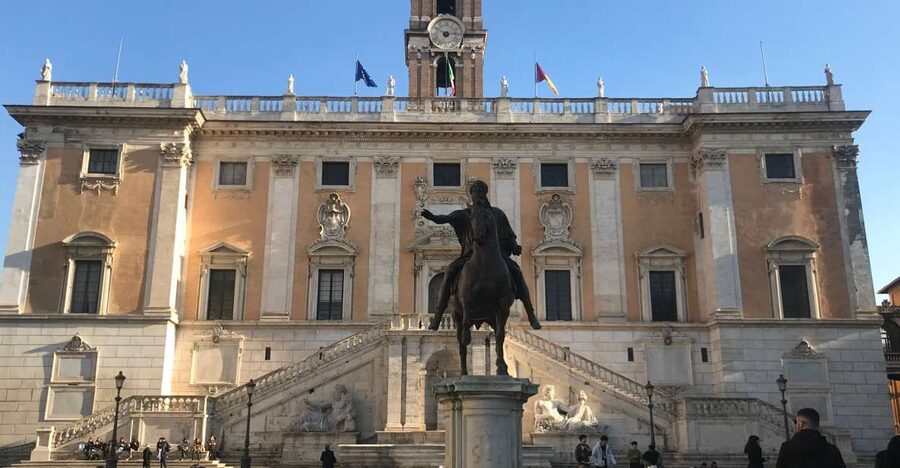
- Michelangelo’s Capitoline Piazza: Begin in the elegant square between the museum buildings, designed by Michelangelo and set above the Roman Forum.
- The she-wolf of Rome: See the sculpture linked with Romulus and Remus, the legendary founders of Rome.
- A public museum since 1734: Pope Clement XII opened the collection to the people of Rome, making this one of the city’s important early public museums.
- Ancient art in a power plant: Centrale Montemartini places classical sculpture beside the machinery of Rome’s first public thermoelectric power plant.
- Two ticket choices: Select the Capitoline Museums alone, or add Centrale Montemartini for a longer museum day.
- Plan the transfer: The second museum is around 10 minutes by car or 30 minutes by public transportation, with no transfer included.
Starting at Piazza d’Aracoeli
Your first stop is not the museum entrance itself. You must redeem your voucher at the TOURISTATION ARACOELI office at Piazza d’Aracoeli 16. Look for the fountain and orange flags in front of the office entrance.
This extra step is easy to miss, so I would build it into your plan. The office provides assistance, free Wi-Fi, and the information needed to enter the museum. Once you have your ticket, you can make your way toward the Capitoline Museums and the grand piazza above the Forum.
The arrangement is practical, but it is not the same as walking straight to a museum door with a digital ticket. Keep the voucher handy and allow time to find the office before your chosen entry. The ticket includes skip-the-line access for the Capitoline Museums, which can be useful when Rome’s central sights are busy.
There is no guided tour included. Instead, you receive access to a city app audio guide that you can download to your smartphone. Bring a charged phone and earphones if you prefer listening privately. The app gives you some structure, but you should not expect a guide leading a group from room to room.
More Museum Tours in Rome
- Vatican: Museums & Sistine Chapel Entrance Ticket
★ 4.5 · 144,003 reviews - Vatican Museums & Sistine Chapel Tour with Optional Basilica
★ 4.3 · 67,413 reviews - Vatican Museums, Sistine Chapel & St Peter’s Basilica Guided Tour
★ 4.5 · 39,149 reviews
Michelangelo’s square above the Roman Forum
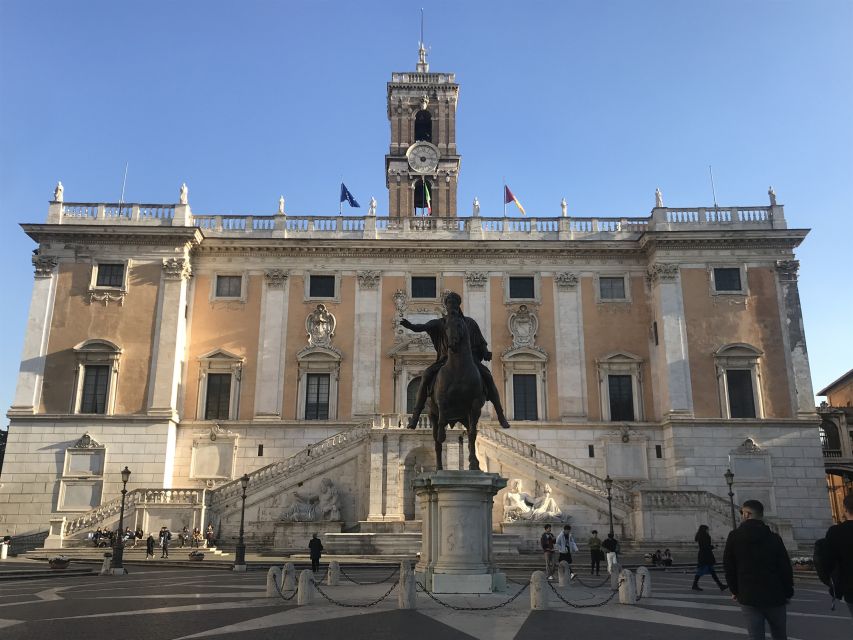
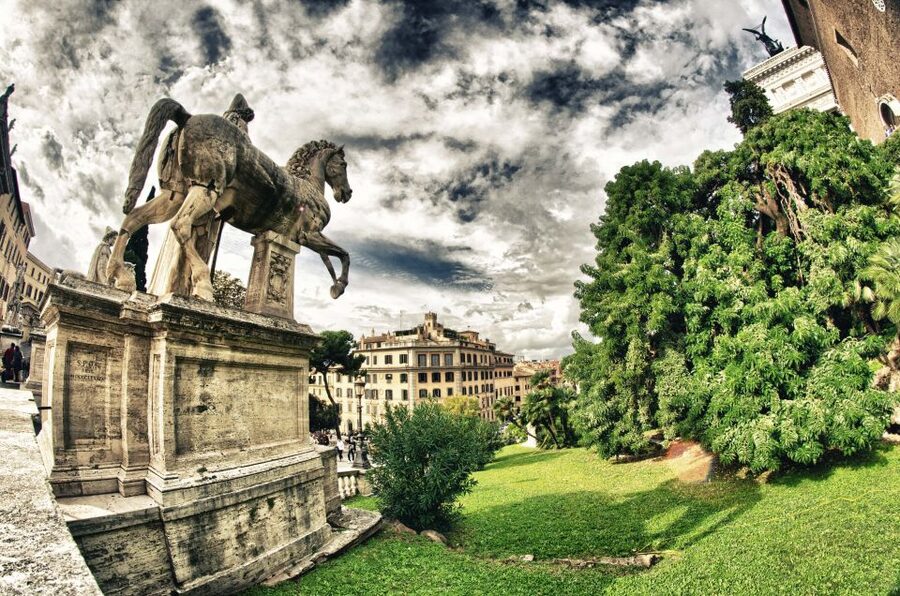
The Capitoline Museums occupy the buildings around Piazza del Campidoglio, the famous square associated with Michelangelo’s architecture. The piazza is part of the experience, not just a place to pass through on the way indoors.
Its position on Capitoline Hill gives you a strong sense of Rome’s layers. The Roman Forum spreads below, and you can look across the remains of the ancient city from a setting shaped by Renaissance design. I like this opening because it places the museum collection in the same physical city it describes.
The square also helps you understand how Rome presents its past. Ancient ruins, papal Rome, Renaissance architecture, and modern city life all meet within a short walk. You do not need a separate sightseeing stop to appreciate the relationship between the museums and the Forum.
The museum buildings sit on opposite sides of the piazza. Their arrangement makes the visit feel like a collection of connected spaces rather than one large modern gallery. Give yourself a few minutes outside before entering. The architectural setting is one of the strongest reasons to choose the Capitoline Museums over a less central collection.
The Capitoline Museums and Rome’s story
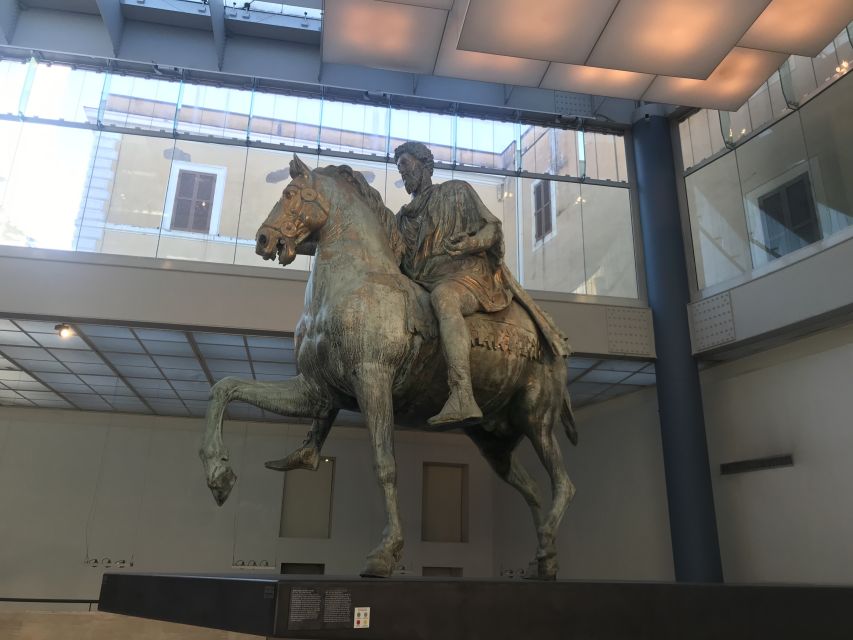
The Capitoline Museums hold art and archaeological objects connected with Rome itself. The collection covers the development of the city from the Republican era through the late Imperial Age, with sculpture and other objects helping you follow Rome’s changing identity.
Pope Clement XII made the collection permanently accessible to the public in 1734. That date matters because the museum was intended as a civic collection, not simply a private store of treasures. You are looking at objects gathered to tell the story of Rome to the people of Rome and to those who come to understand the city.
The collection is broad, so your experience will depend partly on how long you stop at each display. You can move quickly through the major works in a few hours, or spend longer with the sculpture and historical material. The advertised duration of three to five hours allows time for the Capitoline Museums alone, or for both museums if you keep a steady pace.
I would not try to see every object with equal attention. Start with the major works and the rooms that interest you most. Then use the audio app for added context rather than listening to every available track. This approach keeps the visit from becoming a long march through ancient stone.
Meeting the she-wolf of Rome
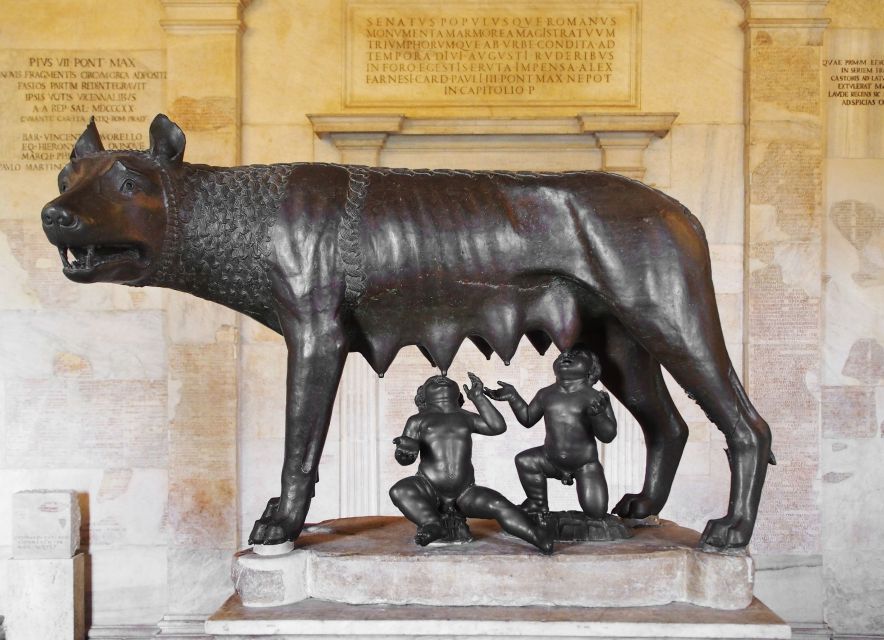
The famous she-wolf sculpture is one of the museum’s essential stops. It shows the she-wolf associated with Romulus and Remus, the twin founders of Rome. The image is instantly recognizable and carries more than artistic importance: it is a symbol of the city’s origin story.
The museum gives you a chance to see this object in its Roman setting, surrounded by a wider collection about the city’s past. That context makes the she-wolf more useful than a quick photograph. It connects mythology, civic identity, and the way Rome has chosen to represent itself.
Keep in mind that the she-wolf is only one part of the collection. If you enter only for this sculpture, you may finish too quickly to make the ticket worthwhile. I would pair it with the piazza, the Forum view, and several rooms of Roman sculpture.
The museum is best for you if you enjoy looking at objects and asking what they meant to the society that made or preserved them. It is less suited to anyone seeking a tightly scripted tour with a guide explaining each room in person.
More Rome museums and collections:
- Rome: Vatican Museums, Sistine Chapel & Basilica Tour
★ 4.3 · 13,872 reviews - Vatican Museums & Sistine Chapel Skip-the-Line Entry Ticket
★ 4.4 · 13,838 reviews - Rome: Vatican Museums, Sistine Chapel & Basilica Tour
★ 4.7 · 13,217 reviews - Rome: Vatican Museums & Sistine Chapel Guided Tour
★ 4.3 · 12,117 reviews
Choosing the Centrale Montemartini option
The combined option adds Centrale Montemartini, an old industrial building converted into a museum. It was Rome’s first public thermoelectric power plant, and its machinery remains part of the setting.
This is the unusual feature that makes the second museum worth considering. Ancient sculpture is displayed beside the equipment of industrial Rome. The contrast is direct and easy to understand: classical gods and civic monuments on one side, pipes, engines, and power machinery on the other.
The museum’s major display, The Machines and the Gods, presents hundreds of sculptures in this former power plant. The setting changes how you look at the objects. A statue that might feel expected in a traditional gallery takes on a different character beside heavy industrial equipment.
I like this option for you if you have already seen several conventional archaeological museums in Rome. Centrale Montemartini gives you another way to think about the city’s past. It also breaks up a day of marble halls and ancient ruins with a building that belongs to a much later chapter of Roman life.
The tradeoff is the transfer. Centrale Montemartini is about 10 minutes away by car or 30 minutes by public transportation. No transportation between the two museums is included, so you must pay for and arrange that part yourself. The combined ticket is not a good choice if you want every stop within a short walk of the next.
What the Machines and the Gods display adds
The second museum reconstructs parts of major monumental complexes and traces the growth of ancient Rome from the Republican era to the late Imperial Age. The sculptures are not presented as isolated decoration. They help show how public spaces and large civic projects developed over time.
The industrial setting adds a second historical thread. You are not only looking at ancient Rome. You are also standing inside a building tied to the city’s modern infrastructure. That makes the visit especially useful if you like museums that explain how a city changes across centuries.
I would allow extra time here rather than treating it as a quick add-on. The former power plant is the reason to come, and rushing through it would reduce the main benefit of the combined ticket. The experience is still self-guided, so your pace is flexible.
The museum also gives you a break from the most crowded historic center. That does not mean it is a quiet private visit, but its location and industrial setting offer a different rhythm from the Capitoline Hill. For some people, that change will be the best part of the day.
How long the visit takes
The stated duration is three to five hours. For the Capitoline Museums alone, three hours gives you time to see the key works, explore the piazza, and use some of the audio guide. You can stay longer if Roman sculpture is a major interest.
For both museums, five hours is a sensible upper limit for a focused visit, especially once you include the transfer to Centrale Montemartini. You may need to move efficiently if you want time at both locations without turning the day into a museum endurance test.
Starting times vary, so check availability before booking. I would avoid placing this experience too close to another timed attraction. The voucher redemption, entry process, museum visit, and transfer all take time, and the second museum is not connected to the first by an included shuttle.
The combined ticket works best as a half-day plan. The Capitoline Museums fit naturally with the Forum area, while Centrale Montemartini requires a separate move across the city. Treat them as two linked museum visits, not as rooms in one building.
What is included and what is not
Your Capitoline ticket includes skip-the-line entry. If you select the combined option, you also receive reserved entrance to Centrale Montemartini. The ticket includes access to Cartier e il Mito ai Musei Capitolini from November 19, 2025, through March 15, 2026.
Assistance is available at the Touristation office, and free Wi-Fi is provided. You can also download the city app audio guide to your smartphone. These features help, but they do not replace a live guide.
Food and drinks are not included. Hotel pickup and drop-off are not included, and public transportation is also your responsibility. The most important omission is the transfer between museums if you choose the combined option.
Large backpacks can be placed in free lockers located in the museum building. That is a useful detail if you are carrying more than you want to take through the galleries. One practical point from the ticket redemption experience is that an Italian-only staff interaction can create confusion if the printed date appears wrong, so check your ticket carefully as soon as you receive it.
Is $42 a fair price?
At $42 per person, the value depends on which option you select and how much time you give the museums. The Capitoline Museums alone can justify the cost if you care about Rome’s ancient collection, Michelangelo’s piazza, and the Forum setting. Skip-the-line entry and assistance at the redemption office add convenience, though you are still responsible for getting to the office first.
The combined option offers more variety, but you must account for your own transportation to Centrale Montemartini. If you already plan to visit the second museum, the paired ticket is convenient. If you are adding it only because it sounds unusual, remember that the extra stop takes a separate trip and several hours.
I see the best value for a first-time Rome visitor who wants one substantial museum visit with a famous symbol of the city. I see even better value for someone who enjoys Roman archaeology and wants a less conventional museum setting. The value is weaker if you prefer guided interpretation, dislike switching locations, or have only a short window before another reservation.
Who should book this experience?
I would recommend the Capitoline Museums to you if you want history connected directly to Rome rather than a general art collection. The she-wolf, Forum view, and city-focused objects give the visit a clear purpose.
Families may appreciate the free lockers and the children’s books available at the ticket office. The collection itself includes subjects that can help younger visitors connect mythology, emperors, and city building, though no dedicated family guide is listed.
The combined option is better for repeat visitors, museum fans, and anyone curious about industrial archaeology. It is also a good choice if you want to compare a traditional museum building with a former power station.
I would skip the second museum if your Rome schedule is already packed with timed sights. The transfer is manageable, but it is not invisible. Give yourself room to travel, enter, and look properly.
Should you book the Capitoline Museums and Centrale Montemartini?
Book the Capitoline Museums if you want a self-guided look at Rome’s own story, framed by Michelangelo’s piazza and views toward the Forum. The famous she-wolf is the headline object, but the wider collection is what makes the ticket worthwhile.
Add Centrale Montemartini if you like unusual settings and have enough time for the transfer. Ancient sculpture beside the machinery of Rome’s first public thermoelectric power plant is a memorable pairing, but it requires more planning than the Capitoline visit alone.
At $42, this is a practical choice for an independent museum day, not a guided sightseeing tour. Redeem your voucher at Piazza d’Aracoeli 16, check the printed date, download the audio app, and plan the second museum only if you are ready to arrange the connection yourself.
FAQ
Where do I redeem my voucher?
Redeem your voucher at the TOURISTATION ARACOELI office at Piazza d’Aracoeli 16. A fountain and orange flags are in front of the office entrance.
What museums can I visit with this experience?
You can select the Capitoline Museums on their own or choose a combined option that also includes Centrale Montemartini.
Is Centrale Montemartini included with every ticket?
No. You must select the combined option to receive reserved entrance to Centrale Montemartini.
How far is Centrale Montemartini from the Capitoline Museums?
The museum is about 10 minutes away by car or 30 minutes by public transportation. The transfer is not included.
Is transportation between the two museums provided?
No. Public transportation and the transfer between attractions are not included.
Is a guided tour included?
No. The experience does not include a guided tour. A city app audio guide can be downloaded to your smartphone.
Can I store a large backpack?
Yes. Free lockers for larger backpacks are located in the museum building.
What is the cancellation policy?
You can cancel up to 24 hours in advance for a full refund. You can also reserve now and pay later, keeping your plans flexible.
Recently reviewed around Rome
- Ancient Rome at Twilight Walking Tour★ 5.0 · 276 reviews
- Domus Aurea Guided Tour: The Golden House of Nero★ 4.5 · 199 reviews
- Early Vatican Museums & Sistine Chapel Small Group Tour★ 4.5 · 314 reviews
- Early Vatican Museums Tour: The Best of the Sistine Chapel★ 4.5 · 900 reviews
- Tivoli Villas Full Day Trip From Rome with Lunch★ 4.0 · 443 reviews
- Jewish Ghetto & Piazza Navona: Food, Wine & Sightseeing Rome Tour★ 5.0 · 460 reviews
- 3 Days in Sorrento, Capri & Pompeii: la Dolce Vita★ 4.0 · 595 reviews
- Cook With Us in Rome: A Hands-On Cooking Experience 09:20AM class★ 5.0 · 234 reviews
Museums, compared.

Vatican: Museums & Sistine Chapel Entrance Ticket
Read our review →
Vatican Museums & Sistine Chapel Tour with Optional Basilica
Read our review →
Vatican Museums, Sistine Chapel & St Peter’s Basilica Guided Tour
Read our review →
Skip-The-Line Uffizi Gallery Timed Entry Ticket
Read our review →
Vatican Museums, Sistine Chapel & Basilica Tour
Read our review →
Vatican Museums & Sistine Chapel Skip-the-Line Entry Ticket
Read our review →Vatican Museums, Sistine Chapel & Basilica Tour
Read our review →
Vatican Museums & Sistine Chapel Guided Tour
Read our review →Browse the lists this tour appears in