
Review · COLOSSEUM & ROMAN FORUM TOURS
Rome: Colosseum, Palatine Hill, and Roman Forum Tour
Rome’s ancient center makes more sense when someone helps you read it. This 2.5-hour guided tour links the Colosseum, Palatine Hill, and Roman Forum in one well-planned route, with reserved admission to all three. I like the historical sweep, from gladiatorial combat to Rome’s founding legends and the political heart of the Republic. I also like the chance to hear guides such as Francisco, Giovanna, Julia, or Tiziana explain details that stone signs cannot.
The main catch is that skip-the-line does not mean walk straight inside. Security checks can still create long delays, especially at busy times. You also need comfortable shoes, water, and patience for sun, uneven ground, and a moderate amount of walking. At $89.50 per person, the price is fair if you want structure and interpretation, but less attractive if you prefer to explore slowly on your own.
In This Review
- Key points at a glance
- Meeting at the Arch of Constantine
- Entering the Colosseum
- Palatine Hill and Rome’s founding story
- Reading the Roman Forum
- A guide makes the difference
- Heat, walking, and practical comfort
- Is $89.50 a fair price?
- Who should book this tour?
- FAQ
- How long does the tour last?
- Where does the tour start?
- How early should I arrive?
- Which sites are included?
- Is the Arena Floor or Underground included?
- What languages are available?
- Do I need to bring identification?
- Can I bring luggage or a stroller?
- Should you book it?
Key points at a glance
- Reserved entry to three major sites: Your ticket covers the Colosseum, Palatine Hill, and Roman Forum.
- A strong first visit to Ancient Rome: The route gives you the broad story without requiring hours of advance research.
- Guides bring the ruins to life: Francisco, Mauricio, Giovanna, Julia, Tiziana, Francesca, and others have been praised for clear storytelling and friendly care.
- Expect real walking and Roman heat: The tour covers open archaeological ground, slopes, and uneven paths.
- A useful Forum viewpoint: You get a wide view across the Roman Forum from the Capitoline Hill area.
- Arena and underground areas are not included: Those require separate tickets and reservations.
Meeting at the Arch of Constantine
The tour begins at the Souvenir Colosseo Shop on Via di S. Giovanni in Laterano 14, near the Arch of Constantine. You must arrive 30 minutes before departure, not merely at the published start time. This matters because the group needs to check in, collect the radio equipment, and enter together.
The Arch of Constantine is a fitting starting point. It is Rome’s largest and one of its best-preserved triumphal arches, built to celebrate Constantine’s victory. Even before entering the Colosseum, your guide can place the monuments around you in a useful order: imperial power, public spectacle, religion, law, and daily business all crowded into this small part of the city.
The meeting point is described as clear, with check-in inside the shop. Still, leave extra time for Rome’s traffic, confusing streets, and crowds around the Colosseum. One person arrived only five minutes before departure and was turned away, so treat the 30-minute instruction as a real requirement.
You receive a radio system so you can hear the guide while moving through crowded spaces. A €10 deposit is required for each device and is returned after you hand it back. Bring a passport or valid ID card. Site staff can refuse entry without one, even if you have a reservation.
Other Rome days travellers weigh against this one:
- Vatican: Museums & Sistine Chapel Entrance Ticket
★ 4.5 · 144,003 reviews - Vatican Museums & Sistine Chapel Tour with Optional Basilica
★ 4.3 · 67,413 reviews - Colosseum, Roman Forum & Palatine Guided Tour
★ 4.7 · 63,148 reviews
Entering the Colosseum
The Colosseum is the tour’s first major stop, and it delivers the instant scale most people expect. The building is not simply a grand photo backdrop. It was a working arena built for mass entertainment, where gladiators, prisoners, animals, and professional performers took part in violent public shows.
A good guide helps you understand how the building functioned and what life was like for the people forced or trained to fight there. Several guides on this tour, including Francisco, Mauricio, Tiziana, Julia, Giovanna, and Francesca, have been singled out for making the ancient events easy to picture. Their success depends on more than dates. The best moments come when the guide turns broken arches and tiers of seating into a working public venue.
The radio system should make this easier, but you should check that yours works before the tour gets moving. One report noted difficulty hearing the guide despite a small group, while other guides were praised for speaking clearly and keeping people together. Crowds can make any Colosseum visit noisy, and a radio is especially useful when several groups are talking nearby.
The reserved ticket helps with the ticketing process, but it does not remove security screening. During peak periods, the entry queue can still be long. One person waited about 50 minutes, though the guide kept the group occupied with explanations. That is a good reminder to think of reserved entry as a way to reduce one kind of delay, not as a guarantee of instant admission.
You should also know what is not included. The ticket covers the regular Colosseum visit, but not the Arena Floor or Underground. If standing where gladiators fought or visiting the lower chambers is your main goal, you need a different product with those reservations.
Palatine Hill and Rome’s founding story
From the Colosseum, the tour continues to Palatine Hill, traditionally linked with the beginning of Rome. Here your guide explains the story of Romulus and Remus, the twin brothers whose rivalry became part of Rome’s foundation myth. The tale is not presented as a simple fact, but it gives the hill its emotional place in the city’s story.
Palatine Hill can be difficult to read without help. Much of what you see is made of low walls, partial rooms, foundations, and scattered stone. If you expect another Colosseum, this section may feel less dramatic. One practical reason to take the guided route is that the guide explains what these fragments once were, rather than leaving you to guess from a pile of masonry.
The hill also includes the House of Augustus, with its frescoes, and the Hippodrome, an elliptical sunken garden connected with the Palace of Domitian. These details show the contrast between public Rome and imperial private life. You move from an arena designed for crowds to palace grounds meant for emperors and their households.
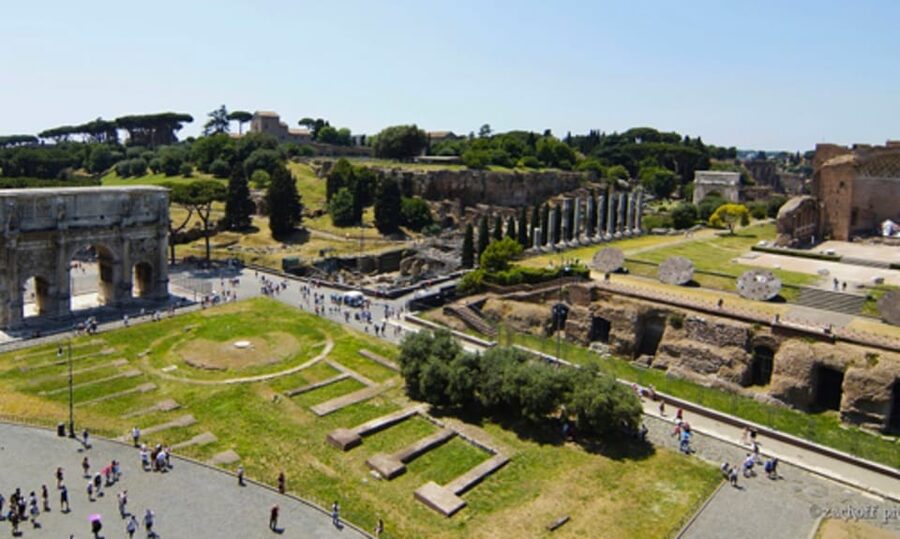
Palatine Hill is also where the tour gives you breathing room. From the high ground, you can look toward the Circus Maximus and across the valley of the Roman Forum. The view is one of the better reasons not to rush this section. You can begin to see how the city’s monuments fit together instead of experiencing each ruin as an isolated stop.
The hill is open and exposed. On hot days, there is limited shade, and the stone paths can be tiring. Guides have helped by pausing in shaded places, offering water assistance, and adjusting the pace. Even so, bring your own water bottle, wear a hat, and avoid treating this as a quick indoor museum visit.
Reading the Roman Forum
The Roman Forum is the most rewarding part of the route for many people, but it is also the place where a guide adds the most value. This was the center of public life in Ancient Rome, a zone of temples, government buildings, shops, law courts, memorials, and processions.
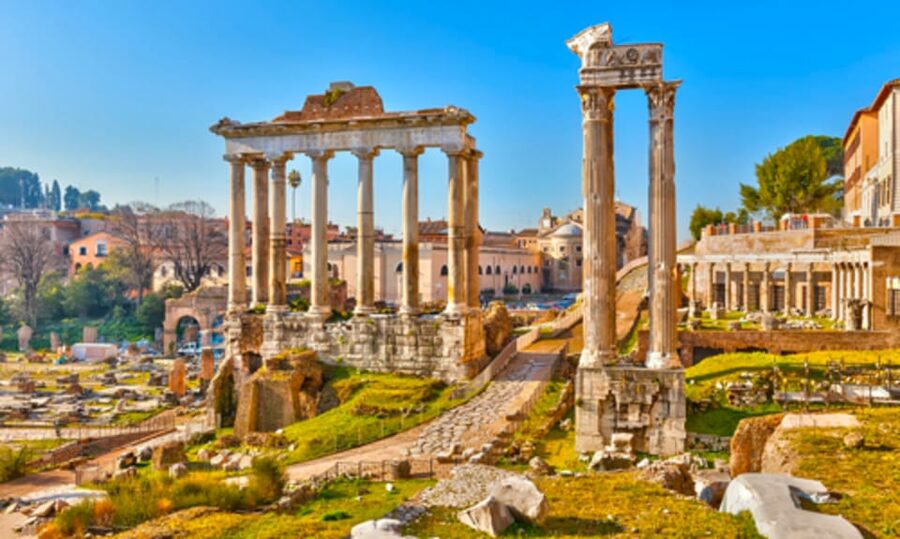
The route takes in the Temple of Julius Caesar, the Arch of Titus, the House of the Vestal Virgins, the Senate House, and the Basilica of Maxentius. Each ruin has a different role in the city’s story. The Temple of Julius Caesar marks the place where Caesar was cremated and later honored. The Arch of Titus recalls a Roman military victory. The Senate House points to the machinery of government, while the Basilica of Maxentius shows the scale of Roman public architecture.
Your guide also explains the Via Sacra, or Sacred Way. This was the triumphal road through the Forum, used for important processions. Walking along it gives the ruins a sense of movement. Ancient Rome was not a silent field of columns. It was a place where officials, soldiers, merchants, priests, moneylenders, and shopkeepers crossed paths every day.
The Forum’s beauty is less immediate than the Colosseum’s. You need time to connect the buildings, alignments, and fragments. The tour provides that framework, though the pace can feel brisk if you want to stop for every photograph or inscription.
At the end, you may have some time to look around on your own, but the amount varies. One account described a longer-than-advertised visit with extra time in the Forum and Palatine Hill, while another wanted more free time inside the Colosseum. If independent exploring matters more to you than guided explanation, ask at the start how much time will remain after the main commentary.
A different way to spend the day, same part of Italy:
- Vatican Museums, Sistine Chapel & St Peter’s Basilica Guided Tour
★ 4.5 · 39,149 reviews - Rome: Colosseum, Palatine Hill and Roman Forum Guided Tour
★ 4.8 · 32,814 reviews - Rome: Guided Tour of Colosseum, Roman Forum & Palatine Hill
★ 4.7 · 27,897 reviews - Rome: Colosseum & Forum with Audio Guide App -Optional Arena
★ 4.2 · 24,770 reviews
A guide makes the difference
This tour is sold partly on access, but the human element determines how much you take away. The strongest guides turn a difficult site into a sequence of clear ideas. Francisco has been praised for answering questions and connecting Roman history with other parts of Italy. Mauricio is described as turning the visit into an excellent experience through detailed explanations.
Giovanna, Julia, Tiziana, Francesca, Rosalia, and Fabrizio have also received warm praise for being friendly, funny, patient, and well informed. Julia and Guilia were especially noted for keeping the talk lively rather than simply marching from one ruin to the next. One guide even helped fill water bottles and handed out hard candies on a hot day.
Guide quality can vary, and English may not be every guide’s first language. One person found the explanations hard to follow, while others found their guide exceptionally clear. The radio system is meant to limit this problem, but it does not replace good speaking and careful group management.
The tours are offered in English and Spanish. When booking, choose the language you can follow most comfortably. A two-and-a-half-hour archaeology tour is tiring enough without working hard to understand every sentence.
Heat, walking, and practical comfort
Rome’s ancient sites are demanding in simple physical ways. You walk over uneven surfaces, climb slopes on Palatine Hill, and spend much of the time outside. The tour is not suitable for wheelchair users, and baby strollers, pets, luggage, and large bags are not allowed.
Wear shoes with firm soles. Sandals that offer little support can become uncomfortable on rough paths. Bring water, sunscreen, and a hat, especially in summer. There are stretches where shade is limited, though guides may pause in cooler spots when possible.
The 34-degree heat mentioned by one participant is not unusual for a Roman summer day. Do not plan this tour at the end of an already packed day if you can avoid it. Some people have combined two tours in one day and found the walking exhausting. I would give this ancient-center visit its own block of time, then leave space afterward for a meal and a slower look at the neighborhood.
Large bags are a particular problem. There is no cloakroom at the sites, and you cannot enter with suitcases or oversized luggage. Arrive with only what you can comfortably carry.
Is $89.50 a fair price?
At $89.50, this is not the cheapest way into Ancient Rome. You are paying for reserved admission, a certified guide, a radio system, and a route that connects three major sites without requiring you to plan each ticket separately.
The value is strongest for a first visit. If you know little about Roman history, the Colosseum alone can leave you with impressive images but few answers. The guide supplies the order: arena first, then the city’s founding hill, then the Forum where Roman public life played out.
The price is less appealing for an independent history enthusiast who wants to linger at every inscription, sit quietly among the ruins, or return to one site later. A group tour must keep moving, and the 2.5-hour schedule leaves limited control over your pace.
There is also no hotel pickup, food, drinks, or transport to and from the meeting point. You handle your own route to Via di S. Giovanni in Laterano 14. Build that into the day’s cost and timing.
Who should book this tour?
I would choose this tour if you want the three core Ancient Rome sites in one organized visit and prefer an explanation to a self-guided audio app. It suits first-time visitors, families with older children who can manage the walking, and anyone with limited time in Rome.
It is also a good fit if long ticket queues would spoil your day. The reserved entry cannot prevent security delays, but it removes the need to arrange separate admission for the three sites.
I would look elsewhere if you need wheelchair access, want the Arena Floor or Underground, are carrying luggage, or dislike group schedules. I would also think twice if your priority is quiet photography and long independent stops.
FAQ
How long does the tour last?
The scheduled duration is 2.5 hours. Some visits may run longer, and the available starting times depend on the date you select.
Where does the tour start?
It starts at the Souvenir Colosseo Shop at Via di S. Giovanni in Laterano 14, 00184 Rome, near the Arch of Constantine.
How early should I arrive?
You should arrive 30 minutes before departure. Arriving only a few minutes before the start can mean missing the group.
Which sites are included?
The tour includes reserved entrance to the Colosseum, Palatine Hill, and Roman Forum.
Is the Arena Floor or Underground included?
No. Tickets and reservations for the Arena Floor and Underground are not included.
What languages are available?
The live tour guide is available in English and Spanish.
Do I need to bring identification?
Yes. Bring a passport or ID card. Site staff may refuse entry without valid identification.
Can I bring luggage or a stroller?
No. Suitcases, large bags, and baby strollers are not allowed, and there is no cloakroom at the site. Pets are also not allowed.
Should you book it?
Book this tour if you want a clear introduction to Ancient Rome, value a professional guide, and accept that reserved entry may still involve security lines. The Colosseum provides the famous spectacle, Palatine Hill supplies the founding legend and wide views, and the Roman Forum ties the whole story together.
The best practical choice is to arrive early, carry light, wear serious walking shoes, and protect yourself from the heat. At $89.50, you are buying organization and interpretation more than extra access. For a first visit, that can be money well spent.
Recently reviewed around Rome
- Ancient Rome at Twilight Walking Tour★ 5.0 · 276 reviews
- Domus Aurea Guided Tour: The Golden House of Nero★ 4.5 · 199 reviews
- Early Vatican Museums & Sistine Chapel Small Group Tour★ 4.5 · 314 reviews
- Early Vatican Museums Tour: The Best of the Sistine Chapel★ 4.5 · 900 reviews
- Jewish Ghetto & Piazza Navona: Food, Wine & Sightseeing Rome Tour★ 5.0 · 460 reviews
- 3 Days in Sorrento, Capri & Pompeii: la Dolce Vita★ 4.0 · 595 reviews
- Tivoli Villas Full Day Trip From Rome with Lunch★ 4.0 · 443 reviews
- Cook With Us in Rome: A Hands-On Cooking Experience 09:20AM class★ 5.0 · 234 reviews
Colosseum & Roman Forum Tours, compared.
Colosseum, Roman Forum & Palatine Guided Tour
Read our review →
Colosseum, Palatine Hill and Roman Forum Guided Tour
Read our review →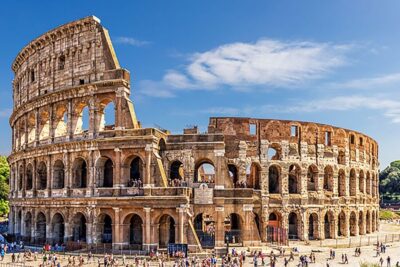
Guided Tour of Colosseum, Roman Forum & Palatine Hill
Read our review →
Colosseum & Forum with Audio Guide App -Optional Arena
Read our review →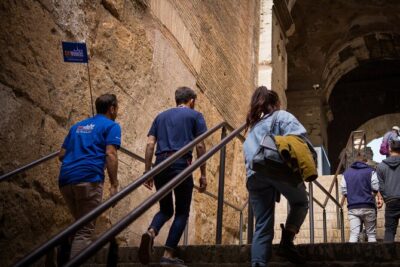
Colosseum, Roman Forum and Palatine Hill Guided Tour
Read our review →
Colosseum, Roman Forum, Palatine with Multimedia Video
Read our review →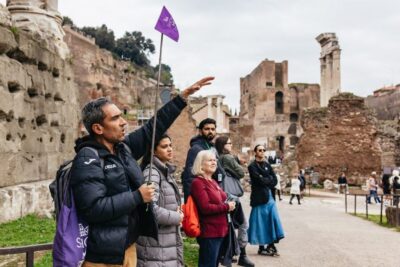
Colosseum, Palatine Hill & Roman Forum Guided Tour
Read our review →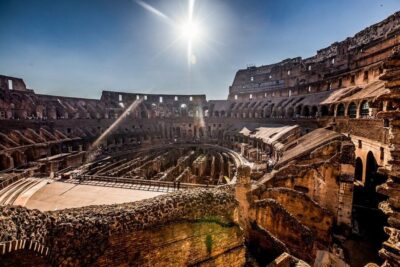
Colosseum: Underground and Ancient Rome Tour
Read our review →Browse the lists this tour appears in