Review · ROME TOURS
Rome: Domus Aurea Tour with Virtual Reality Experience
The best part of this two-hour Domus Aurea tour is the way it joins a real archaeological site with a 3D reconstruction of Nero’s Golden Palace. Inside, you walk through dark, vaulted rooms and faded frescoes. Then the virtual sequence shows what the palace may have looked like when porticoes, gardens, fountains, and colored decoration filled the complex.
I especially like two things here: the chance to see both the east and newly reopened west wings, and the careful explanation of Nero’s place in Roman history. The tour also offers a welcome break from Rome’s busiest monuments. The main drawback is organization at the meeting point. Several people have had trouble finding the entrance, and the opening talk can feel too long if you are eager to get inside.
In This Review
- Key points to know before booking
- Why the Domus Aurea feels different from other Roman sights
- Finding the guide outside the Domus Aurea
- Nero, the fire, and the story behind the palace
- Walking through the east and west wings
- The octagonal room and Roman engineering
- How the 3D virtual reality section works
- How the Domus Aurea disappeared and returned
- Timing, comfort, and access
- Is the guided format worth paying for?
- Who should book this Domus Aurea tour?
- Should you book it?
- FAQ
- How long does the Domus Aurea tour last?
- What language is the tour in?
- Where is the meeting point?
- Is the GetYourGuide voucher the entry ticket?
- How soon do you enter the Domus Aurea?
- Does the tour include the west wing?
- Is virtual reality included?
- What should I bring?
- Can I bring luggage or a large bag?
- Is the tour wheelchair accessible?
Key points to know before booking
- Thirty frescoed halls and the west wing: The visit reaches areas many earlier Domus Aurea visitors could not see.
- A palace buried beneath later Rome: Emperor Trajan built baths over Nero’s residence, helping preserve the rooms below.
- The VR sequence gives the site its shape: The bare archaeological remains make far more sense once you see the reconstructed palace.
- A two-guide format: An outside guide may introduce Nero and ancient Rome, followed by a Domus Aurea guide inside.
- The octagonal room is a highlight: Its unusual design hints at the technical ambition of the palace.
- Bring a jacket and comfortable shoes: The underground rooms can feel cool, and the route is not suitable for wheelchair users.
Why the Domus Aurea feels different from other Roman sights
Rome gives you many grand ruins, but the Domus Aurea asks you to use your imagination. You do not enter a restored palace with complete columns and polished marble. Instead, you walk through a protected archaeological site where the remains are partly underground, the walls are exposed, and the decoration survives in fragments.
That is precisely why the virtual reality section matters. Without it, you might see a sequence of impressive but confusing rooms. With it, you can picture the scale of Nero’s project and understand how the halls connected to gardens, fountains, and open porticoes.
The palace was built after the great fire of July 64 AD. Nero used land cleared by the destruction to enlarge his imperial residence on the Palatine Hill and beyond. The complex included an artificial lake, lavish rooms, and a setting designed for private pleasure, art, and spectacle.
The lake later disappeared beneath the Colosseum. Vespasian’s decision to build the amphitheater there was both practical and political. It returned the area to public use and helped distance the new imperial government from Nero’s unpopular rule.
That layered story gives the Domus Aurea unusual force. You are not simply looking at an imperial home. You are seeing how disaster, politics, architecture, public opinion, and later building projects reshaped Rome.
Other Rome days travellers weigh against this one:
- Vatican: Museums & Sistine Chapel Entrance Ticket
★ 4.5 · 144,003 reviews - Vatican Museums & Sistine Chapel Tour with Optional Basilica
★ 4.3 · 67,413 reviews - Colosseum, Roman Forum & Palatine Guided Tour
★ 4.7 · 63,148 reviews
Finding the guide outside the Domus Aurea
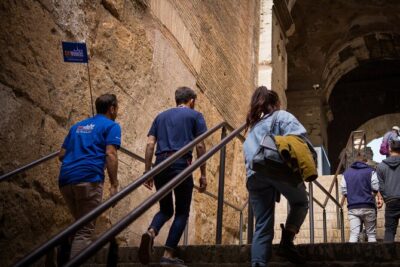
The meeting point is at the Domus Aurea, near coordinates 41.891132, 12.495589. Look outside for a guide holding an OPEN MIND TOURS sign. Your GetYourGuide voucher is not the entrance ticket, since the guide holds the actual entry documents.
Allow extra time to locate the group. The entrance can be surprisingly hard to spot, and one person had to phone the company after finding that the supplied address did not seem to exist. I would arrive early and use the coordinates rather than relying only on the written address.
The tour does not enter immediately after the scheduled start. The guide first gives an introduction, and entry to the Domus takes place at least 20 minutes after the scheduled guide presentation. That arrangement can be useful because the opening talk gives you the political background needed for the rooms inside, but it can also test your patience if you already know ancient Roman history.
The outside introduction varies by guide. Alexei has been praised for a lively account of Rome from its foundation through the Republic and into the Empire. Rosario has also provided a clear explanation of Nero’s palace and greeted groups promptly. On some dates, the opening guide and the guide inside are different people.
Nero, the fire, and the story behind the palace
Nero’s reputation has been shaped by later writers, popular films, and the familiar image of an emperor playing music while Rome burned. The tour offers a more complicated account.
The fire began in July 64 AD and destroyed much of Rome. Nero was away at his seaside villa when it began, and the tour presents the case that he was not responsible for starting it. Afterward, he opened his gardens to people made homeless, distributed basic goods, lowered the price of grain, and introduced new building rules.
Those rules included greater separation between buildings and more use of stone and brick instead of wood. Yet the emperor still faced criticism over the rescue effort and the money available for rebuilding. His decision to expand his own palace across damaged land made the public anger worse.
This is where the tour is most useful. It does not need to make Nero innocent or admirable. It shows why his actions after the fire could appear generous in one light and self-serving in another. His palace was an extraordinary artistic project, but its size and private lake came at a time when many Romans were still suffering.
Nero died by suicide in June 68 AD, only a few years after the fire. The palace was not fully complete. The next rulers suppressed his memory by changing the site, building public monuments over parts of it, and removing signs of his ownership.
Walking through the east and west wings
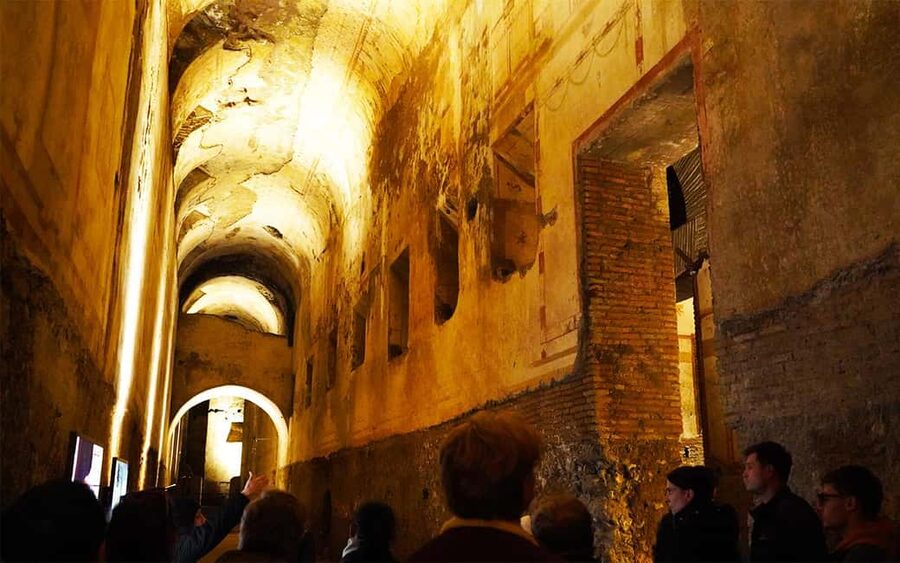
The guided visit inside lasts about 105 minutes. You move through around 30 halls, including the recently reopened west wing. Expect a series of vaulted spaces, high passages, and rooms where painted decoration remains on the walls and ceilings.
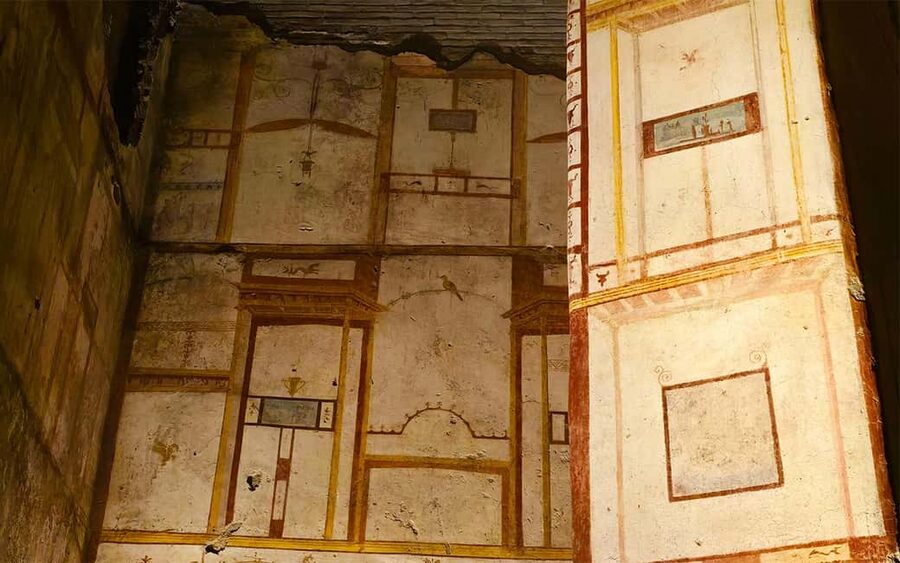
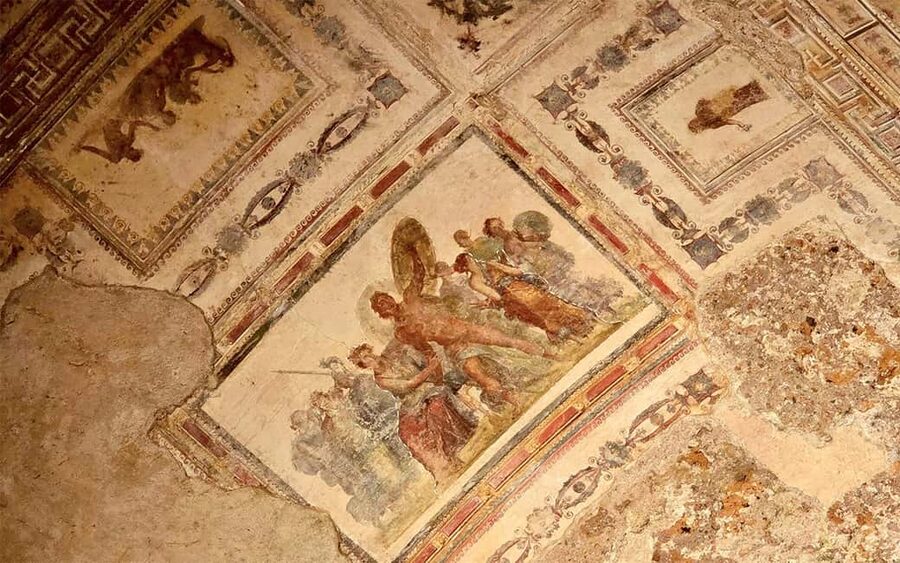
The frescoes are among the main reasons to take a guide. The figures can seem strange at first: hybrids, plants, animals, and delicate decorative forms arranged in ways that do not resemble the heavy public art often associated with Rome. Your guide explains how these designs reflect Nero’s taste and the artistic culture of his court.
The decoration is not simply an exercise in excess. It shows a sensitive, inventive side of Roman art, with careful use of light, color, and repeated patterns. The palace originally combined painted walls with fountains, gardens, and covered walkways. The design was meant to change as you moved through it.
The west wing adds value for anyone who visited the Domus Aurea years ago. The site is much larger than you might expect, and the newly opened rooms help explain that this was not one grand hall but an extensive imperial complex. Conditions and access can change as conservation work continues, so not every section will necessarily feel complete or open in the same way.
Inside, the guide’s position matters. The rooms are large enough for sound to carry poorly, and a big group can make it hard to hear. One visitor found the guide excellent but struggled when standing away from her. Another noted that the guide sometimes began speaking before the whole group had gathered.
I would stay close to the guide and move with the group rather than stopping at the back to take photographs. Professional cameras, tripods, selfie sticks, drones, large bags, and luggage are not allowed. Weapons, sharp objects, aerosols, and glass items are also prohibited.
A different way to spend the day, same part of Italy:
- Vatican Museums, Sistine Chapel & St Peter’s Basilica Guided Tour
★ 4.5 · 39,149 reviews - Rome: Colosseum, Palatine Hill and Roman Forum Guided Tour
★ 4.8 · 32,814 reviews - Rome: Guided Tour of Colosseum, Roman Forum & Palatine Hill
★ 4.7 · 27,897 reviews - Rome: Colosseum & Forum with Audio Guide App -Optional Arena
★ 4.2 · 24,770 reviews
The octagonal room and Roman engineering
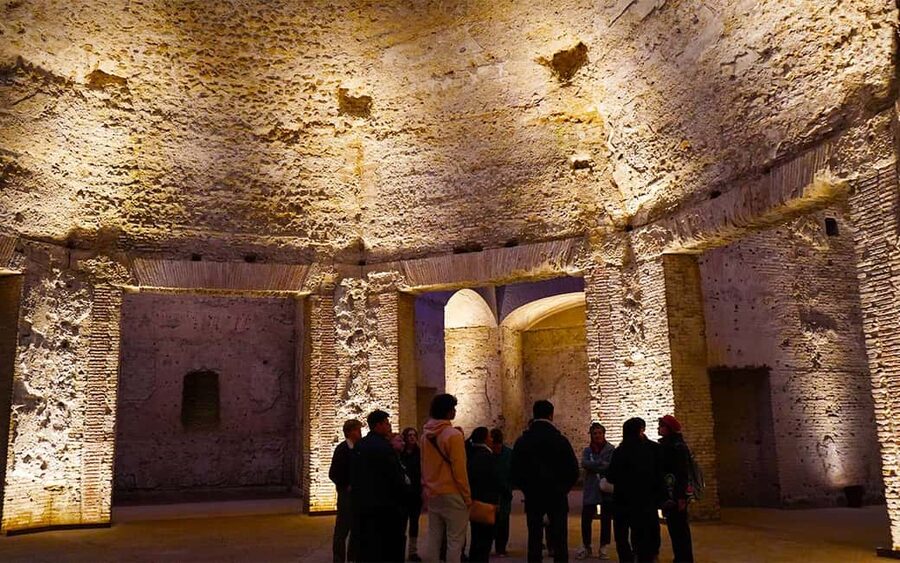
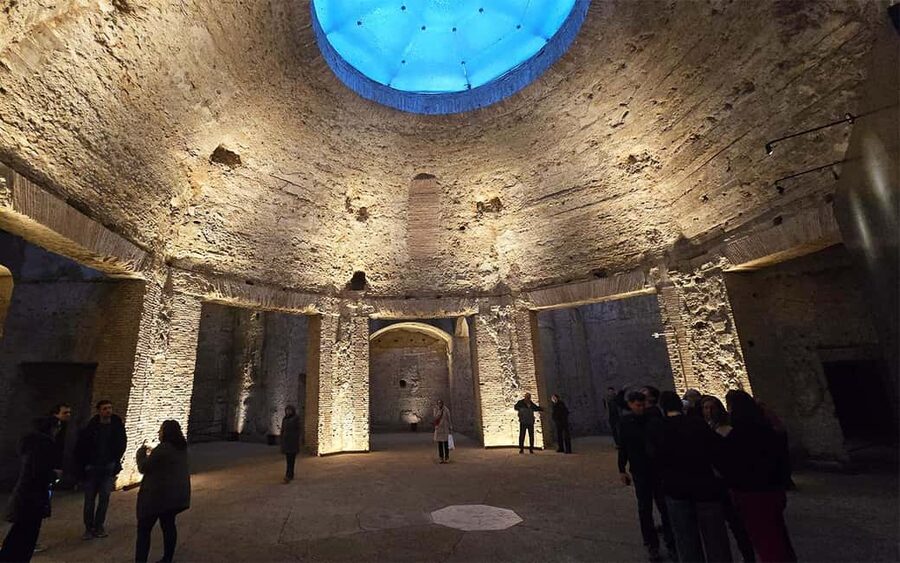
The octagonal room is one of the tour’s most memorable spaces. Its geometry is unusual, and the guide may discuss the possibility of a rotating ceiling. That idea captures the boldness of Nero’s architects, though the structure also needs to be understood in the context of Roman engineering rather than modern fantasy.
The palace shows how Roman builders managed concrete, vaults, light, water, and decoration in combination. Some details are best understood by looking upward, so keep your attention on the ceilings and high wall surfaces. The scale can be easy to underestimate when you are focused on individual frescoes.
I like this section particularly because it connects technical skill with daily experience. The rooms were not impressive only because they used expensive materials. They were arranged to create surprise, shade, reflected light, moving water, and changing views.
The building also reveals the reach of the Roman Empire. Materials, artists, and ideas moved through a huge imperial network. The palace was an architectural statement about power, wealth, and Rome’s ability to draw resources from far beyond Italy.
How the 3D virtual reality section works
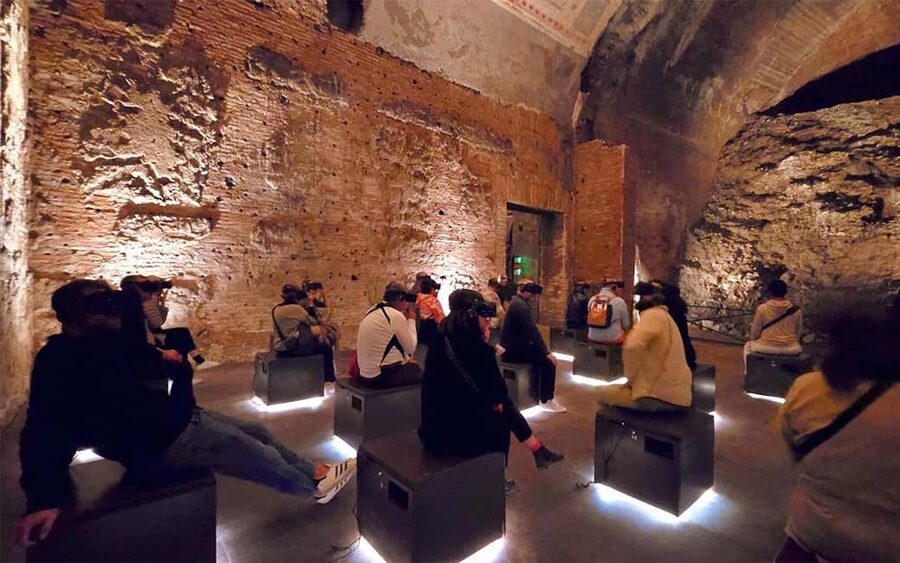
The virtual reality portion is the payoff. During one seated part of the visit, you put on the equipment and see a reconstruction of the palace at its height. The sequence includes interior halls and an elaborate outside portico, even though construction was unfinished when Nero died.
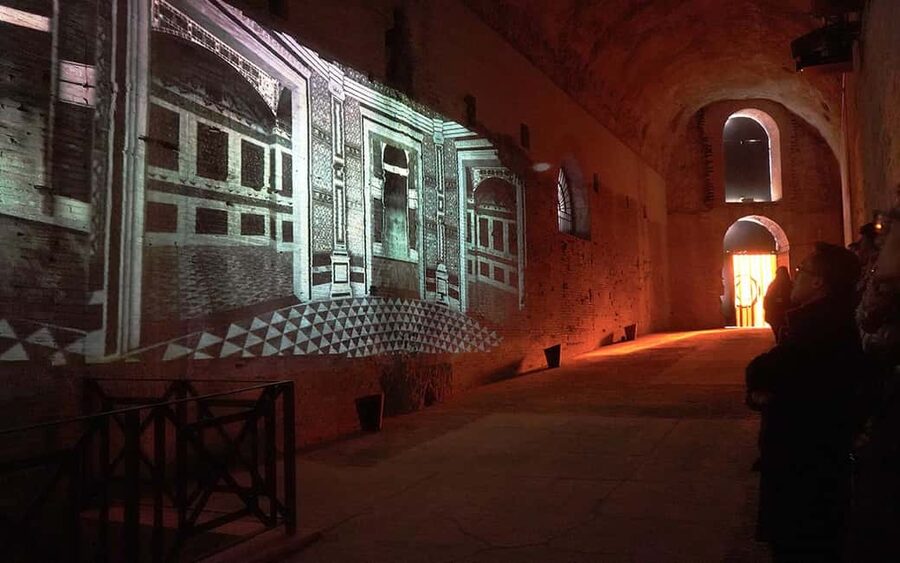
Look around in every direction. The reconstruction is designed to show more than a forward-facing film, and the people who paid attention to the full view got a better sense of the building’s scale. The experience helps restore the missing gardens, open spaces, fountains, and decorative surfaces that are difficult to picture among the surviving ruins.
This is not a substitute for the archaeological visit. The VR images are an interpretation of how the complex may have appeared, while the rooms around you are physical evidence that has survived underground. Seeing both lets you compare the reconstruction with the actual walls and understand where imagination begins.
Some people may find the headsets less comfortable than a normal talk, but the seated format helps. It also gives you a pause after walking through the galleries. The technology feels useful here because the palace has been buried, altered, and stripped of much of its decoration.
How the Domus Aurea disappeared and returned
About 50 years after Nero’s death, Trajan built a huge bath complex over the Domus Aurea. The palace was buried, and much of it was forgotten for nearly 1,500 years.
Its rediscovery in the 1500s changed European art. Renaissance artists entered the buried rooms and copied the strange decorative forms they found. These designs helped inspire the ornamental style later called grotesque, a name connected to the underground chambers, or grottos, where the paintings were found.
That story gives the frescoes another layer of meaning. You are not only seeing decoration from Nero’s age. You are also seeing the remains that helped Renaissance artists reconnect with ancient Roman art.
The site remains an active archaeological area, which means preservation comes first. You may see damp surfaces, conservation measures, or areas that feel unfinished. That is not a flaw in the experience. It is a reminder that this is a living excavation rather than a completed museum display.
Timing, comfort, and access
Plan on two hours in total, with about 105 minutes spent on the guided visit itself. Wear comfortable shoes, since you will be walking through a large archaeological complex and standing for much of the tour.
Bring a jacket. The underground rooms can feel cool, even in Rome’s summer heat. That cooler atmosphere can be pleasant after visiting outdoor ruins, but the temperature may surprise you if you dress only for sunshine.
The experience is not suitable for wheelchair users or people with mobility impairments. The restrictions on bags and equipment are strict enough that you should avoid arriving with luggage or a large daypack.
The tour is in English only. Guides such as Yev, Linda, Laura, and Alexei have been praised for clear explanations and strong command of the subject, but the quality of communication can vary by guide and group size. If you have difficulty hearing, stand near the guide and tell the group leader early.
Is the guided format worth paying for?
The value depends on what you want from the Domus Aurea. If you only want to enter the ruins and look at the walls, booking directly with the archaeological site may be less expensive. One part of this experience, the outside introduction, can also feel unnecessary if you already know Nero’s story.
The guided format becomes more worthwhile if you want the building explained as you move. The palace is not easy to read on your own, and the frescoes, west wing, octagonal room, and later burial all make more sense with a clear sequence.
The tour also takes care of timed admission and uses a separate entrance to skip the regular line. That matters in Rome, where a small saving of time can protect your schedule for the Colosseum or Roman Forum.
I would judge the price against the quality of the guide you receive. A strong guide adds real value by connecting construction, art, politics, and archaeology. A weak or poorly organized guide can make the opening talk feel long and the indoor explanations harder to follow.
Who should book this Domus Aurea tour?
I recommend it most to anyone interested in Roman architecture, ancient art, archaeology, or the less familiar side of imperial Rome. It also suits people who have already seen the Colosseum and want a quieter, more focused site.
The VR sequence makes it a good choice if you find ruins difficult to imagine. Families and older children may enjoy the technology, though the history of Nero, the fire, and his downfall requires attention.
I would skip it if you dislike underground spaces, cannot walk comfortably, or want a fast, self-guided visit. It is also not ideal if you need a tour in a language other than English.
Should you book it?
Book this tour if you want the Domus Aurea to make sense rather than simply appear impressive. The combination of newly reopened rooms, surviving frescoes, Roman engineering, and the 3D reconstruction gives you a fuller picture than the bare ruins alone.
Before booking, allow time to find the meeting point, arrive early, bring a jacket, and keep your group position close to the guide. If the tour date offers a strong indoor guide and access to the west wing, it is a fine use of two hours in Rome, especially for repeat visitors looking beyond the city’s headline monuments.
FAQ
How long does the Domus Aurea tour last?
The full experience lasts two hours. The guided visit inside the Domus Aurea lasts about 105 minutes.
What language is the tour in?
The tour is conducted in English with a live guide.
Where is the meeting point?
The meeting point is outside the Domus Aurea at coordinates 41.89113235473633, 12.495589256286621. Look for a guide holding an OPEN MIND TOURS sign.
Is the GetYourGuide voucher the entry ticket?
No. The voucher is not the entry ticket. Your guide holds the ticket for entry to the Domus Aurea.
How soon do you enter the Domus Aurea?
Entry takes place at least 20 minutes after the scheduled guide presentation, so the tour begins with an outside introduction.
Does the tour include the west wing?
Yes. The visit includes the east wing and the recently reopened west wing, subject to access conditions at the site.
Is virtual reality included?
Yes. The tour includes a seated 3D virtual reality reconstruction of the palace interiors and an outside portico.
What should I bring?
Bring comfortable shoes and a jacket.
Can I bring luggage or a large bag?
No. Luggage and large bags are not allowed. Professional cameras, tripods, selfie sticks, drones, sprays, aerosols, glass objects, weapons, and sharp objects are also prohibited.
Is the tour wheelchair accessible?
No. The experience is not suitable for wheelchair users or people with mobility impairments.
Recently reviewed around Rome
- Ancient Rome at Twilight Walking Tour★ 5.0 · 276 reviews
- Domus Aurea Guided Tour: The Golden House of Nero★ 4.5 · 199 reviews
- Early Vatican Museums & Sistine Chapel Small Group Tour★ 4.5 · 314 reviews
- Early Vatican Museums Tour: The Best of the Sistine Chapel★ 4.5 · 900 reviews
- Jewish Ghetto & Piazza Navona: Food, Wine & Sightseeing Rome Tour★ 5.0 · 460 reviews
- 3 Days in Sorrento, Capri & Pompeii: la Dolce Vita★ 4.0 · 595 reviews
- Tivoli Villas Full Day Trip From Rome with Lunch★ 4.0 · 443 reviews
- Cook With Us in Rome: A Hands-On Cooking Experience 09:20AM class★ 5.0 · 234 reviews
Rome Tours, compared.

Vatican: Museums & Sistine Chapel Entrance Ticket
Read our review →
Vatican Museums & Sistine Chapel Tour with Optional Basilica
Read our review →
Colosseum, Roman Forum & Palatine Guided Tour
Read our review →
Vatican Museums, Sistine Chapel & St Peter’s Basilica Guided Tour
Read our review →
Colosseum, Palatine Hill and Roman Forum Guided Tour
Read our review →
Guided Tour of Colosseum, Roman Forum & Palatine Hill
Read our review →
Colosseum & Forum with Audio Guide App -Optional Arena
Read our review →