
Review · MUSEUMS
Rome: Leonardo da Vinci Exhibition Entrance Ticket
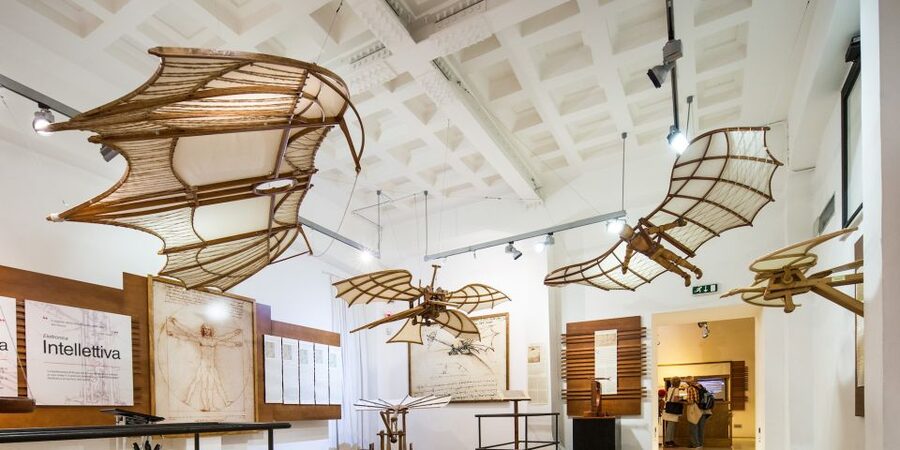
Leonardo da Vinci’s sketches can seem like brilliant but distant ideas. Here, more than 65 full-scale machines turn those drawings into objects you can study, and in many cases touch or operate. You move through exhibits on water, air, fire, and earth, with aviation, military design, mechanics, and art all sharing the same small museum.
I like the hands-on approach, especially the chance to build a version of Leonardo’s bridge and test parts of his machines. I also like the quiet underground setting, which gives you a cool break near Campo de’ Fiori and Piazza Navona. The main drawback is size: most people finish in 45 to 60 minutes, though careful readers and families can spend much longer.
In This Review
- Key points
- What the Leonardo exhibition does well
- Entering Palazzo della Cancelleria near Campo de’ Fiori
- Four sections built around water, air, fire, and earth
- Full-scale machines you can actually test
- Nine holograms and seven interactive drawing stations
- The 43 BC tomb beneath the palace
- How long to allow, and how to use your time
- Is the audio guide worth paying extra for?
- Who will enjoy this most?
- Practical value at $10 per person
- Should you book the Leonardo da Vinci exhibition?
- FAQ
- Where is the Leonardo da Vinci exhibition in Rome?
- How much does admission cost?
- How long is the ticket valid?
- How long does the visit take?
- Is a guide included?
- Is an audio guide available?
- Can I touch the inventions?
- Is the exhibition suitable for children?
- Is the exhibition wheelchair accessible?
- What else can I see at the venue?
Key points
- 65-plus working models: See full-scale reproductions of flying machines, instruments, military devices, bridges, and mechanical systems.
- Four themed sections: Leonardo’s studies of water, air, fire, and earth help link his art and engineering.
- Hands-on displays: Touch and test many models, then build your own version of one of his bridge designs.
- Nine 3D holograms: Watch Leonardo’s paintings and inventions presented through multimedia effects.
- Ancient Roman remains: See the tomb of Auro Irzio, dating from 43 BC, beside a natural underground pond.
- Useful add-on: An audio guide costs extra, but it provides more context than the room labels alone.
What the Leonardo exhibition does well
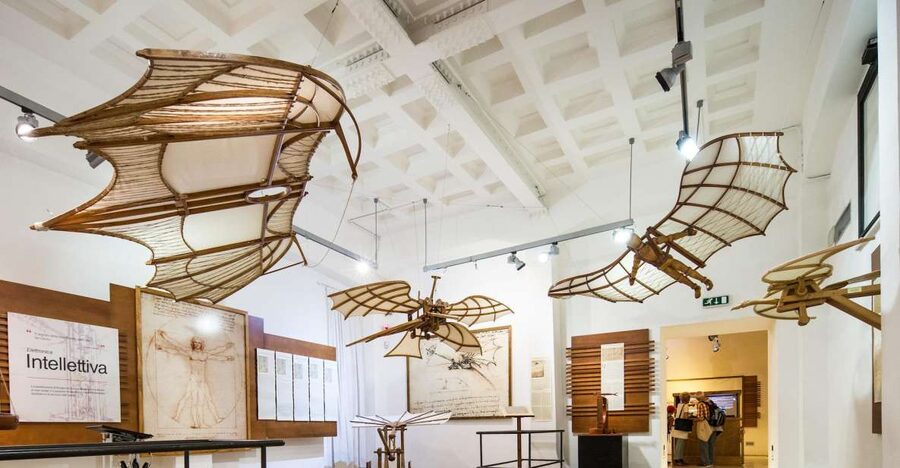
The clever idea here is simple: show Leonardo’s thinking through objects, not just framed reproductions. You see a drawing, then a full-scale model based on it. That change from paper to wood, rope, gears, and metal makes his ideas easier to grasp.
This is not a traditional art museum. The exhibition gives more attention to Leonardo as an engineer, inventor, scientist, theorist, architect, and designer than to his finished paintings. A copy of The Last Supper appears, along with material on his artistic work, but the machines are the main event.
I find that focus useful because Leonardo is often reduced to the Mona Lisa and a handful of famous images. In Rome, you get a broader picture of a man who studied flight, water movement, military technology, musical instruments, construction, and mechanical force.
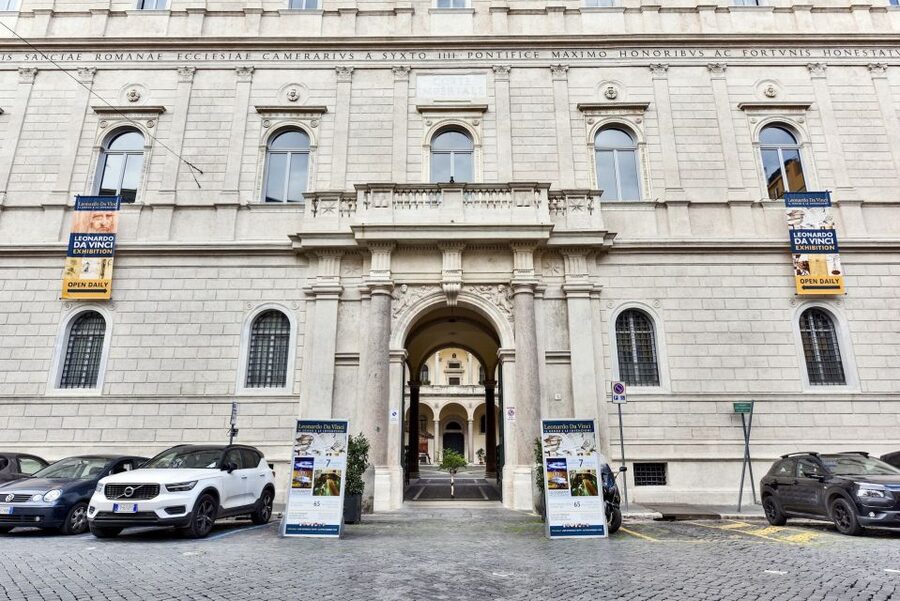
The museum is located in Palazzo della Cancelleria, a historic building owned by the Vatican. The palace itself adds an extra layer to the visit. The upper floor houses the Sacra Rota, where the Church handles marriage dissolutions, while the exhibition occupies an underground area with a very different mood.
More Museum Tours in Rome
- Vatican: Museums & Sistine Chapel Entrance Ticket
★ 4.5 · 144,003 reviews - Vatican Museums & Sistine Chapel Tour with Optional Basilica
★ 4.3 · 67,413 reviews - Vatican Museums, Sistine Chapel & St Peter’s Basilica Guided Tour
★ 4.5 · 39,149 reviews
Entering Palazzo della Cancelleria near Campo de’ Fiori
The entrance is at Piazza della Cancelleria 1, a convenient address if you are already walking between Campo de’ Fiori and Piazza Navona. This is a good place to fit into a day of central Rome sightseeing because the visit does not require a separate trip across the city.
Your ticket allows skip-the-line entry, and the exhibition is valid for one day. Entrance is available until one hour before closing, so do not leave it until the final minutes of the day.
At the desk, you receive a gadget for the exhibition. The staff has a reputation for being friendly and helpful, which matters in a small attraction where a quick explanation can help you understand how the displays work.
The underground location is practical in warm weather. It offers a cooler, quieter pause from Rome’s streets, although the benefit depends on how long you stay. If you only look at the main models, you may be back outside within an hour.
The building is also worth noticing before you focus on Leonardo. The exhibition gives you an unusual chance to pair Renaissance ideas with an older Roman archaeological feature below the palace.
Four sections built around water, air, fire, and earth
The exhibition is organized into four sections linked to Leonardo’s studies of water, air, fire, and earth. This structure helps you see connections between subjects that might otherwise feel scattered.
Water displays explain how Leonardo studied flow, pressure, channels, and movement. The models are especially helpful here because a drawing of a mechanism can be hard to read until you see how its parts are meant to move.
Air leads naturally to flight. You will find models of flying machines and studies connected with aviation. These designs are interesting not because Leonardo successfully built a modern aircraft, but because they show how he watched birds and tried to translate natural movement into mechanical form.
Fire connects to force, weapons, and military engineering. The exhibition includes a model of his tank along with other devices tied to warfare and mechanical power. It is a good reminder that Leonardo’s inventive work was not limited to peaceful machines or elegant scientific sketches.
Earth brings in construction, architecture, instruments, and practical design. Leonardo’s bridge is one of the most engaging examples because you can build your own version. This gives children and adults a direct way to see how a simple structure can gain strength through its shape and balance.
The four-part layout is thoughtful, but the path is not always obvious. Room numbers and audio-guide order may not match perfectly, and some people find themselves briefly unsure where to go next. I recommend checking the sequence before starting and using the printed or displayed information as a guide rather than assuming every number follows a simple line.
Full-scale machines you can actually test
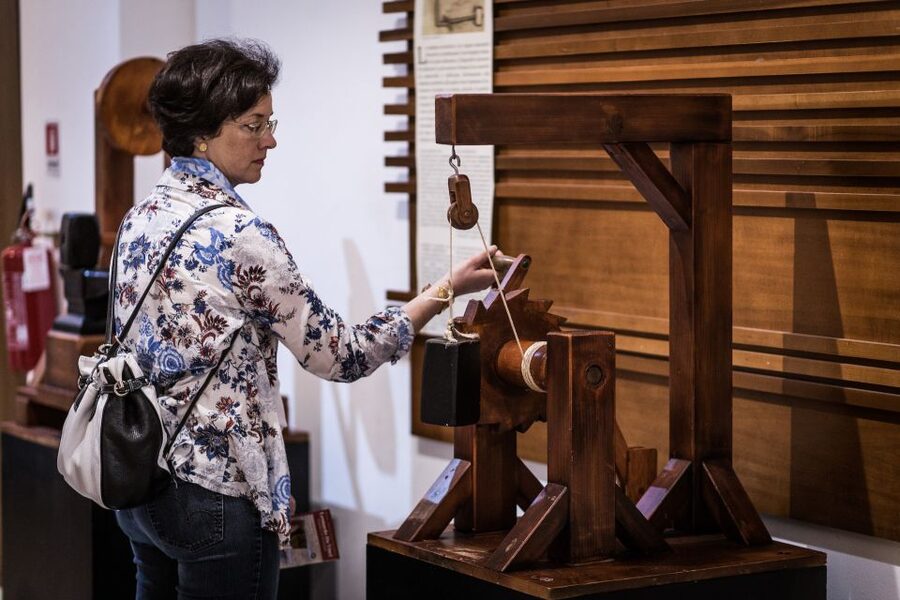
The strongest feature is the number of large models. You see Leonardo’s ideas at a scale that makes them readable, and many displays invite you to touch, turn, pull, or otherwise test them.
That hands-on design changes the mood. You are not simply standing behind a barrier while reading about an invention. You can examine how a mechanism transfers motion, how a bridge holds together, or how an instrument might have worked.
The machines cover several areas:
- Flying machines and aviation studies
- Military devices, including a tank
- Mechanical and engineering instruments
- Bridges and construction ideas
- Water systems and hydraulic studies
- Musical instruments
- Scientific devices and measuring tools
Some models may show wear, and a few are not in perfect condition. That is worth keeping in mind if you expect a polished, high-tech museum. The value comes from being able to understand the design and interact with it, not from every model looking new.
Parents should pay attention to the layout. One family found several trip hazards and unclear touch or do-not-touch signals, particularly for small children. Older children who can follow instructions will likely get more from the displays than toddlers who want to grab everything.
More Rome museums and collections:
- Rome: Vatican Museums, Sistine Chapel & Basilica Tour
★ 4.3 · 13,872 reviews - Vatican Museums & Sistine Chapel Skip-the-Line Entry Ticket
★ 4.4 · 13,838 reviews - Rome: Vatican Museums, Sistine Chapel & Basilica Tour
★ 4.7 · 13,217 reviews - Rome: Vatican Museums & Sistine Chapel Guided Tour
★ 4.3 · 12,117 reviews
Nine holograms and seven interactive drawing stations
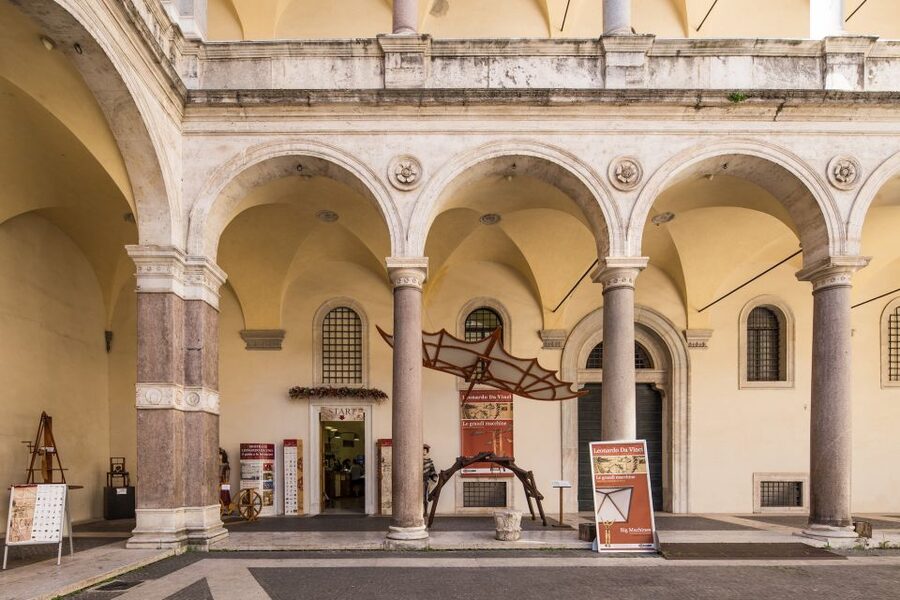
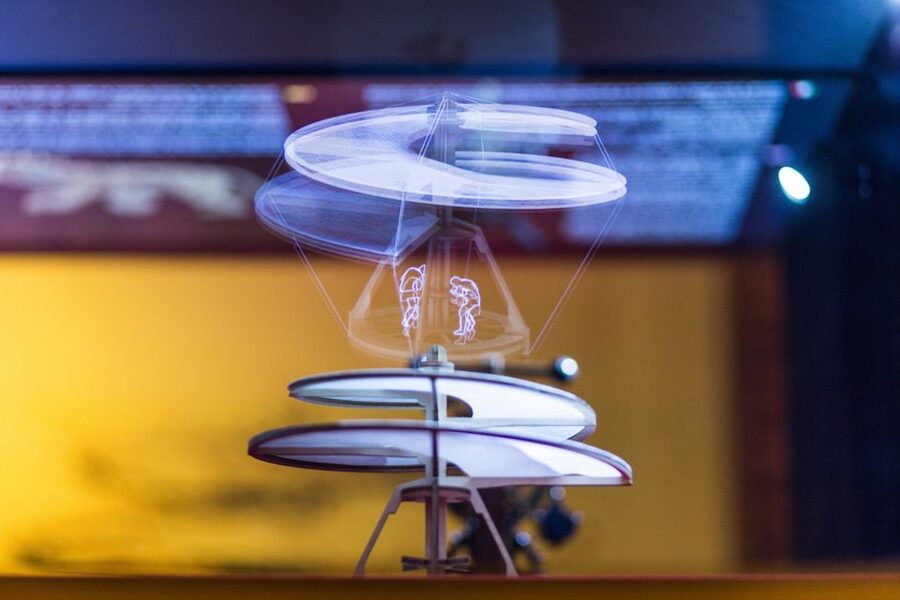
The exhibition adds multimedia elements without letting them replace the physical models. Nine holograms present Leonardo’s paintings and inventions in three dimensions, giving you a quick visual explanation of ideas that could otherwise feel abstract.
The holograms are most useful as a change of pace. After examining wooden machines and printed drawings, you can watch an invention or artwork appear through a more theatrical presentation. Some people will enjoy the effect more than others, but it helps younger visitors stay engaged.
Seven interactive installations focus on Leonardo’s drawings. These stations let you explore his marks and ideas in a more active way than a standard display case permits.
I especially like this pairing of sketch and model. Leonardo’s drawings were not always simple illustrations. They often record a process of testing, measuring, and revising. The interactive displays help you see that he was working through problems, not merely producing attractive images.
The exhibition also includes short videos and explanatory material. English explanations are available throughout the displays, and the optional audio guide adds further detail. Several audio-guide users found it worthwhile, especially when they wanted more background on how Leonardo’s ideas relate to modern transportation and architecture.
One practical warning: the audio sequence may not follow the physical route in perfect order. Use the exhibit numbers as a loose reference, and do not worry if you need to move back or forward to match a recording.
The 43 BC tomb beneath the palace
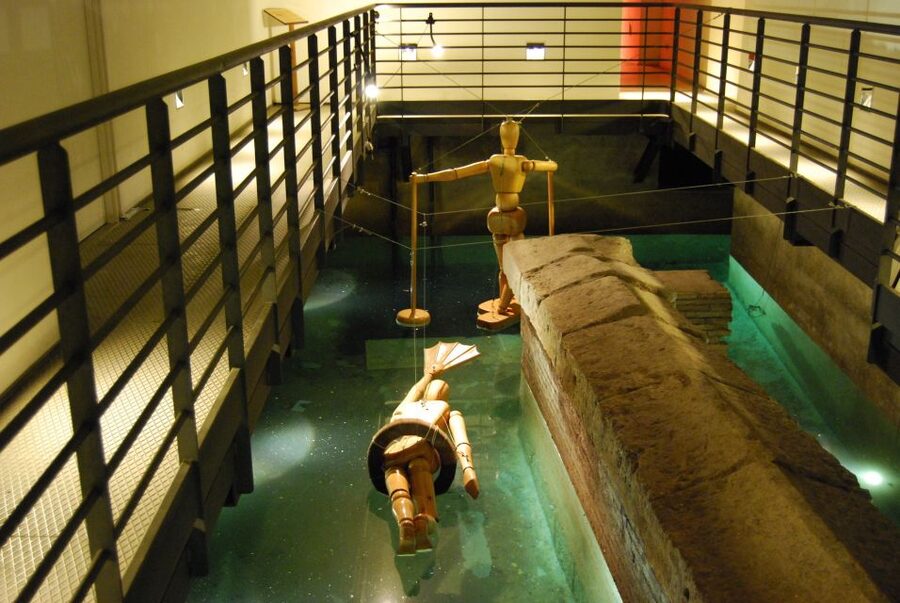
The Roman tomb is an unexpected part of the visit. The tomb of the architect Auro Irzio dates to 43 BC and sits beside an underground natural pond.
This is not the main reason to buy the ticket, but it gives the exhibition a stronger sense of place. You are not entering a generic room filled with reproductions. You are below a Vatican-owned Renaissance palace, looking at an ancient Roman remains while studying a Renaissance thinker.
The underground pond and tomb also add variety to a visit that could otherwise become a steady run of machines and labels. Give yourself a moment to look at this area instead of rushing straight to the next invention.
Because the exhibition is compact, the ancient feature does not require a major time commitment. It is one of the details that makes the stop feel more distinctive than a basic science display.
How long to allow, and how to use your time
Plan on 45 to 60 minutes for a focused visit. That is enough to see the principal inventions, watch some of the multimedia displays, and read selected explanations.
You can spend close to two hours if you do the audio guide, test most of the machines, watch the videos, and stop to discuss the designs. Families often take longer because children want to repeat the hands-on parts while adults read the explanations.
At about $10 per person, the price is strong for a short central Rome activity. It is not a full-day museum, so do not compare it with a large national collection. Instead, judge it as a compact, educational stop that fits between major sights.
The value improves if you are interested in engineering, science, architecture, or interactive museums. It also works well as a hot-weather break. If you only want to see original Leonardo paintings, this is not the right choice, since the focus is on reproductions, models, holograms, and explanations.
The quiet setting can be another advantage. The exhibition is often less crowded than Rome’s major headline attractions, particularly later in the afternoon, though crowd levels can change.
Is the audio guide worth paying extra for?
The basic ticket gives you entry and a gadget, but a guide is not included. You can request an audio guide for an additional cost.
I would add it if Leonardo is a major reason for your visit. The labels provide a useful foundation, but the audio guide explains the machines in greater detail and links some of the designs to modern transportation, construction, and engineering.
It is also helpful if you are visiting with older children or teenagers. The models catch their attention, while the audio explains why the mechanism matters.
If you are short on time or mainly want a quick look at the machines, skip the extra charge. You can still understand the broad purpose of the exhibition from the written information. Just remember that the audio order may not match the room order exactly.
Who will enjoy this most?
This is a good fit for families with school-age children, couples seeking a quieter Rome activity, and anyone curious about how inventions work.
You do not need specialist knowledge. The exhibition is accessible at a basic level, but people with a strong interest in Leonardo’s engineering will have more reasons to linger at each model.
I would particularly suggest it for:
- Children who learn best by handling objects
- Adults interested in engineering or design
- Art lovers who want to see Leonardo beyond his famous paintings
- Visitors needing a cool indoor break near central Rome
- People looking for a short activity between Campo de’ Fiori and Piazza Navona
Very young children may find the trip hazards and touch rules difficult. The exhibition is also too small for anyone expecting several hours of major original artworks.
The museum is wheelchair accessible, which makes it a practical option for many visitors. The supplied information does not provide a detailed route description, so contact the venue directly if you need specific access details beyond general accessibility.
Practical value at $10 per person
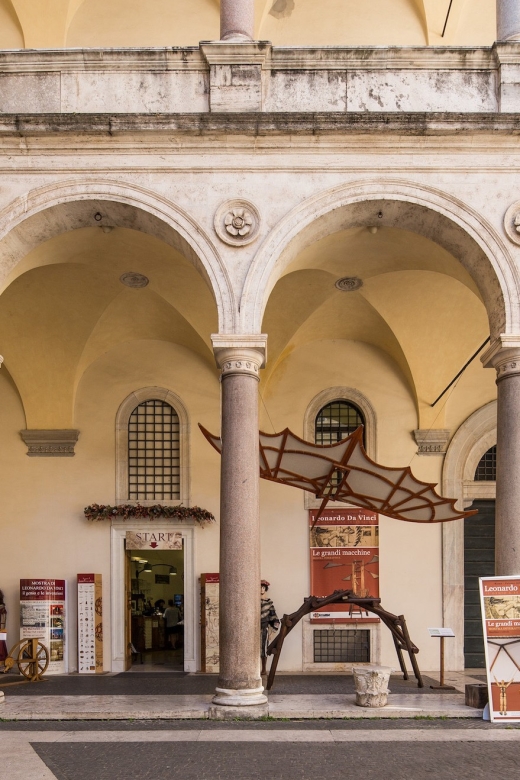
At this price, I see the exhibition as an easy yes for the right audience. You get a central location, skip-the-line entry, a large number of full-scale models, interactive stations, holograms, and access to an unusual underground Roman feature.
The ticket is less compelling if you are already tired of museums or if Leonardo’s machines do not interest you. The visit is compact, and some models show signs of use. This is a working-style educational display, not a grand gallery of original masterpieces.
The free cancellation window of 24 hours and reserve-now-pay-later option make it easier to fit into a changing Rome schedule. You can also enter any time during the valid day, subject to availability and the final admission cutoff.
Do not confuse the exhibition with a guided tour. No guide is included. You explore at your own pace, with written information and the option to pay extra for an audio guide.
Should you book the Leonardo da Vinci exhibition?
Book it if you want to see Leonardo’s inventions brought off the page and into full-size physical form. The bridge-building activity, touchable machines, holograms, and clear English explanations give you more to do than simply look at display cases.
I would place it high on your list with children, engineering fans, and visitors who want a short indoor stop in central Rome. Add the audio guide if you want a fuller explanation of Leonardo’s methods and influence.
Skip it if your priority is original Renaissance art or a large museum with hours of galleries. For everyone else, $10 buys a focused and unusual hour, with enough interactive material to stretch the visit longer if you choose.
FAQ
Where is the Leonardo da Vinci exhibition in Rome?
The exhibition is at Mostra di Leonardo da Vinci, Piazza della Cancelleria 1, near Campo de’ Fiori and Piazza Navona.
How much does admission cost?
The listed price is $10 per person.
How long is the ticket valid?
The ticket is valid for one day, subject to available starting times.
How long does the visit take?
A focused visit takes about 45 to 60 minutes. You can spend up to two hours if you use the audio guide, read the displays closely, watch the videos, and test the interactive models.
Is a guide included?
No guide is included with the entrance ticket. An audio guide or additional guide is available upon request for an extra cost.
Is an audio guide available?
Yes. An audio guide is available for an additional cost and provides more detailed explanations. English information is also provided on the exhibits.
Can I touch the inventions?
You can touch and play with almost all of the machines on display, although you should follow the instructions for each exhibit.
Is the exhibition suitable for children?
Yes, particularly for school-age children who enjoy hands-on activities. Parents should watch small children because the exhibition includes trip hazards and some touch instructions may not be clear.
Is the exhibition wheelchair accessible?
Yes, the activity is listed as wheelchair accessible.
What else can I see at the venue?
Along with the Leonardo exhibition, you can see the tomb of the architect Auro Irzio, dating from 43 BC, beside an underground natural pond. The Palazzo della Cancelleria is owned by the Vatican and is also notable for its architecture.
Recently reviewed around Rome
- Ancient Rome at Twilight Walking Tour★ 5.0 · 276 reviews
- Domus Aurea Guided Tour: The Golden House of Nero★ 4.5 · 199 reviews
- Early Vatican Museums & Sistine Chapel Small Group Tour★ 4.5 · 314 reviews
- Early Vatican Museums Tour: The Best of the Sistine Chapel★ 4.5 · 900 reviews
- Jewish Ghetto & Piazza Navona: Food, Wine & Sightseeing Rome Tour★ 5.0 · 460 reviews
- 3 Days in Sorrento, Capri & Pompeii: la Dolce Vita★ 4.0 · 595 reviews
- Tivoli Villas Full Day Trip From Rome with Lunch★ 4.0 · 443 reviews
- Cook With Us in Rome: A Hands-On Cooking Experience 09:20AM class★ 5.0 · 234 reviews
Museums, compared.
Vatican: Museums & Sistine Chapel Entrance Ticket
Read our review →
Vatican Museums & Sistine Chapel Tour with Optional Basilica
Read our review →
Vatican Museums, Sistine Chapel & St Peter’s Basilica Guided Tour
Read our review →
Skip-The-Line Uffizi Gallery Timed Entry Ticket
Read our review →
Vatican Museums, Sistine Chapel & Basilica Tour
Read our review →
Vatican Museums & Sistine Chapel Skip-the-Line Entry Ticket
Read our review →Vatican Museums, Sistine Chapel & Basilica Tour
Read our review →
Vatican Museums & Sistine Chapel Guided Tour
Read our review →Browse the lists this tour appears in