Review · ROME TOURS
Rome: Welcome To Rome Immersive Multimedia Show
Rome’s ruins can be hard to understand when you see them one piece at a time. Welcome To Rome tackles that problem with a 27-minute projection show that makes the city appear to change beneath your feet, from its earliest days through the imperial age and into modern Rome. Walls and ceilings become part of the presentation, while a large model lights up below you.
I like this experience for two clear reasons: it gives you a timeline before you start sightseeing, and it shows how ancient buildings fit into today’s city. The four interactive models add useful detail, especially for the Imperial Forum, Augustus Forum, Mausoleum of Adrian, and Saint Peter’s Basilica. The main consideration is value. At $21 per person, it is not cheap for roughly an hour indoors, and some visitors may find the presentation brief rather than a full museum visit.
In This Review
- Key points to know before you go
- Why a short visual history lesson helps in Rome
- Inside the ex-Cinema Augustus on Corso Vittorio Emanuele II
- The main projection: Rome in 27 minutes
- Four interactive models worth your time
- The best time to fit it into your Rome plans
- Is the $21 price fair?
- Who will get the most from this experience?
- Small tips that improve the visit
- Should you book Welcome To Rome?
- FAQ
- Where is Welcome To Rome located?
- How long does the main show last?
- Can I start the visit at a fixed time?
- Which landmarks are shown in the interactive models?
- Is an audio guide included?
- Is the experience wheelchair accessible?
- Can I cancel my booking?
Key points to know before you go
- A 27-minute film covers 2,700 years: You get a fast visual guide to Rome’s major eras rather than a long lecture.
- The city model lights up below you: Watch Rome expand and change across the centuries in a way a street map cannot show.
- Four interactive models add context: Examine the Imperial Forum, Augustus Forum, Mausoleum of Adrian, and Saint Peter’s Basilica.
- Start at any point during opening hours: The presentation runs continuously, so you are not tied to one fixed start time.
- A smart first-day activity: It can make the Colosseum, Forum, churches, and palaces easier to understand later.
- Nine audio-guide languages are available: Choose Italian, English, Spanish, French, German, Russian, Chinese, Croatian, or Japanese.
Why a short visual history lesson helps in Rome
Rome is not a city that presents its story in neat chapters. A ruined temple may sit beside a Renaissance church, with a modern road running over the top of both. You can walk past the remains of imperial buildings without knowing what once filled the empty spaces around them.
This show gives you that missing frame of reference. The central idea is simple: Rome is a city built in layers. The presentation moves through the ages that shaped it, showing how the city grew, changed, declined, and developed into the Rome you see today.
I especially like the aerial feeling of the main film. You seem to fly above the city, then move through monuments, palaces, churches, and squares. That visual movement matters because Rome is too large and too complex to grasp from one viewpoint. A photograph of the Forum shows fragments. A reconstruction can suggest the buildings, streets, and public spaces that once connected those fragments.
The tone is designed as edutainment, so you are learning without sitting through a formal classroom talk. The information is arranged in chronological order, which makes it easier to follow if Rome’s political and architectural story is new to you.
More Rome trips worth a second look
- Rome: Gladiator Show and Museum Tickets
★ 4.5 · 237 reviews - Glass Blowing Show Visit Murano Glass Factory & Showroom OMG
★ 4.2 · 679 reviews
Inside the ex-Cinema Augustus on Corso Vittorio Emanuele II
The experience takes place inside the former Cinema Augustus at Corso Vittorio Emanuele II, 203. The entrance is a few hundred meters from Piazza Navona, making it a convenient stop while walking through central Rome.
The setting is useful in practical ways. Rome can be hot, crowded, and tiring, so an indoor presentation gives you a chance to sit down and reset while still doing something connected to the city. It also works well when rain or strong afternoon heat makes outdoor sightseeing less pleasant.
The visit is not a guided walking tour, and there is no named live guide listed for the experience. Instead, you use an audio guide available in nine languages: Italian, English, Spanish, French, German, Russian, Chinese, Croatian, and Japanese.
Because the show runs continuously, you can begin at any point during opening hours. This is a real advantage for a busy Rome schedule. You do not have to cross the city at a precise time, and you can fit the visit between other sights near Piazza Navona.
The last show starts one hour before closing. That detail is easy to overlook, so do not arrive near closing and assume you can begin immediately.
The main projection: Rome in 27 minutes
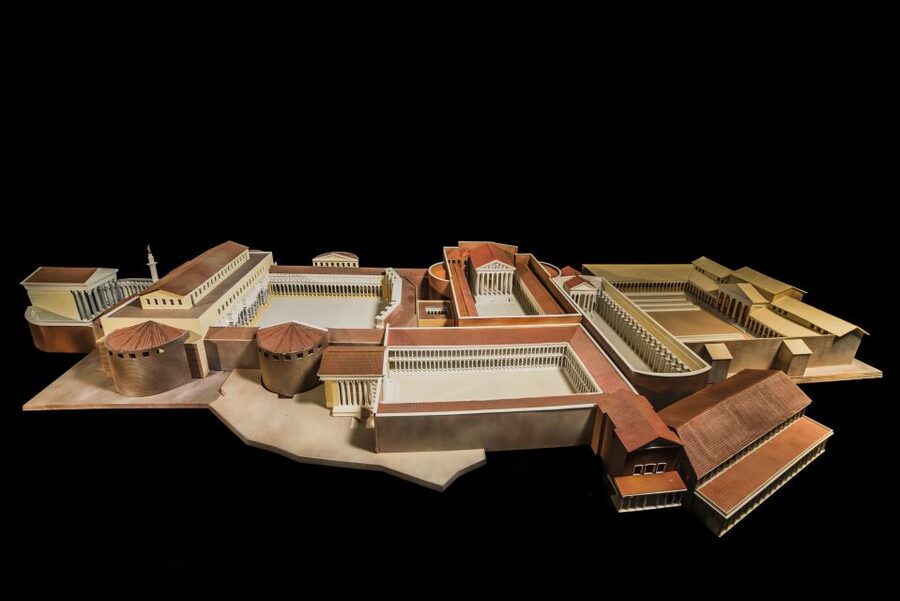
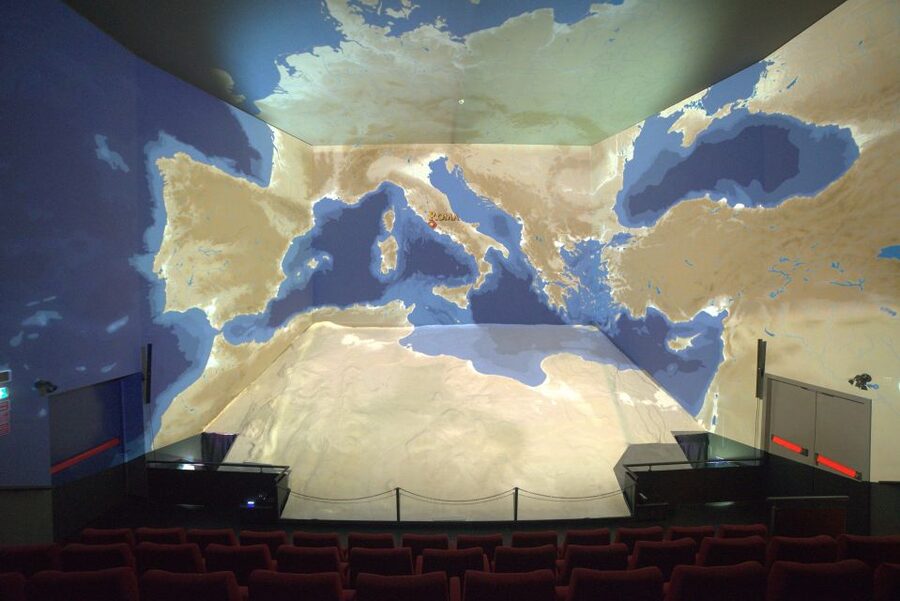
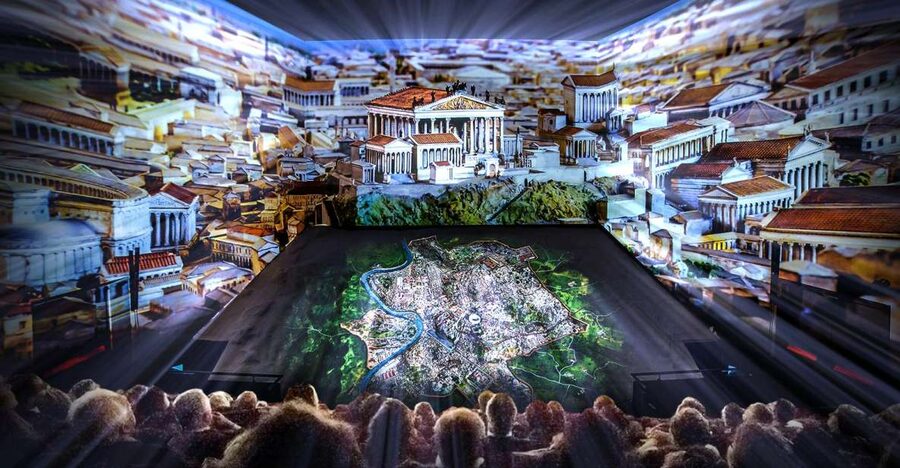
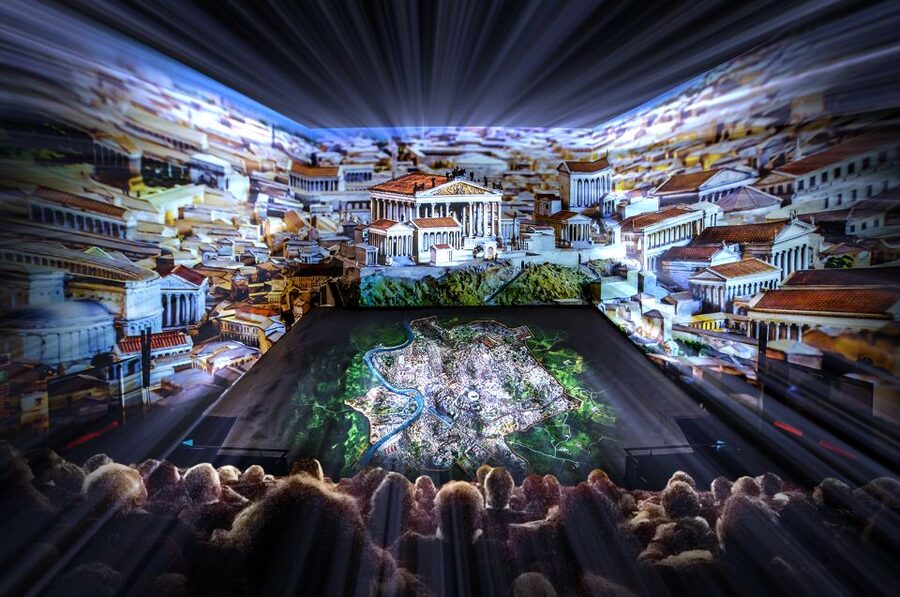
The heart of the experience is a 27-minute multimedia presentation. It uses large-scale projections, sound, narration, and a model of Rome that lights up as the story advances.
The film moves across Rome’s 2,700 years of development. Rather than asking you to memorize dates, it gives you a visual sense of change. Buildings appear, streets shift, districts grow, and the city’s old and new layers begin to make more sense.
The projection covers walls and ceilings, creating the feeling that the room itself is moving. This is not the same as seeing an ancient monument in person, of course. You will not feel the scale of the Colosseum or the texture of Roman stone. What you gain instead is a clear picture of how the city looked and functioned across different periods.
The large model on the floor is one of the most useful parts. As sections light up, you can follow Rome’s expansion and see where major areas fit together. This is particularly helpful before visiting the Roman Forum, where scattered columns and foundations can be difficult to place in their original setting.
The show also helps explain why modern Rome can feel confusing. Ancient ruins, churches, palaces, and contemporary streets occupy the same ground. The projection makes that overlap visible, turning a collection of disconnected sights into one long urban story.
The pace is quick. That is both a strength and a limitation. You get a clear overview in less than half an hour, but the presentation cannot give every emperor, building, political shift, or artistic movement much time. Think of it as a map and orientation session, not a substitute for a full history book or specialist tour.
Four interactive models worth your time
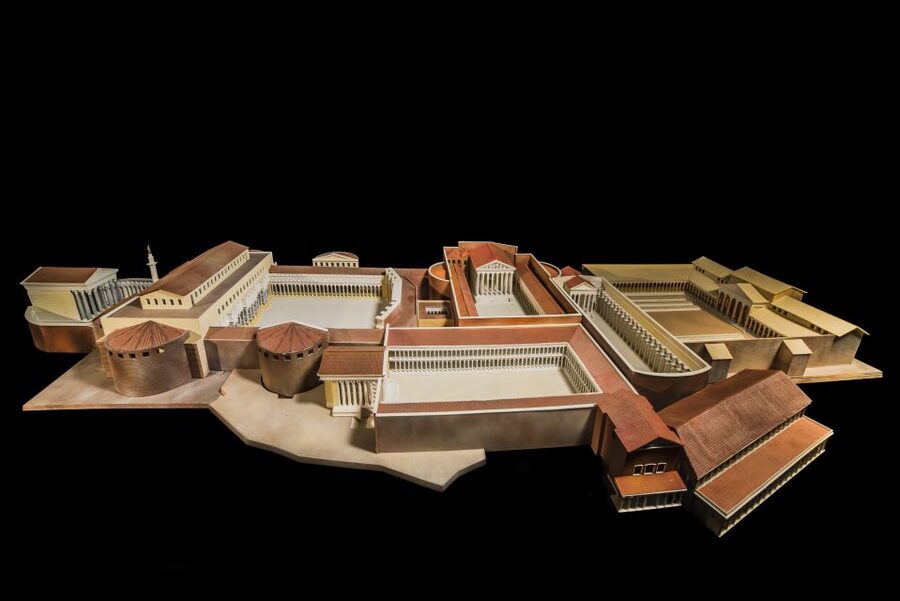
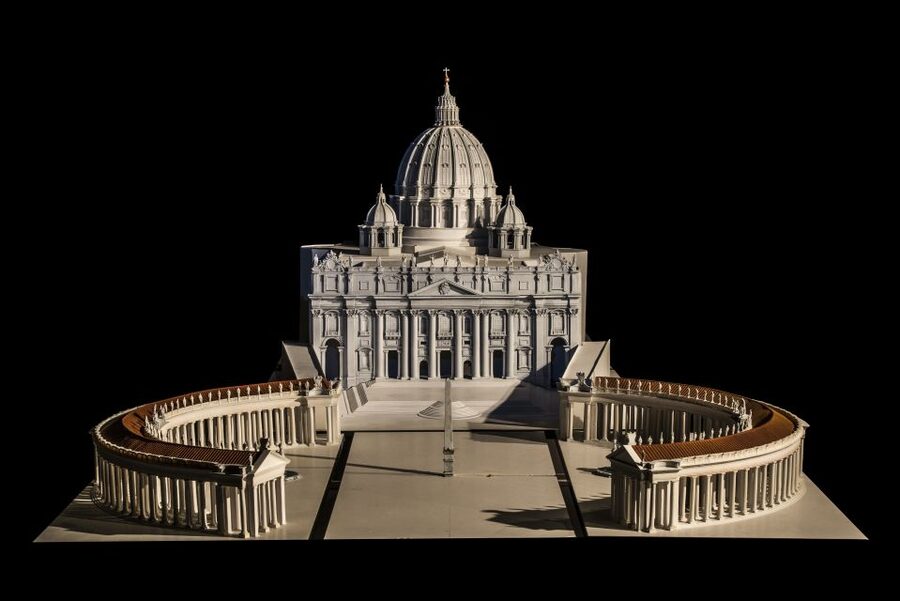
After the main presentation, you can explore four large interactive models. These focus on the Imperial Forum, Augustus Forum, Mausoleum of Adrian, and Saint Peter’s Basilica.
The Imperial Forum model helps you picture the central area of ancient Rome as a working civic and political district. When you later see the surviving arches, columns, and foundations, you have a better idea of how the area once connected.
The Augustus Forum model focuses on one of Rome’s most important imperial building projects. A model can show the relationship between structures and open space much more clearly than surviving ruins alone. It is a useful stop for anyone planning to visit the Forum area.
The Mausoleum of Adrian model gives you a sense of the monument’s original form and purpose. As with many Roman sites, what you see today is only one stage in the building’s long story. The model helps separate the original structure from later changes.
The Saint Peter’s Basilica model shifts the focus to one of Rome’s great Christian landmarks. It provides a visual link between the ancient city and the later religious and architectural center that grew within it.
These displays are best treated as short, focused explanations. You can study the models at your own pace, but the exact length of this part depends on how closely you choose to examine them. The full visit is often around an hour, though the central projection itself lasts 27 minutes.
One practical point is worth noting: the exhibits may require standing. Seating is available for the main film, but not necessarily in every area. If someone in your party cannot stand for long periods, plan on taking the visit at an easy pace and asking staff for help.
A different way to spend the day, same part of Italy:
- Vatican: Museums & Sistine Chapel Entrance Ticket
★ 4.5 · 144,003 reviews - Vatican Museums & Sistine Chapel Tour with Optional Basilica
★ 4.3 · 67,413 reviews - Colosseum, Roman Forum & Palatine Guided Tour
★ 4.7 · 63,148 reviews - Vatican Museums, Sistine Chapel & St Peter’s Basilica Guided Tour
★ 4.5 · 39,149 reviews
The best time to fit it into your Rome plans
I would place Welcome To Rome near the beginning of a first visit. Several parts of the city become easier to read once you have seen the presentation.
For example, the Colosseum is impressive on its own, but the wider Roman setting is harder to picture. The Forum can feel like a field of partial remains. Churches and palaces may seem unrelated to the ancient city unless you understand the layers beneath them.
This experience gives you a working timeline before those visits. You do not need to remember every detail. It is enough to recognize the broad sequence and understand that Rome was repeatedly rebuilt, adapted, and given new meaning.
It also works after sightseeing. If you have already visited the main monuments, the film can connect the pieces you have seen. A ruin on one day, a church on the next, and a palace later in the week may suddenly feel like parts of one story.
For a short stay, the value is even clearer. You can spend one indoor hour getting a broad introduction, then use the rest of your time with a better sense of what deserves your attention. I would not replace a major Roman site with this show, but I would consider it a useful companion to those sites.
Is the $21 price fair?
At $21 per person, this is a mid-priced short attraction rather than a bargain stop. You are paying for a polished audiovisual production, an indoor venue, multilingual narration, the projection film, and the interactive models.
The value depends on how you use it. If you are new to Rome and plan to visit several historical sites, the show can improve the rest of your sightseeing. It provides the background that many major monuments assume you already have.
Families may also find the price reasonable if the children respond well to animation, moving images, and models. The format is more approachable than a long spoken tour, and children around school age can follow the basic story. Very young children may not stay interested for the full presentation, so do not book it solely as child entertainment.
The price may feel high if you only want a quick attraction or already know Rome’s history well. One critical point is that nothing here replaces the real monuments. The projection can reconstruct ancient spaces, but it cannot reproduce the physical scale, weathered surfaces, or atmosphere of the Forum and Colosseum.
I see the strongest value in the show’s ability to make those real places easier to understand. If you treat it as preparation for Rome rather than as the main event, $21 can be justified. If you expect a large museum with hours of exhibits, you may find the visit too compact.
Who will get the most from this experience?
I would recommend it most strongly to first-time visitors, families with older children, and anyone who feels overwhelmed by Rome’s enormous amount of history.
It is also useful for people with limited time. The main film gives you a broad introduction without taking half a day, and the flexible start means you can fit it around other plans.
History fans will appreciate the clear chronology and the reconstructions. You may not learn every detail, but you will see how the city developed across its different ages.
The show is less essential for repeat visitors who already know Rome’s main monuments and historical sequence. Even then, the visual format can offer a new way to connect familiar places.
It is a good choice when you need an indoor break, especially during hot weather. You can sit for the central presentation and then move through the models at your own pace.
The accessible projection and interactive exhibits are suitable for people with disabilities, and the venue is wheelchair accessible. The multilingual audio guide also makes the experience practical for international visitors.
Small tips that improve the visit
Plan to do this early in your stay if you are visiting Rome for the first time. You will recognize the places from the film as you walk through the city, and the ancient remains should feel less abstract.
If your schedule is crowded, combine it with sights around Piazza Navona. The location on Corso Vittorio Emanuele II makes it easy to add to a central Rome walking day.
Allow more than the 27-minute film if you want to examine all four models. The total visit is often about an hour, but the continuous schedule lets you keep it shorter if needed.
Arrive with realistic expectations. This is a visual introduction, not an archaeological museum, a live lecture, or a replacement for walking through Rome itself.
The indoor setting is another reason to keep it in mind as a flexible stop. It can provide a pause from heat while still helping you understand the city.
Should you book Welcome To Rome?
Book it if you want a fast, visual explanation of Rome before tackling the major ruins and churches. The strongest feature is the way the projection and glowing city model show the city changing across 2,700 years. That broad view can make your later sightseeing more meaningful.
I would be more cautious if you already know Rome well or expect several hours of exhibits for the $21 price. The production is compact, and the main film moves quickly.
For most first-time visitors, especially families and people on a short trip, I think it is a smart orientation stop. Schedule it near the start of your visit, then use Rome itself as the full-scale follow-up.
FAQ
Where is Welcome To Rome located?
The entrance is at Corso Vittorio Emanuele II, 203, in Rome, a few hundred meters from Piazza Navona.
How long does the main show last?
The main immersive projection lasts 27 minutes. Allow about an hour if you also want to explore the four interactive models.
Can I start the visit at a fixed time?
You can start at any point during opening hours because the show runs continuously. Check availability for the operating times, and remember that the last show starts one hour before closing.
Which landmarks are shown in the interactive models?
The four models cover the Imperial Forum, Augustus Forum, Mausoleum of Adrian, and Saint Peter’s Basilica.
Is an audio guide included?
Yes. Audio guides are available in Italian, English, Spanish, French, German, Russian, Chinese, Croatian, and Japanese.
Is the experience wheelchair accessible?
Yes. The projection and interactive exhibits are wheelchair accessible.
Can I cancel my booking?
You can cancel up to 24 hours in advance for a full refund. You can also reserve now and pay later, which keeps your plans flexible.
Recently reviewed around Rome
- Ancient Rome at Twilight Walking Tour★ 5.0 · 276 reviews
- Domus Aurea Guided Tour: The Golden House of Nero★ 4.5 · 199 reviews
- Early Vatican Museums & Sistine Chapel Small Group Tour★ 4.5 · 314 reviews
- Early Vatican Museums Tour: The Best of the Sistine Chapel★ 4.5 · 900 reviews
- Jewish Ghetto & Piazza Navona: Food, Wine & Sightseeing Rome Tour★ 5.0 · 460 reviews
- 3 Days in Sorrento, Capri & Pompeii: la Dolce Vita★ 4.0 · 595 reviews
- Tivoli Villas Full Day Trip From Rome with Lunch★ 4.0 · 443 reviews
- Cook With Us in Rome: A Hands-On Cooking Experience 09:20AM class★ 5.0 · 234 reviews
Rome Tours, compared.
Vatican: Museums & Sistine Chapel Entrance Ticket
Read our review →
Vatican Museums & Sistine Chapel Tour with Optional Basilica
Read our review →
Colosseum, Roman Forum & Palatine Guided Tour
Read our review →
Vatican Museums, Sistine Chapel & St Peter’s Basilica Guided Tour
Read our review →
Colosseum, Palatine Hill and Roman Forum Guided Tour
Read our review →
Guided Tour of Colosseum, Roman Forum & Palatine Hill
Read our review →
Colosseum & Forum with Audio Guide App -Optional Arena
Read our review →