Review · ROME TOURS
Taste of Testaccio: Special 15 Year Anniversary Edition
Rome’s Testaccio neighborhood gives you something central Rome often cannot: a real sense of local daily life alongside excellent food. On this three-and-a-half-hour walk, you’ll eat cured meats, cheeses, bruschetta, supplì, trapizzino, three Roman pastas, and gelato, while passing an ancient pyramid and a hill made from broken olive-oil jars.
I especially like the hands-on stop at Testaccio Market, where you make bruschetta with market tomatoes, and the chance to compare carbonara, amatriciana, and cacio e pepe in one sitting. The small maximum of 12 makes it easier to chat with your guide, although the $131.81 price is a serious outlay if you are mainly looking for a light snack walk.
In This Review
- Key points at a glance
- Why Testaccio is the right neighborhood for a food walk
- Starting at Salumeria Volpetti
- The Pyramid of Cestius and Rome’s unusual side
- Making bruschetta at Testaccio Market
- Testaccio’s slaughterhouse and Monte Testaccio
- Flavio al Velavevodetto and Rome’s three essential pastas
- Learning the difference between real and fake gelato
- The guides make the difference
- Is $131.81 good value?
- Who should book this Testaccio food tour?
- Practical details before you go
- Should you book it?
- FAQ
- Where does the Taste of Testaccio tour begin?
- Where does the tour end?
- How long does the tour last?
- How much does the tour cost?
- What language is the tour offered in?
- How many people can join the tour?
- What food is included?
- Can dietary requirements be accommodated?
- Can children join the tour?
Key points at a glance
- Three Roman pastas in one meal: Try carbonara, amatriciana, and cacio e pepe at Flavio al Velavevodetto.
- Testaccio Market with a hands-on tasting: Build bruschetta from fresh market ingredients, then sample buffalo mozzarella, caprese salad, and fried street food.
- A food stop at the 150-cheese Volpetti shop: Begin with cured meats, cheeses, olive oil, balsamic vinegar, and Prosecco.
- Ancient sights between meals: See the Pyramid of Cestius, the Protestant Cemetery, the former slaughterhouse, and Monte Testaccio.
- A lesson in proper gelato: Finish at the historic Giolitti Caffe and Gelateria and learn how to spot the real thing.
- A generous small-group format: The tour runs in English, lasts about 3 hours 30 minutes, and accepts no more than 12 people.
Why Testaccio is the right neighborhood for a food walk
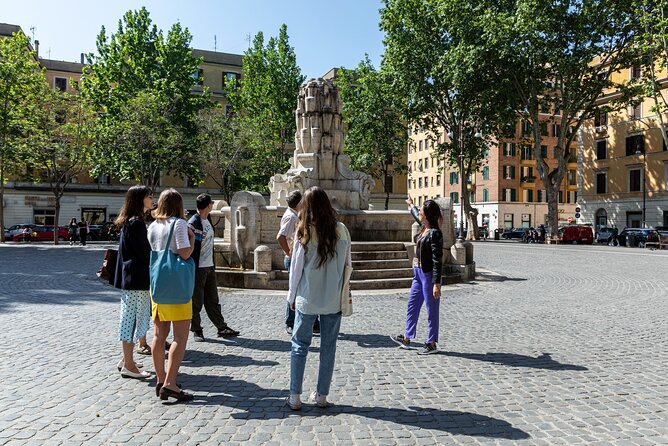
Testaccio sits away from Rome’s grandest sights, but food is central to its identity. The neighborhood grew around the old slaughterhouse and the river port, and its cooking developed a reputation for making good use of every part of an animal. Your guide introduces this quinto quarto tradition as you walk, giving the meal some useful context instead of treating each bite as an isolated sample.
That setting matters. You are not simply being driven from restaurant to restaurant. You walk through a working Roman district, pass local shops, and stop at places that are easy to miss if you stick to the Colosseum, Trevi Fountain, and Pantheon.
The walking is manageable, but you should arrive ready to eat. The food comes in frequent portions, and the experience functions more like a full meal spread across several locations than a quick tasting session. One person even described the portions as enough to skip a meal, which is useful advice: do not eat a heavy breakfast or lunch before arriving.
Other Rome days travellers weigh against this one:
- Vatican: Museums & Sistine Chapel Entrance Ticket
★ 4.5 · 144,003 reviews - Vatican Museums & Sistine Chapel Tour with Optional Basilica
★ 4.3 · 67,413 reviews - Colosseum, Roman Forum & Palatine Guided Tour
★ 4.7 · 63,148 reviews
Starting at Salumeria Volpetti
The tour begins at Piazza Testaccio and soon brings you to Salumeria Volpetti, a respected neighborhood food shop. This is a strong opening because it introduces the Italian habit of buying excellent ingredients before you get into the prepared dishes.
You receive a selection of fine cured meats and artisanal cheeses, along with olive oil and balsamic vinegar. The stop includes a celebratory glass of crisp Prosecco, so the anniversary theme gets an edible welcome rather than a speech.
Volpetti is also a good place to start thinking about quality. Italian food can look simple on the plate, but the ingredients do much of the work. A slice of cured meat, a piece of cheese, or bread with oil can tell you more about local food culture than a complicated dish designed for tourists.
This stop lasts about 40 minutes, making it one of the longer tastings. If you enjoy browsing food shops, you may want to return later with room in your suitcase. The tour focuses on eating and explanation, not on a long shopping period.
The Pyramid of Cestius and Rome’s unusual side
After the first tasting, the route heads toward the Pyramid of Cestius. This authentic Egyptian-style pyramid is about 2,000 years old and remains one of Rome’s strangest sights. It feels especially unexpected here, surrounded by the modern city rather than by an Egyptian archaeological site.
The stop lasts about 15 minutes, so think of it as a quick historical pause, not a visit inside the monument. Your guide uses the walk to share lesser-known Roman stories and point out the Protestant Cemetery, where the poet John Keats is buried.
This pairing works well. The pyramid gives you a striking visual landmark, while the cemetery adds a quieter human detail. Together, they show the range of Testaccio: ancient imperial ambition, later European cultural life, and ordinary neighborhood streets.
The route is outdoors, so weather affects this part of the experience. On a hot day, the walk can feel harder, especially because you are eating and moving for several hours. Bring water, wear comfortable shoes, and protect yourself from the sun. A rainy day does not ruin the food stops, but it can make the open-air portions less pleasant.
Making bruschetta at Testaccio Market
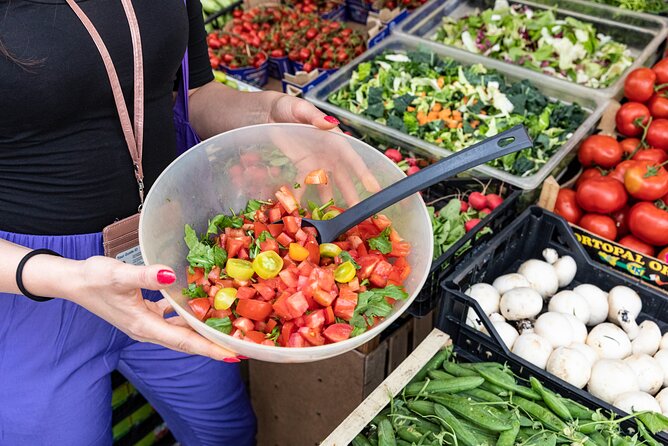
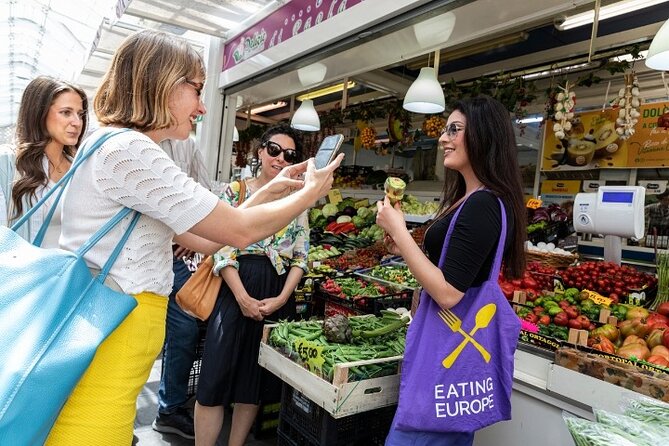
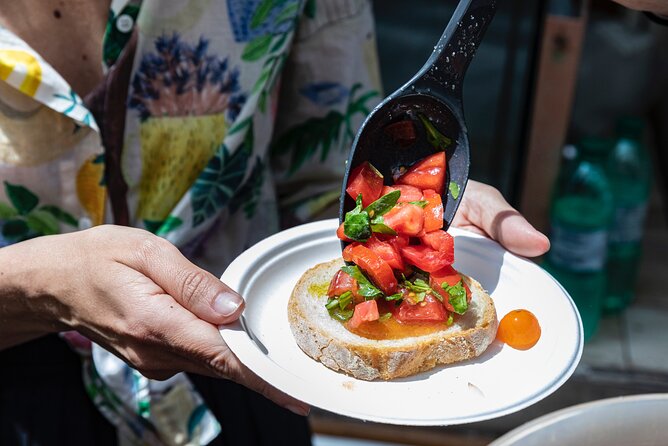
Testaccio Market is the heart of the tour for many people. Here, you get more than a quick sample from a counter. Your guide gathers fresh bread, tomatoes, garlic, cheese, and other ingredients from market vendors, then has the bruschetta put together for you.
The hands-on element makes the stop memorable. You see the produce, meet the people selling it, and taste the ingredients in a simple Roman preparation. The tomatoes are meant to be the star, and the dish shows why good Italian food often needs very little decoration.
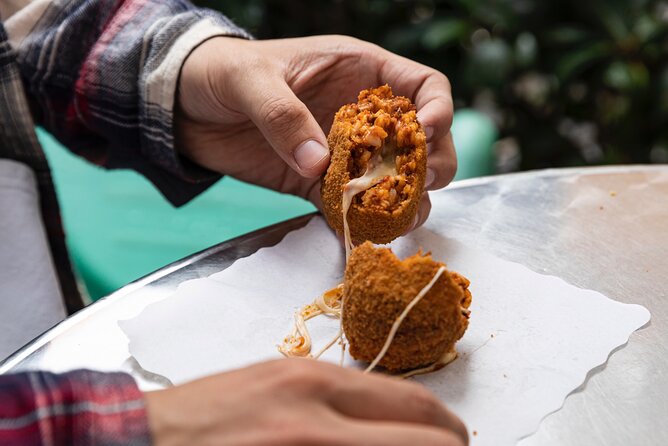
The market tasting can also include buffalo mozzarella, caprese salad, classic fried street food, and supplì. Supplì is Rome’s fried rice ball, usually associated with a crisp exterior and a soft, savory center. It fills the role that arancini play elsewhere in Italy, but it belongs to Roman street-food culture.
This is a 45-minute stop, and it gives you time to look around as well as eat. Still, do not expect a full market tour with every stall explained. The emphasis is on the food selected for the group and on the vendors connected with the tour.
The market is one of the strongest reasons to choose this experience over a generic central Rome food tour. It feels practical and local. You learn where ingredients come from, how they are used, and why Testaccio’s market matters to the neighborhood.
A different way to spend the day, same part of Italy:
- Vatican Museums, Sistine Chapel & St Peter’s Basilica Guided Tour
★ 4.5 · 39,149 reviews - Rome: Colosseum, Palatine Hill and Roman Forum Guided Tour
★ 4.8 · 32,814 reviews - Rome: Guided Tour of Colosseum, Roman Forum & Palatine Hill
★ 4.7 · 27,897 reviews - Rome: Colosseum & Forum with Audio Guide App -Optional Arena
★ 4.2 · 24,770 reviews
Testaccio’s slaughterhouse and Monte Testaccio
Between food stops, your guide explains the former city slaughterhouse, an important part of Testaccio’s story. This complex helped shape the area’s food traditions, including quinto quarto, the Roman cooking style based on less prized cuts and offal.
You may not spend a long time inside the complex, but the explanation adds meaning to what you eat later. Carbonara, amatriciana, and cacio e pepe are not just famous pasta names. They belong to a local food tradition shaped by working families, available ingredients, and a long habit of cooking with care rather than waste.
The route also passes Monte Testaccio, a man-made hill built from fragments of millions of ancient Roman olive-oil amphorae. It is one of those sights that rewards a guide’s explanation. Without context, it can look like an ordinary hill. With the story, it becomes evidence of the scale of Rome’s food supply and the empire’s appetite for olive oil.
These stops keep the walk from becoming a restaurant crawl. You are eating, but you are also learning how food, trade, work, and city growth fit together.
Flavio al Velavevodetto and Rome’s three essential pastas
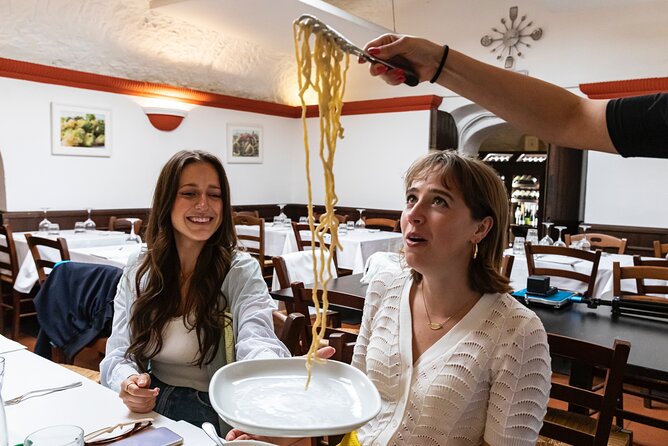
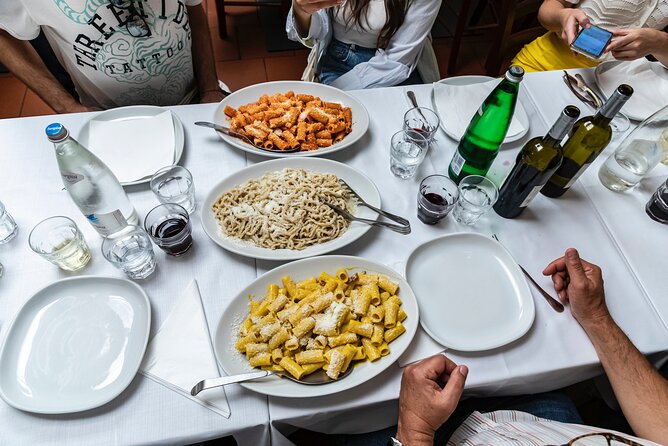
The main meal arrives at Flavio al Velavevodetto, a traditional Roman restaurant in the Testaccio area. Here you taste three classic pastas: carbonara, amatriciana, and cacio e pepe, paired with local wine.
This is the tour’s most useful food lesson. Ordering one pasta in Rome gives you a single impression. Trying three at the same table lets you compare the sauces directly.
- Carbonara is creamy in texture, though traditionally its character comes from eggs, cheese, and cured pork rather than cream.
- Amatriciana brings tomato, cured pork, and a sharper savory flavor.
- Cacio e pepe is the simplest of the three, built around cheese and black pepper.
The portions are tasting portions, but there are three of them, and earlier stops have already supplied plenty of food. The restaurant provides a comfortable break from the street, especially on a hot day. This is where the schedule feels most like lunch rather than grazing.
The tour may also feature a trapizzino, a Roman street-food sandwich made from a pocket of pizza-like bread filled with a dish such as hunter-style chicken. Supplì and local beer may also appear in the food lineup. The exact order and selection can change by day or season, so you should treat the published menu as a guide to the style and quantity, not an absolute promise of every item.
Extra drinks are not included. Wine and other listed pairings are part of the planned tastings, but additional beverages are your responsibility.
Learning the difference between real and fake gelato
The final tasting takes place at Giolitti Caffe and Gelateria, described as a 105-year-old or more than 100-year-old gelateria. The age matters less than the lesson: your guide explains how to tell artisan gelato from the brightly colored, heavily displayed product that can be made for tourists.
You learn to pay attention to signs of freshness and restraint rather than choosing the tallest mound or the most artificial color. It is a small piece of practical advice, but one you can use for the rest of your time in Rome.
The gelato is served near the end, at Via Amerigo Vespucci, just a couple of blocks from the starting point. That makes the finish convenient. You do not need to arrange transport back across the city after eating.
The 25-minute stop gives you time to enjoy the dessert rather than swallow it while walking. If you have already eaten a large amount, gelato may be the point where your appetite finally gives out. Pace yourself from the first stop and save space for this one.
The guides make the difference
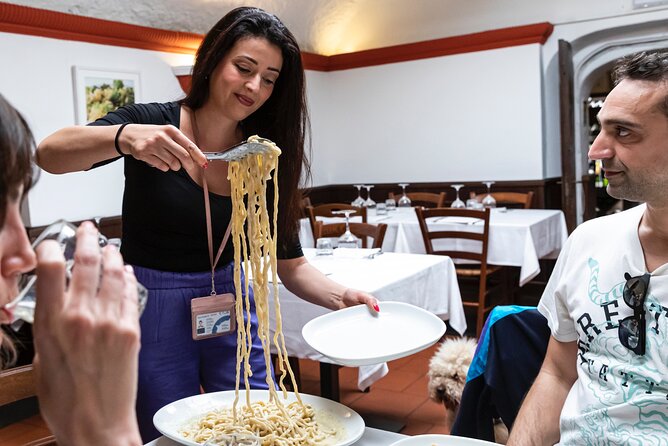
The tour is delivered in English by a local guide, and the guide’s style can shape the day. The strongest experiences described in the supplied material involve guides who explain food and history in an informal way, keep conversation moving, and have good relationships with the market sellers and restaurant staff.
Named guides associated with excellent outings include Luca, Katherine, Francesca, Giuseppe, Valter, Gianluca, Valeria, Rishad, Fabio, Giorgia, Gabriele, and Amin. You may not receive one of these specific guides, but the range of names suggests a larger guiding team rather than a single host.
Luca is repeatedly described as fun, clear, and well informed about Roman food and Testaccio. Katherine is praised for her energy and for handling both the food and historical parts of the walk. Francesca is noted for making a small group feel like a private outing, while Giuseppe created a relaxed, conversational experience for a group of only two.
The tour can feel especially personal when numbers are low. Its cap is 12 people, and it requires at least two. That is a useful middle ground: small enough for questions and easy conversation, but not necessarily private.
There is one serious practical warning. A reported outing had a dispute over the meeting point and a guide who did not appear to one party, ending without a refund. This is not the general picture, given the 4.9 rating from 1,658 reviews and the 99 percent recommendation rate, but it is a reason to arrive early, confirm the exact time and Piazza Testaccio location, and keep all communication if your plans change.
Is $131.81 good value?
At $131.81 per person, this is not a budget food walk. The price makes more sense when you count what is included: cured meats, cheese, oil and balsamic tasting, Prosecco, market food, bruschetta, supplì, trapizzino, three pastas, wine, gelato, and a pastry or espresso-style finish depending on the day’s selection.
You are also paying for access and coordination. A guide organizes the tastings, explains the neighborhood, handles the vendor relationships, and links the food to Testaccio’s history. If you tried to recreate the same afternoon on your own, you could spend less, but you would not necessarily get the same sequence or explanations.
The value is strongest for people who want both lunch and orientation. It can be less appealing if you already know Rome’s food scene, dislike group activities, or prefer to choose every dish yourself. The food is generous, but the exact offerings can vary with season and availability.
Group discounts may be available, and booking tends to happen well in advance, with the average reservation made about 62 days before the date. That suggests you should plan ahead if your Rome schedule is fixed.
Who should book this Testaccio food tour?
I would choose this experience for a first visit to Rome when you want to get beyond the usual center. It is also a good pick for returning visitors who have seen the major monuments and want a neighborhood afternoon built around food.
It suits you especially well if you:
- Like tasting many foods instead of ordering one large meal
- Want Roman history explained through markets, trade, and cooking
- Prefer a small group to a large bus tour
- Enjoy walking between food stops
- Want practical gelato and restaurant tips
- Are happy to let the guide set the menu and pace
Families can bring children. Children under four do not need a ticket, but food is not included for children aged three and under. Paid tickets with food are available from age four.
Vegetarian and gluten-free requests may be accommodated if you email or add a note when booking. The company cannot take responsibility for severe or life-threatening allergies to ingredients found on the tour, so this is not the right choice if you need strict allergy control.
The route is near public transportation, service animals are allowed, and most people can participate. Still, you should be comfortable standing, walking, and eating over several hours.
Practical details before you go
The meeting point is Piazza Testaccio, 39, in Rome. The tour ends at Via Amerigo Vespucci, 35, only a couple of blocks from where you began.
Allow about 3 hours 30 minutes, though food service and group pace can affect the timing. Wear shoes suited to city streets, arrive hungry but not empty, and carry water for the outdoor sections.
The tour is offered in English and includes a mobile ticket. Confirmation arrives when you book. Free cancellation is available up to 24 hours before the start time, but changes or cancellations inside that window are not accepted for a refund.
Because the experience requires at least two people, the company may offer another date or a full refund if the minimum is not met.
Should you book it?
Book this tour if you want a generous, food-heavy introduction to Testaccio rather than another walk through Rome’s famous center. The market, the three pastas, the pyramid, Monte Testaccio, and the gelato lesson create a well-rounded half-day.
I would skip it if $131.81 feels too high for lunch, if you have serious food allergies, or if you want a quiet, self-directed meal. For most food-minded visitors, though, the combination of local stops, strong guides such as Luca or Katherine, and a small group makes this one of the better ways to understand why Testaccio matters.
FAQ
Where does the Taste of Testaccio tour begin?
It begins at Piazza Testaccio, 39, 00153 Rome, Italy.
Where does the tour end?
The tour ends at Via Amerigo Vespucci, 35, 00153 Rome, Italy, a couple of blocks from the starting point.
How long does the tour last?
The experience lasts approximately 3 hours and 30 minutes.
How much does the tour cost?
The listed price is $131.81 per person. Group discounts are available.
What language is the tour offered in?
The tour is offered in English with a local English-speaking guide.
How many people can join the tour?
The maximum group size is 12 people. The activity requires at least two guests.
What food is included?
Food can include cured meats and cheeses, olive oil and balsamic vinegar, Prosecco, bruschetta, buffalo mozzarella, caprese salad, supplì, trapizzino, three Roman pastas, local wine, gelato, espresso, and an Italian pastry. The exact selection can vary by day or season.
Can dietary requirements be accommodated?
Vegetarian, gluten-free, and other dietary requests may be accommodated if you email the company or add a note when booking. The experience is not suitable for severe or life-threatening food allergies to ingredients used on the tour.
Can children join the tour?
Children under four can join without a ticket, but food is not included for children aged three and under. Paid tickets with food are available for children aged four and up.
Recently reviewed around Rome
- Ancient Rome at Twilight Walking Tour★ 5.0 · 276 reviews
- Domus Aurea Guided Tour: The Golden House of Nero★ 4.5 · 199 reviews
- Early Vatican Museums & Sistine Chapel Small Group Tour★ 4.5 · 314 reviews
- Early Vatican Museums Tour: The Best of the Sistine Chapel★ 4.5 · 900 reviews
- 3 Days in Sorrento, Capri & Pompeii: la Dolce Vita★ 4.0 · 595 reviews
- Tivoli Villas Full Day Trip From Rome with Lunch★ 4.0 · 443 reviews
- Jewish Ghetto & Piazza Navona: Food, Wine & Sightseeing Rome Tour★ 5.0 · 460 reviews
- Cook With Us in Rome: A Hands-On Cooking Experience 09:20AM class★ 5.0 · 234 reviews
Rome Tours, compared.
Vatican: Museums & Sistine Chapel Entrance Ticket
Read our review →
Vatican Museums & Sistine Chapel Tour with Optional Basilica
Read our review →
Colosseum, Roman Forum & Palatine Guided Tour
Read our review →
Vatican Museums, Sistine Chapel & St Peter’s Basilica Guided Tour
Read our review →
Colosseum, Palatine Hill and Roman Forum Guided Tour
Read our review →
Guided Tour of Colosseum, Roman Forum & Palatine Hill
Read our review →
Colosseum & Forum with Audio Guide App -Optional Arena
Read our review →