Review · ROME TOURS
The Treasures of Rome
Rome reveals its best work in a tight cluster of streets. On this three-hour morning tour, you move from Bernini fountains to the Pantheon, Raphael’s tomb, Piazza Navona, and finally St. Peter’s Square. It is a brisk introduction to the city’s center, with a local guide adding the stories that turn impressive stone into a real place.
I like the strong first-day orientation and the chance to see several major sights without arranging transport between them. I also like the small maximum group of 20 and the air-conditioned ride to the Vatican. The main caution is simple: this is much more of a walking tour than a bus tour, and the uneven cobblestones can feel hard in Rome’s heat.
In This Review
- Key points to know before booking
- A fast introduction to Rome’s historic center
- Piazza Barberini and Bernini’s Triton Fountain
- Trevi Fountain in a crowded pocket of Rome
- The Pantheon, where the ancient world still feels close
- Piazza Navona and Bernini’s fountains
- The ride to Vatican City and St. Peter’s Square
- How much walking should you expect?
- The guides can make or break the morning
- Is $49.26 a fair price?
- Who should book this Rome morning tour?
- Should you book The Treasures of Rome?
- FAQ
- Where does the tour start?
- What time does the tour begin?
- Where does the tour end?
- How long does the experience last?
- What sights are included?
- Is transportation included?
- Is lunch included?
- Is the tour offered in English?
- What clothing should I wear?
Key points to know before booking
- Trevi Fountain, the Pantheon, and Piazza Navona form the core of the walking route through central Rome.
- The Pantheon is the tour’s richest interior stop, with the tomb of Raphael and the burial place of King Umberto I.
- St. Peter’s Square is the final stop, with time to continue on your own after the guided portion.
- Expect roughly two hours on foot, with only a short vehicle ride between central Rome and Vatican City.
- The tour is multilingual, so the language format may affect how much detail you receive in English.
- Entry rules matter: cover your knees and shoulders for churches and other religious sites.
A fast introduction to Rome’s historic center
The tour begins at 9 a.m. on Via Giovanni Amendola, near Rome’s main Termini area. You meet the guide in central Rome, then set off toward the old city. There is no hotel pickup, so plan extra time to reach the meeting point and arrive early.
The route moves through narrow lanes lined with cafés, churches, fountains, and Renaissance palaces. That mix is the pleasure of central Rome. Ancient remains appear beside later buildings, and a modest-looking street can open suddenly into a grand square.
A morning start is useful. The streets are often easier to manage before the day reaches its full heat and crowds. It also leaves your afternoon open for a museum, a longer visit inside St. Peter’s Basilica, or a slower return to any place that caught your eye.
You should be ready to keep moving. The vehicle is not the main event. One detailed account described only about 15 minutes on the bus and close to two hours walking, often over cobbles. That is a fair way to picture the experience.
Other Rome days travellers weigh against this one:
- Vatican: Museums & Sistine Chapel Entrance Ticket
★ 4.5 · 144,003 reviews - Vatican Museums & Sistine Chapel Tour with Optional Basilica
★ 4.3 · 67,413 reviews - Colosseum, Roman Forum & Palatine Guided Tour
★ 4.7 · 63,148 reviews
Piazza Barberini and Bernini’s Triton Fountain
Piazza Barberini is listed as the opening point of interest. The square sits between the Quirinal Hill and the former Horti Sallustiani, and its central fountain gives you an early lesson in Rome’s Baroque style.
Bernini’s Triton Fountain dates from 1643. The sea god Triton rises above four dolphins, and the dolphins support the shell-like basin. The Barberini family emblems appear in the design, linking the fountain to Pope Urban VIII Barberini, who commissioned it.
There is also the smaller Fountain of the Bees near Via Veneto. Bees were the Barberini family symbol, so even this quieter fountain carries a bit of Roman power politics.
You may not spend a long time here, but the stop helps set the tone. Rome’s fountains are not just decoration. They mark papal ambition, family influence, engineering skill, and the city’s long relationship with water.
Trevi Fountain in a crowded pocket of Rome
The walk continues to the Trevi Fountain, one of Rome’s most famous sights. It can feel surprising when you first reach it. The fountain is tucked into a relatively small space in the historic center, and the huge scale of the sculpture seems to press against the surrounding buildings.
The fountain was designed by Nicola Salvi and completed by Giuseppe Pannini and other craftsmen. Water pours around the central figure of Oceanus, creating the motion and sound that make the scene so memorable.
The scheduled stop lasts about 20 minutes. That is enough for a look, photographs, and the traditional coin toss, but not enough for a leisurely pause if the area is crowded. Keep your group in sight. A famous sight in a compact square is an easy place to lose contact with a guide.
The coin tradition is usually presented as a promise that you will return to Rome. It is a small, playful ritual, but it also fits the city’s habit of attaching stories to ordinary actions.
This stop is free, but the tour price is not buying admission here. You are paying for the guide, the organized route, and the convenience of moving through several sights in one morning.
The Pantheon, where the ancient world still feels close
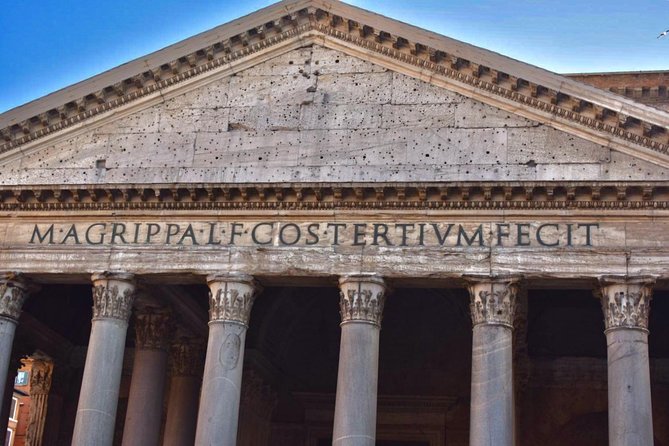
The Pantheon is the strongest reason to choose this experience. It is one of the best-preserved buildings from ancient Rome, and its huge concrete dome remains an astonishing piece of engineering.
The present building was completed under Emperor Hadrian on the site of an earlier temple commissioned during Augustus’s reign. Since the seventh century, it has served as a church dedicated to St. Mary and the Martyrs. That change of purpose helped preserve the building, though it also means you enter a living place of worship rather than a silent archaeological ruin.
Inside, look up at the oculus, the round opening at the center of the dome. It lets in daylight and connects the interior to the sky. Rain can also enter, which gives the floor and the building a direct connection to the weather outside.
The Pantheon contains the tomb of Renaissance artist Raphael, along with the tomb of King Umberto I and others. A good guide can make the visit meaningful by linking the building’s Roman past with its later role in Christian and Italian history.
The planned stop is about 30 minutes. That is enough to see the main features and hear an explanation, but you will need to manage your time. If the interior visit is especially important to you, ask the guide what access is available that day and how long you will have.
A different way to spend the day, same part of Italy:
- Vatican Museums, Sistine Chapel & St Peter’s Basilica Guided Tour
★ 4.5 · 39,149 reviews - Rome: Colosseum, Palatine Hill and Roman Forum Guided Tour
★ 4.8 · 32,814 reviews - Rome: Guided Tour of Colosseum, Roman Forum & Palatine Hill
★ 4.7 · 27,897 reviews - Rome: Colosseum & Forum with Audio Guide App -Optional Arena
★ 4.2 · 24,770 reviews
Piazza Navona and Bernini’s fountains
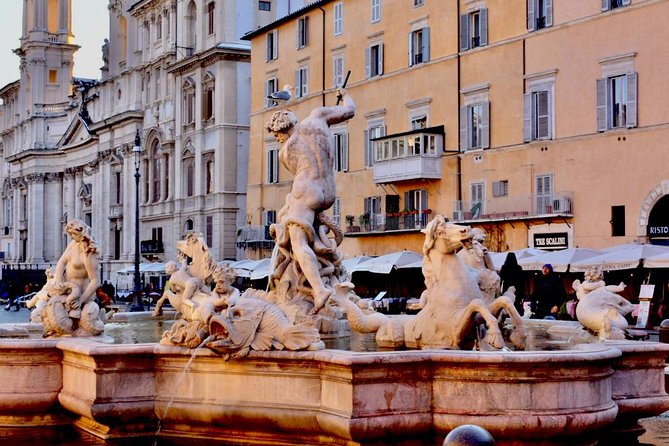
A short walk brings you to Piazza Navona, one of Rome’s most elegant public spaces. Its long oval shape follows the outline of the Stadium of Domitian, built in the first century AD for public games called agones.
Today, the square is known for its Baroque fountains and surrounding architecture. Bernini’s Fountain of the Four Rivers is the centerpiece, with four large figures representing major rivers of the world known in his time. An Egyptian obelisk rises above the fountain, creating the dramatic vertical line that makes the square so easy to recognize.
The stop lasts about 20 minutes. That gives you time to study the main fountain, take in the length of the piazza, and hear how an ancient stadium became a Baroque urban space.
Piazza Navona is also a useful place to notice how Rome layers its eras. The ancient outline remains, but the present square reflects papal Rome, sculpture, church architecture, cafés, and everyday city life.
The drawback is that a short guided stop can feel rushed. You might want to return later, especially if you enjoy looking closely at fountains and façades rather than simply checking off the square.
The ride to Vatican City and St. Peter’s Square
After the central Rome walk, you board an air-conditioned vehicle for the ride to Vatican City. This is the only part of the experience where the vehicle plays a major role, and it offers welcome relief after the cobbled streets.
The tour ends at St. Peter’s Square, where Bernini’s design frames the front of St. Peter’s Basilica with sweeping Doric colonnades. The square was created between 1656 and 1667, and its great arms seem to gather people toward the basilica.
An ancient Egyptian obelisk occupies the center. It was erected in the square in 1586 and provides a striking link between ancient Egypt, Roman imperial history, and the Christian center of Vatican City.
The listed visit to St. Peter’s Basilica is included, but access is not guaranteed on Sundays, religious festivals, or during ceremonies. On those days, the route can change. Some past participants also found that the practical experience focused more on the square than the basilica interior, so you should confirm the plan at the start rather than assume a full interior visit.
The tour ends in Piazza San Pietro. This is both a strength and a limitation. You are left at one of Rome’s great sights with the option to continue exploring, but you must arrange your own return to the city center.
How much walking should you expect?
You should treat this as a walking tour with a short transfer, not as a sightseeing bus ride. The route through the Centro Storico uses narrow streets and uneven cobbles, and the group may need to keep a steady pace to cover the main sights in three hours.
Wear shoes with good support. Bring water, especially in warm weather, and allow time for the group to gather at each stop. Anyone with limited stamina may find the pace demanding, even though remaining on the vehicle is technically possible during some portions. Staying on board means missing much of the historic center.
The route is not designed for a slow, unstructured wander. You get an efficient overview, but you give up time for long café stops, extended photography, or detailed exploration inside each monument.
That tradeoff works well for a first morning in Rome. You get the city’s basic shape, learn where the main squares are, and can return later to the places that deserve more time.
The guides can make or break the morning
The best accounts of this experience praise guides who bring Rome to life with humor, clear explanations, and local pride. Giorgio is specifically praised for being friendly and well informed. Other strong guide experiences included an older lifelong Roman whose affection for the city made the route especially enjoyable.
That personal touch matters. Much of this tour takes place outdoors, where the guide’s storytelling is the main service. A fountain or façade can be admired on your own, but a good explanation gives it context and helps you see details you might otherwise miss.
The multilingual format is worth considering. The tour is offered in more than one language, and you may receive audio equipment or shared explanations depending on the group. English is available, but the amount and pace of English commentary can vary when several languages are in use.
Guide quality is not perfectly consistent. Some reports describe guides as warm, funny, and ready to answer questions. Others describe a guide who gave only basic facts or seemed distracted. I would book this for the route and orientation first, with the guide’s personality as an important bonus rather than a promise.
Is $49.26 a fair price?
At $49.26 per person, the tour is reasonably priced for a three-hour guided introduction, especially if you are new to Rome and want the main sights arranged in one route. The fee includes a local guide and the air-conditioned vehicle transfer.
The value depends on what you need. If you are comfortable navigating Rome on foot and already plan to visit the Trevi Fountain, Pantheon, and Piazza Navona, you can reach these places independently. In that case, the price buys explanation, structure, and a quick connection to St. Peter’s Square.
If your time is limited, the organized route can save planning effort. It also helps you understand the city before returning independently for longer visits.
Lunch is included only if you select that option. Drinks are not included. Hotel pickup and drop-off are also not included, so count the cost and time of reaching Via Giovanni Amendola and returning from Vatican City.
Who should book this Rome morning tour?
I would recommend it for a first visit, a short stay, or anyone who wants a guided overview before exploring alone. It is also useful if you like history but do not want to spend a full day inside museums.
This suits active adults and families with older children who can manage several hours on foot. It is less suitable if you need frequent rests, dislike cobbled streets, or want long interior visits at the Pantheon and St. Peter’s Basilica.
The maximum group size is 20, which should feel more manageable than a large coach group. Still, it is a multilingual tour, and the group may not feel as intimate as a private walk.
Dress carefully. For churches and selected museums, men and women must cover their knees and shoulders. Shorts and sleeveless tops can lead to refused entry, so a light layer or longer clothing is a smart part of your morning plan.
Should you book The Treasures of Rome?
Book it if you want a fast, guided first look at central Rome and you are ready to walk. The Pantheon, Trevi Fountain, Piazza Navona, and St. Peter’s Square make a strong lineup, and the air-conditioned transfer gives the route a useful finish.
Skip it if you want a relaxed day, a guaranteed long visit inside St. Peter’s Basilica, or a tour devoted to one monument in detail. Before booking, check the date carefully, especially if it falls on a Sunday or religious holiday, and treat the Vatican portion as subject to change.
For many people, the best use of this tour is as an introduction. Let the guide show you the city’s main pattern, then return on your own to the Pantheon, Piazza Navona, or Vatican area for a slower look.
FAQ
Where does the tour start?
The tour starts at Via Giovanni Amendola, 32, 00185 Rome, Italy.
What time does the tour begin?
The scheduled start time is 9 a.m.
Where does the tour end?
The tour ends at St. Peter’s Square, Piazza San Pietro, Vatican City.
How long does the experience last?
The tour lasts approximately three hours.
What sights are included?
The route includes Piazza Barberini, the Trevi Fountain, the Pantheon, Piazza Navona, and St. Peter’s Square. The tour may also include the inside of St. Peter’s Basilica, except when Sunday services, religious festivals, or ceremonies prevent access.
Is transportation included?
An air-conditioned vehicle is included for the transfer to Vatican City. Hotel pickup and drop-off are not included.
Is lunch included?
Lunch is included only when you select the option that includes lunch. Drinks are not included.
Is the tour offered in English?
English is offered, but the experience is multilingual.
What clothing should I wear?
You must cover your knees and shoulders to enter places of worship and selected museums. Shorts and sleeveless tops are not allowed, and the dress code is strictly enforced.
Recently reviewed around Rome
- Ancient Rome at Twilight Walking Tour★ 5.0 · 276 reviews
- Early Vatican Museums Tour: The Best of the Sistine Chapel★ 4.5 · 900 reviews
- Domus Aurea Guided Tour: The Golden House of Nero★ 4.5 · 199 reviews
- Early Vatican Museums & Sistine Chapel Small Group Tour★ 4.5 · 314 reviews
- Jewish Ghetto & Piazza Navona: Food, Wine & Sightseeing Rome Tour★ 5.0 · 460 reviews
- 3 Days in Sorrento, Capri & Pompeii: la Dolce Vita★ 4.0 · 595 reviews
- Tivoli Villas Full Day Trip From Rome with Lunch★ 4.0 · 443 reviews
- Cook With Us in Rome: A Hands-On Cooking Experience 09:20AM class★ 5.0 · 234 reviews
Rome Tours, compared.

Vatican: Museums & Sistine Chapel Entrance Ticket
Read our review →
Vatican Museums & Sistine Chapel Tour with Optional Basilica
Read our review →
Colosseum, Roman Forum & Palatine Guided Tour
Read our review →
Vatican Museums, Sistine Chapel & St Peter’s Basilica Guided Tour
Read our review →
Colosseum, Palatine Hill and Roman Forum Guided Tour
Read our review →
Guided Tour of Colosseum, Roman Forum & Palatine Hill
Read our review →
Colosseum & Forum with Audio Guide App -Optional Arena
Read our review →