
Review · WALKING TOURS
Alberobello: History Walking Tour
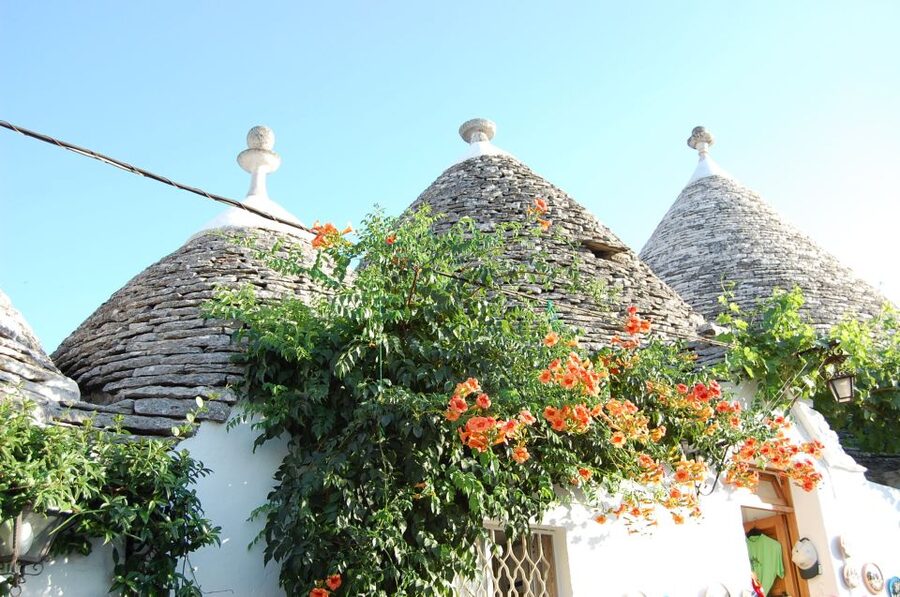
Alberobello makes its first impression with rows of cone-roofed trulli, but the real pleasure comes from learning why these strange-looking homes were built and how people once lived inside them. This 1.5 to 2-hour walk takes you from the Belvedere terrace through Rione Monti and Aia Piccola, then into a traditional trullo home.
I like the personal scale of the tour and the chance to step inside a real trullo instead of only photographing its whitewashed exterior. I also like the guides’ local approach. Guides such as Francesco, Mario, Alessandro, Roberta, Sylvia, and Floriana are praised for clear explanations, good storytelling, and practical suggestions, including places to eat.
The main consideration is that this is entirely a walking tour, with no transfers included. Meeting points can vary by the option you book, and the tour requires at least two participants, so check those details before you commit.
In This Review
- Key points at a glance
- Why Alberobello works best on foot
- Beginning at the Belvedere terrace
- Rione Monti and the famous trulli lanes
- Aia Piccola and a quieter view of daily life
- The trullo-shaped Church of San Antonio
- Inside a traditional trullo home
- The guides make the difference
- Is $40 a fair price?
- Who should book this walk?
- Should you book the Alberobello History Walking Tour?
- FAQ
- Where does the Alberobello walking tour take place?
- How long does the tour last?
- What is included in the price?
- Are transfers included?
- Which languages are available?
- Can I book a private group?
- Is the tour suitable for children?
- Can I cancel the tour for a refund?
- Do I need to pay when I book?
Key points at a glance
- See both sides of Alberobello: Visit the famous Rione Monti district and the quieter Aia Piccola quarter.
- Start above the rooftops: The Belvedere terrace gives you an immediate view of Alberobello’s unusual profile.
- Enter a real trullo: Finish inside a local home and see how the circular rooms, stone walls, and conical roof fit together.
- Learn the reason behind the design: Your guide explains why local builders used dry-stone construction without cement.
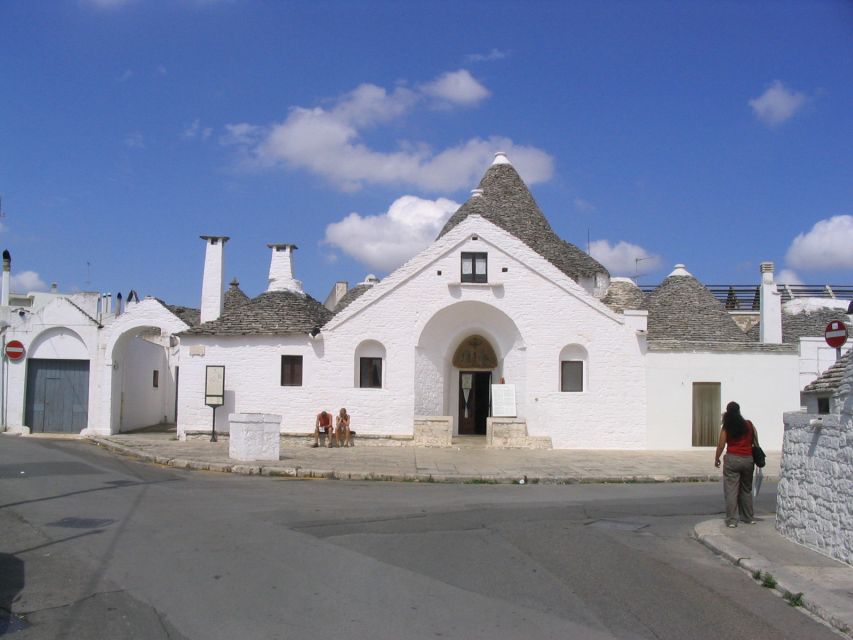
- Reach a church shaped like a trullo: The Church of San Antonio makes a memorable stop along the narrow lanes.
- Choose your language: Tours are offered in English, French, Spanish, or Italian, with a private-group option available.
Why Alberobello works best on foot
Alberobello is not simply a village filled with pretty white houses. Its trulli have a practical story behind them, and that story is easier to understand when you walk among the buildings with someone who knows the town.
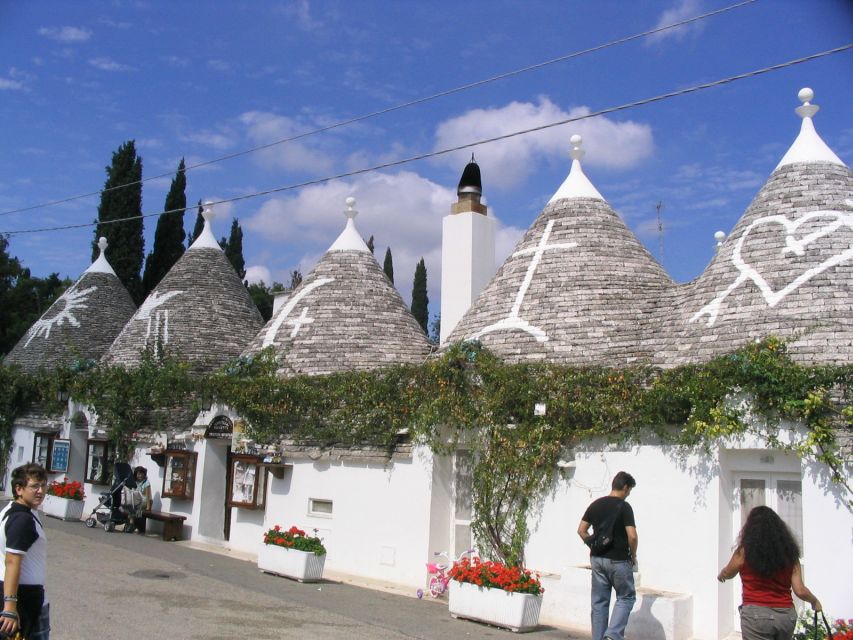
The tour focuses on two districts with different feels. Rione Monti is the famous area, packed with conical roofs and small lanes. Aia Piccola offers a different look at the town, with a more residential character and a chance to see the trulli as homes rather than only as postcard subjects.
That contrast matters. If you explore Alberobello alone, it is easy to admire the shapes, take photographs, and move on without understanding why the buildings look this way. A guide adds the missing framework: how the homes were constructed, why the stonework matters, and how the design shaped daily life.
The short duration is useful if you are fitting Alberobello into a wider Apulia trip. In about two hours, you get an organized introduction without giving up an entire morning or afternoon. The tradeoff is that this is an overview rather than a slow, detailed study of every lane and building.
More Walking Tours in Puglia
- Lecce: Baroque Architecture and Underground Walking Tour
★ 4.7 · 842 reviews - Bari: Guided Walking Tour
★ 4.7 · 744 reviews - Bari: Pasta Experience Walking Tour
★ 4.7 · 660 reviews
Beginning at the Belvedere terrace
The tour starts at the Belvedere terrace, where you can get your bearings before entering the trulli districts. This is a smart opening point because Alberobello’s unusual architecture makes more sense when you first see the town from above.
From the terrace, the clustered roofs form a pattern that is hard to grasp from street level. You can see why Alberobello feels so different from other towns in Puglia. The guide uses this view to explain the town’s past and introduce its place as a UNESCO World Heritage Site.
I would pay close attention here rather than treating the terrace as a quick photo stop. The opening explanation gives you the background needed for the rest of the walk. Once you are among the houses, details such as the roof symbols, stone layers, and compact floor plans become easier to notice.
The exact meeting point may vary depending on the option you select. That is worth checking carefully, especially if you are arriving independently or coordinating the tour with a train, hotel, or another activity.
Rione Monti and the famous trulli lanes
From the terrace, the walk continues through Rione Monti, the district most people picture when they think of Alberobello. Its narrow alleys and rows of white trulli create the classic scene, with conical roofs rising above the lanes.
This is the most visually striking part of the tour. You will have plenty to look at, but the guide keeps the experience from becoming a simple stroll through souvenir shops and photo stops. The focus is on the buildings and the way they were made.
One useful piece of context is the dry-stone construction. The trulli were built with local rocks laid without cement, a method that shaped both their appearance and their structure. Your guide explains the logic of this construction and points out how the architecture works in actual examples.
The stone roofs are not just decorative caps. They are part of the building’s design, and the rounded interiors help explain why a trullo feels different from a conventional rectangular house. You will hear how the walls and roof fit together, then see the ideas in front of you instead of trying to picture them from a museum panel.
Rione Monti can feel busy, particularly because it is the best-known part of Alberobello. That is one reason a guide helps. You can keep moving through the right lanes and spend your limited time on the parts that explain the town rather than wandering without a plan.
Aia Piccola and a quieter view of daily life
The tour also visits Aia Piccola, which gives you a useful counterpoint to Rione Monti. Here, the trulli are presented more as part of a living neighborhood than as a collection of unusual façades.
The value of this stop is comparison. Rione Monti shows the famous public face of Alberobello, while Aia Piccola helps you think about how these buildings functioned as homes. Walking through both districts makes the town feel less like a single attraction and more like a place shaped by ordinary domestic life.
Your guide can point out differences in layout, scale, and use. The information is especially helpful if you are curious about the practical side of trulli architecture. These houses may look playful from a distance, but their construction reflects local materials, limited space, and the needs of the people who lived in them.
The lanes can be uneven and narrow, so comfortable shoes are a sensible choice. The tour does not include transfers, and it is designed as a walking experience from start to finish. If someone in your party has difficulty with extended walking, consider that before booking.
More history-led days around Puglia:
- Lecce History and Street Food Tasting Small Group Tour
★ 5.0 · 288 reviews - Venice: St. Mark Basilica Ticket, Audioguide+History Gallery
★ 3.9 · 4,780 reviews - Venice’s Best: Basilica, Doge’s Palace, Gondola & History Gallery
★ 4.5 · 2,478 reviews - Historic Milan Tour with Skip-the-Line Last Supper Ticket
★ 4.5 · 1,976 reviews
The trullo-shaped Church of San Antonio
One of the walk’s most memorable landmarks is the Church of San Antonio, built in the form of a trullo. It is a natural highlight because it applies the same local architectural language to a religious building.
Rather than seeing the church as an isolated monument, you can place it within the wider story of Alberobello. The conical form here is a reminder that the trullo style was not limited to private homes. It became part of the visual identity of the community itself.
The stop also breaks up the residential sections of the tour. After walking through small lanes and looking closely at individual homes, the church gives you a larger structure to study. Your guide can explain what makes its shape distinctive and how it fits the town’s architectural character.
The available information does not specify the length of the interior visit, so you should think of San Antonio primarily as a guided landmark stop rather than a separate church tour.
Inside a traditional trullo home
The most valuable part of the experience for many people will be the visit to a local home. You do not just look at the outside of a trullo. You get to see how one is composed from within.
This is where the tour becomes more than a photo walk. Exterior walls and roofs can seem mysterious, but an interior visit shows the relationship between the thick stone walls, the rounded rooms, and the cone above. You can better understand how the compact design affected living space.
The visit also gives your guide a chance to explain small architectural details in place. This is more useful than hearing a long description while standing in a street. You can look at the materials and shape of the house as the explanation unfolds.
Several guides are praised for taking time to enter historic homes and explain details carefully. Alessandro, for example, is described as kind and accommodating, while Francesco is praised for making guests feel at home. Those comments point to the strongest feature of this tour: the local contact, not simply the route.
Some outings have also included meetings with residents or a taste of local products. That may depend on the guide and the day, so treat it as a possible bonus rather than a guaranteed part of the published schedule.
The guides make the difference
A walking tour of Alberobello depends heavily on the person leading it. The town is visually distinctive, but the experience can become shallow if the guide only points out attractive roofs.
The guides associated with this experience bring different strengths. Mario is praised for making the tour both informative and funny, while Roberta explains the construction methods and the reasons for building trulli without cement. Sylvia is described as warm and well informed, and Floriana is noted for her pleasant manner and sense of humor.
Domenico, listed in one comment as Dominicio, is praised as a strong storyteller. That matters in Alberobello because the facts become easier to remember when they are tied to people, homes, and local life rather than delivered as a list of dates.
English, French, Spanish, and Italian are available. If language matters to you, select carefully when booking. A private group is also available, which can suit families or couples who want more time for questions and a less fixed pace.
The experience is free for children under 18, but the minimum of two participants still applies. That combination can make it appealing for families, provided everyone is comfortable with the walking time.
Is $40 a fair price?
At $40 per person, this tour is not the cheapest way to wander through Alberobello. You can walk through the districts on your own. The question is what you would miss without the guide.
The price includes a walking tour and a licensed guide. It does not include transportation, so you are paying for interpretation and access to the organized route rather than for a complete day trip from another town.
I think the value is good if you want to understand the architecture and enter a traditional trullo. The home visit adds something you cannot get from photographs, and the explanation of dry-stone construction gives meaning to what you are seeing.
The value is less clear if you only want a quick look at the roofs and a few photographs. In that case, the 1.5 to 2-hour commitment may feel unnecessary. The tour earns its price when you care about the why behind Alberobello, not just the appearance of the place.
Practical extras also improve the value. Guides have offered lunch suggestions, and some have included local product tastings or introductions to residents. These details are not guaranteed, but they show how the tour can connect you with more than the town’s most photographed streets.
Who should book this walk?
I would recommend it to first-time visitors to Alberobello, especially anyone who wants the town explained in plain terms. It suits couples, families with older children, and small groups who prefer a guided introduction rather than reading signs or following a map.
It is also a good fit for architecture fans. The tour gives you a chance to examine how the trulli are made and how their unusual shapes work from inside. If you are interested in local life, the home visit and possible contact with residents add a human side.
Food-focused visitors may appreciate the local suggestions and possible tasting, but this is not presented as a dedicated food tour. The main subject is Alberobello’s buildings and history.
I would be more cautious if you dislike walking, need a transfer service, or prefer a long, unhurried visit with time to explore every lane. The schedule is compact, the meeting point can vary, and the route covers two districts on foot.
Booking is flexible, with cancellation up to 24 hours before the start for a full refund and a reserve-now, pay-later option. Still, confirm the meeting point, language, group type, and starting time before you finalize your plans.
Should you book the Alberobello History Walking Tour?
Book it if you want Alberobello to make sense, not just look pretty. The best parts are the view from the Belvedere terrace, the contrast between Rione Monti and Aia Piccola, and the chance to enter a traditional trullo with a local guide.
The tour is particularly worthwhile for a first visit, when clear context can turn unusual roofs into understandable homes. At $40, it offers fair value for the licensed guide and interior visit, though independent explorers may prefer to walk the town alone.
If you can manage the walking and meet the two-person minimum, this is a practical, focused introduction to one of Puglia’s most distinctive towns.
FAQ
Where does the Alberobello walking tour take place?
The tour takes place in Alberobello in Apulia, Italy. It visits the Rione Monti and Aia Piccola districts, the Church of San Antonio, and a traditional trullo home.
How long does the tour last?
The walking tour lasts about 1.5 to 2 hours. Starting times depend on availability.
What is included in the price?
The price includes the walking tour and a licensed guide.
Are transfers included?
No. Transfers are not included, and the experience ends back at the meeting point.
Which languages are available?
The tour can be conducted in English, French, Spanish, or Italian.
Can I book a private group?
Yes. A private-group option is available.
Is the tour suitable for children?
Children under 18 can join free of charge. A minimum of two participants is required for the tour to run.
Can I cancel the tour for a refund?
Yes. You can cancel up to 24 hours in advance for a full refund.
Do I need to pay when I book?
No. The reserve-now, pay-later option lets you book your place without paying immediately.
Recently reviewed around Puglia
- Tour 3h and half visit of all the caves, bathroom stop and aperitif★ 5.0 · 393 reviews
- UTOPIA Long Mini Cruise★ 4.5 · 322 reviews
- Tour of Lecce with a visit to the basement of the ancient synagogue★ 5.0 · 258 reviews
- Mini-cruise tour to the Caves of Santa Maria di Leuca★ 5.0 · 250 reviews
- Small group tour of the caves of Santa Maria di Leuca★ 5.0 · 806 reviews
- Ostuni, Alberobello and Polignano a Mare. Departing from Lecce★ 5.0 · 195 reviews
- Orecchiette Cooking Class and Wine Pairing in Lecce★ 4.5 · 205 reviews
- Discovering Lecce★ 5.0 · 247 reviews
Walking Tours, compared.

Guided Walking Tour & Last Supper Visit with Ticket
Read our review →
Rialto Bridge & Offbeat Unusual Venice Walking Tour
Read our review →
Private 3 hrs Venice Tour: St Mark’s, Walking tour & Boat tour
Read our review →

Skip the line: Uffizi and Accademia Small Group Walking Tour
Read our review →
Trastevere & Campo de Fiori Street Food Walking Tour
Read our review →Browse the lists this tour appears in