
Review · MUSEUMS
Leonardo Da Vinci Museum Entrance Ticket
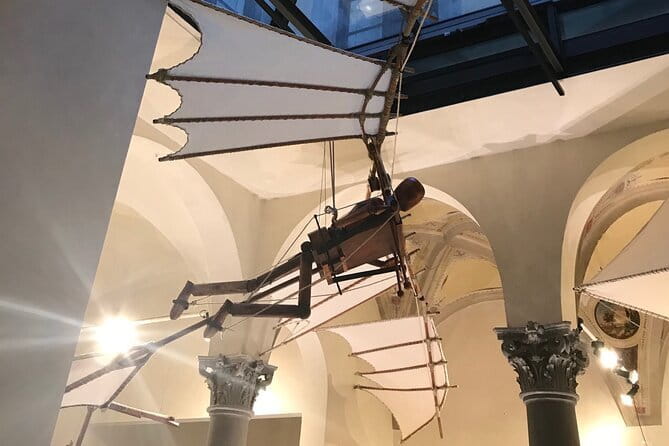
Leonardo da Vinci’s ideas come alive in this small Florence museum, where more than 50 models fill four rooms. The focus is not on the Mona Lisa or original paintings. It is on the restless mind behind flying machines, military devices, building tools, and anatomical studies, with many models built to move or be handled.
I like the working machines, which turn old drawings into something you can understand with your hands and eyes. I also like the easy one-hour length: this fits neatly between major Florence sights, and the cool, compact rooms make a sensible break on a hot day.
The main catch is simple: this is a museum of replicas and interpretations, not a collection of original da Vinci artifacts. Children and curious adults may have a terrific time, but anyone expecting paintings, rare manuscripts, or a large scholarly museum could find the visit slight.
In This Review
- Key points to know before you go
- What you are really visiting in Florence
- The four rooms, from building tools to anatomy
- Working replicas make the sketches easier to understand
- A useful stop for families, but not only for children
- Documentary, bookshop, and a convenient pause
- Is $12.55 a fair price?
- Timing your visit and avoiding a wrong-city mistake
- How to build this into a Florence day
- Who should book this ticket?
- FAQ
- Where is the Leonardo da Vinci Museum located?
- What does the admission ticket include?
- How long does the museum visit take?
- What are the museum’s opening hours?
- Does the museum display Leonardo da Vinci’s original paintings?
- How many models are on display?
- Is this a guided tour?
- Can I cancel the ticket for a refund?
- Should you book it?
Key points to know before you go
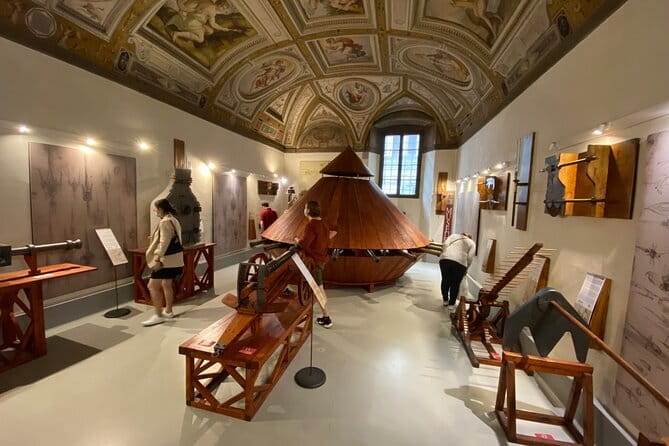
- More than 50 models fill four themed rooms, covering civil engineering, flight, warfare, and anatomy.
- Many machines actually work, helping you see how da Vinci’s sketches might have functioned.
- The museum focuses on inventions, not art, so do not come expecting a gallery of his famous paintings.
- Hands-on displays and a children’s building area make this especially suitable for families.
- A documentary traces da Vinci’s life and work, adding context to the machines.
- The visit takes about one to one and a half hours, with admission priced at about $12.55 per person.
What you are really visiting in Florence
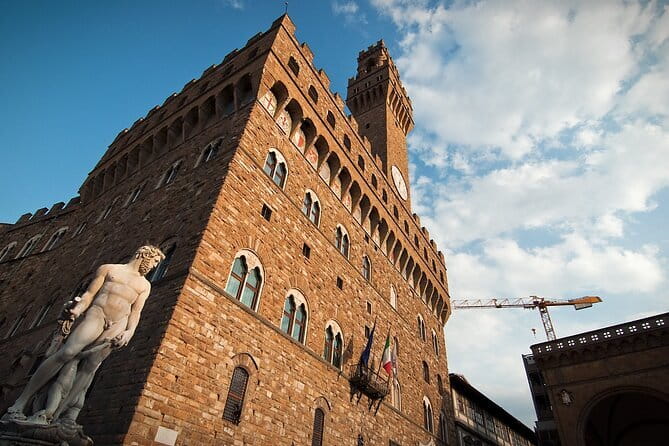
The Leonardo da Vinci Museum occupies the Galleria Michelangelo, a historic exhibition space on one of Florence’s best-known central streets. The building once hosted meetings of the Macchiaioli, the nineteenth-century Italian artists who challenged academic painting.
That setting gives the museum a little more character than a plain modern hall. Painted ceilings and the old gallery atmosphere help you picture the kind of Florentine world in which art, engineering, architecture, and scientific study mixed freely.
This is a self-guided museum, not a guided tour with a named expert leading a group. You receive admission and move through the rooms at your own pace. That works well if you want to stop over one machine, skip a display, or keep your visit short.
The stated opening hours are 10 a.m. to 6 p.m. daily for the listed operating period. Booking information refers to flexible time slots, while one ticket description indicates that entry may not require a strict timed appointment. Check the instructions on your confirmation so you know whether you can arrive at any point during the day or need to follow a selected slot.
More Museum Tours in Florence
- Florence: Skip-The-Line Uffizi Gallery Timed Entry Ticket
★ 4.5 · 27,832 reviews - Florence: Leonardo Interactive Museum Entry Ticket
★ 4.5 · 11,763 reviews - Florence Accademia Gallery Tour with Entrance Ticket Included
★ 4.5 · 6,148 reviews
The four rooms, from building tools to anatomy
The first room is devoted to civil machines. Here, da Vinci’s imagination turns toward construction, lifting, transport, and practical engineering. The models help you see that he was not simply sketching fanciful ideas. He was thinking about force, balance, motion, and how large projects could be made easier.
This section is a good starting point because it shows the method behind his inventions. Look closely at the diagrams and then at the model. You can often see how a wheel, gear, screw, or pulley is meant to do its work.
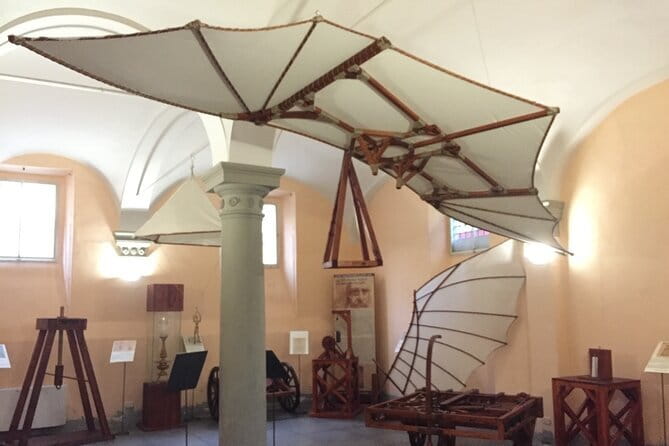
The second room covers flying machines. Da Vinci studied birds and air, then tried to imagine ways humans might rise above the ground. The displays let you compare his observations with his mechanical solutions.
Do not expect a modern aviation museum. These are models based on his designs, and their value lies in showing the question he was asking rather than proving that every machine could fly. For children, the room can feel like a workshop of impossible ideas. For adults, it offers a clear view of how art and observation fed his engineering.
The third room presents war machines. Da Vinci worked in a period when military invention could bring employment and protection, and his drawings include devices designed for defense and attack.
Some of these models are striking, but this section may not appeal equally to everyone. The machines are useful for understanding the broad range of his work, yet you should not expect a detailed military museum or a long account of Renaissance battles. The displays keep the focus on design and mechanics.
The fourth room contains the newer collection of anatomical models. This is where the museum connects most directly with da Vinci’s study of the human body. His interest in anatomy was part of the same habit that shaped his engineering: observe carefully, record precisely, and ask how things work.
Together, the four rooms cover contributions to art, music, architecture, anatomy, civil engineering, and military design. That range is one of the museum’s strongest points. You leave with a fuller picture of da Vinci than the familiar artist associated only with the Mona Lisa.
Working replicas make the sketches easier to understand
A da Vinci drawing can look beautiful and baffling at the same time. A three-dimensional model gives you a better chance to understand the moving parts.
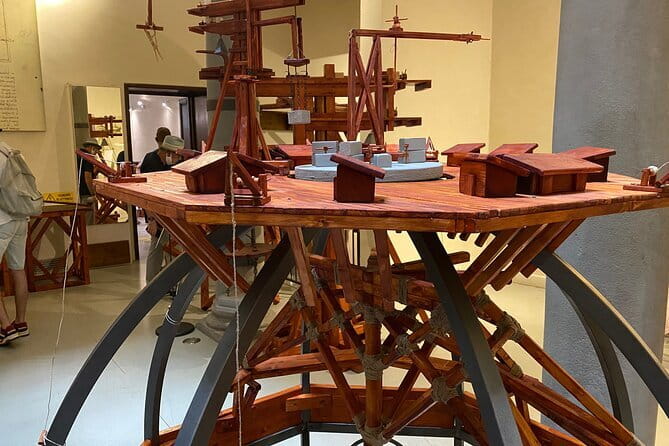
Many of the models are working machines. The practical benefit is clear: instead of staring at a page and trying to imagine motion, you can see how a mechanism is supposed to operate. Selected hands-on exhibits also let you experiment directly.
The hands-on material is one reason families often find the museum rewarding. Children can test ideas, look for moving parts, and use a building area in the basement. Adults who enjoy science or design can spend longer with the displays and read about the ideas behind them.
Not every exhibit is touchable, and some interactive equipment may not always be operating. That matters if you are choosing the museum mainly for hands-on play. Think of it as a museum with interactive elements, not a full-scale science center.
The replicas also create the museum’s biggest limitation. They are modern reconstructions inspired by Leonardo’s drawings, not objects handled by Leonardo himself. If authenticity means original documents and artifacts, the admission price may feel less attractive.
A useful stop for families, but not only for children
The museum has a clear family advantage. The combination of machines, movement, short visit length, and a children’s area gives younger visitors more to do than a traditional painting gallery might.
You can also use it as a break from Florence’s major art museums. After hours of paintings and sculpture, a room full of mechanisms gives your eyes and mind a different task. I especially like this kind of stop when a family needs something educational that does not require everyone to stand quietly.
Adults with a strong interest in invention may enjoy it even more than children. The museum presents da Vinci as an observer and problem-solver, not just as a painter. You can follow his curiosity across subjects and see how often he returned to the same basic questions about movement, structure, and the human body.
Still, the experience is fairly quick. Most people need about an hour, with perhaps 30 extra minutes if they read closely and spend time with the working models. If you want a full day devoted to Leonardo, this visit will not fill it.
More Florence museums and collections:
- Uffizi Gallery Small Group Tour with Guide
★ 4.5 · 4,923 reviews - Florence: Accademia Gallery Guided Tour
★ 4.6 · 4,156 reviews - Florence: Accademia Gallery Guided Tour with Entry Ticket
★ 4.6 · 2,253 reviews - Golf Cart Tour to Fiesole Roman Theatre and Museum
★ 4.5 · 2,039 reviews
Documentary, bookshop, and a convenient pause
Large-screen monitors show a documentary about da Vinci’s life and work. This is helpful if you arrive with only a general idea of him. The film gives the machines a human story and helps connect the different rooms.
The documentary is not a substitute for a specialist lecture. It is best used as an orientation tool, either before seeing the displays or as a pause midway through the visit.
A bookshop sells publications and souvenirs. It is a useful place to look for further reading or a small reminder of the visit. The selection includes gadgets, though not every item will appeal to visitors looking for locally made goods.
The exhibition area has an agreement with Caffé Michelangiolo, a restaurant inside the area. Food and drinks are not included in the ticket, so treat the café as an optional extra rather than part of the admission package.
Is $12.55 a fair price?
At about $12.55 per person, this is a modest admission for central Florence, but value depends on your expectations.
For a family, the price can work well because several people may engage with the same machine in different ways. One child can try an interactive display while an adult reads the explanation. The short duration also helps: you are not committing a whole afternoon or paying for a major all-day attraction.
For an adult seeking original art, the value is weaker. You will not see Leonardo’s paintings here, and the exhibits are largely replicas and models. The museum’s purpose is to explain his inventions and range of interests, not to display rare objects.
I would consider it good value if you are interested in science, engineering, design, or the practical side of Renaissance creativity. I would be more cautious if your main goal is fine art or a serious academic study of Leonardo.
The location adds value because the museum is in central Florence and close to major sights. You can fit it into a busy walking day without arranging hotel pickup or a long journey across town.
Timing your visit and avoiding a wrong-city mistake
The museum is open daily from 10 a.m. to 6 p.m. during the listed period. The ticket is offered in English, and confirmation is provided at booking.
Public transportation is nearby, and most people can take part. One visitor specifically found the museum wheelchair friendly, though the supplied information does not give detailed access notes for every room. If step-free access matters to you, ask ahead before booking.
Pay close attention to the city named on your confirmation. There are Leonardo da Vinci museums in several Italian cities, and tickets are not automatically interchangeable. A booking for Florence will not help you enter a museum in Rome, Milan, or Venice.
This is especially important when you are booking quickly on a phone. Check the city, museum name, date, opening hours, and entry instructions before payment. The cancellation terms allow a full refund if you cancel at least 24 hours before the start time. Changes or cancellations inside that window are not accepted for a refund.
The maximum group size is 20, but since this is self-guided, you are not joining a traditional guided group. The group limit may matter most at busy periods and around entry.
How to build this into a Florence day
Give yourself one to one and a half hours inside. Add a little time for finding the entrance, watching the documentary, browsing the bookshop, or stopping at the café.
The museum works well early in the day before a full schedule of Florence sights. It also makes a handy afternoon stop when the heat is strong and you want an indoor activity.
A sensible approach is to move room by room rather than rush straight to the most dramatic-looking machine. Start with civil engineering, then compare those practical devices with the flying and war designs. Finish with anatomy, where da Vinci’s interest in observation becomes most personal.
If you are with children, save time for the hands-on area and the basement building space. If you are visiting alone or with adults, read the labels and watch the documentary. The same museum can feel like a play space or a compact lesson, depending on how you use it.
Who should book this ticket?
I would recommend it to families, science-minded visitors, and anyone who wants to understand da Vinci beyond his paintings. It is also a good choice for a short indoor stop near Florence’s central sights.
You should think twice if you want original Leonardo works, a large collection, or a guided scholarly presentation. The museum is small, its displays are mostly replicas, and some interactive pieces may not be active.
The ticket is easiest to justify when you value working models and direct experimentation. It is less convincing when you are paying mainly to see authentic Renaissance objects.
FAQ
Where is the Leonardo da Vinci Museum located?
It is located at the Galleria Michelangelo on a renowned street in Florence city center.
What does the admission ticket include?
The ticket includes admission to the Leonardo da Vinci Museum.
How long does the museum visit take?
Allow about one hour to one hour and 30 minutes, depending on how closely you read and use the displays.
What are the museum’s opening hours?
The listed opening hours are 10 a.m. to 6 p.m., Monday through Sunday.
Does the museum display Leonardo da Vinci’s original paintings?
No original paintings are included in the described collection. The museum focuses on models of his machines, inventions, and anatomical designs.
How many models are on display?
More than 50 models are displayed across four rooms.
Is this a guided tour?
No. This is an admission ticket for a self-guided museum visit, allowing you to explore at your own pace.
Can I cancel the ticket for a refund?
You can receive a full refund if you cancel at least 24 hours before the experience start time. Cancellations or changes made less than 24 hours in advance are not accepted for a refund.
Should you book it?
Book this ticket if you want a compact, hands-on look at Leonardo’s inventions and you are comfortable seeing modern replicas rather than original artifacts. The short visit, central location, daily opening hours, and family-friendly displays make it easy to fit into a Florence itinerary.
Skip it if your idea of Leonardo centers on painting, rare documents, or a large museum with extensive historical interpretation. Before paying, confirm that the ticket is for Florence, then plan for about an hour of machines, models, and practical curiosity.
Recently reviewed around Florence
- Walking Food Tour of Florence with Tastings and Wine★ 5.0 · 518 reviews
- Florence Sunset Food Tour with Wine & Dine at a Tuscan farmhouse★ 5.0 · 194 reviews
- Wine Experience In Chianti Hills from Florence★ 4.5 · 195 reviews
- Uffizi Gallery Timed Entry Admission Tickets★ 4.0 · 392 reviews
- Val d’Orcia Brunello Wine Tour with Montalcino and Montepulciano★ 4.5 · 359 reviews
- Wine Tasting Experience in Ponte Vecchio: Best Tuscany selection!★ 5.0 · 197 reviews
- Uffizi Gallery Small Group Tour with Guide★ 4.5 · 879 reviews
- Early Access Guided Uffizi Gallery Tour Skip-the-Line Small Group★ 4.5 · 707 reviews
Museums, compared.
Vatican: Museums & Sistine Chapel Entrance Ticket
Read our review →
Vatican Museums & Sistine Chapel Tour with Optional Basilica
Read our review →
Vatican Museums, Sistine Chapel & St Peter’s Basilica Guided Tour
Read our review →
Skip-The-Line Uffizi Gallery Timed Entry Ticket
Read our review →
Vatican Museums, Sistine Chapel & Basilica Tour
Read our review →
Vatican Museums & Sistine Chapel Skip-the-Line Entry Ticket
Read our review →Vatican Museums, Sistine Chapel & Basilica Tour
Read our review →
Vatican Museums & Sistine Chapel Guided Tour
Read our review →Browse the lists this tour appears in