
Review · CYCLING TOURS
Milan: Guided Bike Tour
Milan reveals itself quickly from a bicycle. In three hours, you can pedal from Sforza Castle and the Peace Arch to the Duomo, with canals, Roman ruins, grand squares, and modern skyscrapers filling the spaces between. It is a smart way to cover a lot of central Milan without spending the day underground on the Metro.
I like the small group of no more than eight people, which makes it easier to hear the guide and pause for questions. I also like the route’s range: you get art and royal power at the castle, ancient Roman remains, the canal district, contemporary public art, and Milan’s grand shopping and opera landmarks.
The main consideration is that this is an active sightseeing tour, not a series of long museum visits. You will mostly see monuments from the outside, with time for courtyards, explanations, and photographs. You also need comfortable shoes, suitable clothing, and enough confidence to ride in a city setting.
In This Review
- Key points at a glance
- Why a bicycle works so well in central Milan
- Starting at Sforza Castle and the Peace Arch
- Canals, Darsena, and Santa Maria delle Grazie
- San Lorenzo and Milan’s Roman remains
- Piazza Affari and L.O.V.E.
- Mercanti Square, La Scala, and the Galleria
- Finishing at the Duomo
- Guides, group size, and the pace of the ride
- Is $55.80 good value?
- Who should book this Milan bike tour?
- Final verdict: a fast, useful introduction to Milan
- FAQ
- How long is the Milan guided bike tour?
- What languages are available?
- How many people are in the group?
- Where does the tour start and finish?
- Is a bicycle provided?
- Does the tour include hotel pick-up?
- What should I bring?
- Can children join the tour?
Key points at a glance
- Three hours by bicycle: Cover Milan’s central sights at a quicker pace than on foot.
- Small groups of up to eight: A practical size for questions, conversation, and keeping together.
- A wide-ranging route: See Sforza Castle, Darsena, the canals, Roman ruins, Sant’Ambrogio, La Scala, and the Duomo.
- French and English guides: Emilio and Katharine have been singled out for clear explanations and a relaxed approach.
- Bike paths and quieter streets: Much of the ride uses routes that feel less stressful than major traffic roads.
- Photo stops rather than full admissions: Bring your camera, but do not expect a tour inside every landmark.
Why a bicycle works so well in central Milan
Milan’s central sights are spread across several districts. On foot, you can reach many of them, but the distances add up. A bicycle lets you connect the castle, canals, Roman remains, financial district, opera house, shopping arcade, and cathedral in one continuous outing.
I especially like this route for a first day in Milan. It gives you a clear mental map of the city, so later you can return to the places that caught your interest. You will also see how different parts of Milan fit together: medieval and Renaissance power near Sforza Castle, remnants of Roman Milan around San Lorenzo, working canals near Darsena, and polished civic spaces around the Duomo.
This is not a high-speed cycling challenge. The ride includes repeated stops for explanations and photographs. A guide can adjust the conversation to the group, and the small size helps everyone remain close together.
Still, you should be comfortable riding a bicycle for several hours. The tour is not suited to pregnant women, people over 254 pounds, or unaccompanied minors. Anyone under 18 must ride with a legal guardian.
More rides around Milan:
- Milan: Hidden Gems Guided Bike Tour
★ 4.8 · 1,040 reviews - Milan’s Hidden Gems: Unique Bike Tour (ENG, NL)
★ 5.0 · 970 reviews - Milan: Highlights and Hidden Gems Guided Bike Tour
★ 4.7 · 498 reviews
Starting at Sforza Castle and the Peace Arch
The tour begins at the Cargo bike store, where you meet the guide, collect a bicycle, and receive a helmet. You need an ID card and, if you booked online, a copy of your payment or voucher.
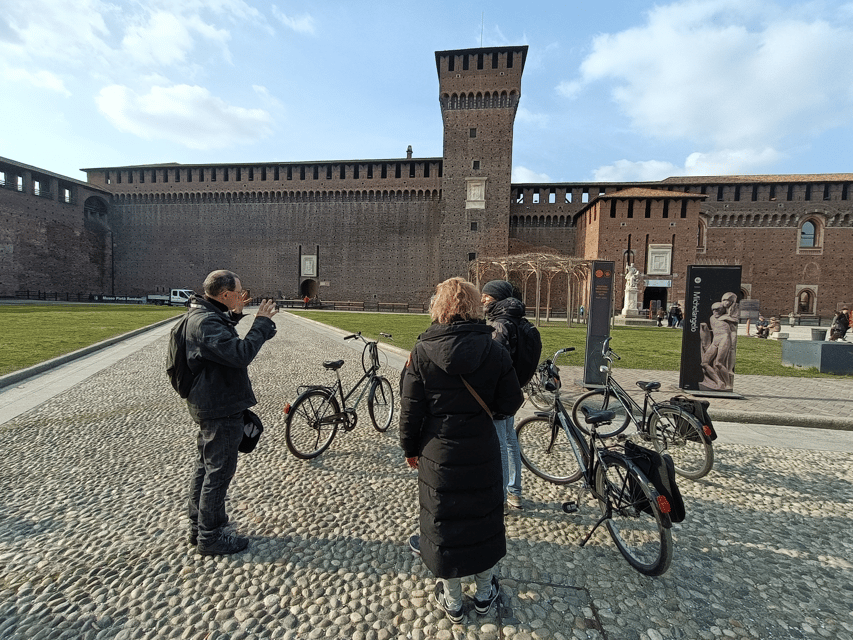
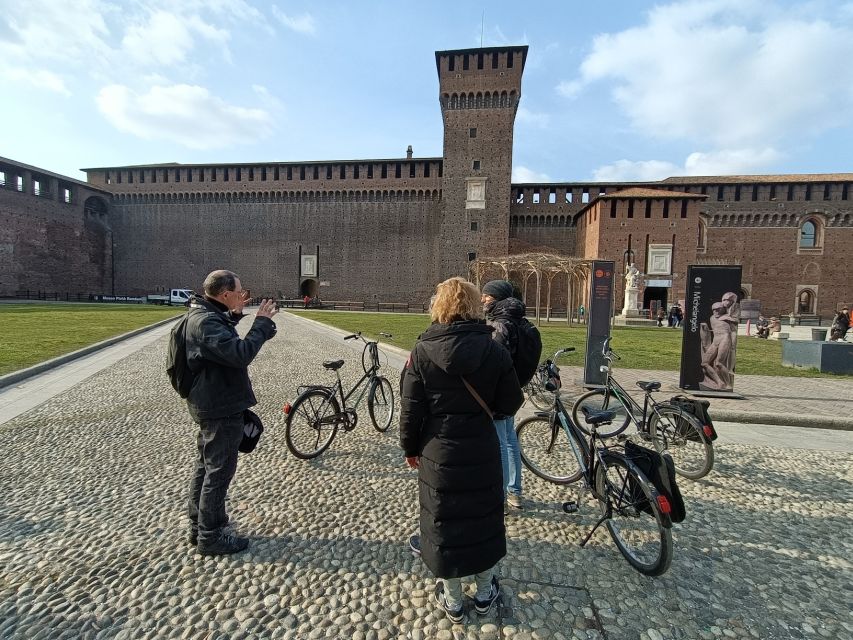
Sforza Castle is one of the best starting points in Milan because it gives the city an immediate sense of scale and power. You will cycle to the outside of the monument, enter its inner courtyards, and hear about its art and history. The courtyards offer more than a quick roadside photograph, though this is still not a full museum visit.
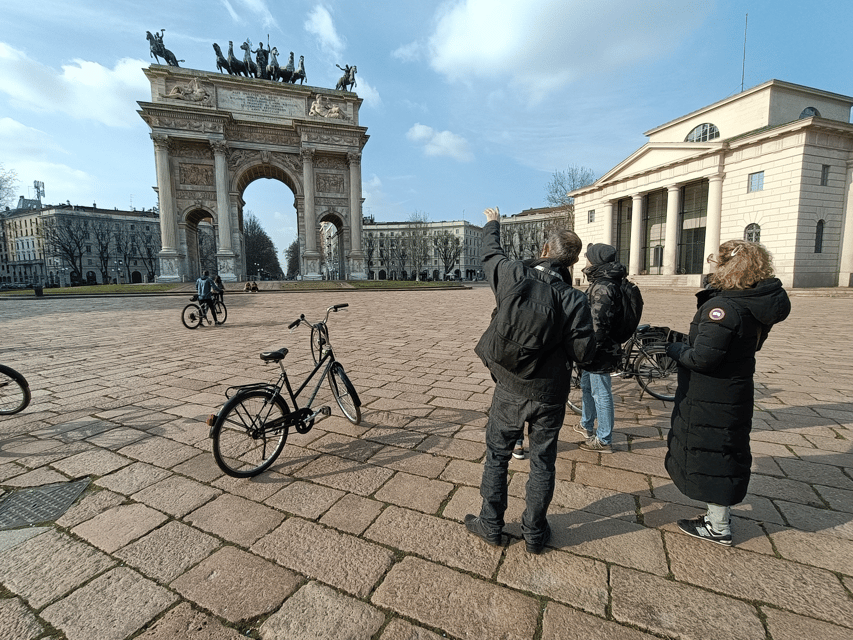
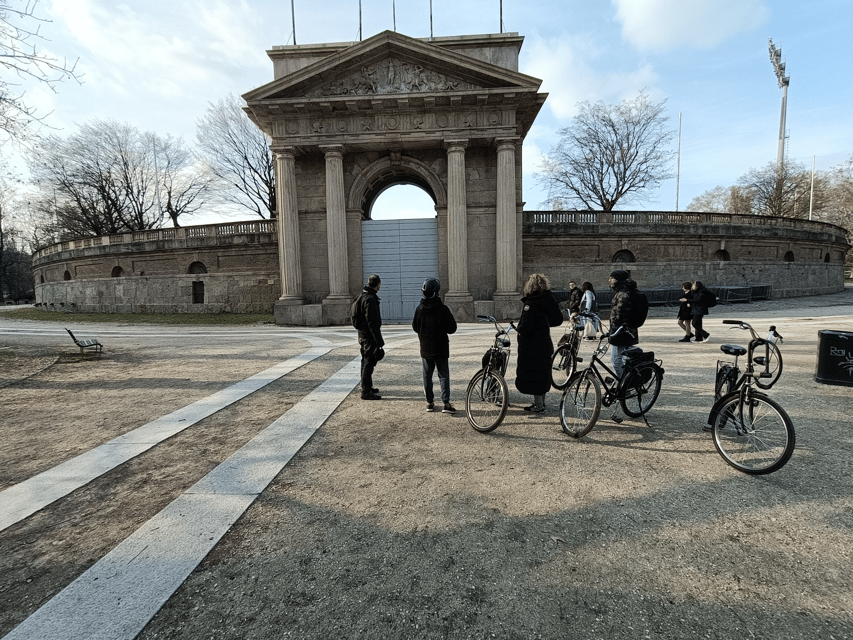
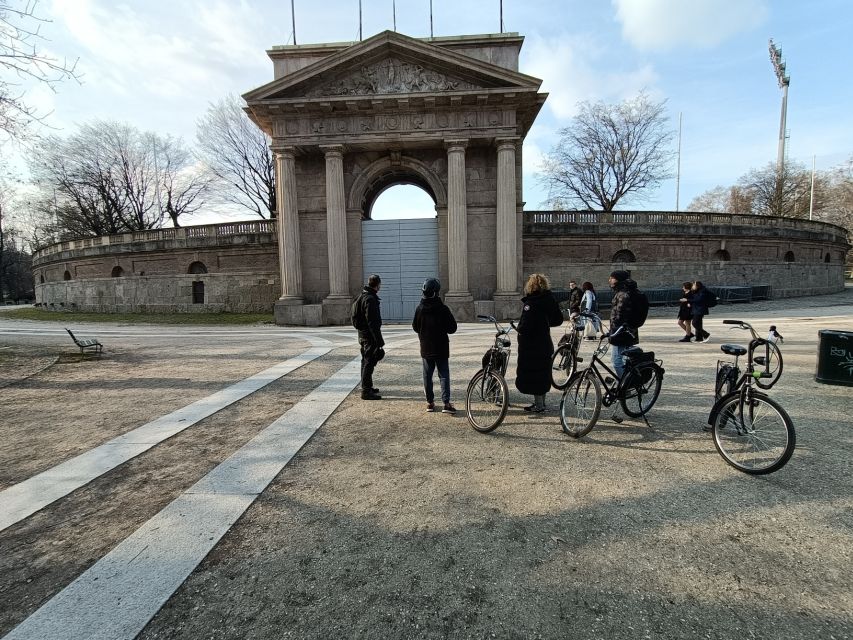
The castle also gives you a useful introduction to Milan’s public spaces. Its broad grounds create a break from the city streets, and the route then continues toward the Arco della Pace, or Peace Arch. This large neoclassical gateway was built as a symbol of peace and provides one of the tour’s strongest photo stops.
Your guide may spend more or less time here depending on the group’s questions. That flexibility is useful. The tour is designed to show you many places, but it does not force every stop into a rigid timetable.
Canals, Darsena, and Santa Maria delle Grazie
After the castle and Peace Arch, the ride moves toward Darsena and Milan’s canals. This part of the route helps correct the common idea that Milan is only about fashion, offices, and monumental buildings. Its waterways were once tied to trade and transport, and they give the city a different mood from the formal center.
Darsena is a natural place to stop for photos. You will have time to take pictures before getting back on the bikes. The canals also make a pleasant contrast with the more heavily built parts of the route.
Santa Maria delle Grazie is included as a view during the ride. The itinerary does not include entry to the church or a visit to Leonardo da Vinci’s Last Supper. That distinction matters. If seeing the painting is a priority, you need a separate timed reservation and a different visit. This bicycle tour gives you the exterior setting and wider city context instead.
Rain does not necessarily ruin the outing, but you should dress for the weather. One rider found the tour worthwhile even in the rain because the bike made it possible to reach parts of Milan that would have been less convenient on foot. Comfortable shoes and practical clothing are essential.
San Lorenzo and Milan’s Roman remains
The next part of the route reaches San Lorenzo and its Roman columns. These weathered columns are among the clearest visible reminders of ancient Milan. They sit in a city that has changed repeatedly, so you can see Roman material beside later churches, streets, and modern urban life.
You will also pass the Roman ruins on Via Brisa. This stop is less polished than the Duomo or Galleria, which is part of its appeal. It helps you see that Milan’s past is not confined to a single archaeological museum. Pieces of older Milan appear in ordinary streets and public spaces.
The Basilica di Sant’Ambrogio adds another major historical point. It is one of the city’s important churches and is closely tied to Milan’s religious identity. The tour gives you an explanation and an exterior view rather than a complete interior visit.
I find this section especially useful because the guide can connect separate fragments into a story. Without context, columns and ruins can look like isolated stones. With a good explanation, you understand why they matter and how they belong to the city around them.
More Milan trips worth a second look
- Milan: Da Vinci’s Last Supper Guided Tour
★ 4.7 · 10,143 reviews - Milan: City Sightseeing Hop-On Hop-Off Bus with Audio Guide
★ 4.0 · 6,256 reviews - Milan: Guided Walking Tour & Last Supper Visit with Ticket
★ 4.7 · 5,409 reviews - Milan: Fast-Track Milan Cathedral and Terraces Guided Tour
★ 4.7 · 5,240 reviews
Piazza Affari and L.O.V.E.
The route then heads to Piazza Affari, Milan’s financial square. Here you will see Maurizio Cattelan’s contemporary sculpture L.O.V.E., a large hand with its fingers removed except for the central finger.
This is a sharp change from churches, castles, and Roman remains. The work is provocative, and the location adds to the point: an unusual modern sculpture sits directly in front of Milan’s stock exchange. The tour pauses here for photographs and a short explanation.
I like this stop because it prevents the itinerary from becoming a parade of old buildings. Milan is also a city of finance, design, fashion, and current artistic debate. The contrast between Piazza Affari and Sant’Ambrogio gives you something to think about, not just another pretty façade.
Do not expect a long contemporary art lecture. The stop is brief, and the point is to see the work in its urban setting. It works best as one memorable piece in a larger city tour.
Mercanti Square, La Scala, and the Galleria
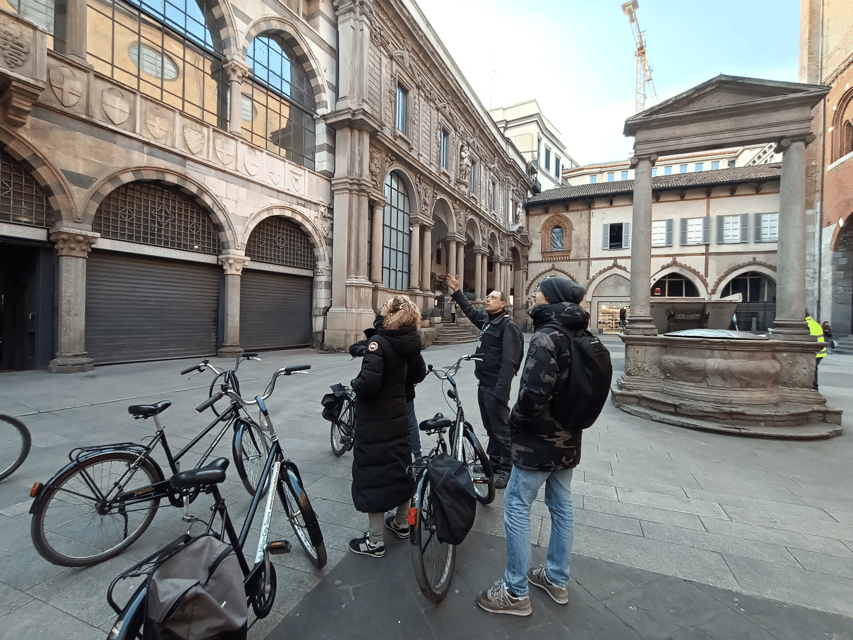
From Piazza Affari, you continue to Mercanti Square, a central medieval square close to the Duomo. Its setting helps you read the historic center as a connected civic area rather than a collection of isolated attractions.
The route then reaches La Scala Square and the Teatro alla Scala. Milan’s opera house is famous around the world, but the exterior can be easy to rush past when you are walking through the center. A guide can explain why this building matters to Milan’s cultural life and point out how it fits into the surrounding square.
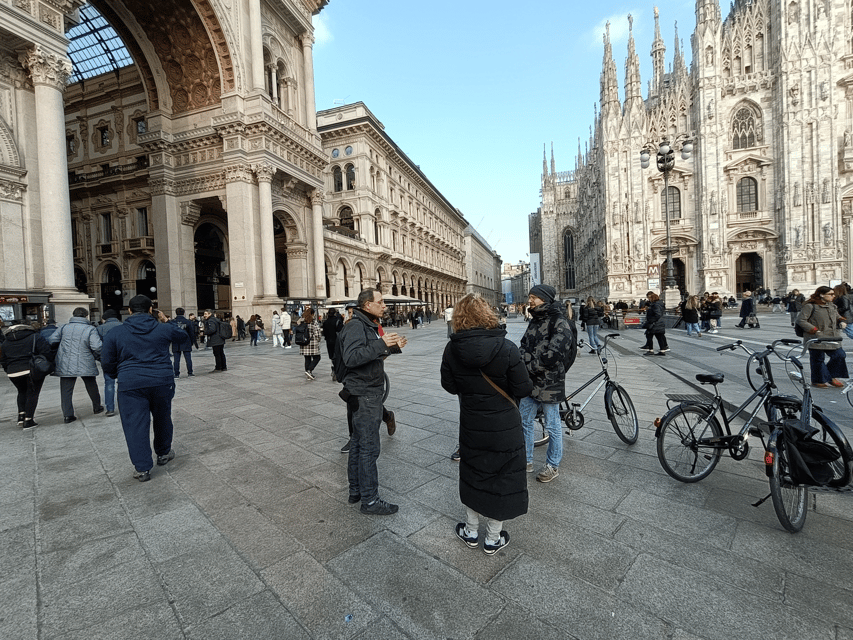
Next comes the Galleria Vittorio Emanuele II, one of Milan’s grandest public interiors. Its glass roof, iron structure, mosaics, and elegant shops make it more than a shopping passage. You can pause to look up, take photographs, and watch the steady flow of people moving between La Scala and the Duomo.
This portion of the ride is where the bicycle provides a practical advantage. You arrive with more energy than you might have after walking across the city, but the guide still gives you time to stop and look. You should remember that crowded pedestrian areas may require you to walk the bicycle for part of the route, depending on local conditions and the guide’s instructions.
Finishing at the Duomo
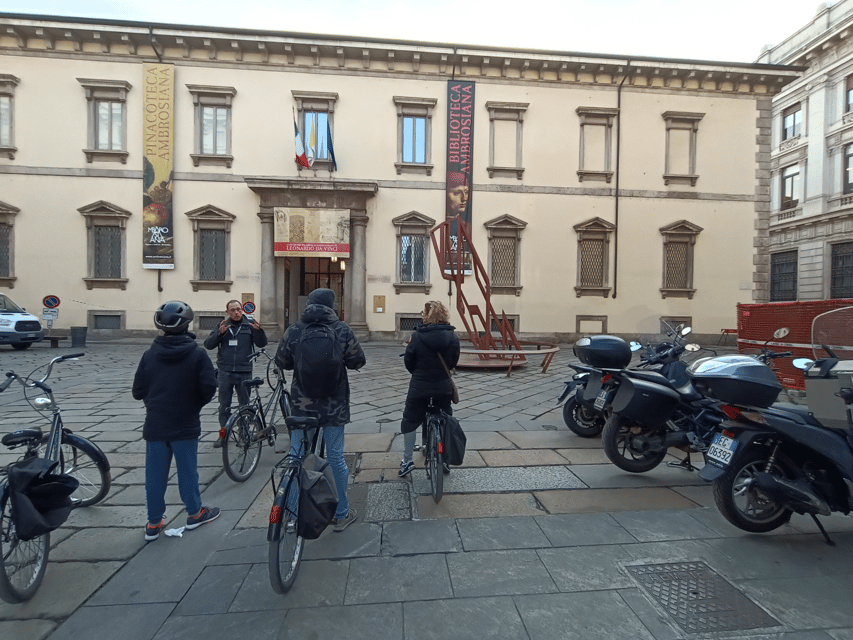
The final major stop is Duomo Square. The cathedral’s scale makes it an obvious climax to the route, and you will have another short photo session before returning to the starting point.
The tour does not include admission to the Duomo. That keeps the bicycle outing within three hours, but it also means you need a separate ticket if you want to visit the cathedral interior or terraces. The bike tour is best viewed as an orientation and overview, not a replacement for Milan’s major paid sights.
Still, arriving at the square after seeing so much of the city gives the Duomo more meaning. You have already passed through places tied to Milan’s military power, religious life, ancient past, modern finance, and cultural prestige. The cathedral becomes part of that larger story.
The activity ends back at the Cargo bike store. Since there is no hotel pick-up or drop-off, you need to make your own way to the meeting point and plan your onward route after the ride.
Guides, group size, and the pace of the ride
The live commentary is available in English or French. Emilio has been praised for his command of English, his grasp of Milanese history and culture, and his ability to keep the tone relaxed. Katharine has also received strong praise for clear explanations, a comfortable ride, and allowing time at the stops rather than rushing the group.
Those details matter more than a long list of attractions. A city bike tour succeeds or fails on the guide’s timing, route choices, and ability to explain what you are seeing while keeping the group together.
The group limit of eight is another real advantage. You can usually hear the guide without standing in a tight crowd, and asking a question is less awkward than it would be in a large coach group. The guide can also shape the conversation around the interests of the people on the ride.
The pace sounds suited to sightseeing rather than sport, but you still need suitable footwear and clothing. Luggage and large bags are not allowed, and intoxicated participants cannot join. These rules are sensible on a bicycle, especially when the route includes several stops and city streets.
Is $55.80 good value?
At $55.80 per person, the tour offers three hours of guiding, bicycle use, and a helmet. There are no hotel transfers, museum admissions, or food costs included.
I consider the price fair if your goal is to see many central landmarks with useful context in a short time. Paying for a guide means you are not simply cycling past the castle, canals, ruins, and squares without knowing why they matter. The bicycle also saves time between districts.
The value is weaker if you prefer slow museum visits or want to enter every major building. You will see the outside of many landmarks and go inside only where the route specifically includes access, such as the courtyards of Sforza Castle. In that case, combine this tour with separate visits to the Duomo, La Scala, and Santa Maria delle Grazie.
Free cancellation up to 24 hours before the start gives you some planning room, and the reserve-now, pay-later option can help if your Milan schedule is still shifting. Check the available starting times before booking.
Who should book this Milan bike tour?
I would choose this experience for a first visit, especially if you have only a short stay and want a strong overview on your first full day. It also suits anyone who likes history but does not want to spend three hours inside one museum.
It is a good match for couples, friends, and families with older children who can ride comfortably. The small group makes it more personal than a large city sightseeing tour, while the three-hour length keeps the commitment manageable.
I would be more cautious if you dislike bicycles, have mobility concerns that make cycling difficult, are pregnant, or are above the stated weight limit. It is also not ideal if your main goal is a long visit inside the Duomo, the Last Supper, or La Scala.
Final verdict: a fast, useful introduction to Milan
Book this tour if you want to cover Milan’s major sights while also seeing Roman remains, canals, and contemporary public art. The route is varied, the group is small, and guides such as Emilio and Katharine bring the history to life without making the ride feel like a formal classroom.
Skip it if you want a slow architectural walk or a ticketed museum experience. For most first-time visitors who are comfortable on a bike, $55.80 buys a practical three-hour introduction and a much clearer sense of how Milan’s different eras fit together.
FAQ
How long is the Milan guided bike tour?
The tour lasts three hours. Starting times vary, so check availability when you book.
What languages are available?
The live tour guide is available in English or French.
How many people are in the group?
The group is limited to eight participants.
Where does the tour start and finish?
You meet at the Cargo bike store, and the activity ends back at the same meeting point.
Is a bicycle provided?
Yes. Bicycle use and a helmet are included in the price.
Does the tour include hotel pick-up?
No. Hotel pick-up and drop-off are not included.
What should I bring?
Bring an ID card, comfortable shoes, suitable clothing, and a copy of your payment or voucher if you booked online.
Can children join the tour?
Participants under 18 must be accompanied by a legal guardian. Unaccompanied minors cannot join.
Recently reviewed around Milan
- Verona and Lake Garda Day Trip from Milan★ 4.5 · 214 reviews
- From Milan: Venice Full-Day Guided Tour With Boat Ride★ 4.5 · 322 reviews
- Venice Day Trip from Milan with Guided City Tour★ 4.0 · 383 reviews
- Full-day Skip-The-Line Milan, The Last Supper and Duomo Cathedral★ 5.0 · 293 reviews
- Small-Group Lake Como & Lugano by Swiss Train + Boat Cruise★ 5.0 · 1,084 reviews
- Tour Bernina Red Train And St Moritz from Milan★ 4.5 · 247 reviews
- Walking Food Tour of Milan with Tastings★ 4.5 · 194 reviews
- Skip the Line: Essential Milan Tour Including Da Vinci’s ‘The Last Supper’★ 4.5 · 339 reviews
Cycling Tours, compared.
Rome EBike Tour: Appian Way, Catacombs & Roman Aqueducts
Read our review →
Top Highlights & Hidden Gems Tour by Cannondale E-Bike
Read our review →
Appian Way, Catacombs, & Roman Aqueducts E-bike Tour
Read our review →
Rome City Small Group Bike Tour with quality Cannondale EBike
Read our review →
Tuscany Bike Tours Through the Chianti Hills with Wine Tasting
Read our review →
Rome by Night – Ebike Small Group Tour – Food and Wine (Option)
Read our review →
Appian Way E-bike Tour with Catacombs, Aqueducts & Food
Read our review →
Browse the lists this tour appears in