Review · GUIDED
Rome: Catacomb of St. Callixtus and Appian Way Guided Tour
The most striking part of this outing is the Catacombs of St. Callixtus, where narrow passages lead past burial niches, early Christian drawings, and the Crypt of the Popes. It is a quiet, sobering look at how ordinary Romans buried their dead outside the city walls.
I like two things especially. First, the tour joins several hard-to-reach sights in one morning: the catacombs, the Appian Way, Cecilia Metella’s tomb, and the aqueduct park. Second, the change of setting is welcome after crowded days around the Colosseum and Vatican. You trade traffic and stone streets for open ground and ancient engineering.
The main drawback is that this is not a relaxed sightseeing ride with little walking. You will go up and down steps underground and walk outdoors on uneven historic roads. The minivans are comfortable, but one account found the low windows poor for seeing the countryside.
In This Review
- Key points at a glance
- Why go beyond Rome’s city walls
- Inside the Catacombs of St. Callixtus
- Walking the Appian Way and seeing Cecilia Metella
- Roman aqueducts at Parco degli Acquedotti
- The guiding makes the difference
- Is $80 a fair price?
- What to wear and how to prepare
- Who should book this Rome catacomb tour?
- Should you book it?
- FAQ
- Where does the tour meet?
- How early should I arrive?
- How long does the tour last?
- What language is the tour in?
- Is transportation included?
- Does the tour include Catacombs of St. Callixtus admission?
- Can I take photographs inside the catacombs?
- What clothing is required?
- Is the tour wheelchair accessible?
- Can I cancel the booking?
Key points at a glance
- St. Callixtus underground: See burial chambers, sarcophagi, religious drawings, and the Crypt of the Popes.
- Three ancient sights in one outing: Combine the catacombs, Appian Way, and Roman aqueducts without arranging separate transport.
- A peaceful break from central Rome: The Appian Way and aqueduct park feel far removed from the city center.
- Strong guiding: Guides including Catia, Marije, Francesca, Lara, and Marije’s fellow guides have been praised for clear storytelling and useful Rome advice.
- Plan for stairs and modest clothing: The catacombs are not wheelchair accessible, and shorts, sleeveless tops, and short skirts are not allowed.
- Good value at $80: Transport, admission, reservations, headsets, and guiding are included, which matters for sights outside the usual tourist circuit.
Why go beyond Rome’s city walls
Rome can fill several days without leaving the historic center. You can spend hours at the Colosseum, Roman Forum, Pantheon, and Vatican Museums, then wonder if there is room for anything else.
I think this three-hour trip earns that room. It gives you a different picture of Rome, one tied to burial customs, early Christianity, road building, and water supply. These are not simply extra ruins added to your sightseeing list. Together, they show how the city worked beyond its famous monuments.
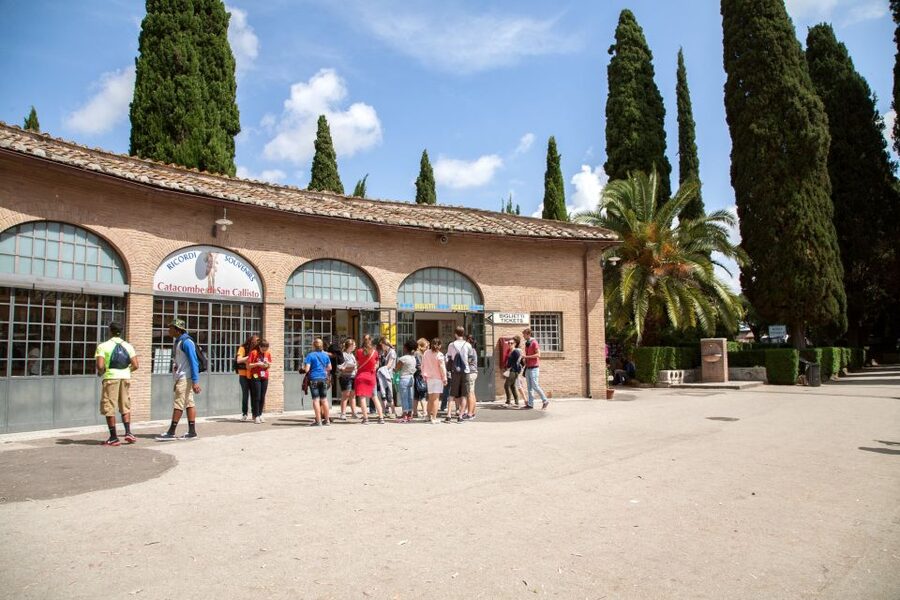
The meeting point is at the bus stop on Via Cavour 224, close to Cavour Metro station on Line B. Arrive 25 minutes before departure. From there, transport carries you between the sites, a real advantage because the catacombs and aqueduct park are difficult to combine efficiently on your own.
The group travels in a minibus or small coach. Most accounts describe the transport as comfortable, and the driver Mario received repeated praise for handling Rome traffic. The smaller vehicle also makes this feel more personal than a large coach tour, though the tradeoff is limited window views in some vans.
More Rome trips worth a second look
- Colosseum, Roman Forum & Palatine Guided Tour
★ 4.7 · 63,148 reviews - Vatican Museums, Sistine Chapel & St Peter’s Basilica Guided Tour
★ 4.5 · 39,149 reviews - Rome: Colosseum, Palatine Hill and Roman Forum Guided Tour
★ 4.8 · 32,814 reviews
Inside the Catacombs of St. Callixtus
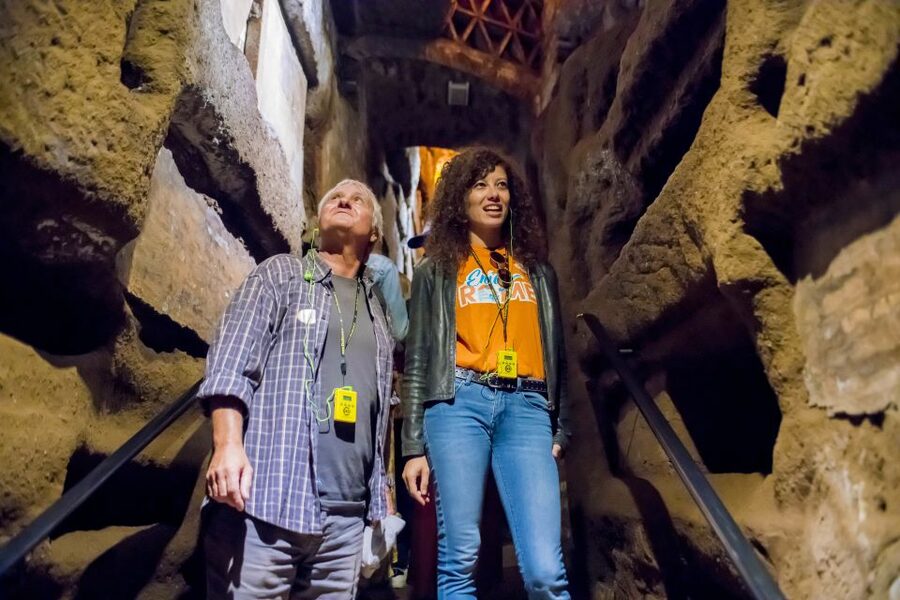
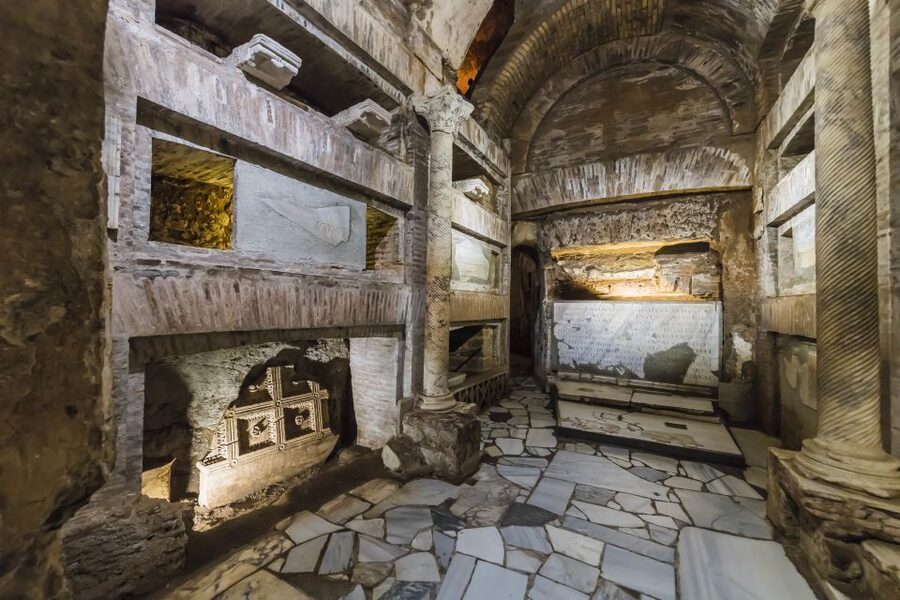
The catacombs are the heart of the outing. They were cut into the soft tufa rock outside ancient Rome between the second and fifth centuries, when Christian communities needed burial space for large numbers of people. Many families could not pay for grand tombs, so underground galleries offered a more practical solution.
Inside, expect narrow corridors and walls lined with burial niches. You may see mosaics, sarcophagi, inscriptions, and early religious drawings. The scale is difficult to grasp from a quick look, so the guide normally walks far enough through the passages to help you understand that this is a large underground complex, not a single small chamber.
A local catacomb guide conducts the visit at St. Callixtus. The main tour guide then handles the rest of the day. That arrangement is useful because the catacomb guide deals with the site’s specific rules and spaces, while your overall guide keeps the wider Roman story connected.
The Crypt of the Popes is one of the key stops. It is associated with early Christian leaders buried here, and the visit also includes a view of a replica tomb connected with St. Cecilia. The art is simple compared with the grand decoration of later churches, but that is part of its force. These are among the earliest examples of Christian art in Rome.
The tunnels are cool, even during Rome’s hottest months. One summer visitor valued the underground temperature as much as the history. That said, do not book this if enclosed spaces cause serious distress. The passages are underground, the lighting is limited, and photography is forbidden.
You also need suitable clothing. Shorts, short skirts, and sleeveless shirts are not permitted. Women must have their shoulders covered, and skirts or trousers should fall below the knee. This is a place connected with Christian worship and burial, so dress for a religious site rather than a hot-weather stroll.
Walking the Appian Way and seeing Cecilia Metella
After the catacombs, the outing continues toward the Appian Way, or Via Appia Antica. This ancient road once connected Rome with southern Italy and remains one of the clearest places to sense the reach of Roman construction outside the city.
The tour includes a walk along part of the original road. The paving is uneven, so wear sturdy shoes and watch your footing. You are not walking the entire route, but even a short section gives you a feel for the road as a working piece of Roman infrastructure rather than a museum display.
The Mausoleum of Cecilia Metella is viewed from the exterior. This large tomb is one of the most recognizable monuments along the Appian Way, and your guide explains its place in the ancient road corridor. Do not expect an extended indoor visit here. The value is in seeing the monument in its original setting, alongside the old road and surrounding countryside.
This section can be affected by weather. On one rainy, cold morning, some participants remained on the bus while others walked with the guide. On a pleasant day, the walk becomes one of the tour’s calmest moments. The road offers a needed change after the darker catacomb visit.
The guides often add context during the drive. Past guides such as Francesca, Catia, Lara, Marije, and Marina or Monica have been praised for explaining sights seen from the bus and offering suggestions for later visits in Rome. That extra commentary makes the transport time useful rather than dead time.
Roman aqueducts at Parco degli Acquedotti
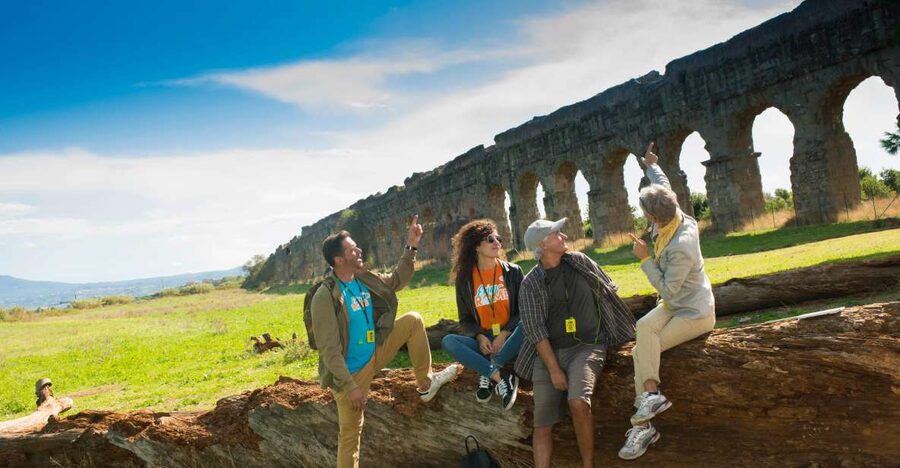
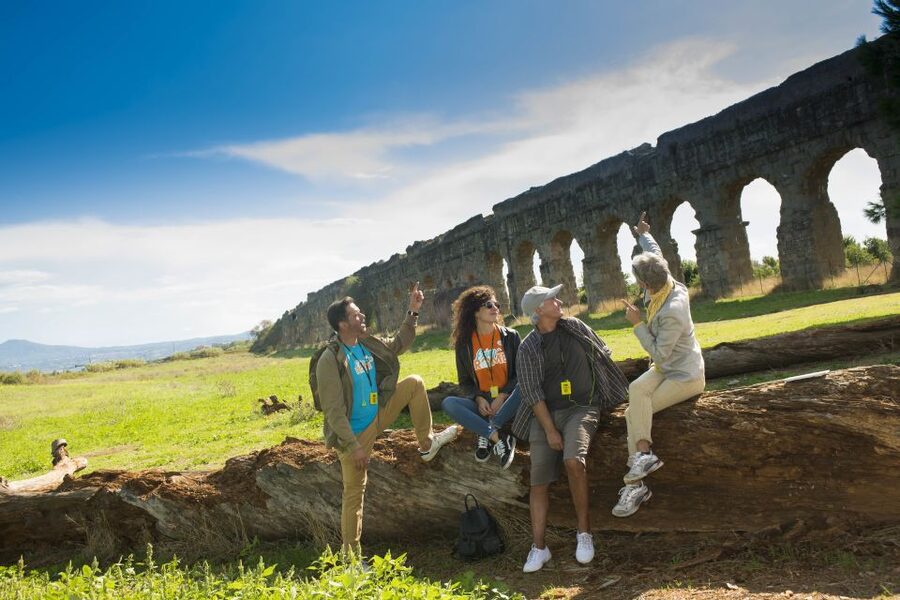
For me, the aqueduct park is likely to be the visual highlight. After parking, you walk along a path to see the great arches of Rome’s ancient water system. The setting is open and quiet, with far more room to step back and take in the structure than you get around central Rome’s monuments.
The aqueducts show Roman engineering on a huge scale. Their purpose was practical: carrying water across the countryside and into the city. Yet the repeated arches have a powerful visual rhythm, and the park lets you appreciate both the technology and the setting.
You are not merely looking at a fragment behind a railing. The walk provides room to move and view the arches from different points. Several people have described this stop as peaceful and unexpectedly memorable, especially after several crowded days in central Rome.
The aqueduct park is also a good reason to take this tour instead of a catacomb visit alone. The day moves from underground burial chambers to a historic road, then into open space beneath monumental water channels. That contrast gives the outing a natural shape.
The amount of walking is moderate, but it is not zero. One person who used a cane managed the stairs and walking, while another visitor with difficulty walking appreciated the vehicle transfers between sites. I would still ask yourself how comfortably you manage uneven ground and steps before booking.
A different way to spend the day, same part of Italy:
- Vatican: Museums & Sistine Chapel Entrance Ticket
★ 4.5 · 144,003 reviews - Vatican Museums & Sistine Chapel Tour with Optional Basilica
★ 4.3 · 67,413 reviews - Rome: Guided Tour of Colosseum, Roman Forum & Palatine Hill
★ 4.7 · 27,897 reviews - Rome: Colosseum & Forum with Audio Guide App -Optional Arena
★ 4.2 · 24,770 reviews
The guiding makes the difference
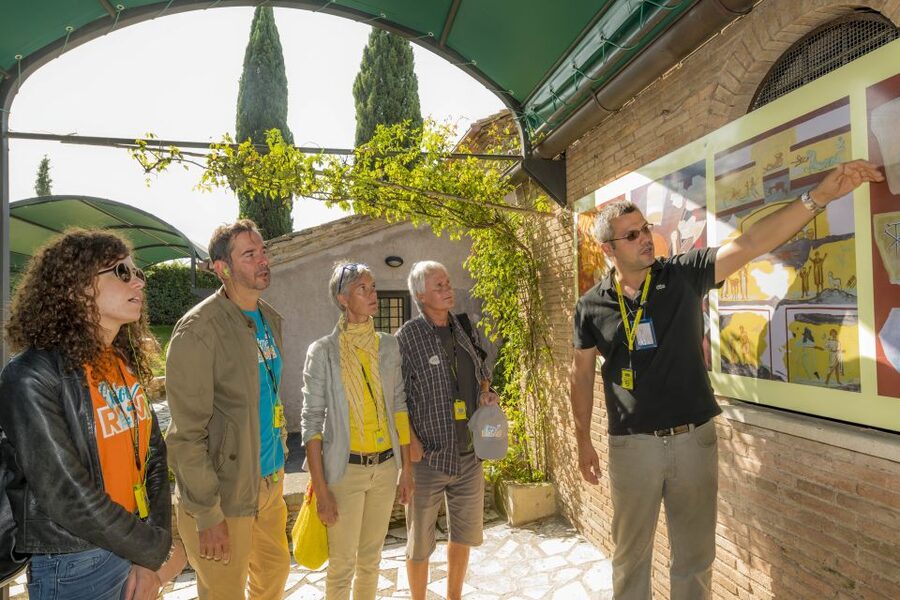
The sights are strong on their own, but the guide determines how much you get from them. The best guides on this route do more than recite dates. They explain what the spaces meant, connect one stop to the next, and keep the ride between sites useful.
Catia has been singled out for lively explanations, patience with children, and practical recommendations for other places in Rome. Marije was praised for storytelling, humor, and a good balance between firm historical detail and lighter trivia. Francesca received similar praise for keeping the pace steady while adding information about sites along the drive.
Other highly regarded guides include Lara, who has an archaeology background, Marcello, Magda, Luisa, and Marije’s fellow English-speaking guides. Names and guide assignments can change, so you should not book on the promise of one particular person. Still, the repeated pattern is encouraging: the company has produced guides who can explain complex subjects in clear English and answer questions.
Headsets are included. These matter when the guide is speaking beside a road, in a park, or while the group spreads out along the Appian Way. The equipment has generally been considered easy to hear, and it helps you pay attention without standing shoulder to shoulder around the guide.
The tour is in English. Some earlier departures included people with different first languages, so clear pronunciation matters. The catacomb guide’s well-articulated English has been especially useful for historical terms and religious details.
Is $80 a fair price?
At $80 per person, this is not the cheapest way to spend three hours in Rome. But the price includes transport from and back to the meeting point, catacomb admission, booking fees, a three-hour guided visit, and headsets.
That package has real value because the sites sit outside the normal center-city route. You could try to arrange public transport and separate entries, but the day would require more planning and less flexibility. The tour also handles the transitions, which is valuable in Rome’s traffic.
The small-vehicle format is another part of the calculation. You are not paying for a private tour, but the group is generally small enough to feel manageable. One group had only six people, and another had about 14. The minimum is five participants, so a departure can be rescheduled or cancelled with a full refund if too few people book.
Lunch is not included. The scheduled experience lasts three hours, and accounts have described returning around lunchtime. That timing makes it easy to plan a meal afterward, but you should not expect food or a full-day excursion.
Free cancellation is available up to 24 hours before departure, and you can reserve now and pay later. Those terms are useful when Rome plans are still shifting.
What to wear and how to prepare
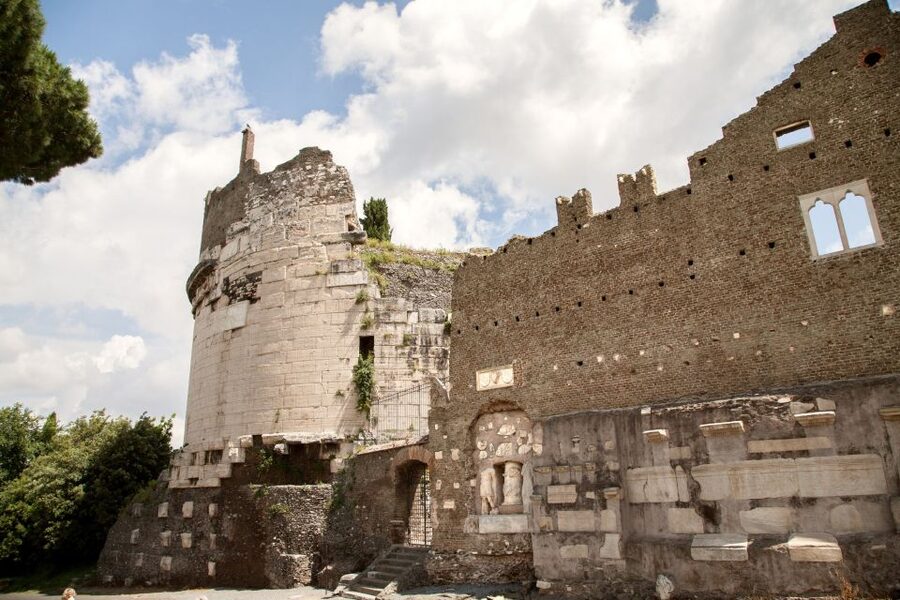
Your preparation matters more here than it does for an ordinary bus tour. Wear comfortable shoes for the Appian Way and aqueduct park, and bring clothing that meets religious-site rules.
Keep these points in mind:
- Arrive at Via Cavour 224 at least 25 minutes early.
- Use Cavour station on Metro Line B as the nearest metro stop.
- Wear trousers or a below-the-knee skirt and cover your shoulders.
- Expect steps in the catacombs.
- Do not plan to take photographs underground.
- Bring water for the outdoor walking portions, especially in warm weather.
- Tell yourself honestly if enclosed spaces are a serious problem.
- Do not bring pets.
- The tour is not wheelchair accessible.
The drive between stops gives you useful sitting time. That helps if you have already spent days walking through Rome, but it does not make the tour suitable for anyone unable to manage the underground stairs or outdoor surfaces.
Who should book this Rome catacomb tour?
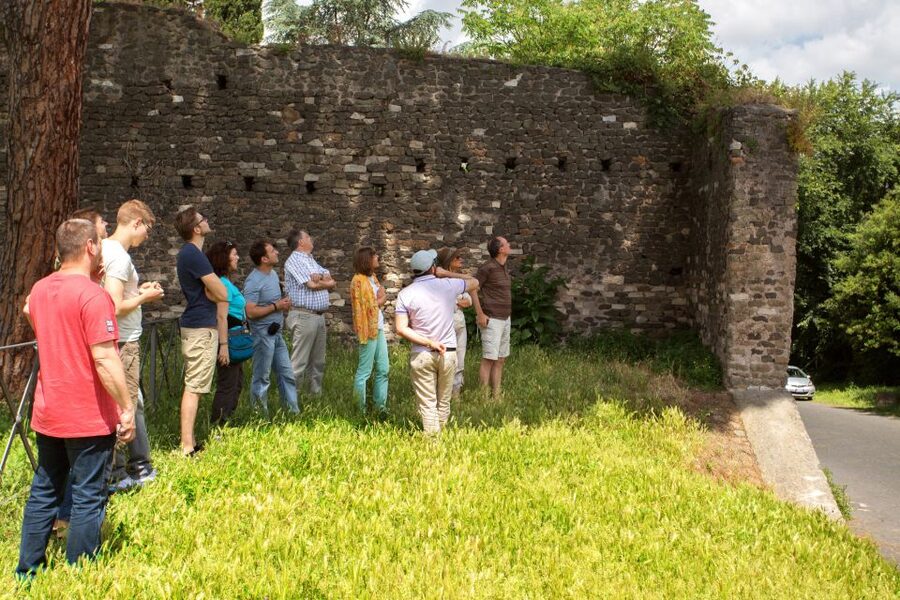
I would choose this outing if you have at least three days in Rome and want to move beyond the standard ancient-city circuit. It suits people interested in early Christianity, Roman engineering, archaeology, and quieter places where the setting does much of the work.
It also fits families who can manage stairs and follow the clothing rules. One guide was praised for adjusting the pace for children and allowing breaks, though the underground environment may not suit every child.
The tour is less suitable if your Rome visit is very short, you want a slow private experience, or you dislike organized transport. You also may prefer a different activity if you want extensive time inside Cecilia Metella’s mausoleum, since this tour views it from outside.
Should you book it?
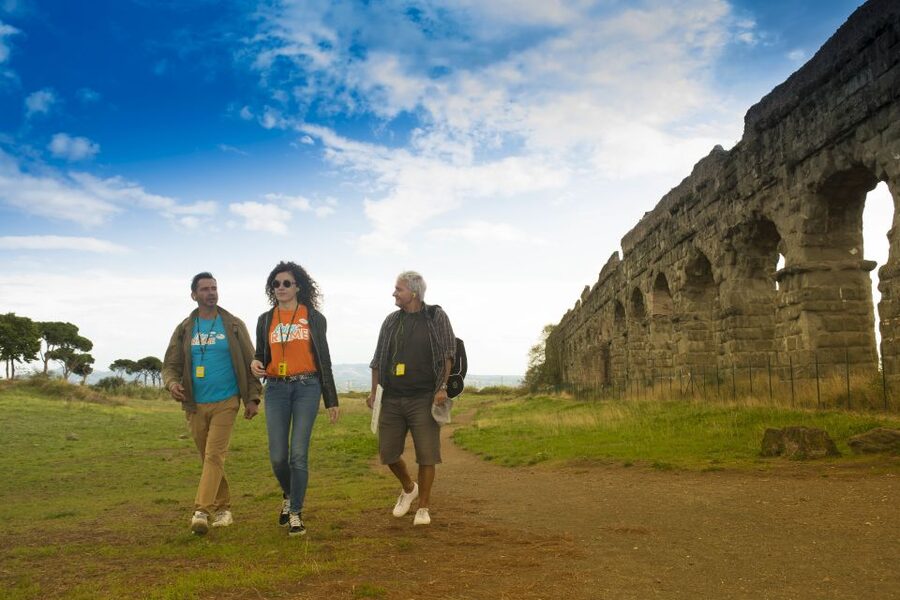
Book this tour if you want a well-organized way to see three distinct parts of ancient Rome that are awkward to connect on your own. The catacombs offer the most unusual experience, the Appian Way supplies the sense of place, and the aqueducts deliver the broad views and Roman engineering.
I would skip it only if stairs, uneven paths, enclosed spaces, or modest dress rules are a serious concern. For most visitors with an extra morning, $80 is a sensible price for the transport, admissions, and strong historical guiding. It is a welcome change from Rome’s packed center and one of the better ways to see how far the ancient city reached.
FAQ
Where does the tour meet?
The meeting point is at the bus stop at Via Cavour 224. Cavour station on Metro Line B is the nearest metro stop.
How early should I arrive?
Arrive 25 minutes before the scheduled departure time.
How long does the tour last?
The advertised duration is three hours. One account described an outing of about three and a half hours, so allow a little flexibility around the stated schedule.
What language is the tour in?
The tour is conducted in English with a live guide.
Is transportation included?
Yes. Transport from and back to the meeting point is included, with travel between the sites by bus or minibus.
Does the tour include Catacombs of St. Callixtus admission?
Yes. The tour includes a guided visit, entrance fees, and booking fees for the Catacombs of St. Callixtus.
Can I take photographs inside the catacombs?
No. Photography is not permitted inside the catacombs.
What clothing is required?
Shorts, short skirts, and sleeveless shirts are not allowed. Shoulders must be covered, and skirts or trousers should fall below the knee.
Is the tour wheelchair accessible?
No. The tour is not wheelchair accessible and includes stairs in the catacombs.
Can I cancel the booking?
You can cancel up to 24 hours in advance for a full refund. You can also reserve now and pay later.
Recently reviewed around Rome
- Haunted Rome Ghost Night Walking Tour★ 5.0 · 495 reviews
- Rome Private Tour: Highlights and Hidden Gems★ 5.0 · 374 reviews
- Haunted Rome Ghost Tour – The Original★ 4.5 · 668 reviews
- Hadrian’s Villa and Villa d’Este Half-Day Trip from Rome★ 3.5 · 808 reviews
- Super Fun Pasta & Gelato Class by Vatican with Wine + Oil Tasting★ 5.0 · 726 reviews
- Rome Golf Cart Tour : Half-Day Private or Small Group Sightseeing★ 5.0 · 528 reviews
- Guided Tour Vatican Museums & Sistine Chapel with Basilica Access★ 5.0 · 309 reviews
- Rome: Skip-the-Line Vatican Museums and Sistine Chapel Tour★ 4.5 · 241 reviews
Guided, compared.
Colosseum, Roman Forum & Palatine Guided Tour
Read our review →
Vatican Museums, Sistine Chapel & St Peter’s Basilica Guided Tour
Read our review →
Colosseum, Palatine Hill and Roman Forum Guided Tour
Read our review →
Guided Tour of Colosseum, Roman Forum & Palatine Hill
Read our review →
Colosseum & Forum with Audio Guide App -Optional Arena
Read our review →
Colosseum, Roman Forum and Palatine Hill Guided Tour
Read our review →
Naples Underground Entry Ticket and Guided Tour
Read our review →