
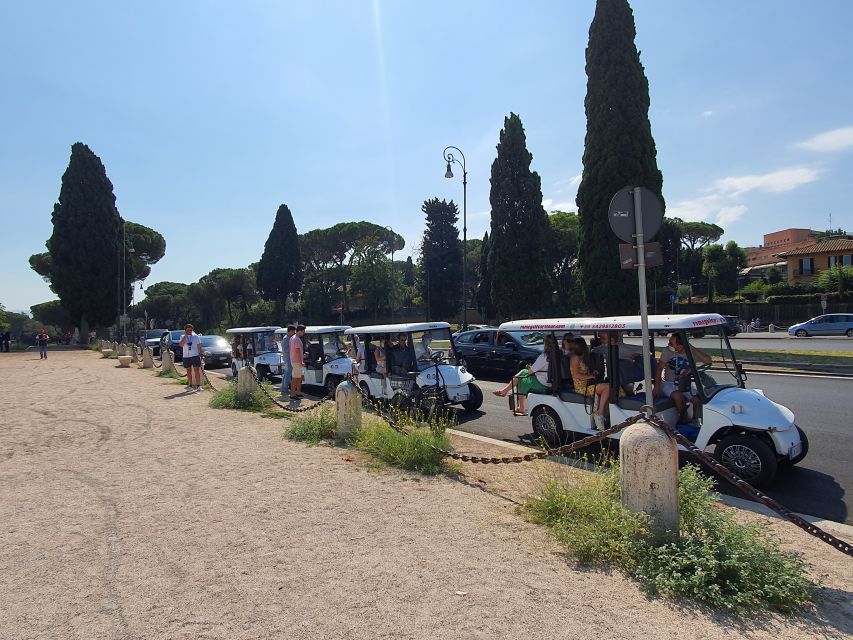
Review · GOLF CART TOURS
Rome: Catacombs and Appian Way Golf Cart Small-Group Tour
The most unusual part of this Rome tour comes below ground. You descend about 16 meters into the catacombs, where early Christians carved burial chambers and places of worship into the earth. Above ground, a golf cart carries you between widely scattered ruins, so you can cover a great deal of Ancient Rome without spending the day on foot.
I like two things here. First, the Appian Way and catacombs pairing gives you both Rome’s grand monuments and its quieter, more solemn side. Second, guides such as Federico, Anna, Antonella, and Claudio are praised for turning bare ruins into clear stories, jokes, and vivid pictures of ancient life. The main catch is the ride itself: cobbled streets can be bumpy, and parts of the monuments are difficult to see from inside the cart.
In This Review
- Key points to know before booking
- Why the golf cart works for Ancient Rome
- The Colosseum and Baths of Caracalla set the scene
- Domine Quo Vadis and the first Christian stories
- The catacombs: sacred, cool, and physically demanding
- The Appian Way puts Rome’s engineering under your feet
- Circus of Maxentius and San Sebastian
- Pyramid of Caius Cestius and the city’s southern edge
- Circus Maximus and the best photo pauses
- Theatre of Marcellus, Venetian Square, and Trajan’s Column
- Guides, headsets, and the human side of the tour
- Is $113.29 a fair price?
- Who will enjoy this Rome tour most?
- Should you book it?
- FAQ
- How long does the tour last?
- What language is the tour conducted in?
- Where does the tour begin?
- Where does the tour end?
- Is the catacomb entrance included?
- Which catacombs does the tour visit?
- How cold are the catacombs?
- Is the tour wheelchair accessible?
- What is included besides the guide and transport?
Key points to know before booking
- Descend 16 meters underground: The catacombs are cool, humid, sacred, and reached by 50 uneven steps down and 50 back up.
- Cover far more ground in three hours: The golf cart links the Colosseum, Appian Way, Circus Maximus, Caracalla’s Baths, and other sites that are too spread out for an easy walking tour.
- Expect an English-speaking guide: Guides including Federico, Anna, Antonella, Alessandro, and Meryl have been praised for warmth, humor, and strong storytelling.
- See the quieter edge of Rome: The Appian Way, San Sebastian, Domine Quo Vadis, and Circus of Maxentius offer a different mood from central Rome’s crowded highlights.
- Use the supplied headset: Traffic and the open-sided cart can make conversation hard, so the headset helps you follow the guide.
- Plan for $113.29 per person: The price is reasonable if you value transport, a live guide, and catacomb admission, but less attractive if you want long visits inside each monument.
Why the golf cart works for Ancient Rome
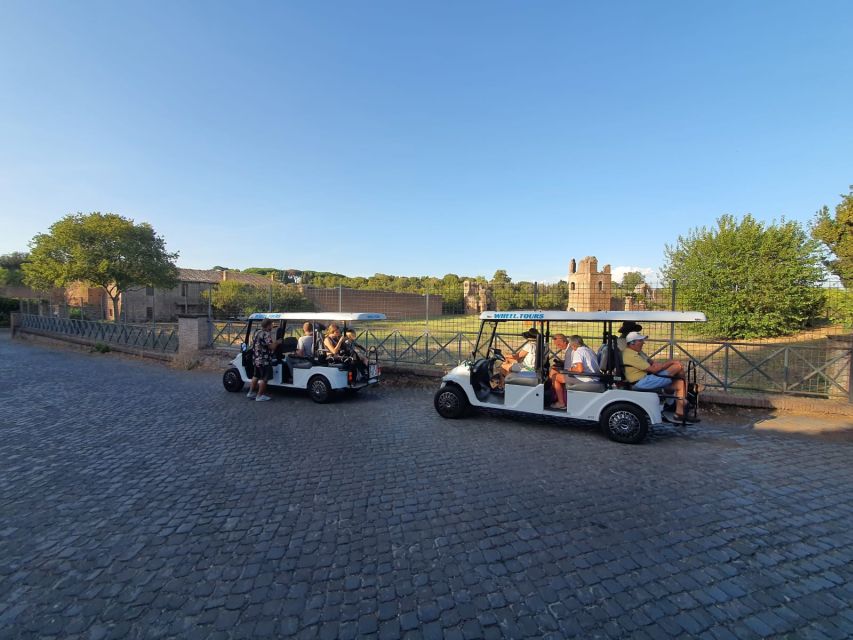
Rome’s ancient sights are not arranged in a tidy museum district. The Colosseum, Caracalla’s Baths, Appian Way, Circus Maximus, Circus of Maxentius, and catacombs sit across a broad area. Walking between them would take much of your day, while public transport does not always connect the archaeological sites in a simple way.
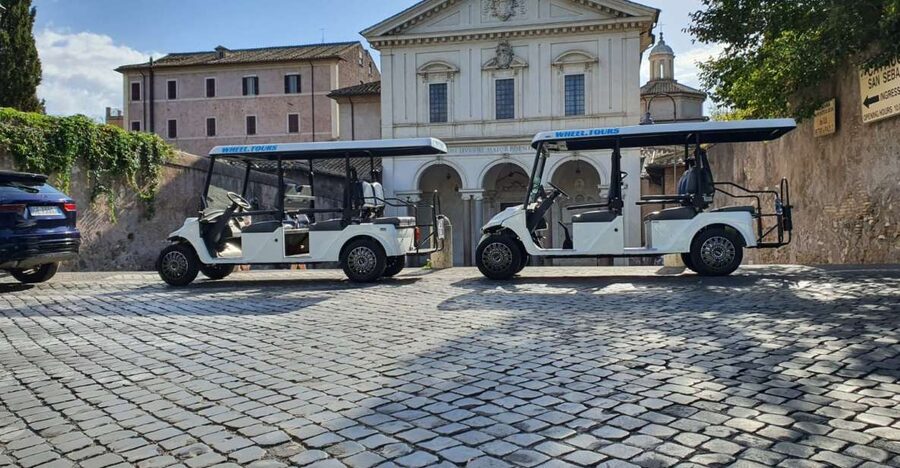
The golf cart solves that problem. You ride between stops while the guide explains what you are seeing, then get out for selected visits and photographs. It is a useful middle ground between a walking tour and a private car: more open and social than a regular vehicle, but much less tiring than covering the same route on foot.
I would not treat this as a slow, scholarly archaeological visit. Three hours is enough to understand the shape of Ancient Rome and see many important places, but not enough to study every ruin at length. The value comes from the route and the interpretation. You see how the sites connect, rather than examining one monument in isolation.
The cart is usually open-sided, and the ride over old stone streets can be rough. Some people also find it hard to see an entire building while seated inside, especially when traffic or other vehicles get in the way. Still, the compact vehicle makes sense for anyone visiting Rome late in a trip, when your feet have had enough.
Other Rome days travellers weigh against this one:
- Vatican: Museums & Sistine Chapel Entrance Ticket
★ 4.5 · 144,003 reviews - Vatican Museums & Sistine Chapel Tour with Optional Basilica
★ 4.3 · 67,413 reviews - Colosseum, Roman Forum & Palatine Guided Tour
★ 4.7 · 63,148 reviews
The Colosseum and Baths of Caracalla set the scene
The route begins with a drive by the Colosseum. You may not enter the amphitheater on this tour, so do not book it as a substitute for a dedicated Colosseum visit. Its role here is to place you in the center of the ancient city and give your guide a dramatic starting point for Rome’s public life, political power, and entertainment.
From there, the cart passes the Baths of Caracalla. These ruins once formed one of Rome’s great public bathing complexes, where bathing was only part of the experience. The baths also offered space for exercise, social life, and leisure. The surviving walls help you picture the size and ambition of Roman building projects, even from a short roadside stop.
This is where the guide matters most. A good explanation helps you imagine the marble, decoration, water systems, and crowds that are no longer there. Federico is particularly noted for describing how sites looked in their original state, while other guides, including Antonella and Alessandro, are praised for mixing facts with humor and questions.
The headset is a practical advantage. Rome’s traffic can be loud, and the cart does not create the quiet setting of a small indoor tour. You can keep listening while the vehicle moves, then ask questions during stops.
Domine Quo Vadis and the first Christian stories
The Church of Domine Quo Vadis brings a different kind of history to the route. The site is linked with the story of Saint Peter meeting Jesus on the Appian Way. It is a brief but memorable stop because it connects a physical road with a religious tradition that shaped Rome for centuries.
You do not need to share the belief behind the story to appreciate the setting. This is one of the tour’s strongest features: it presents Rome as more than imperial ruins. Roman roads carried armies, merchants, exiles, and pilgrims, and the Appian Way later became closely tied to the growth of Christianity.
The church visit also gives the tour a pause from large monuments. The Colosseum and Baths of Caracalla are about scale. Domine Quo Vadis is about memory, faith, and a particular moment connected with the road beneath your feet.
The catacombs: sacred, cool, and physically demanding
The underground visit is the main reason to choose this experience over a standard city sightseeing ride. You descend around 16 meters into the catacombs, entering narrow corridors and burial areas connected with early Christian Rome.
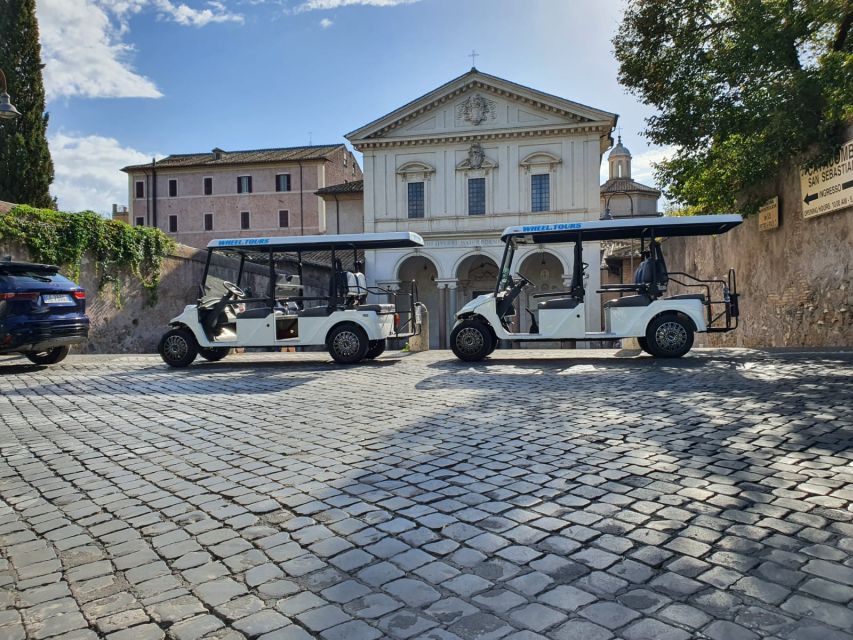
The exact catacomb depends on the departure schedule. The morning route features San Sebastián, while the afternoon itinerary lists San Callixtus. The Basilica of Saint Sebastian is also included as a place to see sacred art and historical objects. Check the available start time carefully if one site matters more to you than the other.
The catacombs are not a polished attraction designed for easy movement. The temperature is about 15 degrees Celsius, or 59 degrees Fahrenheit, and the air is humid. Bring a light layer even on a warm Roman day. You should also follow the request to bring a face covering.
The physical demands deserve plain warning. There are 50 irregular steps down and another 50 up, with no lift, uneven flooring, and nowhere to sit along the route. The catacombs are not suitable for wheelchair users and are not recommended if you have serious walking problems or feel uncomfortable in enclosed spaces.
Inside, the atmosphere is quiet and serious. This is a sacred place, not simply an underground curiosity. Your catacomb guide may be different from the golf cart guide, so the tone and style can change. The strongest experience comes when you treat the visit with respect and allow time for the significance of the burial chambers to sink in.
A different way to spend the day, same part of Italy:
- Vatican Museums, Sistine Chapel & St Peter’s Basilica Guided Tour
★ 4.5 · 39,149 reviews - Rome: Colosseum, Palatine Hill and Roman Forum Guided Tour
★ 4.8 · 32,814 reviews - Rome: Guided Tour of Colosseum, Roman Forum & Palatine Hill
★ 4.7 · 27,897 reviews - Rome: Colosseum & Forum with Audio Guide App -Optional Arena
★ 4.2 · 24,770 reviews
The Appian Way puts Rome’s engineering under your feet
The ancient Appian Way is the tour’s most tangible moment. At a stop along the road, you can walk on original Roman paving that has survived for centuries. You are no longer looking at history behind a barrier. Your feet meet the same route that once connected Rome with the southern parts of Italy.
The stones are uneven, so wear shoes with a firm sole. The stop is not a long hike, but it is a short walk on an old road rather than a smooth pavement. That small inconvenience is part of the appeal.
The road also changes your sense of Rome. Within a short ride, the dense city gives way to a quieter area filled with ancient remains and open views. You see why the Appian Way was so important: it was a working route, a military road, and a stage for stories that later became part of Christian tradition.
This is one place where the golf cart earns its fare. The Appian Way is too far from the central sights for many people to reach comfortably during a short visit, yet it is one of the most rewarding places to add context to Ancient Rome.
Circus of Maxentius and San Sebastian
The Circus of Maxentius is less famous than the Colosseum, but that is part of its appeal. The remains offer a sense of how Roman entertainment sites were arranged outside the city center. Your guide can help you distinguish the racing complex from the surrounding ruins and explain how the site fits into the wider Appian Way area.
The Basilica of Saint Sebastian provides another change of pace. You can go inside to see its religious setting and historical artifacts. Several visitors have found this stop unexpectedly moving because it feels more intimate than Rome’s biggest churches and museums.
The morning program features the Catacombs of San Sebastián, while the afternoon program names San Callixtus. Since the supplied route details describe both versions, confirm the exact schedule before paying if you have a strong preference. In either case, the underground portion gives you a direct look at early Christian burial practices and the way faith communities used these spaces.
Pyramid of Caius Cestius and the city’s southern edge
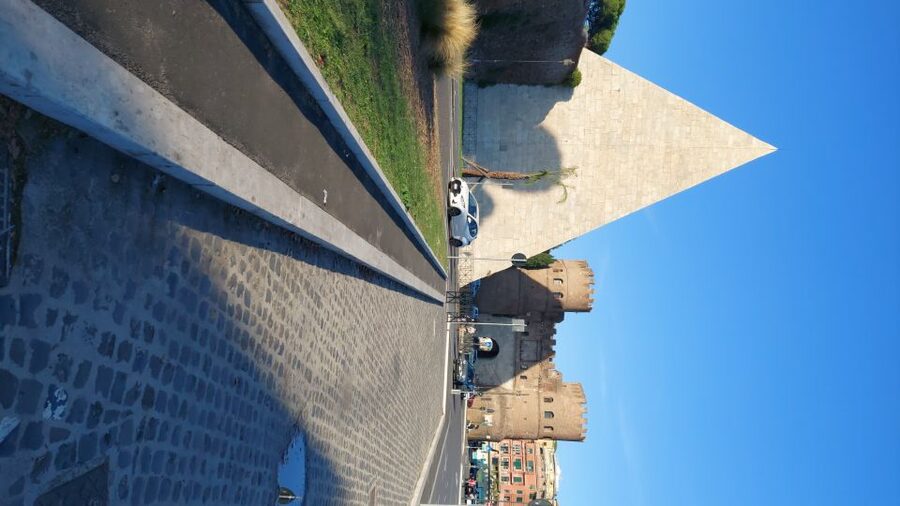
The drive by the Pyramid of Caius Cestius shows another side of Roman ambition. This sharply shaped tomb is easy to miss if you spend your entire visit around the Trevi Fountain, Pantheon, and Spanish Steps. From the cart, you get the story and a chance to photograph it without detouring on foot.
The pyramid also reminds you that Roman history did not stop with the classical monuments most visitors know. The city kept changing, borrowing styles, adapting old spaces, and placing new structures beside ancient ones. A drive-by cannot replace entering a monument, but it adds another useful piece to the city’s story.
Circus Maximus and the best photo pauses
At the Belvedere of Romulus and Remus in the Circus Maximus, the tour pauses for broad views across one of Rome’s most famous ancient sites. The Circus was once a huge venue for chariot races and public gatherings. Today, its open space makes it easier to grasp the scale than it is at some tightly packed ruins.
This is a good photography stop because you have time to get out and look around rather than trying to photograph everything through the cart. The guide also helps you read the site, which otherwise can look like a long field with scattered remains.
The route then passes the Mouth of Truth. You may recognize the round marble face from popular photographs and films. The tour treats it as part of a wider circuit rather than building the whole visit around a single photo opportunity.
Theatre of Marcellus, Venetian Square, and Trajan’s Column
The Theatre of Marcellus offers a striking example of Rome’s layers. Ancient theater architecture, later buildings, and modern city life sit close together. A drive-by explanation helps you notice how old structures were reused instead of simply disappearing.
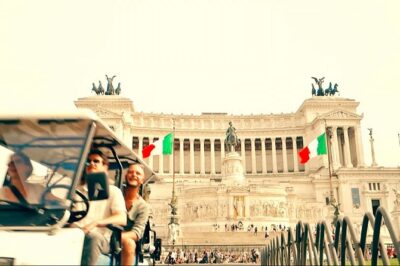
The cart continues toward Venetian Square and the Fatherland Monument, giving you a grand view of the city’s more formal, monumental center. You then see Trajan’s Column, famous for the carved spiral scenes that record the emperor’s military campaigns.
These final sights round out the tour. The Appian Way and catacombs show Rome’s quieter outskirts and early Christian past, while Trajan’s Column and the Fatherland Monument return you to imperial and national Rome. The route is broad by design, and that variety is more important than spending a long time at any single stop.
Guides, headsets, and the human side of the tour
The guide can make or break a fast-moving route, and this experience has a strong record on that point. Federico is repeatedly praised for his passion, theatrical explanations, and ability to answer questions. Anna is described as warm and clear, while Antonella is noted for stories that range from history and religion to plants and word origins.
Alessandro is praised for guiding a very small group with energy and detail. Meryl, Claudio, Arvin, Martino, and others are also singled out for making the ride friendly and informative. Names are useful when choosing, but you cannot necessarily request a particular guide or assume one will lead your departure.
Some guides speak quickly because there is so much ground to cover. Pay attention, and use the headset so you do not miss the explanation while the cart is moving. The best guides check that everyone is following, leave room for questions, and use humor without making the sacred sites feel casual.
The group is described as small, though the exact maximum is not provided. A small group usually means easier questions and quicker stops, but the cart still limits your view compared with standing in an open plaza.
Is $113.29 a fair price?
At $113.29 per person, this is not a bargain sightseeing ride. You are paying for three hours of transport, an English-speaking guide, bottled water, headsets, and admission to the catacombs. There is no hotel pickup, and food and drinks beyond the supplied water are not included.
I think the price makes sense if you want to combine sites that are awkward to reach independently. A taxi or several separate rides could add up, while planning the Appian Way, catacombs, and central monuments on your own takes time and coordination. The guide’s interpretation is also a major part of the value.
The price is harder to justify if you are content with a central walking tour or want long, detailed visits inside museums and monuments. This is a sampler with strong storytelling, not a full archaeological study. You are paying to connect many places in one efficient outing.
Free cancellation is available up to 24 hours before the tour, and you can reserve now and pay later. The activity begins near Termini Station, about a five-minute walk away, and returns to the same meeting point. Look for the guide holding a Wheel Tours sign.
Who will enjoy this Rome tour most?
I would choose this for a first or second visit when you want an overview beyond the usual central sights. It works especially well late in a week in Rome, when your legs are tired but you still want to see the Appian Way and catacombs.
It also suits history-minded adults, couples, families with older children, and anyone who prefers stories while moving rather than a long lecture in one place. The combination of ruins, religious sites, road travel, and underground archaeology gives the outing a useful range.
I would think twice if you have serious mobility limits, dislike enclosed spaces, or need a perfectly smooth ride. Young children may not enjoy the pace and subject matter, and the uneven catacomb stairs are a real issue. On a cold or rainy day, ask about blankets or coverings, as these have been provided on some departures, but should not be assumed.
Should you book it?
Book this tour if you want to cover Rome’s scattered ancient sights efficiently, hear strong local storytelling, and accept a few bumpy stretches. The Appian Way and catacombs give you experiences that are easy to miss on a standard Rome itinerary, while the golf cart saves time and energy.
Skip it if your priority is entering the Colosseum, spending hours at one site, or avoiding stairs and enclosed passages. For the right visitor, though, this is a smart three-hour introduction to Rome’s imperial roads, Christian underground world, and lesser-known ruins.
FAQ
How long does the tour last?
The tour lasts three hours. Starting times vary, so check availability for the date you want.
What language is the tour conducted in?
The live tour guide speaks English.
Where does the tour begin?
The meeting point is about a five-minute walk from Termini Central Train Station. Your guide will be holding a Wheel Tours sign.
Where does the tour end?
The activity ends back at the original meeting point.
Is the catacomb entrance included?
Yes. The entrance fee to the catacombs is included in the tour price.
Which catacombs does the tour visit?
The morning tours feature San Sebastián, while the afternoon itinerary lists San Callixtus. Check the available schedule if you need a specific site.
How cold are the catacombs?
The temperature inside is about 15 degrees Celsius, or 59 degrees Fahrenheit, and the spaces are humid. Bring an appropriate layer.
Is the tour wheelchair accessible?
No. The catacomb visit includes 50 irregular steps down and 50 back up, with no elevator and uneven floors. It is not recommended for people with serious walking problems.
What is included besides the guide and transport?
The tour includes bottled water, headsets, and the catacomb entrance fee. Hotel transfers, food, and drinks are not included.
Recently reviewed around Rome
- Ancient Rome at Twilight Walking Tour★ 5.0 · 276 reviews
- Domus Aurea Guided Tour: The Golden House of Nero★ 4.5 · 199 reviews
- Early Vatican Museums & Sistine Chapel Small Group Tour★ 4.5 · 314 reviews
- Early Vatican Museums Tour: The Best of the Sistine Chapel★ 4.5 · 900 reviews
- Jewish Ghetto & Piazza Navona: Food, Wine & Sightseeing Rome Tour★ 5.0 · 460 reviews
- 3 Days in Sorrento, Capri & Pompeii: la Dolce Vita★ 4.0 · 595 reviews
- Tivoli Villas Full Day Trip From Rome with Lunch★ 4.0 · 443 reviews
- Cook With Us in Rome: A Hands-On Cooking Experience 09:20AM class★ 5.0 · 234 reviews
Golf Cart Tours, compared.
Rome by Golf Cart Private Tour: Beyond the Landmarks
Read our review →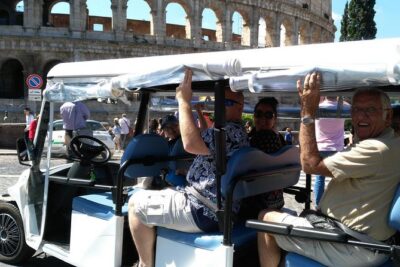
Rome on a Golf Cart Semi-Private Tour Max 6 with Private Option
Read our review →
Golf Cart Tour to Fiesole Roman Theatre and Museum
Read our review →
Eco-Friendly Golf Cart City Tour with Audio Guide
Read our review →

Private/Group 4 Hours Golf Cart SightseeingTour
Read our review →Browse the lists this tour appears in