

Review · WALKING TOURS
Rome: Jewish Ghetto Walking Tour
Rome’s Jewish Ghetto is where 2,000 years of Roman history come together in a compact, walkable area. Ancient theater ruins, a Renaissance fountain, Jewish memorials, a major synagogue, and Tiber Island all fit into one thoughtful route.
I like the way this tour connects famous sights with personal stories, especially the tale linked to the Turtle Fountain and the wartime history of the hospital on Tiber Island. I also like the included kosher gelato or coffee, a small but welcome break during the walk.
The main consideration is that the route is history-heavy and mostly outdoors. You pass the Great Synagogue rather than entering it, and the tour runs in all weather, so comfortable shoes, sun protection, and suitable clothing matter.
In This Review
- Key points to know before booking
- Why this neighborhood deserves two and a half hours
- Starting at Trajan’s Column in central Rome
- The Theater of Marcellus: Rome before the Colosseum
- Piazza Mattei and the Turtle Fountain
- Entering the historic Jewish Ghetto
- The Portico d’Ottavia and the Great Synagogue
- Crossing to Tiber Island
- The guides make the biggest difference
- Is $65 a fair price?
- Timing, weather, and what to bring
- Who should book this walk?
- Should you book the Rome Jewish Ghetto Walking Tour?
- FAQ
- Where does the Rome Jewish Ghetto Walking Tour start?
- How long does the walking tour last?
- What language is the tour offered in?
- Is kosher gelato included?
- Does the tour enter the Great Synagogue?
- What happens if I arrive late?
Key points to know before booking
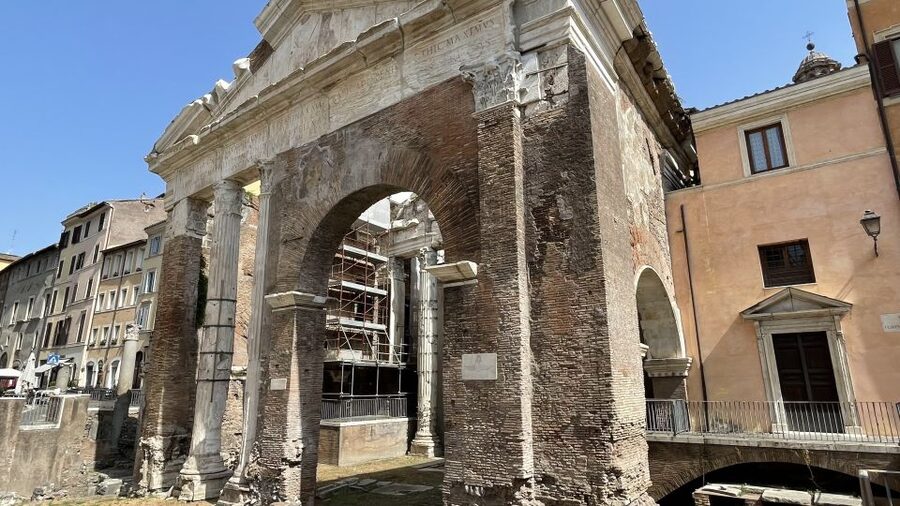
- Theater of Marcellus: See a Roman performance space older than the Colosseum, with later buildings incorporated into its structure.
- Turtle Fountain story: Hear the local tale of unrequited love at one of Rome’s prettiest small squares.
- Jewish Ghetto history: Learn how Rome’s Jewish community endured centuries of restriction, war, and loss.
- Kosher gelato stop: Your tour includes kosher gelato or coffee, but additional food and drinks cost extra.
- Tiber Island ending: Cross Rome’s oldest functioning bridge and finish with stories of healing, Asclepius, and rescue during World War II.
- Strong guide focus: James, Angela, Tom, Daniel, and others have been praised for clear storytelling, patience, and broad knowledge of Rome.
Why this neighborhood deserves two and a half hours

Rome can make history feel scattered. One minute you are looking at imperial stone, and the next you are passing a church, a fountain, or a modern street with little explanation of how the pieces fit together.
This walk gives those layers a clear order. You begin near Trajan’s Column, move toward the Theater of Marcellus, enter the area historically known as the Jewish Ghetto, and finish across the Tiber on Tiber Island. The route is not just a parade of photo stops. Your guide explains how the neighborhood changed and how Rome’s Jewish community lived through those changes.
The tour costs $65 per person. That is not a bargain-priced stroll, but it is fair if you want a live English-speaking guide who can answer questions and connect ancient Roman history with Jewish history and modern memory. The value depends heavily on the guide, and this experience has repeatedly received strong praise for its storytelling and subject knowledge.
The format also works well for people who do not usually choose a Jewish-history tour. You do not need a religious background to follow the story. The walk places Jewish life in the wider story of Rome, Italy, war, architecture, medicine, and public memory.
More Walking Tours in Rome
- Rome: Trastevere & Campo de Fiori Street Food Walking Tour
★ 4.9 · 2,768 reviews - Rome: Paranormal Night Walking Tour & Secret Backstreets
★ 4.9 · 1,921 reviews - Rome by Night Walking Tour – Legends & Criminal Stories
★ 4.5 · 1,003 reviews
Starting at Trajan’s Column in central Rome
The meeting point is Foro Traiano, 84, near Trajan’s Column. Look for an orange Roman Vacations sign.
This is a sensible starting place because Trajan’s Column gives you an immediate view of imperial Rome. Your guide uses the area to set the scene before the group heads toward the Jewish Ghetto. Guides such as James, Tom, and Daniel have been praised for giving enough Roman background to make the later stops easier to understand without turning the entire walk into a lecture on emperors.
Arrive early. The tour cannot wait for late arrivals, and missed tours do not receive refunds. That is especially important in central Rome, where finding the correct column, street, and meeting sign can take longer than expected.
The route lasts about 2.5 hours, although individual stops have shorter guided portions. Expect a steady walk with pauses for stories and questions. Some guides have adjusted their pace for people who walk slowly, but you should still wear comfortable shoes.
The Theater of Marcellus: Rome before the Colosseum
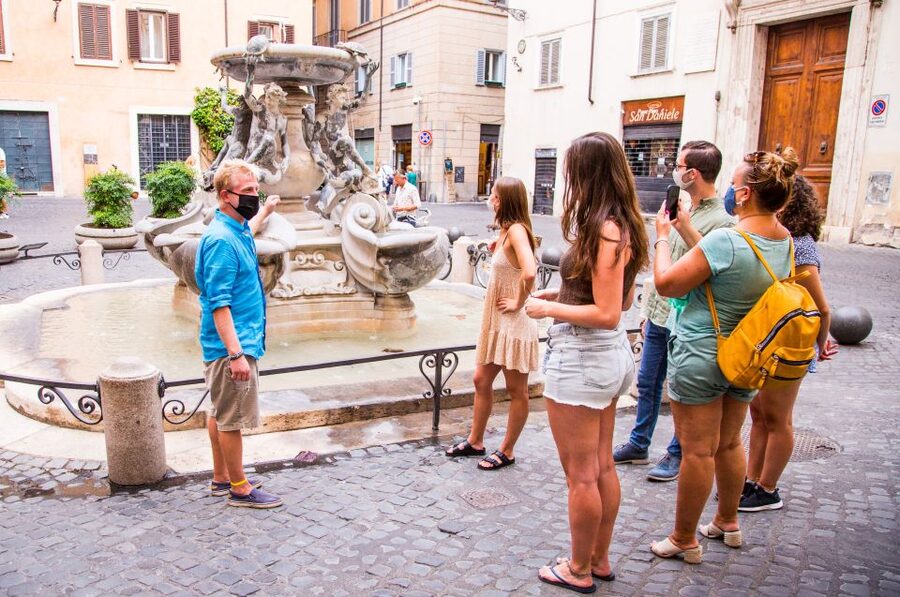
The first major stop is the Theater of Marcellus, where the guided visit lasts about 20 minutes.
Many people know the Colosseum as Rome’s great ancient arena, but the Theater of Marcellus is older. It was built for public performances and remains one of the most striking reminders that ancient Rome was filled with large civic buildings, not just temples and forums.
What makes this stop especially interesting is the way later construction became part of the site. The ancient theater is not preserved as an isolated ruin. Buildings were incorporated into and around it, creating the layered appearance that makes Rome so unusual.
Your guide helps you read the structure rather than simply photograph it. You can expect an explanation of what the theater was used for and how the site fits into the city’s long development. This is one of the best places on the tour for seeing how Rome keeps using old structures instead of placing every ancient monument behind a separate wall.
The drawback is that this is an exterior-focused stop. If you want a long archaeological visit with extensive interior access, this tour is not designed for that. Its strength is the story and the connection to the surrounding neighborhood.
Piazza Mattei and the Turtle Fountain
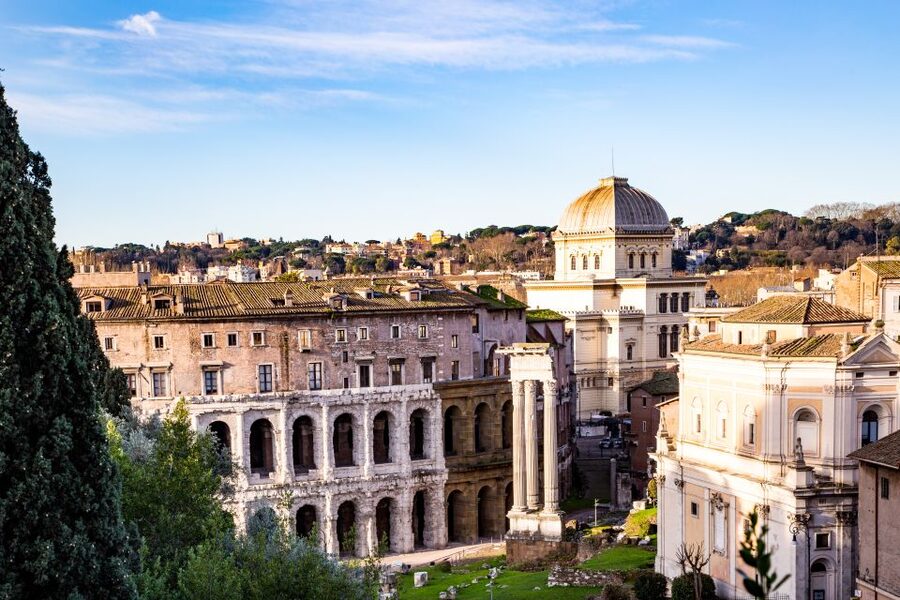
The group then reaches Piazza Mattei for roughly 20 minutes at the Fontana delle Tartarughe, or Turtle Fountain.
The fountain is small compared with Rome’s Trevi Fountain, but that is part of its charm. Piazza Mattei feels intimate, and the fountain rewards a closer look. Its turtles and bronze figures give your guide plenty to point out, while the square provides a quieter setting for the story of unrequited love connected with the fountain.
This is a good example of what the walk does best. You are not simply told that the fountain is attractive. You get a human story that helps you remember the place. Rome is full of grand monuments, but small squares often reveal more about how the city is experienced at street level.
The tour also includes a stop at a gelateria, where you receive homemade kosher gelato or coffee. The exact choice depends on the arrangement that day, but the included refreshment is a useful pause. Do not assume it covers a full snack or extra drinks. Additional food and beverages are not included.
More Rome walks with a guide:
- Rome: Guided City Center Evening Sightseeing Walking Tour
★ 4.4 · 953 reviews - Best of Rome Walking Tour including Trevi Fountain
★ 4.5 · 923 reviews - Rome: Under the Moonlight Evening Walking Tour
★ 4.8 · 852 reviews - Rome: Forbidden History Walking Tour & Pub Crawl with Drinks
★ 4.9 · 688 reviews
Entering the historic Jewish Ghetto
The Jewish Ghetto section lasts about 20 minutes, though the subject continues through later stops.
The word ghetto has a difficult history here. Rome’s Jewish community was confined to this area for centuries, behind walls and under restrictions imposed by papal rule. The neighborhood’s present-day streets can look peaceful, even pretty, so the guide’s explanation matters. Without it, you might walk through and miss the weight of what the area represented.
You learn about daily life, limits placed on the community, and the persistence of Jewish life in Rome across the centuries. The strongest guides do not reduce the story to dates. They explain how people lived, adapted, worshiped, worked, and maintained community under pressure.
This part also benefits from a small group. Several bookings have resulted in groups of only two to four people, and sometimes a scheduled small-group walk has become private when no one else booked. That is not something you should count on, but a smaller group makes it easier to hear clearly and ask direct questions.
The tour is suitable for Jewish and non-Jewish participants alike. If you have a personal or family connection to Jewish history, the subject may feel especially direct. If you do not, the walk still offers a useful account of a major part of Rome’s past that many standard city tours barely address.
The Portico d’Ottavia and the Great Synagogue
The route continues to the Portico d’Ottavia, with about 15 minutes of guided time.
The portico is an ancient Roman structure, and its location within the Jewish Ghetto is important. You see how Roman ruins, medieval changes, religious buildings, and modern city life occupy the same small area. The guide’s job here is to connect the stones to the surrounding community rather than treat the portico as a stand-alone ruin.
The Great Synagogue of Rome comes next as a major visual and historical landmark. Your guide explains the place of the synagogue in Roman Jewish life and the painful events that shaped the community in the modern era. The walk also includes the last remaining piece of the wall that once enclosed the Jewish community.
That surviving section of wall is easy to miss without context. It is not the grandest monument in Rome, but it carries a clear physical reminder of confinement. I find details like this more useful than another sweeping view of a famous ruin because they help you understand how policy affected real streets and real households.
One practical limitation deserves clear mention: the standard experience does not include entry inside the Great Synagogue. The route passes it and discusses its importance. If seeing the interior is essential to you, check separately for visiting arrangements or a tour that specifically includes admission.
Remember to bring a cover for bare shoulders if the route enters any churches. The provided information describes a visit to the church on Tiber Island, so modest clothing is the safe choice.
Crossing to Tiber Island
The final major stop is Tiber Island, with about 15 minutes of guided explanation.
You reach the island by crossing Rome’s oldest functioning bridge. The crossing is brief, but it gives the tour a satisfying change of setting. After the compact streets of the Ghetto, the river and island create a natural closing point.
The island has long been linked with healing. Your guide tells the story of Asclepius, the ancient Greek god associated with medicine, and explains how the former temple site became a church. This is another example of Rome’s habit of layering new religious meaning over older sacred places.
You also hear about the hospital on the island and its role in saving people during World War II. That story shifts the tour from ancient mythology to recent history, showing how the same place continued to matter in a time of danger.
Ending here works well because it brings together several themes from the walk: community, belief, medicine, survival, and the reuse of old places. It also leaves you near other central Roman sights, although no onward transportation is included.
The guides make the biggest difference
The clearest pattern in the feedback is the quality of the guides. James is repeatedly praised for turning history into a story, answering questions, and explaining Rome in a way that held the attention of teenagers as well as adults. Angela is described as energetic, warm, passionate, and especially strong on Jewish history in Rome.
Tom has received praise for putting three thousand years of Roman history into clear, manageable sections. Daniel has been noted for his calm pace, broad command of Roman history, and ability to adapt the walk for someone with difficulty walking.
Other guides, including Maria, Elena, Paul, and others, have also been praised for strong preparation and an easy manner. You should not assume you can select a particular guide unless the booking system says so, but the range of positive feedback suggests that the experience is built around live interpretation rather than a memorized script.
A good guide matters here because the neighborhood does not explain itself. You need someone who can handle ancient Rome, Jewish history, Italian history, wartime events, and present-day memorials without losing the thread. The best accounts describe guides who pause in shady spots, invite questions, and adjust the pace.
Is $65 a fair price?
At $65, this is a mid-priced walking tour rather than a casual pay-what-you-wish stroll.
You are paying for 2.5 hours, an English-speaking guide, a planned route through several important sites, and kosher gelato or coffee. You are also paying for interpretation. The Theater of Marcellus, Turtle Fountain, Portico d’Ottavia, and Tiber Island are all accessible parts of Rome, but the tour gives you a reason to look closely and understand their connection.
I think the price makes sense if you value context and questions. It is less appealing if you prefer wandering alone, reading plaques, and spending only a few minutes at each stop. You will not receive a full meal, private transportation, or standard admission to the Great Synagogue.
The possibility of a very small group improves the value, though it is not guaranteed. A private-feeling walk can make the price feel reasonable, especially for families or couples who want to discuss the subject as they go.
Timing, weather, and what to bring
The tour runs in all weather conditions. Rome’s sun can be tiring, and rain can make old paved streets uncomfortable, so bring the listed basics: comfortable shoes, a sun hat, sunscreen, an umbrella, weather-appropriate clothing, and a reusable water bottle.
There are no specific accessibility details supplied, but the walk is on foot and includes bridges, streets, and stops in an old neighborhood. If you walk slowly or have mobility concerns, contact the provider before booking. Guides have adjusted their pace for some participants, but the tour is not described as a dedicated accessible route.
Friday afternoon may deserve extra thought because the Sabbath begins at sundown. The experience can still be interesting, but the timing may affect the atmosphere around Jewish sites and community life. If your schedule allows, ask about the starting time before choosing that slot.
Cancellation is free up to 24 hours in advance, and you can reserve now and pay later. Those terms help if your Rome plans are still shifting, but they do not protect you from arriving late.
Who should book this walk?
I would recommend it to anyone who wants more than Rome’s standard ancient-history circuit. It is particularly useful if you have already seen the Colosseum and Roman Forum and want a neighborhood where Roman, Jewish, Christian, and modern Italian history meet.
Families with older children and teenagers may do well with a guide who tells stories instead of reciting dates. The feedback about James keeping teenagers interested is a good sign, though attention spans vary and the subject includes serious wartime and persecution history.
The walk also suits people who want a focused introduction to Rome’s Jewish community without committing to a full-day museum program. You receive a broad timeline, a street-level view, and several physical reminders of the past.
I would hesitate if you need indoor attractions, guaranteed synagogue entry, or a food tour. The included refreshment is modest, and the main value lies in the guide’s explanations and the route itself.
Should you book the Rome Jewish Ghetto Walking Tour?
Book it if you want a thoughtful neighborhood walk led by a strong English-speaking guide. The route covers the Theater of Marcellus, Turtle Fountain, the Jewish Ghetto, Portico d’Ottavia, the Great Synagogue area, and Tiber Island without requiring a full day.
The best reason to choose it is the combination of ancient ruins and living memory. You see Rome’s famous layers, but you also learn how restrictions, war, faith, and resilience shaped one specific community.
Skip it if you mainly want grand monuments, long interior visits, or a relaxed food outing. For $65, this is a serious history walk with gelato, not a sightseeing sampler. If that sounds like your kind of Rome, it is a worthwhile addition to your schedule.
FAQ
Where does the Rome Jewish Ghetto Walking Tour start?
The tour starts at Foro Traiano, 84, near Trajan’s Column in central Rome. Look for an orange Roman Vacations sign.
How long does the walking tour last?
The tour lasts 2.5 hours. Starting times vary, so check availability when booking.
What language is the tour offered in?
The live guided tour is offered in English.
Is kosher gelato included?
Yes. The tour includes kosher gelato or coffee. Extra food and drinks are not included.
Does the tour enter the Great Synagogue?
The route visits the Great Synagogue area and explains its importance, but standard tour information does not include entry inside the synagogue.
What happens if I arrive late?
The tour cannot be delayed for late arrivals, and no refund is provided for missed tours or late arrival.
Recently reviewed around Rome
- Ancient Rome at Twilight Walking Tour★ 5.0 · 276 reviews
- Domus Aurea Guided Tour: The Golden House of Nero★ 4.5 · 199 reviews
- Early Vatican Museums & Sistine Chapel Small Group Tour★ 4.5 · 314 reviews
- Early Vatican Museums Tour: The Best of the Sistine Chapel★ 4.5 · 900 reviews
- Jewish Ghetto & Piazza Navona: Food, Wine & Sightseeing Rome Tour★ 5.0 · 460 reviews
- 3 Days in Sorrento, Capri & Pompeii: la Dolce Vita★ 4.0 · 595 reviews
- Tivoli Villas Full Day Trip From Rome with Lunch★ 4.0 · 443 reviews
- Cook With Us in Rome: A Hands-On Cooking Experience 09:20AM class★ 5.0 · 234 reviews
Walking Tours, compared.

Guided Walking Tour & Last Supper Visit with Ticket
Read our review →
Rialto Bridge & Offbeat Unusual Venice Walking Tour
Read our review →

Private 3 hrs Venice Tour: St Mark’s, Walking tour & Boat tour
Read our review →

Skip the line: Uffizi and Accademia Small Group Walking Tour
Read our review →
Trastevere & Campo de Fiori Street Food Walking Tour
Read our review →Browse the lists this tour appears in