
Review · WALKING TOURS
Rome: Moonlight Walking Tour – Free for Kids
Rome changes after sunset. The stone glows, fountains sound louder, and the crowds thin just enough for you to notice the city’s smaller details. This 2 to 2.5-hour moonlight walk links Piazza Navona, the Pantheon, Trevi Fountain, Piazza Venezia, and the Imperial Forums before finishing at a view over the lit Colosseum.
I like the route’s range: you get famous sights plus less obvious stops such as the painted ceiling at Sant’Ignazio di Loyola and Galleria Sciarra. I also like the guides’ strong personal style. Guides including Aline, Diletta, Sila, Dan, Sharon, Anna, Mary, and Csenge have been praised for lively stories, clear explanations, and good rapport with children and teenagers.
The main catch is the walking. Some groups have gone close to three hours, and the route includes cobbles and several long stretches on foot. Bring good shoes, and check the exact meeting point and start time carefully, since options can vary. The tour is listed at $28 per person, with children advertised as free, but confirm the child-age terms when booking.
In This Review
- Key points at a glance
- Why Rome is better after sunset
- Starting in Piazza Navona or near Piazza d’Aracoeli
- The Pantheon and the mystery of its survival
- Sant’Ignazio’s painted dome and Galleria Sciarra
- Trevi Fountain with time for photos
- Piazza Venezia and Rome’s monumental center
- Trajan’s Column and the Imperial Forums
- Finishing above the illuminated Colosseum
- What the guides add to the walk
- Price, pace, and practical value
- Who should book this Rome night walk?
- Should you book it?
- FAQ
- How long does the moonlight walking tour last?
- How much does the tour cost?
- Which languages are available?
- Where does the tour start?
- Where does the tour end?
- Does the tour include food or drinks?
- Does the tour enter the Colosseum?
- Can I book a private group?
Key points at a glance
- Rome after dark: Cooler streets and illuminated monuments give the city a very different feel from a daytime visit.
- A strong first-night route: You cover major landmarks while learning how the historic center fits together.
- Unexpected art stop: Sant’Ignazio di Loyola is known for its remarkable painted false dome, a highlight for many visitors.
- Trevi to the Colosseum: The walk links the Trevi Fountain, Trajan’s Column, Imperial Forums, and a final Colosseum viewpoint.
- Personal guiding: English and Spanish tours are available, with private groups also offered.
- Good family value: Children are advertised as free, and the guides have been praised for involving younger participants.
Why Rome is better after sunset
This is not a late-night pub crawl or a ticketed entry tour. It is a walking introduction to central Rome, built around the mood of the city after dark and the stories attached to its monuments.
At night, familiar sights take on a different character. The fountains and buildings are lit, the temperature is often easier for walking, and the streets can feel less pressured than they do during the middle of the day. You still pass through busy public places, but the focus is on looking, listening, and getting your bearings.
I think the timing makes this especially useful on your first evening in Rome. The route gives you a map in your head: Piazza Navona and the Pantheon in the center, Trevi to the northeast, Piazza Venezia and the Imperial Forums farther south, and the Colosseum beyond. You can then decide which sites deserve a longer daytime visit.
The guide is the key part of the experience. You are not simply being led from one photo stop to another. The best guides on this route explain why a building matters, add side stories, and answer questions as you walk. Past guides such as Sharon and Anna have been praised for keeping people involved, while Sila, Mary, and Csenge were noted for warmth, humor, and enthusiasm.
More Walking Tours in Rome
- Rome: Trastevere & Campo de Fiori Street Food Walking Tour
★ 4.9 · 2,768 reviews - Rome: Paranormal Night Walking Tour & Secret Backstreets
★ 4.9 · 1,921 reviews - Rome by Night Walking Tour – Legends & Criminal Stories
★ 4.5 · 1,003 reviews
Starting in Piazza Navona or near Piazza d’Aracoeli
The activity has two possible starting locations: Piazza di Pasquino or Piazza d’Aracoeli. Your precise meeting point depends on the option you book, so do not assume that every departure begins in Piazza Navona.
The first major stop is Piazza Navona, one of Rome’s grandest public spaces. Its centerpiece is Bernini’s Fountain of the Four Rivers, a dramatic Baroque work with sculpted figures and a tall central obelisk. At night, the lighting helps you see the fountain as a piece of theater rather than just another monument on a sightseeing list.
The guide uses the square to set up Rome’s long story, from ancient foundations to later papal power and urban design. You get about 20 minutes of guided time here, enough for an explanation and photographs without turning the tour into a lecture in one place.
Piazza Navona is also a practical place to begin because it is easy to recognize and surrounded by useful streets and restaurants. Still, public squares can be noisy. Stay close to the guide, especially during the first few minutes while the group is forming.
The Pantheon and the mystery of its survival
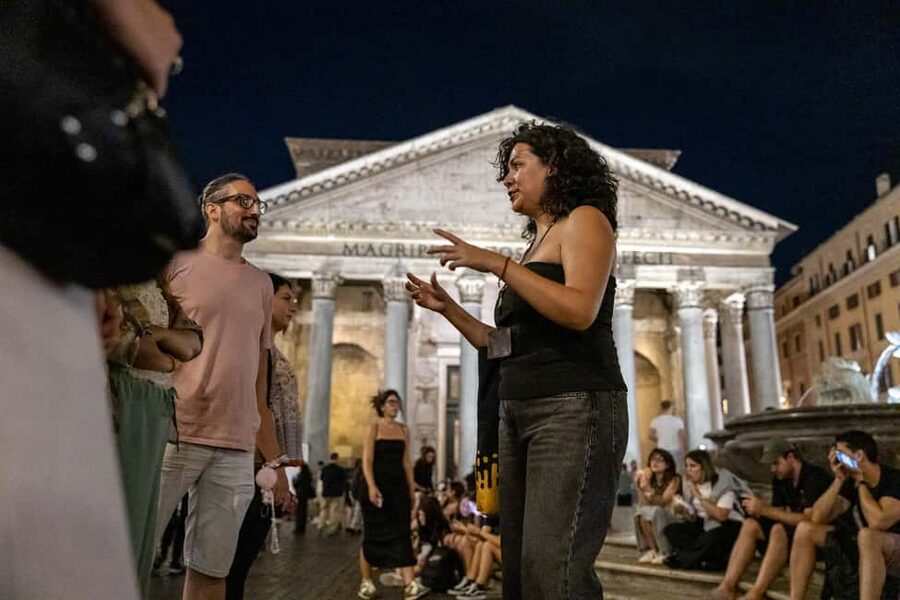
From Piazza Navona, the route passes the Pantheon. The schedule allows around 20 minutes here, but this is listed as a pass-by stop rather than a full interior visit.
That distinction matters. You will hear about the building and have time to admire its massive columns and famous domed form from outside, but this experience is not a substitute for a daytime Pantheon visit if entering the building is a priority. The guide explains why the Pantheon is considered the most intact major building from ancient Rome and discusses the mysteries surrounding its construction and survival.
This is a good example of the tour’s role. It gives you context and a memorable first look, then lets you return later for a closer visit if you want more time.
Sant’Ignazio’s painted dome and Galleria Sciarra
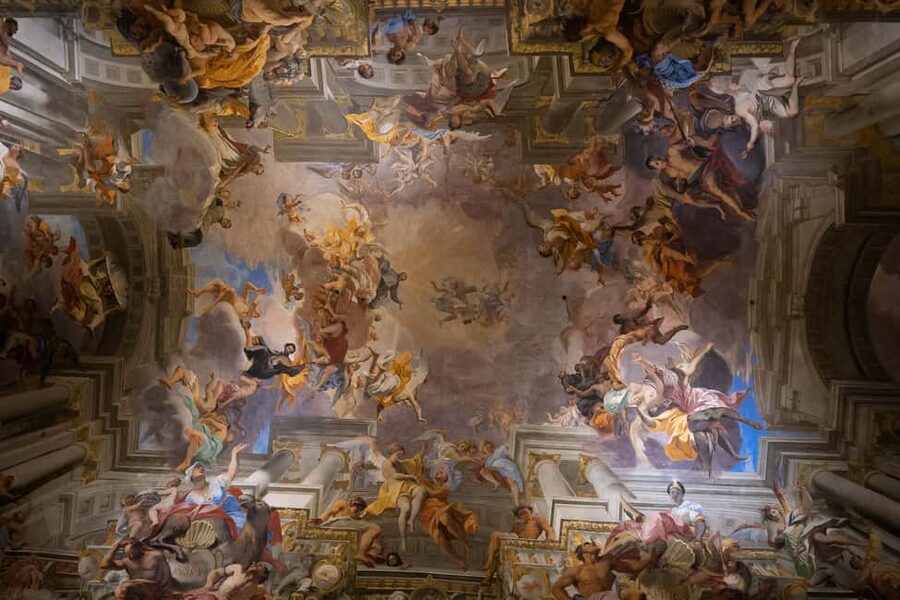
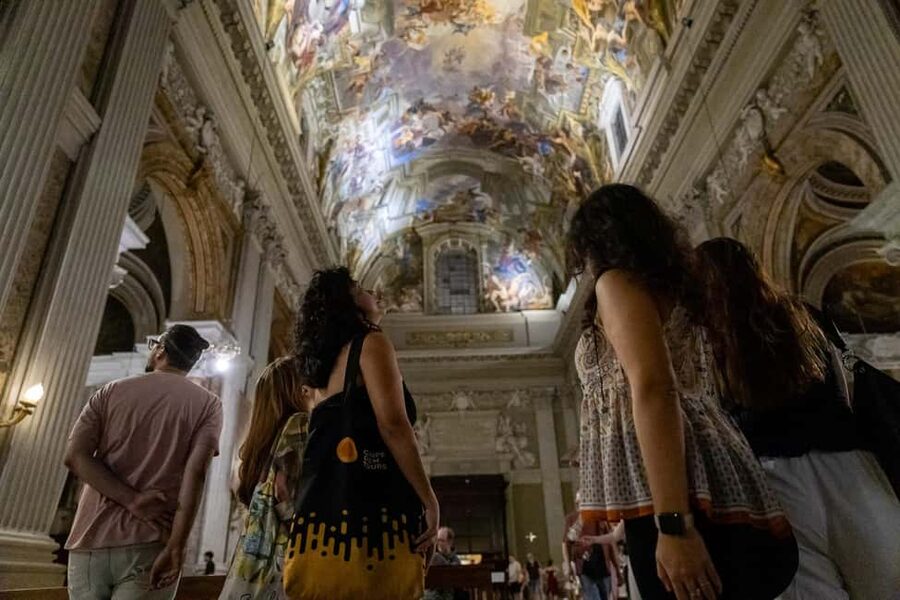
One of the most unusual parts of the walk is the Church of Sant’Ignazio di Loyola. The scheduled guided visit lasts about 30 minutes, making it one of the longer stops on the route.
The church is especially known for its painted illusion of a dome. Seen from the right position, the flat ceiling appears to open into a grand architectural space. This stop adds welcome variety after the large outdoor monuments. Instead of only seeing ancient ruins and famous fountains, you get a lesson in Roman illusion, decoration, and religious art.
A visit here can be a highlight for teenagers and anyone who enjoys visual surprises. The guide can point out details that are easy to miss if you walk in alone.
The next stop, Galleria Sciarra, receives about 20 minutes of guided attention. This covered passage is known for its ornate decoration and is another quieter, more unexpected place on the route. It helps break up the better-known sights and gives you a chance to see how Rome hides elaborate architecture in ordinary-looking city blocks.
Because these stops are not as famous as the Pantheon or Trevi Fountain, they also make the route feel less predictable. Keep in mind that churches and public sites can have their own operating conditions, so the exact viewing experience may vary with the evening schedule.
More Rome walks with a guide:
- Rome: Guided City Center Evening Sightseeing Walking Tour
★ 4.4 · 953 reviews - Best of Rome Walking Tour including Trevi Fountain
★ 4.5 · 923 reviews - Rome: Under the Moonlight Evening Walking Tour
★ 4.8 · 852 reviews - Rome: Forbidden History Walking Tour & Pub Crawl with Drinks
★ 4.9 · 688 reviews
Trevi Fountain with time for photos
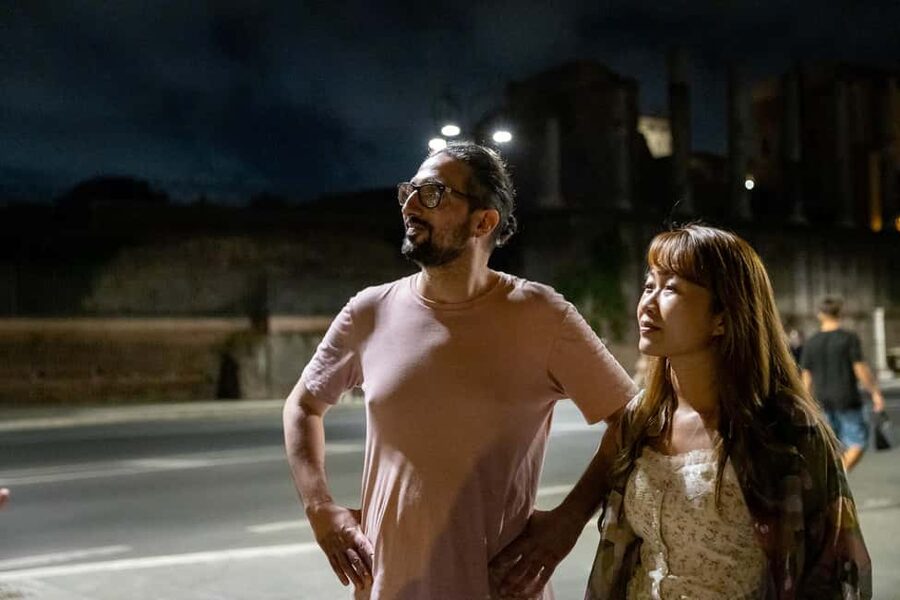
The walk continues through cobbled lanes toward the Trevi Fountain, one of Rome’s most dramatic night sights. The schedule allows about 30 minutes, making this another major stop rather than a quick glance.
Your guide explains the fountain’s design and the familiar coin-toss legend. You will have time to take photographs, but do not expect an empty scene. Trevi remains popular after dark, and the area can be crowded and noisy, especially near the fountain itself.
The evening setting helps here. Artificial light picks out the water, sculptures, and stonework, while the surrounding streets create a more intimate approach than arriving directly in the middle of a daytime sightseeing circuit.
There is also a short pause for photos or a refreshment during the walk. One group stopped for gelato after roughly two hours, which sounds like a sensible break before the final stretch. Food and drinks are not included, so budget separately for anything you buy.
Piazza Venezia and Rome’s monumental center
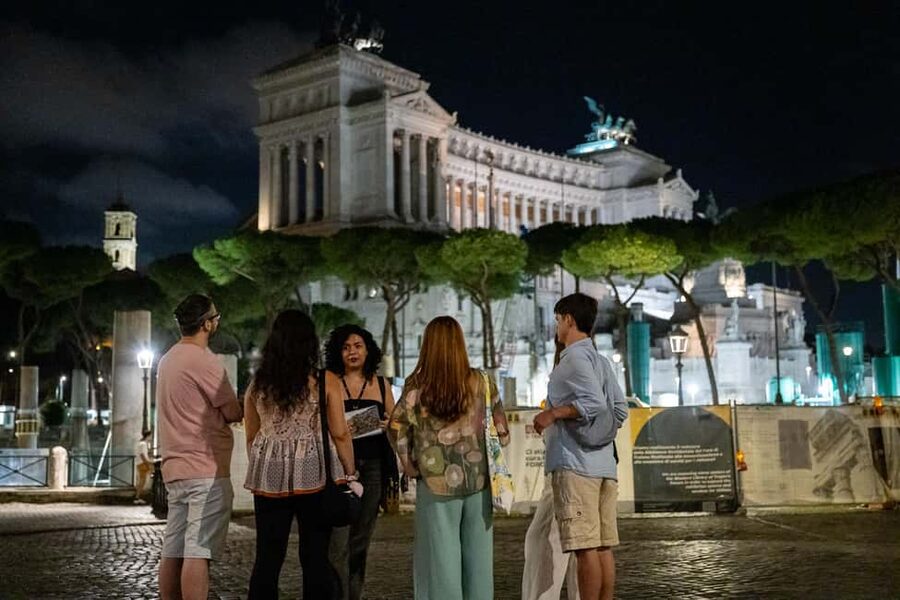
From Trevi, the route moves toward Piazza Venezia. Here you see the huge monument associated with Vittorio Emanuele II, the founder of unified Italy. The building is sometimes called Rome’s largest, and its scale can be startling when approached at night.
The stop lasts about 20 minutes. The guide explains the square’s role in modern Italian history and helps you read the monument in relation to the surrounding city. This is useful because Piazza Venezia can otherwise feel like a confusing traffic junction surrounded by oversized stone buildings.
The route is not designed as a specialist art or architecture course. Instead, it gives you enough background to make the city’s major spaces more understandable. If you return during the day, you will recognize the monument and know which nearby streets lead toward the Forum, Pantheon, or Trevi area.
Trajan’s Column and the Imperial Forums
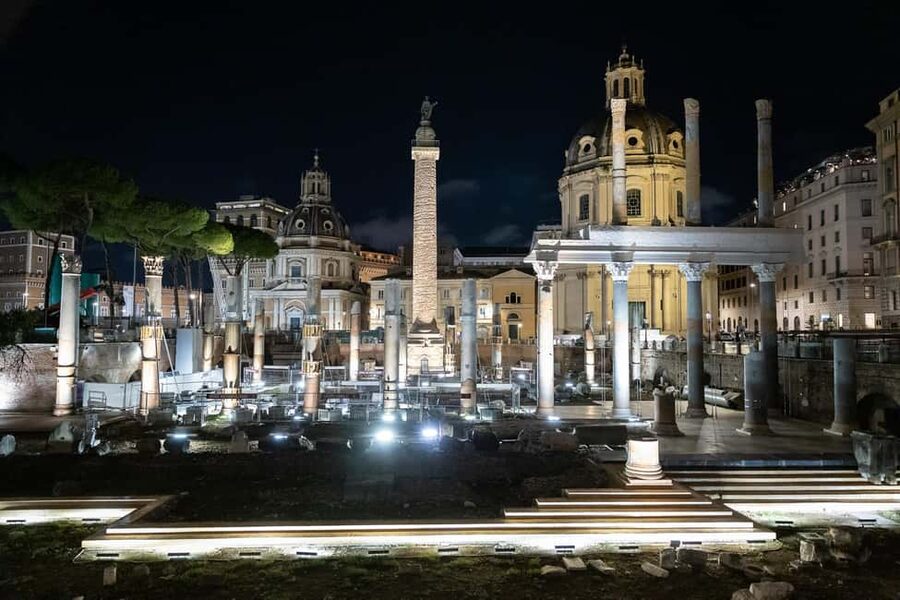
The next guided stop is Trajan’s Column, with about 20 minutes set aside for explanation. The column is covered with a spiraling relief that records military campaigns, and its position near the Imperial Forums places it in a wider archaeological setting.
Night lighting is particularly effective around this section of the route. Statues of emperors, columns, temples, triumphal arches, and ancient roads appear in fragments rather than as one tidy museum display. The ruins can be difficult to understand during a quick daytime walk, so having a guide explain what you are seeing adds real value.
You then continue along Via dei Fori Imperiali. This portion is listed as a pass-by section, but it provides some of the best broad views of the ancient center. You are walking beside one of Rome’s major archaeological corridors, with the illuminated Forum area stretching away from the road.
The walk can feel long here. You have already covered several districts, and there may be limited places to sit. This is where comfortable clothes and shoes matter most. The route is manageable for people used to city walking, but it is not a short stroll between two nearby monuments.
Finishing above the illuminated Colosseum
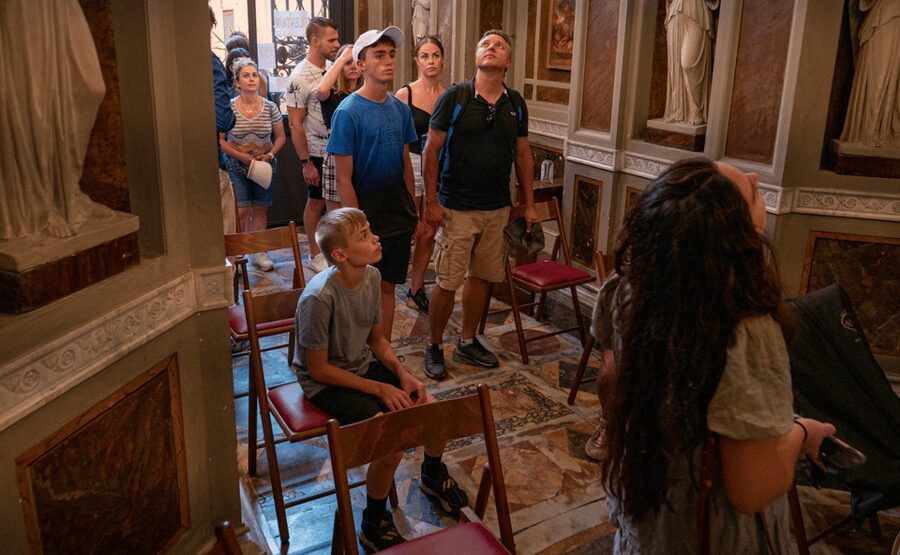
The tour saves its final view for the Colosseum. Rather than making the famous amphitheater the first stop, the guide approaches it after you have built up a sense of Rome’s ancient center.
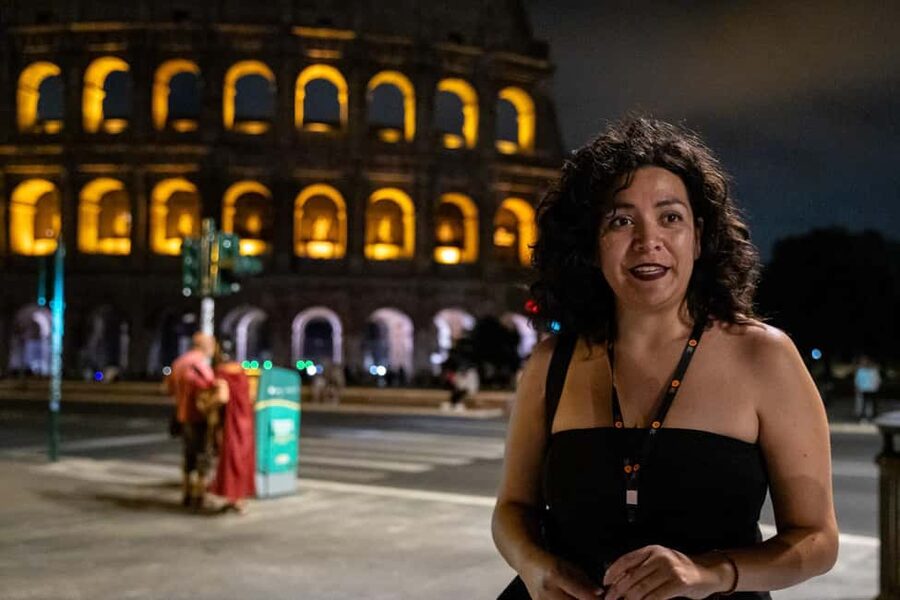
The final location is described as a secret, picture-perfect viewpoint overlooking the illuminated Colosseum. The exact viewpoint is not specified, which is part of the appeal, but you should understand that this is a viewing stop, not a Colosseum interior tour.
You can take photographs and see the amphitheater from a more considered angle. The ending also gives the route a clear payoff. After fountains, churches, imperial monuments, and ancient roads, the Colosseum provides the unmistakable final image.
Drop-off options include Piazza Navona and the Colosseum. The information also says the activity ends back at the meeting point, so confirm your chosen end arrangement when booking. If you are traveling alone, this evening route can be reassuring because you finish at a well-known central landmark, and one solo participant received help arranging a taxi afterward.
What the guides add to the walk
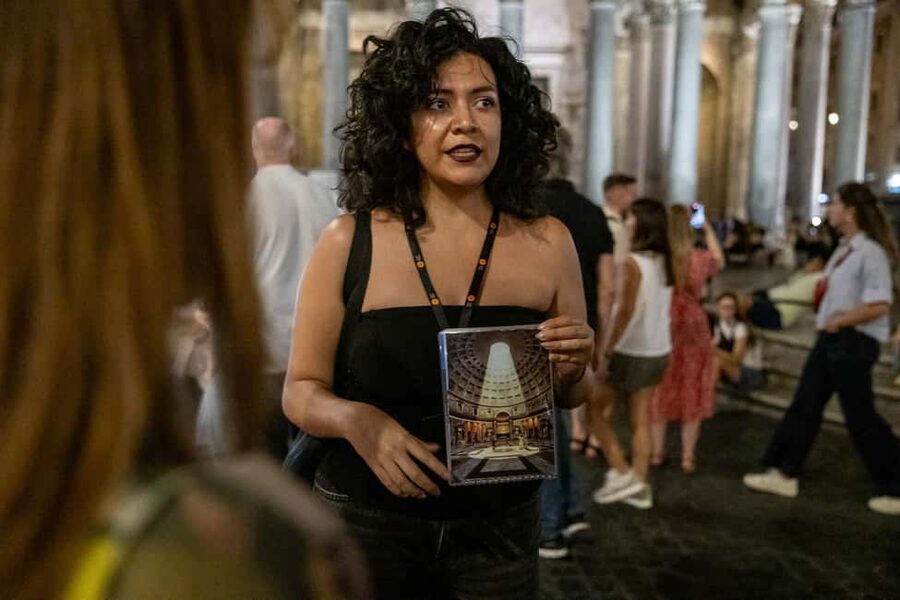
The guide quality is the strongest reason to book this rather than follow the same route with a map. Names attached to especially warm feedback include Aline, Diletta, Sila, Dan, Sharon, Anna, Mary, Anastasia, Paulina, Csenge, and Dogus.
The consistent pattern is clear: the best guides make the history feel connected to the street in front of you. Sila was praised for mixing fun stories with historical facts. Anna added side anecdotes and answered questions. Dan was described as passionate and informative, though his tour ran longer than expected.
That variation is worth keeping in mind. You cannot choose a specific guide from the information provided, and the experience may feel different depending on who leads your group. English and Spanish are available, and private groups can be booked if you want a more personal format.
The tour also seems to work well for families. One guide was praised for involving children and teenagers, and another family found the route engaging even for a hard-to-please teenager. The free-for-kids offer improves the value, but check the booking terms for the exact age limit.
Price, pace, and practical value
At $28 per person, this is a reasonable price for a guided introduction to central Rome, especially if you use it on your first night. You are paying for a live guide, a broad route, local recommendations, and the convenience of seeing several major sights without planning every turn yourself.
The value is strongest if you want orientation and stories. It is weaker if you prefer long, quiet visits at each monument, since the tour covers a lot of ground and most stops are outdoors. The Pantheon and Via dei Fori Imperiali are pass-by sections, and the Colosseum viewpoint does not include entry.
The advertised free admission for children can make this a good family choice. Food and drink are extra, and the route can last longer than the stated 2 to 2.5 hours. A few groups reached three hours, either because of the guide’s enthusiasm or the pace of the evening.
Wear comfortable shoes and clothes. Cobblestones, long stretches of walking, and Rome’s uneven streets are part of the experience. The city is often cooler at night than during the day, but the tour still requires steady walking.
You can cancel up to 24 hours before the activity for a full refund, and the reserve-now, pay-later option keeps your plans flexible. Starting times must be checked for your chosen date, as the available departure changes.
Who should book this Rome night walk?
I would choose this tour for a first evening in Rome, a family that wants a shared introduction, or a solo visitor who would rather explore the historic center with a guide after dark.
It also suits you if you enjoy stories, photographs, and a steady sequence of landmarks more than formal museum visits. The church ceiling, Trevi Fountain, Imperial Forums, and final Colosseum view give the walk enough variety to hold your attention.
I would choose something else if you have limited walking ability, want to enter the Pantheon or Colosseum, or dislike group pacing. In that case, a shorter private walk or a dedicated ticketed visit may fit better.
Should you book it?
Book it if you want Rome’s essential night views tied together by a friendly English- or Spanish-speaking guide. The route is broad, the cost is fair, and the final Colosseum viewpoint gives the evening a satisfying finish.
Before paying, check the exact start point, departure time, child-age rules, and end location. Then leave room in your schedule for a tour that may run longer than two and a half hours. If you can handle the walking, this is a practical and atmospheric way to get your bearings fast.
FAQ
How long does the moonlight walking tour last?
The stated duration is 2 to 2.5 hours. Some tours may run closer to three hours, so allow extra time if your evening plans are fixed.
How much does the tour cost?
The listed price is $28 per person. Children are advertised as free, but the exact age conditions should be confirmed when booking.
Which languages are available?
The live guide is available in English or Spanish.
Where does the tour start?
There are two possible starting locations: Piazza di Pasquino and Piazza d’Aracoeli. The exact meeting point depends on the option booked.
Where does the tour end?
The listed drop-off options are Piazza Navona and the Colosseum. The activity information also says it ends back at the meeting point, so check the details for your selected option.
Does the tour include food or drinks?
No. Food and drinks are not included. There may be a short break when you can purchase a refreshment.
Does the tour enter the Colosseum?
No entry is listed. The tour finishes at a viewpoint overlooking the illuminated Colosseum.
Can I book a private group?
Yes. A private group option is available.
Recently reviewed around Rome
- Ancient Rome at Twilight Walking Tour★ 5.0 · 276 reviews
- Domus Aurea Guided Tour: The Golden House of Nero★ 4.5 · 199 reviews
- Early Vatican Museums & Sistine Chapel Small Group Tour★ 4.5 · 314 reviews
- Early Vatican Museums Tour: The Best of the Sistine Chapel★ 4.5 · 900 reviews
- Jewish Ghetto & Piazza Navona: Food, Wine & Sightseeing Rome Tour★ 5.0 · 460 reviews
- 3 Days in Sorrento, Capri & Pompeii: la Dolce Vita★ 4.0 · 595 reviews
- Tivoli Villas Full Day Trip From Rome with Lunch★ 4.0 · 443 reviews
- Rome Pasta Making Class with Italian Sauces and Wine Included★ 5.0 · 645 reviews
Walking Tours, compared.

Guided Walking Tour & Last Supper Visit with Ticket
Read our review →
Rialto Bridge & Offbeat Unusual Venice Walking Tour
Read our review →
Private 3 hrs Venice Tour: St Mark’s, Walking tour & Boat tour
Read our review →

Skip the line: Uffizi and Accademia Small Group Walking Tour
Read our review →
Trastevere & Campo de Fiori Street Food Walking Tour
Read our review →Browse the lists this tour appears in