
Review · BORGHESE GALLERY TOURS
Borghese Gallery Guided Tour with priority entrance
Rome’s Borghese Gallery packs an astonishing amount of art into a relatively small museum. In two hours, this tour takes you straight to Bernini’s marble drama, Caravaggio’s sharp-eyed paintings, and Raphael’s polished Renaissance beauty, with a guide explaining what your eyes might otherwise miss.
I like the 15-person group limit, which keeps the tour from turning into a flag-following march. I also like the headsets, especially in crowded rooms, because you can study a sculpture while still hearing the guide. The main consideration is time: two hours is enough for the great hits, not every room in the collection, and some galleries may close for restoration without warning.
In This Review
- Key points to know before you book
- Why the Borghese Gallery deserves a guided visit
- Meeting at the gallery and getting inside
- Ground floor: Bernini’s marble stories
- Upstairs: Caravaggio’s people and Raphael’s polish
- The palace interiors deserve your attention
- What two hours feels like inside
- Is the 73 dollar price fair?
- Who will enjoy this tour most
- Practical tips for a smoother visit
- Should you book the Borghese Gallery guided tour?
- FAQ
- How long is the Borghese Gallery guided tour?
- What artworks are included on the tour?
- How large is the tour group?
- Which languages are offered?
- Where do I meet the guide?
- Are entrance tickets included?
Key points to know before you book
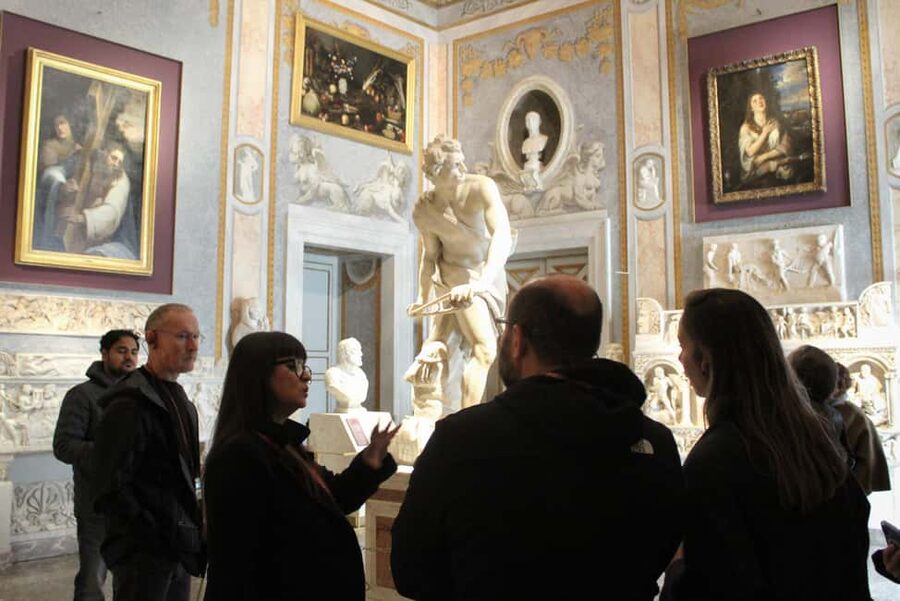
- Bernini gets the grand opening: Begin downstairs with The Rape of Proserpina, Apollo and Daphne, and David, three sculptures that reward close attention.
- Caravaggio takes the tour upstairs: See works including Young Sick Bacchus and Boy with a Basket of Fruit, with help reading their mood, details, and symbolism.
- The small group matters: A maximum of 15 people makes it easier to hear, ask questions, and stay near the guide.
- The palace is part of the experience: Gold crown molding and ceiling frescoes compete for your attention with the art.
- Meet early and pack light: Check in 20 minutes before the start at the main entrance. Food, drinks, luggage, and large bags are not allowed.
- Expect strong guiding: Past guides such as Agnese, Irene, Dimitri, Sylvia, Francesca, and Federico have been praised for clear explanations, humor, and strong art knowledge.
Why the Borghese Gallery deserves a guided visit
The Borghese Gallery is not a plain white-box museum. You enter a former palace where the walls, ceilings, marble floors, painted decoration, and framed canvases all compete for attention. It can feel like too much at first. A good guide gives you a way through it.
That matters here because the collection is dense. You may be looking at a marble figure from every angle while also trying to understand a myth, a patron’s ambition, and the technical trick that makes stone look like skin or hair. Without help, it is easy to admire the surface and miss the point.
The tour’s main strength is selection. Your guide cannot cover every artwork in two hours, so the route focuses on major works by Bernini, Caravaggio, and Raphael. That is a sensible plan for a first visit, especially if you are new to Baroque art or visiting Rome with family members who lose interest in museums after the tenth portrait.
The guides have also been praised for making the art feel accessible rather than academic. Agnese, Irene, Dimitri, Sylvia, and other guides have been singled out for passion, humor, clear speech, and lively storytelling. The best guides do not simply list dates and names. They explain why a hand is positioned a certain way, how a face changes the mood of a painting, or what story the artist expects you to recognize.
More Museum Tours in Rome
- Vatican: Museums & Sistine Chapel Entrance Ticket
★ 4.5 · 144,003 reviews - Vatican Museums & Sistine Chapel Tour with Optional Basilica
★ 4.3 · 67,413 reviews - Vatican Museums, Sistine Chapel & St Peter’s Basilica Guided Tour
★ 4.5 · 39,149 reviews
Meeting at the gallery and getting inside
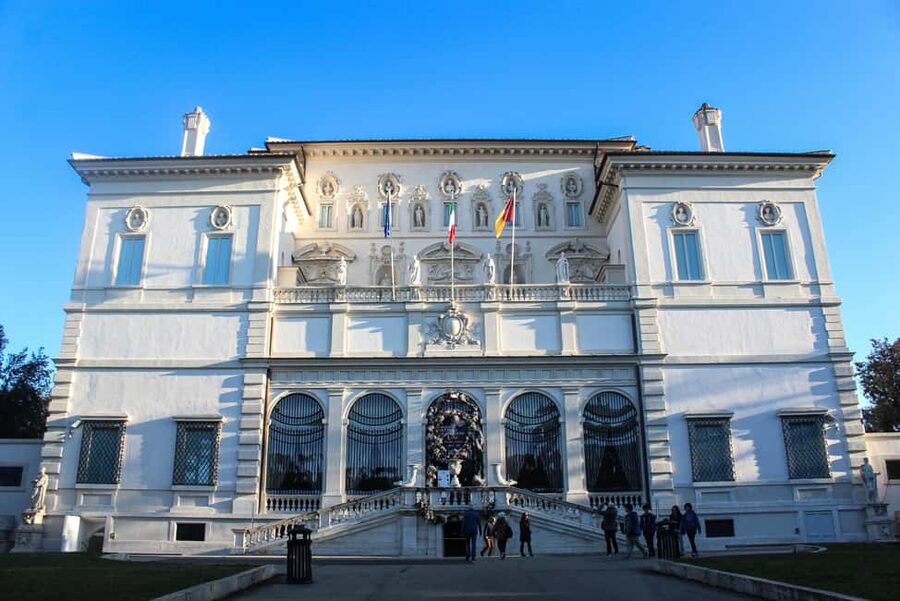
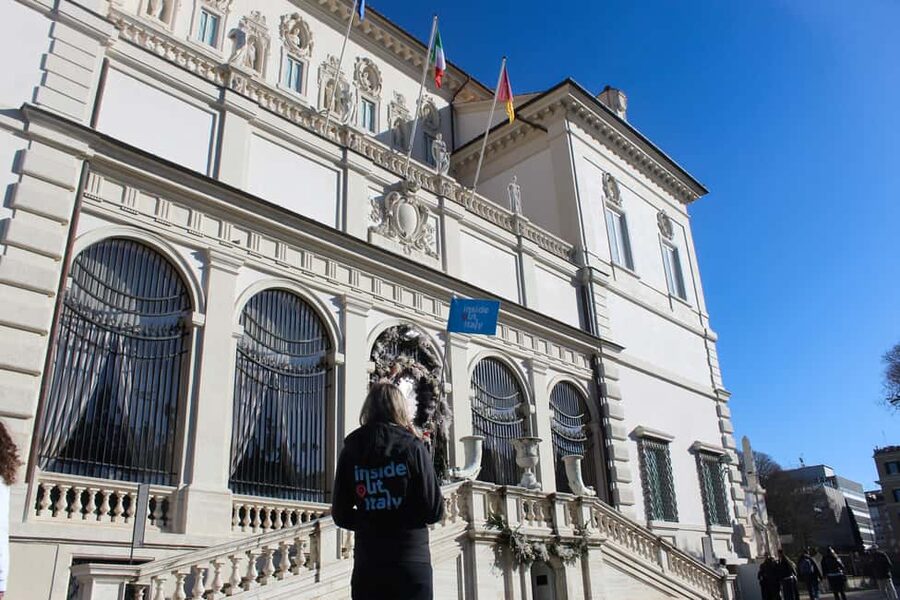
You meet your guide outside the main entrance of the Borghese Gallery. Look for a sign reading INSIDE OUT ITALY, and arrive 20 minutes before the scheduled start. That early arrival is not wasted time. Museum entry is timed and group tours work best when everyone is present before the appointment.
The tour includes skip-the-ticket-line entrance tickets. This does not mean you can arrive at the last second. Priority entry helps with the ticket process, but you still need to find the group and pass through the gallery’s own security and entry procedures.
You receive a headset so you can hear the guide clearly. This is a practical benefit, not a flashy extra. The Borghese rooms can fill with people, and guides must speak at a reasonable volume to protect the atmosphere. With an audio receiver, you can stand back from a sculpture or shift to one side of a painting without losing the explanation.
Leave food and drinks behind, and do not bring luggage or large bags. The tour is also not suited to people with mobility impairments, so check that point carefully before booking.
Ground floor: Bernini’s marble stories
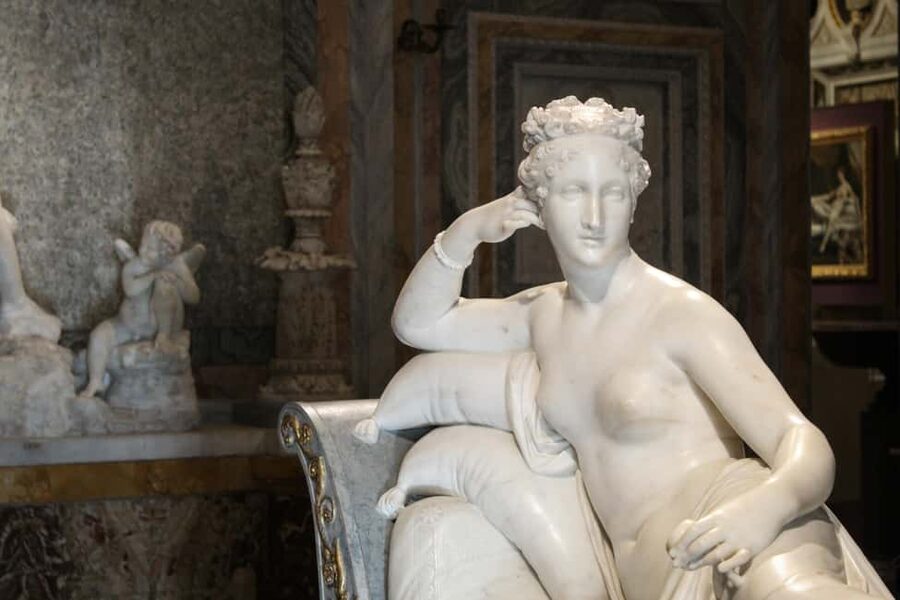
The visit begins on the ground floor, where Bernini takes center stage. This is the right place to start because his sculptures are physical, theatrical, and easy to appreciate even if you know little about art history.
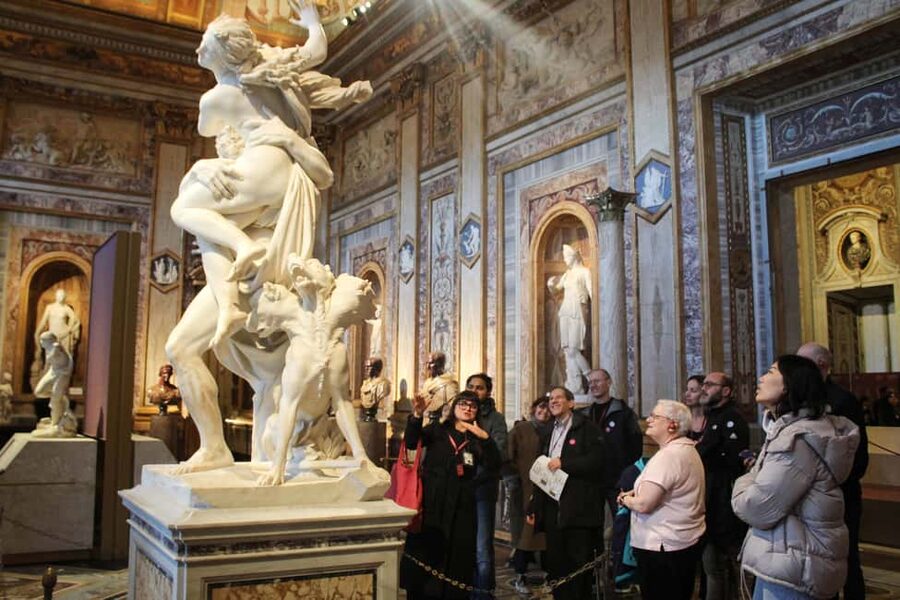
The Rape of Proserpina is an especially strong introduction. The subject comes from a Latin myth: Pluto seizes Proserpina and carries her into the underworld. Bernini turns that violent moment into a frozen burst of movement. Pluto grips her body, and her flesh appears to yield beneath his fingers, even though the material is hard marble.
Your guide can point out the details that make the scene so unsettling. Look at the contrast between Pluto’s power and Proserpina’s struggle. The sculpture is not meant to be viewed from one fixed position. As you move around it, the bodies twist, the expressions change, and the story unfolds in stages.
The title may also prompt a useful correction. This is not a peaceful love story. It is an abduction, and that tension is central to the work. A strong guide helps you look at the piece with both artistic admiration and awareness of its troubling subject.
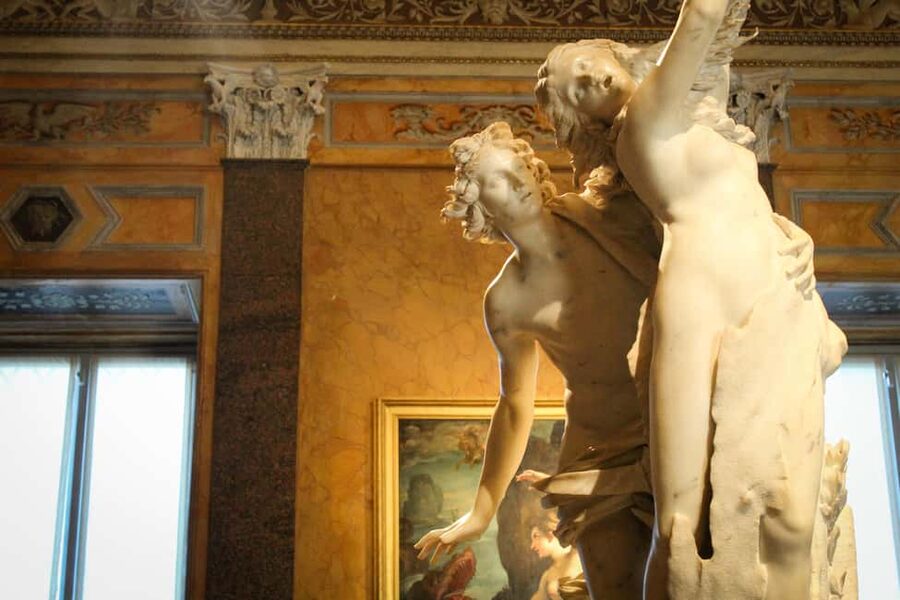
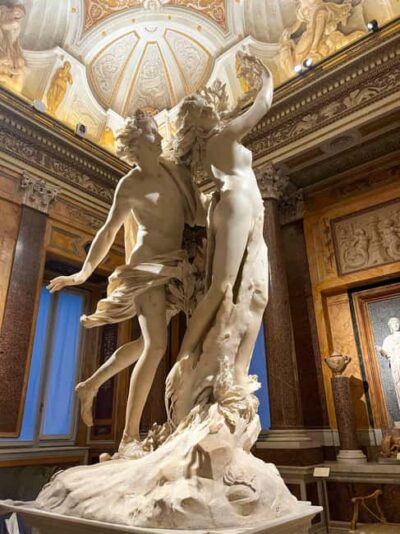
Next comes Apollo and Daphne, another myth transformed into a moment of action. Apollo reaches for Daphne, but she is changing into a laurel tree to escape him. Bernini captures the instant when human flesh becomes bark and hair becomes leaves.
This sculpture rewards a slow look. The fingers, branches, roots, and flowing hair create a sense of movement that seems impossible in stone. You might notice how the surface changes from smooth skin to rough tree bark. Your guide will likely help you connect those details to the story rather than treating them as isolated technical tricks.
David offers a different kind of drama. Bernini does not show David after the victory. He shows him in the middle of the fight, body twisted and face set with concentration. The sculpture asks you to imagine Goliath outside the frame.
That missing opponent is important. You are not simply looking at a figure. You are standing where the enemy would be. A guide can show you how the pose draws you into the scene and how the sculpture differs from the calmer, more self-contained Davids by earlier artists.
The ground floor is also where the headset proves its worth. You may want to circle the sculptures and find the best angle. Staying beside the guide at all times would limit your view, so the ability to hear while moving is useful.
Upstairs: Caravaggio’s people and Raphael’s polish
The route continues to the first floor, where the mood changes. Here you encounter paintings by Caravaggio and Raphael, along with other works from the Borghese collection.
Caravaggio’s Young Sick Bacchus is one of the gallery’s memorable paintings. The figure does not look like an idealized ancient god. He appears tired, pale, and intensely human. The work’s ambiguity is part of its appeal. Is this a self-portrait, a model posed as Bacchus, or a deliberately imperfect image of a mythological figure?
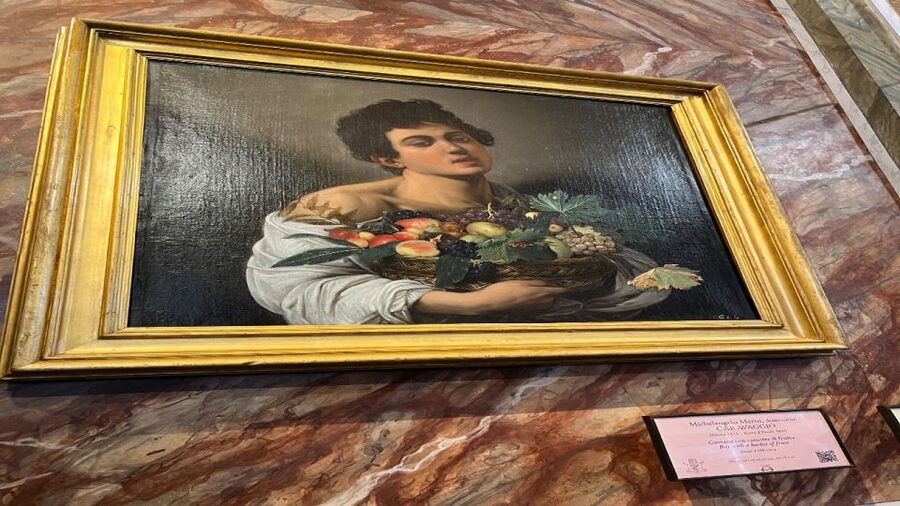
Then look for Boy with a Basket of Fruit. Caravaggio gives ordinary objects unusual force. The fruit, leaves, skin, and fabric seem close enough to touch, while the boy’s expression adds a note of uncertainty. It is not just a painting of attractive food. The guide can help you notice how beauty and decay sit side by side.
Caravaggio’s lighting is another reason to have help. His figures often emerge from a dark background with a startling clarity. The effect directs your eye, builds tension, and makes a small gesture matter. Once the guide explains the arrangement of light and shadow, you may begin to see the whole picture as a carefully controlled stage.
Raphael brings another kind of pleasure. His paintings are associated with balance, grace, and careful design. The Borghese collection also includes La Fornarina, often known as the portrait of a baker’s daughter, and other works connected with the artist’s refined style. The exact route and room access can vary, so your guide will decide how best to include the key Raphael works on the day.
One useful feature of this tour is the chance to ask about pieces outside the planned highlights. Guides such as Francesca, Federico, and Irene have been praised for handling questions about other objects in the rooms, not just delivering a memorized speech. That makes a difference in a museum with such a large collection.
More Rome museums and collections:
- Rome: Vatican Museums, Sistine Chapel & Basilica Tour
★ 4.3 · 13,872 reviews - Vatican Museums & Sistine Chapel Skip-the-Line Entry Ticket
★ 4.4 · 13,838 reviews - Rome: Vatican Museums, Sistine Chapel & Basilica Tour
★ 4.7 · 13,217 reviews - Rome: Vatican Museums & Sistine Chapel Guided Tour
★ 4.3 · 12,117 reviews
The palace interiors deserve your attention
It is easy to focus so closely on Bernini and Caravaggio that you forget to look up. The gallery itself is decorated with gold crown molding and ceilings covered in frescoes. These rooms tell you something about the Borghese family’s taste and ambition.
The setting also changes how the art feels. A Bernini sculpture in a grand palace is not presented like an object in a modern display case. The room gives it ceremony and scale. At the same time, the decoration can distract you, so the guide’s job is partly to direct your attention at the right moment.
Do not rush past the ceilings. Even if you are mainly visiting for the famous names, pause to take in the painted decoration and the sense of wealth built into every room. The building is not a neutral container. It is part of the collection’s story.
What two hours feels like inside
Two hours is a useful length for this museum. It gives you enough time to understand several masterpieces without asking your attention to survive an entire day of art.
The pace is usually structured around key works rather than every room. Your guide will stop at the main sculptures and paintings, explain their stories and details, and move the group onward before the visit becomes repetitive. Past participants have praised this approach, describing calm pacing and efficient coverage of the major pieces.
The limit is obvious: you will not see everything thoroughly. One person specifically noted that the museum’s crowd-control policy and limited room time made a complete visit difficult. That is not a flaw unique to the guide. The gallery controls visitor numbers and some rooms may be closed for restoration. Still, you should book this tour with the right expectation: it is an introduction built around masterpieces, not a complete inventory of the collection.
If you want to linger over every painting, two hours may feel short. If you want a clear path through the essential works, the time is well judged. You can always return to the gallery later if your schedule and ticket arrangements allow, though no return visit is included in this activity.
Is the 73 dollar price fair?
At 73 dollars per person, this is not a cheap museum entry. You are paying for more than access: the price includes the gallery ticket, a live guide, priority entrance, headset equipment, and a small group capped at 15 people.
The value depends on how much guidance you want. If you already know Bernini, Caravaggio, and Raphael well, you may prefer to visit independently and set your own pace. If you want the major works explained in plain language, the guide can make the ticket feel worthwhile.
I think the price is easier to justify for a first visit, a short stay in Rome, or a family group with mixed interest in art. A guide who can turn sculpture and painting into stories may save you from wandering past the best works without understanding them.
The value also depends on the quality of the individual guide. The strongest feedback names Agnese, Irene, Dimitri, and several others for warmth, humor, and strong command of art and history. Guide assignments can vary, so do not book on the assumption that one particular person will lead your departure. The overall pattern points to a well-regarded guiding team, but personalities and presentation styles naturally differ.
Who will enjoy this tour most
I would choose this tour for a first-time Borghese visitor who wants the major works explained without sitting through a long lecture. It also suits couples, families, and small groups who prefer a focused visit to an unstructured museum wander.
The tour works particularly well if you are curious about how to look at art. You will hear the myths behind Bernini’s sculptures, see how Caravaggio uses light and ordinary faces, and learn to connect visual details with a painting’s meaning.
It may not suit you if you need step-free or fully mobility-friendly access, since the activity is not recommended for people with mobility impairments. It is also not ideal if you dislike a set route or want to spend ten minutes alone with one painting.
The available languages are Italian, English, French, and Spanish. Private or small-group arrangements are available, so check the option shown for your chosen time if group size matters to you.
Practical tips for a smoother visit
Wear comfortable shoes. You will be on your feet for the full two hours, and the best viewing often requires shifting position around the sculptures.
Arrive 20 minutes early at the main entrance. Bring the booking details you need, look for the INSIDE OUT ITALY sign, and allow time for the group to assemble.
Pack lightly. Food, drinks, luggage, and large bags are not allowed. A small, practical bag is safer than arriving with shopping or a full daypack.
Keep an open mind about room access. Restoration work can close galleries without prior notice, and barricades or blocked areas may affect the route. The guide can adjust the visit, but no tour can show a room that the museum has closed.
The activity offers free cancellation up to 24 hours before the start time, and you can reserve now and pay later. Those terms are useful when your Rome schedule is still changing, but check the exact booking conditions before confirming.
Should you book the Borghese Gallery guided tour?
Book it if you want a focused introduction to Rome’s finest Bernini sculptures and a strong selection of Caravaggio and Raphael, without losing time in the gallery’s many rooms. The small group, headsets, priority entrance, and lively guiding style make the 73 dollar cost easier to defend.
Skip it if you prefer total freedom, already have a solid grasp of the artists, or want to inspect every corner at your own pace. For most first-time visitors, though, the Borghese Gallery is one of those places where a good guide changes the experience from beautiful but confusing to vivid and memorable.
FAQ
How long is the Borghese Gallery guided tour?
The tour lasts two hours. Starting times vary, so check availability when selecting your date.
What artworks are included on the tour?
The route includes Bernini’s The Rape of Proserpina, Apollo and Daphne, and David. Upstairs, the guide highlights paintings by Caravaggio and Raphael, including Young Sick Bacchus and Boy with a Basket of Fruit.
How large is the tour group?
The group is limited to a maximum of 15 participants. Private and other small-group options are also available.
Which languages are offered?
Live guiding is available in Italian, English, French, and Spanish.
Where do I meet the guide?
Meet outside the main entrance of the Borghese Gallery. The guide will hold a sign reading INSIDE OUT ITALY. Check in 20 minutes before the start time.
Are entrance tickets included?
Yes. Skip-the-ticket-line entrance tickets, the live guide, and the small-group arrangement are included. Hotel pickup and drop-off are not included.
Recently reviewed around Rome
- Ancient Rome at Twilight Walking Tour★ 5.0 · 276 reviews
- Domus Aurea Guided Tour: The Golden House of Nero★ 4.5 · 199 reviews
- Early Vatican Museums & Sistine Chapel Small Group Tour★ 4.5 · 314 reviews
- Early Vatican Museums Tour: The Best of the Sistine Chapel★ 4.5 · 900 reviews
- Jewish Ghetto & Piazza Navona: Food, Wine & Sightseeing Rome Tour★ 5.0 · 460 reviews
- 3 Days in Sorrento, Capri & Pompeii: la Dolce Vita★ 4.0 · 595 reviews
- Tivoli Villas Full Day Trip From Rome with Lunch★ 4.0 · 443 reviews
- Cook With Us in Rome: A Hands-On Cooking Experience 09:20AM class★ 5.0 · 234 reviews
Borghese Gallery Tours, compared.
Borghese Gallery and Gardens Guided Small-Group Tour
Read our review →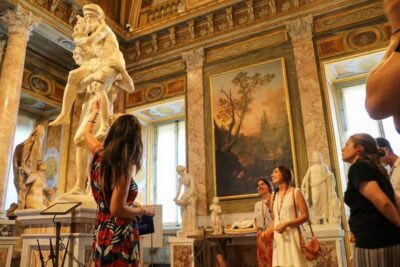
Borghese Gallery Guided Tour with Skip-the-Line Entry
Read our review →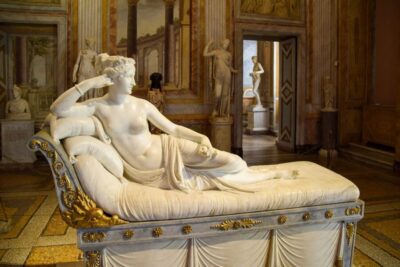
Borghese Gallery Skip-the-Line Tickets with Audioguide
Read our review →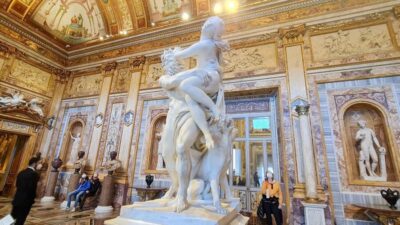
Borghese Gallery Entry Ticket & Optional Guided Tour
Read our review →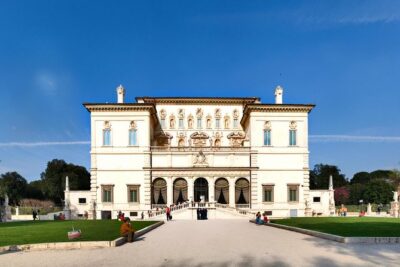
Borghese Gallery & Gardens Small Group Guided Tour
Read our review →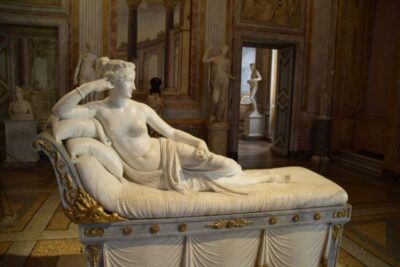
Borghese Gallery Guided Tour with Skip-the-Line Entry
Read our review →Browse the lists this tour appears in