
Review · AUDIO TOURS
Florence: Michelangelo’s David Entrance Ticket and Audio App
Michelangelo’s David is the reason most people come to Florence’s Accademia Gallery, and the first sight of that immense marble figure can stop you in your tracks. This ticket gives you a reserved entry time, then leaves you free to take in David and the museum at your own pace with a phone-based audio guide.
I like the separate entrance, which can save you from the long ticket-office queue, and I like the freedom of a self-guided visit. You can spend your time where you please instead of following a live guide. The main drawbacks are the sometimes-fussy Pop Guide app and the fact that this is not a live tour, so the depth of explanation depends on how well the app works for you.
In This Review
- Key points to know before you book
- Seeing David without waiting at the ticket office
- Michelangelo’s David deserves your first few minutes
- The unfinished sculptures show Michelangelo at work
- Gipsoteca: plaster models from Florence’s sculptors
- Medici instruments and three Stradivarius violins
- Medieval and Renaissance paintings beyond the main hall
- The top floor and its medieval altarpieces
- How the Pop Guide audio app works
- Is $38 a fair price?
- Timing, bags, and access
- Who should choose this Accademia visit?
- Should you book it?
- FAQ
- Where do I meet the activity staff?
- What happens at the meeting point?
- Is this a live guided tour?
- What audio guide app is used?
- Do I need to bring headphones?
- Do I need a smartphone?
- Is entry guaranteed if I arrive late?
- Can I bring luggage or large bags?
- What identification do children need?
- Is the Accademia Gallery wheelchair accessible?
Key points to know before you book
- David is the main event: Michelangelo’s famous statue is displayed in the main hall, alongside several unfinished works that reveal his carving process.
- Timed entry saves time: You exchange your voucher for a physical ticket and join the appropriate entrance line at your assigned time.
- The audio guide is self-paced: Download the Pop Guide app before arriving, bring headphones, and use your own smartphone.
- There is more than David: The collection includes Giotto, Botticelli, medieval altarpieces, plaster models, and Medici musical instruments.
- Allow up to three hours: The listed duration gives you room to see the full museum, though a focused visit can take less.
- Plan carefully for your entry slot: Late arrival may mean no admission and no refund, while a 15 to 20 minute wait can still occur.
Seeing David without waiting at the ticket office
The practical value of this experience begins before you enter the museum. You meet a staff member in front of the Carrefour Express Supermarket and exchange your voucher for a physical Accademia ticket.
Look for the person holding a white flag marked ENJOY ROME. That detail matters because the meeting point is outside the museum, and you do not want to spend your timed entry window searching among several queues. The instructions describe a well-organized handoff, and the staff member directs you to the correct entrance.
You still need to arrive on time. This is a timed ticket, not an open admission pass. Late arrivals are not guaranteed entry or a refund. The museum may also delay admission when too many people are already inside, so reserved entry does not mean you walk through the door at the exact second printed on your ticket.
A short wait, sometimes around 15 or 20 minutes, can occur under museum rules. Even so, the separate entrance is the chief reason to choose this option. During busy periods, standing in the wrong line can cost more time than the museum visit itself.
More Florence trips worth a second look
- Florence: Cathedral & Brunelleschi’s Dome Ticket & Audio App
★ 4.4 · 6,973 reviews - Florence: Michelangelo’s David Priority Ticket & Audio App
★ 4.4 · 6,812 reviews - Florence: Uffizi Priority Ticket & Masterpieces Audio App
★ 4.2 · 6,402 reviews
Michelangelo’s David deserves your first few minutes
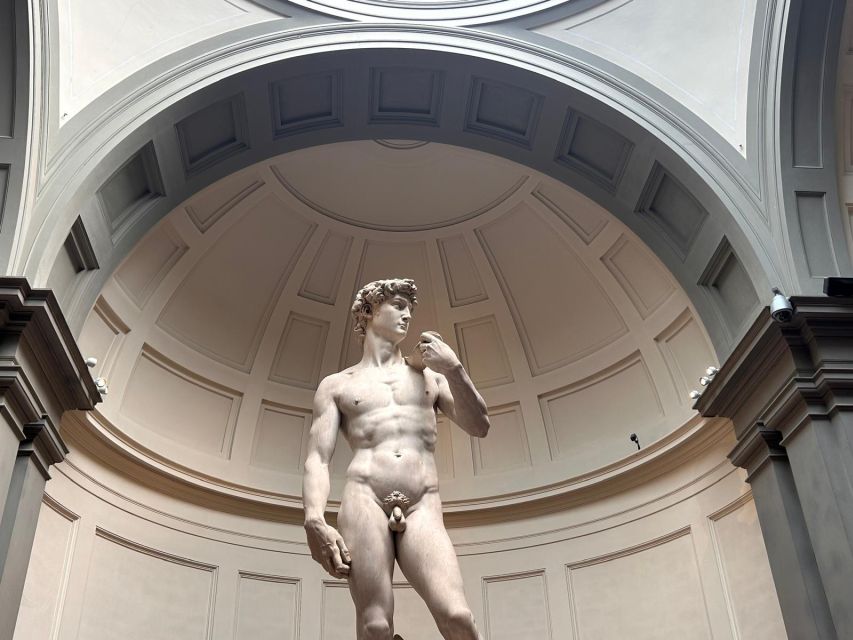
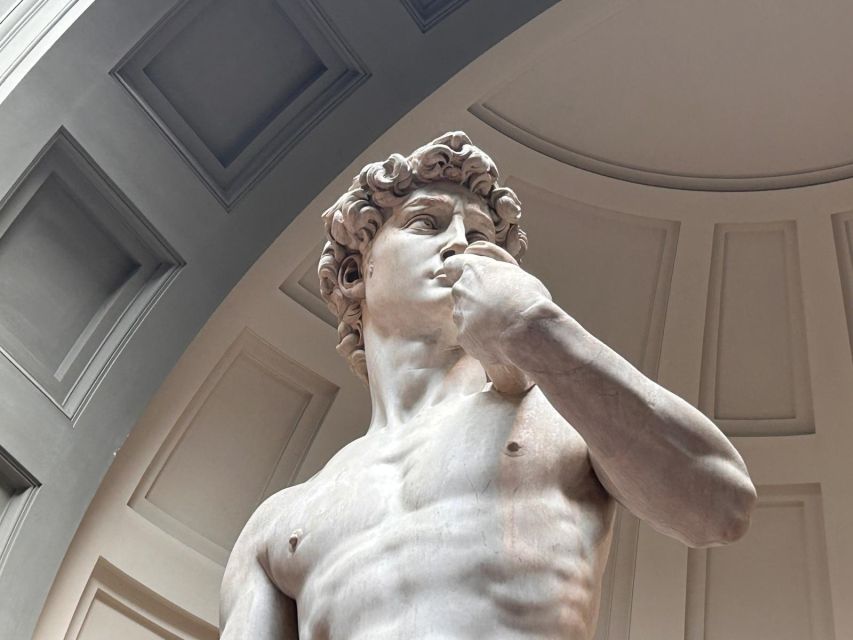
Once inside, head toward the main hall and David. You have likely seen photographs of this statue countless times, but the real thing has a force that photographs cannot quite capture. The figure is enormous, finely worked, and presented so you can walk around it and study the details from several angles.
Michelangelo carved David from marble in the early 1500s, showing the biblical hero before his encounter with Goliath. The pose is calm but tense. His expression, hands, and muscular frame suggest a mind preparing for action rather than a battle already won.
Give yourself time before reaching for your phone. Look at the proportions, the hands, the feet, and the way the marble surface changes across the figure. The scale is part of the shock. You are not looking at a small model or a reproduction, but at the original sculpture in the place where it has been displayed for generations.
The audio app can add useful context, but I would first take in David quietly. The room can be crowded, and the statue draws nearly every eye. If you want a calmer look, move around the gallery rather than stopping directly in front of the first viewing spot.
The unfinished sculptures show Michelangelo at work
Near David, you can see unfinished works often called Michelangelo’s Prisoners or Slaves. These sculptures are valuable because they show figures still emerging from the marble.
The contrast with David is striking. David appears complete and perfectly controlled. The unfinished figures retain broad sections of stone, making it easier to imagine the sculptor cutting away what did not belong. The effect is not merely an unfinished display. It gives you a direct look at Michelangelo’s approach to carving and at the physical link between raw material and finished body.
This is one of the best reasons not to rush through the museum after seeing David. The famous statue may take the spotlight, but the unfinished works provide a clearer sense of the artist’s skill. You can compare the rough stone with the smooth surfaces of David and consider how much planning, patience, and labor went into the final result.
The audio guide is useful here if the relevant stop loads correctly. Some people find the explanations clear and brief, while others have had trouble matching the app’s numbered points to the correct artwork. Use it as a helpful layer, not as the only way to understand what you are seeing.
Gipsoteca: plaster models from Florence’s sculptors
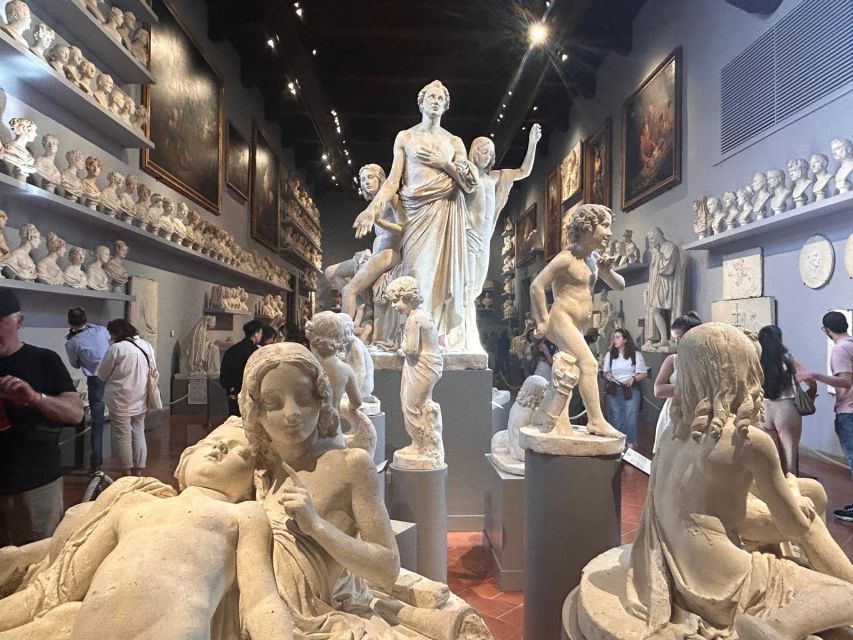
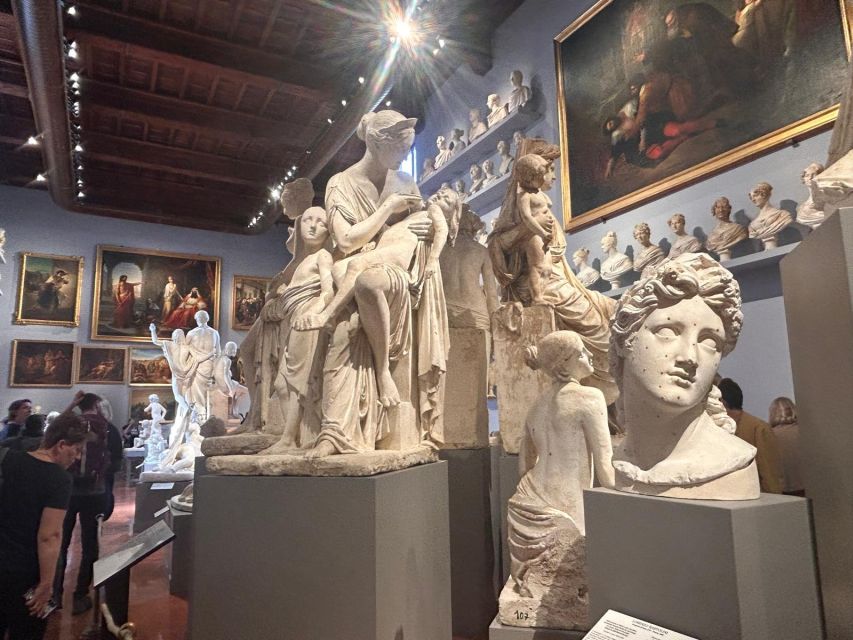
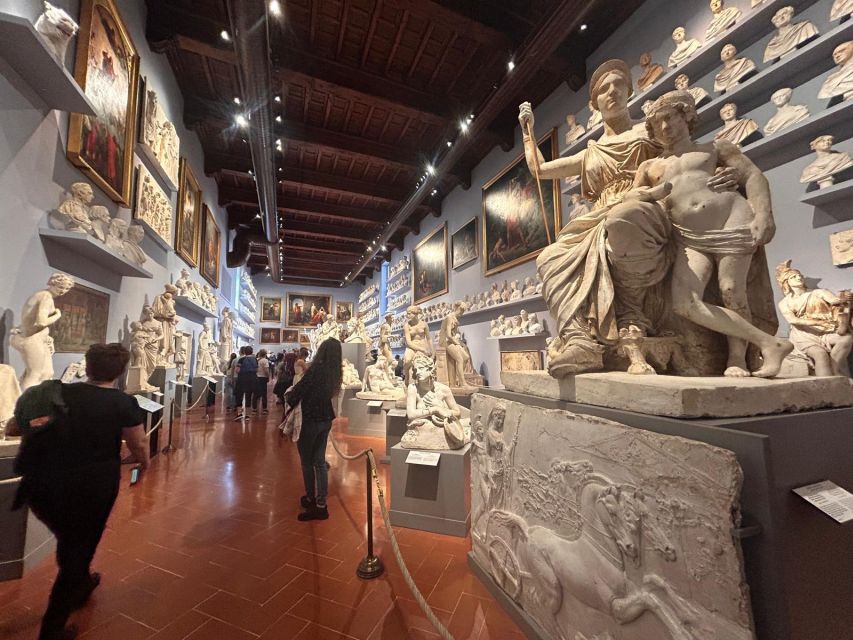
Continue to the Gipsoteca, the gallery of plaster casts and models. Here you see original plaster models made by 19th-century Florentine sculptors.
This room provides a change of pace after the intensity of David. Plaster models are part of the working process of sculpture, and they help you think about how artists developed a figure before producing a larger or final version. The displays also broaden the visit beyond one Renaissance master.
If your interest is limited to Michelangelo, you may move through this room quickly. If you enjoy sculpture, it rewards a slower look. The figures and models show a later period of Florentine art and help place the Accademia within a longer story of artistic training and production.
The museum is compact enough for you to make your own choices. You do not have to give equal time to every gallery. Spend longer with the works that catch you, then use the app when you want extra information.
A different way to spend the day, same part of Italy:
- Florence: Skip-The-Line Uffizi Gallery Timed Entry Ticket
★ 4.5 · 27,832 reviews - Tuscany Day Trip from Florence: Siena, San Gimignano, Pisa and Lunch at a Winery
★ 5.0 · 21,634 reviews - Florence: Timed Entrance Ticket to Michelangelo’s David
★ 4.6 · 16,983 reviews - Florence: Michelangelo’s David Skip-the-Line Entry Ticket
★ 4.5 · 12,764 reviews
Medici instruments and three Stradivarius violins
The collection also includes original musical instruments from the Medici collection. Three instruments are by Stradivarius, a detail that is easy to miss if you focus only on paintings and sculpture.
This section adds a different kind of connection to Florence’s court culture. The instruments are objects of design and craftsmanship, but they also point to music as part of life at the Medici court. After looking at marble and painted panels, the cases offer a welcome change.
You might not spend as long here as in the David hall, especially during a crowded visit. Still, the instruments are worth seeking out because they show that the museum is not simply a one-statue stop. The Accademia has several collections under one roof, and the musical displays make that clear.
Medieval and Renaissance paintings beyond the main hall
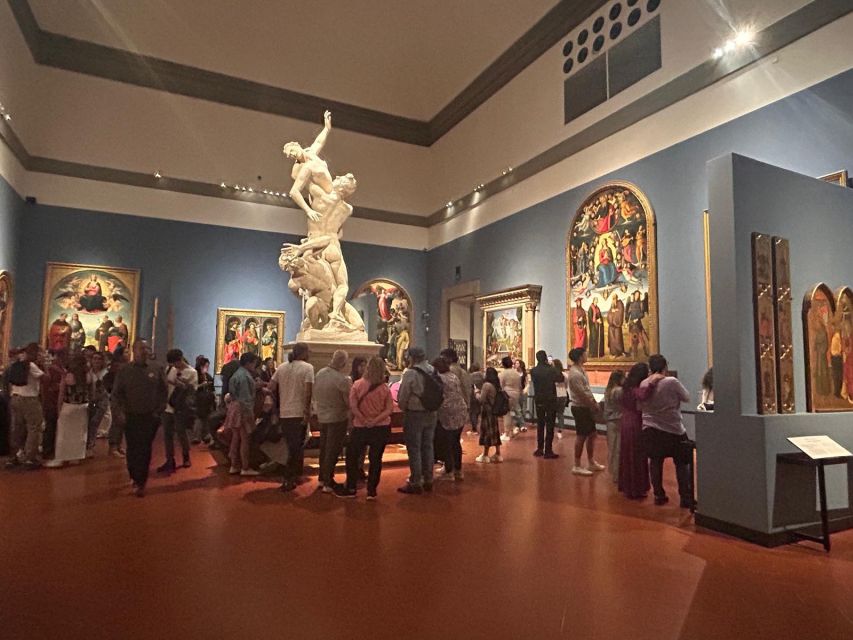
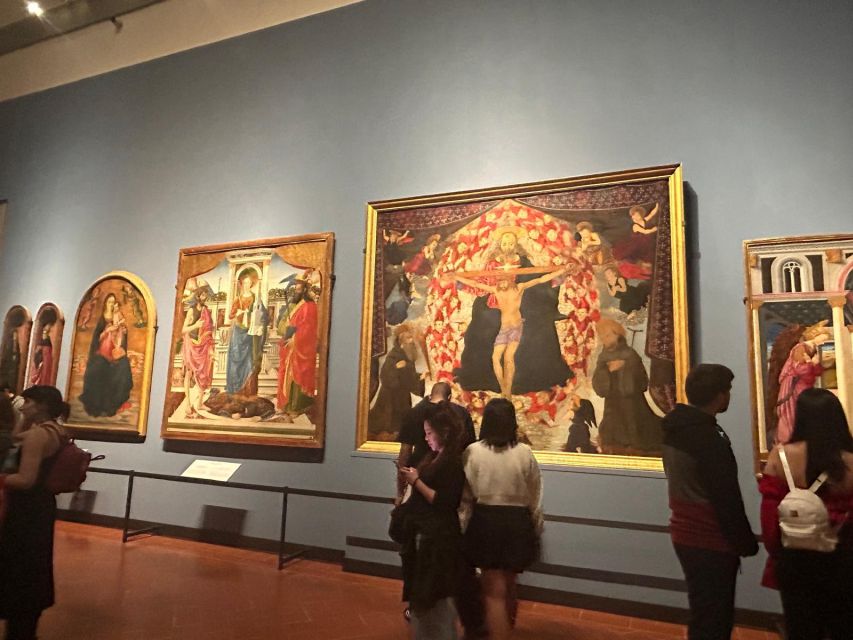
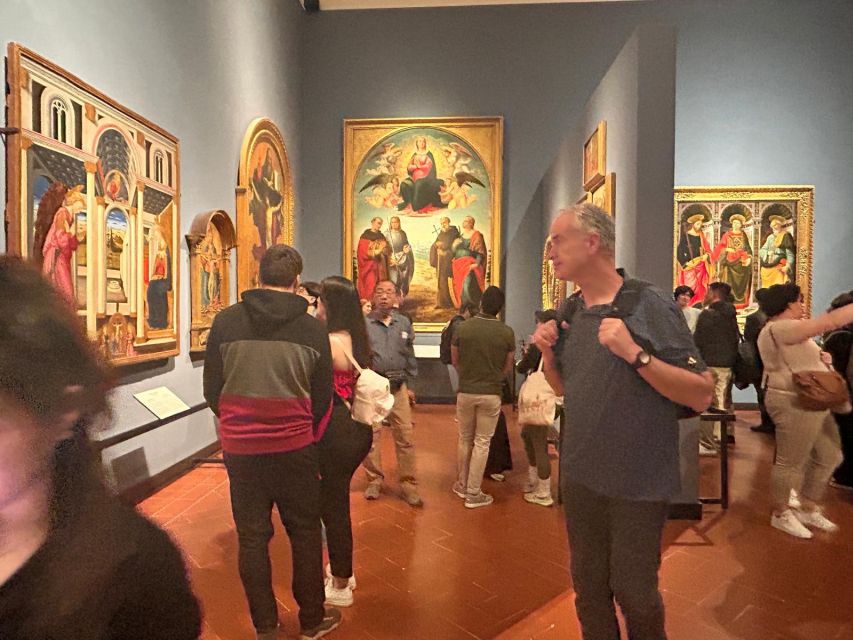
After the sculpture galleries, continue into the painting rooms. You can see works by medieval and Renaissance artists, including Giotto and Botticelli.
These paintings give the visit more historical range. The museum’s sculpture is the headline, but the paintings show how Florentine art changed across different periods. Medieval works can look more formal and devotional, while Renaissance pieces draw greater attention to human figures, space, and natural detail.
Do not expect the painting collection to rival Florence’s largest art museums. The Accademia’s strongest draw remains its sculpture, especially David. Still, the paintings make the admission more worthwhile and give you something substantial to see after the main attraction.
The app’s coverage is not perfectly consistent. Some art may have a clear audio stop, while another work may be absent or difficult to locate on the digital map. I recommend checking the app before walking away from a room, but also trusting your own eyes. You can appreciate a painting without an audio number attached to it.
The top floor and its medieval altarpieces
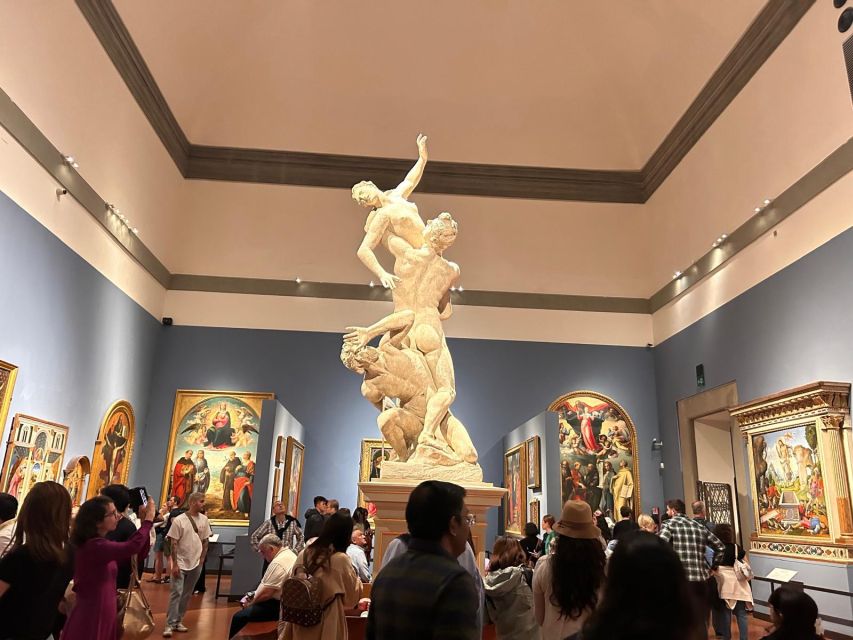
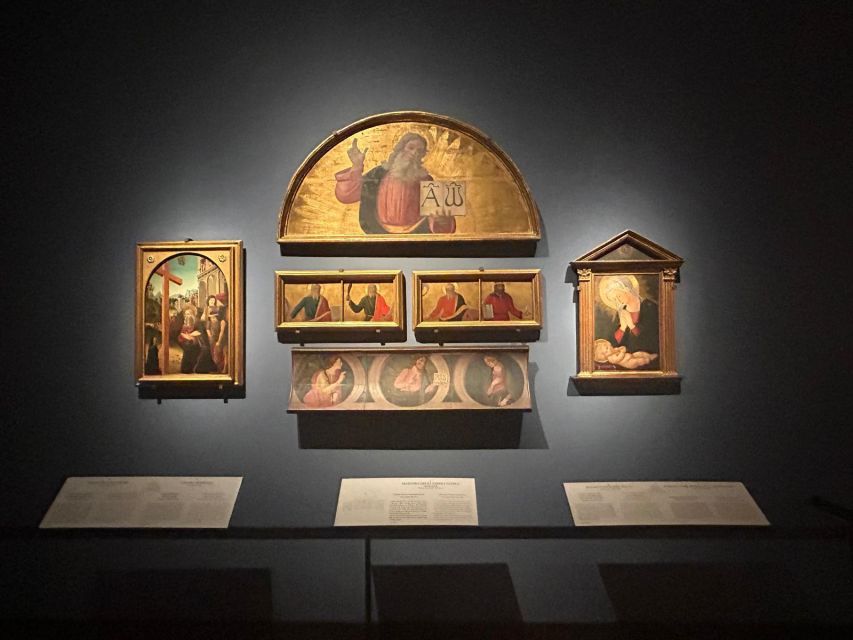
Finish on the top floor, where impressive medieval altarpieces are displayed. These works are often larger and more visually complex than a quick glance suggests.
Take a moment to examine the separate scenes, painted figures, and decorative details. An altarpiece was designed to guide attention across several images, not just one central portrait. The upper gallery can feel quieter and more reflective than the David hall, making it a good place to end.
This final section is especially useful for visitors who want more than the familiar Michelangelo stop. It also gives your visit a clear route through the museum: David and the unfinished sculptures first, sculpture and instruments next, then paintings and medieval works above.
How the Pop Guide audio app works
The included audio guide is provided through the Pop Guide application. Download the app before you arrive, then receive login credentials from the staff member at the meeting point.
Bring your own headphones. This is important. The activity does not provide a headset, and using your phone’s speaker in a crowded gallery is neither practical nor considerate. You also need a charged smartphone for the app.
The app’s strongest feature is flexibility. You can pause, skip, or replay sections and move through the museum without staying beside a live guide. That works well for families or couples with different interests. One person can spend extra time with David while another moves ahead to the paintings.
The tradeoff is reliability. The audio content is described as informative but brief, and some sections may not line up easily with the artwork in front of you. One part of the collection may have a useful explanation while another has no obvious matching stop. Downloading the app in advance reduces the amount of work you need to do at the meeting point.
If you want a detailed art lesson, a live guide would likely offer more depth and answer questions as they arise. This ticket is better for independent sightseeing with a modest amount of background information.
Is $38 a fair price?
At $38 per person, this is more expensive than buying a simple museum ticket directly when official tickets are available. The extra cost pays for convenience: a reserved entry time, help at the meeting point, a physical ticket, and the audio app.
The value becomes clearer when official admission is sold out for your dates. The ticket gives you a way to visit the Accademia instead of rearranging your Florence schedule around an uncertain queue. Several people have found the extra charge modest compared with the time saved, especially when the alternative is waiting in a long line.
I would not book it solely for the audio guide. The app is a useful bonus, but it is not as dependable or detailed as a live tour. I would book it for the timed entry and treat the audio as an added tool.
For a family, the time savings can be worth more than the price difference. For a solo visitor with an open schedule, buying directly may be better if official tickets remain available. The best value depends on how busy your date is and how much you value certainty.
Timing, bags, and access
The listed duration is three hours, which is generous enough for a careful self-guided visit. You might finish sooner if David is your only goal, but the full collection deserves more than a quick photograph and exit.
Arrive early at the Carrefour Express meeting point. You need time to find the white flag, exchange the voucher, receive your ticket, and join the correct line. Do not wait until the last few minutes before your entry slot.
Large bags and luggage are not allowed. Pets are also not allowed. Bring a passport or photo ID for children aged 6 to 17, because the discounted ticket requires proof of age. Without valid identification, the child may need an adult ticket.
The activity is listed as wheelchair accessible. You should still arrive prepared for possible crowding and museum-controlled entry delays.
Who should choose this Accademia visit?
I recommend this experience if you want to see David and prefer a clear arrival process over the uncertainty of a walk-up queue. It suits first-time visitors who want the major sculpture, a sampling of Florentine paintings, and the freedom to explore without a live group.
It is also a good fit for families, since you can move at your own speed and avoid standing at the ticket office for a long time. Independent museum visitors will appreciate the flexible audio format.
You may want a different option if you want a scholar-level explanation, personal questions answered, or a guide who points out every important detail. The host helps you get inside, but the museum visit itself is self-guided.
Should you book it?
Book this ticket if your Florence dates are fixed, the Accademia is important to you, or official tickets are unavailable. The reserved entry is the strongest feature, and the physical ticket handoff is straightforward when you follow the meeting instructions.
Skip it if you already have an official timed ticket and do not need the app. At $38, the experience makes the most sense as a time-saving solution, not simply as a way to add a short audio tour.
My practical advice is simple: download Pop Guide before leaving your hotel, charge your phone, bring earbuds, arrive early at the Carrefour Express, and give David more than a quick glance. The statue is famous for good reason, but the unfinished sculptures, instruments, paintings, and medieval altarpieces turn this into a worthwhile museum visit rather than a single-photo stop.
FAQ
Where do I meet the activity staff?
Meet the staff member in front of the Carrefour Express Supermarket. Look for a person holding a white flag marked ENJOY ROME.
What happens at the meeting point?
You exchange your voucher for a physical Accademia Gallery entry ticket. The staff member then directs you to the appropriate entrance line.
Is this a live guided tour?
No. The experience includes an audio guide app, but it does not include a live guide inside the museum.
What audio guide app is used?
The audio guide is provided through the Pop Guide application. You should download it before arriving and receive login credentials at the meeting point.
Do I need to bring headphones?
Yes. Headphones are not listed as included, so bring your own headset or earbuds.
Do I need a smartphone?
Yes. You need a charged smartphone to use the Pop Guide audio guide.
Is entry guaranteed if I arrive late?
No. The ticket is timed, and late arrivals are not guaranteed admission or a refund.
Can I bring luggage or large bags?
No. Luggage and large bags are not allowed. Pets are also not allowed.
What identification do children need?
Visitors aged 6 to 17 need a valid photo ID showing their date of birth to qualify for a discounted ticket. Without it, they may need to purchase a full adult ticket.
Is the Accademia Gallery wheelchair accessible?
The activity is listed as wheelchair accessible. Museum entry may still involve a delay of 15 to 20 minutes, or longer when visitor numbers are high.
Recently reviewed around Florence
- Walking Food Tour of Florence with Tastings and Wine★ 5.0 · 518 reviews
- Florence Sunset Food Tour with Wine & Dine at a Tuscan farmhouse★ 5.0 · 194 reviews
- Wine Experience In Chianti Hills from Florence★ 4.5 · 195 reviews
- Val d’Orcia Brunello Wine Tour with Montalcino and Montepulciano★ 4.5 · 359 reviews
- Wine Tasting Experience in Ponte Vecchio: Best Tuscany selection!★ 5.0 · 197 reviews
- Uffizi Gallery Timed Entry Admission Tickets★ 4.0 · 392 reviews
- Uffizi Gallery Small Group Tour with Guide★ 4.5 · 879 reviews
- Early Access Guided Uffizi Gallery Tour Skip-the-Line Small Group★ 4.5 · 707 reviews
Audio Tours, compared.

Colosseum & Forum with Audio Guide App -Optional Arena
Read our review →
Pantheon Fast-Track Ticket and Official Audio Guide
Read our review →
La Fenice Opera House Entry Ticket with Audio Guide
Read our review →
St. Peter’s Basilica & Dome Entry Ticket & Audio Tour
Read our review →
Cathedral & Brunelleschi’s Dome Ticket & Audio App
Read our review →
Michelangelo’s David Priority Ticket & Audio App
Read our review →
Uffizi Priority Ticket & Masterpieces Audio App
Read our review →Browse the lists this tour appears in