
Review · WALKING TOURS
Florence: Private Walking Tour of Florence’s Hidden Gems
Florence reveals its story best from the street, where a church facade, Medici palace, jewelry shop, and grand square line up within a short walk. This private two-hour tour links the city’s biggest sights, from Santa Croce and Ponte Vecchio to Pitti Palace and the Duomo, while guides such as Giacomo, Claudia, Marco, and Manuela have made the past lively for families and first-time visitors.
I like the clear route across both sides of the Arno, and I like that a private guide can answer your questions instead of delivering a fixed speech. The main catch is speed: this is an exterior overview, not a ticketed museum tour, and the route covers a lot of ground in two hours.
In This Review
- Key points to know before booking
- What this Florence walk is really designed to do
- Meeting in Florence’s central streets
- Santa Croce and the Bargello: Florence’s public face
- Piazza della Signoria and Neptune’s Fountain
- Ponte Vecchio and the view toward Pitti Palace
- Via Maggio, Santa Trinita, and Florence’s style today
- Strozzi Palace and Piazza della Repubblica
- The Duomo finale, with an important clothing rule
- The guides are the heart of the experience
- Pace, footwear, and mobility
- What you get for the time and cost
- Who should book this walk?
- Should you book the Florence private walking tour?
- FAQ
- How long is the Florence walking tour?
- Is this a private tour?
- Which languages are available?
- Does the tour enter the Uffizi Gallery?
- Does the tour enter the Florence Cathedral?
- Where does the tour meet?
- What should I bring?
- Is the tour suitable for wheelchair users?
- Can I cancel or pay later?
Key points to know before booking
- A compact Florence orientation: See major squares, palaces, bridges, churches, and shopping streets in one walk.
- Private format: Your group receives a live guide in English or Italian, with more room for questions and family-friendly explanations.
- Exterior sightseeing only: The route passes the Uffizi, Bargello, Santa Croce, Pitti Palace, and Duomo, but admission is not included.
- A cross-Arno route: Ponte Vecchio and Ponte Santa Trinita connect the historic center with the Oltrarno side.
- Strong guide reports: Giacomo, Claudia, Marco, Manuela, Ilaria, and others are praised for clear storytelling and local suggestions.
- Wear proper shoes: Narrow streets, bridge crossings, and a steady sightseeing pace make comfortable footwear essential.
What this Florence walk is really designed to do
Think of this as a first look at Florence, not a full art tour. In two hours, you move through the city center while your guide explains how its churches, ruling families, artists, and public spaces fit together.
That purpose matters. Florence can feel like a jumble of famous names on your first day: Uffizi, Medici, Duomo, Bargello, Strozzi, Pitti. A good guide gives you a mental map, so you can return later to the places that deserve more time.
The private setup is useful for couples, families, and small groups with different interests. You can ask about Medici politics, Renaissance art, leather goods, restaurants, or the best way to reach a viewpoint. Guides have also adjusted their approach for children. Claudia, for example, kept two girls aged 10 and 7 involved rather than speaking only to the adults.
The route is busy in content, if not always fast on foot. Expect roughly ten minutes of guided attention at many stops, plus time spent walking between them. That means you will hear context at each place, but you will not study artworks in detail or enter every major building.
More Walking Tours in Florence
- Florence: Guided Walking Tour
★ 4.5 · 3,334 reviews - Skip the line: Uffizi and Accademia Small Group Walking Tour
★ 4.5 · 3,135 reviews - Florence: Guided Walking Tour
★ 4.6 · 1,602 reviews
Meeting in Florence’s central streets
The stated meeting point is Door 8 at Accord Tours, near the provided coordinates at 43.774654, 11.252746. Other tour details refer to Piazza San Firenze, and the itinerary gives Piazza di Madonna degli Aldobrandini as one of two possible starting points.
Because the starting location can change with the selected option, check your booking confirmation carefully. This is especially important if you are arriving by train, carrying luggage, or meeting your guide at a precise time.
Once underway, the guide leads you through central Florence on foot. The route includes narrow historic streets, open squares, and several busy crossing points. Stay close to the guide, particularly around Piazza della Signoria and Ponte Vecchio.
Santa Croce and the Bargello: Florence’s public face
The walk is described as beginning near Piazza San Firenze, home to the Bargello and the Tribunale Fiorentino. The Bargello is one of Florence’s major sculpture museums, but here you see it from outside. That is still worthwhile because the building itself helps show how Florence reused imposing medieval structures for civic purposes.
The route then reaches the Basilica of Santa Croce. This is one of the most meaningful stops because the church is both an artistic landmark and a burial place for important Italian figures. The tour presents the exterior and surrounding area only, so plan a separate visit if you want to see the church interiors and artworks.
Santa Croce gives your guide plenty to explain: the role of religious institutions, the public memory of famous Florentines, and the way art shaped the city’s identity. Guides such as Marco have been praised for connecting architecture with artists and the rise of the Medici family, rather than treating each building as an isolated photo stop.
If you have a strong interest in sculpture, painting, or church interiors, note the limit here. You get orientation and stories, not a museum visit.
Piazza della Signoria and Neptune’s Fountain
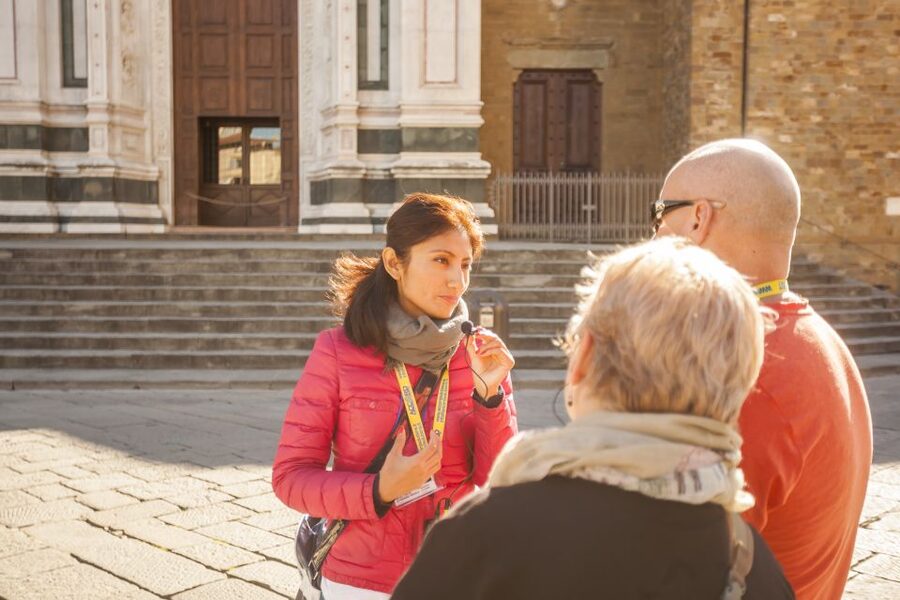
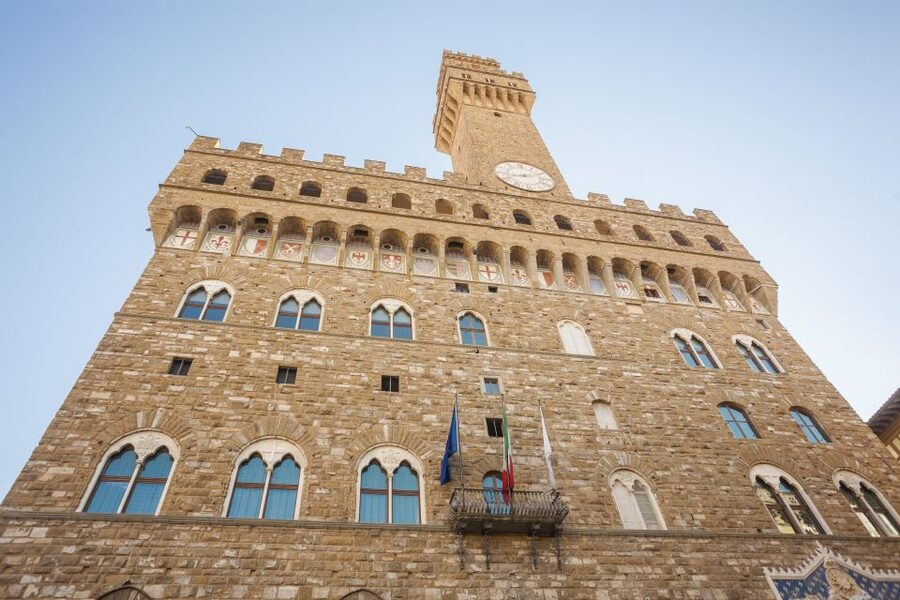
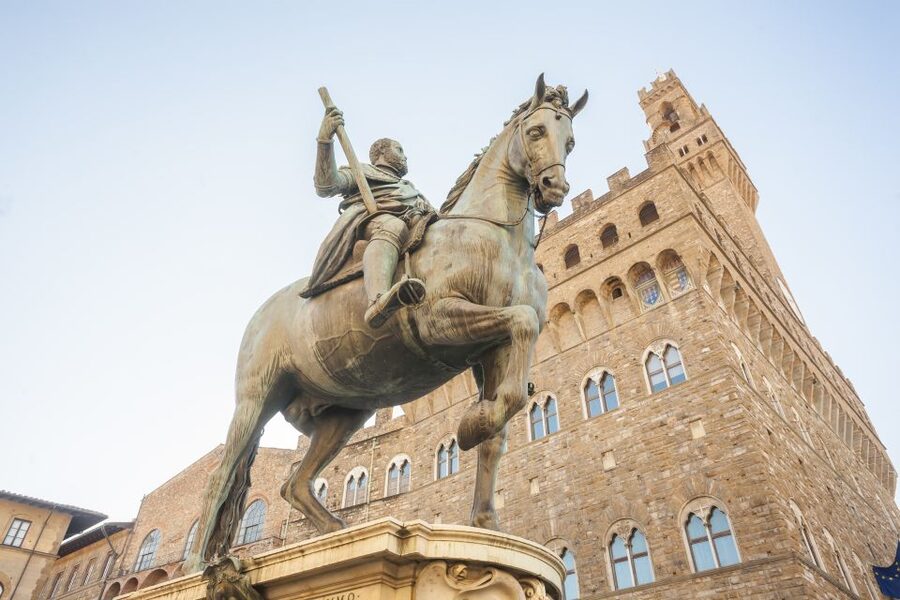
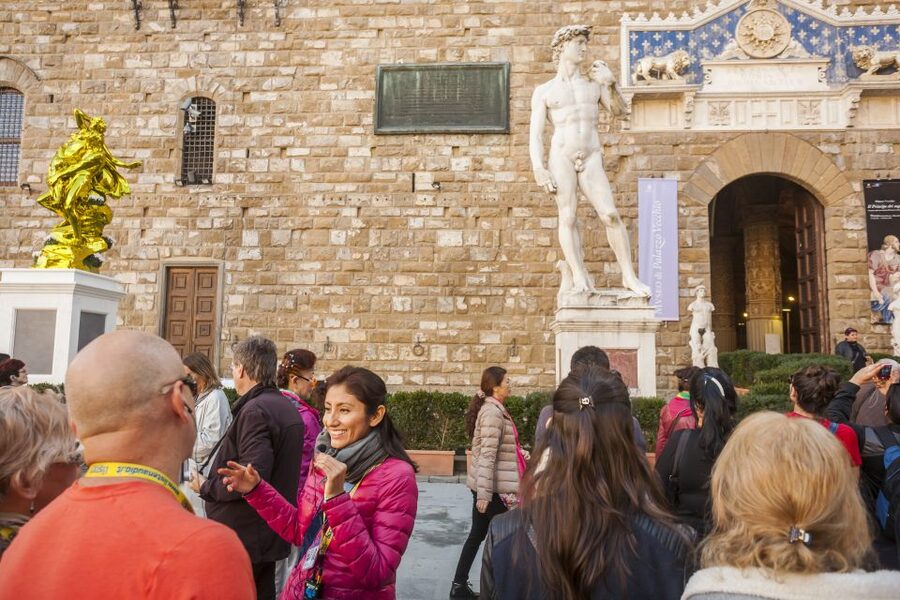
From Santa Croce, the walk continues to Piazza della Signoria, one of Florence’s grandest outdoor rooms. The square gathers Palazzo Vecchio, sculptures, arcades, and Neptune’s Fountain in one view.
This is a good place to understand Florence as a political city. Palazzo Vecchio was not simply a pretty palace. Its position and scale reflect the power once held by Florence’s civic government and ruling families.
The guide pauses at Neptune’s Fountain for photographs, then explains the surrounding monuments. You can expect a short stop rather than a long art lesson. That balance works well for a first visit because the square is visually dense, and a guide helps you notice details you might otherwise miss.
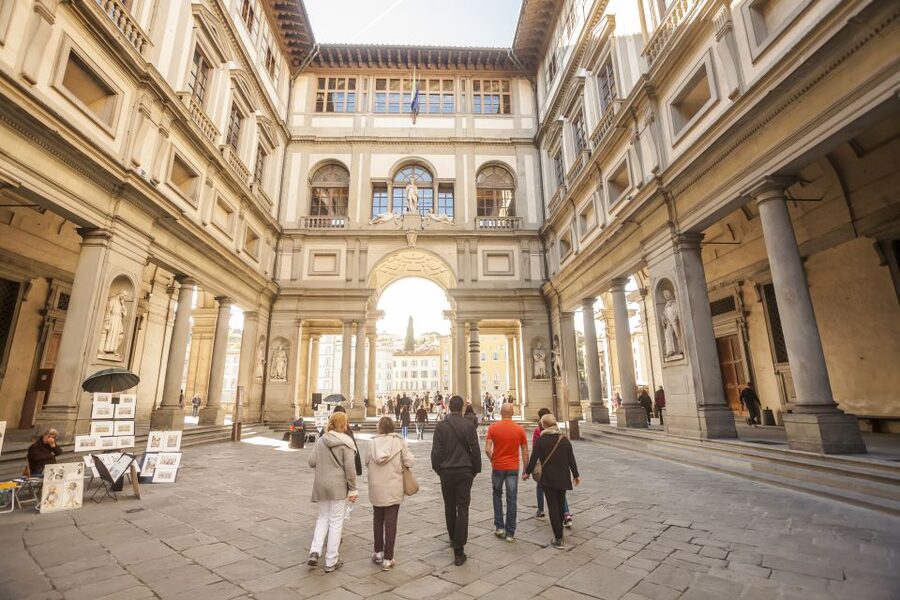
The nearby Piazzale degli Uffizi leads toward the Uffizi Gallery. Despite the itinerary wording that gives the Uffizi a guided-tour stop, the important practical point is that this experience includes exteriors only. You do not enter the gallery or receive timed admission through this walk.
For the Uffizi, plan a separate ticketed visit if you want Botticelli, Leonardo, Michelangelo, or the other galleries inside. This tour helps you understand where the museum sits in the city and how it connects to the Arno.
More Florence walks with a guide:
- Florence: Renaissance and Medici Tales Guided Walking Tour
★ 4.8 · 1,549 reviews - Florence: Uffizi & Accademia Small Group Walking Tour
★ 4.7 · 1,380 reviews - Skip-the-Line Florence Highlights and David Walking Tour
★ 5.0 · 1,127 reviews - Florence: Dark Mysteries and Legends Guided Walking Tour
★ 4.6 · 1,081 reviews
Ponte Vecchio and the view toward Pitti Palace
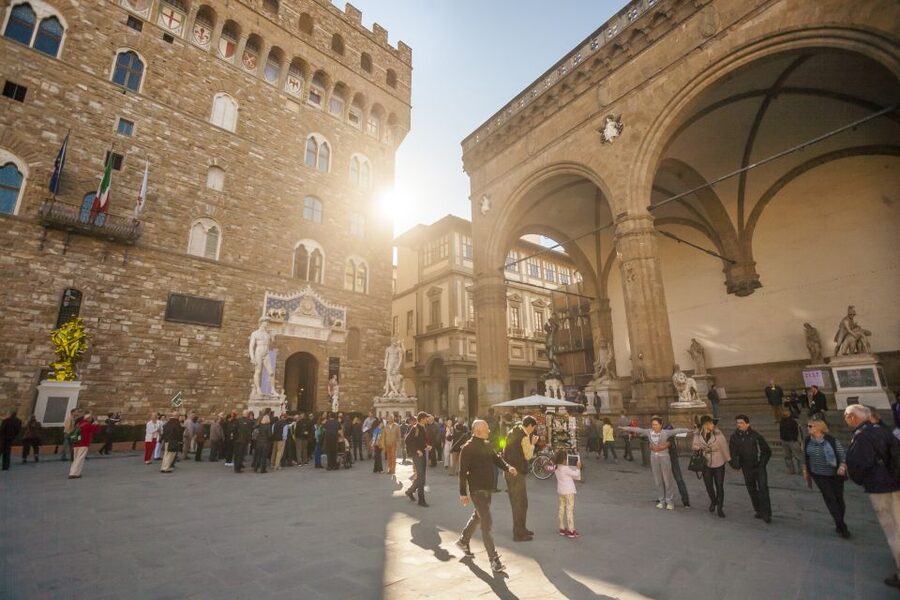
Crossing Ponte Vecchio is one of the walk’s most enjoyable sections. This medieval stone bridge is lined with gold jewelry shops and crosses the Arno at the heart of Florence.
The bridge can be crowded, and the walkway is not a place for a long stop in the middle of the flow. Your guide can point out the bridge’s role in the city while keeping the group moving. Look back toward the river when there is room, but keep your camera ready before you cross.
On the far side, the route reaches Pitti Palace, the former Medici residence. Again, you see the palace from outside. Its massive facade makes a useful contrast with the smaller lanes and merchant buildings closer to the Duomo.
Pitti Palace marks a shift in the tour. You are now in the Oltrarno, the area across the river, and the guide can show how Florence changes from the dense civic center to a district associated with palaces, workshops, and local streets.
The itinerary also includes Piazza Pitti, where you receive a shorter explanation. If you want the palace museums or Boboli Gardens, allow extra time and arrange admission separately.
Via Maggio, Santa Trinita, and Florence’s style today
The walk heads back toward the historic center along Via Maggio and crosses Ponte Santa Trinita. This gives you a second bridge perspective and a chance to see the Arno from a different angle.
Via Maggio is associated with antique shops and historic buildings, although the exact experience can vary with the guide and time available. The route then reaches Via de’ Tornabuoni, Florence’s polished fashion street.
This part adds a useful modern note to a tour otherwise filled with medieval and Renaissance monuments. You see top fashion boutiques alongside old palaces, a reminder that Florence is not only a museum city. The guide can also offer practical advice on shopping, leather goods, and restaurants, as Marco and Claudia did for past groups.
Do not expect time to browse shops during the walk. The street is included for its setting and contrast. If you want to shop, return later when you can take your time.
Strozzi Palace and Piazza della Repubblica
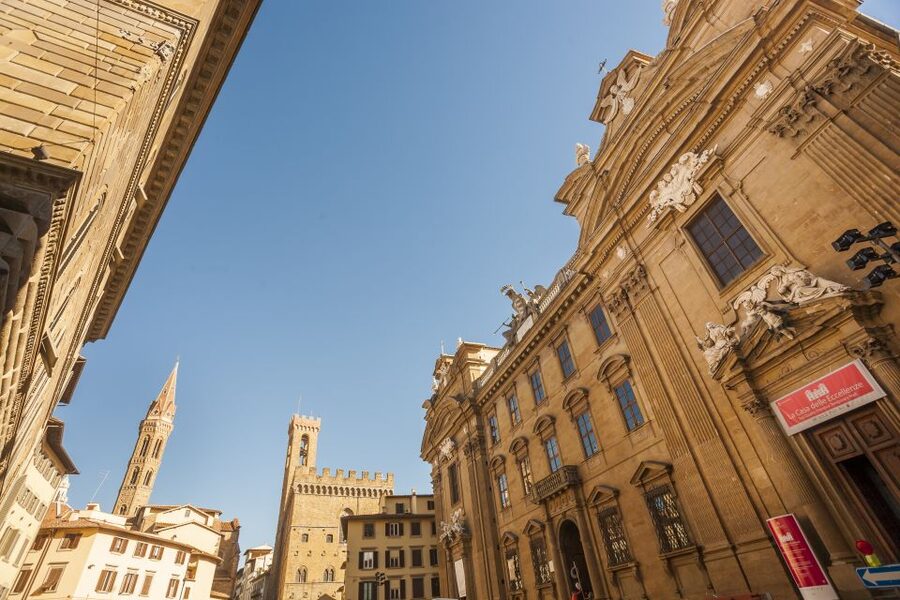
Palazzo Strozzi is a fine exterior stop for anyone interested in Renaissance architecture. It is often described as a model of the period’s palace design, with a strong, orderly facade that reflects the ambitions of Florence’s wealthy families.
The guide uses the building to explain how private power shaped the center. This is one of the moments when a local guide adds real value. You can see the stonework yourself, but the political and family connections are harder to grasp without context.
The route finishes at Piazza della Repubblica, a large square with cafes, shops, and a very different feel from the medieval lanes. It is a useful final orientation point because several central streets meet here, and you can easily return to it after the tour.
The square also shows how Florence changed over time. Not every part of today’s city comes directly from the Renaissance period, and the guide can help separate older structures from later urban changes.
The Duomo finale, with an important clothing rule
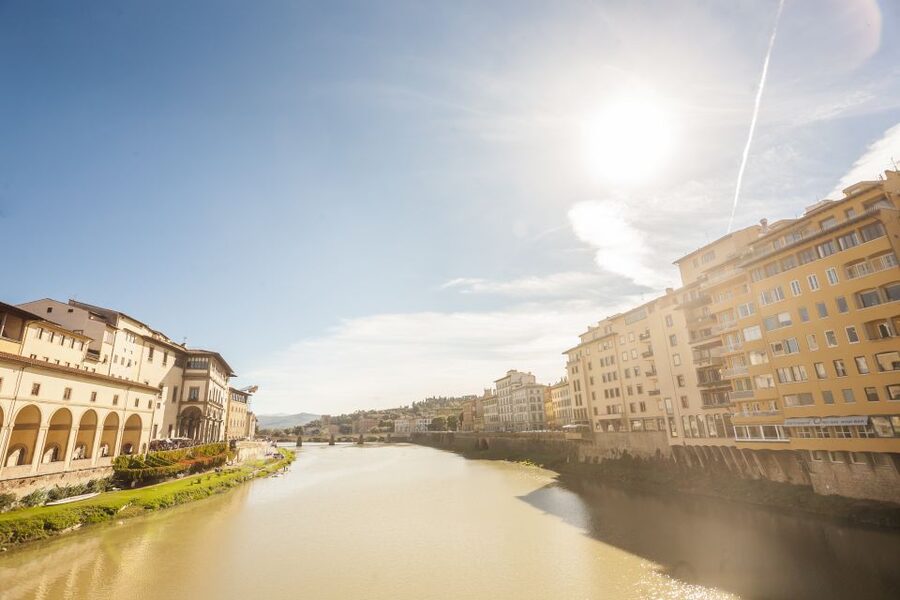
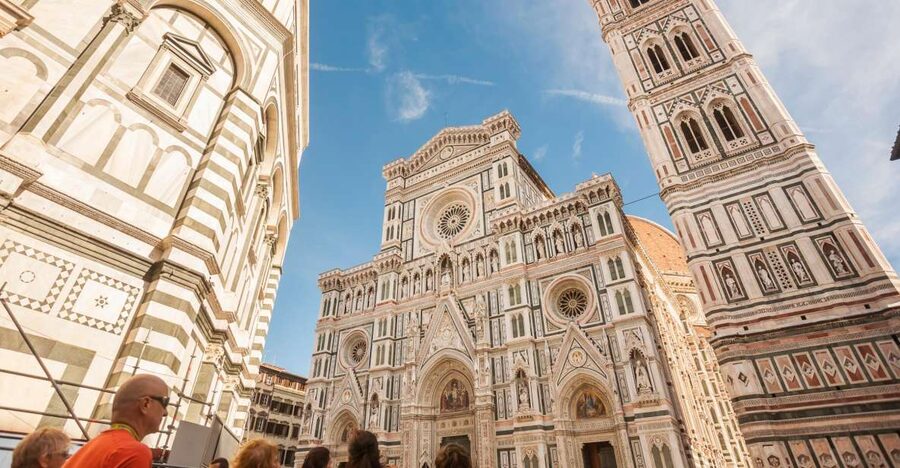
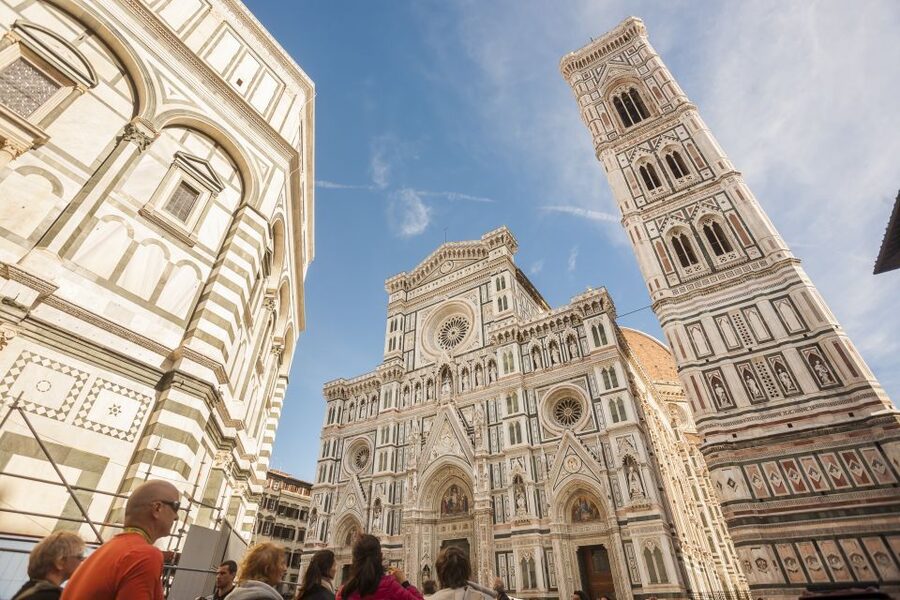
The final major stop is the Florence Cathedral complex, including the famous Duomo. This is the visual payoff of the route, with the cathedral facade, Brunelleschi’s dome, Giotto’s Campanile, and the Baptistery area gathered close together.
The tour provides an exterior explanation for about ten minutes. That is enough to identify the main buildings and hear some history, but not enough for a detailed architectural study. If the Duomo is your top priority, book a separate interior or dome experience.
You may enter the cathedral during a separate visit, but shorts and sleeveless tops are prohibited. Dress with that rule in mind, particularly during hot weather. The exterior can be admired at any time, but entry requires appropriate clothing.
Ending here is practical. You are left in one of Florence’s easiest areas from which to continue sightseeing, find food, or return to a museum later.
The guides are the heart of the experience
The strongest part of this tour is the human explanation. Past guide names include Giacomo, Claudia, Ilaria, Marco, Manuela, Natalia, Giulio, Silvia, Isabella, and Christina. The specific guide depends on availability, so you should not book expecting one named person unless the operator confirms it.
The best guide feedback centers on clear history, good English, patience, and the ability to answer questions. John’s guide went beyond basic facts about buildings and streets, while Giacomo was praised for making Florence’s complicated past easy to follow.
Families have had particularly good results. Claudia directed explanations toward children as well as adults, and another guide kept a 9-year-old involved. That does not mean every child will enjoy two hours of history, but the private format gives the guide more freedom to adjust the pace and examples.
Several tours ended with gelato or a cafe stop, and one guide offered cappuccinos, croissants, and gelato for the children. Treats are not a dependable formal feature, so regard them as a possible extra rather than part of the guaranteed program. One recent booking also noted that gelateria vouchers were no longer accepted, so check any voucher before relying on it.
One caution is audio. A past participant found background noise made the guide hard to hear, and another found the pace too slow at times. Conditions vary, but busy Florence streets can make listening difficult. Stay near the guide and speak up if you cannot hear.
Pace, footwear, and mobility
Wear comfortable shoes. You walk for two hours over city paving, cross bridges, and move through crowded public spaces. The route is not an easy seated sightseeing option.
The activity is marked wheelchair accessible, but it is also described as unsuitable for people with mobility impairments. That contradiction deserves a direct check before booking. Ask the operator about the exact starting point, route surface, bridge access, and any changes needed for your group.
The pace has varied from group to group. Some tours lasted exactly two hours, while one small private group received about two and a half hours. Do not build a tight museum reservation immediately after the scheduled finish.
What you get for the time and cost
No price is provided here, so the value depends on the quote you receive, the size of your private group, and how much you value live guidance. For two people, a private tour can cost more per person than a shared walk. In return, you get a tailored conversation and the chance to ask about exactly what interests you.
For a family or group of friends, the arithmetic may work better. You also avoid spending your first day wandering between disconnected sights without knowing what deserves a return visit.
The tour does not replace admission tickets to the Uffizi, Santa Croce, Pitti Palace, the Bargello, or the Duomo interior. Budget separately for those places. Its value lies in orientation, background, and route planning.
Free cancellation up to 24 hours before the activity and the reserve-now, pay-later option make it easier to fit into a changing Florence schedule. Starting times depend on availability.
Who should book this walk?
I would choose this for a first morning or afternoon in Florence, especially if you want the city to make sense before committing to museums. It is also a good match for families, couples, and small groups who prefer questions and conversation over a large fixed group.
History fans will get the most from the links between the Medici, civic buildings, churches, art, and public squares. Shoppers may also appreciate the route along Via Tornabuoni and the practical suggestions about leather and restaurants.
I would choose something else if your main goal is time inside the Uffizi, a close study of the Duomo, or access to Pitti Palace. You will need separate visits for those. I would also avoid booking it on a day when your group cannot manage a steady two-hour walk.
Should you book the Florence private walking tour?
Book it if you want a friendly, efficient introduction to central Florence and value a guide who can explain why the city looks the way it does. The route covers an impressive number of major sights, and the private format can turn a standard overview into a useful conversation.
Skip it if you already know Florence well or want interior access rather than exterior views. For a first visit, though, this is a sensible way to get your bearings, mark places for a return visit, and learn the city’s basic story before tackling its museums.
FAQ
How long is the Florence walking tour?
The scheduled duration is two hours. Some past groups received a little longer, but you should plan around the stated two-hour schedule.
Is this a private tour?
Yes. The activity is for a private group with a live guide.
Which languages are available?
The guide can conduct the tour in English or Italian.
Does the tour enter the Uffizi Gallery?
No. The visit to the listed monuments is exterior-only. You need a separate admission ticket to enter the Uffizi Gallery.
Does the tour enter the Florence Cathedral?
No. The Duomo complex is explained from the outside. If you plan to enter the cathedral separately, shorts and sleeveless tops are not permitted.
Where does the tour meet?
The stated meeting point is Door 8 at Accord Tours, at coordinates 43.774654, 11.252746. Other available starting points include Piazza di Madonna degli Aldobrandini, and the itinerary may change with the meeting point.
What should I bring?
Bring comfortable shoes. You will walk through central Florence, across bridges, and along historic streets.
Is the tour suitable for wheelchair users?
The activity is marked wheelchair accessible, but it is also listed as unsuitable for people with mobility impairments. Contact the provider before booking to confirm whether the selected route works for your needs.
Can I cancel or pay later?
You can cancel up to 24 hours in advance for a full refund. The reserve-now, pay-later option lets you book without paying immediately.
Recently reviewed around Florence
- Walking Food Tour of Florence with Tastings and Wine★ 5.0 · 518 reviews
- Florence Sunset Food Tour with Wine & Dine at a Tuscan farmhouse★ 5.0 · 194 reviews
- Wine Experience In Chianti Hills from Florence★ 4.5 · 195 reviews
- Uffizi Gallery Timed Entry Admission Tickets★ 4.0 · 392 reviews
- Val d’Orcia Brunello Wine Tour with Montalcino and Montepulciano★ 4.5 · 359 reviews
- Wine Tasting Experience in Ponte Vecchio: Best Tuscany selection!★ 5.0 · 197 reviews
- Uffizi Gallery Small Group Tour with Guide★ 4.5 · 879 reviews
- Early Access Guided Uffizi Gallery Tour Skip-the-Line Small Group★ 4.5 · 707 reviews
Walking Tours, compared.

Guided Walking Tour & Last Supper Visit with Ticket
Read our review →
Rialto Bridge & Offbeat Unusual Venice Walking Tour
Read our review →
Private 3 hrs Venice Tour: St Mark’s, Walking tour & Boat tour
Read our review →

Skip the line: Uffizi and Accademia Small Group Walking Tour
Read our review →
Trastevere & Campo de Fiori Street Food Walking Tour
Read our review →Browse the lists this tour appears in