
Review · ACCADEMIA GALLERY TOURS
Small-group Accademia tour with skip-the-line access to David
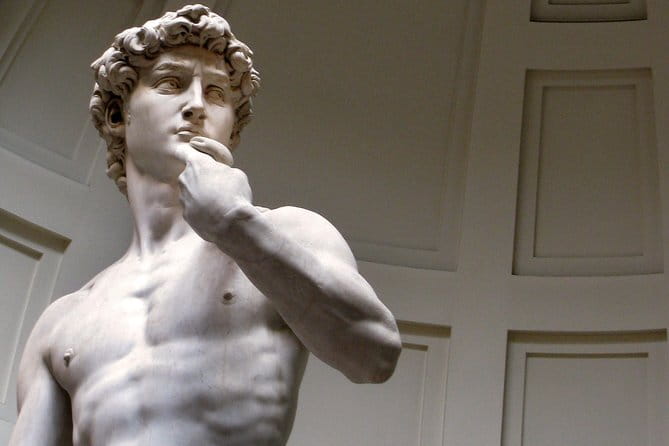
Michelangelo’s David is the reason most people come to Florence’s Accademia Gallery, but the unfinished sculptures leading to it give the visit its best sense of drama. With a guide, you get more than a quick look at a famous marble figure. You get the story of how Michelangelo worked, what the sculpture meant to Florence, and why its details matter.
I like the small-group format, capped at nine in the tour description and listed elsewhere with a maximum of 12. I also like the fast-track admission, especially when the regular line stretches down Via Ricasoli. The musical-instrument collection, with a 1690 Stradivarius and an early piano, adds an unusual extra.
The main limitation is time. The guided portion lasts about one hour, so the visit is focused rather than leisurely. One guide received a serious complaint for poor engagement, though the overall score is 4.7 out of 5 from 361 ratings, with 94 percent recommending the experience. Your result will depend partly on the guide assigned that day.
In This Review
- Key points to know before booking
- Why Accademia deserves more than a David photo
- Meeting your guide on Via Ricasoli
- The priority entrance and what it really saves
- Following Michelangelo from rough marble to David
- The musical instruments are an unexpected highlight
- What you get in one hour
- Is $71.38 a fair price?
- Who will get the most from this tour?
- Booking, timing, and cancellation notes
- Should you book the Accademia David tour?
- FAQ
- How long does the Accademia tour last?
- What is the price?
- Is admission to the Accademia included?
- Does the tour include Michelangelo’s David?
- Does the tour visit the musical-instrument collection?
- What instruments can you see?
- How large is the group?
- What language is the tour offered in?
- Where does the tour meet?
- Is hotel pickup included?
- Can I cancel for a refund?
Key points to know before booking
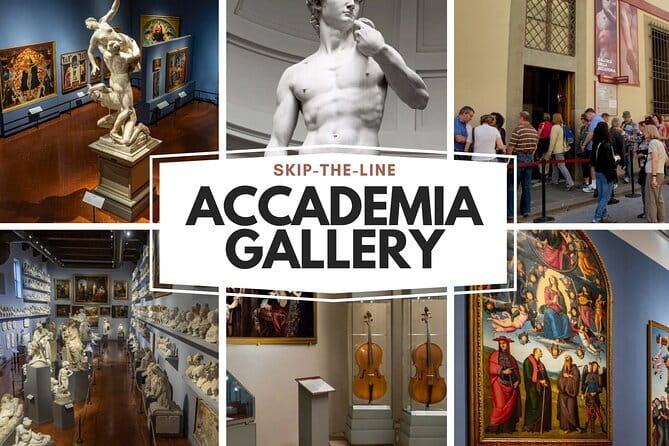
- David comes first: The tour focuses on Michelangelo’s most famous sculpture and the unfinished works that prepare you for it.
- Fast-track admission matters: A priority ticket helps you avoid the ordinary entrance line, though a short wait at the priority gate is still possible.
- The group stays small: The stated group size is up to nine in one section of the booking information and up to 12 in another, so check the exact size when reserving.
- Look for the instruments: The route includes the Conservatorio Luigi Cherubini collection, home to a 1690 Stradivarius and one of the first modern pianos.
- You can remain afterward: Once the guided hour ends, you may continue exploring the Accademia on your own.
- Bring comfortable earbuds if offered equipment bothers you: One participant found the supplied hard plastic earpieces uncomfortable and preferred personal ones.
Why Accademia deserves more than a David photo
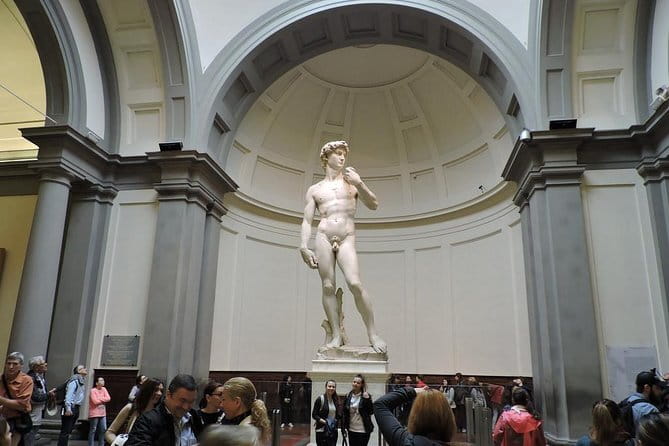
The Accademia is smaller than Florence’s Uffizi, which makes it easier to handle in a short visit. Still, it is not simply a room built around one celebrity statue. Its sculptures, paintings, and musical instruments give you a more complete look at Florence’s artistic life.
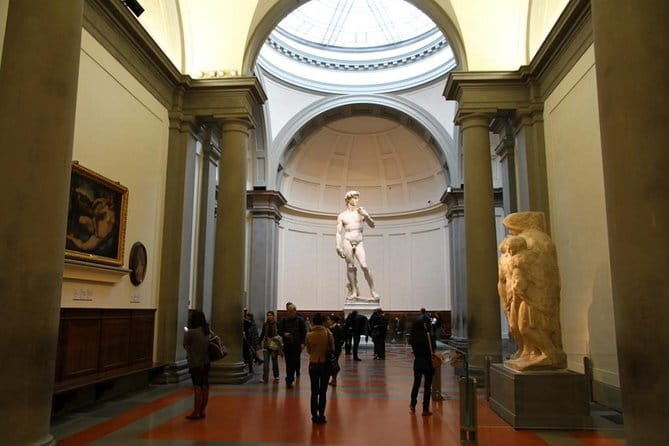
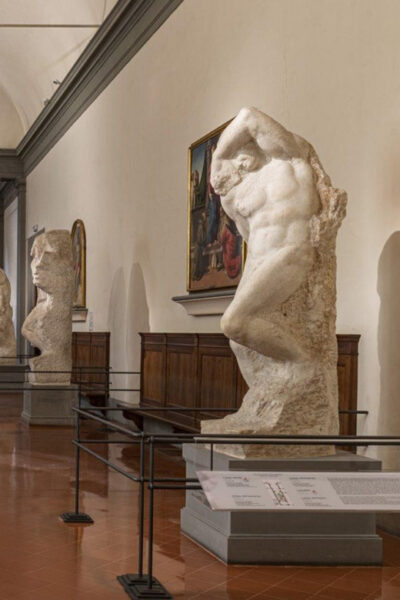
The usual mistake is to rush straight to David, take a picture, and leave. That approach misses the museum’s visual build-up. Michelangelo’s unfinished figures, often called the Prisoners or Slaves, appear to push and twist their way out of the marble. They help you see the labor behind David’s smooth finish.
A good guide points out how the unfinished surfaces change your view of Michelangelo’s method. You begin to notice the contrast between rough stone and polished anatomy, then appreciate David not only as a handsome statue but as the finished result of a demanding artistic process.
I especially like that this route includes the musical-instrument section. It is easy to overlook, particularly if your main goal is David. The collection belongs to the Conservatorio Luigi Cherubini and includes an original Stradivarius made by Antonio Stradivari in 1690 for the Great Prince. It also includes an early modern piano, invented in Florence.
That stop gives the tour a welcome change of pace. You are not looking only at marble and religious paintings. You are also seeing objects tied to the development of music in the city.
More Florence trips worth a second look
- Florence: Skip-The-Line Uffizi Gallery Timed Entry Ticket
★ 4.5 · 27,832 reviews - Florence: Michelangelo’s David Skip-the-Line Entry Ticket
★ 4.5 · 12,764 reviews - Florence: Skip-the-Line Uffizi Small Group Tour
★ 4.6 · 5,926 reviews
Meeting your guide on Via Ricasoli
The meeting point is outside the Galleria dell’Accademia di Firenze at Via Ricasoli 58/60, 50129 Florence. The activity begins and ends at the meeting point, and hotel pickup and drop-off are not included.
You receive a mobile ticket, and confirmation arrives when you book. The location is near public transportation, so it is practical to reach from other parts of central Florence. Leave enough time to find the entrance and your guide, since the area can be busy and the museum entrance system may involve more than one line.
The tour is offered in English. Several guides are praised in the available feedback, including Laura, Gianna, Guido, Elisabeth, Fabio, Ivano, Christina Maria, Maria, and Jannett. Their styles appear to vary. Some are described as lively and humorous, while others are praised for careful detail and strong art training.
That variation is worth keeping in mind. Most of the feedback praises guides for being friendly, animated, well prepared, and able to explain Michelangelo in clear terms. One poor experience described a guide who did not introduce herself, did not engage the group, and walked ahead while speaking. The company responded that it would examine the matter. This appears to be an isolated complaint among many positive accounts, but it is still a fair reason to keep your expectations realistic.
The priority entrance and what it really saves
The fast-track ticket is included in the price. That does not mean you walk through every door with no pause, since the supplier notes that a queue can still form at the priority entrance. It does mean you avoid the ordinary admission line, which can be a major advantage at a museum with a famous single attraction.
One person reported seeing a very long line and found the priority entry well worth having. Another arrived for a 9:15 a.m. tour and found David relatively easy to approach by 10:00. One hour later, the crowd had grown considerably.
That makes an early start a smart choice if you want a calmer view. The tour does not promise a private room or an empty gallery, but early timing can improve your chance of standing close enough to study the carving rather than simply seeing the statue over a wall of heads.
The ticket benefit is most valuable during busy periods. If you visit in a quieter season, you may not save as much time, but the guide and the organized entry still remove some uncertainty.
Following Michelangelo from rough marble to David

The heart of the visit is Michelangelo’s work. The guide leads you through other sculptures before bringing you to David, explaining the artists, subjects, and details along the way.
This order matters. David can feel almost too familiar from reproductions, posters, and souvenirs. In person, the scale and finish are different. You can examine the veins in the hands, the alert expression, the tension in the body, and the way the pose suggests action before the fight with Goliath.
A good explanation also places David within Florence’s identity. The statue became a symbol of the city, and its proud, watchful pose carried meaning beyond biblical illustration. You do not need a long academic lecture to understand this. You need a guide who can connect the artwork to Florence and point out details your eye might otherwise skip.
The strongest feedback repeatedly praises this part of the experience. Guides such as Laura, Guido, Gianna, and Christina Maria are described as entertaining, passionate, and able to make the art easy to follow. One family with three teenage daughters found the guide engaging enough for all ages, while another visitor appreciated receiving just the right amount of detail.
That balance is important. Art tours can become tiring when every object receives a long speech. Here, the guided hour is designed to give you a clear path through the museum, with enough background to make the key works meaningful.
A different way to spend the day, same part of Italy:
- Tuscany Day Trip from Florence: Siena, San Gimignano, Pisa and Lunch at a Winery
★ 5.0 · 21,634 reviews - Florence: Timed Entrance Ticket to Michelangelo’s David
★ 4.6 · 16,983 reviews - The Best tour in Florence: Renaissance & Medici Tales – guided by a STORYTELLER
★ 5.0 · 12,316 reviews - Florence: Leonardo Interactive Museum Entry Ticket
★ 4.5 · 11,763 reviews
The musical instruments are an unexpected highlight
The instrument collection is a real point of difference. Many short Accademia visits concentrate only on Michelangelo, so this added section can make the experience feel less predictable.
The Stradivarius from 1690 is the star of the collection. It was made by Antonio Stradivari for the Great Prince, and its presence connects Florence to the history of European music and court culture. The early piano is another useful surprise because it shows how Florence contributed to the development of an instrument now familiar around the world.
The room may not always be open. The supplier specifically warns that museum organization can lead to rooms being closed without advance notice, including the musical-instrument room. If that happens, the guide may take you through a different route.
That warning is not a reason to avoid the tour. It is a reason not to book solely for the Stradivarius. Think of the instruments as a special bonus within a David-focused visit, not as a guaranteed separate museum experience.
What you get in one hour
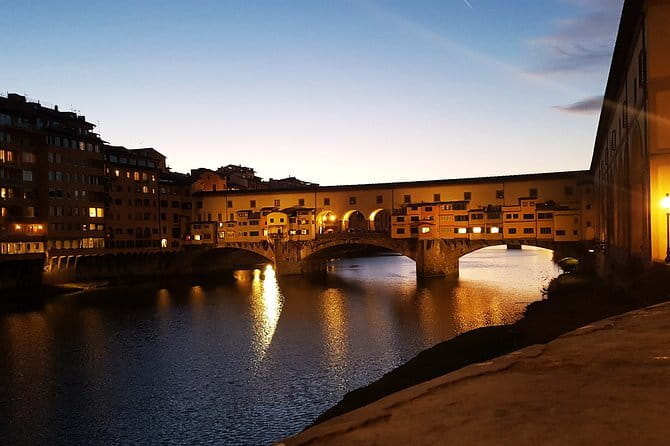
The listed duration is approximately one hour. That is enough time for a guided introduction to the Accademia’s major highlights, but it is not enough for a slow examination of every gallery.
The guide handles the main explanation, so you can pay attention rather than constantly read wall labels. The tour covers the unfinished Michelangelo sculptures, David, other sculptures and artworks, and, when open, the musical instruments.
At the end, you may stay inside and continue looking around on your own. This is one of the tour’s most useful features. The guided section gives you structure, then you can return to a painting, sculpture, or instrument that caught your eye.
If you have a tight Florence schedule, the one-hour format fits neatly before lunch or another central-city sight. If the Accademia is a major personal interest, plan extra time after the tour. The guided portion is only the beginning of what the museum offers.
The supplied listening equipment may be hard plastic earbuds. If you are sensitive to that kind of earpiece, bring your own earbuds if the system allows them. The available information does not specify the exact audio setup, so treat this as a practical suggestion rather than a guarantee about the equipment.
Is $71.38 a fair price?

At $71.38 per person, this is not the cheapest way to enter the Accademia. You are paying for three things beyond the basic museum visit: a professional certified guide, a small group, and priority admission.
The value is strongest when the line is long and when you want context rather than a quick look at David. A guide can save you from spending your limited Florence time trying to understand the museum’s layout or reading every label. The small group also gives the guide a better chance to speak clearly and answer questions than a large coach group would.
The value is weaker if you already know Michelangelo well, prefer reading at your own pace, or are visiting during a quiet period when entry is easy. In that case, self-guided admission may suit you better.
Still, the price can make sense for a first visit. David is one of Florence’s most important sights, and a poor visit can feel rushed or vague. Paying for a focused explanation helps you see why the statue matters, not just what it looks like.
Tips are not included. Tipping in Italy is optional but welcomed if you liked the service. Hotel transportation is also not included, though the central meeting point is near public transportation.
Who will get the most from this tour?
I would choose this experience for a first-time Florence visitor who wants a clear introduction to Michelangelo without committing half a day to a large museum. It also fits families, couples, and small groups who prefer a personal guide and a short, focused visit.
The tour has worked well for teenagers in the past because David is visually powerful, the unfinished sculptures are easy to compare, and a lively guide can make the stories stick. Ask questions if your guide invites them. The small format should make that easier than on a large group tour.
It is also a good choice if you are visiting in a busy period. The priority ticket will not remove every possible delay, but avoiding the standard line may be worth a great deal in a city where time disappears quickly.
I would skip it if you want a silent, unhurried museum visit or if your main purpose is to study a broad collection of paintings. The Uffizi is the better choice for a much larger sweep of art. Accademia is more compact and more tightly centered on Michelangelo, with the instruments as an extra attraction.
Booking, timing, and cancellation notes
The experience is offered in English and uses a mobile ticket. Most people can participate, and the museum is near public transportation.
Book ahead rather than assuming a same-day place will be available. This activity is booked, on average, 51 days in advance, which signals steady demand. An early morning time, such as 9:15 a.m., may give you a better chance of seeing David before the gallery grows crowded.
Free cancellation is available up to 24 hours before the start time for a full refund. Cancellations or changes made less than 24 hours before the start time are not accepted for a refund, and cut-off times follow Florence local time.
Should you book the Accademia David tour?
Book it if you want David plus useful context, not just a quick photograph. The combination of a short English guided visit, priority admission, a small group, and the chance to remain in the museum afterward makes this a practical choice for most first visits.
Choose an early time if you can. Expect the instrument room to be subject to closure, and remember that the guide quality can vary even though most named guides receive strong praise. At $71.38, the tour is a reasonable splurge when your Florence schedule is tight and the regular line is long.
If you are comfortable exploring alone and have plenty of time, self-guided entry may save money. For everyone else, this is a focused way to meet Florence’s most famous marble citizen and understand why he still matters.
FAQ
How long does the Accademia tour last?
The guided experience lasts approximately one hour. Afterward, you may remain inside the museum and continue exploring on your own.
What is the price?
The listed price is $71.38 per person.
Is admission to the Accademia included?
Yes. The admission ticket and fast-track entrance are included.
Does the tour include Michelangelo’s David?
Yes. Seeing David is the central focus of the tour, along with other Michelangelo sculptures and works of art.
Does the tour visit the musical-instrument collection?
The planned route includes the musical-instrument collection in the Conservatorio Luigi Cherubini. The room may be closed because of museum organization, in which case the guide may follow a different route.
What instruments can you see?
The collection includes an original Stradivarius made by Antonio Stradivari in 1690 for the Great Prince, as well as the first modern piano, which was invented in Florence.
How large is the group?
The tour is advertised as a small group. One part of the information gives a maximum of nine people, while another gives a maximum of 12, so confirm the group size when booking.
What language is the tour offered in?
The tour is offered in English.
Where does the tour meet?
The meeting point is Galleria dell’Accademia di Firenze, Via Ricasoli 58/60, 50129 Florence, Italy.
Is hotel pickup included?
No. Hotel pickup and drop-off are not included. The meeting point is near public transportation.
Can I cancel for a refund?
Yes. You can cancel at least 24 hours before the start time for a full refund. Cancellations and changes made less than 24 hours before the start time are not accepted for a refund.
Recently reviewed around Florence
- Walking Food Tour of Florence with Tastings and Wine★ 5.0 · 518 reviews
- Florence Sunset Food Tour with Wine & Dine at a Tuscan farmhouse★ 5.0 · 194 reviews
- Wine Experience In Chianti Hills from Florence★ 4.5 · 195 reviews
- Uffizi Gallery Timed Entry Admission Tickets★ 4.0 · 392 reviews
- Val d’Orcia Brunello Wine Tour with Montalcino and Montepulciano★ 4.5 · 359 reviews
- Wine Tasting Experience in Ponte Vecchio: Best Tuscany selection!★ 5.0 · 197 reviews
- Early Access Guided Uffizi Gallery Tour Skip-the-Line Small Group★ 4.5 · 707 reviews
- Uffizi Gallery Small Group Tour with Guide★ 4.5 · 879 reviews
Accademia Gallery Tours, compared.
Florence Accademia Gallery Tour with Entrance Ticket Included
Read our review →

Skip the line: Uffizi and Accademia Small Group Walking Tour
Read our review →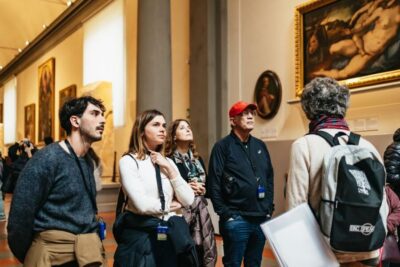
Accademia Gallery Guided Tour with Entry Ticket
Read our review →
Uffizi Gallery and Accademia Gallery Guided Tour
Read our review →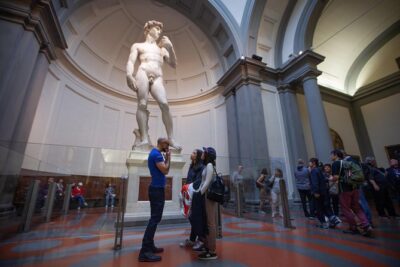
Michelangelo’s David, Accademia & Uffizi Small Group Tour
Read our review →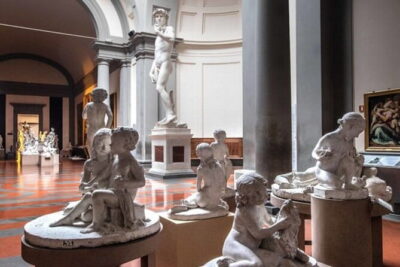
Accademia & Uffizi Museums: Small Group Tour with Optional Lunch
Read our review →Browse the lists this tour appears in