
Review · WALKING TOURS
The Best of Florence Walking Tour in a Small Group
Florence makes the most sense on foot, and this tour gives you a brisk introduction to the city’s grandest landmarks in about 1 hour 45 minutes. You’ll follow the Medici story from San Lorenzo to Palazzo Pitti, with the Duomo, Signoria, Uffizi, and Ponte Vecchio along the way.
I like the 15-person cap, which keeps the walk more personal than a large flag-following parade. I also like the local advice: guides such as Manuel, Simona, and Camilla add food suggestions, side streets, church details, and small observations that guidebooks often miss. The main consideration is pace. Fourteen stops in less than two hours means most are brief exterior explanations, not long museum visits.
In This Review
- Key points
- Why this is a smart first walk in Florence
- San Lorenzo and the Medici beginning
- Medici Chapels and Palazzo Medici Riccardi
- The Duomo complex, from Baptistery to Brunelleschi’s dome
- Signoria, Palazzo Vecchio, and the public face of Florence
- Uffizi and the Renaissance art story
- Ponte Vecchio and the walk toward Palazzo Pitti
- What the $59.26 price really buys
- Pace, comfort, and who will enjoy it
- Should you book the Best of Florence Walking Tour?
- FAQ
- How long is the Best of Florence Walking Tour?
- What time does the tour start?
- Where does the tour begin?
- Where does the tour end?
- Are attraction admission tickets included?
- How many people can join the tour?
Key points
- The Medici story gives the route a clear thread, linking churches, palaces, libraries, and chapels.
- Fourteen central Florence stops fit into a compact walk, useful for a first afternoon in town.
- A maximum of 15 people and a whisper system make it easier to hear the guide on busy streets.
- The tour ends near Ponte Vecchio, placing you close to the Arno, Palazzo Pitti, and the Oltrarno side of Florence.
- Guides offer practical food and sightseeing advice, including side streets, shops, churches, and local street food.
- Admissions are generally not included, so plan to return later for the interiors you want to see.
Why this is a smart first walk in Florence
Florence is compact, but its story is not. A few steps can carry you from a medieval church to a Renaissance palace, then from Michelangelo’s architecture to the political theater of Palazzo Vecchio. This walk helps you connect those pieces before you tackle the museums on your own.
The route is especially useful if Florence is new to you. You’ll see the major center without spending half a day inside one building. That matters because the city’s best first impression comes from the streets themselves: marble façades, crowded squares, narrow lanes, and the changing view of the Duomo as you turn a corner.
The guide’s role here is less about giving you access and more about giving you context. Manuel has been praised for turning the walk into a story, while Simona brings humor, personal stories, and a clear love for Florence. Camilla is noted for pointing out architecture, local shops, churches, and places to eat. Guides can vary, but the experience is built around that local perspective.
The 12:15 p.m. start is practical for many visitors. You can have a relaxed morning, then meet at Caffè Scudieri Firenze on Piazza di San Giovanni, beside the Duomo area. If you prefer seeing Florence at its quietest, though, midday brings more heat, more foot traffic, and stronger sun in the open squares.
More Walking Tours in Florence
- Florence: Guided Walking Tour
★ 4.5 · 3,334 reviews - Skip the line: Uffizi and Accademia Small Group Walking Tour
★ 4.5 · 3,135 reviews - Florence: Guided Walking Tour
★ 4.6 · 1,602 reviews
San Lorenzo and the Medici beginning
The walk starts at Basilica di San Lorenzo, one of Florence’s largest churches and the burial place of leading Medici figures from Cosimo il Vecchio through Cosimo III. Even with only about five minutes assigned here, the stop gives the whole tour its central theme: Florence was shaped by a family that mixed banking, politics, art, religion, and grand architectural ambition.
The basilica sits in the city’s main market district, so you begin in an area where daily life and major history meet. The contrast is useful. Florence is not just a collection of polished monuments. It is also a working city with food stalls, shops, cafés, and narrow streets around its famous buildings.
Admission to the basilica is not included. Treat this stop as an introduction, then return later if you want time inside. That is a recurring pattern on this tour, and it is important to understand before booking. You are getting a guided overview, not a ticketed museum program.
Nearby, the Biblioteca Medicea Laurenziana brings in Michelangelo and the Medici family library. The library was supported by Medici pope Clement VII and helped present the family as patrons of learning and the Church, not merely wealthy merchants. Its Mannerist design is one of the reasons this brief stop matters.
Again, the tour allows only a few minutes here, and admission is not included. You may see the exterior and hear why the building matters, but you should not expect a full look at the reading room or manuscript collection during the walk.
Medici Chapels and Palazzo Medici Riccardi
The Cappelle Medicee, or Medici Chapels, were built in the 16th and 17th centuries as extensions to Brunelleschi’s earlier church. The purpose was clear: honor the Medici family, their role as church patrons, and their position as Grand Dukes of Tuscany.
The New Sacristy was designed by Michelangelo, making this one of the most significant art stops on the route. The short visit is enough to place the chapels in the city’s political and artistic story, but not enough for a proper interior visit. Admission is not included, so art lovers should schedule a separate return.
Palazzo Medici Riccardi continues the family story. Built between 1444 and 1484 for Cosimo de’ Medici, it shows how the family turned private wealth into public influence. This was not just a residence. It was a statement about status, taste, and power.
I find this part of the walk valuable because it explains why Florence feels so concentrated. The Medici did not leave one isolated monument. They shaped a chain of churches, homes, libraries, chapels, and public projects across the center. Once you see that pattern, the city’s Renaissance story becomes easier to follow.
The Duomo complex, from Baptistery to Brunelleschi’s dome
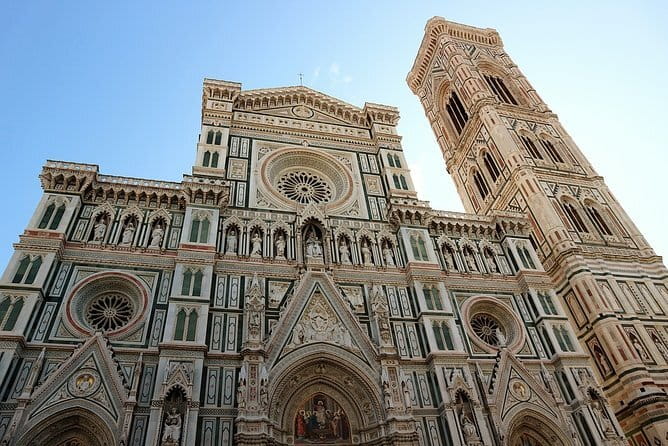
The route then reaches the Duomo, Florence’s cathedral, formally Cattedrale di Santa Maria del Fiore. The cathedral was begun in 1296 in the Gothic style, and its white, green, and pink marble exterior is one of the city’s defining sights.
The tour lists several separate stops around the cathedral complex: the cathedral, the Baptistery, Brunelleschi’s Cupola, Giotto’s Campanile, and another cathedral viewpoint. That repetition reflects the way the buildings work together. You are not seeing one monument from one angle. You are circling a carefully planned religious center.
At the Battistero di San Giovanni, you’ll hear about one of Florence’s oldest buildings. It was built between 1059 and 1128 in the Florentine Romanesque style and sits across from the cathedral and bell tower. Its age helps explain why the Duomo complex contains several different architectural periods rather than one unified style.
The Cupola del Brunelleschi is the standout engineering subject. It was once the largest dome in the world and remains the largest brick dome ever built. The tour allows about ten minutes here, which gives the guide room to explain why the dome was such a difficult construction problem and why it changed the city’s profile.
Do not confuse a stop at the dome with a dome climb. Admission is not included, and the listed experience does not promise entry. If climbing the cupola is a priority, arrange a separate ticket and visit. The same applies to Giotto’s Campanile, which offers its own paid experience.
Giotto’s Campanile is adjacent to the cathedral and Baptistery. Its Gothic design, sculptural decoration, and colored marble make it a major sight even from street level. The five-minute stop is enough to point out the tower’s place in the complex, but not enough to explore its details at leisure.
The whisper system is particularly useful here. Piazza del Duomo can be crowded, and a guide speaking at normal volume may be hard to follow. With an earpiece, you can keep a little distance, look up at the buildings, and still hear the explanation.
More Florence walks with a guide:
- Florence: Renaissance and Medici Tales Guided Walking Tour
★ 4.8 · 1,549 reviews - Florence: Uffizi & Accademia Small Group Walking Tour
★ 4.7 · 1,380 reviews - Skip-the-Line Florence Highlights and David Walking Tour
★ 5.0 · 1,127 reviews - Florence: Dark Mysteries and Legends Guided Walking Tour
★ 4.6 · 1,081 reviews
Signoria, Palazzo Vecchio, and the public face of Florence
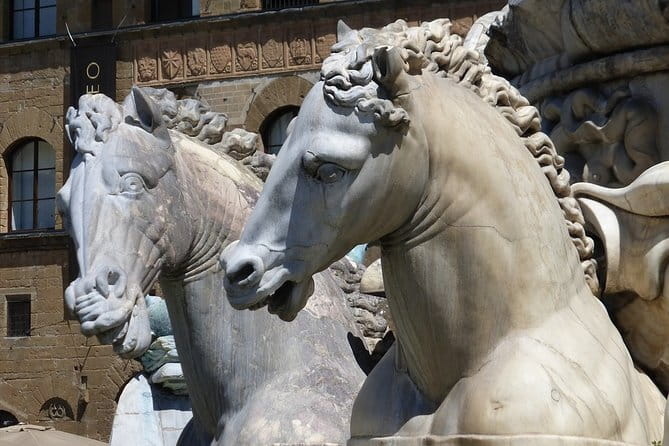
From the Duomo, the walk continues toward Piazza della Signoria, the L-shaped square in front of Palazzo Vecchio. This is Florence’s civic stage, a place where political power, public sculpture, and modern city life meet.
The square is free to visit, and the tour can explain the statues and buildings without requiring an admission ticket. It is also a useful orientation point, close to Palazzo Vecchio and the entrance area for the Uffizi Gallery.
Palazzo Vecchio is Florence’s town hall, built as a massive fortress-palace. Its severe exterior is very different from the decorative face of the Duomo. That contrast tells you something about Florence: religious authority and civic power were displayed side by side, but they spoke in different architectural languages.
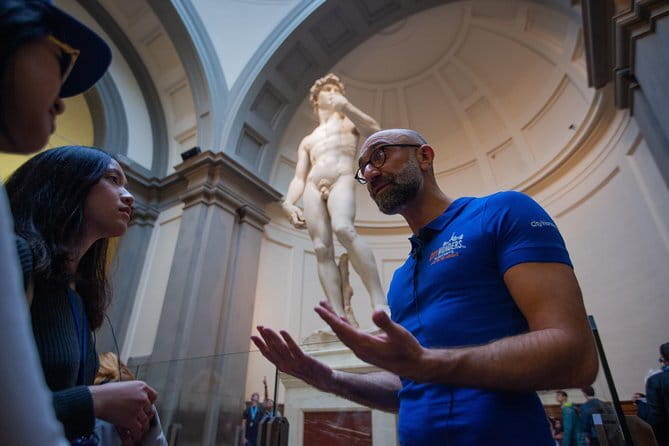
Outside, you’ll see a copy of Michelangelo’s David and the statues in the adjacent Loggia dei Lanzi. The original David is now in the Accademia Gallery, so this is an important distinction for first-time visitors. You will get the setting and the story here, but not the original sculpture.
Entry to Palazzo Vecchio is not included. If you want the grand halls and museum displays, plan that visit separately. The walking tour’s short stop is best used to understand the building’s role in Florentine government and public life.
Uffizi and the Renaissance art story
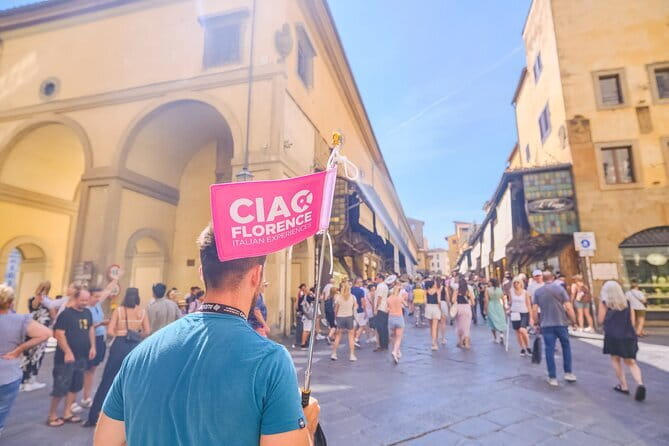
The Uffizi Gallery sits beside Piazza della Signoria and is one of Italy’s most important art museums. Its collection is especially strong in Renaissance works. The building began in 1560 under Giorgio Vasari for Cosimo I de’ Medici, originally as offices for Florentine magistrates. The name uffizi means offices.
That origin makes the Uffizi a fitting stop on a Medici-focused walk. It was not first created as a museum. It was part of the machinery of government, and the family’s later art collection transformed it into one of the world’s major galleries.
The tour only allows around five minutes at the Uffizi, and admission is not included. You should think of this as a preview and a chance to learn how the museum fits into Florence’s political and artistic development. If you plan to visit inside, set aside several hours on another part of your schedule.
This is also where local recommendations can save you time and money. Guides have offered advice on sights, food, and places beyond the main route. Ask your guide what to reserve, what can wait, and where to eat after the walk. That practical conversation may be as useful as the formal commentary.
Ponte Vecchio and the walk toward Palazzo Pitti
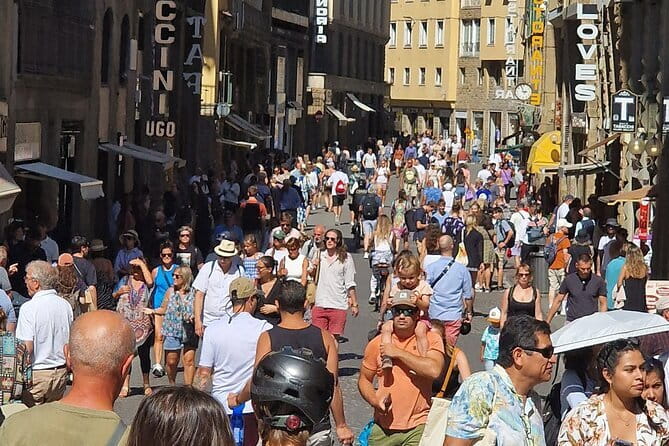
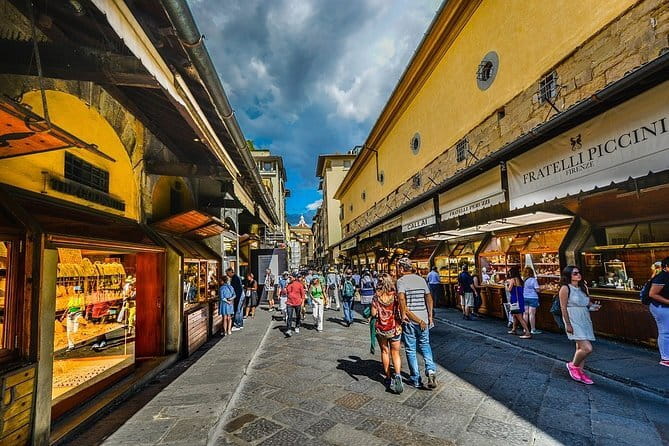
The tour reaches Ponte Vecchio, Florence’s oldest bridge over the Arno. Its shops originally housed butchers, tanners, and farmers. Today, jewelers and art dealers fill the storefronts, giving the bridge a very different commercial identity.
The bridge is free to cross, and it is a natural place to pause after the denser monument route. It also makes a clear transition from the historic center toward the Oltrarno side of the river.
The final listed sight is Palazzo Pitti. The Medici family bought the palace in 1549, and it became the main residence of the ruling families of the Grand Duchy of Tuscany. Later generations filled it with paintings, dinnerware, jewelry, and luxury possessions.
The experience ends at or near Ponte Vecchio, though the exact endpoint can vary slightly within the area. That is convenient if you want to continue toward Palazzo Pitti, but remember that the palace itself is not an included visit. The walk gives you the connection and the location, then leaves you free to choose what deserves your afternoon.
What the $59.26 price really buys
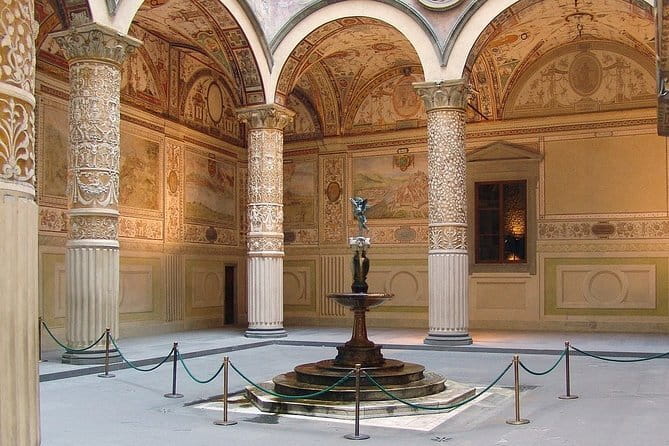
At $59.26 per person, this is not a cheap stroll around town. It is a paid orientation with a licensed guide, a small group, and a whisper system. The value depends on how much help you want making sense of Florence quickly.
I think the price works best for a first visit, a short stay, or a family that wants the city explained before choosing museums. You are paying for structure, local interpretation, and the chance to ask questions. The guide can point out what deserves a return visit, which helps prevent wasted time.
The value is weaker if you want long interior visits. Nearly every major paid sight on the route lists admission as not included. You will need separate tickets for places such as the Medici Chapels, Uffizi, Palazzo Vecchio, the library, or the dome experience.
Group discounts may make the cost more attractive for larger parties. The maximum group size is 15, but the actual group can be smaller. One particularly useful possibility is a very small departure, which allows the guide to adjust the route or answer more questions. On the other hand, one account noted that a group felt a bit large, so the small-group label does not guarantee a private or quiet walk.
Pace, comfort, and who will enjoy it
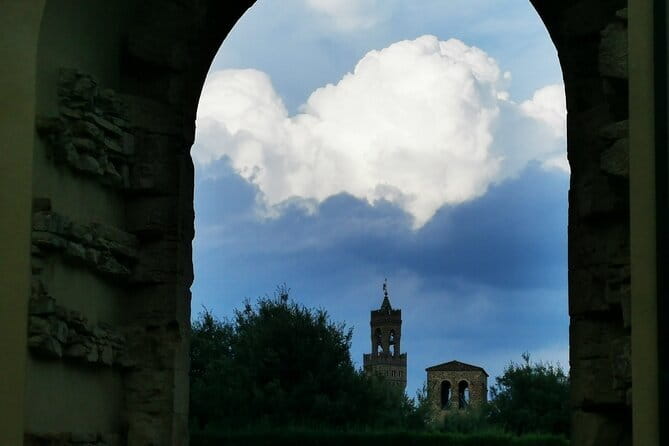
Most people can take part, and the tour is near public transportation. Service animals are allowed. The experience is offered in English, and confirmation is provided at booking.
You should wear comfortable shoes. The route covers much of central Florence and includes busy squares, open streets, and bridge approaches. The pace has been described as comfortable, but the amount of ground covered is still significant for a 1 hour 45 minute walk.
The midday timing deserves attention. In warm weather, Piazza del Duomo and Piazza della Signoria can feel exposed. Simona has been praised for moving the group into shade during explanations, but shade will depend on the day and the exact stopping point.
I would recommend this walk for:
- First-time visitors who want a clear city overview
- Couples and families who prefer a guided introduction
- People with only one day in Florence
- Art lovers who want context before visiting museums
- Food-focused visitors who will ask for restaurant and street-food advice
- Returning visitors who want side-street details and a fresh angle
I would choose another experience if your priority is a single museum, a cathedral interior, or a dome climb. This tour points you toward those places, but it does not replace time inside them.
Should you book the Best of Florence Walking Tour?
Book it if you want Florence explained as a connected story rather than a checklist of monuments. The strongest parts are the Medici thread, the local food and neighborhood advice, the manageable group size, and the guides’ ability to add humor and personal detail. Manuel, Simona, and Camilla have each been singled out for making the city easier to understand and more fun to explore.
Go in with the right expectation: this is a compact walking orientation. You will see the outsides of many major sights, hear why they matter, and finish near Ponte Vecchio. You will not receive admission to most interiors, and five minutes at a landmark is enough for context, not a full visit.
For best value, take it near the start of your Florence stay. Keep the rest of the day or a later day open for the Uffizi, Medici Chapels, Palazzo Vecchio, or the dome, guided by what you learn on the walk. Free cancellation is available up to 24 hours before the 12:15 p.m. start, while poor weather or an unmet minimum may lead to a new date or a full refund.
FAQ
How long is the Best of Florence Walking Tour?
The tour lasts approximately 1 hour and 45 minutes.
What time does the tour start?
The scheduled start time is 12:15 p.m.
Where does the tour begin?
It begins at Caffè Scudieri Firenze, Piazza di San Giovanni, 19R, Florence.
Where does the tour end?
It ends at or near Ponte Vecchio. The precise endpoint may vary slightly within the indicated area.
Are attraction admission tickets included?
Most attraction admissions are not included. The tour includes a licensed guide, a small group, and a whisper system. Piazza della Signoria, Ponte Vecchio, and the listed cathedral stop are shown as free, but the tour does not provide general admission to the paid sights.
How many people can join the tour?
The maximum group size is 15 people. Group discounts are available, and the experience is offered in English.
Recently reviewed around Florence
- Walking Food Tour of Florence with Tastings and Wine★ 5.0 · 518 reviews
- Florence Sunset Food Tour with Wine & Dine at a Tuscan farmhouse★ 5.0 · 194 reviews
- Wine Experience In Chianti Hills from Florence★ 4.5 · 195 reviews
- Uffizi Gallery Timed Entry Admission Tickets★ 4.0 · 392 reviews
- Val d’Orcia Brunello Wine Tour with Montalcino and Montepulciano★ 4.5 · 359 reviews
- Wine Tasting Experience in Ponte Vecchio: Best Tuscany selection!★ 5.0 · 197 reviews
- Uffizi Gallery Small Group Tour with Guide★ 4.5 · 879 reviews
- Early Access Guided Uffizi Gallery Tour Skip-the-Line Small Group★ 4.5 · 707 reviews
Walking Tours, compared.

Guided Walking Tour & Last Supper Visit with Ticket
Read our review →
Rialto Bridge & Offbeat Unusual Venice Walking Tour
Read our review →
Private 3 hrs Venice Tour: St Mark’s, Walking tour & Boat tour
Read our review →

Skip the line: Uffizi and Accademia Small Group Walking Tour
Read our review →
Trastevere & Campo de Fiori Street Food Walking Tour
Read our review →Browse the lists this tour appears in