
Review · MUSEUMS
Venice: Leonardo Da Vinci Museum Entrance Ticket
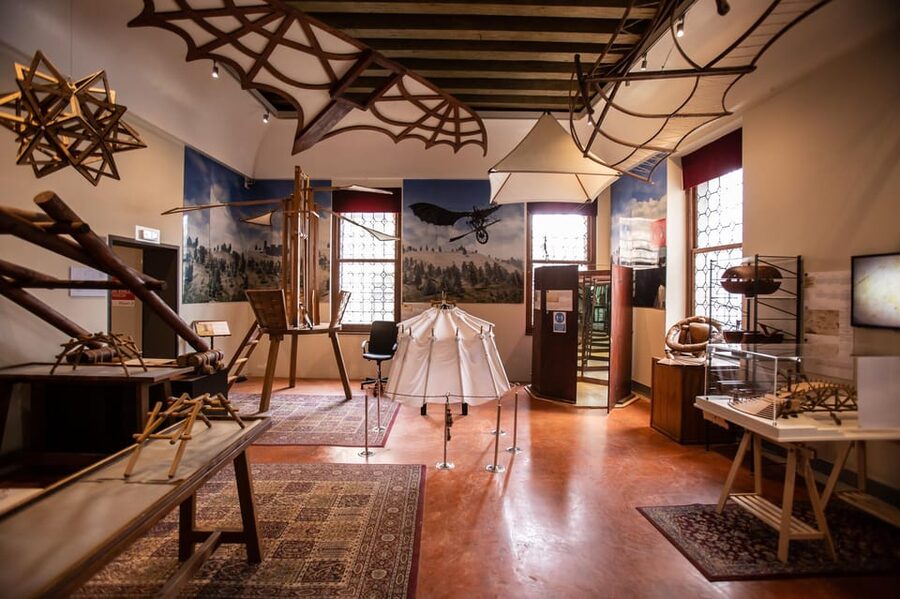
Leonardo da Vinci’s genius is easiest to understand when you can turn a crank, test a gear, build a wooden structure, or study a machine based on one of his drawings. This hands-on museum in Venice turns his ideas into working models arranged around Earth, Water, Fire, and Air.
I like the chance to see more than Leonardo the painter. His anatomy work, engineering plans, and flying-machine ideas get equal attention. I also like the price and flexible visit length: at $10, it works well as a one-hour stop between Venice sights. The drawback is its size. You can see it in 30 minutes if you hurry, and even a careful visit usually takes about 60 to 90 minutes.
In This Review
- Key points to know before you go
- Why this small museum works so well
- Finding Campo San Rocco
- Earth: Leonardo’s practical engineering
- Water: movement, flow, and machines
- Air: flight and the limits of imagination
- Fire: invention, force, and visual explanation
- Anatomy and the artist behind the engineer
- The hands-on activities children actually use
- How long to allow for the visit
- Is the $10 ticket good value?
- Practical advice for a better visit
- Who should book the Leonardo museum?
- FAQ
- Where is the Leonardo da Vinci Interactive Museum in Venice?
- Is this a guided tour?
- How long does the museum visit take?
- What are the museum’s four sections?
- Are the machines original Leonardo inventions?
- Are children allowed to enter alone?
- Can I take photographs inside?
- What languages are available?
- Is there an audio guide?
- Is there a shop at the museum?
Key points to know before you go
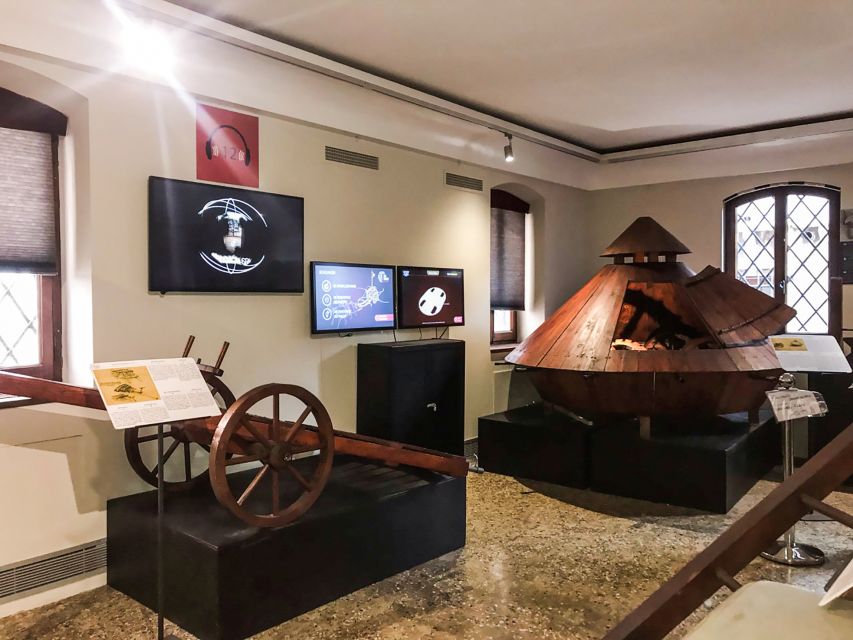
- Working replicas you can operate: Turn wheels, test mechanisms, and examine machines rebuilt from Leonardo’s designs.
- Four themed sections: Earth, Water, Fire, and Air organize the exhibition and give your visit a clear path.
- A strong family stop: Children and adults can try puzzles, wooden structures, drawing activities, and other interactive displays.
- More than inventions: Anatomy studies, manuscripts, high-resolution painting reproductions, and a short film fill out the picture.
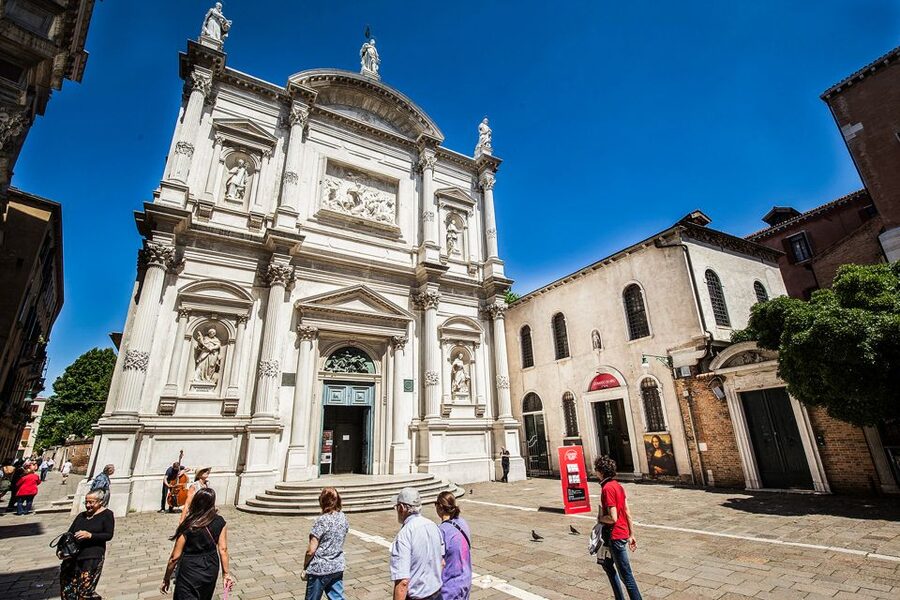
- Easy central location: The museum is at Campo San Rocco, behind the Frari church and opposite the Scuola Grande di San Rocco.
- Plan for about an hour: A quick visit takes 30 to 60 minutes, while families who try everything may stay around 90 minutes.
Why this small museum works so well
Venice has no shortage of grand churches, palace rooms, and famous paintings. This museum offers a different kind of break. Instead of standing behind a rope and quietly studying finished art, you can handle models and see how simple pieces create movement.
The exhibition focuses on Leonardo as a polymath, a person who worked across art, science, engineering, and anatomy. That wider view matters. If you know him mainly for the Mona Lisa or The Last Supper, you may leave with a better sense of how many problems he tried to solve.
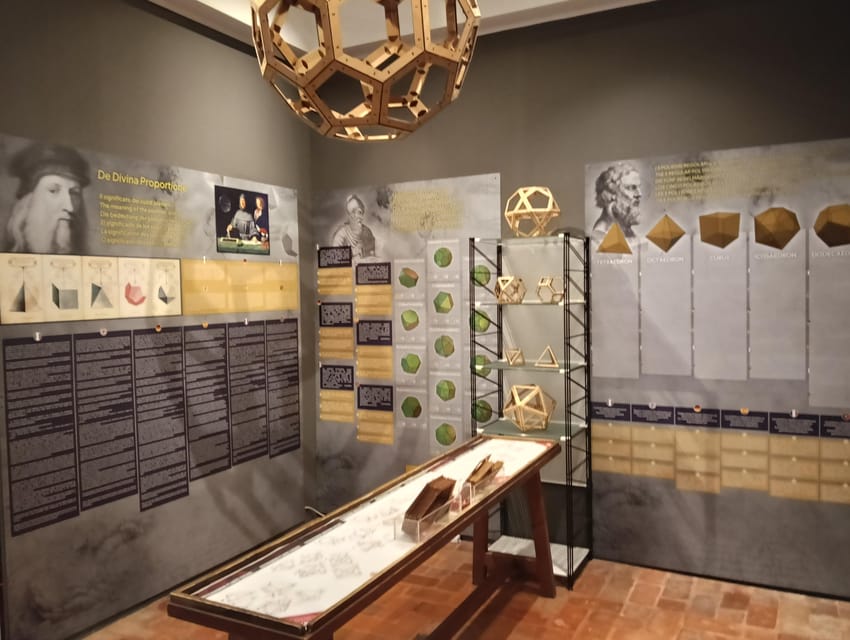
The museum is compact, with a long main room, smaller rooms downstairs, and four rooms upstairs. That makes it manageable in Venice, where you may already have a full day of churches and canals ahead. It also means you should set your expectations correctly. This is not a large national museum with original masterpieces. It is an educational exhibition built around reproductions and interactive models.
More Museum Tours in Venice
- Venice: St. Mark Basilica Ticket, Audioguide+History Gallery
★ 3.9 · 4,780 reviews - Venice’s Best: Basilica, Doge’s Palace, Gondola & History Gallery
★ 4.5 · 2,478 reviews - Venice: Vivaldi’s Four Seasons Concert & Music Museum Visit
★ 4.8 · 2,065 reviews
Finding Campo San Rocco
The entrance is at the Leonardo da Vinci Interactive Museum, Campo San Rocco, 3052, Venezia. Look for the building called the Scolette di San Rocco, opposite the Scuola Grande di San Rocco and behind the Church of the Frari.
The location is useful for planning. You can combine the museum with the Frari, the Scuola Grande di San Rocco, and a walk through the San Polo area. The museum itself is the meeting point. There is no guide waiting in a square or leading a group through Venice. Present your ticket at reception and enter.
That detail is worth knowing because the booking language can sound like a tour meeting point. It is really a self-guided museum visit. You control the pace, and you can spend extra time at the machines that catch your attention.
Earth: Leonardo’s practical engineering
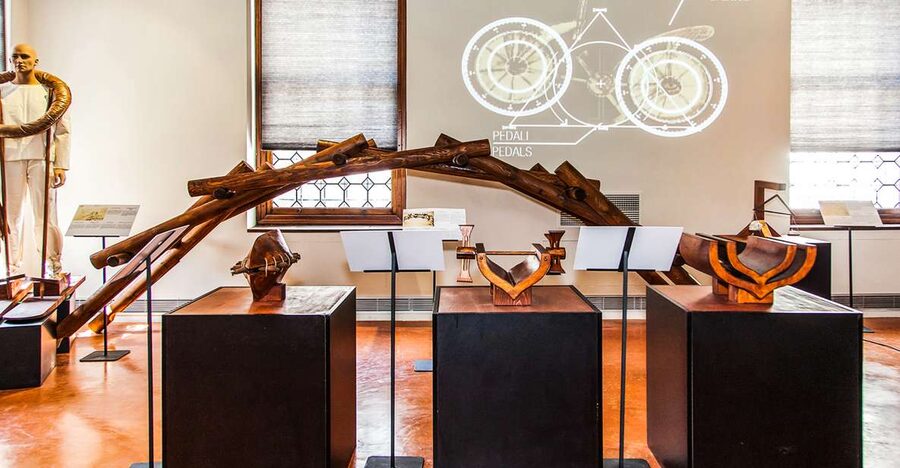
The Earth section introduces the solid, mechanical side of Leonardo’s work. Expect models that show how he studied structures, force, movement, and construction.
This is where the museum’s replicas earn their place. A drawing in a book can look clever, but a model shows you what the idea actually does. Turning or moving a mechanism gives you a basic feel for the problem Leonardo was working on.
Wooden construction puzzles are among the most enjoyable activities. One bridge puzzle is easier with a second person, so families and couples should work on it together. Other wooden structures ask you to think about balance and shape. These are simple tasks, but they make the visit active instead of passive.
The practical lesson is that Leonardo did not separate art from mechanics. He observed form, proportion, and movement, then applied those observations to machines and structures. You do not need a technical background to follow the displays, since the explanations are designed for a general audience.
Water: movement, flow, and machines
The Water section looks at Leonardo’s interest in canals, water movement, and mechanical systems. The models help you see how he approached a problem: observe it carefully, sketch possible solutions, then test how parts might work together.
You can operate several machines yourself. That is the real value of this section. Children may simply enjoy making something move, while adults can pause to notice the principles behind the design.
The displays also show why Leonardo’s work still feels familiar. Some ideas resemble the basic systems used in later engineering. The exhibition does not require you to treat every model as a modern invention, but it does show how far ahead his questions were for his time.
If the museum is busy, the hands-on stations may take longer because you need to wait for your turn. A quieter visit gives you more time with each mechanism. Since the ticket is valid for one day, you have some flexibility around the timing listed when you book.
More Venice museums and collections:
- Vatican: Museums & Sistine Chapel Entrance Ticket
★ 4.5 · 144,003 reviews - Vatican Museums & Sistine Chapel Tour with Optional Basilica
★ 4.3 · 67,413 reviews - Vatican Museums, Sistine Chapel & St Peter’s Basilica Guided Tour
★ 4.5 · 39,149 reviews - Florence: Skip-The-Line Uffizi Gallery Timed Entry Ticket
★ 4.5 · 27,832 reviews
Air: flight and the limits of imagination
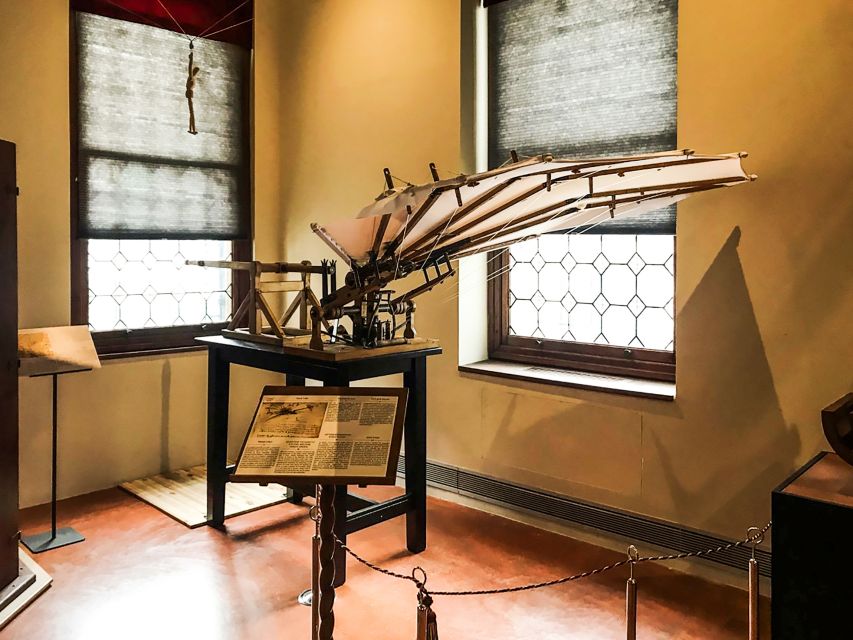
The Air section is likely to appeal to anyone curious about flight. Leonardo studied birds, wings, and the possibility of human-powered flight long before aircraft existed.
The displays make his imagination easier to grasp because you can compare the original ideas with physical replicas. Some concepts were not practical in their original proportions, and the museum explains that the machines have been rebuilt from his designs, with changes made when the original scale would not work.
That qualification is important. You are not looking at machines preserved from the Renaissance, and these are not working aircraft. You are seeing modern reproductions built to communicate Leonardo’s plans. For a $10 museum visit, that is a fair trade, as long as you understand what you are viewing.
The section works especially well for children and teenagers because it connects a historical figure to a familiar question: how can a person get into the air? It also gives adults a reason to think about the gap between a bold idea and a workable machine.
Fire: invention, force, and visual explanation
The Fire section rounds out the four-element layout with machines and studies linked to force, energy, and invention. As in the other rooms, the purpose is not to present a large collection of original objects. The purpose is to show how Leonardo’s ideas can be understood through models, images, and short explanations.
The exhibition uses multimedia displays and written descriptions in Italian, English, French, German, Spanish, and Russian. That makes the museum easy to use for international visitors. You can read at your own pace, and the visual design helps if you do not want to study every paragraph.
A short film gives a compact account of Leonardo’s life and work. It is useful early in your visit because it provides context before you examine the machines. If you are pressed for time, watch the film and focus on the interactive displays that interest you most.
Anatomy and the artist behind the engineer
Leonardo’s anatomy studies give the visit more depth. He was not simply sketching bodies for artistic practice. He studied human structure in detail, trying to understand muscles, bones, proportions, and movement.
The museum presents reproductions of his medical work alongside his inventions. High-resolution, backlit replicas of major paintings also connect the scientific and artistic sides of his work.
I find this combination helpful because it stops the exhibition from becoming a room full of clever machines. Leonardo’s drawings show a single habit behind both art and science: careful observation. He wanted to understand how things were built, how they moved, and how they looked.
The reproductions are not substitutes for seeing an original Leonardo painting in Milan or another major collection. Still, they let you place his art beside his technical studies. If you have already seen The Last Supper in Milan, the Venice museum can add useful context rather than simply repeat the same experience.
The hands-on activities children actually use
The museum is well suited to families because its activities are not limited to a single children’s corner. Adults can try the machines too, and many of the puzzles work better when people cooperate.
Look for the drawing activities on iPads, which let children create images in a Leonardo-inspired way. The mirror box is another memorable stop. It shows reflections from different angles and gives you an immediate visual lesson in perspective and geometry.
The wooden bridge puzzle is a good example of the museum’s approach. You do not need a lecture to understand the basic challenge. You try to fit the pieces, adjust your plan, and see what happens. Bring patience, and if possible, a second person to help.
Parents should keep an eye on younger children around the exhibits. The machines are made to be touched, but they are not toys to be pulled or climbed on. A little care helps preserve the displays for the next person.
How long to allow for the visit
You can rush through the museum in 30 minutes, especially if you read only selected panels. Allow 60 minutes for a sensible first visit, and closer to 90 minutes if you are with children or want to try most of the activities.
That range is one of the museum’s strengths. It fits into a crowded Venice schedule without demanding half a day. You can visit before lunch, stop in during an afternoon walk, or use it as an indoor break when the streets feel hot and crowded.
The museum is air-conditioned, which makes it particularly useful during warm weather. It is also a calmer place than the main tourist routes. Do not plan your entire day around it, but do use it to give your feet and attention a rest.
The last entrance is one hour before closing. Check the available starting times when booking, then avoid arriving at the very end of the day if you want time to test the displays.
Is the $10 ticket good value?
At $10 per person, I consider this a good-value short museum visit. You are paying for an interactive exhibition, multilingual information, a film, working replicas, and the chance to take photographs inside. Children under three enter free.
The value is strongest for families, curious adults, and anyone who likes science or design. A person who wants original Renaissance paintings may find the reproductions less satisfying. Someone hoping for a large museum could also feel finished sooner than expected.
You receive a 10 percent discount in the bookshop, which sells Leonardo-themed gifts and souvenirs. That is a small but useful extra if you want a book or educational item for a child.
The ticket allows free cancellation up to 24 hours before the visit, and you can reserve now and pay later. Those terms help if your Venice plans are still shifting, but the main value comes from the museum’s manageable size and active displays.
Practical advice for a better visit
Scan the QR code at the front of the shop if you want to use the audio guide. It is easy to miss this step at reception, and you may need to return to the start if you walk straight into the exhibition.
Start with the short film if you want a quick outline of Leonardo’s life. Then move through the four elements, stopping at the machines rather than trying to read every panel. If you have children, let them choose a few activities and give yourself enough time for puzzles.
The museum permits photographs, so your phone can help you remember the models and display panels. Keep the ticket ready at reception, and remember that the museum itself is the meeting point.
The written material is available in six languages: Italian, English, French, German, Spanish, and Russian. There is no guided tour included, so you should choose this place if you prefer independent exploring rather than a scheduled explanation from a guide.
Who should book the Leonardo museum?
I would book this museum for families with children, teenagers who need something more active than a traditional gallery, and adults who enjoy machines, puzzles, art, or the history of ideas.
It is also a smart choice if you have only a couple of days in Venice. The museum is close enough to major San Polo sights to fit into a walking route, and the visit can be as short as half an hour.
I would skip it if your top priority is seeing original works by Leonardo. This exhibition uses faithful reproductions and rebuilt machines, not a collection of original paintings or Renaissance instruments. I would also skip it if you dislike interactive displays or have no interest in spending time with models.
For most people, the $10 price makes the decision easy. You get a clear look at Leonardo the engineer and anatomist, not just Leonardo the painter, and you can leave after an hour without feeling that you sacrificed your whole Venice day. Book it if you want a practical, family-friendly stop with enough substance to keep adults interested.
FAQ
Where is the Leonardo da Vinci Interactive Museum in Venice?
It is at Campo San Rocco, 3052, Venice, in the Scolette di San Rocco building. The entrance is opposite the Scuola Grande di San Rocco and behind the Church of the Frari.
Is this a guided tour?
No. The ticket provides museum entry, but no guided tour is included. You present your ticket at reception and explore independently.
How long does the museum visit take?
A quick visit can take 30 to 60 minutes. If you try the activities and read more of the displays, plan on about 90 minutes.
What are the museum’s four sections?
The exhibition is arranged around Earth, Water, Fire, and Air. Each section presents machines and ideas linked to its element.
Are the machines original Leonardo inventions?
The machines are rebuilt according to Leonardo’s designs. Changes may have been made when the original proportions required adjustment.
Are children allowed to enter alone?
Children under 15 must be accompanied by an adult. Children under three receive free admission.
Can I take photographs inside?
Yes. Photography inside the museum is included with the ticket.
What languages are available?
Descriptions and multimedia displays are available in Italian, English, French, German, Spanish, and Russian.
Is there an audio guide?
An audio guide is available through a QR code at the front of the shop. Scan it before entering the main exhibition area.
Is there a shop at the museum?
Yes. The bookshop sells Leonardo-themed gifts and souvenirs, and the ticket includes a 10 percent discount on bookshop purchases.
Recently reviewed around Venice
- St Mark’s Basilica and Doge’s Palace Priority Entry Ticket★ 4.2 · 885 reviews
- Venice: Lords of the Night Prison’s Palace Cells & Tortures★ 4.0 · 1,067 reviews
- Venice: Hard Rock Cafe with Set Menu for Lunch or Dinner★ 4.4 · 1,102 reviews
- Venice: Doge’s Palace and St. Mark’s Basilica Guided Tour★ 4.6 · 458 reviews
- Venice: Walking tour, Doge Palace, & St. Mark’s Basilica★ 4.5 · 884 reviews
- Punta Sabbioni: Murano, Burano & Torcello Guided Boat Tour★ 4.3 · 236 reviews
- Murano: Glass Blowing Demonstration with Optional Drinks★ 4.5 · 294 reviews
- Murano: Glass Blowing Demonstration and Artistic Glass Gift★ 4.6 · 507 reviews
Museums, compared.
Vatican: Museums & Sistine Chapel Entrance Ticket
Read our review →
Vatican Museums & Sistine Chapel Tour with Optional Basilica
Read our review →
Vatican Museums, Sistine Chapel & St Peter’s Basilica Guided Tour
Read our review →
Skip-The-Line Uffizi Gallery Timed Entry Ticket
Read our review →
Vatican Museums, Sistine Chapel & Basilica Tour
Read our review →
Vatican Museums & Sistine Chapel Skip-the-Line Entry Ticket
Read our review →Vatican Museums, Sistine Chapel & Basilica Tour
Read our review →
Vatican Museums & Sistine Chapel Guided Tour
Read our review →Browse the lists this tour appears in