
Review · VENICE TOURS
Venice: Sightseeing Tour with a Local expert
Venice reveals itself best in its narrow lanes, quiet squares, and small details that are easy to miss when you rush between St. Mark’s and the Rialto Bridge. This two-hour English walking tour starts in Dorsoduro, then threads through San Polo and historic backstreets before ending in Piazza San Marco.
I like the route’s gentle progression from less crowded areas into Venice’s headline sights, and I like having a local guide explain why the city works the way it does. Guides such as Valentina, Julia, Flavia, Irene, and Gianmarco are praised for lively storytelling, personal tips, and a good feel for the city. The main drawback is simple: no interiors are included, so you will admire the basilicas and palaces from outside.
In This Review
- Key points at a glance
- Why this route works for a first look at Venice
- Campiello dei Squelini and Campo San Pantalon
- Campo San Rocco and the San Polo district
- Basilica dei Frari and the story behind the monument
- Crossing the Grand Canal at Rialto Bridge
- San Giovanni and Paolo, St. Mark’s Basilica, and the Doge’s Palace
- The guides make the difference
- What you learn beyond the monuments
- Is $41 good value?
- Who should book this walk?
- FAQ
- How long does the Venice sightseeing tour last?
- What language is the tour conducted in?
- Where does the tour meet?
- Does the tour enter the basilicas or Doge’s Palace?
- Is the tour suitable for wheelchair users?
- What should I bring?
- Should you book it?
Key points at a glance
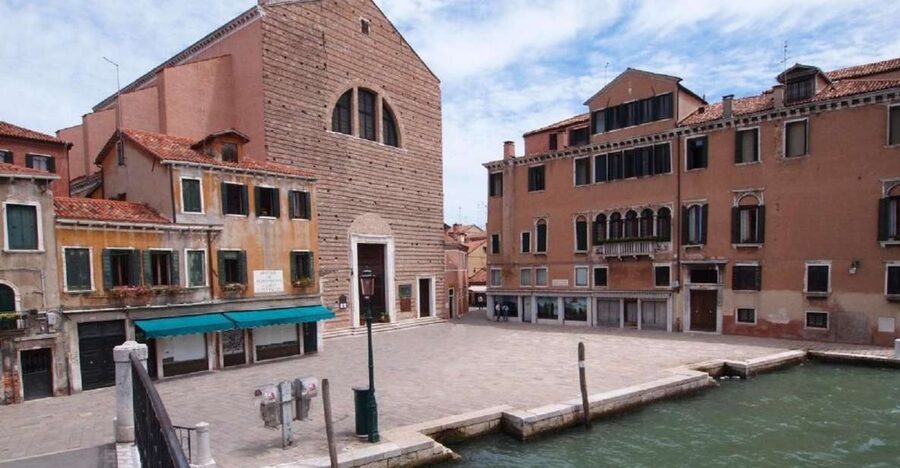
- Starts away from the main sights: Meet at Campiello dei Squelini near Ca’ Foscari University in Dorsoduro, by the coloured wall.
- Explores three historic districts: Walk through Dorsoduro, San Polo, Rialto, and toward San Marco rather than sticking to one compact tourist zone.
- Includes Venice’s famous crossings: Cross the Grand Canal on Rialto Bridge and use the smaller pedestrian bridges that make Venice feel like Venice.
- Focuses on local context: Guides explain the city’s islands, trade past, architecture, daily life, and easy-to-miss details.
- Ends at the big landmarks: Finish near St. Mark’s Basilica and the Doge’s Palace, with no admission lines or interior visits.
- Best for a first day: The route helps you understand Venice’s layout and gives you ideas for places to return to later.
Why this route works for a first look at Venice
A first day in Venice can feel like a beautiful maze. The streets twist, canals interrupt every route, and a short walk on the map can take much longer than expected. This tour gives you a useful framework before you set off on your own.
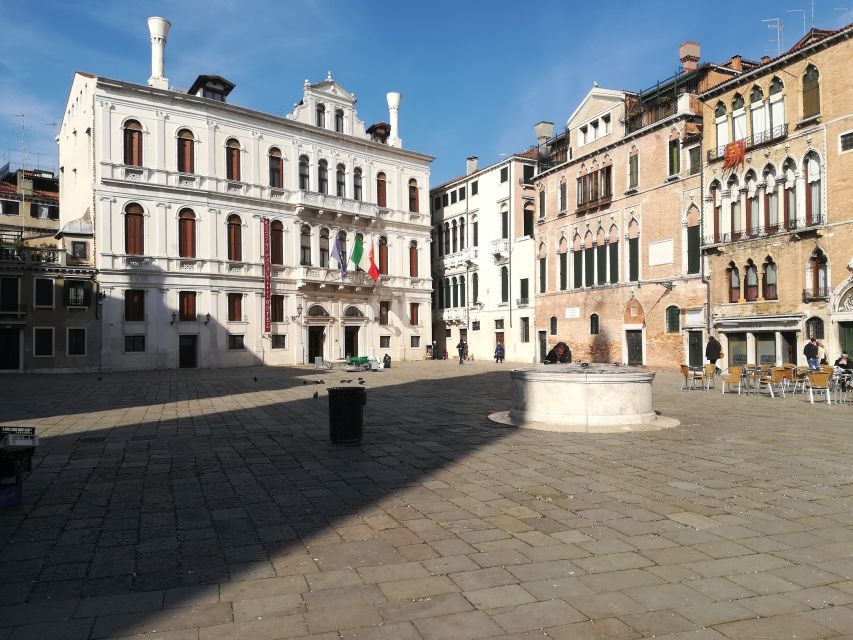
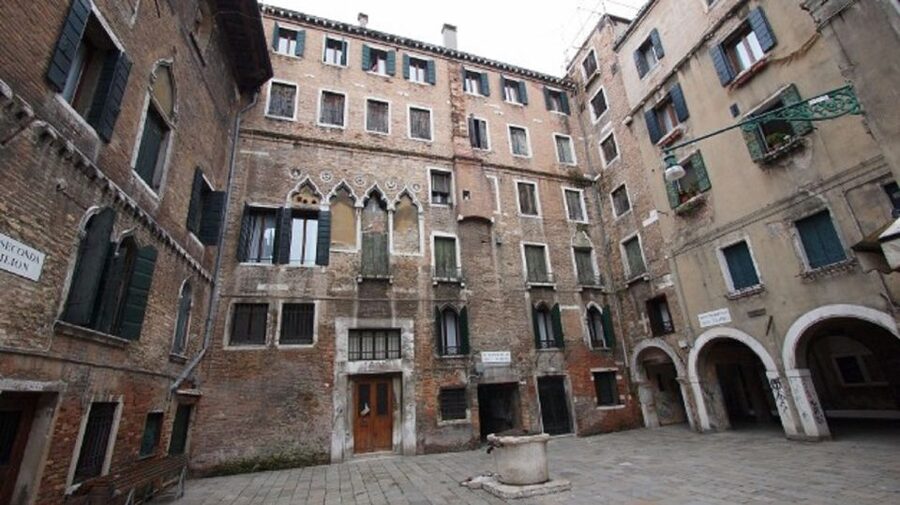
You begin near Ca’ Foscari University in Dorsoduro, not directly beside the city’s busiest monuments. That choice matters. Instead of starting in the thickest crowds, you ease into Venice through local streets and smaller squares. You get a sense of how the city changes as you move from quieter neighbourhoods toward San Marco.
The route also gives you a mix of famous sights and less obvious corners. You will see places that may not appear on a standard first-time checklist, yet they help explain how Venice developed. Guides have pointed out details that are easy to pass without context, from odd features in buildings to clues about the old trading city.
I especially like this kind of introduction because it leaves room for the rest of your visit. After the walk, you can return to the places that caught your attention, visit an interior on your own, or follow the guide’s suggestions for food, drinks, and further sightseeing.
Other Venice days travellers weigh against this one:
- Venice: Doge’s Palace Reserved Entry Ticket
★ 4.6 · 42,716 reviews - Venice: Grand Canal Gondola Ride with App Commentary
★ 4.1 · 18,908 reviews - Boat Trip: Glimpse of Murano, Torcello & Burano Islands
★ 4.3 · 15,699 reviews
Campiello dei Squelini and Campo San Pantalon
The meeting point is Campiello dei Squelini, near Ca’ Foscari University in the Dorsoduro district. Look for the coloured wall. You should arrive at least 10 minutes early because the group can wait no more than five minutes once the tour is due to begin.
That timing is worth taking seriously. Venice’s lanes are confusing, and arriving at a vaporetto stop or a nearby square is not the same as reaching the meeting point. Allow extra time if you are coming by water bus, especially if you are unfamiliar with the city.
From there, the walk reaches Campo San Pantalon, where the guide pauses for about 15 minutes. This format works well for Venice: walk, stop, listen, then move on before your feet and attention start to tire. You are not confined to a coach or fixed behind a glass window. The city’s bridges, passages, and canals are part of the experience.
A local guide can also point out how Venice’s public spaces function. A campo is a square, but these spaces are not all grand or formal. Some feel open and civic, while others are small neighbourhood meeting places. That distinction is easier to grasp on foot than from a list of monuments.
Campo San Rocco and the San Polo district
The next section continues through Campo San Rocco and San Polo, with another guided stop of about 15 minutes in each area. San Polo is one of the city’s oldest central districts and is tied to Venice’s long commercial life.
This is where the tour begins to show the difference between seeing Venice and understanding it. You can photograph a bridge or an old façade on your own. With a guide, you learn to connect the street to the city’s past as a trading centre during the Venetian Empire.
The route uses narrow lanes and smaller bridges, so comfortable shoes are not a minor suggestion. Venice is not a flat, smooth museum floor. You will be walking over paving and crossing bridges, often with steps. The tour is not suitable for wheelchair users, and anyone with limited mobility should consider that carefully.
The pace is generally described as steady rather than hurried. That helps when the group pauses for explanations, questions, and photographs. One guide, Julia, was especially praised for balancing detailed information with a relaxed, friendly manner. Several guides are also noted for keeping the mood light, which is useful when the route gets busy or the group stretches out across a bridge.
Basilica dei Frari and the story behind the monument
The Basilica di Santa Maria Gloriosa dei Frari is one of the most important stops on the walk. The church is known here as the burial place of the painter Titian, a major Venetian artist.
You do not enter the basilica as part of this activity. That is an important distinction if you want to see its interior, art, or tomb in detail. The guide can explain why the building matters and point out its place in Venice’s artistic story, but an outdoor walking tour cannot replace a dedicated church visit.
Still, seeing the Frari as part of a neighbourhood walk has real value. You encounter it not as an isolated sight reached by a direct route, but as part of the fabric of San Polo. The surrounding lanes and squares help you understand how major monuments sit beside everyday Venetian streets.
If the Frari interests you, note it as a return visit. The walking tour gives you the orientation and historical reason to come back, while a separate visit allows you to spend time inside without holding up the group.
A different way to spend the day, same part of Italy:
- Venice: Grand Canal by Gondola with Live Commentary
★ 4.1 · 13,681 reviews - Venice: La Fenice Opera House Entry Ticket with Audio Guide
★ 4.6 · 11,742 reviews - Doge’s Palace & St. Mark’s Basilica with Terrace Access Tour
★ 4.7 · 10,697 reviews - Venice: Burano, Torcello & Murano Boat Tour w/Glassblowing
★ 4.4 · 10,245 reviews
Crossing the Grand Canal at Rialto Bridge
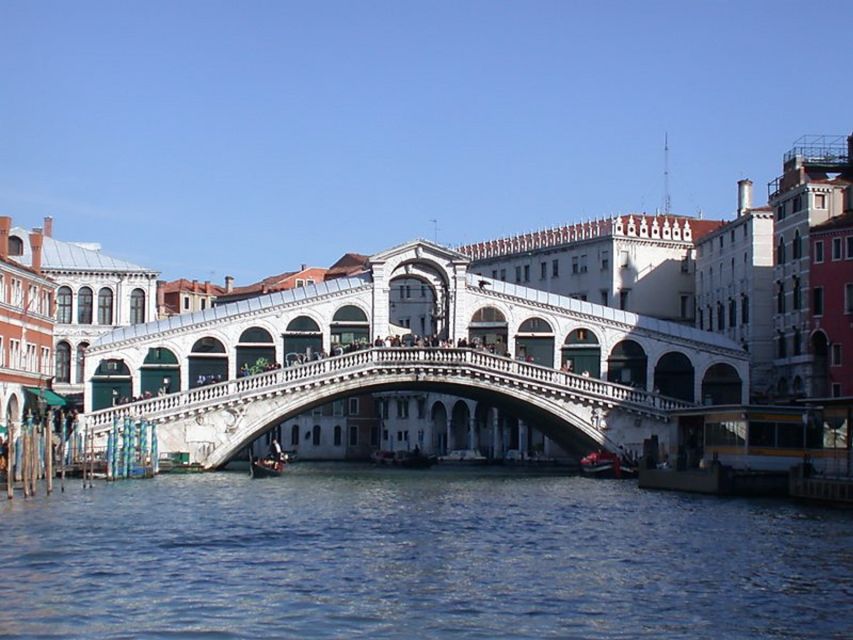
Rialto Bridge is the tour’s most recognisable crossing. The bridge carries pedestrians over the Grand Canal and connects the districts on either side of Venice’s historic commercial centre.
Your guide places the bridge within the story of trade and movement. That context changes how you look at the crowds and shopfronts. Rialto is not simply a famous photo stop. It was, and remains, a key point for crossing the Grand Canal and reaching the old market area.
The bridge can be crowded, particularly at busy times. You may need to pause at the edges rather than expect an empty view. That is part of the practical advantage of having a guide: someone familiar with the route can keep the group moving and help you focus on the structure, the waterway, and the surrounding district instead of getting stuck in the flow of foot traffic.
The walk also uses Venice’s smaller pedestrian bridges. These crossings are often more revealing than the big landmark. You notice how the city’s routes bend around canals, how close the buildings sit to the water, and how quickly a noisy main path can give way to a quiet lane.
San Giovanni and Paolo, St. Mark’s Basilica, and the Doge’s Palace
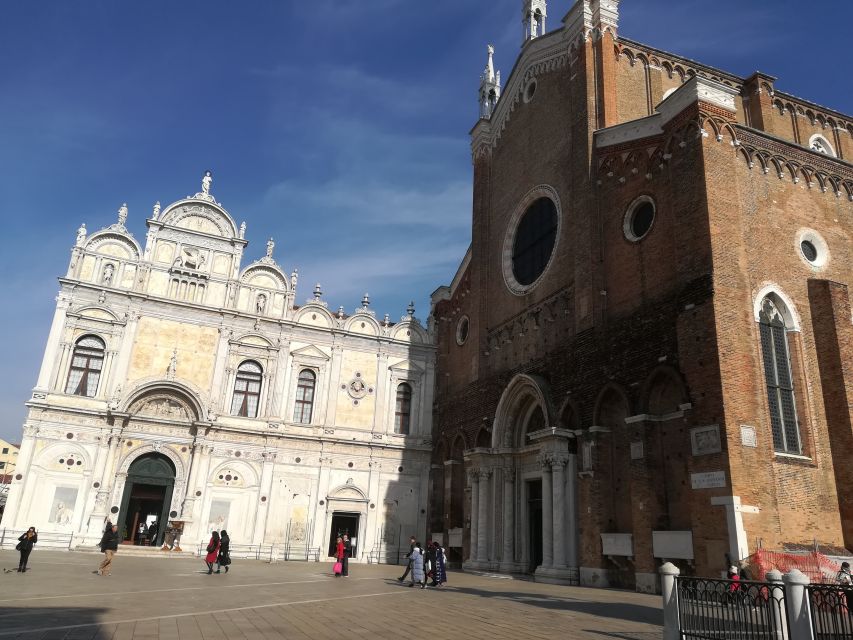
The planned route continues toward the Basilica di San Giovanni e Paolo, one of Venice’s grand Gothic churches. It is associated with the burial of 25 doges, the elected leaders who governed the Venetian Republic.
As with the Frari, the church is viewed from outside on this tour. That keeps the walk moving, but it also means you should not book this experience expecting a church art tour. The guide’s role is to explain the monument and its place in Venetian history, not to provide admission or an interior lecture.
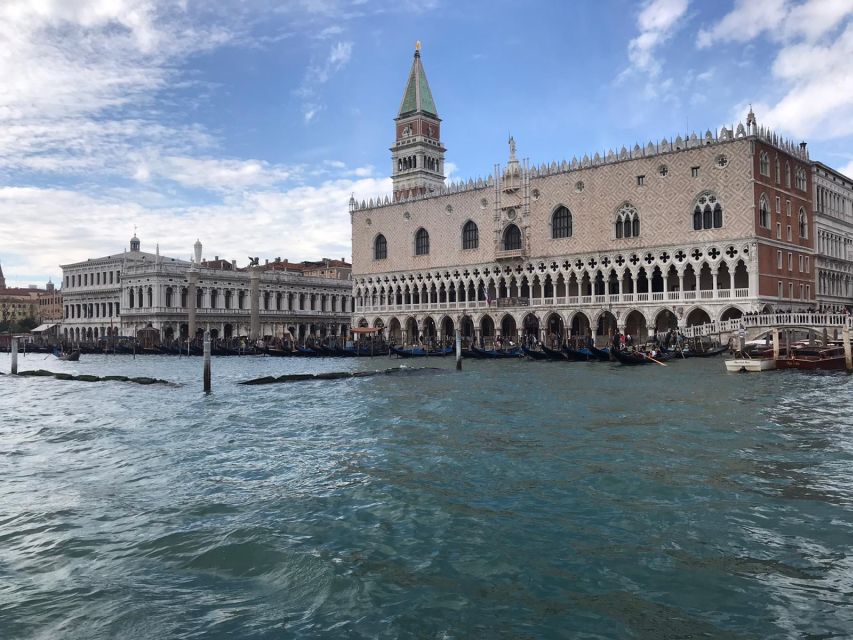
The final destination is Piazza San Marco. Here you can admire the exterior of St. Mark’s Basilica and the Doge’s Palace, two of Venice’s defining sights. Ending at this square is practical. Once the tour finishes, you are already in position to explore the area independently, take a break, or join a separate timed visit if you have arranged one.
Do not assume that finishing in St. Mark’s Square means you will enter either landmark. This is an outdoor route, and admissions are not part of the $41 price. For many people, that is a fair trade: you receive a guided overview for a modest cost, then decide which interiors deserve your own time and entrance fee.
The guides make the difference
The strongest part of this experience is the human touch. Guides named in the feedback include Valentina, Julia, Flavia, Irene, Donata, Gianmarco, Olga, Ana, Monika, Daisy, and Denise. The most praised qualities are their local connection, clear explanations, humour, and willingness to answer questions.
Valentina is especially associated with lively storytelling and practical recommendations. She has also been praised for suggesting places to eat, drink, and visit after the tour. Julia is noted for combining strong local knowledge with personal anecdotes and a down-to-earth manner. Irene is praised for her passion for Venice and for taking groups into areas away from the main tourist routes.
That does not mean every departure will have one of these specific guides. Your guide is assigned by the operator, Raphael Tours & Events. Still, the repeated pattern is useful: the activity is designed around a person who can interpret the city, not just recite dates.
Some departures use remote earpieces, which can make a difference when the group is spread out or the surrounding streets are noisy. Group size can vary, and one comment notes that a larger group still worked because the guide helped everyone stay involved. If you prefer a private, slow-paced visit with constant photo stops, this may feel less personal.
What you learn beyond the monuments
The walk covers the history of Venice, its islands, its districts, and its role as a trading power. It also connects the past to modern Venetian life. That balance is one of the better reasons to choose a local-led route.
You might hear why a square, bridge, or building looks the way it does. You may also learn about daily life in the city, details that do not appear in a standard guidebook, and places you would probably overlook alone. The best guides use stories and observations to help you read the city as you walk.
The experience is also useful for orientation. Venice has no conventional street grid, and the names of districts can feel abstract until you move through them. By the end, you have walked between Dorsoduro, San Polo, Rialto, and San Marco, giving you a clearer sense of how the central city connects.
Bring a bottle of water. The route does not include additional stops, and you should not expect time to pause for refreshments along the way. Summer heat, crowded streets, and bridge steps can make even a two-hour walk feel demanding.
Is $41 good value?
At $41 per person, this is a sensible price for a small-group guided walk in central Venice. You are paying for two hours with an English-speaking local expert, not for transport or admission tickets.
The value is strongest if you are new to Venice and want a quick introduction before exploring on your own. A guide can save you time by showing you a logical route through several districts and by explaining the details you would otherwise pass without noticing.
The price is less attractive if your only aim is to see St. Mark’s Basilica, the Doge’s Palace, and Rialto Bridge. You can reach those places without a tour, and this activity does not include entry. It earns its cost through context, local observations, and the less obvious parts of the route.
The free cancellation window up to 24 hours before the start and reserve-now, pay-later option also make it easier to fit into a changing schedule. Confirmation is sent at booking, but you still need to check the precise starting time and get to the meeting point early.
Who should book this walk?
I would choose this for a first or second day in Venice. It gives you a map in your head, introduces the main districts, and helps you decide where to spend the rest of your time.
It suits couples, families with older children, solo visitors, and anyone who enjoys learning while walking. The English-only format is helpful if you want a full explanation without switching languages.
You should think twice if you need wheelchair access, dislike walking over bridges with steps, or want substantial time inside churches and palaces. It is also not a hotel pickup service. You must reach Campiello dei Squelini yourself and arrange your own return from St. Mark’s Square.
FAQ
How long does the Venice sightseeing tour last?
The activity is scheduled for two hours. Some departures may feel slightly longer depending on the pace and group, but the advertised duration is two hours.
What language is the tour conducted in?
The tour is conducted only in English, with a live English-speaking local guide.
Where does the tour meet?
Meet at Campiello dei Squelini near Ca’ Foscari University in the Dorsoduro district, by the coloured wall. Arrive 10 minutes early because the group cannot wait more than five minutes after the start.
Does the tour enter the basilicas or Doge’s Palace?
No. This is an outdoor walking tour, and entrance tickets are not included. You view the Basilica dei Frari, San Giovanni e Paolo, St. Mark’s Basilica, and the Doge’s Palace from outside.
Is the tour suitable for wheelchair users?
No. The activity is not suitable for wheelchair users. The route includes narrow lanes, bridges, and walking across Venice’s historic districts.
What should I bring?
Wear comfortable shoes and bring a bottle of water. There are no added stops during the route, so it is wise to arrive prepared for continuous outdoor walking.
Should you book it?
Book this tour if you want Venice to make sense before you tackle it alone. The combination of quiet lanes, San Polo’s old trading centre, the Frari, Rialto Bridge, and St. Mark’s Square gives you a useful first look at the city without spending the day in a museum line.
The best reason to choose it is the guide. Valentina, Julia, Flavia, Irene, and other local experts have made this walk especially strong through stories, humour, and practical suggestions. If you want interiors, a private pace, or mobility-friendly access, choose a different activity. For most first-time visitors who want a well-priced orientation with local character, this is a smart start.
Recently reviewed around Venice
- St Mark’s Basilica and Doge’s Palace Priority Entry Ticket★ 4.2 · 885 reviews
- Venice: Lords of the Night Prison’s Palace Cells & Tortures★ 4.0 · 1,067 reviews
- Venice: Hard Rock Cafe with Set Menu for Lunch or Dinner★ 4.4 · 1,102 reviews
- Venice: Doge’s Palace and St. Mark’s Basilica Guided Tour★ 4.6 · 458 reviews
- Venice: Walking tour, Doge Palace, & St. Mark’s Basilica★ 4.5 · 884 reviews
- Punta Sabbioni: Murano, Burano & Torcello Guided Boat Tour★ 4.3 · 236 reviews
- Murano: Glass Blowing Demonstration with Optional Drinks★ 4.5 · 294 reviews
- Murano: Glass Blowing Demonstration and Artistic Glass Gift★ 4.6 · 507 reviews
Venice Tours, compared.
Grand Canal Gondola Ride with App Commentary
Read our review →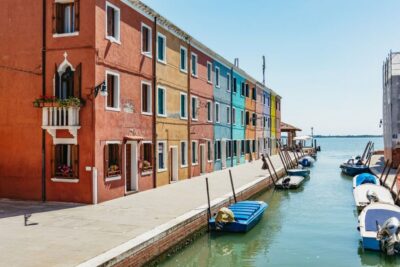
Boat Trip: Glimpse of Murano, Torcello & Burano Islands
Read our review →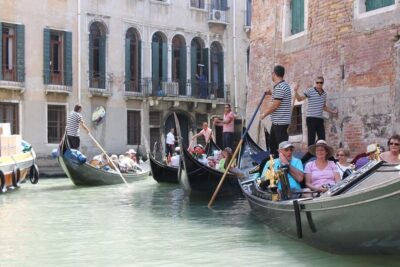

La Fenice Opera House Entry Ticket with Audio Guide
Read our review →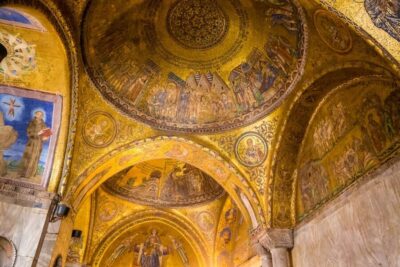
Doge’s Palace & St. Mark’s Basilica with Terrace Access Tour
Read our review →
Burano, Torcello & Murano Boat Tour w/Glassblowing
Read our review →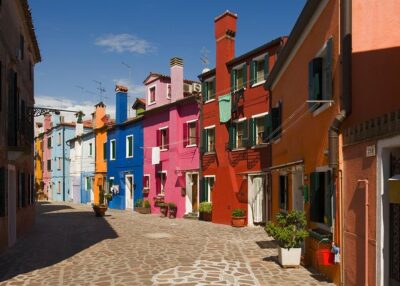
Murano, Burano and Torcello Half-Day Sightseeing Tour
Read our review →Browse the lists this tour appears in