
Review · BOLOGNA & EMILIA TOURS
Guided Tour of Mosaic Tiles in Ravenna
Ravenna’s mosaics are not small decorative details you glance at on the way to something else. They cover domes, walls, and apses with gold, blue, solemn faces, imperial processions, and scenes meant to explain Christian belief. This tour brings that art together with Ravenna’s religious and political story, making the city’s monuments easier to understand.
I especially like the included admission to the main sites, since it saves you from sorting out separate tickets and lines. I also like the way the guides connect the mosaics to people such as Justinian, Theodora, Galla Placidia, and Dante Alighieri. The main caution is practical: expect plenty of walking, possible crowds, and a tour that can run longer than the advertised two to three hours.
In This Review
- Key points to know before booking
- Why Ravenna’s mosaics need a guide
- Starting at Piazza San Francesco
- Galla Placidia and the ceiling that captured Dante
- San Vitale and the power of Justinian and Theodora
- The Neonian Baptistery and a brilliant blue dome
- Three monuments, and possibly more mosaic sites
- How much does the $33.86 price buy you?
- Group size, sound, and the pace of the walk
- Who should book this Ravenna mosaic tour?
- Practical tips for a better visit
- Should you book it?
- FAQ
- How much does the guided mosaic tour cost?
- How long does the tour last?
- Which language is the tour offered in?
- Is admission to the monuments included?
- Where does the tour begin?
- Where does the tour end?
- Which monuments are included?
- How large can the group be?
- Is audio equipment provided?
- Can I cancel for a full refund?
Key points to know before booking
- Galla Placidia’s starry ceiling: See the small mausoleum whose blue-and-gold dome inspired Dante.
- San Vitale’s imperial portraits: Study the famous mosaics of Byzantine Emperor Justinian and Empress Theodora.
- A fifth-century baptism scene: Look up at Christ’s Baptism and the Twelve Apostles in the Neonian Baptistery.
- Guides who add context: Guides including Elisabetta, Chiara, Marco, Serena, and Francesca have led tours praised for clear history, humor, and enthusiasm.
- Radio equipment for larger groups: A transmitter and earpieces can help you hear while standing slightly apart from the group.
- A busy walking tour: The group can reach about 28 people, and some outings have visited five mosaic sites.
Why Ravenna’s mosaics need a guide
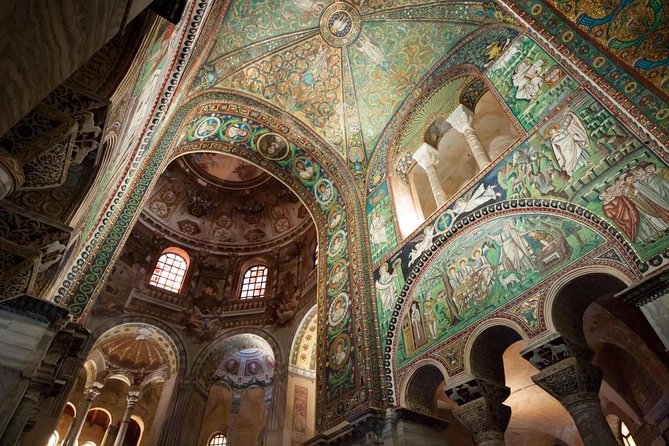
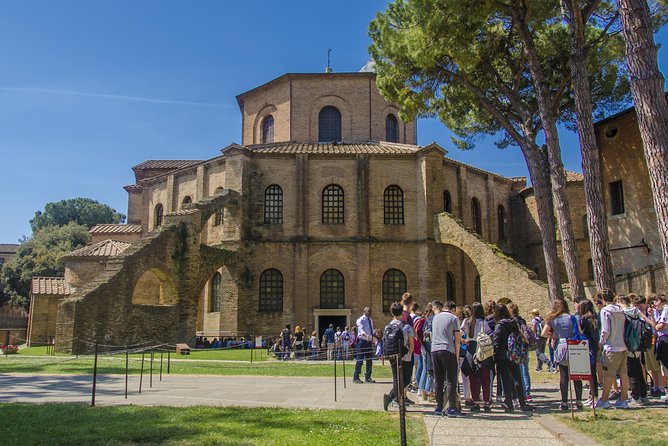
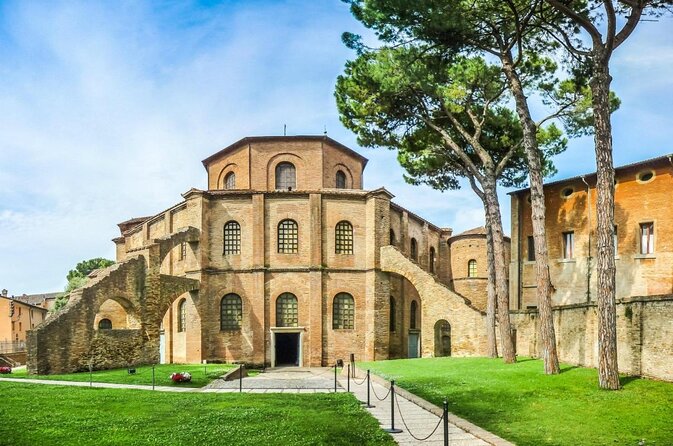
Ravenna is easy to underestimate. Its streets are fairly calm, and the exteriors of several major monuments are plain brick. Then you step inside and find ceilings glowing with gold tesserae, processions of saints, symbols of power, and carefully arranged scenes that carry political and religious messages.
You can certainly visit these places alone. The challenge is knowing where to look and understanding what you are seeing. A guide can point out the gestures, clothing, halos, inscriptions, animals, and imperial symbols that turn a beautiful wall into a document about late Roman and Byzantine society.
The best guides on this experience explain more than the images themselves. They place Ravenna under different rulers, show how religion shaped public art, and connect Christian symbolism with the ambitions of emperors and bishops. Guides such as Chiara, Elisabetta, Marco, Serena, Francesca, Silvia, Assunta, and Bardo have been singled out for lively explanations, good pacing, humor, and careful answers to questions.
That human layer matters here. Without it, you may remember a dazzling ceiling but miss why an emperor and empress appear in a church, why certain figures face the altar, or why a simple cross-shaped building became a source of inspiration for Dante.
More Bologna & Emilia trips worth a second look
- Ravenna: UNESCO Monuments and Mosaics Guided Tour
★ 4.8 · 3,108 reviews - Bologna: Walking Food Tour with a Local Guide
★ 4.8 · 882 reviews - Guided group tour TastyBus: Parmesan Cheese and Parma Ham
★ 5.0 · 241 reviews
Starting at Piazza San Francesco
The meeting point is Piazza San Francesco 7, in Ravenna’s historic center. You check in at the Tourist Information Office before the visit begins. That last detail matters because the address can be easy to misunderstand if you expect to meet outdoors at a specific statue or corner.
Give yourself time to locate the office. The tour is timed around monument entries, so arriving at the last minute may create unnecessary stress. The area is near public transportation, and the activity ends somewhere different from the starting point, so do not plan on collecting luggage or leaving items at the meeting point.
The tour is offered in English and uses a mobile ticket. The maximum group size is 28 people. That is not a private or intimate walk, but it is manageable when the radio equipment works properly. You can sometimes move a little farther from the guide while still following the explanation, which is helpful inside large churches.
The sound system is worth treating as part of the practical equation. Many people have found it useful, especially in a group of more than 20. One poor experience involved both equipment trouble and difficulty hearing the guide, so if the audio is unclear at the start, speak up promptly rather than trying to follow three hours of muffled commentary.
Galla Placidia and the ceiling that captured Dante
The first stop is the Mausoleo di Galla Placidia, built around the middle of the fifth century at the order of Galla Placidia, a powerful figure who ruled the Western Roman Empire.
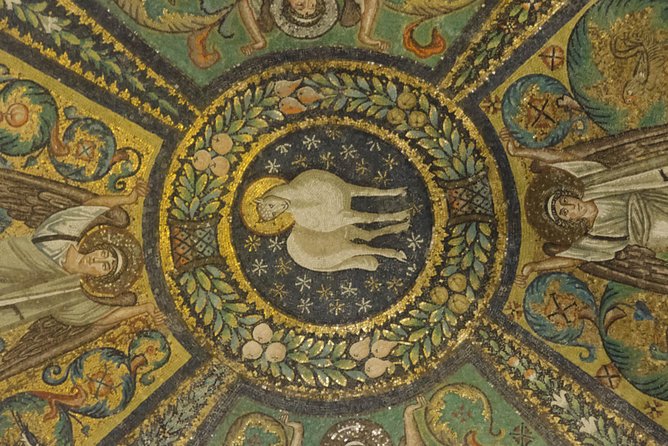
From the outside, the building is modest. Its Latin-cross plan and brick walls give little warning of what waits inside. The effect is immediate once you enter: the small interior is covered in an intense mosaic program, with a deep blue dome scattered with what seem to be countless stars.
The ceiling is one of Ravenna’s great visual surprises. The space is compact, so the patterns press close around you. Gold catches the light, while the blue field gives the room a quiet, almost night-sky feeling. The design is not simply pretty. It creates a sense of heaven above the visitor and ties the building to Christian ideas of salvation and eternal life.
This is also where the Dante connection becomes useful rather than decorative. The great poet saw these stars and drew inspiration from them for verses in the Divine Comedy. A good guide can turn that literary reference into a way of seeing the room, helping you understand why this small building has stayed so powerful in the imagination.
The scheduled visit here is about 10 minutes, though actual timing can depend on entry procedures and the group. That may sound brief, but the mausoleum is small, and a focused explanation works well. Look up before the guide begins, take in the whole ceiling, then follow the details being pointed out.
San Vitale and the power of Justinian and Theodora
The Basilica di San Vitale is the largest and most imposing stop on this route. Built in the sixth century, it reflects strong eastern influence and uses an unusual octagonal plan. Above it rises a large dome, while the apse contains the mosaics that make this one of Italy’s essential early Christian monuments.
When you enter, the height of the interior changes the mood. Galla Placidia feels close and jewel-like. San Vitale feels ceremonial. Your eye moves upward through arches and galleries before settling on the apse, where the mosaic decoration presents a carefully ordered world of Christ, saints, rulers, and ritual.
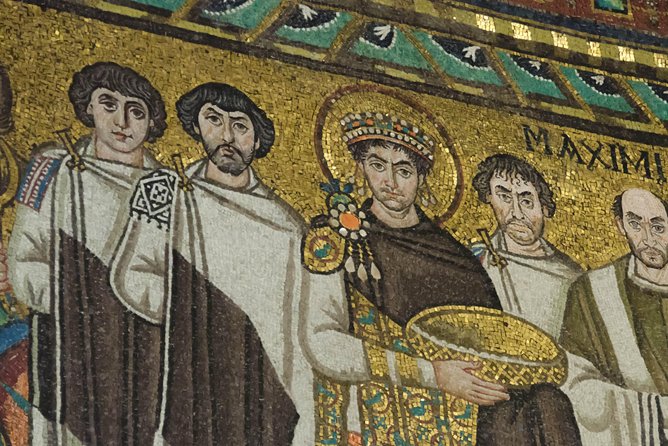
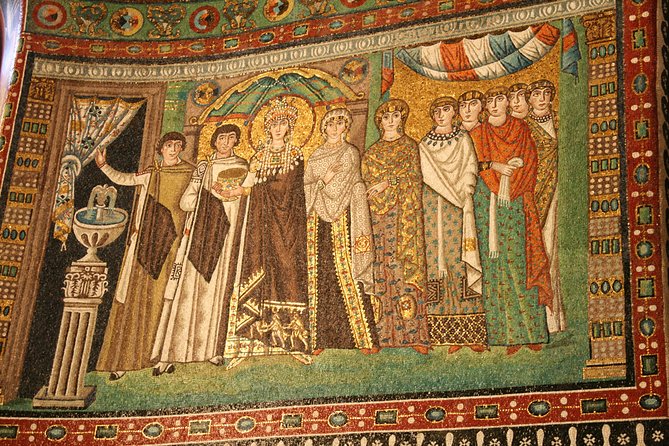
The most famous images are the imperial panels showing Justinian and Theodora with their attendants. These are not casual portraits. The emperor carries the signs of authority, while the empress appears with her own elaborate entourage and ceremonial presence. Their inclusion in the church links political power with religious devotion and sends a clear message about the role of the Byzantine state.
This is one of the places where a guide’s historical framing pays off. You can look at the faces and fabrics on your own, but a guide can explain how the clothing, objects, placement, and procession communicate rank. The commentary also helps you place Ravenna between Roman, Christian, and Byzantine worlds.
About 30 minutes are scheduled here. That is the right amount of time for a first visit, though you may wish for longer if you enjoy architecture or want to study every panel. The church can be crowded, and groups must keep their voices low. A large group may not fit neatly in one spot, so the radio system becomes especially useful.
Some of the strongest tour experiences have come from guides who maintain a good pace without rushing the art. Marco has been praised for organized timing, while Chiara has been noted for combining a steady schedule with a sense of humor. Those qualities matter when the day includes timed entries and several interiors.
A different way to spend the day, same part of Italy:
- Bologna: City Center Walking Tour
★ 4.5 · 3,478 reviews - Maranello: Ferrari Museum Entrance Ticket
★ 4.6 · 1,505 reviews - Bologna Food & Market Tour with 6 Tastings, Pasta, Wines & More
★ 5.0 · 1,328 reviews - Bologna Food Experience: Factory tours & Family-Style Lunch
★ 5.0 · 1,201 reviews
The Neonian Baptistery and a brilliant blue dome
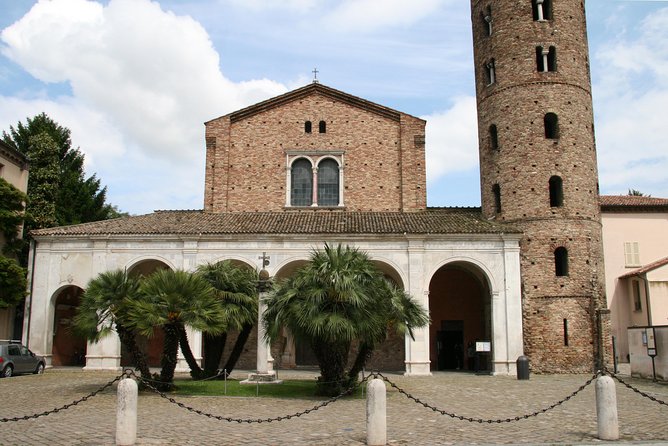
The Battistero Neoniano, also called the Baptistero degli Ortodossi, is among Ravenna’s oldest monuments. Its exterior is simple brick, much like the mausoleum. Inside, the decoration shifts to marble, stucco, and mosaics with a clear Hellenistic-Roman influence.
The central image is on the dome. Christ is shown being baptized, surrounded by a procession of the Twelve Apostles against bright blue tesserae. The scene is circular, and the design leads your eye around the dome rather than toward a single frontal panel.
The building’s octagonal shape is part of the meaning. Eight-sided baptisteries relate to Christian ideas of renewal and the beginning of a new life. You do not need to arrive with a background in theology to appreciate the form, but the guide’s explanation can make the architecture feel purposeful rather than merely unusual.
Bishop Neone commissioned the dome in the mid-fifth century. Inside, you can also see the baptismal font from the Renaissance period, shaped to match the building’s octagonal plan, along with a fifth-century ambo. These later and earlier elements share the same compact interior, giving you a quick lesson in how a working religious site changes over time.
The scheduled stop is about 10 minutes. Again, the short visit works if the explanation is well focused. Stand where you can look up without blocking others, and take a moment to let your eyes adjust to the ceiling’s pattern.
Three monuments, and possibly more mosaic sites
The named route centers on three major monuments: Galla Placidia, San Vitale, and the Neonian Baptistery. Tour experiences have also included five mosaic sites, so the exact number of interiors may depend on the departure and timing that day.
That difference is worth clarifying before you book if your main goal is to see a particular church or all of Ravenna’s celebrated mosaics. The three listed stops already make a strong introduction, but the broader version can give you a fuller sense of the city’s religious art.
The walk also includes Ravenna’s streets and the movement between sites. This is not a coach tour that drops you at each doorway. Wear shoes suited to several hours on foot, and plan for standing inside churches. One outing extended close to four hours, so do not schedule a tight train departure immediately afterward.
Cold weather deserves attention too. The interiors can feel chilly, especially if you are standing still while listening. Bring an extra layer in winter or on a cool day. This is a small point, but it can shape your enjoyment more than you expect.
How much does the $33.86 price buy you?
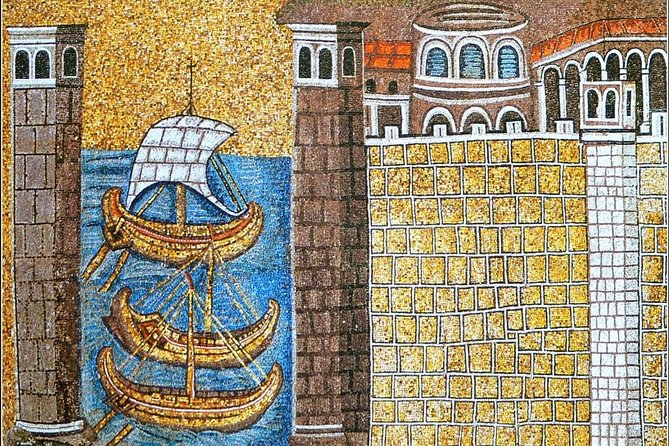
At $33.86 per person, the tour is priced as an efficient introduction rather than a luxury experience. The key value comes from combining a guide with admission to the listed monuments. You avoid working out separate entries, and you gain an explanation of what you are seeing at the exact moment the mosaics are in front of you.
If you already have a strong background in Byzantine art, early Christian architecture, or Ravenna’s history, you may prefer exploring at your own speed. You will also have less control over how long you spend at each panel on a guided route.
For most first-time visitors, the price is sensible because Ravenna’s art rewards interpretation. The tour helps you see the main sites in a few hours, which is useful if you are making a day trip from Bologna or fitting Ravenna into a wider journey through Emilia-Romagna.
The value is strongest when the guide is clear and the audio works well. Excellent guides have made three hours feel quick by linking art, architecture, religion, and political history. A difficult-to-hear guide can weaken the experience, especially in a quiet church where you cannot move close enough to catch every word.
The tour is recommended by 97 percent of customers and has a 4.9 rating from 1,693 reviews. Those figures point to a consistently strong experience, but they do not remove the practical risks of group size, sound quality, crowds, or a longer-than-planned visit.
Group size, sound, and the pace of the walk
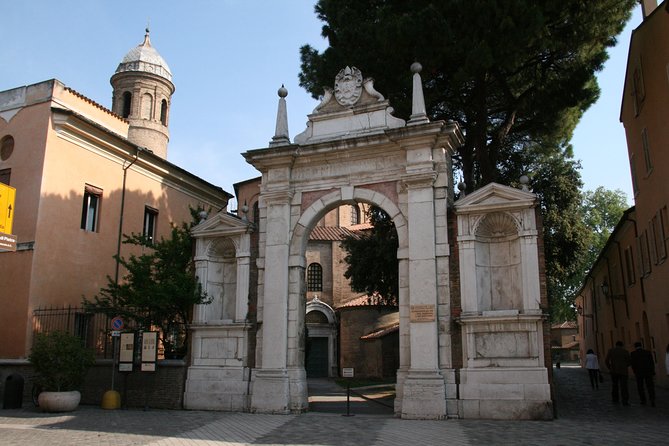
A group of up to 28 people is large enough to affect the feel of the tour. You may wait for everyone to enter, gather in doorways, or find a place where the whole group can listen without disturbing worshippers.
The radio device helps. With an earpiece, you can hear the guide while standing a few steps away from the main cluster. That gives you a better view and reduces the need to press close to the group. It does not solve every problem, however. Equipment can malfunction, and accents or a soft voice can still make listening difficult.
The walking pace is generally described as reasonable, with enough time to keep the group together. Still, the route includes several monuments, queues, and quiet interiors. You will get more from it if you stay alert to the guide’s meeting instructions and do not wander too far ahead.
The tour can also run beyond the stated two to three hours. That may happen because of lines, timed entries, questions, or extra sites. The added time can be a benefit if the explanation is engaging, but it is a problem if you have a fixed train or lunch reservation.
Who should book this Ravenna mosaic tour?
I would recommend it to a first-time visitor who wants the essential monuments explained in English. It is especially useful for a day trip, since you can see major sites without spending your limited time arranging tickets or studying guidebooks between stops.
It also suits anyone who enjoys the connection between art and power. The tour does not treat the mosaics as isolated decoration. It explains how emperors, bishops, religious belief, and the changing Roman world shaped the buildings.
Families and mixed-age groups can take part because most visitors are able to participate. The main issue is stamina. You should be comfortable walking and standing for two to three hours, with the possibility of a longer outing.
You may want to skip it if you need a private pace, dislike group schedules, or want to spend a long time photographing individual mosaics. You should also reconsider a same-day booking if you have a strict departure time.
Practical tips for a better visit
- Arrive early at the Tourist Information Office in Piazza San Francesco 7, rather than waiting outside and wondering where the group gathers.
- Wear warm layers in cool weather. Some people find the church interiors cold.
- Use the radio earpiece from the beginning and tell the guide if the sound is poor.
- Keep your schedule flexible. The official duration is about two to three hours, but the visit can run longer.
- Look up before listening to the explanation. First impressions matter in the small mausoleum and the two domed interiors.
- Bring questions. Guides such as Elisabetta, Francesca, Marco, Serena, and Chiara have been praised for answering them and adding useful anecdotes.
- If you want all five reported mosaic sites, confirm the exact route before booking, since the core schedule names three monuments.
Should you book it?
Book this tour if you want Ravenna’s major mosaics to make sense, not simply sparkle. The included entries, English commentary, and compact route offer good value, particularly for a first visit or a day trip from Bologna.
Go in prepared for a group, some walking, possible lines, and a flexible finish time. If you can handle those limits, this is a practical way to meet Galla Placidia’s stars, San Vitale’s imperial court, and the Neonian Baptistery’s blue dome with the history still attached.
FAQ
How much does the guided mosaic tour cost?
The price is $33.86 per person.
How long does the tour last?
The stated duration is approximately two to three hours. It can sometimes run longer, so allow extra time after the scheduled finish.
Which language is the tour offered in?
The tour is offered in English.
Is admission to the monuments included?
Yes. Admission tickets are included for the listed stops.
Where does the tour begin?
It begins at Piazza San Francesco 7, 48121 Ravenna, Italy. Participants should enter the Tourist Information Office there and check in.
Where does the tour end?
The activity ends at a different location from the starting point. The exact end point is provided in the booking details.
Which monuments are included?
The route includes the Mausoleo di Galla Placidia, Basilica di San Vitale, and Battistero Neoniano, also called the Battistero degli Ortodossi.
How large can the group be?
The maximum group size is 28 people.
Is audio equipment provided?
If the group is large, a radio device is used so you can listen to the guide’s commentary through an earpiece.
Can I cancel for a full refund?
You can cancel at least 24 hours before the experience start time for a full refund. Cancellations or changes made less than 24 hours before the start time are not accepted for a refund.
Recently reviewed around Bologna & Emilia
- Guided group tour TastyBus: Parmesan Cheese and Parma Ham★ 5.0 · 241 reviews
- Tour Parmigiano Reggiano dairy and Parma ham★ 5.0 · 601 reviews
- Tasting and Biking Parma★ 5.0 · 218 reviews
- Private Half Day Parma Food Walking Tour★ 5.0 · 561 reviews
- Cavedoni Balsamic Vinegar Tour: The Oldest in Modena★ 5.0 · 267 reviews
- Bologna on the plate, Cooking Class with Alessia★ 5.0 · 260 reviews
- Bologna Private Highlights & Hidden Gems Tour with a Local★ 5.0 · 359 reviews
- Bologna Local Pasta Cooking Class, Ragu, Spritz, Wine & Gelato★ 5.0 · 527 reviews
Bologna & Emilia Tours, compared.
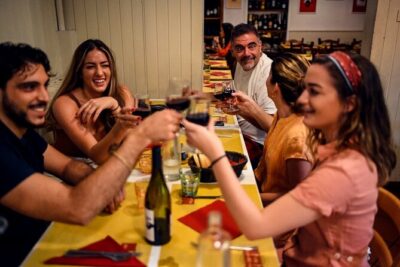
Bologna Food & Market Tour with 6 Tastings, Pasta, Wines & More
Read our review →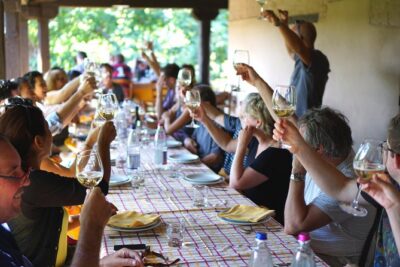
Bologna Food Experience: Factory tours & Family-Style Lunch
Read our review →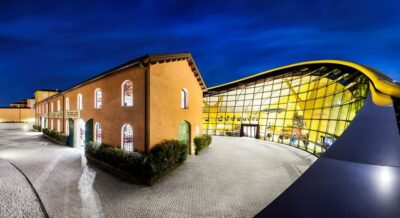
Maranello and Modena: Ferrari Museums Combo Tickets
Read our review →
Browse the lists this tour appears in