
Review · MUSEUMS
Leonardo3 The World of Leonardo: Tickets for the Interactive Exhibition
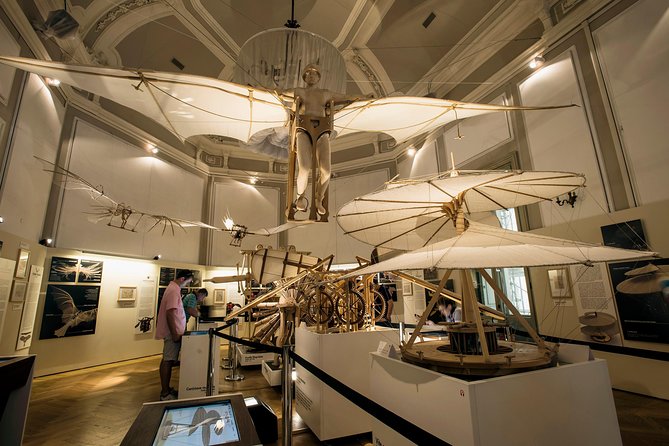
Leonardo3 turns Leonardo da Vinci’s sketches into things you can actually see and understand. Instead of only admiring paintings, you’ll examine working models of his machines, digital versions of his notebooks, and a restoration of The Last Supper. The inventions are the star, and the hands-on displays make them easier to grasp.
I like the location beside the Duomo and the way the exhibition packs a lot into a small space. I also like the digital restorations, especially the chance to study Leonardo’s work without needing to decipher every page of the Codex Atlanticus yourself. The main drawback is size: this is a compact exhibition, and it can feel crowded or warm when many people arrive at once.
In This Review
- Key points to know before you go
- What Leonardo3 reveals about Leonardo’s mind
- The Duomo setting and finding the entrance
- Inside the exhibition: machines, notebooks, and hands-on displays
- The digital restoration of The Last Supper
- Why the audio guide can be worth the extra cost
- How long to stay, and when to go
- Price, skip-the-line access, and overall value
- Who will get the most from Leonardo3
- Practical details that shape the visit
- Should you book Leonardo3?
- FAQ
- Where is Leonardo3 located?
- How long does the visit take?
- Is admission to the real Last Supper included?
- Is an audio guide included?
- Does the ticket include skip-the-line access?
- Are children allowed?
- Are souvenirs included?
- Can I cancel for a refund?
Key points to know before you go
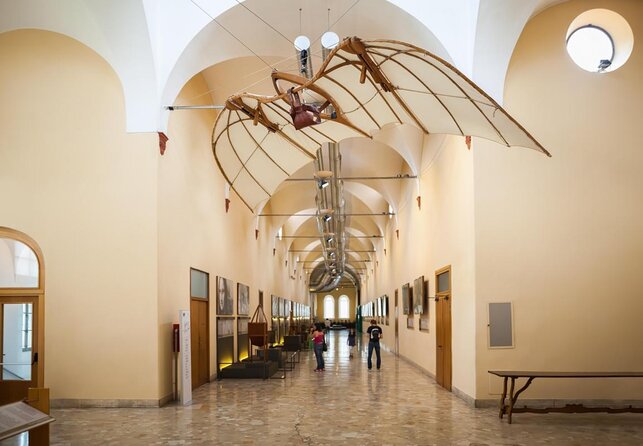
- Working models bring Leonardo’s sketches to life: See reconstructions of machines that might otherwise remain flat drawings on a page.
- The Last Supper is shown digitally: This helps explain the fresco, but it is not a visit to the original painting.
- Plan on one to two hours: You can move quickly, but reading the displays and using the interactive stations takes time.
- The Duomo location is exceptionally central: The entrance is near Milan’s cathedral, along the Galleria area, though it can take a little attention to spot.
- An audio guide costs extra: It is available in Chinese, English, French, German, Italian, Portuguese, Russian, and Spanish.
- Skip-the-line entry is included: Instant confirmation is provided, and children must be accompanied by an adult.
What Leonardo3 reveals about Leonardo’s mind
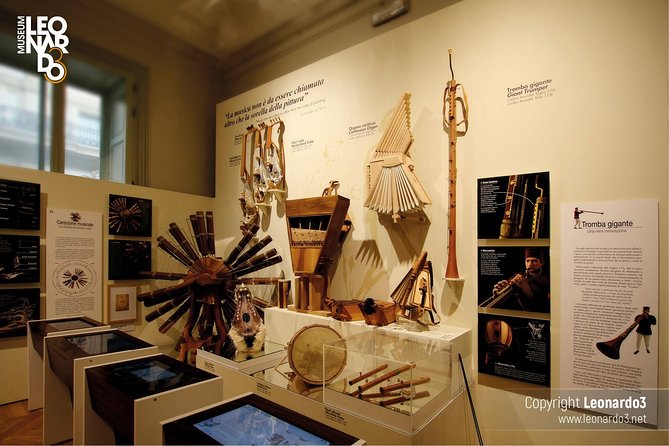
Many people first meet Leonardo as the painter of the Mona Lisa or The Last Supper. Leonardo3 gives you a broader picture. Here, he appears as an artist, engineer, anatomist, musician, and practical problem solver who filled notebooks with ideas far beyond painting.
The exhibition’s central strength is its use of physical reconstructions and digital technology. Leonardo’s original drawings can be hard to follow. A machine may be shown from one angle, with tiny notes written backward or in an old Italian style. A model lets you see how the parts fit together. An interactive screen can show how the mechanism moves or how Leonardo’s thought process developed.
That approach works particularly well for visitors who do not usually enjoy museums of drawings or manuscripts. You are not simply looking at a wall of old pages. You are trying to understand what Leonardo imagined, how he designed it, and what problem he hoped to solve.
The exhibition also makes a useful point about Leonardo’s work: he rarely stayed inside one subject. A study of water could lead to a design for a machine. An interest in anatomy could improve his painting. Music, geometry, architecture, military engineering, and flight could all appear in the same working life.
More Museum Tours in Milan
- Milan: Science and Technology Leonardo da Vinci Museum Entry
★ 4.5 · 7,169 reviews - Official San Siro Stadium and Museum Guided Tour
★ 4.4 · 3,573 reviews - Milan: Leonardo3 The World of Leonardo Museum Entry Ticket
★ 4.4 · 3,241 reviews
The Duomo setting and finding the entrance
Leonardo3 is in Milan’s city center, close to the Duomo. That makes it easy to combine with cathedral visits, time in the Galleria, or a walk through the surrounding streets. The exhibition is near public transportation, so you do not need a separate transfer from a distant museum district.
Finding the entrance may take a moment. A useful orientation tip is to walk through the Galleria from the Duomo toward the next small piazza. The exhibition is described as being just after the city information storefront on the left. Look carefully rather than assuming it will have the presence of a large national museum.
That compact entrance reflects the exhibition itself. This is a small, tightly packed museum, not a grand multi-floor institution. The benefit is convenience. You can fit it into a busy Milan day without giving away half your afternoon. The tradeoff is that busy periods may make the rooms feel tight, especially around the popular interactive displays.
Inside the exhibition: machines, notebooks, and hands-on displays
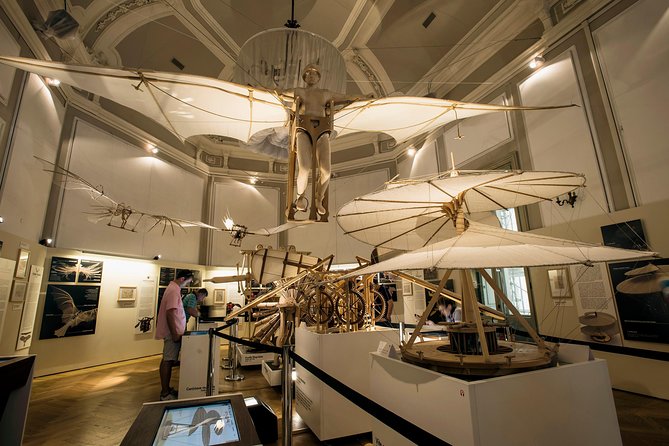
The first part of your visit introduces Leonardo’s inventions and working methods. You will see models based on his designs, along with digital material that helps explain the drawings behind them.
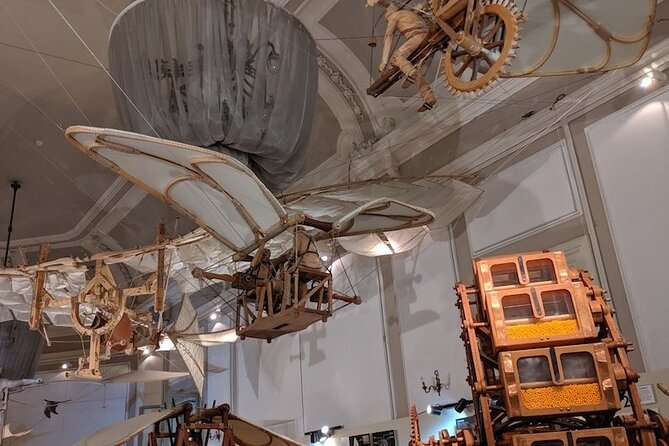
Some reconstructions show familiar ideas in a new way. Instead of staring at a sketch of gears, wings, bridges, or mechanical parts, you can study a model and see the intended movement. That is the reason to choose this exhibition over a standard display of reproductions. Leonardo’s ideas become three-dimensional objects, not just historical images.
Interactive stations add a playful element. You may be able to inspect details on a screen, move through a reconstruction, or test how a design works. This is useful for families, although children who want constant action may lose interest once they reach the reading-heavy sections. Adults and older children are likely to get the most from the mix of visual displays and explanation.
The exhibition also includes material related to Leonardo’s writing and notebooks. His handwriting and method of recording ideas are part of the appeal. One especially interesting detail is the attention given to his writing style, not only to the finished inventions. The displays help show how Leonardo observed, experimented, and revised his ideas.
You should allow at least an hour if you want to see the main displays. Two hours is a better target if you plan to read the explanations, try the interactive material, and use the audio guide.
The digital restoration of The Last Supper
The Last Supper section gives you a different way to think about Milan’s most famous Leonardo connection. You do not see the original fresco here. Instead, you see a digital restoration and learn more about the painting’s condition and appearance.
That distinction matters. A digital presentation cannot replace standing in front of the actual mural at the refectory of Santa Maria delle Grazie. Entry to that site is separate, and this ticket does not provide transportation or admission there. Still, the digital restoration can help you look more closely at Leonardo’s composition and the damage that has affected the fresco.
If you already have a reservation for the real Last Supper, seeing Leonardo3 first may be helpful. It gives you background and visual context before the limited viewing at Santa Maria delle Grazie. One practical suggestion is to visit this exhibition before seeing the original, not after, so you arrive with a better sense of Leonardo’s technique and intentions.
If you cannot obtain a ticket to the real fresco, Leonardo3 offers a useful alternative for learning about it. Just keep your expectations clear: it is a digital restoration and interpretation, not the original painting.
More Milan museums and collections:
- Milan: La Scala Theater & Museum Guided Experience
★ 4.1 · 2,931 reviews - Milan: Pinacoteca Ambrosiana & da Vinci Codex Exhibition
★ 4.6 · 1,816 reviews - Milan: La Scala Theater and Museum Tour with Entry Tickets
★ 4.7 · 1,722 reviews - Milan: Cathedral, Archeological Area and Museum Ticket
★ 4.5 · 1,093 reviews
Why the audio guide can be worth the extra cost
Admission includes entry, but not an audio guide. The guide is available in eight languages: Chinese, English, French, German, Italian, Portuguese, Russian, and Spanish.
I would consider buying it if you want more than a quick look. Some displays have limited English text, and the exhibition contains enough material that a clear explanation can help connect the machines, drawings, and artistic work. The guide also gives you a way to move at your own pace instead of waiting for a group explanation.
You do not need the audio guide to enjoy the models. The large visual displays are understandable without it, especially if you prefer exploring independently. But if Leonardo’s engineering interests you, the extra commentary may make the admission feel more worthwhile.
There is no named guide included with this ticket. This is a self-guided museum visit, with the audio guide available for purchase rather than a scheduled live tour.
How long to stay, and when to go
The stated visit time is approximately one to two hours. That range is realistic. You can see the main machines and digital displays in about an hour, but you will need closer to two hours if you read carefully or use the interactive stations.
The exhibition has flexible opening hours during the listed periods. From November 18 through December 15, 2025, it is open daily from 9:30 a.m. to 8 p.m. On December 16, 2025, the listed hours are 2 p.m. to 8 p.m. From December 17 through December 23, 2025, it is again listed as open daily from 9:30 a.m. to 8 p.m.
Check the date and hours carefully when booking. The supplied ticket information also includes an older validity note ending November 13, 2024, which conflicts with the later 2025 opening dates. That is a reason to confirm the current ticket validity before paying, especially if your visit is scheduled after the earlier date.
For the most comfortable visit, I would aim for the first part of the day or another quieter period. The rooms are small, and the best displays can draw a crowd. A locker is available, which is useful if you are carrying bags while moving around Milan.
Price, skip-the-line access, and overall value
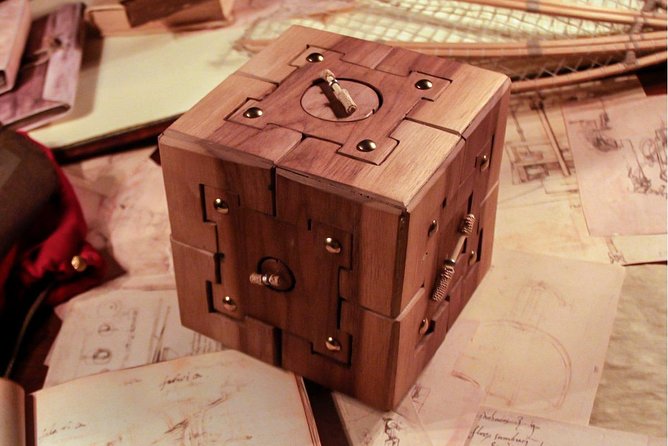
At about $19.22 per person, the ticket is reasonably priced for a central Milan attraction, particularly if you are interested in Leonardo beyond his paintings. The value comes from the number of ideas presented in a short visit and from the cost of building and maintaining the physical models and digital material.
Still, compare the ticket terms carefully. The exhibition can be visited independently, and standard admission may be lower if you buy directly at the venue. The main added convenience here is instant confirmation and skip-the-line access, which can matter when you have only a day or two in Milan.
This is not a full-day museum. If you expect a large collection, multiple floors, or extensive original artwork, you may feel the visit ends quickly. If you want a focused introduction to Leonardo’s inventions and an easy stop near the Duomo, the price is easier to justify.
Souvenirs are available, but they are not part of the ticket. Transportation to and from the attraction is also not included. Since the museum is in the center and close to public transportation, reaching it is your responsibility but should fit easily into a normal Milan sightseeing plan.
Who will get the most from Leonardo3
I would recommend this experience to:
- Adults curious about Leonardo’s engineering and scientific work
- Families with older children who enjoy machines and interactive displays
- Visitors who want context before seeing the original Last Supper
- Art lovers who want to understand Leonardo as more than a painter
- Anyone planning a compact activity near the Duomo
- Visitors who enjoy digital interpretation and reconstructed objects
I would be more cautious if your main goal is to see original Leonardo paintings. This exhibition focuses heavily on inventions, reproductions, models, and digital restorations. It is also not ideal for anyone expecting a quiet, spacious museum with large galleries.
Young children may enjoy the hands-on features but could lose interest in the explanations. Older children and teenagers are more likely to appreciate the way a drawing becomes a working object.
Photography may be restricted, so do not count on taking pictures of every model. That rule can be frustrating when a display catches your eye, but it also encourages you to spend time with the objects rather than rushing from one photo opportunity to the next.
Practical details that shape the visit
Children must be accompanied by an adult. The activity is listed as private, with only your group participating, although the exhibition itself is a public museum space rather than a live guided tour.
Confirmation is provided at booking. Keep your ticket accessible, and if you have trouble downloading it, resolve that before arriving. The admission is tied to the booking details, so do not assume that proof of payment alone will always be enough at the entrance.
Free cancellation is available if you cancel at least 24 hours before the experience start time. Cancellations made less than 24 hours in advance are not refunded, and late changes are not accepted. The cut-off follows local Milan time.
The provider is World of Leonardo da Vinci. Since opening information and ticket validity can change, check the date-specific details before setting out.
Should you book Leonardo3?
Book it if you want a short, central, visually engaging look at Leonardo’s machines and working methods. The reconstructed inventions are the strongest reason to go, and the digital Last Supper section adds useful context for anyone interested in Milan’s famous fresco.
Skip it if you only want original masterpieces or if your schedule already includes several technology and museum stops. It is small, and two hours is usually enough. But for about $19.22, with skip-the-line entry and a location beside the Duomo, Leonardo3 is a sensible choice for curious adults, families with older children, and anyone who wants to see how Leonardo’s ideas moved from notebook pages into the physical world.
FAQ
Where is Leonardo3 located?
Leonardo3 is in central Milan, beside the Duomo and near public transportation. The entrance is along the Galleria route toward the next small piazza, after the city information storefront on the left.
How long does the visit take?
The approximate duration is one to two hours. You can see the main displays in about an hour, but reading the explanations and using the interactive features may take closer to two hours.
Is admission to the real Last Supper included?
No. The experience includes a digital restoration and information about The Last Supper. Admission and transportation to the original fresco are not included.
Is an audio guide included?
No. An audio guide is available to purchase separately in Chinese, English, French, German, Italian, Portuguese, Russian, and Spanish.
Does the ticket include skip-the-line access?
Yes. The ticket includes skip-the-line access and instant confirmation at booking.
Are children allowed?
Yes. Children may participate, but they must be accompanied by an adult.
Are souvenirs included?
No. Souvenirs are available to purchase separately at the exhibition.
Can I cancel for a refund?
Yes, if you cancel at least 24 hours before the experience start time. Cancellations made less than 24 hours before the start time are not refunded, and late changes are not accepted.
Recently reviewed around Milan
- From Milan: Venice Full-Day Guided Tour With Boat Ride★ 4.5 · 322 reviews
- Venice Day Trip from Milan with Guided City Tour★ 4.0 · 383 reviews
- Verona and Lake Garda Day Trip from Milan★ 4.5 · 214 reviews
- Full-day Skip-The-Line Milan, The Last Supper and Duomo Cathedral★ 5.0 · 293 reviews
- Small-Group Lake Como & Lugano by Swiss Train + Boat Cruise★ 5.0 · 1,084 reviews
- Tour Bernina Red Train And St Moritz from Milan★ 4.5 · 247 reviews
- Walking Food Tour of Milan with Tastings★ 4.5 · 194 reviews
- Skip the Line: Essential Milan Tour Including Da Vinci’s ‘The Last Supper’★ 4.5 · 339 reviews
Museums, compared.

Vatican: Museums & Sistine Chapel Entrance Ticket
Read our review →
Vatican Museums & Sistine Chapel Tour with Optional Basilica
Read our review →
Vatican Museums, Sistine Chapel & St Peter’s Basilica Guided Tour
Read our review →
Skip-The-Line Uffizi Gallery Timed Entry Ticket
Read our review →
Vatican Museums, Sistine Chapel & Basilica Tour
Read our review →
Vatican Museums & Sistine Chapel Skip-the-Line Entry Ticket
Read our review →Vatican Museums, Sistine Chapel & Basilica Tour
Read our review →
Vatican Museums & Sistine Chapel Guided Tour
Read our review →Browse the lists this tour appears in