Review · FLORENCE TOURS
Medici Legends & Renaissance Wonders: Florence Small Group Tour
The Medici family gives this walk a clear storyline: banking power becomes political power, then artistic and religious influence. You move from San Lorenzo and the Medici Chapels to the Duomo, Palazzo Vecchio, Ponte Vecchio, Palazzo Pitti, and the Uffizi, seeing Florence as one connected stage rather than a pile of separate sights.
I like the tight route through central Florence and the way a good guide can turn façades, family crests, and public squares into clues. I also like the small maximum of 15 people, plus the whisper system, which should make it easier to follow a guide in crowded streets.
The main caution is important: this is primarily an exterior walking tour. The itinerary gives about five minutes at each stop, and admission tickets are not included, so you should not book it expecting extended museum or church visits. The price is $119.77 per person, making the guide’s storytelling and city orientation the main value.
In This Review
- Key points to know before booking
- Florence in 105 minutes, told through one family
- San Lorenzo and the family’s starting point
- Michelangelo’s library and the Medici Chapels
- Palazzo Medici Riccardi and the family’s first grand address
- The Duomo complex and Brunelleschi’s great puzzle
- Palazzo Vecchio and Piazza della Signoria
- Ponte Vecchio and the Arno crossing
- Palazzo Pitti and the Medici move across the river
- The Uffizi and the promise of Renaissance art
- What $119.77 buys you
- Pace, group size, and the best way to use the walk
- Who should book this Medici walk?
- Should you book it?
- FAQ
- How long does the Medici Legends and Renaissance Wonders tour last?
- What time does the tour start?
- Where does the tour begin?
- Where does the tour finish?
- What language is the tour offered in?
- How large is the group?
- Are museum and church admission tickets included?
- Is a tour guide included?
- Is an audio system provided?
- Can I cancel for a full refund?
Key points to know before booking

- The Medici story links 14 major sights: You see how one family shaped churches, palaces, squares, bridges, and museums.
- The tour lasts about 1 hour 45 minutes: It suits a first afternoon in Florence or a short visit.
- The group is capped at 15 people: That is small enough for questions without the cost of a fully private walk.
- The route begins near the Duomo at 12:15 pm: Meet at Caffè Scudieri Firenze in Piazza di San Giovanni.
- Admissions are not included: Expect guided exterior commentary unless your guide arranges or explains entry separately.
- The guide makes or breaks the experience: Guides named in the feedback include Manuel, Martina, Amanda, and Giacomo, with special praise for clear storytelling and local insight.
Florence in 105 minutes, told through one family
This is a fast orientation walk, not a museum tour. You cover a large part of central Florence in less than two hours, with the Medici family acting as your thread through the city.
That approach works well because Florence can feel confusing at first. The Duomo, San Lorenzo, Palazzo Vecchio, the Arno, and the Uffizi are close enough to visit on foot, yet each belongs to a different chapter of the city’s story. A guide helps you connect them.
The strongest guides add human detail. Manuel is praised for answering many questions and pointing out things easy to miss. Martina is especially good for people curious about Medici symbols, including the changing family crest. Amanda is described as funny and sharp, while Giacomo has been praised for personal attention and practical tips.
Guide assignments can change, so do not book on the promise of one particular person. The useful point is that the tour depends heavily on the individual guide’s skill. A strong storyteller can make a short stop memorable. A less focused presentation may leave you wishing for more Medici detail.
Other Florence days travellers weigh against this one:
- Florence: Skip-The-Line Uffizi Gallery Timed Entry Ticket
★ 4.5 · 27,832 reviews - Tuscany Day Trip from Florence: Siena, San Gimignano, Pisa and Lunch at a Winery
★ 5.0 · 21,634 reviews - Florence: Timed Entrance Ticket to Michelangelo’s David
★ 4.6 · 16,983 reviews
San Lorenzo and the family’s starting point
The walk begins at Caffè Scudieri Firenze, at Piazza di San Giovanni, 19R, near the Duomo. At 12:15 pm, you meet in one of Florence’s most central areas, with public transportation nearby.
The first listed sight is Basilica di San Lorenzo, one of Florence’s major churches and the burial place of principal Medici family members from Cosimo il Vecchio through Cosimo III. That fact gives the tour an immediate anchor: the Medici were not just wealthy patrons who bought paintings. They made a public and lasting claim on Florence.
The scheduled stop is about five minutes, with no admission included. Think of this as a lesson in position and purpose. Your guide can explain why the family tied itself so closely to San Lorenzo, while you decide later if the church and its chapels deserve a separate visit.
The market district around the basilica also helps set the scene. This was not an isolated royal quarter. The family’s power grew in the commercial heart of Florence, among shops, banking interests, religious institutions, and public life.
Michelangelo’s library and the Medici Chapels
Next come the Biblioteca Medicea Laurenziana and the Cappelle Medicee. Both are valuable stops for understanding how the Medici wished to be seen.
The Laurentian Library was funded through the patronage of Medici pope Clement VII. Its purpose went beyond storing books. The library helped present the Medici as educated, intellectual, and tied to the Church, not merely as merchants and bankers.
Michelangelo designed the library, and it is known as an example of Mannerist architecture. The tour’s five-minute exterior stop cannot replace seeing the staircase, reading room, or manuscript collection, but it can explain why the building matters.
The Medici Chapels were added to Brunelleschi’s earlier church between the 16th and 17th centuries. The New Sacristy was designed by Michelangelo, and the chapels were built to honor the family as patrons and Grand Dukes of Tuscany.
Here, I would pay close attention to the difference between a church used by ordinary Florentines and a family monument built to project status. If you want sculpture and interiors, plan a separate visit. The tour provides the setting and the story, not a long examination of the art.
Palazzo Medici Riccardi and the family’s first grand address
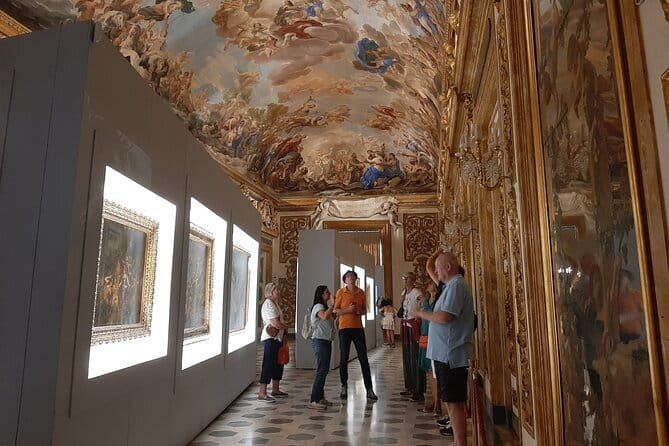
Palazzo Medici Riccardi was designed for Cosimo de’ Medici and built between 1444 and 1484. This is where the Medici’s public image becomes architectural.
A family palace is never just a home. It tells the city how powerful a family believes it should appear. The building’s connection to Cosimo helps explain the careful balance the Medici had to maintain: wealthy enough to lead, but not so openly royal that Florence’s republican traditions turned against them.
The brief stop is best used as a visual prompt. Look at the scale and setting, then let the guide explain what the palace meant in its own time. The Medici story becomes easier to follow when you see that influence was built through buildings as much as through politics.
For anyone who has watched a television series about the Medici, this section should help separate dramatic storytelling from the city’s physical evidence. The walk is especially useful for teenagers and adults who enjoy seeing historical events tied to real streets.
A different way to spend the day, same part of Italy:
- Florence: Michelangelo’s David Skip-the-Line Entry Ticket
★ 4.5 · 12,764 reviews - The Best tour in Florence: Renaissance & Medici Tales – guided by a STORYTELLER
★ 5.0 · 12,316 reviews - Florence: Leonardo Interactive Museum Entry Ticket
★ 4.5 · 11,763 reviews - The Best Tour in Florence: Renaissance and Medici Tales
★ 5.0 · 10,810 reviews
The Duomo complex and Brunelleschi’s great puzzle
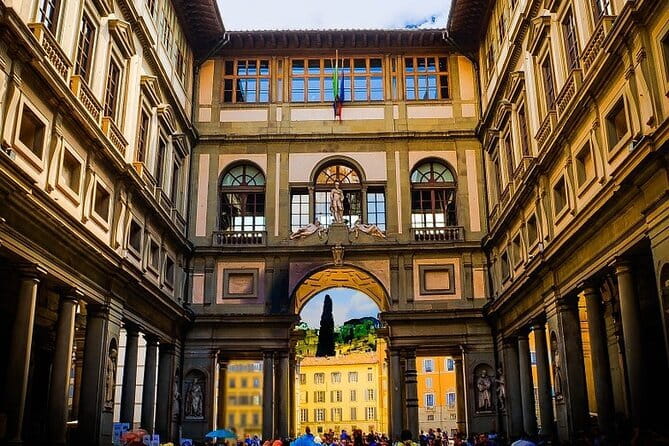
The route then reaches the Duomo, officially the Cattedrale di Santa Maria del Fiore. The cathedral began in 1296 in the Gothic style, designed by Arnolfo di Cambio. Its white, green, and pink marble exterior makes it one of Florence’s most recognizable sights.
The cathedral complex includes the Baptistery and Giotto’s Campanile, all within the UNESCO-listed historic center. You see the cathedral more than once in the schedule, along with separate stops for the Baptistery, dome, and bell tower. That repetition may feel slightly awkward on paper, but it reflects how much there is to explain in this one square.
The Baptistery of Saint John is one of Florence’s oldest buildings, built between 1059 and 1128 in the Florentine Romanesque style. Its position opposite the cathedral and campanile makes the religious center of Florence easy to understand as a group rather than as isolated monuments.
Then comes Brunelleschi’s Cupola, the largest brick dome ever constructed. The five-minute stop will not let you study every engineering detail, but it gives your guide a chance to explain why this roof was such a difficult achievement and why it changed the look of Florence.
The route also includes Giotto’s Campanile, next to the cathedral and Baptistery. Its sculptural decoration and colored marble make it a major example of Florentine Gothic design. You should expect to look, listen, and move on, rather than climb the tower or spend time inside.
The Duomo section is one of the tour’s biggest strengths for first-time visitors. You get the basic map, the major names, and a reason to return with prearranged admission for the interiors.
Palazzo Vecchio and Piazza della Signoria
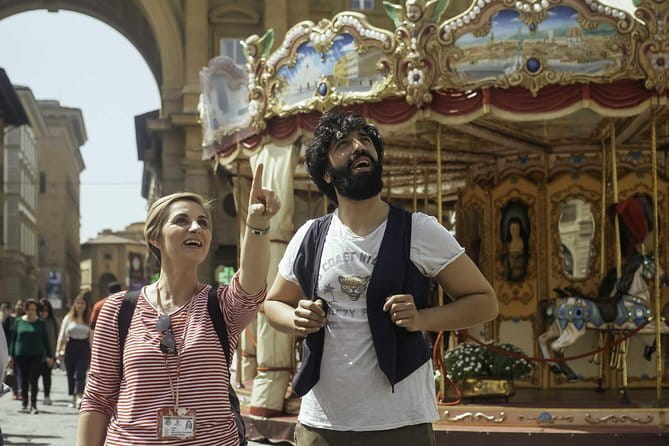
From the religious center, the walk shifts to civic power. Palazzo Vecchio is Florence’s town hall, a fortress-palace overlooking Piazza della Signoria.
The square is an L-shaped public space and a meeting place for Florentines and visitors. It also serves as a gateway toward the Uffizi Gallery. With a copy of Michelangelo’s David outside Palazzo Vecchio and statues in the nearby Loggia dei Lanzi, the area works like an open-air introduction to Florence’s public art.
This is where the Medici story can widen beyond family buildings. The city’s political life, sculpture, ceremony, and control of public space all meet here. A guide who explains the symbolism can help you see why Florence used art in places where everyone could encounter it.
Again, five minutes is short. You will not properly visit Palazzo Vecchio’s rooms or museums during this stop unless a separate arrangement is made. Still, the square is one of the best places on the route for a quick explanation of power in public view.
Ponte Vecchio and the Arno crossing
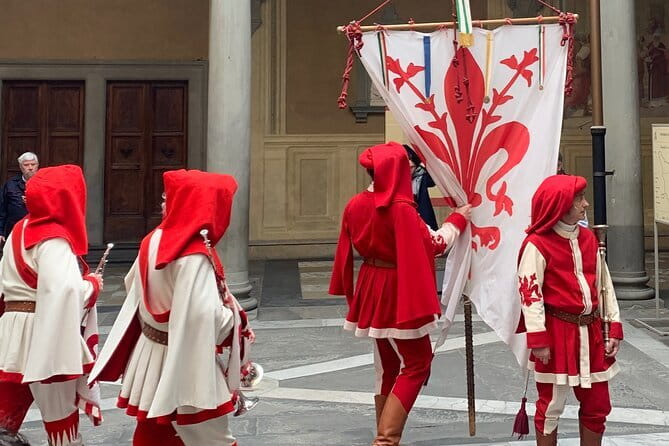
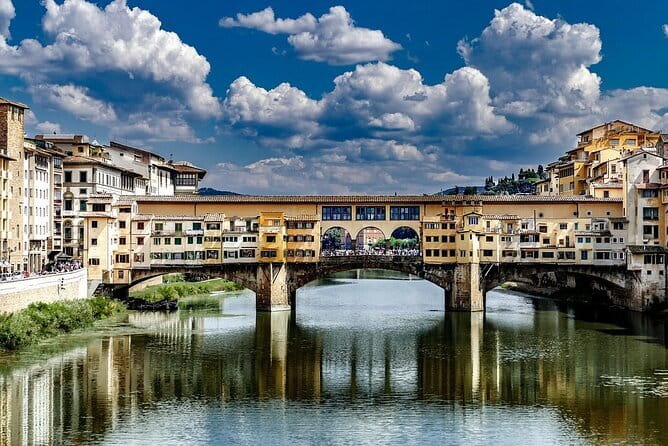
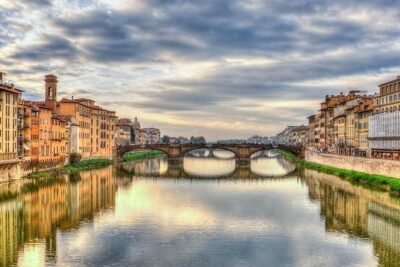
Ponte Vecchio is the only stop listed with free admission. It is the oldest bridge over the Arno in Florence and is famous for shops built along its span.
The bridge once housed butchers, tanners, and farmers. Today, jewelers and art dealers occupy the shops. That change tells you something simple but useful about Florence: the bridge is both a working crossing and a carefully maintained symbol of the city.
The walk ends in this area, though the endpoint is only indicative and may vary slightly nearby. That is practical. You finish close to one of Florence’s most recognizable places, with the Arno and the Oltrarno district at hand for your next walk.
Do not expect a long pause for shopping or photographs. If you want clear bridge views, you may need to return after the tour. The group’s pace and street noise can also affect how much you hear while crossing.
Palazzo Pitti and the Medici move across the river
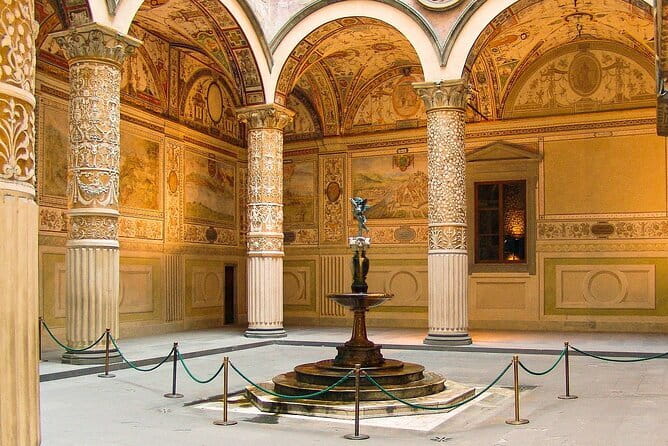
Palazzo Pitti was bought by the Medici family in 1549 and became the main residence of the ruling families of the Grand Duchy of Tuscany. Later generations filled it with paintings, plates, jewelry, and luxury possessions.
This stop shows how far the family’s position had changed. The story begins with merchants and civic influence, then moves toward grand-ducal residence and court life.
The palace is across the river in the Oltrarno area, so its inclusion gives you a wider sense of Florence than a Duomo-only walk. The exterior stop is brief, and admission is not included. If the palace interests you, treat the tour as your introduction and return with time for the interior collections.
Because the end point is Ponte Vecchio, the route’s final section also makes geographical sense. You see the Medici residence after crossing from the city’s older civic and religious center.
The Uffizi and the promise of Renaissance art
The final major sight is the Gallerie degli Uffizi, one of Italy’s most important museums and home to paintings by Michelangelo, Leonardo da Vinci, Raphael, Botticelli, and other masters.
The Uffizi collection covers paintings from the 12th through the 16th centuries across more than 80 halls. The tour cannot provide a full museum visit in five minutes, and admission is not included. That distinction matters. You will hear why the gallery belongs in the Medici story, but you will not have time to stand before its major works at the pace they deserve.
I see this as a useful preview. If you are unsure how to use your Florence time, the guide’s explanation may help you decide if the Uffizi deserves a full entry later. Do not assume that seeing the exterior means you have visited the museum.
What $119.77 buys you
At $119.77 per person, this is not a cheap way to tick off Florence’s sights. You are paying for a licensed guide, a small group capped at 15 people, and a focused explanation of the city.
The value is strongest if you are short on time, new to Florence, or find architectural history hard to sort out alone. A clear guide can save you from wandering between famous buildings without knowing how they connect.
The value is weaker if you expect admission to the Medici Chapels, Palazzo Vecchio, Palazzo Pitti, or Uffizi. Those tickets are not included, and the schedule gives only short stops. You may spend as much or more later if you decide to enter several museums.
Group discounts are available, and a mobile ticket is offered. The whisper system is included, though one older couple found that the audio setup did not always cut through street noise while the guide was walking and speaking. If hearing clearly is important to you, stay close to the guide and ask for a check that you can follow.
Pace, group size, and the best way to use the walk
The advertised duration is about 1 hour 45 minutes. With 14 listed sights and several five-minute stops, the pace is necessarily efficient. You will walk between locations, pause for an explanation, and keep moving.
That makes this a good first-day activity. Several people found that taking it early helped them understand Florence and notice Medici symbols later in the trip. I agree with that use. Book it near the start of your stay, then return to the interiors that catch your interest.
The group maximum of 15 is a sensible middle ground. It should feel more personal than a large city tour, but it is not the same as a private walk. One booking was described as private rather than small group, so check the exact product details at booking if exclusivity matters to you.
The tour is offered in English. Most people can participate, and the route is near public transportation. Good weather is required, and the operator may cancel if the minimum number is not met. In either case, a different date or experience, or a full refund, is offered.
Who should book this Medici walk?
I would choose this tour for:
- First-time visitors who want Florence explained quickly
- People with only a day or two in the city
- Families with older children or teenagers
- Anyone interested in how art, religion, banking, and politics overlap
- Fans of Medici stories who want to see the real places
- Repeat visitors who want a fresh historical thread through familiar sights
I would choose something else if your main goal is extended time inside museums, detailed art interpretation, or a slow architectural study. The tour is an overview with a strong narrative, not a full Medici museum experience.
The feedback gives a useful age clue: a family found it suitable for three teenagers, and another group said two teenagers stayed interested. The guide’s energy matters here. A lively storyteller can keep the chronology from becoming a list of names.
Should you book it?
Book it if you want a quick, guided map of Medici Florence and understand that most stops are brief exterior visits. The tour’s best features are its route, its family-centered storyline, and the chance to ask questions in a group of no more than 15.
Skip it if $119.77 feels high for a walking introduction or if you mainly want museum admission. In that case, put the money toward individual tickets and a longer visit inside the Medici Chapels, Palazzo Vecchio, Palazzo Pitti, or the Uffizi.
For most first-time visitors, I would place this walk near the beginning of a Florence stay. Come ready to walk, listen through city noise, and note which interiors you want to revisit. Free cancellation is available until 24 hours before the start time, which gives you some flexibility, but changes or cancellations inside that window are not refunded.
FAQ
How long does the Medici Legends and Renaissance Wonders tour last?
The experience lasts approximately 1 hour and 45 minutes.
What time does the tour start?
The scheduled start time is 12:15 pm.
Where does the tour begin?
It begins at Caffè Scudieri Firenze, Piazza di San Giovanni, 19R, 50123 Firenze FI, Italy.
Where does the tour finish?
The stated endpoint is Ponte Vecchio. The exact ending point may vary slightly within the indicated area.
What language is the tour offered in?
The tour is offered in English.
How large is the group?
The maximum group size is 15 travelers.
Are museum and church admission tickets included?
No. Admission tickets are not included for the listed churches, chapels, palaces, cathedral sites, or museums. Ponte Vecchio is listed with free admission.
Is a tour guide included?
Yes. A licensed tour guide is included.
Is an audio system provided?
Yes. A whisper system is included. Street noise may make it harder to hear while walking, so staying close to the guide can help.
Can I cancel for a full refund?
Yes, if you cancel at least 24 hours before the experience start time. Cancellations made less than 24 hours before the start time are not refunded. If poor weather or an insufficient minimum number causes the operator to cancel, you are offered another date or experience, or a full refund.
Recently reviewed around Florence
- Walking Food Tour of Florence with Tastings and Wine★ 5.0 · 518 reviews
- Florence Sunset Food Tour with Wine & Dine at a Tuscan farmhouse★ 5.0 · 194 reviews
- Wine Experience In Chianti Hills from Florence★ 4.5 · 195 reviews
- Uffizi Gallery Timed Entry Admission Tickets★ 4.0 · 392 reviews
- Val d’Orcia Brunello Wine Tour with Montalcino and Montepulciano★ 4.5 · 359 reviews
- Wine Tasting Experience in Ponte Vecchio: Best Tuscany selection!★ 5.0 · 197 reviews
- Uffizi Gallery Small Group Tour with Guide★ 4.5 · 879 reviews
- Early Access Guided Uffizi Gallery Tour Skip-the-Line Small Group★ 4.5 · 707 reviews
Florence Tours, compared.
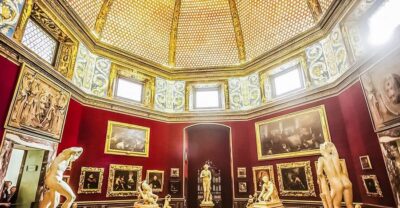
Skip-The-Line Uffizi Gallery Timed Entry Ticket
Read our review →
Tuscany Day Trip from Florence: Siena, San Gimignano, Pisa and Lunch at a Winery
Read our review →
Michelangelo’s David Skip-the-Line Entry Ticket
Read our review →
The Best tour in Florence: Renaissance & Medici Tales – guided by a STORYTELLER
Read our review →
The Best Tour in Florence: Renaissance and Medici Tales
Read our review →