Review · TICKETS
Rome: Catacombs of Priscilla Entry Ticket & Guided Tour
Rome’s Catacombs of Priscilla preserve something you will not find in the city’s grand public monuments: an intimate look at early Christian life, death, and art underground. I like the ancient frescoes, including paintings dated to roughly 240 to 280 AD, and the way the site still feels like an active archaeological place rather than a polished tourist show.
I also like the small groups of up to 10 people, which matter in narrow passageways, and the guides’ mix of archaeological detail and religious context. The drawback is simple: 45 minutes can feel short, and the catacombs are outside Rome’s oldest core on Via Salaria. Photography is forbidden, and the site is not suitable for people with mobility impairments.
In This Review
- Key points to know before booking
- Why Priscilla offers a different side of Rome
- Entering the galleries beneath Via Salaria
- The first floor and its wall niches
- The Greek Chapel and the Acili hypogeum
- Frescoes that changed the way people saw Christian art
- Martyrs, popes, and the human story underground
- What the guide adds to the $16 price
- Who should book this underground visit
- Practical planning for a smoother visit
- Should you book the Catacombs of Priscilla?
- FAQ
- How long does the Catacombs of Priscilla tour last?
- How much does the experience cost?
- What languages are available?
- Where do I meet the guide?
- Is transportation included?
- Can I take photographs inside?
- Is the tour suitable for people with mobility impairments or baby strollers?
Key points to know before booking
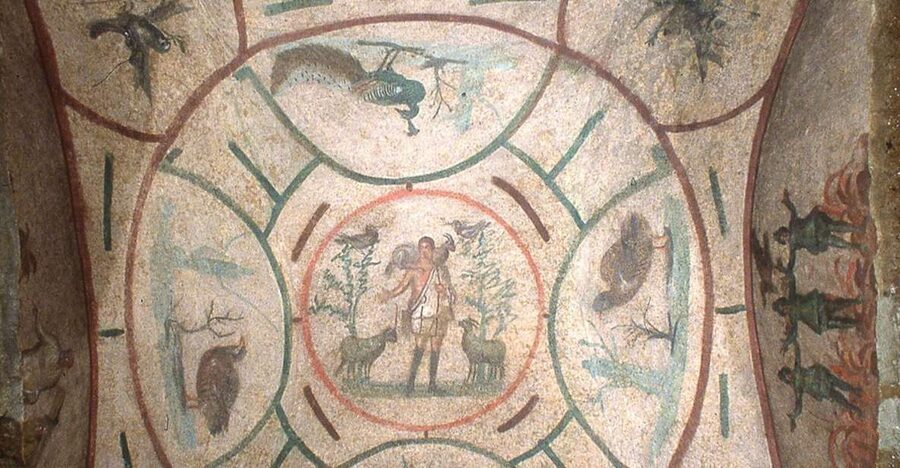
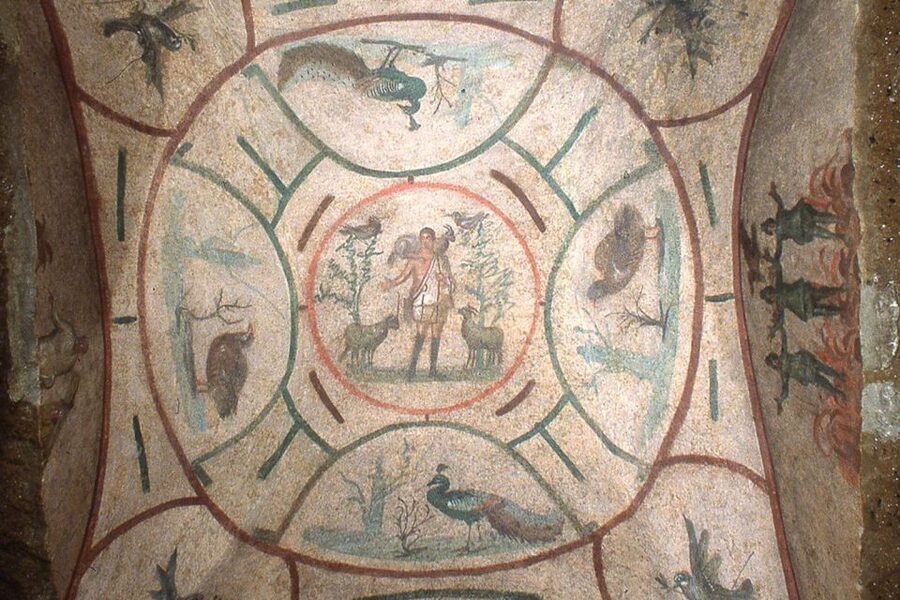
- See early Christian art underground: The catacombs contain some of the oldest Christian paintings in Rome, including a celebrated early image of Mary and Jesus.
- Follow narrow burial galleries: The first level began as an abandoned sand quarry before Christians created hundreds of wall niches and around 20 larger niche tombs.
- Hear stories of martyrs and popes: Felicita and her seven sons, along with several popes, are linked to Priscilla.
- Keep the visit focused: The guided route lasts 45 minutes, with some tours running longer when guides answer questions.
- Expect a quiet, authentic site: The catacombs have not been turned into a flashy attraction, which helps preserve their solemn character.
- Plan your arrival carefully: Go directly to the ticket office and show your reservation at least 10 minutes before the scheduled start.
Why Priscilla offers a different side of Rome
Rome can fill your day with emperors, fountains, churches, and grand marble interiors. Priscilla changes the scale. Here, you walk through low underground corridors where Christian communities buried their dead and marked their faith with simple symbols and paintings.
That change of scale is the main reason I recommend this tour. You are not simply looking at an old structure. You are seeing how an early Christian community used a difficult, irregular space for burial and remembrance.
The site is spread over two levels, though the first floor is the main focus of its early development. Its origin differs from many other Roman catacombs. It began as an arenarium, a place where sand was extracted, then was abandoned before Christians adapted its large, uneven galleries at the beginning of the third century.
The atmosphere is quiet and serious. That may sound obvious for a burial site, but it makes the visit feel different from Rome’s crowded headline attractions. You will not get the grand visual punch of the Colosseum or the Vatican Museums. Instead, you get a closer look at ordinary religious practice, ancient burial customs, and the beginnings of Christian art.
More Rome trips worth a second look
- Vatican: Museums & Sistine Chapel Entrance Ticket
★ 4.5 · 144,003 reviews - Rome: Pantheon Fast-Track Ticket and Official Audio Guide
★ 4.3 · 21,008 reviews - Rome:Hop-On Hop-Off Panoramic Open Bus Ticket 3 Circuits x 1
★ 4.0 · 15,405 reviews
Entering the galleries beneath Via Salaria
You meet at the catacomb’s ticket office on Via Salaria. The arrangement is straightforward: go directly to the office, show your reservation, and arrive at least 10 minutes before the tour begins. Hotel transfers and transportation are not included, so you need to plan the journey yourself.
The location is one practical weakness. It is not beside the Trevi Fountain or the Colosseum, and one account of the visit specifically notes that it takes a little effort to reach from the old Rome area. A bus can get you there cheaply and on time, but check your route before leaving your hotel. Signage near the catacombs may not be as clear as you would like.
Once inside, the guide leads the group below ground. The passages can be narrow and twisty, so the limit of 10 people is useful. You can usually hear the explanation without competing with a large crowd, and the guide can pause at important features without losing half the group.
The setting is cool, even in Rome’s hot summer. Bring a light layer, especially if you are sensitive to cooler indoor spaces. One person who visited in October specifically advised taking a top, and that is sensible advice for any season.
The first floor and its wall niches
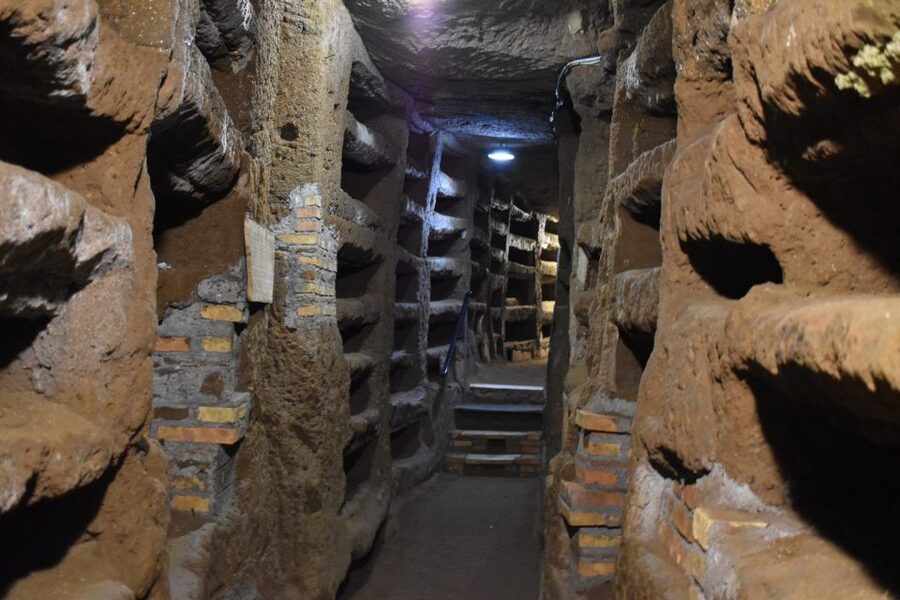
The first level developed as Christians began using the abandoned quarry in the early third century. They shaped about 20 niche tombs and cut hundreds of smaller burial niches into the walls.
These niches are the key to understanding the place. The catacombs were not designed as grand underground halls. They were practical burial corridors, expanded over time as the Christian community grew. The irregular layout reflects the reuse of an earlier quarry rather than a single master plan.
Your guide explains how the spaces were used for burial and funeral commemoration. That context makes the walls easier to read. Without a guide, you might see rows of openings and miss the social meaning behind them. With one, the galleries become evidence of how people organized family memory, religious identity, and communal care.
Do not expect to see bodies in the tombs. The burial spaces are empty, and the remains were moved. That is worth knowing before you arrive, since some people may picture intact burials or open tombs. The interest here lies in the architecture, inscriptions, paintings, and the history attached to the site.
The route can feel physically close. You will walk through enclosed corridors and stop in small spaces while the guide explains what you are seeing. If you dislike confined areas, a short visit underground may still feel long. For many people, though, 45 minutes is a useful limit. It gives you enough time to understand the site without turning the experience into an exhausting underground expedition.
The Greek Chapel and the Acili hypogeum
An adjacent area contains a cryptoporticus, the Greek Chapel, and a large underground room connected to the catacomb. This section adds another layer to Priscilla’s story because it began as a noble family burial area before being linked to the wider catacomb.
The Acili hypogeum has its own unusual past. It was originally a water cistern, and inscriptions connected with the Acili family were found there and are now displayed. The catacomb probably takes its name from Priscilla, a woman associated with the Acili senatorial family whose name appears in one of those inscriptions.
This is where the guide’s role becomes especially important. The spaces are not self-explanatory, and the names and changing uses can blur together. Guides including Sister Lydia, also referred to as Lidia, Alexandra, and Clara have been praised for explaining the archaeology clearly while also discussing the Christian purpose of the site.
The best guides do more than list dates. They connect the physical place with the people who used it. Some guides have used questions to draw the group into the explanation, while others have added extra time for questions. That style works well in a small group, though the quality of English can vary by guide.
The tour is offered in English, Italian, and Spanish. If you need a particular language, confirm the available departure when you book. The experience is guided rather than self-paced, so the language choice matters.
A different way to spend the day, same part of Italy:
- Vatican Museums & Sistine Chapel Tour with Optional Basilica
★ 4.3 · 67,413 reviews - Colosseum, Roman Forum & Palatine Guided Tour
★ 4.7 · 63,148 reviews - Vatican Museums, Sistine Chapel & St Peter’s Basilica Guided Tour
★ 4.5 · 39,149 reviews - Rome: Colosseum, Palatine Hill and Roman Forum Guided Tour
★ 4.8 · 32,814 reviews
Frescoes that changed the way people saw Christian art
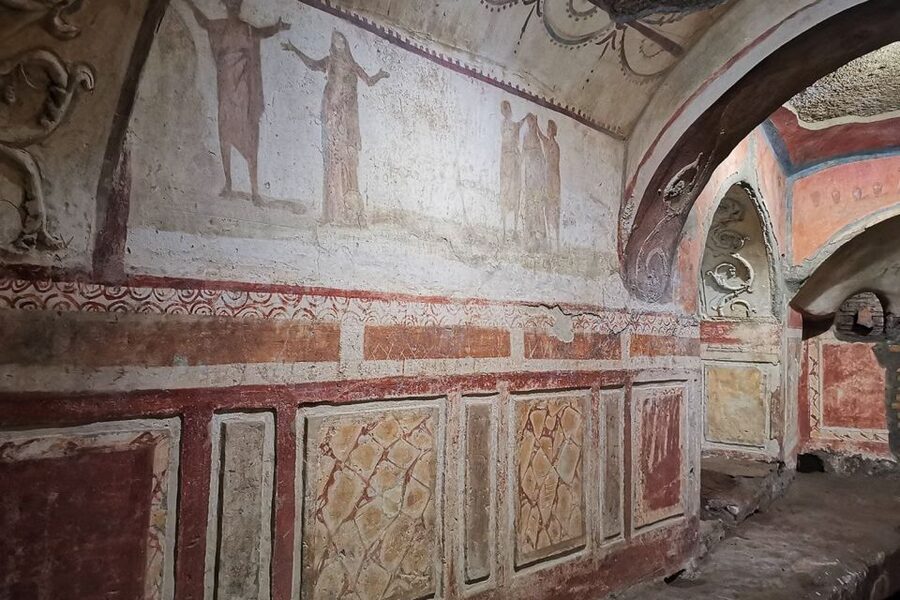
The catacombs contain paintings that make the visit worthwhile for anyone interested in art. Several accounts of the experience highlight the early frescoes, including paintings dated to around 240 to 280 AD.
The most famous image here is an early depiction of the Virgin Mary with the infant Jesus. It is often presented as the oldest known image of Mary and Jesus, and it has become a major highlight of the visit. You cannot photograph it inside the catacombs, but postcard prints are available for a small charge, reported as about 30 cents.
The no-photography rule may disappoint you. I understand the frustration, especially when you see fragile art that has survived for nearly two millennia. Still, the rule helps protect the paintings and keeps the visit calm. You will need to pay attention in the moment rather than rely on your phone to remember every detail.
The art is valuable not just because it is old. It shows how Christian symbols and stories appeared in an early period, before Christian art developed the familiar visual language you see in later churches. Your guide can explain what the images mean and place them within the wider story of Rome and early Christianity.
Do not expect a large gallery of perfectly preserved paintings. Some areas are better preserved than others, and the tour route includes modest remains as well as its strongest highlights. The appeal comes from standing beside art made in an underground burial setting, not from the volume of objects on display.
Martyrs, popes, and the human story underground
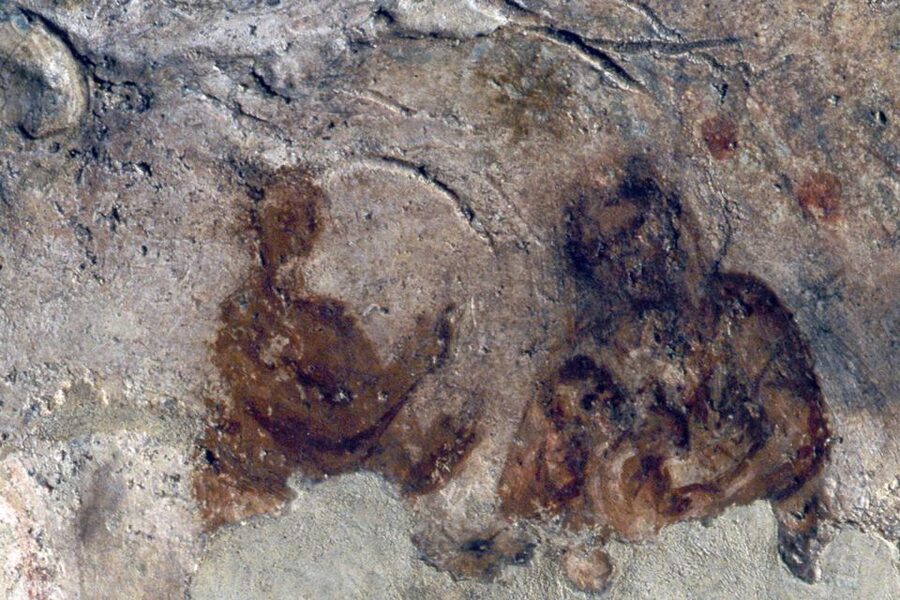
Priscilla is connected with several Christian martyrs. Among them are Felice and Filippo, who were killed, probably during the reign of Diocletian, along with their mother Felicita and their brothers Alessandro, Marziale, Vitale, Silano, and Gennaro.
The story of Felicita and her seven sons gives the site a personal dimension. It is not only a record of burial construction. It is also a place associated with memory, persecution, family, and religious conviction.
Several popes were buried at Priscilla as well: Marcellino, Marcello, Silvestro, Liberius, Siricius, Celestino, and Vigilius. Their dates range from the late third century to the sixth century. A guide can help sort out this long span, since the catacombs developed over many generations rather than belonging to one moment in Roman history.
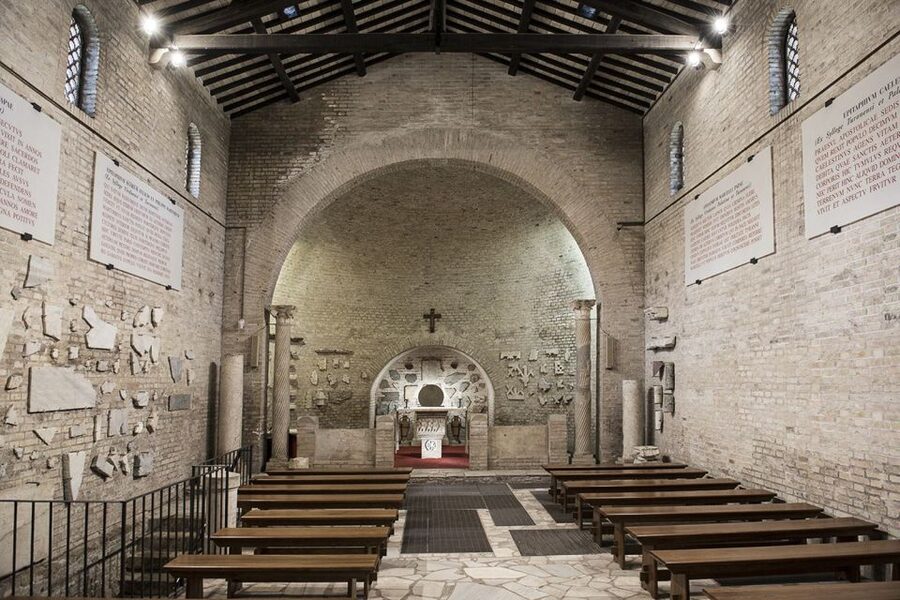
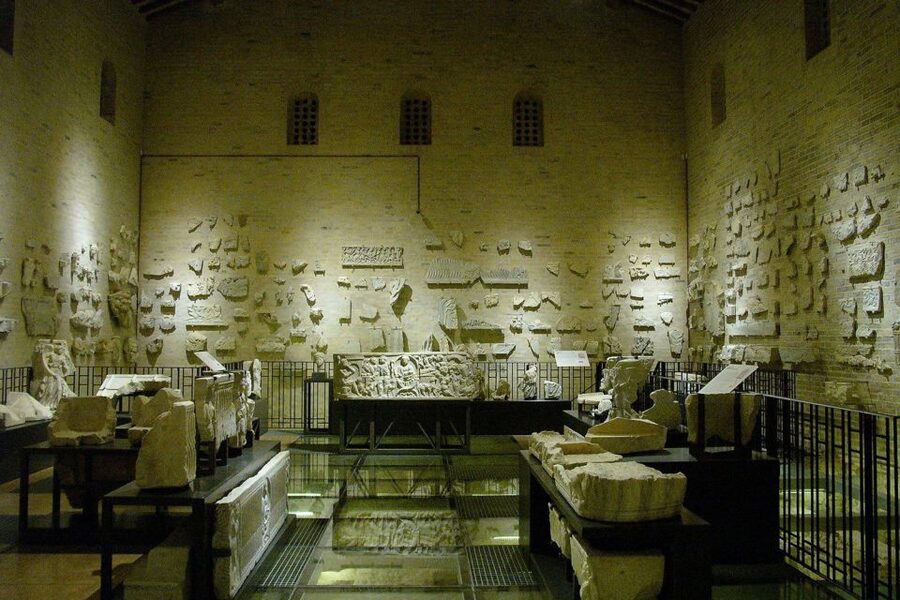
Nearby, inside Villa Ada, the Basilica built by Pope St. Silvestro corresponds with the tomb of Felice and Filippo. A museum near the basilica displays hundreds of sarcophagus fragments found during excavations in the area.
The basic tour is only 45 minutes, so do not assume it includes a full visit to every related feature above ground. The catacombs are the central experience. If the basilica or museum matters to you, ask at the site how much time you should allow for those areas.
What the guide adds to the $16 price
At $16 per person, this is a good-value Rome activity if you care about archaeology, early Christianity, or unusual historical sites. The fee includes the entrance ticket and guided tour, so you are paying for both access and interpretation.
That second part matters here. The underground corridors, empty niches, inscriptions, and faded paintings do not explain themselves. A guide turns an eerie walk into a coherent account of quarrying, burial, family connections, early Christian practice, and ancient art.
The small-group limit improves the value. Ten people is still enough to create a group atmosphere, but it is far better than being folded into a large crowd in narrow corridors. One visit had a group that felt large in tight spaces, so the actual experience may depend on the departure and guide. Still, the stated limit is reassuring.
Some tours finish at the advertised 45 minutes. Others run longer when the guide answers questions or begins early for a group that arrives ahead of time. I would not book it expecting a long excursion, but you may receive a little extra explanation if time and staff allow.
The price is less attractive if you want dramatic architecture, extensive museum displays, or lots of independent exploring. It is more attractive if you want a focused lesson in early Christian Rome and a break from the city’s busiest sights.
Who should book this underground visit
I would choose this tour for anyone who has already seen the Colosseum and Trevi Fountain and wants a quieter subject. It suits adults interested in archaeology, religious art, Roman history, and burial customs.
Teenagers can enjoy it too, especially if they like unusual places rather than standard monuments. A family with teenagers aged 15 and 18 found the visit engaging, and the short duration helps hold attention.
The tour also works well in hot weather. The underground temperature gives you a break from the sun, though you should treat that as a bonus rather than the main reason to book. The subject is serious, and the experience is more thoughtful than entertaining.
I would think twice if you have mobility limitations. The activity is specifically not suitable for people with mobility impairments, and baby strollers are not allowed. Narrow passageways and underground access make this a poor choice for anyone who needs a step-free or spacious route.
The experience may also be less satisfying if you need to take photographs or prefer to wander alone. Photography inside is prohibited, and the route is guided. You see the site through the guide’s explanations and the group’s pace.
Practical planning for a smoother visit
Book a departure in a language you can follow comfortably. English, Italian, and Spanish are available, but the quality of communication can vary slightly between guides. Names associated with especially well-received tours include Sister Lydia, Alexandra, and Clara, though you should not assume a particular guide will lead your departure.
Arrive early enough to find the ticket office without rushing. The instruction is to show your reservation at least 10 minutes before the scheduled start, and that matters because the group enters together.
Wear sensible shoes and bring a light layer. The supplied information does not specify a dress code, but the underground setting is cool and the route involves walking through narrow galleries.
Keep your phone away once the tour begins. You cannot take photographs, so make notes afterward if you want to remember names, dates, or symbols. The staff may have postcard images available, including inexpensive prints of the important art.
Allow extra time around the 45-minute tour if you want to ask questions or visit nearby related sites. The Basilica of St. Silvestro and the museum of sarcophagus fragments add context, but the tour itself is centered on the catacomb.
Free cancellation is available until 24 hours before the scheduled visit. That gives you some flexibility if your Rome plans change.
Should you book the Catacombs of Priscilla?
Book it if you want early Christian art, ancient burial customs, and a calm break from Rome’s major sights. The $16 price is fair, the small group helps, and the guides generally bring strong archaeological and religious knowledge to a place that would be hard to understand on your own.
Skip it if you need an accessible attraction, cannot tolerate enclosed spaces, or want grand visual drama. Priscilla is modest, cool, quiet, and sometimes visually understated.
For the right reader, that is exactly its strength. You leave with a clearer picture of how Christian communities remembered their dead, how Rome reused underground spaces, and how fragile paintings survived beneath the modern city.
FAQ
How long does the Catacombs of Priscilla tour last?
The scheduled guided tour lasts 45 minutes. Some visits may run slightly longer when the guide answers questions or adds extra explanation.
How much does the experience cost?
The listed price is $16 per person. It includes entrance to the Catacombs of Priscilla and the guided tour.
What languages are available?
Tours are available in Italian, English, and Spanish. Check the departure details for the language offered at your chosen time.
Where do I meet the guide?
Go directly to the ticket office at the Catacombs of Priscilla on Via Salaria. Show your reservation at least 10 minutes before the scheduled tour.
Is transportation included?
No. Hotel pickup, hotel drop-off, and transportation are not included. You must arrange your own way to Via Salaria.
Can I take photographs inside?
No. Photography is not allowed inside the catacombs. Postcard prints of the art may be available at the site.
Is the tour suitable for people with mobility impairments or baby strollers?
No. The experience is not suitable for people with mobility impairments, and baby strollers are not allowed.
Recently reviewed around Rome
- Ancient Rome at Twilight Walking Tour★ 5.0 · 276 reviews
- Domus Aurea Guided Tour: The Golden House of Nero★ 4.5 · 199 reviews
- Early Vatican Museums & Sistine Chapel Small Group Tour★ 4.5 · 314 reviews
- Early Vatican Museums Tour: The Best of the Sistine Chapel★ 4.5 · 900 reviews
- Jewish Ghetto & Piazza Navona: Food, Wine & Sightseeing Rome Tour★ 5.0 · 460 reviews
- 3 Days in Sorrento, Capri & Pompeii: la Dolce Vita★ 4.0 · 595 reviews
- Tivoli Villas Full Day Trip From Rome with Lunch★ 4.0 · 443 reviews
- Cook With Us in Rome: A Hands-On Cooking Experience 09:20AM class★ 5.0 · 234 reviews
Tickets, compared.

Vatican: Museums & Sistine Chapel Entrance Ticket
Read our review →
Cathedral and Duomo’s Terraces Entrance Ticket
Read our review →
Skip-The-Line Uffizi Gallery Timed Entry Ticket
Read our review →
Naples Underground Entry Ticket and Guided Tour
Read our review →
Pantheon Fast-Track Ticket and Official Audio Guide
Read our review →
Entry Ticket and Guided Tour with an Archaeologist
Read our review →