
Review · POMPEII & VESUVIUS TOURS
Pompeii: Entry Ticket and Guided Tour with an Archaeologist
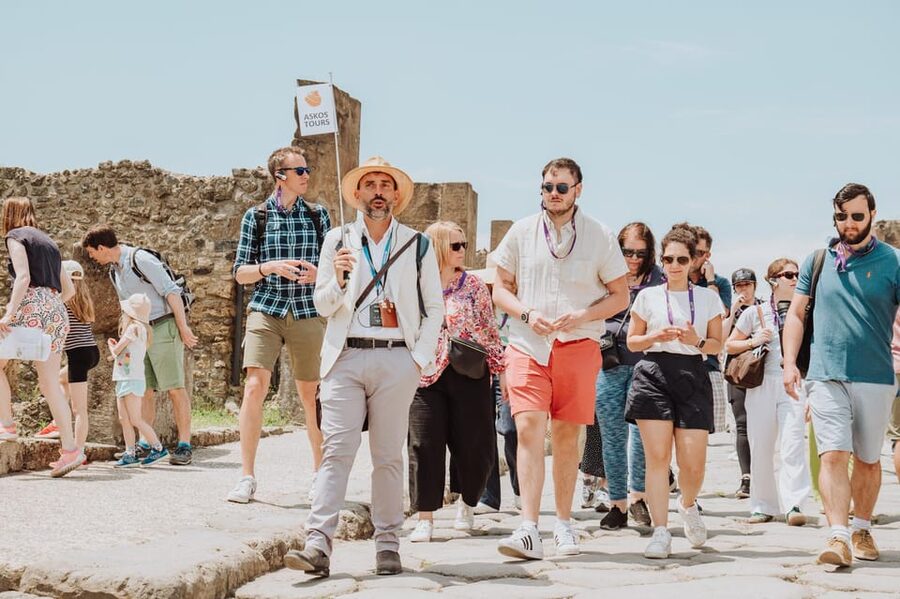
Pompeii makes much more sense with someone who can read the ruins for you. This two-hour walk takes you from the Marina Gate and Forum to the House of the Faun, Lupanar, and House of Menander, turning broken walls into a picture of Roman daily life. The archaeologist guide is the main reason to book.
I like the small group of up to 20 and the skip-the-ticket-line access. Guides such as Teresa, Alfredo, Raffaella, and Anna have been praised for making the site clear, lively, and easy to follow. The main drawback is the ground: Pompeii has uneven paving, steps, long walking stretches, and little shelter, so this is not a good choice for wheelchair users or people with mobility limits.
In This Review
- Key points at a glance
- Why Pompeii is better with an archaeologist
- Starting at Porta Marina and the Temple of Apollo
- The Forum, Pompeii’s public center
- The House of the Faun and Roman domestic life
- The Lupanar and the less polished side of Pompeii
- The House of Menander and everyday people
- The Macellum and the Forum Baths
- Streets, theaters, and the plaster casts
- Two hours, walking pace, and the right expectations
- Group size, headsets, and language choices
- Is $35 a fair price?
- Who should book this Pompeii tour?
- Should you book it?
- FAQ
- How long does the Pompeii guided tour last?
- What is included in the price?
- Is transportation included?
- Where does the tour meet?
- Does the tour skip the ticket line?
- Which Pompeii sights are visited?
- What languages are available?
- Is the tour suitable for wheelchair users?
- Are children allowed?
- Can I cancel the booking?
Key points at a glance
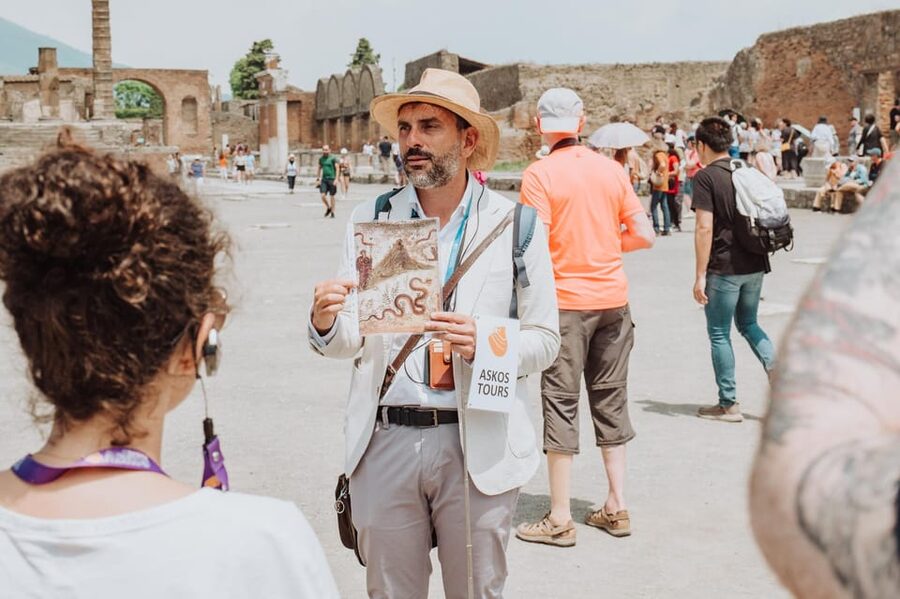
- Ancient streets with modern help: An archaeologist explains what the buildings were for and how ordinary Pompeiians used them.
- The essential sights in two hours: See the Forum, Temple of Apollo, House of the Faun, Lupanar, House of Menander, Macellum, baths, theaters, and plaster casts.
- Small-group format: Groups can include up to 20 people, with headsets supplied when the group reaches 10 or more.
- A useful first visit: The guide finishes with suggestions for exploring more of Pompeii or the modern town.
- Good value at $35: Your entrance ticket and guided visit are included, saving you from wandering through a huge site without context.
- Bring water and sturdy shoes: Uneven stones, heat, rain, and a great deal of walking can shape your day.
Why Pompeii is better with an archaeologist
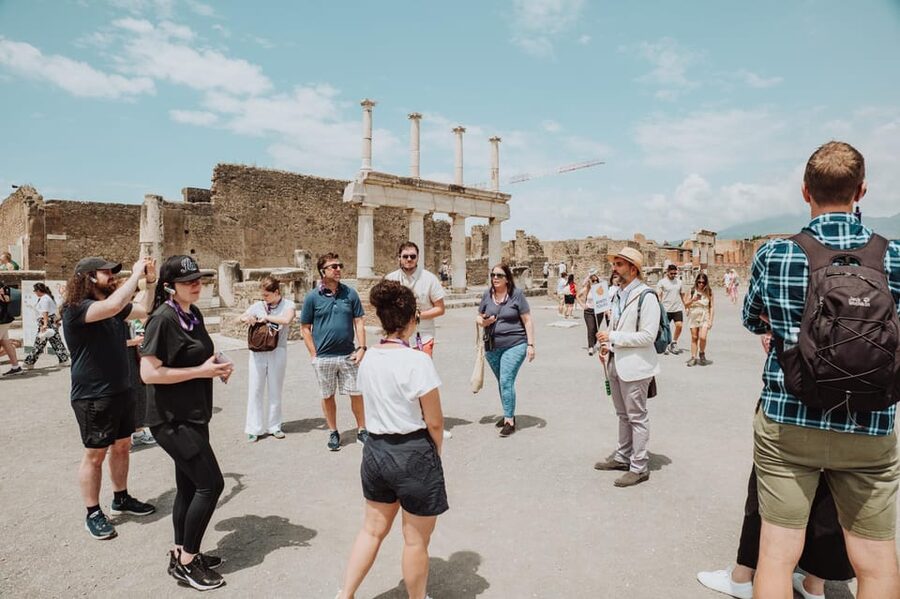
Pompeii is not a single monument you can understand in one glance. It is a large ancient city, with streets, homes, shops, temples, public buildings, baths, theaters, and businesses spread across a broad area. Without guidance, you can spend hours looking at walls and still miss what made each building important.
An archaeologist gives you the missing frame. A doorway becomes part of a Roman house. A painted counter reveals a food shop. A public bath shows how the city handled daily washing and social life. The guide also helps you picture Pompeii before Mount Vesuvius erupted in 79 AD, when this was a working town rather than a silent archaeological site.
The guides are the strongest part of the experience. Teresa is praised for her clear English, warmth, and ability to make difficult history feel natural. Alfredo is described as factual and engaging, while Raffaella has been noted for her energy and humor. Other guides named by participants include Anna, Sergio, Paolo, Giancarlo, Amedeo, Mario, and Alexandra, who has a PhD in archaeology.
That does not mean every guide will use the same route or tell the same stories. It does mean you are getting a live explanation from someone prepared to answer questions and point out details you would likely miss alone.
More Pompei Campania trips worth a second look
- Pompeii: Skip-the-Line Entrance Ticket with Audio Guide
★ 4.0 · 2,509 reviews - Pompeii: Skip-the-line-Ticket and Guided Tour
★ 4.6 · 1,152 reviews - Pompeii: Skip-the-Line Entry Ticket with Digital Guide App
★ 4.1 · 770 reviews
Starting at Porta Marina and the Temple of Apollo
The meeting point can vary with the option you book, with starting locations listed along Via Villa dei Misteri, 2. Check your confirmation closely before setting out, since Pompeii has more than one entrance and the meeting point matters.
The walk begins near Porta Marina, one of the main entrances into the ancient city. You pass through the area rather than stopping for a long formal visit. The guide starts laying out the basic geography of Pompeii, helping you understand how the city connected its gates, streets, public spaces, and neighborhoods.
Next comes the Temple of Apollo. It is another pass-by stop, but it gives you an early look at Pompeii’s religious life and the layers of history beneath the Roman city. This part of the walk helps you get oriented before the tour reaches the large civic center.
The first stretch is not a museum-style sequence of indoor rooms. You are walking across ancient paving, stopping to look, listen, and take photographs. Good shoes matter from the first few minutes.
The Forum, Pompeii’s public center
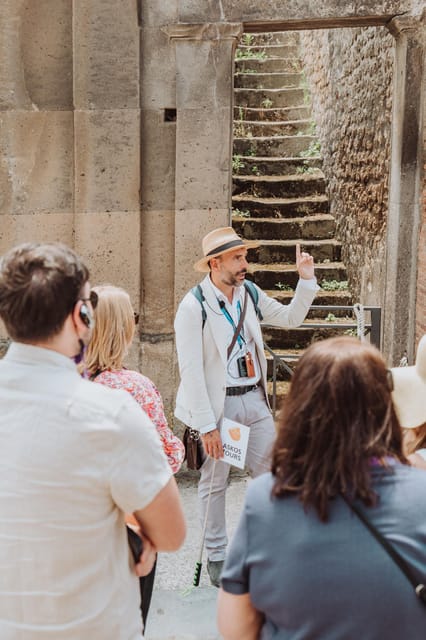
The Foro Civile di Pompei, or Forum, is one of the tour’s key outdoor sections. This broad public space was the center of civic, religious, and commercial life. The guide explains the buildings around it and helps you read the space as a functioning town square rather than a collection of columns.
You spend about 20 minutes passing through this area. That is enough time to get the main idea and hear the important context, but not enough to inspect every surrounding building in detail. This is one reason the tour works well as a first visit. You get a clear route through the major sights, then receive suggestions for what to see next on your own.
The Forum can also be one of the more exposed parts of the walk. In summer, sun and heat will be a concern. In wet weather, open spaces and slick stone can slow you down. The tour normally continues in poor weather, and a raincoat or compact umbrella is sensible.
The House of the Faun and Roman domestic life
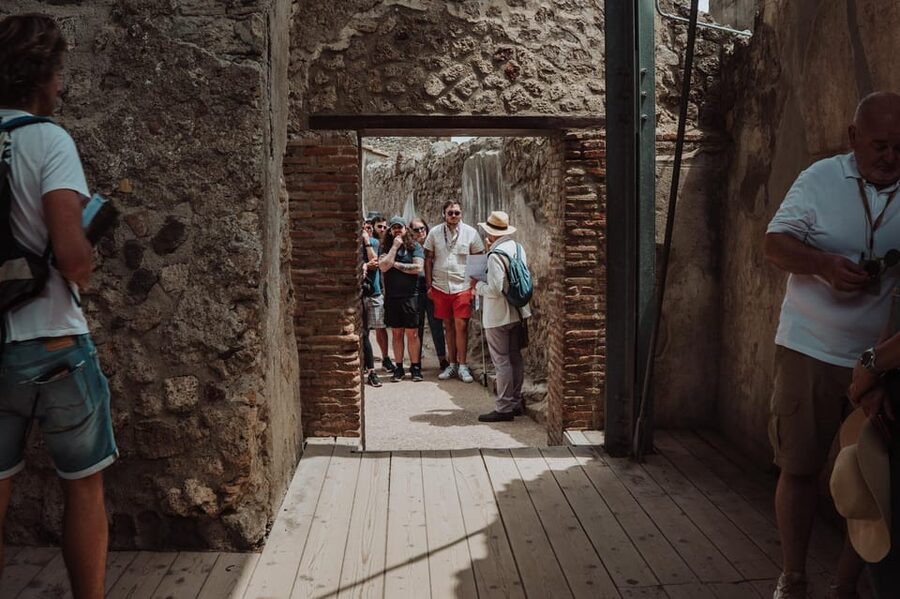
The House of the Faun is one of Pompeii’s celebrated residences and receives about 20 minutes of guided attention. Its scale and decoration make it a useful place to discuss wealth, status, architecture, and the way Roman homes were organized.
The value here is not simply seeing a grand house. Your guide helps you compare the building with the lives of people who lived and worked elsewhere in the city. The strongest explanations connect the rooms to human activity: receiving visitors, displaying wealth, moving through the house, and managing household life.
The site can be crowded, and some interior areas may feel tight when several groups arrive at once. Headsets help larger groups stay connected, although one participant found the earpiece awkward in noisy areas and had to hold it to the ear. That is a minor irritation, but it is worth knowing if you dislike audio equipment.
A different way to spend the day, same part of Italy:
- Pompeii: Small Group Tour with an Archaeologist
★ 4.8 · 12,264 reviews - Naples: Pompeii and Mt. Vesuvius with Lunch and Wine Tasting
★ 4.5 · 2,454 reviews - Pompeii: Small-Group Tour of Pompeii and Herculaneum
★ 4.8 · 867 reviews - Pompeii: Guided Tour with Skip-the-Line Entry
★ 4.9 · 812 reviews
The Lupanar and the less polished side of Pompeii
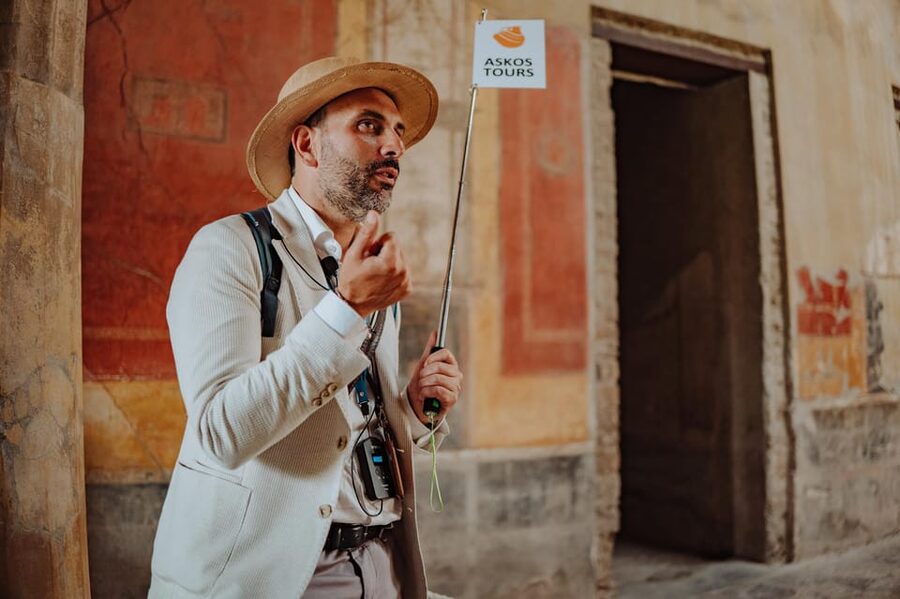
The Lupanar is Pompeii’s famous brothel. The guide gives it roughly 20 minutes, using the building to discuss an aspect of urban life that is often softened in history books.
This stop can be busy and its rooms are small. You may need to listen while standing close to other people, and the experience is more about interpretation than spacious viewing. Still, it is an important part of understanding the city. Pompeii was not just temples and wealthy villas. It was a place where commerce, food, bathing, entertainment, sex, religion, and politics all sat close together.
A good guide handles the subject with historical context rather than cheap jokes. The praised guides on this tour are repeatedly described as humorous, but also serious and clear when explaining how Roman society worked.
The House of Menander and everyday people
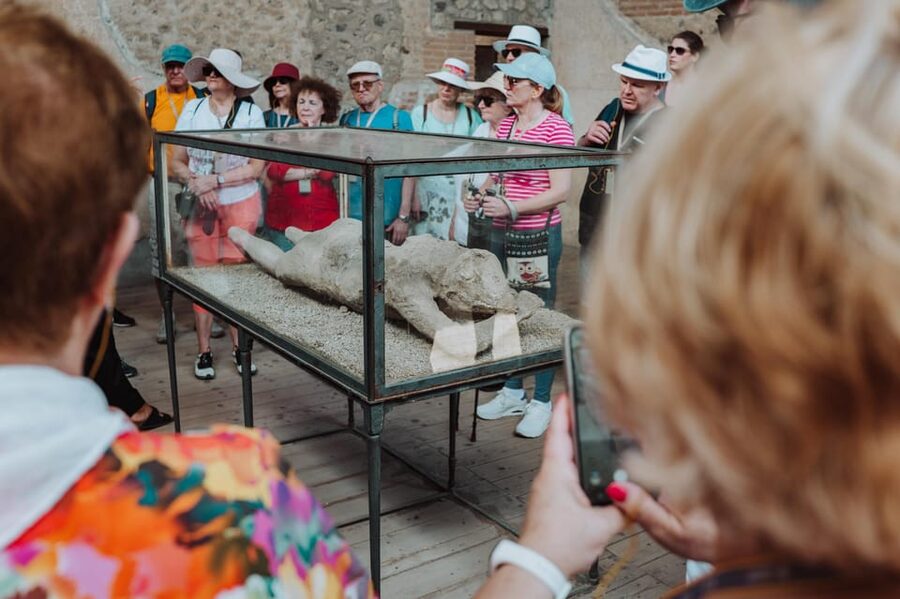
The House of Menander is another guided stop of about 20 minutes. Like the House of the Faun, it offers a look at domestic space, but the real strength of the visit is the discussion around daily life.
I especially like that the tour is not limited to emperors, generals, and famous families. Guides explain how regular people lived, worked, ate, bathed, and moved through the city. That focus came through in comments about learning the lives of ordinary Pompeiians and seeing the site through the eyes of its residents.
You might find that some rooms are closed or that access changes on the day. Archaeological sites are active places, and preservation work can affect the route. The guide can still give you the meaning of a building even if you cannot enter every part.
The Macellum and the Forum Baths
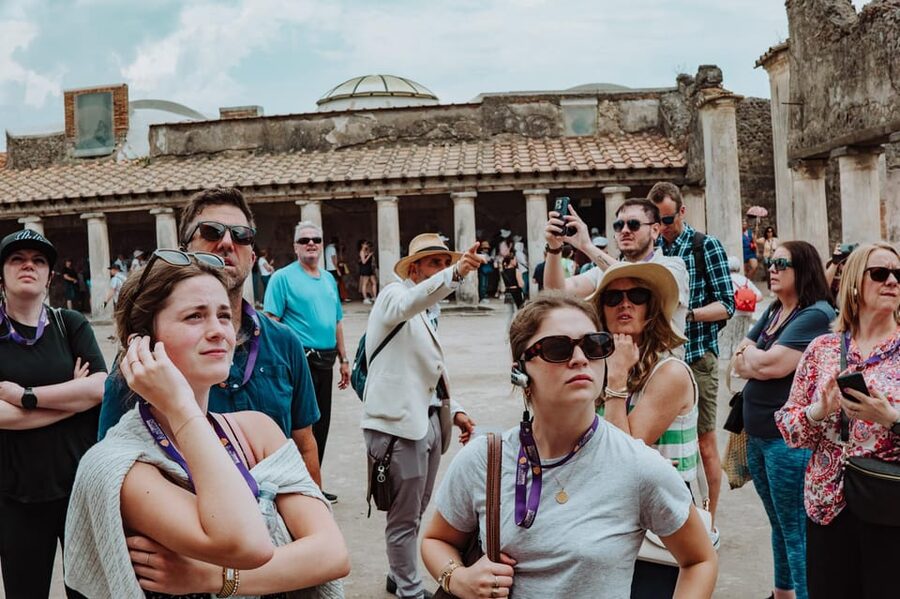
The Macellum, Pompeii’s market building, receives about 10 minutes. This is where the tour shifts toward food, trade, and the practical business of feeding an ancient city. The stop pairs well with the Termopolium, a food counter mentioned among the important sights, even though the formal route lists the Macellum as the guided stop.
The Forum Baths follow, with about 10 minutes devoted to the public bathing complex. Baths were not merely places to wash. They were social spaces and part of the city’s public infrastructure. The guide explains enough to help you understand how these buildings functioned within Roman life.
These shorter stops are useful because they widen the picture. You are not seeing only grand houses and temples. You are also seeing shopping, food service, hygiene, and the systems that kept the city running.
Streets, theaters, and the plaster casts
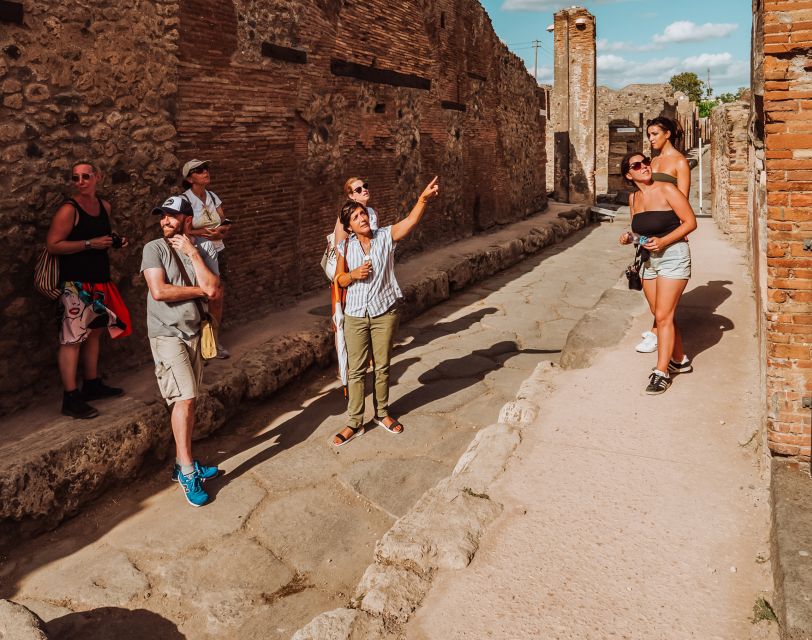
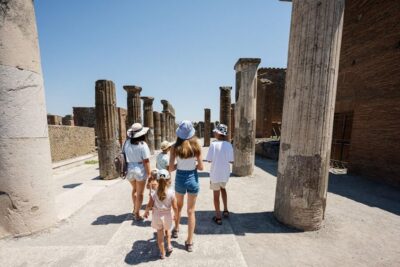
The route includes Pompeii’s main streets, historic theaters, ancient baths, and the poignant plaster casts of victims. Some are formal guided stops, while others are seen along the way or passed during the broader walk.
The streets are among the most revealing parts of Pompeii. Raised sidewalks, worn paving, thresholds, and surviving walls show how people moved through the city. You will need to watch your footing, but the uneven surfaces are also part of what makes the place feel real.
The plaster casts require a quieter kind of attention. They are not simply archaeological objects. They are physical evidence of people caught in the eruption, and their presence changes the tone of the visit. A guide can provide context without turning the moment into spectacle.
Theaters add another side of city life, showing that Pompeii had organized entertainment as well as government, religion, trade, and private homes. You do not receive an exhaustive examination of every theater or street in two hours. Instead, you get a well-chosen introduction to the city’s main themes.
Two hours, walking pace, and the right expectations
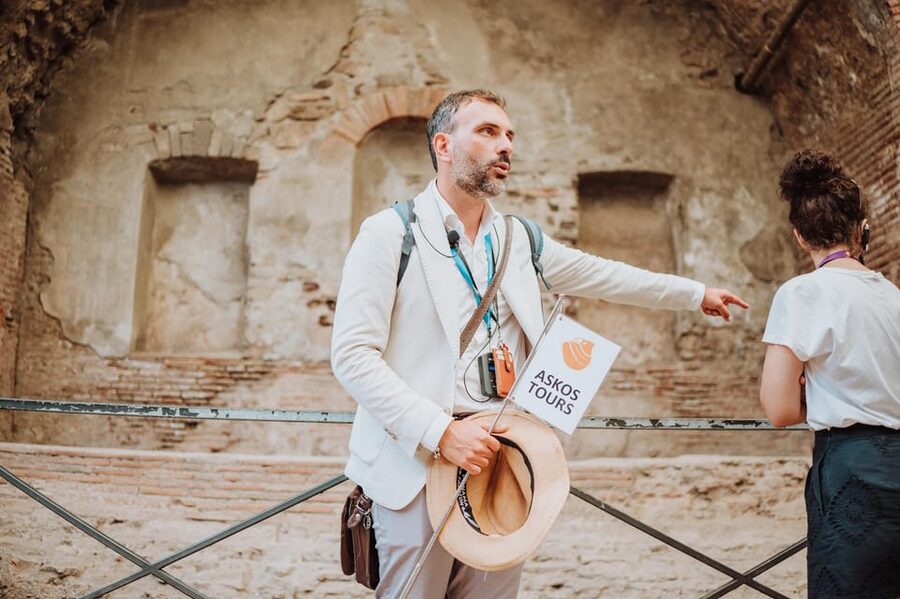
The advertised duration is two hours, though one participant found the visit lasted longer than expected. Timing can vary with group size, crowding, questions, weather, and the guide’s route. Plan some breathing room after the tour rather than scheduling a tight train departure immediately afterward.
The walk covers a lot. Several people describe Pompeii as a place where you can walk almost endlessly, and that is not an exaggeration in practical terms. Even after the guided portion, you may want to remain inside and continue exploring.
The pace is generally designed to keep the group moving while allowing time for photographs and explanations. It is not a relaxed sit-down history lesson. You will be standing and walking for most of the two hours, with steps and uneven stone underfoot.
Bring water. Food and drinks are not included, and one person finished the visit dehydrated and hungry after staying on to explore. Wear shoes with firm soles, since smooth fashion footwear is a poor match for ancient paving.
Group size, headsets, and language choices
A group can contain up to 20 people. That is small enough for a personal feel compared with a large coach tour, but it is not private. At busy sights, you may need to stay close to the guide and accept that photographs take a little patience.
Headsets are included for groups of 10 or more. They are useful when the Forum or popular houses are crowded, since you can hear while standing a few steps away. The tradeoff is that earpieces can be uncomfortable or less effective when people are talking nearby. Hold the receiver close if needed and stay aware of the group as you move.
Tours are offered in English, Spanish, French, Italian, Portuguese, and German. Choose the language that lets you follow detail easily. Pompeii rewards explanations, and missing half the guide’s comments would reduce much of the value.
Is $35 a fair price?
At $35 per person, the price includes the Pompei Express entrance ticket, the archaeologist guide, the small-group format, and headsets when required. Food, drinks, transport, and hotel pickup are not included.
For me, the value is strongest if this is your first visit. Pompeii is too large and too layered to reduce to a quick stroll, and the guide saves you from spending your first hour simply trying to work out where you are. The ticket alone gets you inside, but the explanation gives the ruins purpose.
The price is less compelling if you have already studied Pompeii closely or prefer to read every panel at your own pace. Even then, the guide’s route can help you cover major sights efficiently before you continue independently.
Skip-the-line access is another practical gain. It does not mean every part of the site will be quiet, but it can reduce wasted time at the entrance, especially when your day also includes Naples, Sorrento, or Mount Vesuvius.
Free cancellation up to 24 hours before the start and a reserve-now, pay-later option add flexibility. These are useful in Campania, where train delays and changing weather can disrupt a careful plan. One booking was rescheduled after a delayed train from Naples, though you should still arrive early and not rely on a last-minute rescue.
Who should book this Pompeii tour?
I would choose this tour for a first-time Pompeii visitor who wants the important sights explained without committing to a full-day guided program. It also suits history fans, families with older children, and anyone who finds ancient ruins hard to interpret alone.
It is a good match if you want to continue exploring after the guide leaves. Several guides provide suggestions for the remaining site, and the route gives you a useful map in your head.
I would think twice if you have a mobility impairment, use a wheelchair, or depend on a mobility scooter. The experience is specifically not suitable for wheelchair users or people with mobility impairments, and mobility scooters are not allowed. Unaccompanied minors are also not permitted.
Dogs are allowed only under strict limits: no more than 10 kilograms and no taller than 40 centimeters. They must remain on a leash, be carried inside buildings, and have their waste collected. Children under 18 are advised to bring a passport or ID for free admission.
Should you book it?
Book this Pompeii tour if you want the ruins to make sense, not just look impressive. The archaeologist guides are repeatedly praised for clear explanations, humor, strong English, and stories about ordinary Roman life. The route covers the essential public buildings, homes, businesses, baths, and more difficult parts of the site in a focused two hours.
Skip it if you want total independence, dislike group audio systems, or need an accessible route. For most first visits, though, $35 is a sensible cost for entry, direction, and the context that turns Pompeii from scattered ruins into a city you can picture.
FAQ
How long does the Pompeii guided tour last?
The stated duration is two hours. The actual visit may run longer depending on the route, crowd levels, questions, and weather.
What is included in the price?
The $35 price includes the Pompei Express entrance ticket, an archaeologist guide, the small-group tour, and headsets for groups of 10 people or more.
Is transportation included?
No. Hotel pickup, hotel drop-off, and transportation are not included.
Where does the tour meet?
The meeting point can vary depending on the option booked. The listed starting locations are along Via Villa dei Misteri, 2, so check your booking details carefully.
Does the tour skip the ticket line?
Yes. Skip-the-ticket-line access is included.
Which Pompeii sights are visited?
The route includes Porta Marina, the Temple of Apollo, the Forum, House of the Faun, Lupanar, House of Menander, Macellum, and Forum Baths. It also includes views of streets, theaters, and plaster casts of victims.
What languages are available?
The live tour guide is available in English, Spanish, French, Italian, Portuguese, and German.
Is the tour suitable for wheelchair users?
No. The experience is not suitable for wheelchair users or people with mobility impairments. Mobility scooters are not allowed.
Are children allowed?
Unaccompanied minors are not allowed. Children under 18 are advised to bring a passport or ID to qualify for free admission.
Can I cancel the booking?
You can cancel up to 24 hours in advance for a full refund. A reserve-now, pay-later option is also available.
Recently reviewed around Pompei Campania
- Pompeii 3hours Villa of Mysteries tour with an Archaeologist★ 4.8 · 486 reviews
- Pompeii: Small-Group Tour of Pompeii and Herculaneum★ 4.8 · 867 reviews
- Pompeii: Skip-the-Line Entry & Audioguide★ 3.8 · 225 reviews
- Pompeii: Skip-the-line-Ticket and Guided Tour★ 4.6 · 1,152 reviews
- Pompeii: Guided Tour with Skip-the-Line Entry★ 4.9 · 812 reviews
- Pompeii: Tour with Archaeologist Guide & Skip-the-Line Entry★ 4.5 · 478 reviews
- Pompeii: Afternoon to Sunset Guided Tour with Ticket★ 4.9 · 484 reviews
- Pompeii: Skip-the-Line Entry Ticket with Digital Guide App★ 4.1 · 770 reviews
Pompeii & Vesuvius Tours, compared.


Pompeii Small Group Tour with an Archaeologist
Read our review →
Pompeii, Amalfi Coast and Positano Day Trip from Rome
Read our review →
Pompeii and Mount Vesuvius Day Trip from Rome with Pizza Lunch
Read our review →Browse the lists this tour appears in