
Review · WALKING TOURS
Ferrara: City Highlights Walking Tour with Local Guide
Ferrara reveals its character best on foot, and this tour follows the city’s most graceful thread: from the moat-ringed Estense Castle through the Renaissance streets planned by Duke Ercole I d’Este. You’ll see how medieval power gave way to a bold new urban plan, then finish among gardens, a former Carthusian church, and a square honoring poet Ludovico Ariosto.
I like the carefully chosen route, especially Corso Ercole I d’Este and the little-known Certosa complex. I also like that the tour costs only $17, includes a local Italian-speaking guide and Italian audio guide, and keeps the visit to a useful two hours. The main consideration is language: the live guide and audio are in Italian, and entrance tickets are not included.
In This Review
- Key points
- Why Ferrara Works So Well on Foot
- Beginning in the Courtyard of Estense Castle
- Walking Corso Ercole I d’Este
- Palazzo dei Diamanti and the Addizione Erculea
- Massari Park and the Botanical Garden
- San Cristoforo alla Certosa
- Ending at Piazza Ariostea
- The Guide, Language, and Audio Support
- What $17 Buys You
- Comfort, Weather, and Access
- Who Will Get the Most From This Walk
- Should You Book the Ferrara Highlights Walk?
- FAQ
- Where does the Ferrara walking tour meet?
- How long does the tour last?
- What language is the tour offered in?
- Are entrance tickets included?
- Is the tour wheelchair accessible?
- What should I bring if rain is expected?
Key points
- Start at Estense Castle: Meet in the castle courtyard near the loggia, at the city’s most recognizable landmark.
- Follow Ferrara’s Renaissance spine: Walk Corso Ercole I d’Este and learn how Biagio Rossetti planned the northern expansion.
- See Palazzo dei Diamanti: Reach Ferrara’s famous palace at the heart of the Addizione Erculea.
- Visit San Cristoforo alla Certosa: Enter the Renaissance church within the former Carthusian complex and later monumental cemetery.
- Finish at Piazza Ariostea: End beneath the square’s loggia, with Ariosto’s statue watching over the open space.
- Plan for Italian: The guide and audio guide operate in Italian, so this suits Italian speakers best.
Why Ferrara Works So Well on Foot
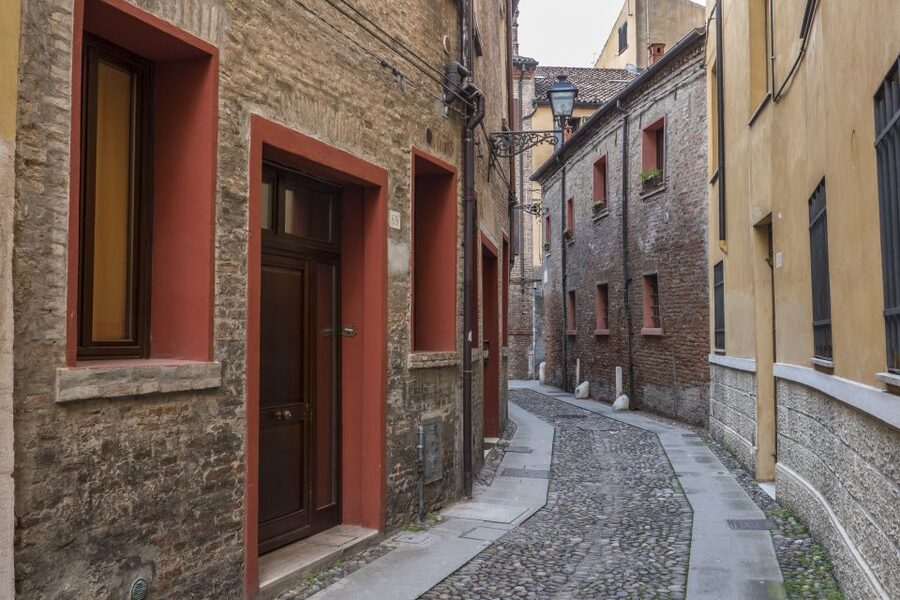
Ferrara is a manageable city, and this route takes advantage of that. You move through streets, parks, squares, and monuments without needing a bus or taxi between major sights. That keeps the focus on the city’s shape, not just its individual buildings.
The central idea is the meeting of two Ferraras. One is the medieval city gathered around the Este court and castle. The other is the ordered Renaissance expansion created under Ercole I d’Este. The tour makes that change visible as you walk north from the castle along Corso Ercole I d’Este.
I find that useful because Ferrara can seem quiet at first glance. Its appeal is not packed streets or one enormous monument. It comes from the way palaces, churches, arcades, gardens, and broad avenues fit together. A guide helps you notice the plan behind the calm surface.
The route is also human-sized. Two hours is enough to get a strong first picture of Ferrara without turning the day into a march. You’ll still want extra time afterward if you plan to enter more museums or spend longer at the castle.
More Bologna & Emilia walks with a guide:
- Bologna: City Center Walking Tour
★ 4.5 · 3,478 reviews - Bologna: Walking Food Tour with a Local Guide
★ 4.8 · 882 reviews - Private Half Day Parma Food Walking Tour
★ 5.0 · 561 reviews
Beginning in the Courtyard of Estense Castle
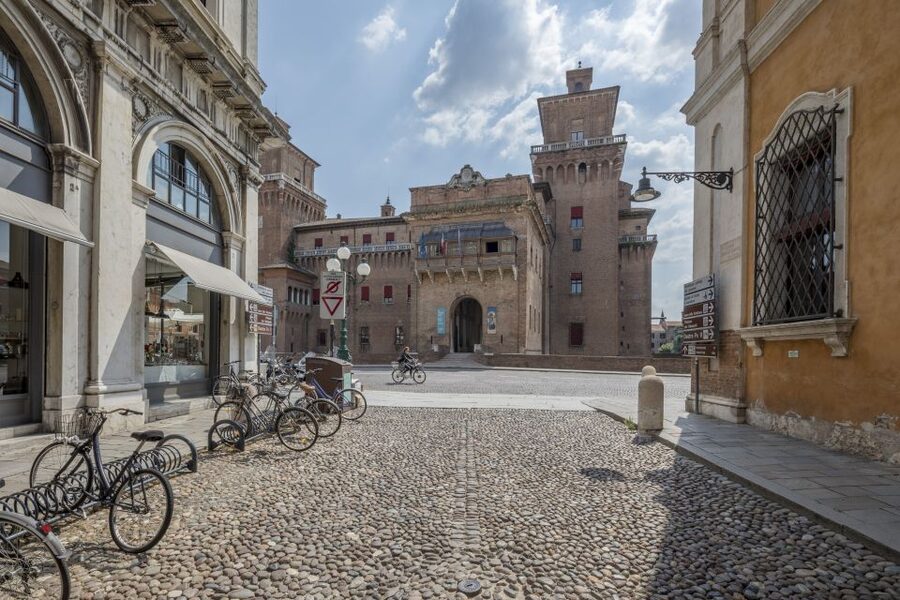
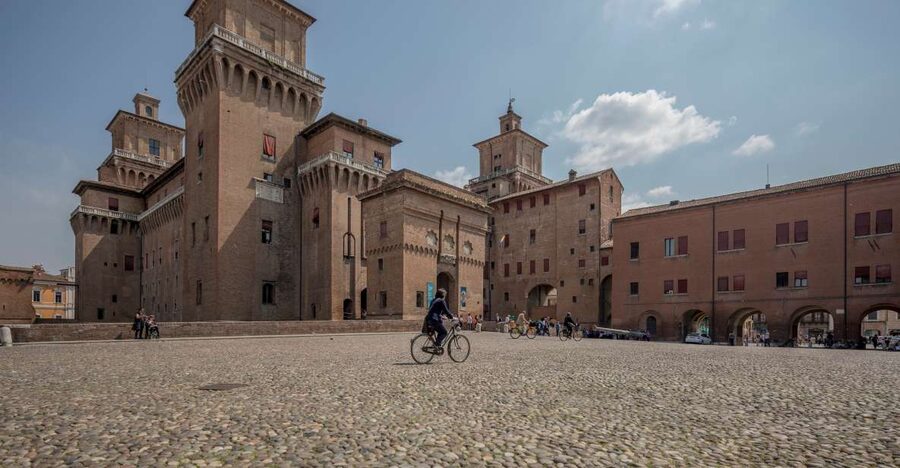
The meeting point is in the courtyard of Estense Castle, near the loggia. This is a sensible place to start: the castle is the symbol of Ferrara, and its position helps explain the power of the Este family.
The castle was the center of civic and court life, and the tour uses it as a doorway into the city’s political story. Expect attention to the secrets and legends linked with the Este family, rather than a simple list of dates and architectural terms.
The castle itself is not listed as an included interior visit, and entrance tickets are separate. That matters if you expect to tour its rooms during the two-hour walk. You can treat the castle as the opening landmark for this experience, then decide if you want to return for a paid visit on your own.
Meeting in a castle courtyard also makes finding the guide fairly straightforward, though you should allow enough time to locate the loggia before the scheduled start. Starting times vary, so check availability when booking.
Walking Corso Ercole I d’Este
From the castle, the route follows Corso Ercole I d’Este. This road links the castle with the northern gate of Ferrara’s walls and crosses the Renaissance expansion known as the Addizione Erculea.
This is the architectural heart of the outing. Duke Ercole I d’Este commissioned the expansion at the end of the 15th century, and Ferrarese architect Biagio Rossetti gave it a carefully planned form. You are not simply walking down a handsome street. You are walking through an early example of a city being enlarged according to a broad urban design.
That distinction gives the tour more value than a quick photo stop at the main palace. The guide can point out how the road, buildings, and open spaces relate to the old center. You’ll get a clearer sense of why Ferrara belongs to the UNESCO World Heritage list.
Corso Ercole I d’Este is also a good stretch for people who prefer atmosphere over crowds. The appeal is the view along the street and the gradual appearance of Renaissance palaces and churches. It is not a single, dramatic reveal. Give your attention to the sequence of buildings and the way the avenue draws you north.
Palazzo dei Diamanti and the Addizione Erculea
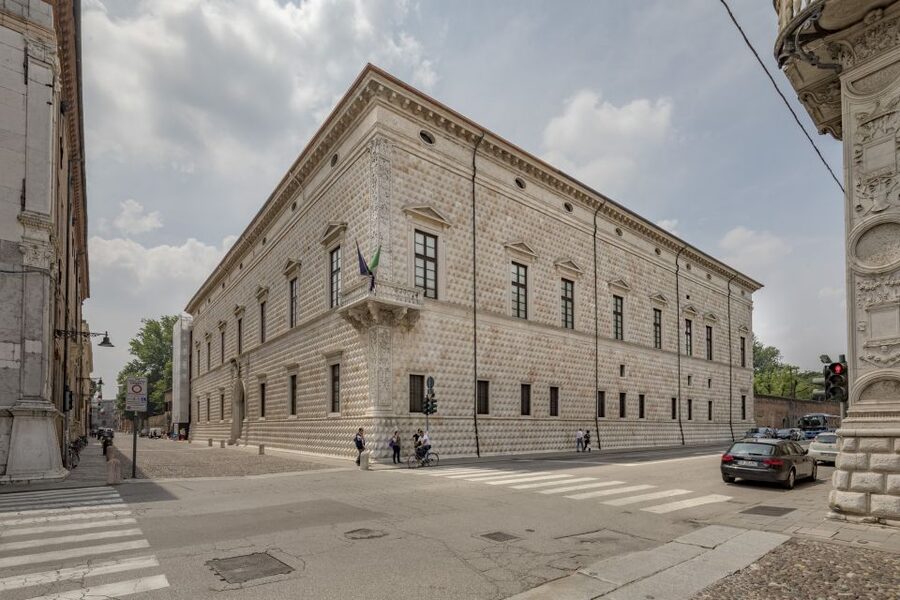
The route reaches Palazzo dei Diamanti, one of Ferrara’s most recognizable Renaissance buildings. Its exterior is famous for diamond-shaped stone points that catch light differently as you move past them.
The palace sits at the center of the Addizione Erculea, so it is important for both its appearance and its place in the city plan. Here, the guide can connect the unusual facade with the wider ambition of Ferrara’s expansion.
Do not expect a long museum visit inside the palace. Entrance tickets are not included, and the tour is built around the city’s streets and views. You’ll appreciate this stop most if you want to understand how the palace fits into Ferrara rather than spend your entire visit inside one attraction.
This is also a good moment to pause for photographs. The palace’s patterned exterior gives you something very different from the castle’s heavy medieval presence. Together, the two sights show the change from fortified court city to Renaissance capital.
More Bologna & Emilia trips worth a second look
- Ravenna: UNESCO Monuments and Mosaics Guided Tour
★ 4.8 · 3,108 reviews - Guided Tour of Mosaic Tiles in Ravenna
★ 5.0 · 1,693 reviews - Guided group tour TastyBus: Parmesan Cheese and Parma Ham
★ 5.0 · 241 reviews - Bologna: City Center Guided Wine Walking Tour
★ 4.9 · 210 reviews
Massari Park and the Botanical Garden
After the historic crossroads near Palazzo dei Diamanti, the route continues toward Massari Park. The park is marked by old cedars of Lebanon and thick plant growth, with views toward the University Botanical Garden.
This change of setting keeps the tour from becoming a procession of facades. You move from formal avenues and palaces into a greener part of the city, where the route feels quieter and more reflective.
For you, the value is variety. The walk does not ask you to concentrate on architecture for two straight hours. The park gives your eyes a rest and adds a sense of Ferrara as a lived-in city, not only a historical display.
The botanical garden is mentioned as part of the nearby view, not as an included entry. The same applies here as at the castle and Palazzo dei Diamanti: enjoy the setting during the walk, but plan separately if you want to visit an interior or paid attraction.
San Cristoforo alla Certosa
A few steps from the park, the tour reaches the monumental complex of San Cristoforo alla Certosa. Over time, the former Carthusian monastery became a monumental cemetery, and its square is framed by elegant arcades.
This may be the most distinctive stop on the route. The castle and Palazzo dei Diamanti are the sights most people associate with Ferrara, but the Certosa offers a quieter look at the city’s religious and civic past. The arcades create a solemn enclosure, and the setting changes the pace of the walk.
The route includes an internal visit to the Renaissance church. It began as a church for Carthusian monks brought to Ferrara by Duke Borso d’Este in the mid-15th century. That detail ties the church back to the Este dynasty, while the later cemetery use gives the complex a second layer of meaning.
You should expect a place of recollection rather than a lively sightseeing stop. That is part of its appeal, but it also means the atmosphere may feel more serious than the open streets earlier in the tour. Listen closely to the guide here, since the change from monastery to monumental cemetery is the sort of detail easy to miss alone.
Ending at Piazza Ariostea
The final stop is Piazza Ariostea, a historic square named for Ludovico Ariosto, one of Italy’s major poets. His statue rises above the central column, giving the open space a clear focal point.
The tour ends under the loggia along the green area. This is a pleasant finish because you are not pushed back into the busiest central streets or left at an unclear corner. The square gives you a natural place to pause and decide what to do next.
Piazza Ariostea also rounds out the cultural story. The tour begins with the ruling Este family, follows their urban project, visits a religious complex connected with the dukes, and ends with a reminder of Ferrara’s literary life.
You will not see every major sight in Ferrara in two hours, nor is this intended as a full museum tour. Instead, the ending leaves you with a connected route and several useful starting points for independent exploring.
The Guide, Language, and Audio Support
The experience is led in Italian, with an Italian audio guide included. That makes it a strong choice for Italian speakers who want local context without paying for a private tour.
The most praised element in the available feedback is the guide’s manner and preparation. Maria Chiara is specifically named, and other guide comments describe the tours as precise, professional, punctual, pleasant, and well structured. One recent assessment called the guide passionate and prepared, while another highlighted an empathetic and courteous approach.
Those qualities matter on a walking tour. Ferrara’s sights are close enough that a weak route could feel like a string of disconnected stops. A prepared guide can make the relationship between the medieval center, the Renaissance expansion, the Este family, and the Certosa much easier to follow.
The language is still the key limitation. If you do not understand Italian, the included audio guide may not solve the problem because it is also in Italian. Check the language carefully before reserving, especially if you are comparing this with a tour in English or another language.
What $17 Buys You
At $17 per person, this is a low-cost way to get organized context in Ferrara. You are paying for a two-hour guided walk with a local Italian-speaking guide, not for admission to the castle, Palazzo dei Diamanti, or other ticketed sights.
I think the value is strongest for a first visit. The route links several areas that might otherwise seem separate, and the guide gives you the background needed to understand why Corso Ercole I d’Este matters. You also avoid spending your first hours guessing which streets lead to the Renaissance expansion.
The price is less compelling if you want lengthy indoor visits. Since entrance tickets are excluded, you may add museum costs later. That is not unusual, but you should budget for it if your main aim is seeing interiors rather than walking through the city.
The two-hour length keeps the cost and time commitment modest. You can schedule this early in your Ferrara stay, then return to the places that interest you most. You can also use it as a focused stop during a short visit to Emilia-Romagna.
Comfort, Weather, and Access
This is a walking tour, so comfortable shoes are sensible even though the route is described as accessible for wheelchair users. The experience covers streets, a park, squares, and monument areas, so weather will affect your comfort more than the distance alone.
Bring an umbrella if rain is possible. The advice is simple but useful, since much of the experience takes place outdoors and the route continues through parks and open squares.
The tour is listed as wheelchair accessible, which is important for planning. Still, if you have very specific mobility needs, you should confirm current route conditions and access details when booking, since historic sites can have practical limits that are not always obvious from a general accessibility label.
There is no transportation component to arrange. You meet at the castle and continue on foot, making this easier than an experience that depends on a coach or a series of transfers.
Who Will Get the Most From This Walk
I would choose this tour if you want a clear introduction to Ferrara’s medieval and Renaissance character, especially if you prefer streets and public spaces to a long indoor museum visit.
It suits:
- First-time visitors who want orientation before exploring alone
- Italian speakers looking for local historical and cultural context
- Architecture fans interested in urban planning and Renaissance palaces
- Visitors who enjoy quieter places such as parks, arcades, and church interiors
- People with only two hours to spare
- Wheelchair users looking for a listed accessible walking option
It is less suitable if you need an English-speaking guide or want a tour centered on castle interiors. It may also feel too short if you want every major church and palace covered in detail.
The strongest version of the day is to take the walk early, then use the route as a map for the rest of your visit. After seeing Palazzo dei Diamanti from the outside, you may want to return for its interior if an exhibition interests you. The same goes for Estense Castle.
Should You Book the Ferrara Highlights Walk?
Book it if you want a compact, good-value introduction to Ferrara and can follow Italian. The route has a clear story, the price is modest, and the stops go beyond the obvious castle and palace to include Massari Park, the Certosa, and Piazza Ariostea.
I would be especially inclined to book when Maria Chiara is leading, since her preparation and warm manner receive specific praise. Still, the activity’s value does not depend on one name alone. The structure is sound, the guide is local, and the two-hour length fits neatly into a day of sightseeing.
Skip it if you require another language, want admission tickets included, or prefer to spend your limited time inside museums. For everyone else, this is a practical way to see Ferrara as a connected city rather than a checklist of isolated monuments.
FAQ
Where does the Ferrara walking tour meet?
The meeting point is in the courtyard of Estense Castle, near the loggia.
How long does the tour last?
The walking tour lasts two hours.
What language is the tour offered in?
The live guide speaks Italian, and the included audio guide is also in Italian.
Are entrance tickets included?
No. Entrance tickets are not included in the tour price.
Is the tour wheelchair accessible?
Yes, the activity is listed as wheelchair accessible.
What should I bring if rain is expected?
An umbrella is advisable because much of the tour takes place outdoors.
Recently reviewed around Bologna & Emilia
- Guided group tour TastyBus: Parmesan Cheese and Parma Ham★ 5.0 · 241 reviews
- Tour Parmigiano Reggiano dairy and Parma ham★ 5.0 · 601 reviews
- Tasting and Biking Parma★ 5.0 · 218 reviews
- Private Half Day Parma Food Walking Tour★ 5.0 · 561 reviews
- Cavedoni Balsamic Vinegar Tour: The Oldest in Modena★ 5.0 · 267 reviews
- Bologna on the plate, Cooking Class with Alessia★ 5.0 · 260 reviews
- Bologna Private Highlights & Hidden Gems Tour with a Local★ 5.0 · 359 reviews
- Bologna Local Pasta Cooking Class, Ragu, Spritz, Wine & Gelato★ 5.0 · 527 reviews
Walking Tours, compared.

Guided Walking Tour & Last Supper Visit with Ticket
Read our review →
Rialto Bridge & Offbeat Unusual Venice Walking Tour
Read our review →
Private 3 hrs Venice Tour: St Mark’s, Walking tour & Boat tour
Read our review →

Skip the line: Uffizi and Accademia Small Group Walking Tour
Read our review →
Trastevere & Campo de Fiori Street Food Walking Tour
Read our review →Browse the lists this tour appears in