
Review · BOLOGNA & EMILIA TOURS
Ravenna: UNESCO Mosaics Entry Tickets
Ravenna’s mosaics are the main event here, and they are astonishingly well preserved. This self-guided combo ticket brings you to San Vitale, Sant Apollinare Nuovo, and St. Andrew’s Chapel, with an expanded option adding Galla Placidia’s Mausoleum and the Neonian Baptistery.
I like the seven-day validity, since you can see the monuments at a calm pace instead of racing from church to church. I also like the strong value at $14 per person, especially if you choose all five sites. The tradeoff is simple: no guide is included, so you need to read the displays or arrange your own guide if you want the stories explained as you go.
In This Review
- Key points to know
- Why Ravenna’s mosaics deserve your time
- San Vitale and the imperial mosaics
- Galla Placidia’s small, glowing mausoleum
- Sant Apollinare Nuovo and a long story in tile
- St. Andrew’s Chapel and the Archiepiscopal Museum
- The Neonian Baptistery completes the five-site option
- Is the $14 ticket good value?
- How to plan your seven-day visit
- What the self-guided format is really like
- Who should book this ticket?
- Should you book Ravenna’s mosaic ticket?
- FAQ
- How long is the ticket valid?
- Which sites are included in the basic ticket?
- What does the five-monument option add?
- Is a guided visit included?
- What clothing is required?
- Can I cancel for a refund?
Key points to know
- San Vitale’s octagonal interior: A sixth-century church filled with Old Testament scenes and the famous mosaics of Emperor Justinian and Empress Theodora.
- Sant Apollinare Nuovo’s Christ cycle: See one of the oldest surviving mosaic sequences connected with the life of Christ.
- St. Andrew’s Chapel: A small former bishops’ chapel with mosaics, inscriptions, church treasures, and an ivory throne.
- Optional five-monument ticket: Add Galla Placidia’s Mausoleum and the Neonian Baptistery for a fuller look at Ravenna’s early Christian art.
- Easy walking plan: The five locations are close enough to visit on foot, and the ticket allows one entry to each site within seven days.
- Practical rules: Cover your knees and shoulders, wear comfortable shoes, and leave your camera flash switched off.
Why Ravenna’s mosaics deserve your time
Ravenna can seem quieter and less polished than Italy’s headline cities, but its churches hold some of the country’s most remarkable art. The mosaics are not small decorative touches. They cover walls, ceilings, arches, and domes with thousands of colored tiles.
I find Ravenna especially rewarding because the art feels direct. Gold backgrounds catch the light. Figures look out from the walls with solemn expressions. Biblical scenes sit beside imperial portraits, showing how closely religion and political power were linked in the late Roman and Byzantine worlds.
This ticket is a good fit if you want to see the major mosaic sites without signing up for a fixed group itinerary. You show the official ticket at each entrance, visit once per monument, and choose the order that works for you. The booking ticket arrives in a separate email, so check for that message before you set out.
More Bologna & Emilia trips worth a second look
- Maranello: Ferrari Museum Entrance Ticket
★ 4.6 · 1,505 reviews - Maranello and Modena: Ferrari Museums Combo Tickets
★ 4.7 · 994 reviews - Modena: Enzo Ferrari Museum Entrance Ticket
★ 4.5 · 422 reviews
San Vitale and the imperial mosaics
Begin at the Basilica of San Vitale, an octagonal sixth-century church that blends Roman design with Byzantine style. The building is impressive before you even study the mosaics. Its unusual shape leads your eye upward, while the interior opens into a grand central space surrounded by galleries and arches.
The mosaics are the reason to linger. Scenes from the Old Testament fill the walls with detailed figures, architecture, landscapes, and symbols. Small glass tiles create a surface that changes as you move. From one angle, the gold seems calm and flat. From another, it flickers with light.
The most famous panels show Emperor Justinian I and Empress Theodora. Their portraits are not casual royal snapshots. They present the rulers as powerful, ceremonial figures linked to the church and its worship. Justinian appears with attendants and religious leaders, while Theodora arrives with her own richly dressed court.
Take your time here. A quick look from the doorway will not do justice to the building. Since the ticket is valid for seven days, you do not need to force San Vitale into a crowded morning. You can return to the area later, though the ticket permits only one visit to each monument.
Galla Placidia’s small, glowing mausoleum
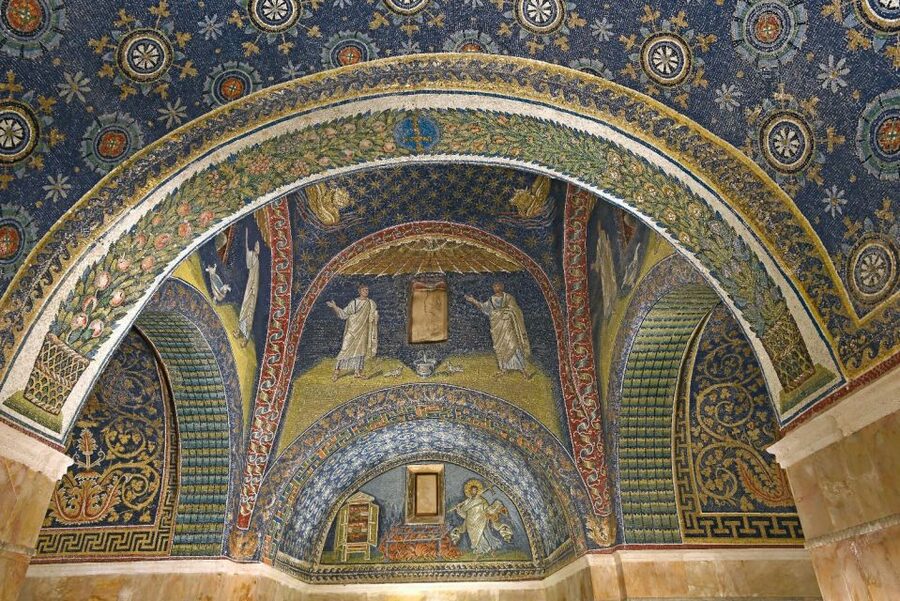
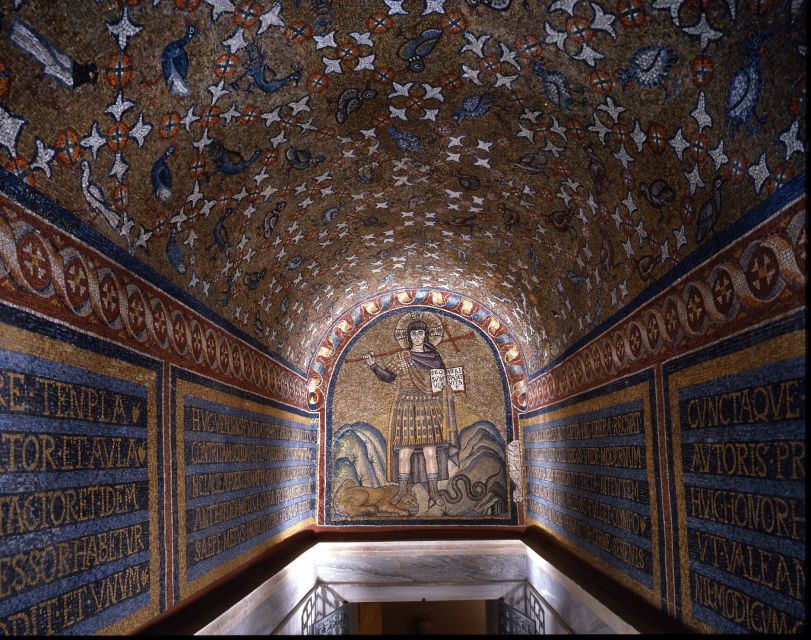
If you select the five-monument option, add the Mausoleum of Galla Placidia near San Vitale. It dates from the first half of the fifth century and feels very different from the large basilicas.
The structure is compact, and the darker interior makes the mosaics feel close and personal. Blue tones, stars, symbolic figures, and luminous details create a strong contrast with San Vitale’s larger imperial scenes. The small scale is part of its power. You are not looking across a huge church. You are surrounded by the decoration.
This is one of the clearest reasons to consider the five-site ticket rather than the basic option. The Mausoleum gives you a different kind of mosaic experience, one based on intimacy rather than size. If you care about early Christian art, it belongs near the top of your list.
Sant Apollinare Nuovo and a long story in tile
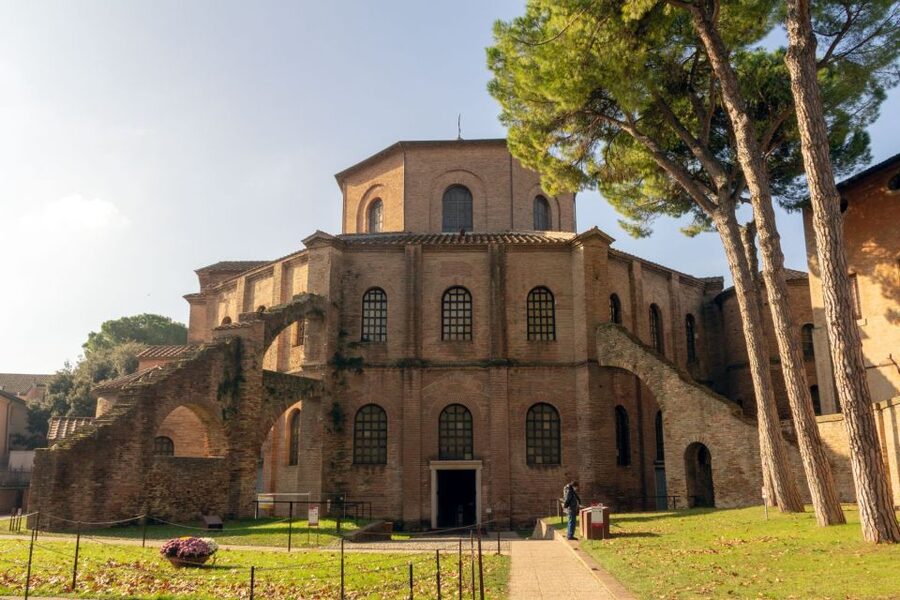
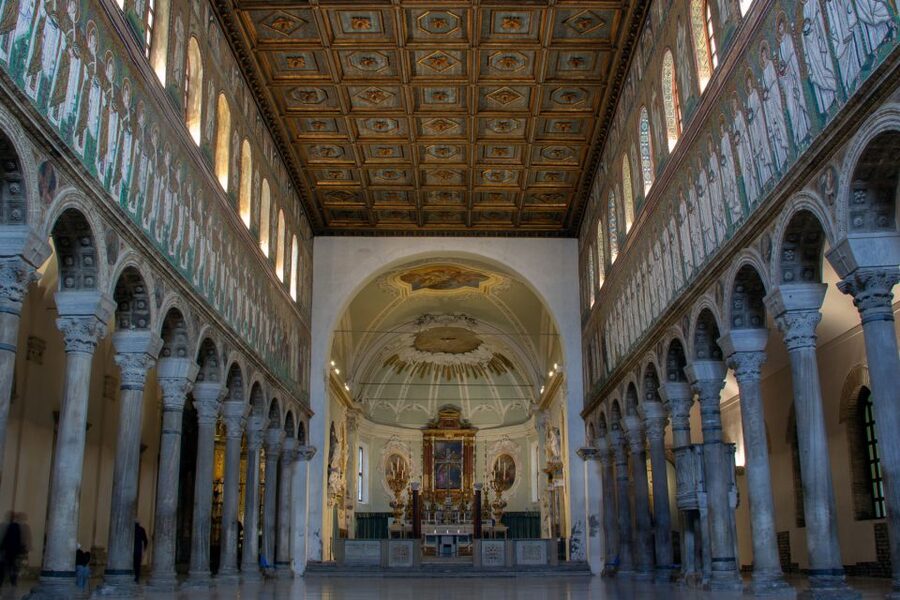
Sant Apollinare Nuovo was built in the sixth century by Ostrogoth king Theodoric the Great. From the outside, it is more restrained than San Vitale. Inside, the walls open into a remarkable sequence of Byzantine mosaics.
Look up toward the long bands of decoration. You will see processions of saints, biblical scenes, and carefully arranged figures moving across the church. The site contains one of the oldest mosaic cycles connected with the life of Christ, making it especially valuable for anyone interested in how religious stories were presented before modern painting.
The church also carries traces of later conflict and change. Some mosaics were altered, and certain images were painted black under Pope Gregory the Great, reportedly to keep worshippers focused on prayer. Damage during World War I led to reconstruction work as well.
That mix of original work, alteration, and repair makes Sant Apollinare Nuovo more than a pretty interior. It shows how art changes under pressure from religious policy, war, and restoration. Give yourself time to follow the scenes from one end of the nave to the other.
A different way to spend the day, same part of Italy:
- Bologna: City Center Walking Tour
★ 4.5 · 3,478 reviews - Ravenna: UNESCO Monuments and Mosaics Guided Tour
★ 4.8 · 3,108 reviews - Guided Tour of Mosaic Tiles in Ravenna
★ 5.0 · 1,693 reviews - Bologna Food & Market Tour with 6 Tastings, Pasta, Wines & More
★ 5.0 · 1,328 reviews
St. Andrew’s Chapel and the Archiepiscopal Museum
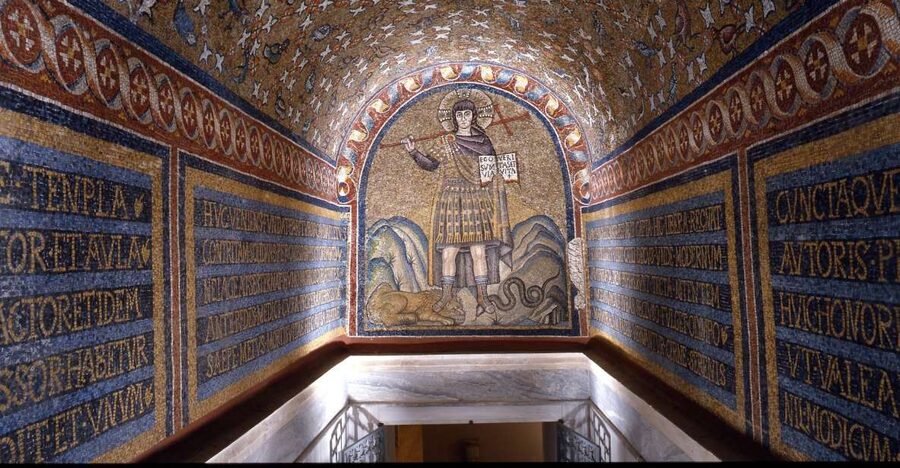
The Archiepiscopal Museum includes St. Andrew’s Chapel, a private chapel once used by Ravenna’s bishops. It is smaller than the basilicas, but do not treat it as a quick add-on.
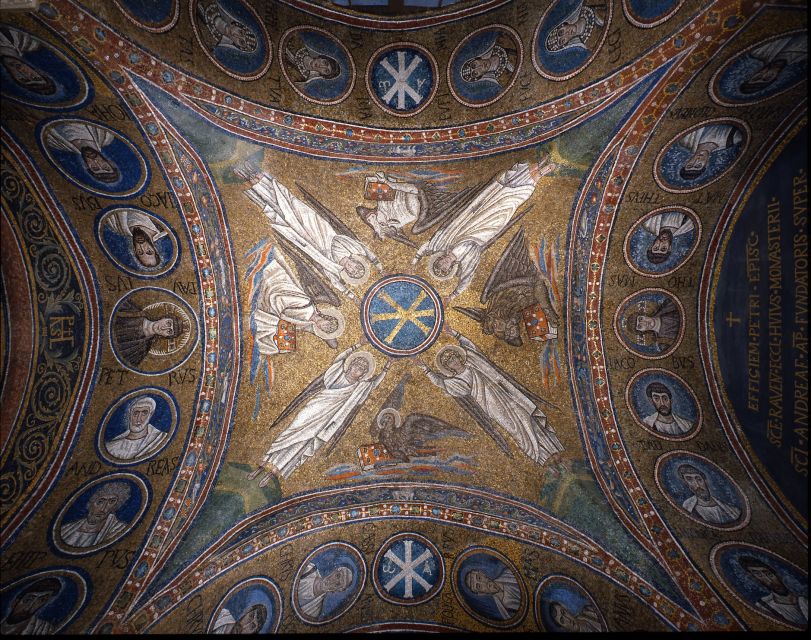
The chapel contains mosaics linked to the religious divisions of the early Byzantine period. The decoration also points to important people and places in Ravenna. Its size gives you a closer look at the workmanship, and the setting feels more private than the city’s grand public churches.
The museum adds other objects to the visit, including inscriptions, the cathedral treasure, and an ivory throne associated with Bishop Maximian. These pieces help connect the mosaics to the people who commissioned, used, and preserved them.
This stop is included with the basic three-site ticket. If you are visiting without a guide, read every available panel and take a moment to connect the objects in the museum with the churches you have already seen. The chapel is easy to underestimate if you measure value only by size.
The Neonian Baptistery completes the five-site option
The Neonian Baptistery is included only with the five-monument selection. It takes its name from Bishop Neon, who continued the building after his predecessor Ursus.
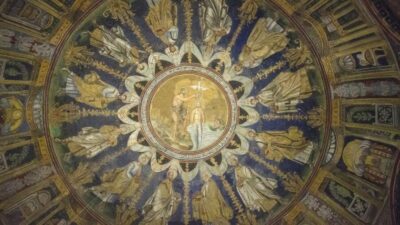
The main feature is the mosaic dome. Baptisteries were places of initiation, so the decoration focuses on Christian symbolism and baptismal imagery. The circular design draws your attention upward, and the dome provides a useful contrast to the wall mosaics at San Vitale and Sant Apollinare Nuovo.
One practical point matters here: the time allowed inside may feel short. Plan your look before entering. Start with the center of the dome, then work outward through the surrounding figures and details. If you want to study every tile, you may wish you had longer, so avoid arriving at the end of a packed day.
Is the $14 ticket good value?
At $14 per person, the ticket is a strong buy for anyone planning to see several monuments. The price covers San Vitale, Sant Apollinare Nuovo, the Archiepiscopal Museum, and St. Andrew’s Chapel. The five-monument option adds the Mausoleum of Galla Placidia and the Neonian Baptistery.
The value improves if you use the full seven-day period. You can spread the visits over several days, return to Ravenna’s center between sites, and avoid the fatigue that comes from staring at intricate mosaics for hours at a time.
You also receive a 20 percent discount in the bookshops at the sites. That matters most if you want a guidebook, art book, or small publication to help explain what you saw. It is not a reason to buy the ticket by itself, but it adds a useful extra benefit.
The main limit is the lack of a guided visit. The buildings are easier to appreciate with context. You can see the beauty without help, but you may miss why Justinian and Theodora matter, how the mosaic programs changed over time, or what the religious divisions represented.
If you have already read about Ravenna, a self-guided visit should work well. If this is your first encounter with Byzantine art, consider arranging a separate guide. One guide named in the available information is Cinzia, described as an informative and accommodating guide, but a guide is not part of this ticket and no particular guide is guaranteed.
How to plan your seven-day visit
The five monuments are within walking distance of one another, making this a manageable city-center route. You do not need to visit them in the order listed, and the seven-day validity gives you room to adjust for opening times, weather, meals, and your own energy.
A sensible approach is to group San Vitale and Galla Placidia together because they are close. Visit the Archiepiscopal Museum and St. Andrew’s Chapel during the same part of town, then set aside time for Sant Apollinare Nuovo and the Neonian Baptistery.
You might finish all the sites in one day, but I would not recommend rushing. Mosaics require close looking, and the repeated gold surfaces can tire your eyes. Two days would give you a better chance to notice the details and still enjoy Ravenna between visits.
Wear comfortable shoes. The ticket does not include transport or a guided route, so you will be walking between the monuments and standing inside the churches. Dress for church entry: knees and shoulders must be covered, and clothing with rips, holes, or transparent material is not allowed.
Flash photography is prohibited. Even when photography is allowed, use your phone or camera carefully and keep your attention on the artwork rather than trying to record every panel.
What the self-guided format is really like
This is an entry ticket, not a tour with a leader. You go directly to each attraction and show the official ticket at the entrance. That freedom is useful, but it also puts the planning in your hands.
There has been at least one report of an issued ticket causing trouble at a door because the issuer was not recognized. If that happens, you may need to return to the ticket office to sort it out. Keep the separate booking email available, and do not delete the ticket after downloading it.
The activity is wheelchair accessible, though the supplied information does not detail every surface, entrance, or internal route. If accessibility is important for your visit, confirm the current arrangements before arrival.
Cancellation is flexible: you can cancel up to 24 hours in advance for a full refund. Starting times vary by availability, while the ticket itself remains valid for seven days.
Who should book this ticket?
I would choose it for an independent visitor who wants Ravenna’s major mosaic sites without paying for a full guided tour. It also works well for art lovers, architecture fans, and anyone with enough time to spread the visits across more than one day.
Families may appreciate the flexible schedule, since you can pause between churches instead of following a group. The churches are also close together, which keeps the walking plan simple.
I would hesitate only if you want a detailed explanation at every stop and do not plan to read on your own. The ticket gets you inside the right places, but it does not interpret the mosaics for you. A separate guided visit could be worth the extra cost, especially at San Vitale and Sant Apollinare Nuovo.
Should you book Ravenna’s mosaic ticket?
Yes, if you want to see Ravenna’s central UNESCO sites at your own pace. The $14 price is particularly fair when you choose all five monuments, use the seven-day validity, and take advantage of the bookshop discount.
Choose the five-site option if you can spare the time for Galla Placidia’s Mausoleum and the Neonian Baptistery. Choose the basic ticket if your schedule is tight but you still want San Vitale, Sant Apollinare Nuovo, St. Andrew’s Chapel, and the Archiepiscopal Museum.
Bring comfortable shoes, modest clothing, and a little patience. Ravenna rewards slow looking, and these mosaics are far more memorable when you stop trying to see everything at once.
FAQ
How long is the ticket valid?
The ticket is valid for seven days. It permits one visit to each monument.
Which sites are included in the basic ticket?
The basic ticket includes San Vitale Basilica, Sant Apollinare Nuovo Basilica, the Archiepiscopal Museum, and St. Andrew’s Chapel.
What does the five-monument option add?
The five-monument option adds the Mausoleum of Galla Placidia and the Neonian Baptistery.
Is a guided visit included?
No. The ticket provides entry only, and a guided visit is not included.
What clothing is required?
Your knees and shoulders must be covered. Clothing with rips, holes, or transparent material is not allowed.
Can I cancel for a refund?
Yes. You can cancel up to 24 hours in advance for a full refund.
Recently reviewed around Bologna & Emilia
- Guided group tour TastyBus: Parmesan Cheese and Parma Ham★ 5.0 · 241 reviews
- Tour Parmigiano Reggiano dairy and Parma ham★ 5.0 · 601 reviews
- Tasting and Biking Parma★ 5.0 · 218 reviews
- Private Half Day Parma Food Walking Tour★ 5.0 · 561 reviews
- Cavedoni Balsamic Vinegar Tour: The Oldest in Modena★ 5.0 · 267 reviews
- Bologna on the plate, Cooking Class with Alessia★ 5.0 · 260 reviews
- Bologna Private Highlights & Hidden Gems Tour with a Local★ 5.0 · 359 reviews
- Bologna Local Pasta Cooking Class, Ragu, Spritz, Wine & Gelato★ 5.0 · 527 reviews
Bologna & Emilia Tours, compared.



Bologna Food & Market Tour with 6 Tastings, Pasta, Wines & More
Read our review →
Bologna Food Experience: Factory tours & Family-Style Lunch
Read our review →
Maranello and Modena: Ferrari Museums Combo Tickets
Read our review →
Browse the lists this tour appears in