

Review · NAPLES & POMPEII TOURS
Caserta: Small-Group Royal Palace Tour
The Royal Palace of Caserta is the kind of place that can overwhelm you before you understand what you are seeing. Built for the Bourbon rulers of Naples and completed in 1774, it contains about 1,200 rooms, grand ceremonial halls, a chapel, a library, and a staircase with 116 marble steps. I like that this tour puts the palace’s scale into human terms, and I like the small groups, which make it much easier to hear your guide and ask questions. The tour also begins with a view toward the gardens, a useful first glimpse of the enormous royal project.
The main consideration is time. Two hours is enough for the palace highlights, but not for the full grounds. The Royal Park and English Gardens are not part of the guided tour, and the gardens lie at the far end of a very large site. You need to plan extra time, and perhaps an ebike, shuttle, or golf cart, if they are a priority.
In This Review
- Key points to know before you book
- Why Caserta Palace deserves two hours
- Meeting at Piazza Carlo di Borbone
- The first view toward the gardens
- The Palatine Chapel and the grand staircase
- The Throne Room and the theater of monarchy
- The Astrea Room and Four Seasons Room
- The Palatine Library and the quieter side of court life
- Joachim Murat’s apartments
- How the guides shape the visit
- What the garden exclusion means for your day
- Is $23 good value?
- Who should book this Caserta tour?
- Should you book it?
- FAQ
- Where does the Caserta Palace tour meet?
- How long does the guided tour last?
- What rooms and areas are included?
- Are the Royal Park and English Gardens included?
- Is transportation included?
- What languages are available?
- Is the tour suitable for wheelchair users?
- When is the Royal Palace of Caserta closed?
Key points to know before you book

- The 116-step staircase sets the tone: You enter the royal apartments by way of Caserta’s dramatic marble grand staircase.
- The tour covers the palace highlights: Expect the Palatine Chapel, Throne Room, Astrea Room, Four Seasons Room, Palatine Library, and Joachim Murat’s apartments.
- Small groups improve the experience: Groups can be small enough to hear clearly and interact with the guide.
- Guides add useful context: Alessia, Gennaro, Walter, Sylvia, Antonietta, and others have led tours praised for clear explanations, humor, and strong English.
- The gardens require a separate plan: The guided visit does not include the Royal Park or English Gardens, which can add a long walk and several hours to your day.
- The price is modest for a major site: At $23 per person, skip-the-line palace entry and a two-hour live guide make this a strong-value introduction.
Why Caserta Palace deserves two hours
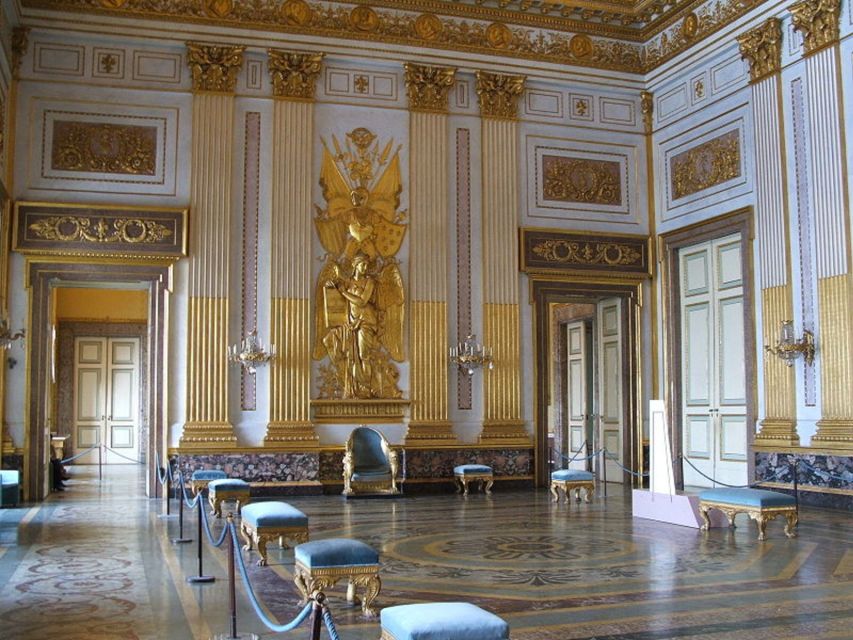
Caserta is not a quick royal residence where you peek into a few rooms and move on. Luigi Vanvitelli designed it as a huge seat of power for the Neapolitan monarchy, and its size is part of the story. The palace was completed in 1774, and its scale was meant to communicate wealth, order, and authority.
I find a guided visit especially useful here because the building can blur into a parade of marble, painted ceilings, chandeliers, and decorated doors. A guide gives you a reason to pause. Instead of simply seeing another grand room, you learn which spaces mattered to the court, which details were symbolic, and how the palace connected to the rulers of Naples.
The tour lasts two hours, which is a sensible length for a first visit. You get the main interior route without spending half the day standing in front of every painting. If you want an exhaustive look at the palace, you will need more time on your own. For most people, this tour works best as an introduction that helps you decide where to return.
Other Naples & Pompeii days travellers weigh against this one:
- Naples: Naples Underground Entry Ticket and Guided Tour
★ 4.4 · 21,781 reviews - Pompeii: Entry Ticket and Guided Tour with an Archaeologist
★ 4.8 · 19,459 reviews - Pompeii: Entry Ticket with Optional Audio Guide
★ 4.2 · 12,360 reviews
Meeting at Piazza Carlo di Borbone
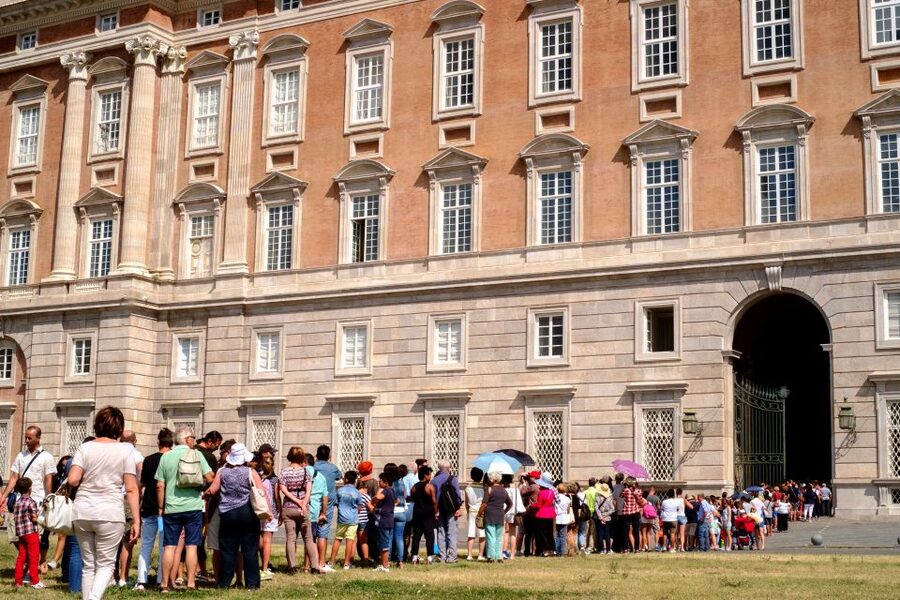
You meet at Piazza Carlo di Borbone, at the central entrance portal beneath the hanging flags. Look for the guide holding an ASKOS TOURS sign. The meeting point is straightforward, but arrive with enough time to locate the portal before the scheduled start.
The tour does not include transportation, meals, or a visit to the park and English Gardens. That makes the starting point important: you need to arrange your own way to Caserta and plan the rest of your day around the palace visit.
The skip-the-line ticket is useful at a busy monument of this size. It does not turn the palace into a private building, and there may still be normal movement inside, but you avoid spending valuable sightseeing time at the ticket queue. At $23, the package is appealing because the cost includes both entry and a live guide.
The first view toward the gardens
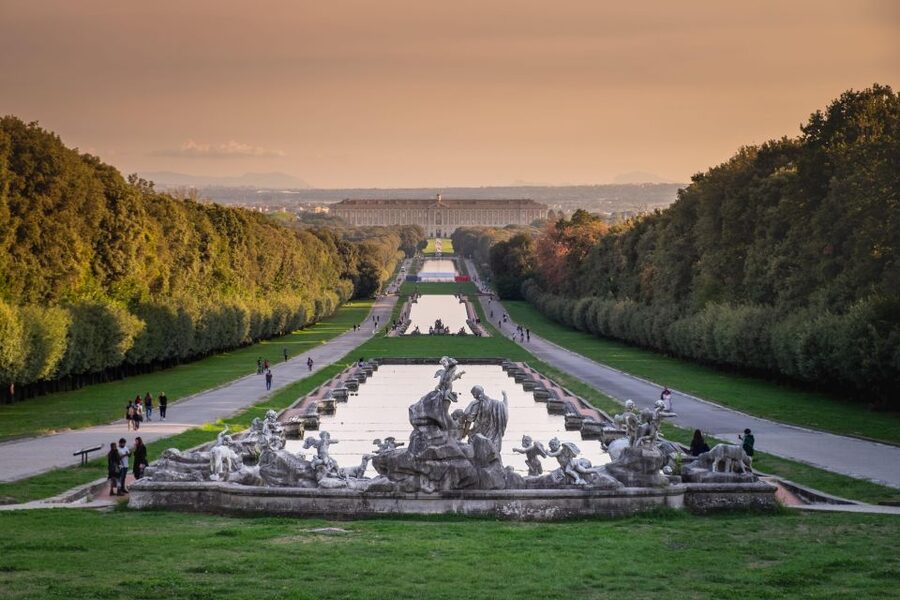
The tour begins by taking in the view toward the gardens. This is more than a pretty opening scene. It helps you grasp the palace’s long relationship with the grounds behind it and gives you a sense of the scale before you begin looking at individual rooms.
You should keep that view in mind as you move indoors. Caserta’s interior decoration is impressive, but the gardens are part of the original royal design. The palace and grounds were planned together, so it is worth treating the garden visit as a separate part of your day rather than assuming the two-hour tour covers everything.
The guide can give you the broad outline, while you save detailed garden exploration for afterward. This division works well, especially if you prefer to see the interior with a guide and then move through the grounds at your own pace.
The Palatine Chapel and the grand staircase
The Palatine Chapel is one of the early stops. Its frescoes and decorative details introduce you to the religious side of court life, while the surrounding architecture shows how carefully the palace balanced ceremony and function.
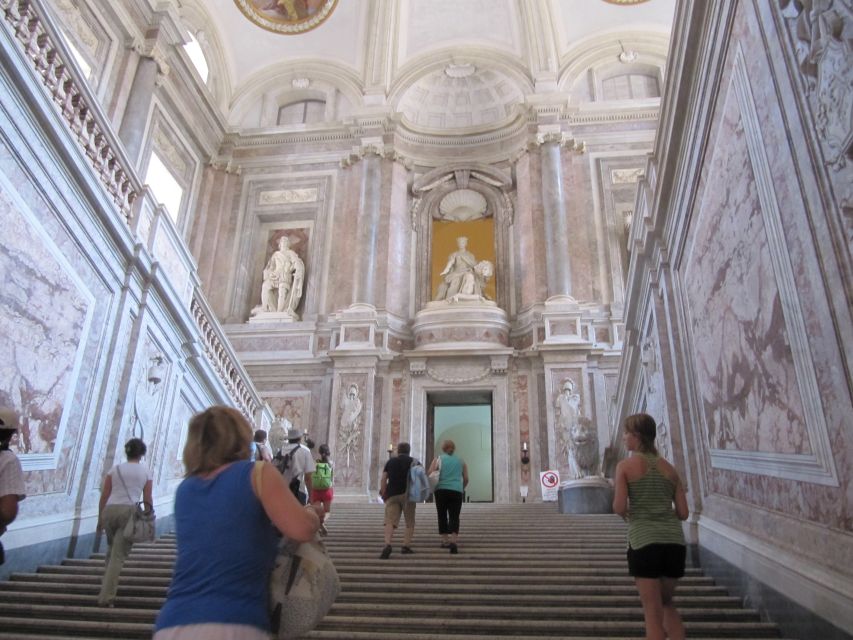
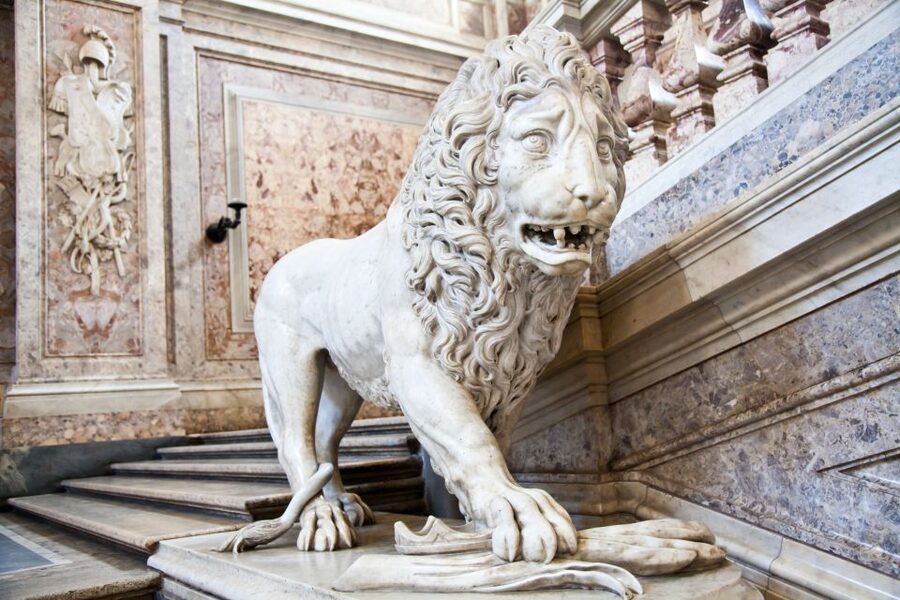
From there, you ascend the monumental staircase. The staircase has 116 marble steps and statues along the route. It is not simply a way upstairs. It was designed as a theatrical approach to the royal apartments, and the climb gives you a physical sense of how visitors were meant to experience the palace.
Take your time here if you can. The staircase is one of the most memorable parts of the visit, but it also matters practically. This tour is not suited to people with mobility impairments or wheelchair users. The provided information specifically lists those limitations, so anyone concerned about stairs should check accessibility before booking.
A different way to spend the day, same part of Italy:
- Pompeii: Small Group Tour with an Archaeologist
★ 4.8 · 12,264 reviews - From Naples: Pompeii Ruins & Mount Vesuvius Day Tour
★ 4.3 · 11,459 reviews - From Naples: Sorrento, Positano and Amalfi Full-Day Tour
★ 4.6 · 10,988 reviews - From Naples: Sorrento, Positano & Amalfi Coast – Small Group Tour
★ 5.0 · 8,643 reviews
The Throne Room and the theater of monarchy
The Throne Room is the central ceremonial space on the route. This is where the Neapolitan kings received people and performed the public side of monarchy. Expect sumptuous decoration, formal proportions, and an atmosphere designed to make visitors feel the power of the court.
A guide is helpful in this room because decoration alone does not explain how the space was used. The setting was not just luxurious. It was political theater. Every approach, doorway, and ornament helped reinforce the rank of the ruler.
The two-hour format means you will not linger indefinitely, but a good guide can point out the main features without burying you in names and dates. The strongest comments about this tour focus on guides who explain clearly, answer questions, and connect Caserta with Naples and the wider story of Italy.
The Astrea Room and Four Seasons Room
The Astrea Room brings a different mood, with celestial motifs and decorative references to the heavens. It is a good reminder that royal rooms were not decorated at random. Themes could suggest justice, order, nature, or the ruler’s place in the world.
The Four Seasons Room uses frescoes to represent the changing seasons. I like these rooms because they reward a slower look at the ceiling and walls. You are not only seeing expensive materials. You are reading an artistic program designed to surround the court with ideas about time, nature, and order.
If you visit without a guide, you might appreciate the colors and scale but miss the reason these themes appear where they do. The guide’s role here is to provide enough context to make the decoration memorable, without turning the visit into a lecture detached from what is directly in front of you.
The Palatine Library and the quieter side of court life
The Palatine Library offers a change from the formal spectacle of the throne room. Its shelves hold a large collection of rare books, making it one of the palace’s most appealing stops for anyone interested in reading, education, or the intellectual life of the court.
The library also helps round out your picture of royal life. Palaces were not only places for ceremonies and lavish apartments. They were working environments where rulers and their advisers dealt with administration, culture, religion, and political affairs.
This is one of the stops where a guide’s storytelling can make a difference. Ask questions if time allows, particularly if you want to know more about the books, the room’s purpose, or the people who used it. The small-group format is valuable here because you are less likely to feel lost at the back of a crowd.
Joachim Murat’s apartments

The final section includes the opulent apartments of Joachim Murat, Napoleon’s brother-in-law and King of Naples. These rooms shift the focus from the Bourbon palace project to a later chapter of political change.
Murat’s apartments give you a more personal view of royal living. Rather than concentrating only on state ceremony, the rooms suggest how members of the ruling elite occupied and decorated their private spaces. They also connect Caserta to the turbulent period shaped by Napoleon and the changing governments of southern Italy.
This stop is a useful finish because it brings the palace’s long political story forward. You leave with more than an image of one royal family. You see a building used by different rulers and shaped by changing power.
How the guides shape the visit
The tour is available in English, Spanish, Italian, French, German, and Portuguese. A private group option is also available, though the standard experience is designed around a small group.
The strongest guide experiences have included Alessia, Gennaro, Walter, Sylvia, Antonietta, and other members of the team. Alessia has been particularly effective with families, using details that keep children between nine and eleven interested while still giving adults useful historical context. She has also been praised for enthusiasm, humor, and an ability to connect palace stories with modern life.
Gennaro has been noted for strong English and broad knowledge of Caserta, Naples, and Italy. Sylvia has offered detailed explanations of the palace and the families connected with it. Walter and Antonietta have also led clear, engaging visits.
Guide quality can vary from one departure to another, as it does on any live tour. Still, the consistent pattern here is important: the value rests heavily on the person leading you. A guide who answers questions and keeps the group moving can turn a huge palace into a coherent story.
Headphones are provided if the group has more than six people. That matters in large rooms with hard marble surfaces, where voices can scatter. If your group is smaller, you may not need them, and the intimacy of a small group can make conversation easier.
What the garden exclusion means for your day
The tour does not include a guided visit to the Royal Park or English Gardens. You can still visit them separately, but you should not treat them as a quick add-on.
The grounds are very large, with the English Gardens at the far end of an almost two-mile route. One useful timing point is that the English Gardens close at 2 p.m., so check your schedule before beginning the palace tour if you want to include them.
You may walk, rent an ebike, use a shuttle, or take a golf cart. The ebike and shuttle can take you to the entrance of the gardens, while the golf cart can take you through them. These options are not part of the $23 guided palace price, so budget separately if you want help covering the distance.
I would allow extra time rather than trying to squeeze the gardens into the final minutes of your visit. The palace tour gives you a structured two-hour interior experience. The grounds need a more flexible plan.
Is $23 good value?
At $23 per person, this is a strong price for a two-hour guided visit with skip-the-line palace admission. You are paying less for luxury treatment than for practical orientation, which is exactly what a site this large needs.
The value is best if you want historical context and a clear route through the main rooms. You could visit independently, but the palace’s size makes it easy to see grand decoration without understanding its purpose. The guide helps you focus on the Palatine Chapel, staircase, royal rooms, library, and Murat apartments in a limited amount of time.
The price is less compelling if you want a full-day experience covering every room and the gardens. Those are not included, so you would need extra admission or transport costs where applicable, as well as more time.
Flexible booking also helps. You can cancel up to 24 hours in advance for a full refund, and you can reserve now and pay later. The palace is closed every Tuesday, as well as January 1 and December 25, so check the date before you commit.
Who should book this Caserta tour?
I would choose this tour if you are visiting from Naples or elsewhere in Campania and want an efficient first look at one of Italy’s largest royal residences. It suits first-time visitors, families who want a guide to keep the visit moving, and anyone who finds huge palaces difficult to interpret alone.
It is also a good match for people who care about architecture and court life but do not want a full-day lecture. The route includes the major visual highlights, while the guide supplies the political and cultural context.
Families should ask about the guide assigned to their departure if possible, but the format can work well with children. The staircase, hidden-looking details, grand rooms, and stories of kings can hold attention better than a room-by-room audio guide.
I would hesitate if stairs are a problem, if you use a wheelchair, or if your main goal is the English Gardens. The tour does not include a guided garden visit, and the palace route involves the monumental staircase.
Should you book it?
Book this tour if you want to understand Caserta Palace rather than simply walk through it. The $23 price, skip-the-line entry, small-group setting, and clear two-hour route make it an especially sensible choice for a first visit.
Plan the gardens separately, arrive at the central entrance with the ASKOS TOURS sign in view, and leave room in your schedule for the long grounds. If you do that, this tour gives you a focused introduction to the palace’s grandest rooms and the royal world behind them.
FAQ
Where does the Caserta Palace tour meet?
Meet at Piazza Carlo di Borbone, at the central entrance portal beneath the hanging flags. The guide will be holding an ASKOS TOURS sign.
How long does the guided tour last?
The guided palace tour lasts two hours.
What rooms and areas are included?
The tour includes the Palatine Chapel, the monumental staircase, the Throne Room, the Astrea Room, the Four Seasons Room, the Palatine Library, and the apartments of Joachim Murat.
Are the Royal Park and English Gardens included?
No. The guided tour covers the palace, but not the Royal Park or English Gardens.
Is transportation included?
No. Transportation is not included. You arrange your own transport to the meeting point and any transport you want to use in the grounds.
What languages are available?
The live guide service is available in English, Spanish, Italian, French, German, and Portuguese.
Is the tour suitable for wheelchair users?
No. The activity is not suitable for wheelchair users or people with mobility impairments.
When is the Royal Palace of Caserta closed?
The palace is closed every Tuesday, January 1, and December 25.
Recently reviewed around Naples & Pompeii
- Pompeii Skip-the-line Tour with Archaeologist Guide★ 5.0 · 559 reviews
- Sharing Tour of Pompeii★ 5.0 · 487 reviews
- Skip the Line Guided Tour of Pompeii led by an Archaeologist★ 5.0 · 703 reviews
- Visit in Pompeii – Pompeii Private Tour with Ada★ 5.0 · 436 reviews
- Pompeii Private Tour with an Archaeologist and Skip The Line★ 5.0 · 391 reviews
- Private Day Tour to Vesuvius, Herculaneum & Pompeii with Pick Up★ 5.0 · 279 reviews
- Pompeii Vineyard Escape: Private Wine Tasting & Lunch★ 5.0 · 329 reviews
- Pompeii Guided Group Tour with Entry Ticket and Archaeologist★ 4.5 · 269 reviews
Naples & Pompeii Tours, compared.
Naples Underground Entry Ticket and Guided Tour
Read our review →
Entry Ticket and Guided Tour with an Archaeologist
Read our review →



Sorrento, Positano and Amalfi Full-Day Tour
Read our review →
Sorrento, Positano & Amalfi Coast – Small Group Tour
Read our review →
Catacombs of San Gennaro Entry Ticket & Guided Tour
Read our review →Browse the lists this tour appears in