
Review · POMPEII & VESUVIUS TOURS
Pompeii: Small Group Tour with an Archaeologist
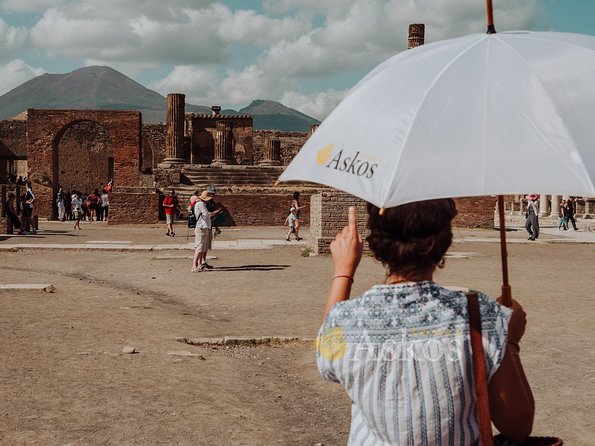
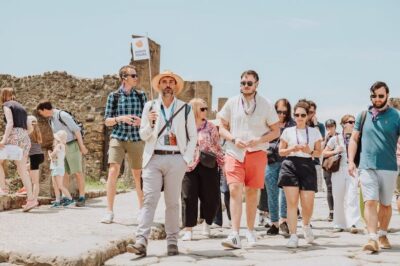
Pompeii makes far more sense when someone helps you read its streets. An archaeologist can point out cart tracks, handprints on fountains, shop entrances, plaster casts, and the small clues that are easy to miss when you walk among the ruins alone. This tour gives you that useful first look, then lets you stay inside the site and keep exploring.
I like the choice between a small-group tour and a private visit, since you can match the format to your budget and interest in questions. I also like the guides’ practical advice at the end. Guides such as Roxanne, Alessandra, Paolo, Nicoletta, and Teresa are praised for mixing facts with humor and clear storytelling, rather than turning the tour into a dry lecture.
The main drawback is time. Pompeii is enormous, and two hours only introduces it. The three-hour option adds the Villa of the Mysteries, but you will still need to choose what to see afterward. Uneven paving, ramps, steps, and a short steep climb also make this a poor fit for wheelchair users or anyone with serious mobility limits.
In This Review
- Key points to know before you book
- Why an archaeologist changes your Pompeii visit
- Entering through Porta Marina Superiore
- The Forum, Temples, and Civic Pompeii
- Baths, bakeries, and the House of Menander
- Lupanar and the adult side of ancient Pompeii
- The House of the Faun and the House of the Vettii
- The Great Theater and the three-hour choice
- Why the Villa of the Mysteries is worth the extra hour
- Group size, headsets, and guide quality
- Is $40 a good value?
- Who should book this Pompeii tour?
- My verdict on the Askos Tours experience
- FAQ
- What does the Pompeii tour include?
- What is included in the three-hour option?
- Can I choose a private tour?
- Which languages are available?
- Can I stay at Pompeii after the guided tour?
- What should I bring?
- Is the tour suitable for wheelchair users or people with mobility impairments?
Key points to know before you book
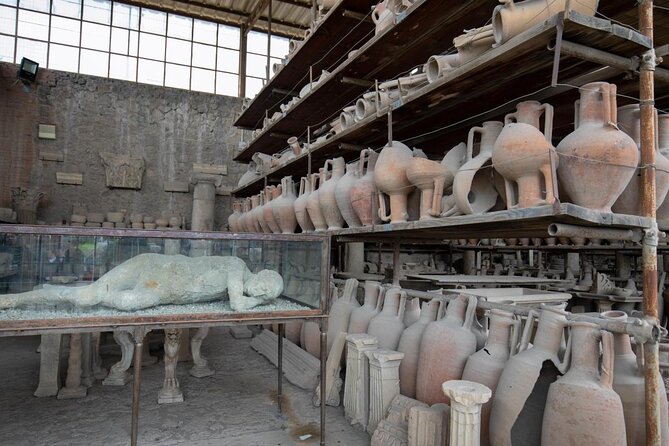
- A working archaeologist leads the visit: Expect explanations about daily life, buildings, art, burial evidence, and the eruption of Mount Vesuvius in AD 79.
- The two-hour tour is an introduction, not a full day: You will see major landmarks, then remain in the park to continue alone.
- The three-hour option includes the Villa of the Mysteries: Its preserved frescoes are one of Pompeii’s most striking artistic sights.
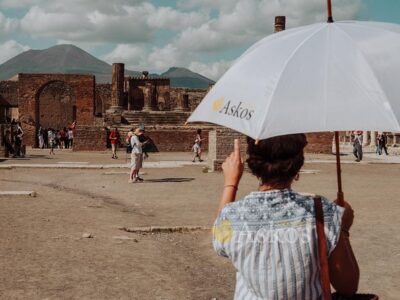
- The Forum gives you the essential orientation: You can see the old civic center and look toward Mount Vesuvius from the ruins.
- Small details make the walk worthwhile: Cart ruts, fountains, shop layouts, mosaics, graffiti, and painted walls help you picture ordinary Roman life.
- Timing affects your extra exploration: A late tour may leave only a short period before closing, and some areas can close before the official park closing time.
Why an archaeologist changes your Pompeii visit

Pompeii is not a tidy museum arranged room by room. It is a large ancient city with streets, houses, temples, shops, baths, theaters, and public buildings spread across a wide area. Without help, you can see plenty and still miss what makes the place human.
This tour gives you a framework. Your guide explains how Pompeii grew from earlier settlements into a Roman city, how public life worked, and how the eruption stopped the city in its tracks. You are not simply looking at broken walls. You are learning how to read them.
That matters most in the private homes. A doorway, pavement pattern, garden, or painted panel can reveal whether you are looking at a residence, a commercial space, or a building designed to impress. Guides have pointed out details such as different entrance features that help identify shops and homes, along with handprints on fountains and wheel marks in the road.
The tone also seems to depend heavily on your individual guide. Paolo and Pablo are praised for enthusiasm and humor. Teresa is noted for her excavation experience. Anna, Alexandra, Nicoletta, Mario, Jolanda, and others are described as engaging and generous with questions. You cannot choose a particular guide from the information provided, but the archaeologist-led format is the real reason to book this experience.
Other Pompei Campania days travellers weigh against this one:
- Pompeii: Entry Ticket and Guided Tour with an Archaeologist
★ 4.8 · 19,459 reviews - Pompeii: Skip-the-Line Entrance Ticket with Audio Guide
★ 4.0 · 2,509 reviews - Naples: Pompeii and Mt. Vesuvius with Lunch and Wine Tasting
★ 4.5 · 2,454 reviews
Entering through Porta Marina Superiore
The walk begins at Porta Marina Superiore, one of Pompeii’s ancient gates. This is a good starting point because it puts you directly into the old city rather than easing you in with a modern museum display.
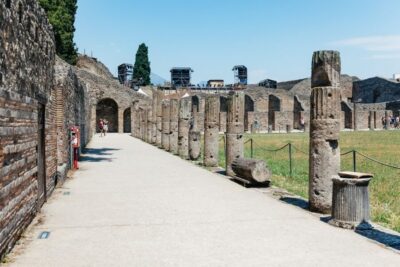
Your guide leads you along the main streets, where the paving stones and surviving buildings begin to show Pompeii as a functioning place. The city was not only a collection of grand villas. It had bakeries, public baths, temples, theaters, businesses, homes, and spaces for ordinary errands.
The site entrance and meeting point can vary with the option you book. Several possible meeting locations are listed around Via Villa dei Misteri, Via Roma, and the Hortus Pompei restaurant and garden bar area, so check your confirmation carefully. Transportation is not included, and you need to make your own way to the meeting point.
The entry ticket is included, and the tour offers skip-the-ticket-line access. Bring your passport or an accepted copy. Large bags and luggage are not allowed, though a free cloakroom is located beside the Porta Marina Superiore entrance when available.
The Forum, Temples, and Civic Pompeii
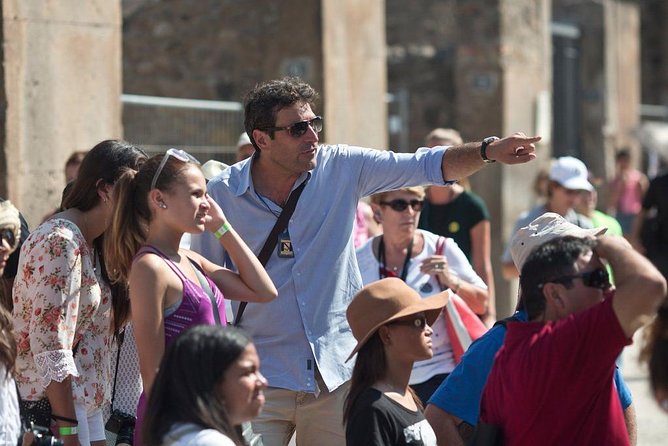
The Forum was the center of public life, and it is one of the most important stops on the walk. From here, your guide can explain how religion, politics, business, and law came together in one broad civic space.
The Temple of Apollo and Temple of Jupiter help show the city’s religious side. The Basilica served as a business and legal center, so it offers a useful contrast with the temples. This is where an archaeologist’s explanation helps you connect architecture to purpose. A row of columns may look impressive, but knowing how the building worked gives it meaning.
The view toward Mount Vesuvius adds a powerful connection between the city and the disaster that buried it. You can look across the ruins toward the volcano while hearing how ash and volcanic material preserved much of Pompeii for nearly 2,000 years.
The Forum is also where the sheer size of Pompeii starts to become clear. The ruins continue well beyond the central square. One useful piece of advice is to avoid assuming you can see everything in a single afternoon. It can take roughly half an hour to walk from one side of the site to the other, and some sections may close before the whole park does.
Baths, bakeries, and the House of Menander
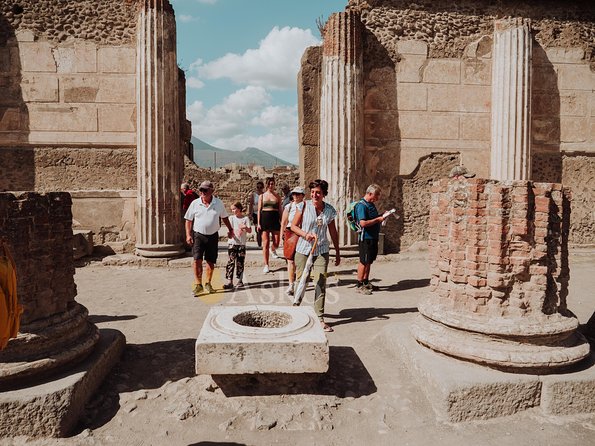
The Forum Baths show how public bathing formed part of Roman social life. The tour also includes the House of Menander, a home known for its fine decoration and scale. These stops help you move from public buildings into private life.
The bakery offers another change of pace. It shows the practical side of the city, where food was produced and sold. Pompeii becomes more relatable when you see evidence of daily routines rather than only temples and monuments.
The House of Menander and other residences also help explain the difference between a grand home and a basic dwelling. Your guide may draw attention to gardens, wall paintings, floor designs, and the way rooms were arranged around central spaces. I find these details more useful than a long list of dates because they help you picture people moving through the house.
The preserved artwork is one of the strongest reasons to take a guided tour. Mosaics and frescoes can be easy to overlook when you are focused on the larger ruins. A guide can tell you where to look and explain what the decoration says about taste, wealth, status, or Roman culture.
A different way to spend the day, same part of Italy:
- Pompeii: Skip-the-line-Ticket and Guided Tour
★ 4.6 · 1,152 reviews - Pompeii: Small-Group Tour of Pompeii and Herculaneum
★ 4.8 · 867 reviews - Pompeii: Guided Tour with Skip-the-Line Entry
★ 4.9 · 812 reviews - Pompeii: Skip-the-Line Entry Ticket with Digital Guide App
★ 4.1 · 770 reviews
Lupanar and the adult side of ancient Pompeii

The Lupanar, Pompeii’s famous brothel, is included on the route. Its name, preserved stone beds, and wall paintings are explained during the visit. The stop has adult themes, including explicit imagery and graffiti, so families should decide in advance whether it suits their children.
One parent noted that a ten-year-old largely missed the adult context, but that will depend on the child and the guide’s presentation. The material is part of the site’s real story, not a sensational extra. Your guide can place it within the wider social life of the ancient city.
The Lupanar can draw crowds. One advantage of a smaller group is that the guide may adjust the order of stops to avoid the thickest congestion. Several guides are praised for shifting the route when areas became crowded or for finding quieter corners where the group could hear more clearly.
That flexibility is useful, but it also means the exact order can change. Temporary closures and crowding may lead to slight variations in the route. The listed sights are targets, not a promise that every room will be open on your date.
The House of the Faun and the House of the Vettii
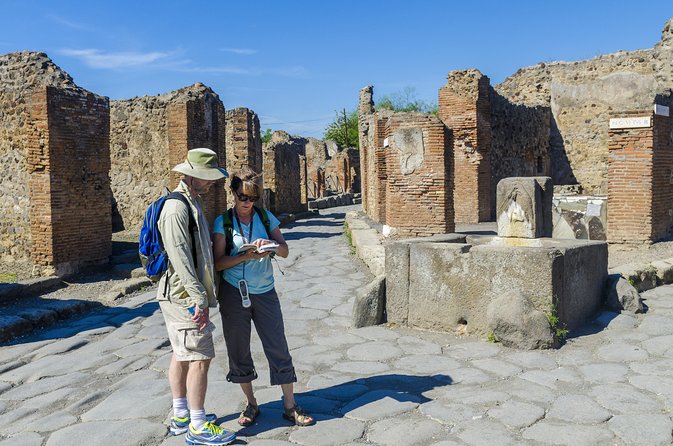
The House of the Faun is one of the major residences on the route. Its size and decoration give you a sense of how wealthy Pompeian families used architecture to display status. The House of the Vettii offers another close look at domestic decoration and elite taste.
These homes are where the tour’s focus on frescoes, mosaics, and rooms pays off. Pompeii’s art is not gathered in a separate gallery. It remains connected to the spaces where it was used. You see decoration in relation to courtyards, entrances, dining rooms, and private areas.
I especially like having a guide explain what you are looking at before you wander on your own. The site can overwhelm you with one impressive house after another. A short explanation helps you remember why a particular fresco, mosaic, or room matters.
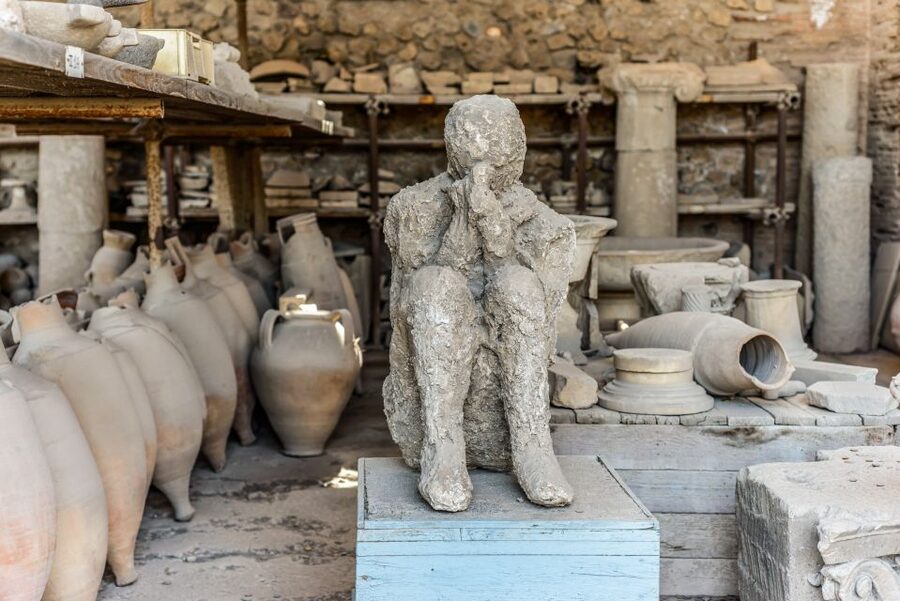
The plaster casts require a small note of caution. The tour includes a chance to see casts of people caught during the eruption, but their display locations can change. Recent information indicates that casts once seen inside dwellings may no longer be there, with three displayed in sealed glass cases. Do not plan your whole visit around a specific cast location.
The Great Theater and the three-hour choice
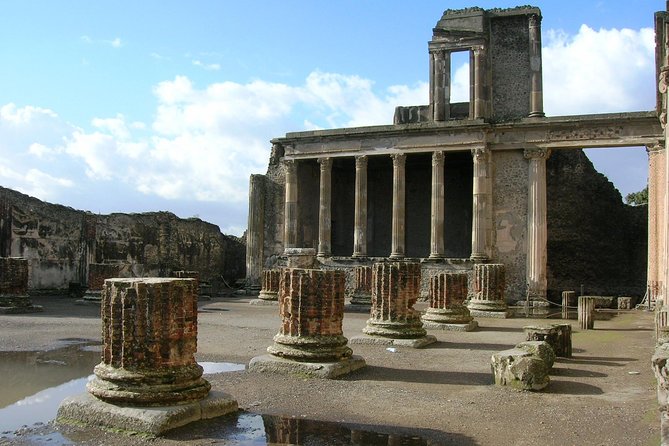
The Large Theater is one of the tour’s memorable stops. Walking into the theater gives you a strong sense of scale and place, and it is easier to appreciate when your guide explains how entertainment fitted into Pompeian life.
The two-hour option covers the central highlights and gives you a useful introduction. It is a good choice if you want structure but also prefer to spend the rest of your day setting your own route. After the guided visit, you can remain inside the archaeological site and follow the guide’s suggestions.
The three-hour option adds the Villa of the Mysteries. This is the better pick if ancient painting is a priority or if you want the guide to cover more of the site before leaving you on your own.
The extra hour costs more of your day, but it can be worthwhile. One three-hour visit included detailed explanations of the Villa’s frescoes, while another guide helped a teenager stay interested through the longer walk. Still, three hours does not turn Pompeii into a complete visit. You will continue to make choices once the formal tour ends.
Why the Villa of the Mysteries is worth the extra hour
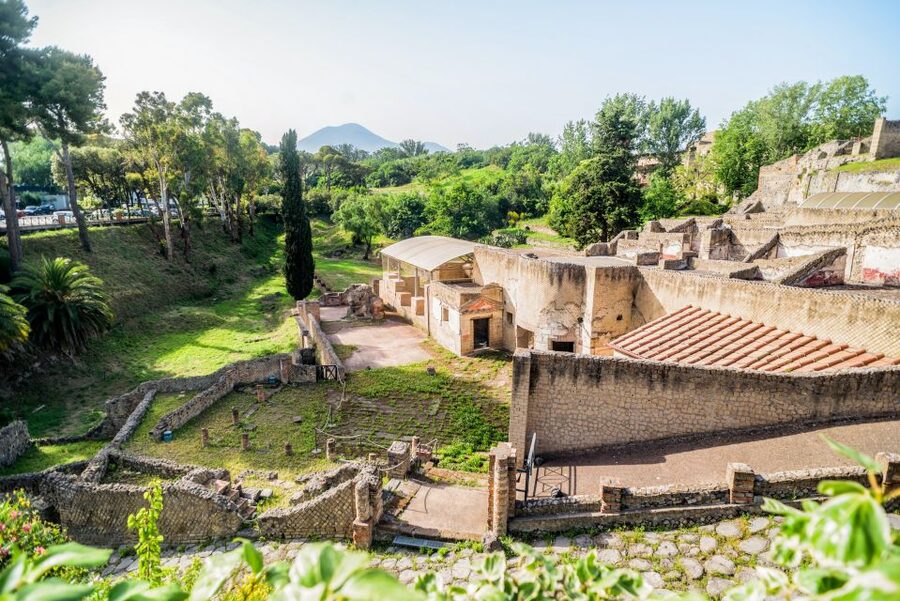
The Villa of the Mysteries is known for its remarkable frescoes, and the three-hour tour finishes there. The paintings are the main attraction, so this extension is especially useful if you want context rather than a quick look.
A guide can explain the scenes, the building, and the questions surrounding their meaning without pretending that every interpretation is certain. That kind of careful explanation is valuable at Pompeii, where art and architecture often invite debate.
The Villa is also a reason to think about timing. If you book a later tour, you may have less time afterward to explore other parts of the park. One afternoon group finished around 4 p.m. and had about an hour before closing, with some sections already shut.
For most people, a morning or earlier afternoon start makes better use of the included freedom to stay on. After the tour, ask your guide which areas remain open and which are most worth your remaining time.
Group size, headsets, and guide quality
The experience is offered as a shared small group or a private group. A shared group usually gives you the lower price, while a private visit can make it easier to ask questions and shape the pace around your party. The exact group size is not specified, so do not book this expecting a guaranteed tiny party.
Headsets are available for groups of 16 or more. That may sound backward at first, but larger groups need them most. If you join a smaller group, you may hear the guide directly, though noise and crowds can still affect how clearly you catch every word.
Guide quality is the heart of this experience. The strongest descriptions consistently focus on clear storytelling, enthusiasm, humor, and the ability to explain small details. Teresa’s excavation background, Alexandra’s work connected with burial items, and the passion shown by guides such as Nicoletta, Anna, Roxanne, Mario, and Giovanni can make the ruins feel much less distant.
Language choices include English, Italian, French, Spanish, German, and Portuguese. Shared and private options do not always offer the same languages, so check the language attached to the exact format you want.
Is $40 a good value?
At about $40 per person, the shared two-hour tour is a sensible buy for a first visit. Your ticket is included, an archaeologist gives you a clear route through major buildings, and you can stay inside afterward without paying for a second visit.
The value comes from what you would otherwise miss. Pompeii is not difficult because it lacks things to see. It is difficult because there are too many things to see, and the meaning of a doorway, wall, bath, or temple is not always obvious.
The three-hour option offers better value if you care about the Villa of the Mysteries or want a longer guided introduction. A private group is likely to appeal most if your party values a personal pace and extra questions, though the price structure for that option is not specified here.
Food, drinks, transportation, and personal expenses are extra. Plan for a long outdoor walk, bring water, and wear shoes that can handle uneven ancient paving. Smoking is not allowed, and dogs over 10 kilograms cannot enter.
Who should book this Pompeii tour?
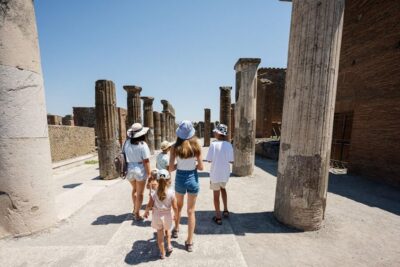
I would choose this tour for a first visit, especially if you want the ruins explained by someone trained in archaeology. It also suits families with older children and teenagers, provided you are comfortable with the adult material at the Lupanar and the physical demands of the site.
The two-hour format works for you if you want a focused orientation followed by independent wandering. The three-hour format is better if you want more art, more explanation, and the Villa of the Mysteries before exploring alone.
I would think twice if you use a wheelchair, mobility scooter, or walking stick. The site includes steps, ramps, uneven ground, slopes, and a short steep climb, and the tour is not recommended for people with mobility impairments.
If you are arriving by train or on a tight schedule, leave a margin for the meeting point. One group was helped after arriving late, but another had a check-in mix-up and had to find the guide inside. Make sure your name is checked off when you arrive, and do not assume the group will wait.
My verdict on the Askos Tours experience
Book this tour if you want Pompeii to feel like a city rather than a field of ruins. The archaeologist-led explanations, strong focus on daily life, and freedom to continue alone afterward create a good balance between guidance and independence.
Choose two hours for value and flexibility. Choose three hours for the Villa of the Mysteries and a fuller first look. Start early when possible, keep your expectations realistic about the site’s size, and save time after the tour for the areas your guide recommends.
At $40, this is a solid way to get your bearings, notice details you might otherwise walk past, and begin a longer Pompeii visit with a clear sense of what you are seeing.
FAQ
What does the Pompeii tour include?
The experience includes the Pompeii Express entry ticket, a two-hour or three-hour guided tour led by an archaeologist, and the chance to remain inside the archaeological site and explore independently after the guided portion.
What is included in the three-hour option?
The three-hour tour includes a visit to the Villa of the Mysteries, known for its preserved frescoes. The two-hour option does not include this added visit.
Can I choose a private tour?
Yes. You can choose a shared small-group tour or a private group option. The available languages can differ between these formats, so check the language offered for your preferred option.
Which languages are available?
The tour may be available in English, Italian, French, Spanish, German, and Portuguese. The language options depend on the tour format and selected departure.
Can I stay at Pompeii after the guided tour?
Yes. You are free to remain inside the archaeological site and continue exploring on your own after the formal tour ends. Your guide can suggest additional areas to visit.
What should I bring?
Bring your passport or an accepted copy. Do not bring luggage or large bags. A free cloakroom is located beside the Porta Marina Superiore entrance when the service is available.
Is the tour suitable for wheelchair users or people with mobility impairments?
No. The tour is not recommended for wheelchair users or people with mobility impairments because the route includes uneven ground, steps, ramps, slopes, and a short steep climb.
Recently reviewed around Pompei Campania
- Pompeii 3hours Villa of Mysteries tour with an Archaeologist★ 4.8 · 486 reviews
- Pompeii: Small-Group Tour of Pompeii and Herculaneum★ 4.8 · 867 reviews
- Pompeii: Skip-the-Line Entry & Audioguide★ 3.8 · 225 reviews
- Pompeii: Skip-the-line-Ticket and Guided Tour★ 4.6 · 1,152 reviews
- Pompeii: Guided Tour with Skip-the-Line Entry★ 4.9 · 812 reviews
- Pompeii: Tour with Archaeologist Guide & Skip-the-Line Entry★ 4.5 · 478 reviews
- Pompeii: Afternoon to Sunset Guided Tour with Ticket★ 4.9 · 484 reviews
- Pompeii: Skip-the-Line Entry Ticket with Digital Guide App★ 4.1 · 770 reviews
Pompeii & Vesuvius Tours, compared.
Entry Ticket and Guided Tour with an Archaeologist
Read our review →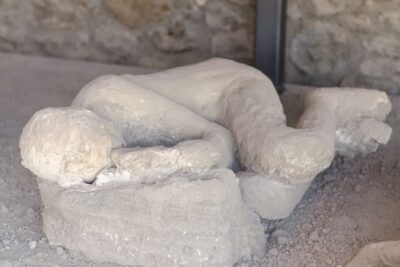

Pompeii Small Group Tour with an Archaeologist
Read our review →
Pompeii, Amalfi Coast and Positano Day Trip from Rome
Read our review →
Pompeii and Mount Vesuvius Day Trip from Rome with Pizza Lunch
Read our review →Browse the lists this tour appears in