
Review · POMPEII & VESUVIUS TOURS
Pompeii Private Tour with an Archaeologist and Skip The Line
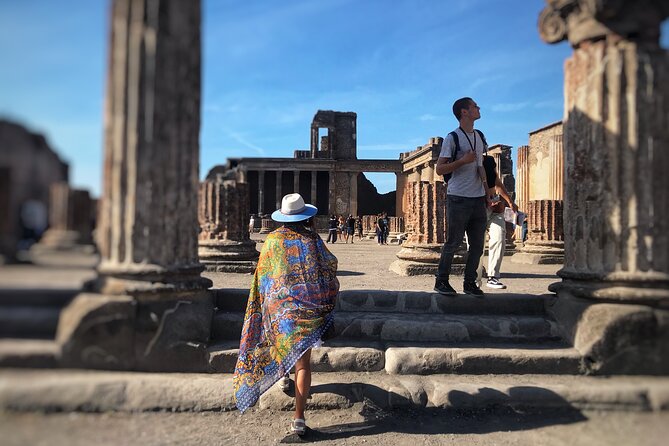
Pompeii is easiest to understand when someone helps you read the streets, houses, shops, and theaters as parts of one Roman town. This private tour puts an archaeologist beside you for the key sights, including the casts of people killed in the eruption, the Stabian Baths, the Forum, and the lavish Casa del Fauno. The casts can be sobering, but they give the ruined city a human scale.
I like two things here: the private format, which lets your guide adjust the pace and answer your questions, and the focus on high-value sights during a short two-hour visit. Guides such as Luisa, Eliana, Viktoria, and Raffaele have been praised for lively explanations, family-friendly storytelling, and finding quieter routes. The main drawback is clear: entrance tickets are not included, despite the skip-the-line wording, so you must budget another 19 euros per adult and arrange tickets before arrival if you want to avoid the ticket office.
In This Review
- Key points to know before you book
- A smart way to enter Pompeii
- Why a private archaeologist helps at Pompeii
- The Small Theater and Great Theater
- Via dell’Abbondanza and everyday Pompeii
- The Forum, Basilica, and Temples
- The Granaries and the human cost of the eruption
- The Stabian Baths and Roman leisure
- Gladiator quarters and the theater district
- The Lupanar and the less polished side of Roman life
- Casa del Fauno and the world of the wealthy
- What $375.05 means for your group
- Timing, weather, and comfort
- Who should book this Pompeii tour?
- FAQ
- Are entrance tickets included in the tour price?
- What does skip the line mean for this experience?
- How do I buy Pompeii tickets in advance?
- How long does the tour last?
- Where does the tour start and finish?
- Is this a private tour?
- What happens if bad weather cancels the tour?
- Should you book it?
Key points to know before you book
- The archaeologist changes the visit: You get context for the buildings, not just a walk past old walls.
- The route covers Pompeii’s big sights: Expect theaters, temples, baths, shops, fast food counters, the Forum, gladiator quarters, a brothel, casts, and a grand private house.
- Tickets cost extra: Adults pay 19 euros, while visitors under 18 enter free with identification.
- Skip the line needs advance planning: The operator sends a link for online tickets, usually one day before the tour.
- Two hours is a highlights visit: You will see much, but Pompeii is large enough to fill several days.
- The private group can include up to 10 people: The $375.05 price is per group, not per person.
A smart way to enter Pompeii
Your meeting point is Piazza Esedra, 10, near Pompeii Archaeological Park. The tour ends at the same meeting point, and the location is near public transportation.
The most important practical detail is the ticket arrangement. The tour price covers the authorized guide, assistance, the private format, and skip-the-line help, but it does not cover the archaeological park entrance fee. The adult ticket costs 19 euros per person. Children under 18 enter free, but they should bring a passport or other identification because staff may check their date of birth.
The operator sends a link to the official ticket website before the visit. The stated timing is usually one day before the tour, though you can contact the company earlier if you want to buy ahead. In high season, I would not wait until arrival. An online ticket lets you head toward entry rather than first joining the ticket-office queue.
This is where the phrase skip the line needs careful reading. It means help bypassing the ticket office once you already have a valid ticket. It does not mean your admission is prepaid. If you buy on the spot, you may still have to wait before entering.
More Naples & Pompeii trips worth a second look
- Herculaneum: Skip-the-Line Guided Tour with Archaeologist
★ 4.8 · 3,439 reviews - Mount Vesuvius: Skip-the-Line Ticket and Smart Digital Guide
★ 4.2 · 2,780 reviews - From Naples: Pompeii Skip-the-Line Entry Ticket and Tour
★ 4.4 · 2,753 reviews
Why a private archaeologist helps at Pompeii
Pompeii is not a compact ruin with one obvious path. It is a large Roman city, and its streets can quickly become confusing. A guide gives you a thread to follow: public life in the Forum, entertainment in the theaters, bathing at the spa, shopping along Via dell’Abbondanza, and domestic life inside wealthy homes.
The tour is offered in English, with another language possible only by request. It is designed for your own group, with up to 10 people, rather than a large mixed crowd. That matters when you want to ask questions, stop for photographs, or spend a little longer on a feature that catches your attention.
The strongest guide names attached to this experience include Luisa, Eliana, Viktoria, Raffaele, Luciana, Mattia, Antonio, Danilo, Marina, Francesco, Roberto, and Max. You cannot assume which person will lead your visit, but the guide team is presented as a group of archaeologists and authorized local guides. The best feedback centers on clear explanations, enthusiasm, patience, and the ability to change the route around a family’s interests.
Some guides have adjusted explanations for children, found shady spots during hot weather, or used a map at the end to show what to explore independently. One guide was especially praised for using a quieter back route and helping an older family group move comfortably. Those details show the practical value of a private visit: you are not locked into one pace.
The Small Theater and Great Theater
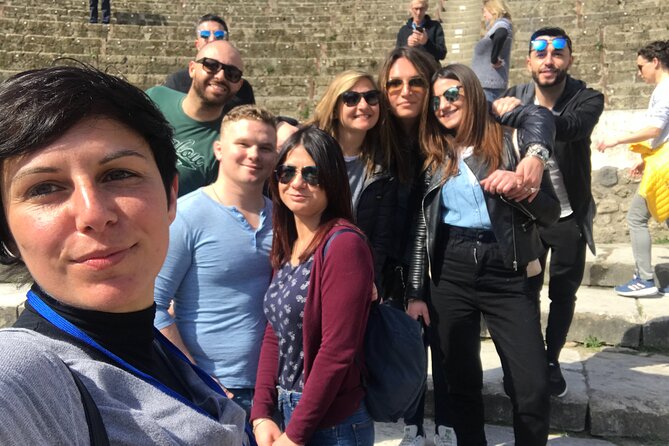
The Small Theater, or Odeion, is a good opening lesson in Roman design. Your guide explains how its shape helped carry sound, giving you a direct sense of how Romans thought about performance and acoustics.
The nearby Great Theater is the larger and more important performance space in Pompeii. Allow about 15 minutes here. You will learn how theater fit into public life, while the size of the structure helps you picture an audience gathering before the eruption.
The two theaters work well together. The Odeion shows careful design on a smaller scale, while the Teatro Grande gives you the broader civic picture. If your guide keeps moving, that is partly because Pompeii contains far more than can fit into a short tour.
Via dell’Abbondanza and everyday Pompeii
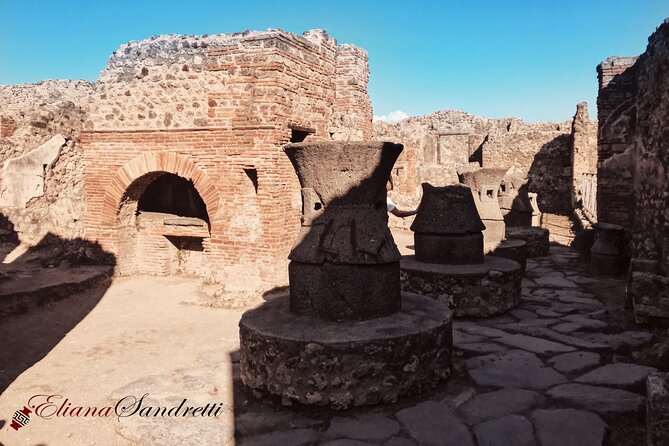
The route crosses Via dell’Abbondanza, Pompeii’s main street. This is one of the most useful parts of the visit because it connects the major monuments with ordinary urban life.
Along the way, you see shops, food counters, and signs of daily commerce. The fast-food stop is not a separate formal attraction, but it helps explain how residents bought and ate food in the city. Look for the way commercial spaces open toward the street and compare them with the larger private homes nearby.
A guide can point out details that are easy to pass without context. You may otherwise see a counter, doorway, or worn paving stones without understanding how the street functioned. The route also gives you a feel for Pompeii as a lived-in town, not simply a field of temples.
A different way to spend the day, same part of Italy:
- Naples: Naples Underground Entry Ticket and Guided Tour
★ 4.4 · 21,781 reviews - Pompeii: Entry Ticket and Guided Tour with an Archaeologist
★ 4.8 · 19,459 reviews - Pompeii: Entry Ticket with Optional Audio Guide
★ 4.2 · 12,360 reviews - Pompeii: Small Group Tour with an Archaeologist
★ 4.8 · 12,264 reviews
The Forum, Basilica, and Temples
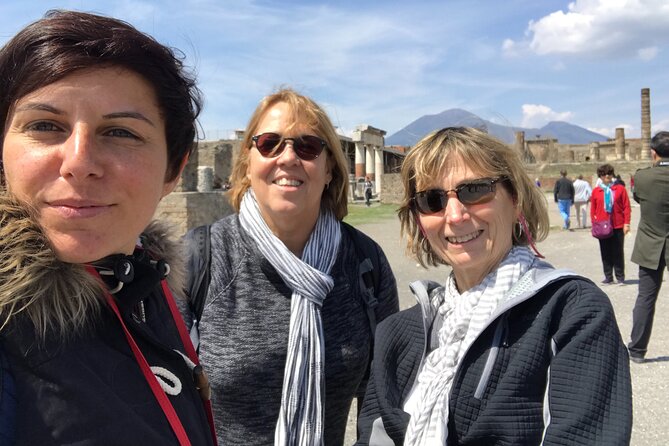
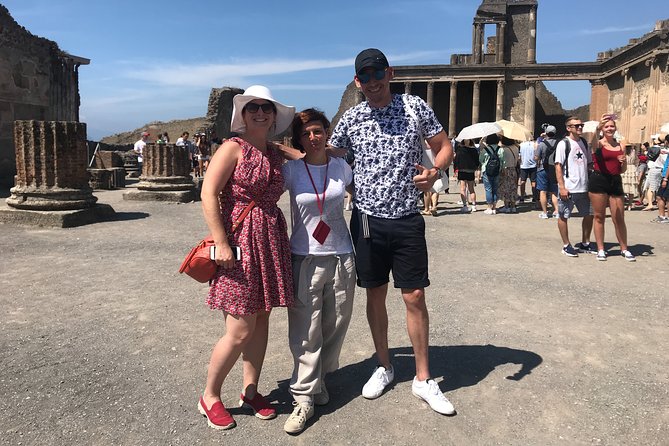
The Forum was Pompeii’s main square, a civic and religious center lined with markets and temples. The tour spends about 10 minutes at the Forum, followed by the Basilica, where legal matters were handled.
The Basilica helps you see that Roman public buildings were not only religious spaces. Justice was administered here, and the building formed part of the city’s political and commercial life. At the Forum, your guide can connect the temples and markets to the wider role of the square.
The Temple of Jupiter is also included. It occupied a major position in the Forum and gives the visit a clear religious focus. The Temple of Venus appears later in the route, reminding you that Pompeii had its own civic identity and a favored city deity.
This section is best for visitors who want structure and context. Without a guide, the Forum can feel like a wide open area surrounded by broken columns. With explanation, it becomes the city’s center of power, trade, worship, and public business.
The Granaries and the human cost of the eruption
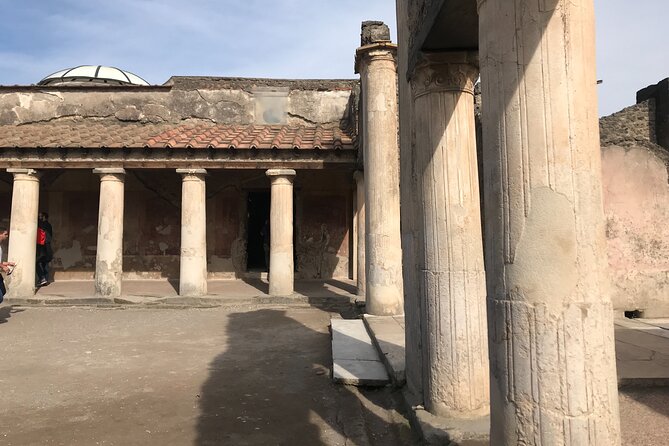
At the Granai del Foro, or Forum Granaries, you see casts of people who died during the eruption of 79 AD. The archaeological deposit also contains amphorae, tools, and other objects.
This stop may be the most emotionally difficult part of the tour. The casts are not simply archaeological curiosities. They show that the disaster affected real people in the middle of ordinary lives. I appreciate that this experience places those human remains within a wider setting of storage vessels and work tools, rather than treating them as an isolated display.
Give yourself a moment here. The two-hour schedule is brisk, but this is one place where a short pause helps. Your guide can explain what the objects reveal about work, storage, and the final days of the city.
The Stabian Baths and Roman leisure
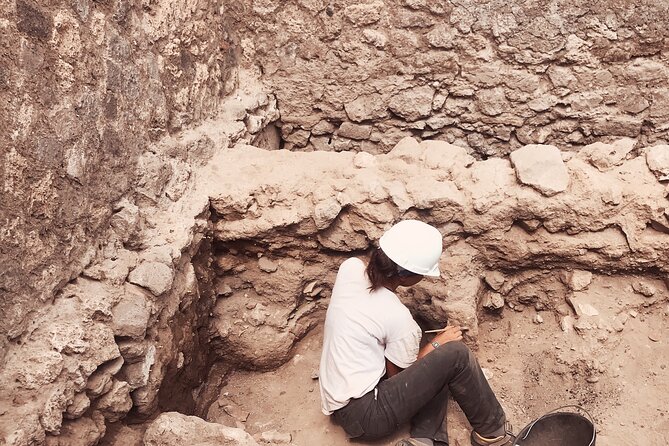
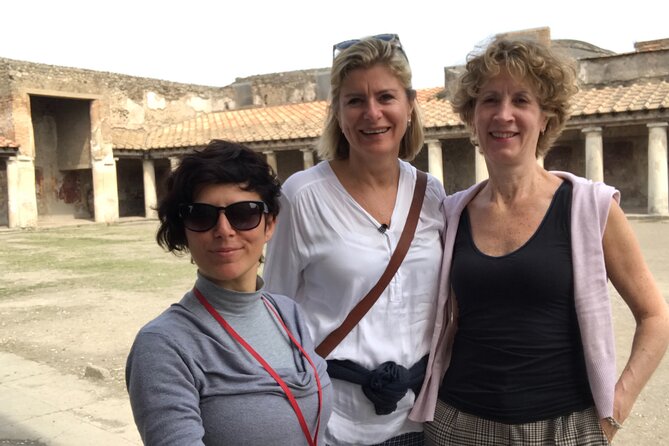
The Stabian Baths are described as the best-preserved spa complex in Pompeii. The visit lasts about 15 minutes and offers a useful look at Roman bathing culture.
Baths were not merely places to wash. They were social spaces, and the building’s layout helps show how Romans moved through public leisure. Your guide can point out the different rooms and explain how heat, water, and social life came together.
This is also a good example of why an archaeologist adds value. A bare wall or tiled room can be hard to read on your own. A guide helps you picture the building in use, then links it to the shops, Forum, theaters, and houses you have already seen.
Gladiator quarters and the theater district
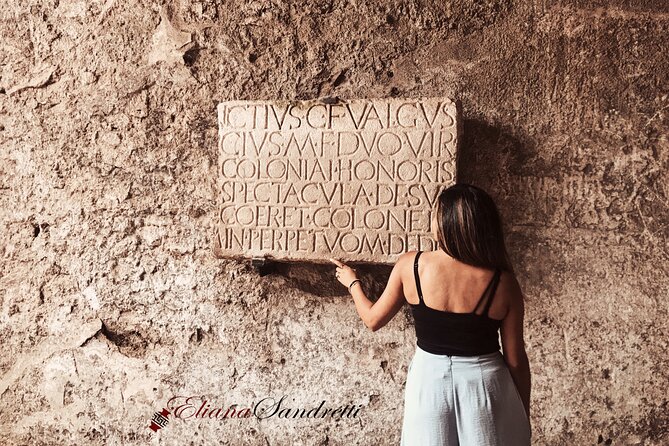
The Quadriporticus of the Theaters includes the gladiator barracks, where gladiators had apartments and trained. The area offers a different view of Pompeii’s entertainment world, away from the audience seats.
You get about 15 minutes here. The stop works especially well after the theaters because it connects the spectacle with the people who performed in it. You see the spaces associated with their daily lives, not just the grand public venue.
The experience is still a highlights tour, so the guide may not spend equal time on every room. If gladiatorial culture is your main interest, tell the guide at the beginning. The private format makes that request possible.
The Lupanar and the less polished side of Roman life
The Vicolo del Lupanare leads to Pompeii’s ancient brothel district. The stop lasts about 15 minutes and is free of a separate admission charge.
The Lupanar is often one of the most memorable parts of Pompeii, but it is worth treating it as an ordinary business within the city rather than a sensational detour. The location helps explain how commerce, entertainment, and private life overlapped in Roman streets.
Some areas of Pompeii can be closed or crowded on a given day. A private guide can adjust the order of the route, but no tour can guarantee access to every room. If this stop matters to you, mention it when you meet your guide.
Casa del Fauno and the world of the wealthy
Casa del Fauno is one of Pompeii’s grandest residences. The house gives you a look at how a wealthy family used space, decoration, and display to signal status.
The name refers to a faun sculpture, and the home is remembered for its scale and luxury. It is a strong final stop because it brings the earlier themes together: private life, art, social rank, and the contrast between a rich residence and the city’s shops or working spaces.
You may also see colorful decorations and architectural details that are easy to overlook without help. One guide used the house and other residences to make Pompeii feel like a lived-in place rather than a collection of walls. That is exactly the right approach here.
What $375.05 means for your group
The listed cost is $375.05 per group of up to 10 people. At the maximum group size, the guide fee works out to about $37.51 per person before admission. Add the 19 euro entrance fee for each adult, and the total becomes notably higher.
For two people, the private guide fee is expensive. For a family or group of eight to 10, the arithmetic is more attractive because you share the guide cost. The value also improves if you have only two hours in Pompeii and want to use that time well.
You are paying for more than a person who points out buildings. You get a private route, archaeological interpretation, assistance with entry, and the chance to shape the visit around your interests. Families may find that worth the cost, especially when children need a quicker pace or simpler explanations.
Still, budget honestly. Tickets, food, drinks, and tips are extra. The two-hour length also means you may want to stay inside the park afterward and explore on your own. The tour gives you orientation and major sights, not every corner of Pompeii.
Timing, weather, and comfort
The experience lasts about two hours. Pompeii is exposed, and hot weather can make a fast walking route tiring. Comfortable shoes, water, and sun protection are sensible, though food and drinks are not included.
A late-day start can be appealing in summer. One visit at 5 p.m. was praised for lighter crowds and less severe heat. That timing will not suit every schedule, and opening conditions can vary, but it is worth asking about available start times if you are visiting in July or August.
The tour requires good weather. If a storm cancels it, you can choose another date or receive a full refund. Most travelers can participate, and service animals are allowed. The operator also describes the activity as near public transportation.
Communication before the tour is part of the service. You should receive confirmation at booking and information about the meeting point and online tickets. Arrive with your admission arranged, your identification ready for anyone under 18, and enough time to find Piazza Esedra.
Who should book this Pompeii tour?
I would choose this tour if you have limited time, want an English-speaking archaeologist, or prefer a private visit over wandering alone. It is also a good match for families, older relatives, and groups with mixed interests because the guide can change the pace and explanation style.
The tour fits first-time visitors especially well. The route covers the Forum, Basilica, temples, baths, theaters, shops, brothel, gladiator quarters, casts, and Casa del Fauno. You get a strong introduction without spending hours trying to decode the map.
You may want something else if you prefer a full-day archaeological study or want to explore every neighborhood at leisure. Two hours goes quickly, and Pompeii is too large for any short route to cover it all. Independent visitors who already know the site may find the private guide fee harder to justify.
FAQ
Are entrance tickets included in the tour price?
No. Adult admission costs 19 euros per person. Visitors under 18 enter free, but they should bring a passport or other identification so their date of birth can be checked.
What does skip the line mean for this experience?
The skip-the-line service helps you avoid the ticket-office line after you have purchased your admission ticket. The tour price does not include entry, so you should buy through the official website or at the site.
How do I buy Pompeii tickets in advance?
The operator sends a link to the official ticket website, usually one day before the tour. You can also contact the company earlier if you want to arrange tickets more than one day ahead.
How long does the tour last?
The tour lasts approximately two hours. It covers the main sights, but Pompeii is large and you may want to continue exploring independently afterward.
Where does the tour start and finish?
You meet at Piazza Esedra, 10, 80045 Pompei, Italy. The activity ends back at the same meeting point.
Is this a private tour?
Yes. Only your group participates, with up to 10 people included in the group price.
What happens if bad weather cancels the tour?
If a storm or other poor weather cancels the activity, you can select another date or receive a full refund. You can also cancel for a full refund if you cancel at least 24 hours before the start time.
Should you book it?
Book this Pompeii tour if you want the ruins explained by an archaeologist and you value a private route over the lowest possible price. The strongest reasons are the personal attention, the broad list of major sights, and the guide team’s ability to adapt for children, older relatives, crowds, heat, and special interests.
Just handle the ticket issue before you arrive. The $375.05 price is only the guide service, and the 19 euro adult admission is separate. With that understood, this is a practical way to turn two hours in Pompeii into a focused visit that gives you both the famous sights and a clearer sense of how the city worked.
Recently reviewed around Naples & Pompeii
- Pompeii Skip-the-line Tour with Archaeologist Guide★ 5.0 · 559 reviews
- Sharing Tour of Pompeii★ 5.0 · 487 reviews
- Skip the Line Guided Tour of Pompeii led by an Archaeologist★ 5.0 · 703 reviews
- Visit in Pompeii – Pompeii Private Tour with Ada★ 5.0 · 436 reviews
- Private Day Tour to Vesuvius, Herculaneum & Pompeii with Pick Up★ 5.0 · 279 reviews
- Pompeii Vineyard Escape: Private Wine Tasting & Lunch★ 5.0 · 329 reviews
- Pompeii Guided Group Tour with Entry Ticket and Archaeologist★ 4.5 · 269 reviews
- Pompeii Private Tour with an Archaeologist and Skip The Line – 3 hours★ 5.0 · 564 reviews
Pompeii & Vesuvius Tours, compared.

Entry Ticket and Guided Tour with an Archaeologist
Read our review →




Pompeii Small Group Tour with an Archaeologist
Read our review →
Pompeii, Amalfi Coast and Positano Day Trip from Rome
Read our review →Browse the lists this tour appears in