
Review · WALKING TOURS
Discover the Charm of Palermo: A 3-Hour UNESCO Sites Walking Tour
Palermo’s story is written in layers: Greek, Roman, Arab, Norman, Spanish, and Italian influences all appear within a few blocks. This three-hour walk gives you a fast, useful introduction, moving from Teatro Massimo through markets and Baroque squares to the Cathedral and the Norman Palace.
I like the way the tour mixes grand sights with ordinary Palermo life, especially the open-air markets and narrow streets around Via Bandiera. I also like the included Cathedral visit and the Sicilian cannolo or granita at the end. The main drawback is that the Palatine Chapel is explained from outside, and the Royal Palace entry is not included.
In This Review
- Key points before you book
- Why this is a smart first morning in Palermo
- Teatro Massimo sets the scale
- Via Maqueda, Galleria delle Vittorie, and market streets
- San Domenico and Palermo’s civic memory
- Piazza Marina, the Garraffo Fountain, and old finance
- La Martorana shows Palermo’s Greek and Byzantine side
- Piazza Pretoria and the theatrical Baroque center
- Quattro Canti is Palermo’s compass
- Palermo Cathedral, with time to go inside
- Villa Bonanno and the Norman Palace area
- Pace, comfort, and practical details
- Who gets the most from this Palermo walk
- Should you book it?
- FAQ
- How long does the Palermo walking tour last?
- Where does the tour begin?
- Is entry to Palermo Cathedral included?
- Can I enter the Palatine Chapel during this tour?
- Is food included?
- Can I cancel for a full refund?
Key points before you book
- See Palermo’s major center in three hours: The route links Teatro Massimo, San Domenico, Piazza Pretoria, Quattro Canti, the Cathedral, and the Norman Palace area.
- Expect a strong local-history focus: Guides explain Palermo’s Norman-Arabic architecture, Baroque design, markets, mafia history, and daily life.
- The Cathedral is included: You go inside here, but the Palatine Chapel and Royal Palace require separate admission.
- Markets are for looking, not shopping: The route crosses colorful market streets, but the pace keeps the group moving.
- A Sicilian treat is part of the experience: You receive a typical cannolo or granita, with some tours also including a coffee stop.
- Good value at $31.88: For a small-group walk with a licensed English-speaking guide, a major church entry, and a snack, the price is reasonable.
Why this is a smart first morning in Palermo
I would put this walk near the start of a Palermo visit. The city center can feel confusing at first, with grand churches beside worn facades, busy traffic cutting through pedestrian streets, and several historical periods packed into one square.
A good guide gives those contrasts a shape. You learn why a Norman church may contain Byzantine mosaics, why an Arab-style street plan still affects the center, and how Palermo’s public squares became stages for power, religion, and civic life.
The tour is also useful for planning the rest of your stay. Guides such as Valeria, Fabio, Renata, Laura, Simone, Giada, Lara, and Debbie have been praised for clear English, local knowledge, restaurant suggestions, and an easy willingness to answer questions. Fabio, in particular, uses an amplification system, which can make a difference beside traffic and in crowded streets.
The group can include up to 20 people. That is not an intimate private walk, but it is still manageable, and some departures may be much smaller. One participant had a private experience because nobody else joined that departure.
At $31.88 per person, I see solid value if you want orientation rather than long interior visits. You are paying for a licensed guide, a carefully arranged route, entry to Palermo Cathedral, and a cannolo or granita. You are not paying for entry to every monument, hotel transport, or a long market-shopping session.
More Walking Tours in Sicily
- Palermo: NO Mafia Walking Tour
★ 4.8 · 2,431 reviews - Palermo Original Street Food Walking Tour by Streaty
★ 5.0 · 2,105 reviews - Palermo: Street Food and History Walking Tour
★ 4.9 · 1,294 reviews
Teatro Massimo sets the scale
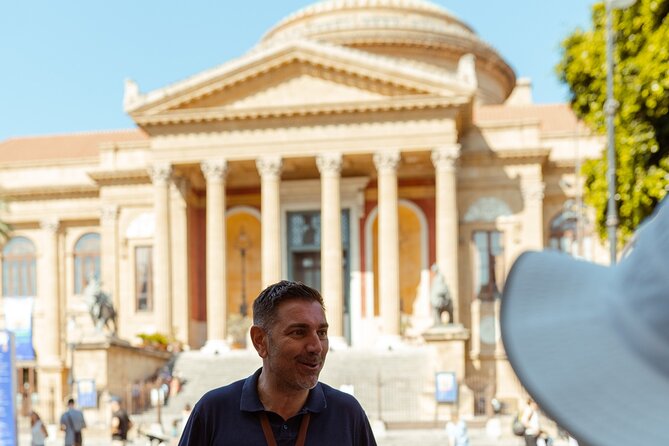
The walk begins at Via Volturno, 44, close to Teatro Massimo. The opera house sits on Piazza Verdi and is Italy’s largest, as well as one of Europe’s largest by area when it opened.
You have about five minutes here, so this is an exterior introduction rather than an opera-house tour. Your guide can explain the building’s size, its dedication to Victor Emmanuel II, and its reputation for excellent acoustics.
Teatro Massimo makes a useful opening point because it immediately shows Palermo’s grand nineteenth-century ambitions. It is also a practical landmark, easy to recognize near the meeting area.
Do not expect to enter or spend time studying the interiors. The value here is the setting and the context before the walk turns toward older Palermo.
Via Maqueda, Galleria delle Vittorie, and market streets
The route continues toward Galleria delle Vittorie, a former commercial arcade on Via Maqueda. The five-story structure has deteriorated over time, although restoration has been attempted.
This is not a polished attraction, and that is exactly why it can be interesting. Palermo often reveals its past through buildings that are partly restored, partly worn, and still tied to city life. The gallery helps your guide explain changing commerce and the uneven condition of the historic center.
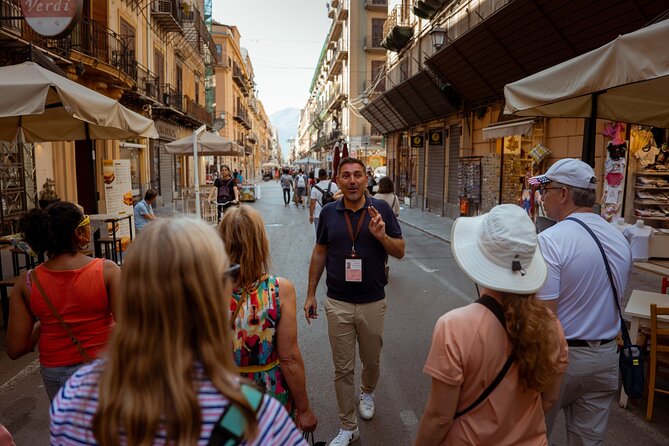
You then cross Via Bandiera near a typical open-air market. Later, the walk reaches the market around Piazza Caracciolo, part of the area once called la Bucceria, a name linked to the French word for butcher shop.
The market section is one of the tour’s most useful touches. You see the city as a place where people shop, eat, argue, and move through narrow lanes, not just as a collection of monuments. Street food is part of the atmosphere, and the area reflects Palermo’s mix of cultures.
The limitation is pace. You will pass through the market, but this is not a scheduled shopping stop. One account specifically wished for more time to browse, while also noting that the group needed to keep moving. If you want to buy food or gifts, return later on your own.
San Domenico and Palermo’s civic memory
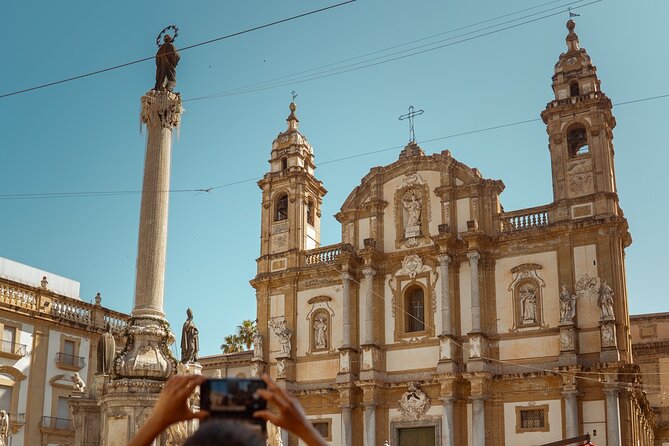
Chiesa di San Domenico fills the square of the same name with a sense of weight and ceremony. In size and importance, it follows Palermo Cathedral among the city’s best-known churches.
Inside, the church is regarded as a pantheon of important Sicilian figures. It is also linked with the city’s opposition to the mafia, giving the stop a modern civic meaning alongside its religious and artistic importance.
The scheduled visit is about ten minutes, and admission is free. That is enough for an explanation and a look around, though not enough for a slow study of every chapel or monument.
This is where a strong guide matters. The best departures connect architecture with Palermo’s political and social life. Several guides have been praised for explaining mafia history and corruption without turning the subject into cheap entertainment.
More Palermo walks with a guide:
- Palermo No Mafia walking tour: discover the Anti-mafia culture in Sicily
★ 5.0 · 1,011 reviews - Palermo: Private Custom Walking Tour with Local Guide
★ 4.7 · 661 reviews - Palermo: Street Food Walking Tour with Local Guide & Tasting
★ 4.9 · 632 reviews - Palermo Walking Tour and Street Food
★ 5.0 · 617 reviews
Piazza Marina, the Garraffo Fountain, and old finance
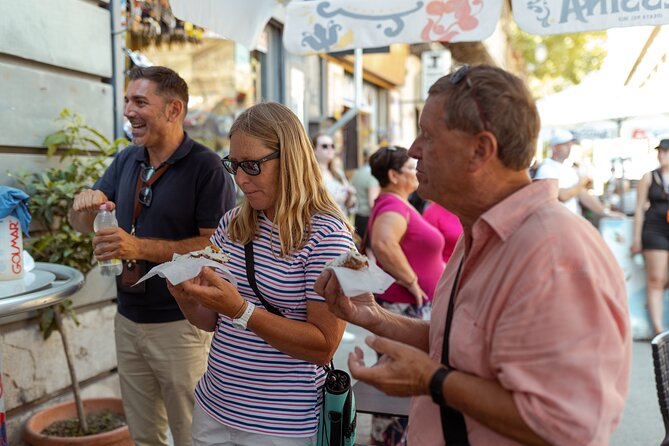
The walk proceeds through more layers of the old center, including the Garraffo Fountain. This Baroque fountain is located in Piazza Marina, near the ancient Cassaro, now Via Vittorio Emanuele.
The route also passes the former Palermo Stock Exchange. Palermo traded actively from 1845 and had one of the most important exchanges in the Kingdom of the Two Sicilies after Naples. Trading continued there until Italian stock exchanges were unified in 1997.
You may not think of a walking tour as a way to learn about finance, but this stop gives Palermo a broader identity. The city was not only a royal and religious center. It was also a commercial capital with links across Sicily and southern Italy.
The descent of the Judges adds another small but memorable street detail. It runs from Piazza Sant’Anna toward Piazza Bellini and takes its name from judges who once lived near the monastery of Santa Caterina. These brief explanations turn ordinary-looking lanes into readable pieces of the city.
La Martorana shows Palermo’s Greek and Byzantine side
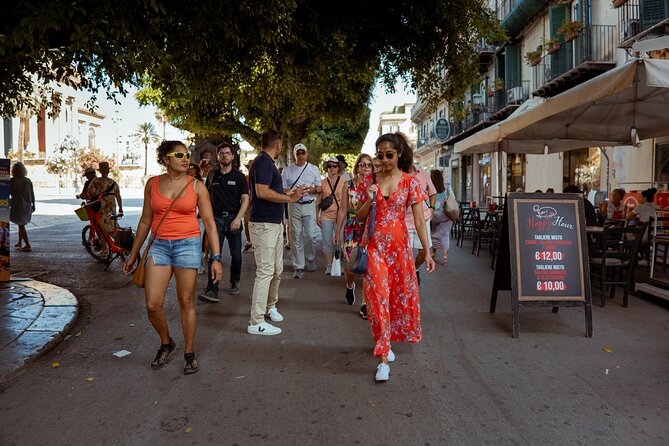
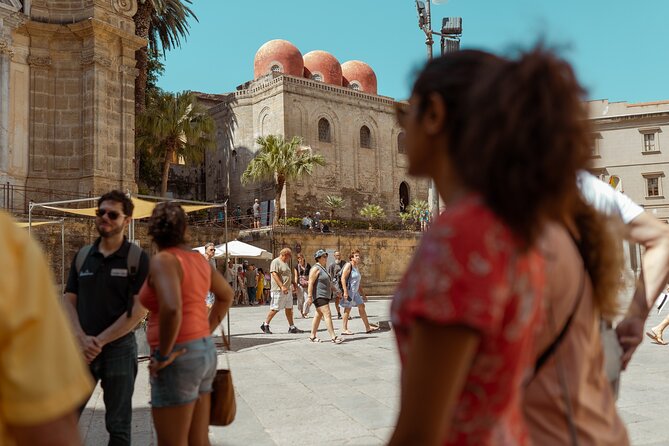
At Piazza Bellini, you see Santa Maria dell’Ammiraglio, better known as La Martorana. The church was built between 1143 and 1185 by George of Antioch, a Greek admiral who dedicated it to the Virgin Mary.
La Martorana belongs to the Italo-Albanian Catholic Church, and services have traditionally been held in Greek or Albanian. That detail matters because Palermo’s identity is not simply Norman, Italian, or Arab. Several communities shaped the city, and religious buildings preserve those connections.
The itinerary presents this as an exterior stop. Your guide explains the church’s origins and its place in the city, but you should not assume an interior visit is included.
Piazza Pretoria and the theatrical Baroque center
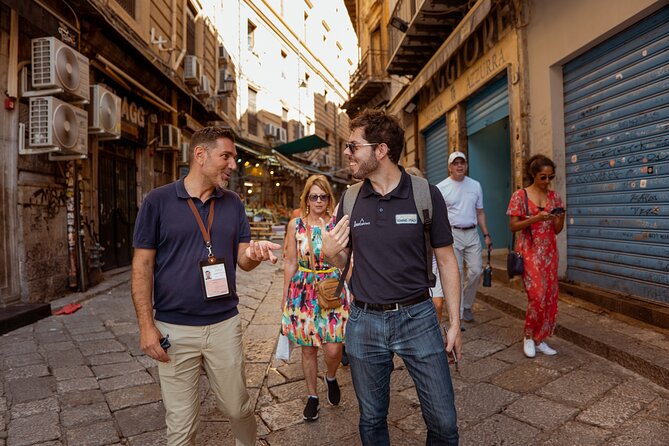
Piazza Pretoria receives about twenty minutes, giving you time to look closely at its famous fountain and surrounding architecture. The fountain was first made for a garden in Florence before arriving in Palermo.
The work was commissioned from Florentine sculptor Francesco Camilliani, a student of Baccio Bandinelli. Its crowded arrangement of figures and water basins makes the square one of Palermo’s most theatrical public spaces.
Your guide can also explain how the plot changed from a garden connected with the nuns of San Domenico to an important civic setting. This is a good place to pause and take photographs, but the square can feel exposed in hot weather.
The route does not treat the fountain as an isolated artwork. It connects the sculpture to Palermo’s habit of borrowing, relocating, and reshaping pieces of its past. That larger idea helps you understand why the city can feel visually surprising from one block to the next.
Quattro Canti is Palermo’s compass
From Piazza Pretoria, the walk reaches Quattro Canti, also called Piazza Vigliena. Four buildings frame the intersection of Palermo’s old quarters, with construction taking place between 1608 and 1620 and decorative work completed later.
The four curved facades create a compact Baroque stage. Statues and architectural details represent the seasons, Spanish rulers, and the city’s historic districts. The design was meant to make the intersection feel grand from every approach.
You spend about twenty minutes here. That is enough to hear the explanation, look up at the facades, and understand why this point works as a city compass.
I find this stop especially helpful because Palermo’s old center can otherwise feel like a maze. Once you know that Quattro Canti links the four historic quarters, the map in your head becomes much clearer.
Palermo Cathedral, with time to go inside
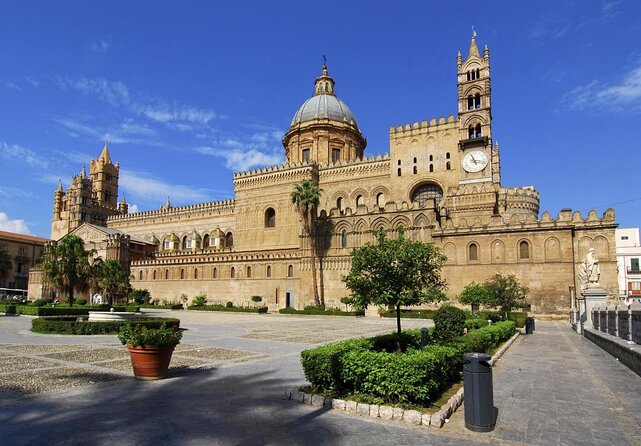
The Cathedral is the tour’s most substantial interior visit, with about thirty minutes scheduled. It began in 1184 under the Normans on a site that had previously held a Christian basilica and a Muslim mosque.
The building changed repeatedly over the centuries. Gothic, medieval, Arabic, and Neoclassical elements appear together, and a passage from the Koran remains engraved on one of the columns. The mixture is not a neat design plan. It is the visible record of Palermo’s changing rulers and religious communities.
The Cathedral was built in part to rival Monreale Cathedral, so scale and decoration were never modest goals. Your guide points out the important areas and explains what you are seeing, which makes the visit more useful than a quick unaided walk through the building.
The Cathedral entry is included, but this is still a short visit. If you want roof access, tomb details, side chapels, or a slow look at every architectural period, return later if your schedule allows.
This is also where the included treat is often served. You receive a typical Sicilian cannolo or granita. Some departures have included a coffee stop as well, but the stated inclusion is the cannolo or granita, not a guaranteed full refreshment break.
Villa Bonanno and the Norman Palace area
Villa Bonanno is a palm-filled public garden created in 1905 by mayor Pietro Bonanno. The garden includes statues and busts of notable Palermo figures, along with a fountain and monument connected with Philip V.
Roman patrician houses with mosaics were found near the garden. The mosaics of the seasons and Orpheus are now kept in the National Archaeological Museum, so do not expect to see those original pieces in the villa.
The stop lasts about ten minutes and admission is not included. It works mainly as a pause and a setting for the final approach to the Norman Palace.
The walk then reaches Palazzo dei Normanni, also called the Royal Palace. The building traces Palermo’s long political story, from early settlements through later periods. It contains the Palatine Chapel, whose Arab-Norman decoration and mosaics form part of Palermo’s UNESCO-recognized heritage.
Here you need to read the inclusions carefully. The tour explains the palace and Palatine Chapel from outside, but admission to the palace is not included. The chapel is therefore not a guaranteed interior visit.
That is the clearest weakness for anyone booking specifically to see the famous mosaics. One person found the outside explanation disappointing for that reason. If the Palatine Chapel is a top priority, buy a separate entry or choose a tour that clearly includes it.
The stated end is back at the meeting point, although the route description places the final sightseeing near the Norman Palace. Confirm the exact end point with the guide on the day, especially if you are returning to a cruise ship or have a timed reservation.
Pace, comfort, and practical details
This is a real city walk, not a slow photo tour. You cover several neighborhoods in roughly three hours, often on busy streets and through market lanes. Wear comfortable shoes and bring water, especially in warm weather.
The pace has received mixed reactions. Some people appreciated the efficient route and frequent rest stops. Others wanted more time at the markets or felt the information came too quickly. I would not choose this tour if you walk slowly or prefer long, quiet visits at each monument.
Headsets or an amplification system may be used, depending on the guide and departure. That helps near traffic and in crowded squares. Guides have also adjusted the route for heat by keeping groups in the shade when possible.
The tour operates in all weather, so carry rain protection in wet conditions. One departure continued in cold rain and still worked well, though conditions naturally affect comfort.
Most people can participate, and service animals are allowed. Pets are not permitted. Tell the operator in advance about mobility needs or other special requirements so an effort can be made to help.
There is no hotel pickup or drop-off. You make your own way to Via Volturno, 44, near Teatro Massimo, and the activity is offered in English.
Who gets the most from this Palermo walk
I would recommend it most strongly to:
- First-time visitors who want a clear map of central Palermo.
- People with only a day or two in the city.
- Cruise passengers seeking a compact introduction.
- History and architecture fans who enjoy connections between buildings and politics.
- Anyone who wants restaurant and pastry suggestions from a local guide.
- Visitors who prefer a guide to explain markets rather than simply pass through them.
You may want another format if you want extensive palace interiors, serious food tasting, or free time to shop. The route covers a lot, but it does not linger.
The tour has a maximum of 20 people, and the price is modest enough that I consider it a useful orientation expense. It can save you time later by showing where to return for a longer Cathedral visit, a market meal, or a separate Palace entry.
Should you book it?
Book this walk if you want a lively first look at Palermo and understand that the route is mainly an exterior tour with one included church entrance. The strongest features are the range of sights, the local stories, the market passages, and the practical advice you can use for the rest of your stay.
I would book it early in your visit, ideally before spending time on the center by yourself. Ask at the start whether the day includes headsets, where the final stop will be, and how the guide is handling Palace access.
Do not book it expecting to sit inside the Palatine Chapel beneath its mosaics. For that, plan a separate visit. With that one limitation in mind, the tour offers a useful three-hour introduction at a fair price, especially with an engaging guide such as Valeria, Fabio, Renata, Lara, or Debbie.
FAQ
How long does the Palermo walking tour last?
The tour lasts approximately three hours.
Where does the tour begin?
It begins at Via Volturno, 44, 90138 Palermo, Italy.
Is entry to Palermo Cathedral included?
Yes. Entrance to the Cathedral is included in the tour.
Can I enter the Palatine Chapel during this tour?
The Palatine Chapel is discussed from outside. Admission to the Royal Palace and Palatine Chapel is not included.
Is food included?
Yes. You receive a typical Sicilian cannolo or granita. Some departures may also include a coffee stop, but that is not listed as a guaranteed inclusion.
Can I cancel for a full refund?
Yes, if you cancel at least 24 hours before the experience start time. Cancellations made less than 24 hours in advance are not refunded, and late changes are not accepted.
More 3-Hour Experiences in Palermo
- Discover Palermo in 3 hours. Art, history, markets and street food
★ 5.0 · 352 reviews - Eat Like a Local: Venice 3-Hour Small-Group Food Tasting Tour
★ 5.0 · 3,137 reviews - Naples: The Holy Mile 3-Hour Guided Tour
★ 4.9 · 711 reviews - Tour of the Costa degli Dei by boat, 3 hours with aperitif included
★ 5.0 · 667 reviews
Recently reviewed around Palermo
- Sicilian Cooking Class★ 5.0 · 289 reviews
- Discover Palermo in 3 hours. Art, history, markets and street food★ 5.0 · 352 reviews
- Palermo : Private Custom Walking Tour with a Local Guide★ 4.5 · 237 reviews
- Palermo’s Delight: Unleash the Secrets of Pizza and Gelato Making★ 5.0 · 497 reviews
- Palazzo Conte Federico★ 5.0 · 650 reviews
- Palermo No Mafia walking tour: discover the Anti-mafia culture in Sicily★ 5.0 · 1,011 reviews
- Night Street Food Tour of Palermo with a Local -For real foodies!★ 5.0 · 486 reviews
- Wanna be Sicilian: Palermo Cooking Class and Market Tour★ 5.0 · 197 reviews
Walking Tours, compared.

Guided Walking Tour & Last Supper Visit with Ticket
Read our review →
Rialto Bridge & Offbeat Unusual Venice Walking Tour
Read our review →
Private 3 hrs Venice Tour: St Mark’s, Walking tour & Boat tour
Read our review →

Skip the line: Uffizi and Accademia Small Group Walking Tour
Read our review →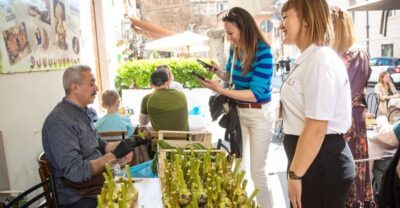
Trastevere & Campo de Fiori Street Food Walking Tour
Read our review →Browse the lists this tour appears in