

Review · POMPEII & VESUVIUS TOURS
Pompeii Small Group Tour with an Archaeologist
Pompeii is far too large to understand from a map alone. This two-hour tour with an archaeologist gives you a clear route through the ruins, linking grand public buildings with ordinary streets, bathhouses, homes, and the sobering plaster casts of eruption victims.
I like the carefully chosen highlights, especially the House of Menander and Stabian Baths, and I like that you finish inside the ruins rather than being led straight back to the entrance. Guides such as Alessandra, Paolo, Teresa, and Amedeo have earned praise for clear explanations, humor, and patience with children.
The main drawback is the group size, which can reach 20 people per guide. Two hours is enough for a strong introduction, but not enough for every corner of Pompeii. A delayed start or faulty headset can also cut into your time, so arrive early and expect a brisk walking tour.
In This Review
- Key points to know before booking
- Why an archaeologist makes Pompeii easier to understand
- Meeting at Porta Marina Superiore
- The Basilica and Forum: starting with public Pompeii
- The Forum granaries and the plaster casts
- Walking Pompeii’s original streets
- House of Menander: domestic life at its finest
- Stabian Baths and the Lupanar
- House of the Faun: Pompeii at its grandest
- The small theater and Teatro Grande
- How much can you see in two hours?
- Who should book this Pompeii tour?
- Practical value at $35.67
- Should you book it?
- FAQ
- Where does the Pompeii tour start?
- Where does the tour finish?
- Is admission to Pompeii included?
- How many people can join the tour?
- Is the tour suitable for people with mobility problems?
- What happens if I need to cancel?
Key points to know before booking
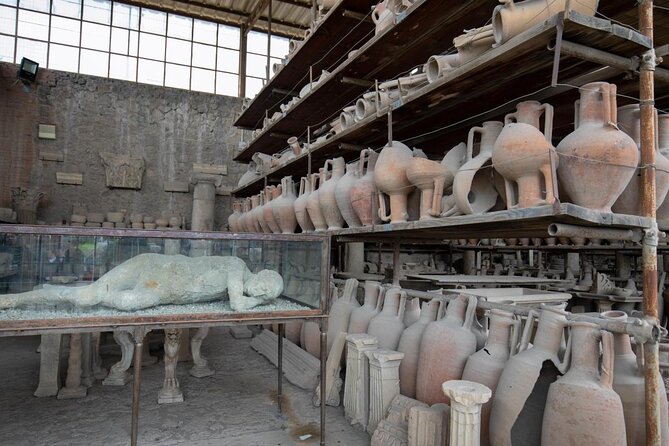
- An archaeologist leads the route: Guides including Alessandra, Paolo, Teresa, Amedeo, and Vincenzo have been praised for bringing the ruins and their people to life.
- The tour covers Pompeii’s essential sights: You see the Basilica, Forum, victim casts, House of Menander, Stabian Baths, Lupanar, House of the Faun, and both major theaters.
- The Pompeii Express ticket is included: You enter through Porta Marina Superiore with the guide instead of arranging admission separately.
- You finish inside the archaeological park: This makes it easy to continue exploring on your own after the guided portion.
- Expect uneven ground and little shade: Wear sturdy shoes, carry water, and bring sun protection, particularly in summer.
- The group can reach 20 people: Headsets are provided for groups of 16 or more, though a larger group may slow stops at popular buildings.
Why an archaeologist makes Pompeii easier to understand
Pompeii can feel like a giant stone maze. Streets cross at odd angles, buildings are partly open to the sky, and many rooms look bare until someone explains what you are seeing. A good guide gives the ruins a human scale.
That is the real value here. You are not simply shown a column and told its name. You hear how public life worked in the Forum, why Roman homes were arranged around courtyards, how the baths served different purposes, and what the eruption meant for the people caught in it.
The guides are licensed and have an archaeological background. Several named guides, including Alessandra, Paolo, Teresa, and Amedeo, are praised for combining facts with storytelling. That matters at Pompeii, where a long lecture can lose children and adults alike. A guide who can explain clearly, answer questions, and keep the pace moving will make the site much less tiring.
You also get a sense of Pompeii as a working city, not just a collection of ruins. The route moves from government and commerce to private houses, bathing, entertainment, and tragedy. That variety is one of the tour’s best features.
Other Naples & Pompeii days travellers weigh against this one:
- Naples: Naples Underground Entry Ticket and Guided Tour
★ 4.4 · 21,781 reviews - Pompeii: Entry Ticket and Guided Tour with an Archaeologist
★ 4.8 · 19,459 reviews - Pompeii: Entry Ticket with Optional Audio Guide
★ 4.2 · 12,360 reviews
Meeting at Porta Marina Superiore

The meeting point is the main archaeological entrance at Via Villa dei Misteri 2, identified as Porta Marina Superiore. Look for the guide holding a sign with Askos Tours at the top.
Plan to arrive before the stated start time. Pompeii is enormous, and once a group moves into the site, catching up can be difficult. The operator explains that late arrivals may not be able to join the guide, particularly because phone service inside the ruins can be poor. A substantial delay may also mean no refund.
The included ticket is called the Pompeii Express entrance ticket. The advertised price is $35.67 per person, which is a fair cost if you want orientation and interpretation rather than only admission. You are paying for the guide’s two hours, assistance through the entrance, and a route that avoids wasting your first hour figuring out where to go.
The tour is available in English and uses a mobile ticket. Food, drinks, and transportation are not included, so you must make your own way to Pompeii.
The Basilica and Forum: starting with public Pompeii
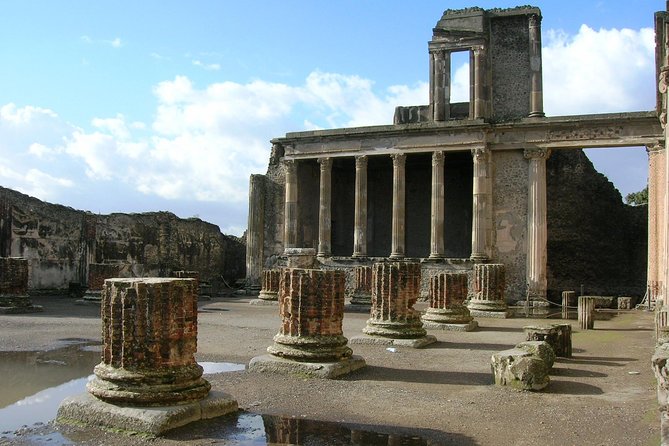
The Basilica is the first substantial stop. Despite its name, this was not a Christian church. It was a large open portico used for business, legal matters, and other public activity. The remains help you picture Pompeii as a place where merchants, officials, and customers met under shelter.
From there, the route reaches the Forum, the city’s main square. This is the logical place to begin because it introduces Pompeii’s civic center. Your guide can help you read the surrounding remains as parts of a functioning town rather than isolated walls.
The Forum is also one of the areas where a guide earns the ticket price. Its scale and importance are easier to grasp when someone points out the relationship between public buildings, temples, and the open square. Without that context, it is easy to take a few photographs and move on without understanding why the space mattered.
Expect the guide to pause for explanations here. That is useful, but it can make the tour feel stationary if too much time is spent speaking in one place. One poor experience involved a long lecture near the entrance after delays with the headsets. That does not appear to be the normal pattern, but it is a fair reminder that organization affects how much of Pompeii you see.
The Forum granaries and the plaster casts
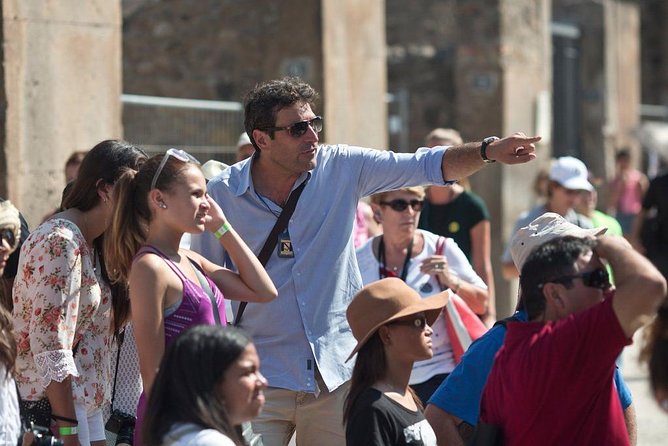
The granaries of the Forum hold one of the tour’s most emotional stops. You can see marble tables, fountain basins, decorative objects, and plaster casts connected to victims of the eruption. There are also casts of a dog and a tree.
The casts are powerful because they preserve the shape of people who died in the catastrophe. This is not a lighthearted stop, and a thoughtful explanation helps you approach it with respect. The guide connects the objects and remains to the final days of Pompeii, giving the tragedy a human focus rather than treating it as a spectacle.
Allow yourself a moment here. The tour has a set route and a limited time, but this is one place where you may want to stop listening and simply look. Families with older children and teenagers can find this section especially memorable, though parents should decide how much detail is right for younger children.
A different way to spend the day, same part of Italy:
- Pompeii: Small Group Tour with an Archaeologist
★ 4.8 · 12,264 reviews - From Naples: Pompeii Ruins & Mount Vesuvius Day Tour
★ 4.3 · 11,459 reviews - From Naples: Sorrento, Positano and Amalfi Full-Day Tour
★ 4.6 · 10,988 reviews - From Naples: Sorrento, Positano & Amalfi Coast – Small Group Tour
★ 5.0 · 8,643 reviews
Walking Pompeii’s original streets
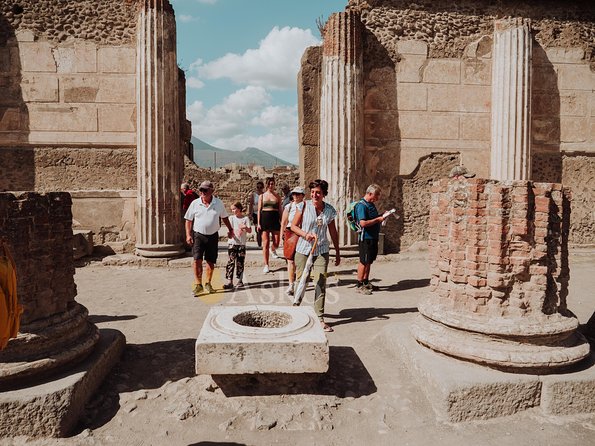
Between the major stops, you walk along the ancient paved roads. This is where the city begins to feel practical and lived in. The uneven stones are not a minor detail. They can be hard on your feet, and some roads include ramps or slightly steep sections.
Wear trainers or sturdy walking shoes. Sandals with thin soles are a poor choice. Bring a small bottle of water, a hat, sunglasses, and sunscreen. Several sections have little shade, and summer heat can make even a two-hour route feel longer.
The walk is part of the experience, not merely a way to get from one building to the next. You see how homes, public facilities, and entertainment spaces were connected. Your guide can point out details that are easy to miss when you are focused on finding the next marked site.
House of Menander: domestic life at its finest

The House of Menander is one of the most impressive private residences on the route. It is noted for its architecture, decoration, and contents, giving you a chance to see how a wealthy Pompeian household differed from the city’s public spaces.
Frescoes and mosaics are a major reason to take this tour with an archaeologist. Walls and floors can look decorative at first glance, but their placement and subject matter tell you something about the owner’s wealth and the way the home was organized.
Do not expect a complete, intact Roman house. Pompeii is a ruin under ongoing care, and access or visibility can vary. Still, this stop gives the tour a useful change of mood after the Forum and the victim casts. You move from public power and disaster to private taste and daily life.
Stabian Baths and the Lupanar
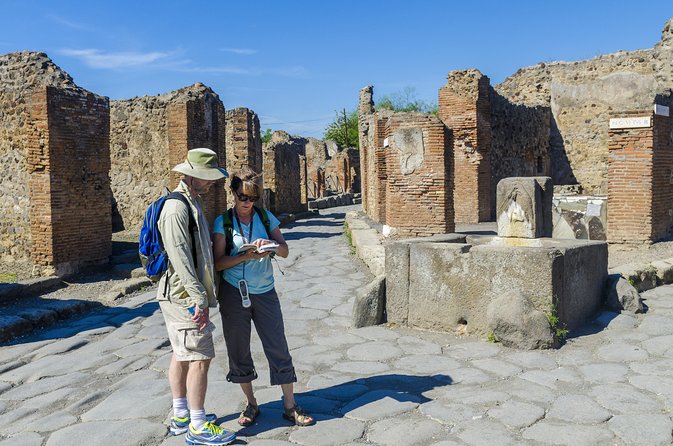
The Stabian Baths occupy a broad section near the Brothel Lane, the Holconius crossroads, and Via Stabiana. They are described as the oldest thermal complex in the city and offer a good look at the importance of bathing in Roman society.
The baths were not simply places to wash. They were social spaces, and their rooms and layout help explain how public facilities supported city life. Pompeii’s baths are also a good reminder that Roman comfort depended on complex systems of heating, water, and maintenance.
The next stop is the Lupanar, Pompeii’s most famous brothel. Small rooms and surviving wall paintings make it one of the site’s most talked-about buildings. The guide’s interpretation is useful here because the building can otherwise become a quick, jokey photo stop.
You may find this section less suitable for very young children, depending on how the guide presents the material. Children must be accompanied by an adult throughout the tour.
House of the Faun: Pompeii at its grandest
The House of the Faun was one of Pompeii’s largest and most impressive private residences. Its size helps you understand the range of wealth within the city. Pompeii was not made up only of modest shops and crowded streets. Some families lived in grand homes with elaborate decoration and substantial courtyards.
This is a good place to compare private space with the public buildings seen earlier. The Forum showed the city’s official face. The House of the Faun shows how status could be expressed at home.
The guide may spend more time at certain highlights than at others. That is normal for a two-hour tour, and it is one reason the route works best as an introduction. You receive an explanation of selected buildings rather than a full scholarly treatment of every room.
The small theater and Teatro Grande
The route includes a brief look at the Teatro Piccolo, or small theater, before ending at Teatro Grande, Pompeii’s most important theater.
The smaller theater gives you a quick sense of the city’s performance culture. The larger theater provides the stronger finish, with enough scale to show how entertainment formed part of public life. A guide can help you imagine the audience, the stage, and the role these buildings played in the city.
Ending here is practical as well as fitting. You remain inside the archaeological park after the tour, so you can continue at your own pace. This is a major advantage. Pompeii is too large to finish in two hours, and the guided route is best treated as your foundation for further exploration.
Ask your guide where to go next before the tour ends. One useful criticism of the experience was that the guide did not clearly explain how to find the exits. Since you finish inside the ruins, you should confirm the nearest exit and any areas worth visiting afterward.
How much can you see in two hours?
You can see many of Pompeii’s major highlights in two hours, but you cannot see the entire site. The route includes nine named stops, plus the main street, the small theater, and connecting roads. That is a solid introduction, especially if you have limited time.
The pace is generally described as relaxed enough to enjoy, with guides adjusting for the group’s ability. At the same time, larger groups can take longer at each building because everyone needs a chance to gather and see the important details.
A group of up to 20 is not truly intimate. If you want constant access to the guide or a very flexible route, a private tour may suit you better. For the $35.67 price, though, the group format keeps the cost reasonable while giving you expert interpretation.
Headsets are included for groups of 16 or more. They should make it easier to hear while walking, though technical problems can happen. Arriving early gives staff more time to sort out equipment before the clock starts.
Who should book this Pompeii tour?
I would choose this tour if you are visiting Pompeii for the first time, have roughly two hours for a guided overview, or feel uneasy about navigating a huge archaeological park alone. It is also a good fit for families with older children and teenagers, since several guides have been praised for using humor and keeping young people involved.
It suits you especially well if you want the story behind the stones. The guide explains architecture, public life, homes, baths, theaters, and the human cost of the eruption. You then have the option to remain inside and continue on your own.
You should think twice if you have significant mobility limitations. The site includes uneven ground, steps, ramps, and some slightly steep climbs. Mobility scooters are not allowed. Small dogs weighing no more than 10 kilograms and measuring no more than 40 centimeters at the shoulder may enter under the stated conditions, including a leash and being carried inside buildings.
The tour runs year-round, rain or shine. That makes weather planning important. On hot days, sun protection and water are essential. On wet days, uneven ancient paving may be more awkward underfoot.
Practical value at $35.67
At $35.67, the tour offers good value if you use it as a guided orientation rather than your complete Pompeii visit. Admission is included, and you get a licensed guide with an archaeological background, assistance for the full tour, and headsets for larger groups.
The strongest value comes from the route. You see the Forum, a wealthy house, public baths, a brothel, theaters, streets, and the victim casts in one compact visit. That range would be difficult to organize efficiently if you were unfamiliar with the site.
The price is less attractive if you want a very small group. Twenty people is the maximum, and a full group can make it harder to hear without headsets or gather quickly around a fresco. Still, private tours cost more, and this option gives you the main interpretive benefit at a moderate price.
You can cancel for a full refund up to 24 hours before the local start time. Cancellations or changes within 24 hours are not refunded, so do not book this with a loose schedule or an uncertain arrival plan.
Should you book it?
Book this Pompeii tour if you want a clear, efficient introduction led by an archaeologist, especially on a first visit. The strongest guides, including Alessandra, Paolo, Teresa, Amedeo, and Vincenzo, have been praised for clear storytelling, humor, patience, and a genuine concern for the site.
Do not expect to see every house or complete the ruins in two hours. Arrive early, wear sturdy shoes, bring water and sun protection, and stay inside afterward to explore more. If you can accept the possible 20-person group and the brisk route, this is a sensible way to make Pompeii feel like a city rather than a pile of ancient walls.
FAQ
Where does the Pompeii tour start?
The tour starts at Porta Marina Superiore, the main archaeological entrance at Via Villa dei Misteri 2, Pompei. The guide holds a sign with Askos Tours at the top.
Where does the tour finish?
The tour finishes inside the Pompeii archaeological ruins. You can continue exploring independently after the guided portion.
Is admission to Pompeii included?
Yes. The Pompeii Express entrance ticket is included in the tour price.
How many people can join the tour?
The group can have a maximum of 20 travelers per guide. Headsets are provided for groups of 16 or more.
Is the tour suitable for people with mobility problems?
The tour is not recommended for people with mobility issues because the route includes steps, ramps, uneven ground, and slightly steep climbs. Mobility scooters are not allowed.
What happens if I need to cancel?
You can receive a full refund if you cancel at least 24 hours before the experience starts. Cancellations or changes made less than 24 hours before the start time are not refunded.
Recently reviewed around Naples & Pompeii
- Pompeii Skip-the-line Tour with Archaeologist Guide★ 5.0 · 559 reviews
- Sharing Tour of Pompeii★ 5.0 · 487 reviews
- Skip the Line Guided Tour of Pompeii led by an Archaeologist★ 5.0 · 703 reviews
- Visit in Pompeii – Pompeii Private Tour with Ada★ 5.0 · 436 reviews
- Private Day Tour to Vesuvius, Herculaneum & Pompeii with Pick Up★ 5.0 · 279 reviews
- Pompeii Private Tour with an Archaeologist and Skip The Line★ 5.0 · 391 reviews
- Pompeii Vineyard Escape: Private Wine Tasting & Lunch★ 5.0 · 329 reviews
- Pompeii Guided Group Tour with Entry Ticket and Archaeologist★ 4.5 · 269 reviews
Pompeii & Vesuvius Tours, compared.

Entry Ticket and Guided Tour with an Archaeologist
Read our review →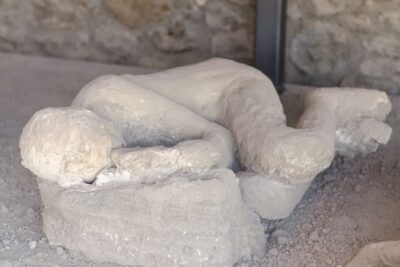



Pompeii, Amalfi Coast and Positano Day Trip from Rome
Read our review →
Pompeii and Mount Vesuvius Day Trip from Rome with Pizza Lunch
Read our review →Browse the lists this tour appears in