
Review · POMPEII & VESUVIUS TOURS
Priority Access Pompeii & Mt. Vesuvius Full day from Sorrento
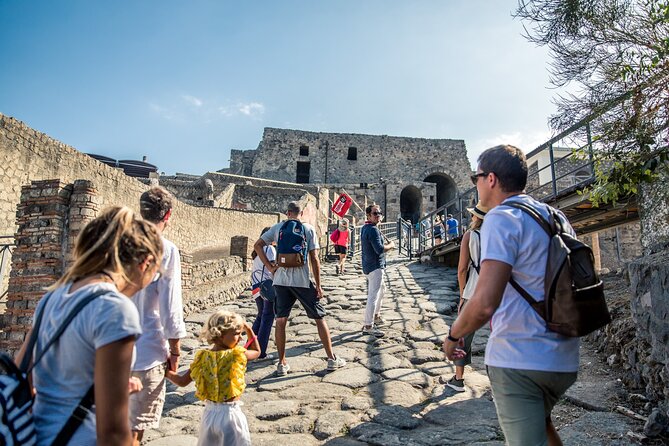
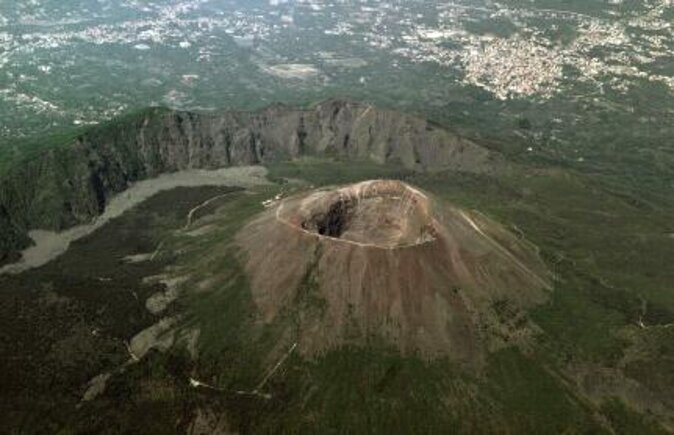
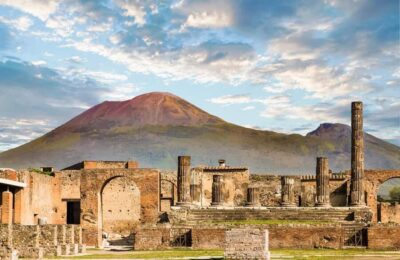
Pompeii and Mount Vesuvius make a natural double act: one is the Roman city destroyed by the volcano, and the other is the volcano itself. This eight-hour trip from Sorrento lets you walk Pompeii’s streets in the morning, then climb from about 1,000 meters to the crater rim at roughly 1,280 meters.
I like the early start, which can get you inside Pompeii before the biggest crowds arrive, and I like having round-trip transport on roads where a large vehicle takes real skill. Guides such as Louisa, Lulu, Roberto, and Luigi have earned praise for mixing solid facts with humor and keeping the day moving.
The trade-off is time. Traffic and the distance from Sorrento mean that a large part of the day is spent in the minibus, and the Pompeii portion can feel brisk. The group may also feel bigger than expected, so this is a practical highlights tour, not a slow private walk.
In This Review
- Key points to know before booking
- Why this Sorrento day trip works
- Starting at Piazza Torquato Tasso in Sorrento
- Pompeii before the crowds
- The Forum, Temple of Jupiter, and Macellum
- Baths, shops, and the less polished side of Pompeii
- The House of the Faun and Pompeii’s elite
- Theater and Basilica
- Lunch before the volcano
- Climbing Mount Vesuvius to the crater
- How the guide affects the Pompeii visit
- Group size, timing, and who should book
- Should you book this Pompeii and Vesuvius tour?
- FAQ
- Where does the tour depart from?
- Where does the tour end?
- How long does the tour last?
- Are Pompeii and Vesuvius admission tickets included?
- Is lunch included?
- How difficult is the Mount Vesuvius hike?
- What happens if Mount Vesuvius is closed?
Key points to know before booking
- Two major sights in one day: Visit the Pompeii ruins and hike Mount Vesuvius without arranging separate transport.
- An early Pompeii arrival: The morning timing can help you see important ruins before the site becomes much busier.
- A real uphill walk: The path to the crater is uneven and steep in places, so firm shoes and moderate fitness matter.
- Guided Pompeii highlights: See the Forum, Temple of Jupiter, Macellum, Stabian Baths, Via dell’Abbondanza, Lupanar, House of the Faun, theater, and Basilica.
- Transport and admissions included: The price covers the air-conditioned vehicle, Pompeii and Vesuvius entry, skip-the-line access, and a Pompeii guide.
- Lunch costs extra: You can arrange your own meal, with an optional fixed-price lunch reported at €18.
Why this Sorrento day trip works
At $139.07 per person, this tour is priced for convenience. You are paying for transport from central Sorrento, entrance fees, a Pompeii guide, and access to two headline sights. If you tried to arrange both places independently, you would still need to manage transport, tickets, timing, and the climb at Vesuvius.
I see the main value in the combination. Pompeii gives you the human story: homes, shops, baths, public buildings, and streets frozen by the eruption of AD 79. Vesuvius gives you the physical setting and lets you look into the crater that shaped the whole region.
That convenience comes with a compromise. This is not a day built around lingering in one place. The schedule covers many Pompeii highlights, but some stops last only about ten minutes. If you want to study every mosaic, read every sign, or wander far beyond the main route, you may prefer a separate Pompeii visit.
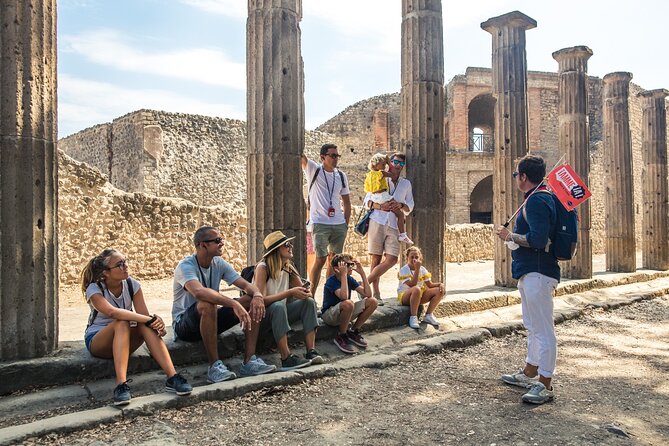
The experience is offered in English, though the guide may be multilingual. The stated maximum is 30 people, and headphones are provided in Pompeii for groups larger than ten. Those headphones matter. Pompeii is spread out, and it is easy to lose the guide’s voice when other groups are nearby.
More Sorrento trips worth a second look
- From Sorrento: Amalfi and Positano Full-Day Trip by Boat
★ 4.7 · 1,041 reviews - Sorrento: Full-Day Boat Tour to Positano, Amalfi and Ravello
★ 4.3 · 793 reviews - From Sorrento: Amalfi Coast Full-Day Trip by Boat
★ 4.8 · 367 reviews
Starting at Piazza Torquato Tasso in Sorrento
The meeting point is the IAMME IA! Gray Line Amalfi Coast office at Piazza Torquato Tasso, 16, in central Sorrento. The tour ends at the same meeting point, which makes planning your evening simple.
You board a climate-controlled minibus and head inland. The vehicle is an important part of the package because the route combines city traffic with narrow, winding roads on the approach to Vesuvius. Drivers including Luciano and Rosario have been singled out for handling the bends and tight parking areas with care.
Comfort is less certain. Some departures use a pleasant vehicle, while the close seating has been uncomfortable for some people. If you are tall or dislike sitting close to other passengers, keep the transport style in mind. It is a shared minibus experience, not a roomy coach or private car.
The drive also limits the amount of time you spend walking. Depending on traffic, roughly three to four hours of the eight-hour day can be taken up by transport and the lunch stop. That is not unusual for a Sorrento excursion to Pompeii and Vesuvius, but it is worth knowing before you book.
Pompeii before the crowds
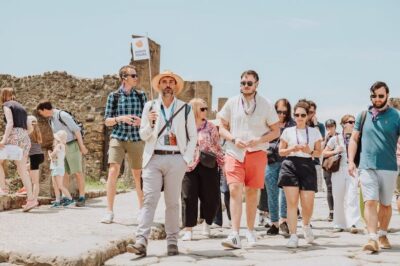
The first main stop is the Archaeological Park of Pompeii, where you have about two hours with admission included. The early timing is one of the tour’s strongest practical features.
Arriving early can give you a quieter first stretch through the ruins. Several departures have reached Pompeii before the rush, allowing the group to see key areas with more room to listen and take photographs. By the time you leave, the difference can be striking, with larger crowds arriving behind you.
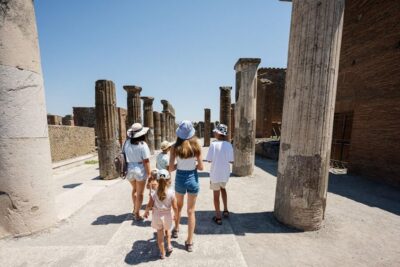
The guided walk focuses on the city’s main public and private spaces. Pompeii was not a simple collection of broken walls. Before the eruption, it was a functioning Roman town with places for trade, worship, politics, bathing, entertainment, and private life.
Your guide explains how ash and pumice from Vesuvius buried the city in AD 79. The covering preserved walls, streets, decorative floors, and building layouts in a way that gives you a rare look at Roman urban life.
A guide can also help you make sense of scale. Pompeii is vast, and without a plan you could spend a lot of time walking between areas without understanding how the city worked. The route here is designed to show important highlights rather than every open building.
The Forum, Temple of Jupiter, and Macellum
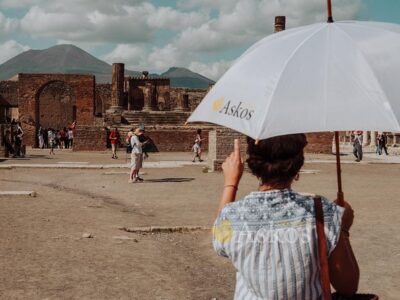
The Civil Forum was Pompeii’s civic center. It brought together public administration, justice, business, markets, and worship, so this is the place where the guide can explain how the city functioned as a whole.
You then see the Temple of Jupiter, or Capitolium. It was dedicated to Jupiter, Juno, and Minerva, the central gods of Roman state religion. Its position at the Forum helped make it one of the city’s most important religious buildings.
The Macellum was the food and provision market. Its location beside the Forum tells you how closely commerce and public life were linked. The building had already been damaged by the earthquake of AD 62, years before the final eruption, a reminder that Pompeii was in the middle of repair and rebuilding when disaster came.
These stops are short, usually around ten minutes each. That pace lets you cover several key structures, but it also means you need to listen while walking and avoid getting separated from the guide.
A different way to spend the day, same part of Italy:
- Sorrento: Exclusive Capri Boat Tour and Optional Blue Grotto
★ 4.8 · 3,170 reviews - Sorrento Farm and Food Experience including Olive Oil, Limoncello, Wine tasting
★ 5.0 · 2,524 reviews - Capri Blue Grotto Small-Group Boat Day Tour From Sorrento
★ 4.5 · 2,511 reviews - From Sorrento/Nerano: Amalfi and Positano Boat Tour
★ 4.6 · 2,440 reviews
Baths, shops, and the less polished side of Pompeii
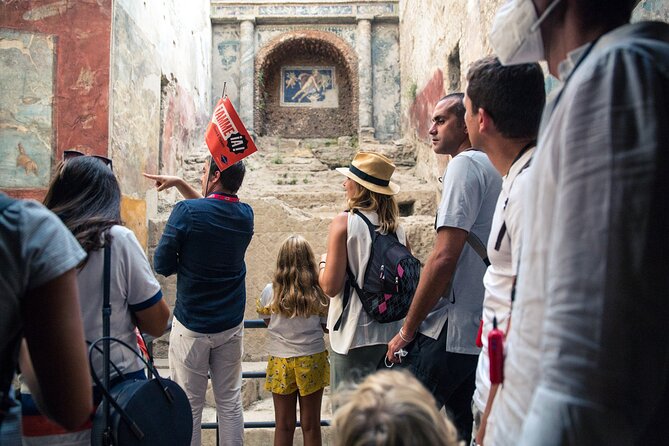
The Stabian Baths offer a close look at Roman bathing culture. The complex had separate men’s and women’s areas, with spaces for changing, cold baths, medium-temperature baths, and hot baths. The men’s section includes an apodyterium, tepidarium, frigidarium, and calidarium.
The baths were also damaged in the earthquake of 62 AD. Their partially restored rooms help show both the sophistication of Roman engineering and the damage Pompeii suffered before the eruption.
The route also includes Via dell’Abbondanza, the city’s main east-west street. In ancient times, this was a busy commercial road lined with shops, workshops, cafés, snack bars, and places selling food and drink. The street can be more revealing than a grand temple because it shows ordinary daily routines.
The Lupanar, Pompeii’s best-known brothel, is another stop on the route. Its erotic wall paintings are famous, and the name comes from the Latin word for brothel. It is a memorable, sometimes surprising part of the visit, especially for anyone interested in the everyday realities of Roman society rather than only its public monuments.
The House of the Faun and Pompeii’s elite
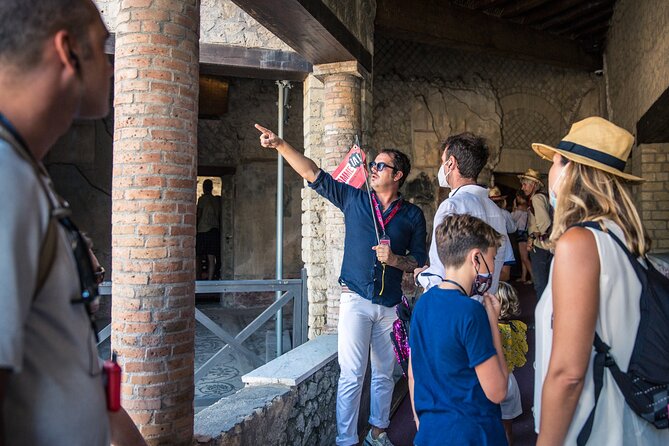
The House of the Faun occupies an entire city block and ranks among Pompeii’s largest and most luxurious private homes. It takes its name from the bronze dancing faun once found in the main atrium.
The house reflects the wealth of Pompeii’s upper class. Its two garden courtyards, large rooms, and detailed floor mosaics show how private residences could be designed to impress visitors.
The most famous artwork associated with the house is the Alexander Mosaic, depicting Alexander the Great battling Darius III of Persia. The original is now displayed in Naples, but the house remains an important stop because it helps you picture the scale and ambition of an elite Roman home.
This is a good example of why a guided visit helps. A quick look at a grand entrance does not tell you much on its own. With context, you can read the home as a statement of status, taste, and contact with the wider Greek and Roman world.
Theater and Basilica
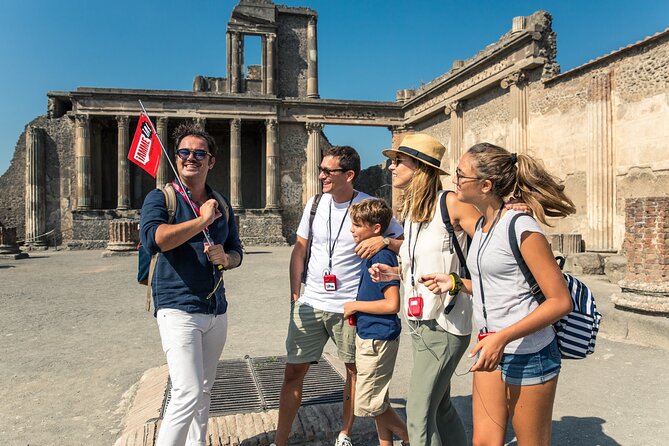
The Large Theater was built into a natural slope, allowing the Romans to use the shape of the ground for the auditorium. It was divided into five sections and hosted tragedies based on Greek and Roman traditions.
The theater gives the day a welcome change of pace after the streets and houses. You can picture Pompeii as a place of public entertainment, not just a city preserved by catastrophe.
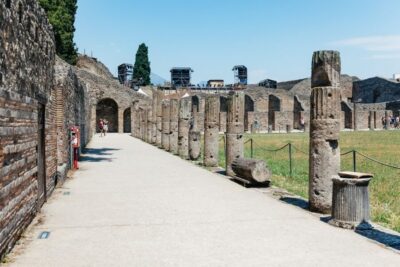
The Basilica, covering about 1,500 square meters, was the Forum’s grandest building. It was used for business and the administration of justice. Though its modern appearance is ruinous, its size and position show how central law and commerce were to city life.
At the end of the Pompeii walk, you have seen religious buildings, commercial spaces, homes, leisure facilities, and civic structures. That broad range is the tour’s strength. Its weakness is that two hours cannot give you an exhaustive visit to such a large site.
Lunch before the volcano
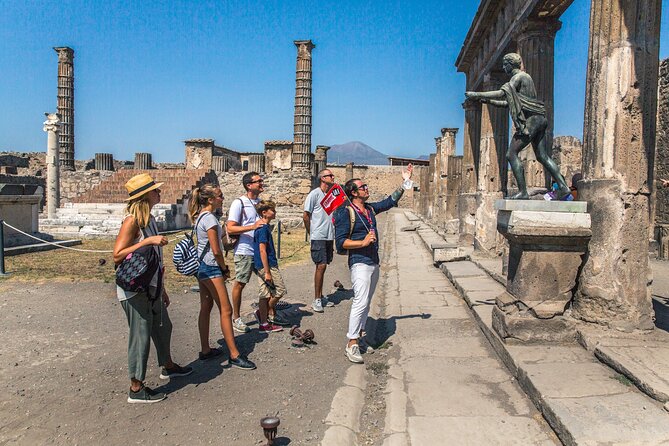
Lunch is not included. You can bring or buy your own food, or use the restaurant option offered during the stop. The fixed-price meal has been set at €18 and includes three courses, though it may be more food than you want in the middle of a walking day. An à la carte option is also available at the same restaurant.
The lunch stop takes about an hour. That pause gives you time to sit down before the climb, but it also reduces the time available for sightseeing. If you are focused on seeing as much of Pompeii as possible, you may find the fixed lunch break long.
I would treat the meal as a chance to refuel rather than a reason to book the tour. The main point of the day is the archaeological site and the volcano. Carrying water and choosing a lighter meal may serve you better before the uphill walk.
Climbing Mount Vesuvius to the crater
After Pompeii, the minibus climbs toward Vesuvius National Park. The vehicle drops you at about 1,000 meters, and the route continues on foot to the crater edge at around 1,280 meters.
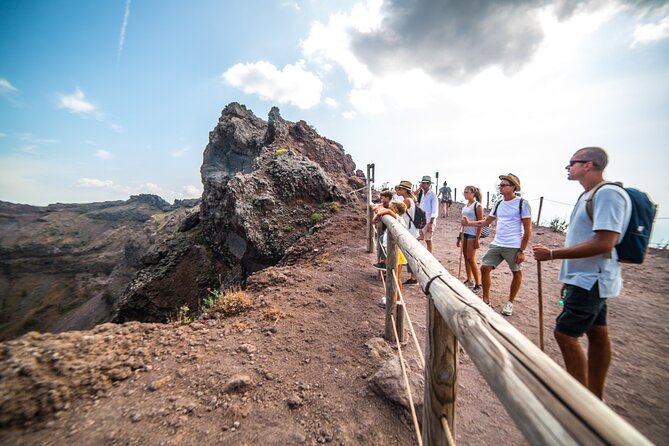
The hike is short in distance but not effortless. The surface is uneven, and the slope can feel steep, especially after a morning of walking through Pompeii. You have about an hour in the park, including the climb, time at the top, and the return to the vehicle. A further 30 minutes is listed for reaching the crater rim and taking in the view.
Wear proper walking shoes. Sandals, smooth soles, or flimsy footwear will make the uneven path harder. Pace yourself rather than trying to match the fastest people in the group. The climb is described as challenging but rewarding, and you should have moderate physical fitness for the day.
At the crater, you can look across the volcanic interior and out toward the Bay of Naples. On a clear day, the high viewpoint gives you broad views toward Naples and the Mediterranean. Clouds and rain can change the experience quickly, though. Park authorities can close the upper area, sometimes after the vehicle has already reached the mountain.
If Vesuvius is closed, the alternative offered is a skip-the-line visit to Herculaneum. That provides a useful backup, but it is not the same experience as standing beside the crater, so check the weather forecast before departure and be prepared for conditions to alter the plan.
There are no restrooms on the mountain according to the practical advice provided for this tour. Use facilities before the ascent and before leaving the Pompeii area.
How the guide affects the Pompeii visit
The Pompeii guide can shape your day as much as the ruins themselves. Guides such as Louisa have been praised for giving a steady flow of facts without overwhelming the group. Lulu, Luigi, Roberto, and others have also been noted for humor and lively explanations.
That said, guiding style is personal. Some people prefer a guide who pauses for longer explanations, while others want to keep walking and see more buildings. A few visitors have found that too much time was spent standing and talking, leaving less time to explore independently.
This is a guided highlights route, so you should expect the group to stay together. You will not have unlimited freedom to stop at every side street or spend twenty minutes with one mosaic. If you want a fully self-paced visit, an audio guide and independent entry may suit you better.
For most first-time visitors, the guide’s role is useful because Pompeii can otherwise feel confusing. The best guides connect the Forum to the baths, the street life to the houses, and the eruption to the physical evidence under your feet.
Group size, timing, and who should book
The tour has a stated maximum of 30 people, though groups can be combined during the day and may feel large in the Pompeii ruins. Headphones are supplied for groups over ten, which helps, but a larger group still moves more slowly and gives you less room to choose your own pace.
I would book this if you want to see both Pompeii and Vesuvius in one day without handling the transport yourself. It is also a good fit if you value a clear route through Pompeii and want the background explained as you go.
You should think twice if you want a small-group or private experience, dislike long minibus rides, or hope to explore Pompeii in detail. Cruise passengers should not book this group tour because the timing is not designed for cruise schedules.
The tour is offered in English, may use a multilingual guide, and is near public transportation. Confirmation is sent at booking. Free cancellation is available up to 24 hours before the local start time, but the operator can cancel if the minimum number of people is not reached.
Should you book this Pompeii and Vesuvius tour?
I would recommend it for a first visit from Sorrento, especially if your priority is seeing both the ancient city and the volcano in a single, well-organized day. The early Pompeii arrival, included admissions, skilled driving, and strong local guides make the $139.07 price reasonable for the convenience.
Book it with realistic expectations. You will spend substantial time in the vehicle, lunch costs extra, the Pompeii walk covers highlights rather than every corner, and the Vesuvius hike is a genuine uphill effort. Bring water, wear firm shoes, use the restroom before the mountain, and check the weather.
If that sounds like a fair exchange for two of Campania’s essential sights, this is a sensible choice. If you want maximum freedom, more time at Pompeii, or a quieter group, arrange the sites separately or choose a private guide instead.
FAQ
Where does the tour depart from?
It departs from the IAMME IA! Gray Line Amalfi Coast office at Piazza Torquato Tasso, 16, in Sorrento.
Where does the tour end?
The activity ends back at the same meeting point in Sorrento.
How long does the tour last?
The tour lasts approximately eight hours, though traffic and unforeseen conditions can change the duration.
Are Pompeii and Vesuvius admission tickets included?
Yes. Admission to Pompeii Archaeological Park and Vesuvius National Park is included, along with skip-the-line access where available.
Is lunch included?
No. Lunch is at your own expense. An optional fixed-price lunch has been offered at €18, and an à la carte choice is also available.
How difficult is the Mount Vesuvius hike?
The path to the crater rim is uneven and steep in places. You need a moderate level of physical fitness and should wear suitable walking shoes.
What happens if Mount Vesuvius is closed?
If Vesuvius is closed, the alternative offered is a skip-the-line ticket to visit the archaeological site of Herculaneum.
Recently reviewed around Sorrento
- The Three Tenors in Sorrento: Opera Arias, Naples and Songs★ 4.8 · 327 reviews
- Sorrento: Lemon Garden Tour with Marmalade Tasting★ 4.6 · 405 reviews
- From Sorrento: Capri Island Day Trip with Boat Cruise★ 4.7 · 469 reviews
- From Sorrento: Amalfi Coast Full-Day Trip by Boat★ 4.8 · 367 reviews
- Sorrento: Sightseeing Cruise with Limoncello Tasting★ 4.0 · 224 reviews
- Sorrento: Pizza Making Class at Tirabusciò Cooking School★ 4.8 · 188 reviews
- Sorrento: Guided Walking Tour & Limoncello Tasting★ 5.0 · 472 reviews
- SORRENTO: Pizza School Mastering Neapolitan Delights★ 4.9 · 201 reviews
Pompeii & Vesuvius Tours, compared.
Entry Ticket and Guided Tour with an Archaeologist
Read our review →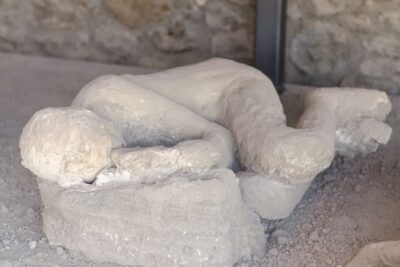
Pompeii Small Group Tour with an Archaeologist
Read our review →
Pompeii, Amalfi Coast and Positano Day Trip from Rome
Read our review →Browse the lists this tour appears in