
Review · HISTORICAL TOURS
2 Hours Private Historical Tour in Genoa
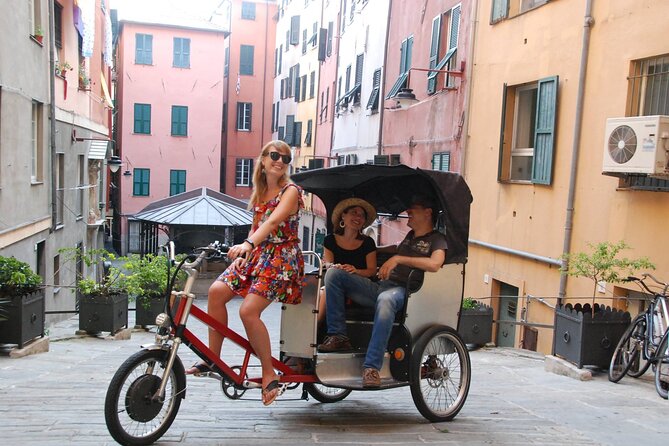
Genoa is a city made for getting lost, and this private electric rickshaw tour gives you a way to see its narrow lanes without spending two hours wrestling with a map or climbing every hill. You move from the medieval core to grand palaces, the cathedral, and the Old Port while a local driver-guide handles the route.
I like two things here: the small private format, limited to your group of up to two, and the chance to cover far more ground than you could comfortably walk in a short port stop. I also like the local touch provided by guides such as Eleonora, Yusuf, Sophie, and Giulia, who add stories and restaurant tips rather than simply pointing at buildings.
The main caution is the vehicle itself. Most rides appear to run smoothly, but a few bookings were delayed by flat tires, broken spokes, or mechanical trouble. The tour also requires good weather, so leave some flexibility in your plans.
In This Review
- Key points to know before booking
- Why a rickshaw works so well in Genoa
- Sarzano and the city’s earliest center
- Via Garibaldi and Genoa’s palace culture
- Columbus’s House beside Porta Soprana
- Piazza Banchi and the old trading city
- San Lorenzo Cathedral and the medieval civic stage
- Giardini Luzzati and the pleasure of a surprise
- Piazza De Ferrari and the public face of Genoa
- Palazzo San Giorgio and the port connection
- The Old Port and Renzo Piano’s waterfront
- What the guides add to the ride
- Price, timing, and who gets the best value
- The honest downside: mechanical trouble
- Should you book this Genoa tour?
- FAQ
- How long does the Genoa historical tour last?
- How much does the tour cost?
- Where does the tour begin?
- Where do I meet the driver?
- Where does the tour finish?
- Is the tour private?
- Is pickup available?
- What language is offered?
- Can I cancel for a refund?
- What happens if the weather is poor?
Key points to know before booking
- A private ride for two: The listed price is $114.93 per group, not per person, for up to two people.
- A smart port-day introduction: The tour begins at Galata Museo del Mare and returns there, making it useful when your time in Genoa is limited.
- Ten central stops: You see Sarzano, Via Garibaldi, Columbus’s House, Piazza De Ferrari, the cathedral area, Palazzo San Giorgio, and the Old Port.
- Narrow lanes without the long walk: The rickshaw can reach parts of the old center that are awkward by car and tiring on foot.
- Strong guide element: The best part of the tour is the driver-guide’s commentary, with past guides including Eleonora, Yusuf, Sophie, Giulia, Lucia, Beatrice, and Gavino.
- Allow for weather and vehicle risk: Rain can cancel the outing, and occasional mechanical problems have shortened or delayed rides.
Why a rickshaw works so well in Genoa
Genoa’s old center is compact but not simple. Medieval streets twist between tall buildings, stairways, small squares, churches, and busy roads. A standard sightseeing bus cannot reach much of it, while a walking tour asks you to keep pace through a city with slopes and uneven streets.
The electric rickshaw fills that gap. You sit back, look around, and let the guide choose the route. It is not a silent ride, and you will be visible to people on the street. One rider noted that other visitors looked at the vehicle, so expect a little attention. That is a small price for getting a clear view without watching your phone every few minutes.
The format is especially useful if you are visiting Genoa from a cruise ship. The meeting point is in the square in front of the terminal exit at Galata Museo del Mare, at Calata Ansaldo De Mari 1. You do not need to arrange a complicated transfer into the center, and the ride ends back at the same point.
This is also a good first look at Genoa. I would book it early in your visit, not after you have already spent the morning wandering. Once you see the city’s main zones from the rickshaw, you can return on foot to the places that catch your eye.
More history-led days around Genoa & Cinque Terre:
- Genoa: 2-Hour Guided Walking Tour of the Historical Center
★ 4.2 · 605 reviews - Genoa Food, Wine Tasting & History Walking Tour
★ 5.0 · 212 reviews - Genoa: Historic Guided Tour of Christopher Columbus’ House
★ 4.4 · 186 reviews
Sarzano and the city’s earliest center
The tour starts at Piazza Sarzano, an area associated with the original nucleus of Genoa, or Ianua. This is a useful opening because it begins with the city’s medieval bones rather than its later port wealth.
You can look toward the bell tower of Sant’Agostino church and a small temple, with colorful Ravecca Street in the background. The stop lasts about 15 minutes, enough for an explanation, a few photographs, and a first sense of how old Genoa grew around tight streets and small open spaces.
Sarzano is not a grand ceremonial square like Piazza De Ferrari. Its appeal is more intimate. You see the contrast between a modest neighborhood street and the historic structures that have survived around it.
From here, the ride continues to the Church of Santi Cosma e Damiano. The stop is brief, around five minutes, and the details are intentionally not laid out in advance. That makes it a quick visual pause rather than a full church visit. If you want extended interior time at every church, two hours will feel short.
Via Garibaldi and Genoa’s palace culture
Via Garibaldi is one of the tour’s biggest architectural moments. The street was once called Strada Maggiore, then Strada Nuova, and was known for a period as Via Aurea, or the Golden Street. It took the name Via Garibaldi in 1882.
The street is lined with imposing palaces and gardens. This is where Genoa’s commercial power turned into architecture meant to impress. The ride gives you a quick introduction to the buildings and their place in the city, without asking you to spend the whole afternoon inside museums.
The planned stop is about 15 minutes. That is enough to admire the façades and hear the basic story, but not enough for a detailed look at every palace. If Via Garibaldi interests you, mark it for a later return. You may want to visit the palaces at a slower pace after the tour.
The rickshaw is useful here because you can focus on the vertical architecture. Genoa’s streets often make you look up, and a guided ride lets you do that without worrying about navigation or traffic.
Columbus’s House beside Porta Soprana
The so-called Columbus’s House is located near Porta Soprana, just outside the medieval walls. It is generally described as an 18th-century reconstruction of the medieval home where Christopher Columbus spent part of his youth.
The building has two floors. His father, Domenico Columbus, reportedly used the ground floor as a wool-weaving and trading workshop, while the family lived above. Written sources place Columbus here between 1455 and 1470.
This stop takes about 10 minutes and is best understood as a compact historical marker, not a major museum visit. The original building was probably destroyed during the French fleet’s bombardment of Genoa in 1684, so the structure you see is a later reconstruction.
I like this stop because it connects a famous global name to an ordinary urban setting: a home, a workshop, a medieval gate, and city walls. It also gives you a reason to return to the Porta Soprana area on foot.
More Genoa & Cinque Terre trips worth a second look
- Lucca: 2-Hour City Center Walking Tour
★ 4.7 · 1,314 reviews - Milan Duomo and Rooftop 2-Hour Guided Tour
★ 4.6 · 1,076 reviews - Florence: 2-Hour Guided Sightseeing Bike Tour
★ 4.5 · 1,004 reviews - Alberobello: 2-Hour Guided Trulli Tour
★ 4.6 · 727 reviews
Piazza Banchi and the old trading city
Piazza Banchi sits near one of Genoa’s important docks. In the 12th century, money changers worked under the porticoes, giving the square its name. It was also the site of the old grain market.
The stop lasts about 15 minutes. Here the story shifts from churches and family homes to banking, trade, and the machinery of a port republic. The square helps explain why Genoa grew powerful: ships, goods, credit, and commerce all met close together.
This is one of the places where a guide adds real value. A quick look at a square may not tell you much on its own. With context, the porticoes and surrounding buildings become part of a working city rather than just attractive scenery.
San Lorenzo Cathedral and the medieval civic stage
The cathedral area is centered on Cattedrale di San Lorenzo, Genoa’s most important church. The stop is listed under the Archdiocese of Genoa and lasts around 15 minutes.
San Lorenzo is not only a religious site. Its parvis became a key stage for social and political life during the Middle Ages, especially after the cathedral moved and the city walls changed the shape of the surrounding area. Genoa had few true squares, so this open space mattered.
The cathedral’s walls and artistic details have also produced legends and curiosities. The guide can point out the features that make the building more than a quick photograph.
Keep your expectations realistic. The tour schedule gives you time to see the area and hear its story, but not necessarily to explore every interior detail at leisure. If you want a proper cathedral visit, ask the guide how much time remains and plan a return visit if needed.
Giardini Luzzati and the pleasure of a surprise
Giardini Luzzati is another short stop in the medieval center, with about 10 minutes set aside. The exact appeal is left open, so this portion works as a small discovery within the larger route.
That element of surprise suits Genoa. The city’s character often appears in places that are not its headline monument: a little square, an unusual view, or a corner that makes more sense once someone explains it.
Do not expect a long break here. Think of it as a chance to look around, take photographs, and get another angle on the old center before the route moves toward Genoa’s major modern square.
Piazza De Ferrari and the public face of Genoa
Piazza Raffaele De Ferrari is Genoa’s main square and one of the clearest changes of scale on the tour. It is named for the Duke of Galliera, who donated a large sum in 1875 to help expand the port.
A monumental bronze fountain sits at the center. Around it are the Teatro Carlo Felice, the Accademia Ligustica di Belle Arti, Palazzo Ducale’s side façade, the Liguria regional offices, and Palazzo della Nuova Borsa.
The square brings together several periods of Genoese architecture. Carlo Barabino designed both the opera house and the fine arts academy, while the former stock exchange is a notable example of Genoese Art Nouveau from 1912.
The scheduled stop is only 10 minutes, but that is enough to orient you. I would use the time to photograph the fountain and note the nearby Palazzo Ducale. The main entrance to that palace is on adjacent Piazza Matteotti, a useful detail if you plan to return.
Palazzo San Giorgio and the port connection
Palazzo San Giorgio receives another 10-minute stop. The building is one of the historic palaces in the medieval center and sits within the larger story of Genoa’s maritime and commercial life.
This part of the route bridges the old streets and the waterfront. You are moving toward the port, where Genoa’s past as a trading power and its present as a major urban waterfront meet.
The stop is short, so the guide’s explanation matters more than a long visit. If you are interested in Genoa’s civic buildings, ask for the building’s connection to the port and the surrounding old city.
The Old Port and Renzo Piano’s waterfront
The final stop is Genoa’s Old Port, with about 15 minutes to look around. The waterfront plaza was reshaped by Genoese architect Renzo Piano and now combines open views, cultural attractions, recreation, and harbor scenery.
This is a fitting finish. The tour begins near the maritime museum, threads through the old city, and ends beside the water that helped make Genoa important. You get a visual link between medieval streets, grand civic buildings, and the modern port area.
The Old Port is also where you may want extra time after the tour. The schedule offers an introduction, not a full afternoon. If your ship is not waiting, stay in the area for a meal, a museum visit, or more waterfront viewing. The experience itself returns to the original meeting point, so check the remaining time before extending your own visit.
What the guides add to the ride
The strongest part of this experience is the driver-guide. Past guides named in the feedback include Eleonora, Yusuf, Youssef, Sophie, Giulia, Julia, Lucia, Beatrice, Gavino, and Lulu. Several riders singled out Eleonora for her local knowledge and warm manner, while Yusuf was praised for making the route both informative and easygoing.
Giulia was described as someone who grew up in Genoa, which can be valuable when you want more than dates and building names. One guide also recommended a dinner restaurant, and another dropped riders at their hotel. Those extras should not be treated as guaranteed features, but they show how much the experience can depend on the person assigned to you.
The tour is offered in English according to the booking details. A German-language ride has also been arranged in the past, but you should confirm language availability when booking rather than assume it.
Price, timing, and who gets the best value
The price is $114.93 per group of up to two people. For a couple, that works out to about $57.47 each for two hours of private guiding and transport. That is fair value if you are arriving by ship, have limited time, or would otherwise pay for a separate walking tour and taxi transfers.
For one person, the value is less compelling because the full group price still applies. The private format does give you more control than a large group, though the supplied details do not promise a fully customized route.
The tour is booked an average of 43 days ahead, so it is sensible to reserve early during busy cruise periods. Confirmation arrives at booking unless you book within one day of departure, when it depends on availability.
Wear clothing suitable for an open vehicle. A breeze can make the ride feel cool, while sun exposure can be strong. A hat or sunscreen was specifically recommended by one rider. The tour also requires good weather, and poor conditions may lead to a new date or a full refund.
The honest downside: mechanical trouble
The overall rating is 4.8 from 248 ratings, with 94 percent recommending the experience. Still, the less favorable accounts point to a real issue: the vehicle can fail.
One ride used three vehicles after a rickshaw stopped working, followed by a broken wheel spoke and a vehicle that could not manage a hill. The group finished about 30 minutes late. Another booking was shortened after a flat tire caused a long wait for help, and the guide had to deal with pressure about another scheduled job.
These appear to be exceptions, not the normal result. The operator says extra rickshaws are available for emergencies, but you should still avoid booking this too close to a ship departure, airport transfer, or restaurant reservation. If you need a precise finish time, ask about the contingency plan before setting out.
The vehicle type also appears to vary in descriptions, with electric rickshaw, pedal bike, and pedi-bike references. Confirm what will be provided if that distinction matters to you.
Should you book this Genoa tour?
Book it if you want a fast, private orientation to Genoa and would rather look at the city than study a navigation app. It is especially useful for couples on a cruise, people who find hills or long walks tiring, and first-time visitors who want to decide which areas deserve a second look.
I would book it for the beginning of a Genoa visit, ideally with enough spare time afterward. The guide can show you the old center, Via Garibaldi, San Lorenzo, De Ferrari, and the Old Port in one sweep, giving you a practical map in your head.
Skip it if you want long interior visits, a slow museum tour, or a guaranteed timetable with no mechanical risk. For most people with two hours to spare, though, this is a lively and efficient way to meet Genoa, provided you accept that an open rickshaw is a small vehicle with moving parts.
FAQ
How long does the Genoa historical tour last?
The tour lasts approximately two hours.
How much does the tour cost?
The listed price is $114.93 per group of up to two people.
Where does the tour begin?
It begins at Galata Museo del Mare, Calata Ansaldo De Mari 1, Genoa.
Where do I meet the driver?
You meet the driver in the square in front of the terminal exit.
Where does the tour finish?
The activity ends back at the original meeting point.
Is the tour private?
Yes. Only your group participates, with a maximum of two people at the listed group price.
Is pickup available?
Pickup is offered, and the stated meeting arrangement is in the square outside the terminal exit.
What language is offered?
The booking information lists English. You should confirm any other language before reserving.
Can I cancel for a refund?
You can cancel at least 24 hours before the local start time for a full refund. Cancellations or changes made less than 24 hours before departure are not refunded or accepted.
What happens if the weather is poor?
The experience requires good weather. If the operator cancels because of poor conditions, you will be offered another date or a full refund.
Recently reviewed around Genoa & Cinque Terre
- Rafting Sesia★ 5.0 · 304 reviews
- Cinque Terre Sunset Boat Tour Experience★ 5.0 · 402 reviews
- Kayak experience with Carnassa Tour in Cinque Terre + Snorkeling★ 5.0 · 359 reviews
- Cinque Terre Sunset Cruise with Aperitif from Monterosso★ 5.0 · 258 reviews
- Cinque Terre Small Group or Private Day Tour from Florence★ 4.5 · 1,248 reviews
- Cinque Terre Private Boat Tour★ 5.0 · 202 reviews
- Private Tour to Cinque Terre from Florence★ 5.0 · 343 reviews
- Cinque Terre Sunset Tour by Boat★ 5.0 · 274 reviews
Historical Tours, compared.
St. Mark Basilica Ticket, Audioguide+History Gallery
Read our review →
Venice’s Best: Basilica, Doge’s Palace, Gondola & History Gallery
Read our review →
Historic Milan Tour with Skip-the-Line Last Supper Ticket
Read our review →
Rome in a Day Tour with Vatican, Colosseum and Historic Center
Read our review →
Rome Food Tour in the Historic Centre with 8+ Food Tastings
Read our review →Browse the lists this tour appears in