
Review · POMPEII & VESUVIUS TOURS
Explore Pompeii with an Archaeologist
Pompeii makes more sense when someone helps you read it as a city, not just a field of ruins. This two-hour tour with an archaeologist takes you from the main square to private houses, public baths, shops, and the theater, giving each stone a job and a story.
I like the small-group format, capped at 20 people, and the sensible route through many of Pompeii’s headline sights. I also like that admission is included, so you can focus on the ruins rather than sorting out tickets at the entrance.
The trade-off is time. Ten minutes at each listed stop gives you a brisk introduction, not a full study of Pompeii. Crowds can also make some rooms hard to see and hear, even with headsets.
In This Review
- Key points to know before you book
- Meeting your archaeologist at Porta Marina Superiore
- The Forum and Basilica explain how Pompeii worked
- The Lupanar and Forum granaries reveal everyday business
- Three houses, three views of Pompeian life
- Stabian Baths show the city’s public routine
- Via dell’Abbondanza and the Thermopolium bring Pompeii down to street level
- The theater gives the tour a strong finish
- What the $35.67 price buys you
- Heat, uneven ground, and group size
- Cancellation and timing details worth knowing
- Is this Pompeii tour right for you?
- FAQ
- Where does the Pompeii tour begin?
- Where does the tour end?
- How long does the tour last?
- Is Pompeii admission included?
- How large is the group?
- Can I cancel for a refund?
Key points to know before you book
- A fast tour of major sights: The route covers the Forum, Basilica, Lupanar, famous houses, baths, shops, Via dell’Abbondanza, and the theater.
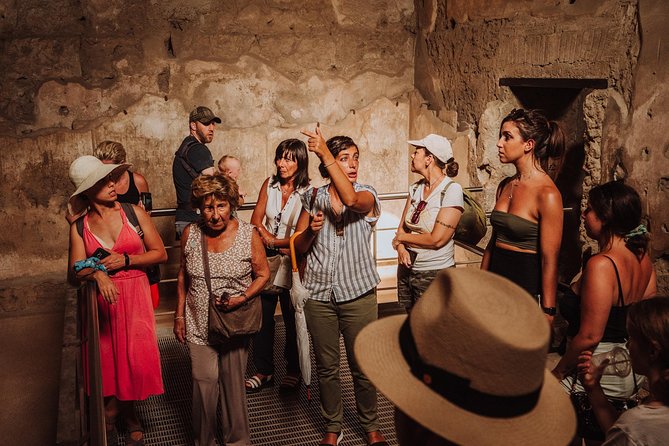
- An archaeologist leads the walk: Guides including Mario, Teresa, Alexandra, Rosanna, Ilaria, and Antonio are praised for clear explanations and good answers to questions.
- Admission is included: You meet at Porta Marina Superiore, the main entrance, with the Pompeii entry fee covered.
- Expect uneven walking: Pompeii is a large archaeological site with rough surfaces, heat, and plenty of walking.
- The group can reach 20 people: Smaller than a large coach tour, but not the same as a private visit.
- You can continue alone afterward: The tour ends at Piazza Esedra, leaving you free to explore more of the site on your own.
Meeting your archaeologist at Porta Marina Superiore
Your tour begins at Via Villa dei Misteri 2, by Porta Marina Superiore. Look for a guide holding a sign with Askos Tours printed at the top. This detail matters because Pompeii has several entrances and a missed meeting point can waste precious time.
The meeting point is at the main entrance of the archaeological park, and the tour ends at Piazza Esedra. Transportation is not included, but the site is near public transportation and is easy to reach by train according to the tour information.
The English tour lasts about two hours. Confirmation arrives when you book, and the mobile ticket makes it practical to keep your booking on your phone. I would still arrive early. A two-hour Pompeii visit has little spare time, and even a short delay can put you behind the group.
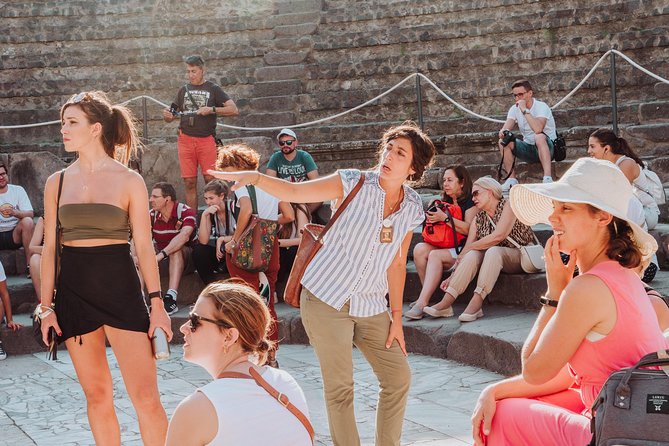
Askos Tours limits each guide to 20 people. That is a useful middle ground. You get the structure of a guided visit without the scale of a giant group, and you have a reasonable chance to ask about details as you go. Some guides are especially praised for adjusting their pace and checking that the group is keeping up.
For groups of 16 or more, headsets are provided. They help in a noisy ruin, though sound can still be difficult when crowds gather around popular rooms.
Other Naples & Pompeii days travellers weigh against this one:
- Naples: Naples Underground Entry Ticket and Guided Tour
★ 4.4 · 21,781 reviews - Pompeii: Entry Ticket and Guided Tour with an Archaeologist
★ 4.8 · 19,459 reviews - Pompeii: Entry Ticket with Optional Audio Guide
★ 4.2 · 12,360 reviews
The Forum and Basilica explain how Pompeii worked
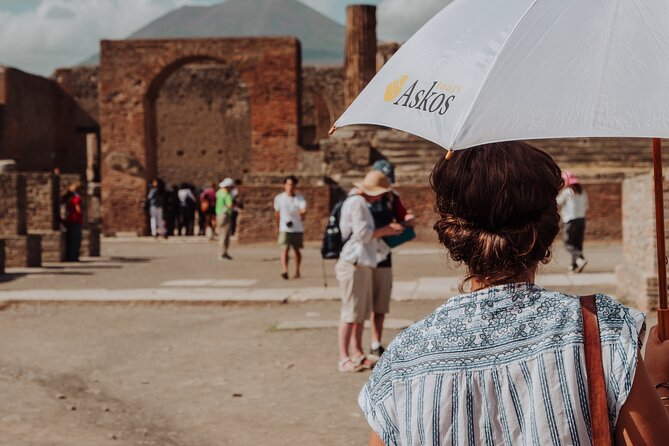
The first major stop is the Forum, Pompeii’s main square. This is the right place to begin because it gives you the broadest view of the city as a public center. Instead of immediately getting lost among house names and painted walls, you can first understand where public life took place.
The guide’s job here is to explain how the surrounding buildings fit together. A good explanation turns the Forum from an open rectangle into a place used for civic, commercial, and social business.
Next comes the Basilica, described as the courthouse. This stop adds an important piece to the picture. Pompeii was not only a collection of homes frozen in time. It had institutions, legal business, and public buildings that shaped daily life.
The ten-minute timing is enough for a focused explanation and a look around. It is not enough for long photography stops or detailed architectural study. Keep your attention on the guide, since this early context makes the later houses and streets easier to understand.
The Lupanar and Forum granaries reveal everyday business
The Lupanar is one of Pompeii’s best-known stops. The building is identified as a brothel, and it often draws a crowd. The guide can give the site context without turning it into a cheap joke, helping you see it as part of the city’s ordinary commercial life.
This is also one of the places where crowd control can affect the experience. You may need to wait briefly to enter certain rooms, and the group may move through quickly. If this sight is your main reason for visiting Pompeii, a longer or private tour could give you more time.
The route then returns to the Forum granaries, ancient storage buildings. Their value is less theatrical than the Lupanar, but they help you picture how food and goods were handled. I like that the itinerary includes this kind of practical site. Pompeii becomes more believable when you see storage and supply, not just grand villas and famous paintings.
These brief stops are a reminder of the tour’s main strength and limitation. You cover many kinds of buildings in a short period, but the guide has to keep moving.
Three houses, three views of Pompeian life
The House of Menander, House of the Faun, and House of the Vettii form the heart of the residential section. Together, they show why Pompeii is so valuable: the city preserves not only public structures but also the spaces where people lived, entertained, displayed wealth, and moved through their day.
The House of Menander is one of the featured homes on the route. Your guide can point out the layout and the decorative details that make a Roman house more than a set of rooms. Listen for how the spaces relate to one another. In Pompeii, the arrangement of a house often tells you as much as any single object.
The House of the Faun is another major highlight. Its scale and reputation make it one of the places you will want to see carefully, but the tour allows roughly ten minutes. That is enough for orientation and explanation, not a slow examination of every feature.
The House of the Vettii closes this part of the route. It is another chance to look at domestic architecture and decoration through the guide’s explanation. Guides such as Alexandra and Rosanna are praised for making complicated material easy to follow, while Mario is singled out for telling stories rather than simply naming buildings.
These houses can be busy. Stay close enough to hear, but do not block doorways while taking pictures. If a room is closed or crowded on the day of your visit, the guide can still explain its place in the larger route, but you may not get an unobstructed look.
A different way to spend the day, same part of Italy:
- Pompeii: Small Group Tour with an Archaeologist
★ 4.8 · 12,264 reviews - From Naples: Pompeii Ruins & Mount Vesuvius Day Tour
★ 4.3 · 11,459 reviews - From Naples: Sorrento, Positano and Amalfi Full-Day Tour
★ 4.6 · 10,988 reviews - From Naples: Sorrento, Positano & Amalfi Coast – Small Group Tour
★ 5.0 · 8,643 reviews
Stabian Baths show the city’s public routine
The Stabian Baths are among the most useful stops for understanding daily life. Public baths were not simply places to wash. They were social spaces, and the surviving structure lets you see how public amenities fitted into the city.
The tour gives you about ten minutes here. That quick visit works well if you want a clear overview of the baths and their purpose. It will feel short if you are interested in construction methods, room functions, or the finer details of the surviving walls.
This is where a guide with archaeological training adds real value. Ruins often look obvious until you ask what a room was used for. The best explanations connect the physical remains to ordinary routines, making the site easier to imagine without pretending that every detail is certain.
Via dell’Abbondanza and the Thermopolium bring Pompeii down to street level
Via dell’Abbondanza is the main street on the route. Walking along it gives you a change of scale after the large public spaces and wealthy houses. You see how Pompeii was organized as a working city, with movement, storefronts, and homes connected by streets.
The itinerary lists this stop as free admission, while the other stops are included within the Pompeii entry. In practical terms, you are already inside the archaeological park, so there is no separate ticket to arrange.
The Thermopolium is one of the most memorable stops because it represents fast food in the ancient city. The preserved counter and shop layout make the place immediately understandable. You do not need a long lecture to see its appeal, but the guide can explain how this kind of business fitted into everyday Pompeian life.
This stop also shows why guided context helps. Without explanation, you might simply see a counter with openings. With a good guide, you can picture the shop as a place where people bought prepared food and drinks.
The theater gives the tour a strong finish
The Teatro Grande, or Large Theater, brings the route to one of Pompeii’s public entertainment spaces. After houses, shops, baths, and civic buildings, the theater adds another part of city life: organized performances and communal leisure.
The open setting can make the theater easier to appreciate than a small interior room. You have space to look at the structure while the guide explains its function and place in Pompeii.
The route includes the theater before returning toward the end point at Piazza Esedra. The tour does not promise a full visit to every corner of Pompeii, including newly excavated areas. Think of this as a carefully chosen introduction, then use the remaining time to continue alone if you want more.
One useful feature is that the guide can offer suggestions for further exploration after the formal tour ends. That makes the two-hour format more flexible. You get a planned route first, then you can revisit a favorite house or seek out areas the group did not have time to cover.
What the $35.67 price buys you
At $35.67 per person, this tour is priced as an affordable guided introduction rather than a private archaeological study. The fee includes Pompeii admission, an expert archaeologist as your guide, dedicated assistance, and headsets for groups of 16 or more.
That admission inclusion matters. Pompeii’s entrance fee is not an extra cost to calculate, and you do not have to spend the first part of your visit working out where to buy a ticket.
The strongest value comes from the guide. Pompeii is large, and the ruins can blur together without a plan. A guide who explains the Forum, houses, baths, and shops can save you from wandering past important details.
Still, the tour is not ideal if you want every answer or a slow look at each room. One low-rated experience described a guide who spoke too slowly, encouraged too little interaction, and did not handle questions well. That appears to be an exception among the supplied feedback, but it points to a real issue: a group tour depends heavily on the individual guide.
The tour has a 4.9 rating from 511 reviews, with 98 percent of customers recommending it. The most consistent praise goes to clear explanations, archaeological expertise, friendly pacing, and guides who make the subject enjoyable for families. Mario, Teresa, Alexandra, Rosanna, Ilaria, Antonio, Diego, Sergio, Jolanta, and Rafaela are among the guides specifically praised for their approach.
I would book it for value, then plan extra time afterward. One guide described the two-hour route as a good overview, while also noting that Pompeii can take several more hours to see properly. That is the fairest way to judge the price.
Heat, uneven ground, and group size
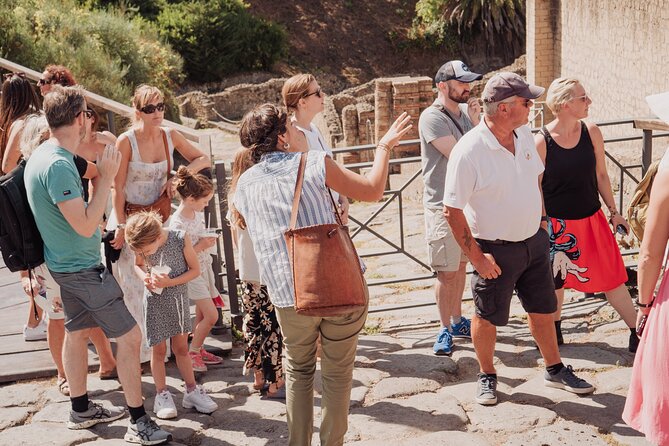
Pompeii is physically demanding. You will walk over uneven surfaces, and the site can be very hot. Bring a hat or umbrella, a refillable water bottle, and water for the route. Drinking water is available from fountains.
Comfortable shoes matter more here than stylish ones. Even if you are fit, the combination of heat, stone surfaces, and constant standing can wear you down. The tour suits most people, but it is not a gentle stroll.
Families can do well on this experience. Several guides are praised for explaining the ruins in a way that kept children interested, and the variety of houses, shops, baths, and theater spaces gives younger visitors different things to look at.
Service animals are allowed. For other dogs, Pompeii permits only animals no heavier than 10 kilograms and no taller than 40 centimeters. Dogs must be leashed, carried in the buildings, and cleaned up after.
Anyone under 18 should bring a passport or identity card to qualify for free admission. This is an easy item to forget, and it is worth handling before you arrive.
The tour allows up to 20 people. That is manageable, but it is not intimate. If you want to stop often for detailed questions, work at your own pace, or focus on a particular house, a private tour may suit you better.
Cancellation and timing details worth knowing
Free cancellation is available up to 24 hours before the experience begins. If you cancel less than 24 hours ahead, you will not receive a refund, and changes made inside that window are not accepted.
The cut-off follows local time in Pompeii. Watch transport plans closely, especially if you are arriving by train or from a cruise port. One reported problem involved a national train strike and a late refund request, so I would not leave cancellation decisions until the last minute.
Is this Pompeii tour right for you?
Book this tour if you want a reasonably priced, organized first look at Pompeii and prefer explanations to wandering alone. It is especially useful for families, first-time visitors, and anyone with only a few hours.
You should also book it if you value a clear route through the major sights. The Forum, Basilica, Lupanar, granaries, three important houses, baths, main street, Thermopolium, and theater give you a solid sample of the city.
Choose a private or longer visit instead if you want to study architecture, spend extended time in the painted rooms, or explore excavation areas beyond the standard highlights. The two-hour schedule moves quickly, and crowds can limit what you see inside popular buildings.
For most people, the best plan is simple: take the guided tour, listen for the larger story, then stay on at the end and explore independently. At $35.67, admission included, that gives you structure without giving up the freedom to see more.
FAQ
Where does the Pompeii tour begin?
The meeting point is at Via Villa dei Misteri 2, by Porta Marina Superiore, the main entrance to Pompeii’s archaeological site. The guide holds an Askos Tours sign.
Where does the tour end?
The experience ends at Piazza Esedra in Pompeii.
How long does the tour last?
The guided visit lasts approximately two hours.
Is Pompeii admission included?
Yes. The Pompeii admission fee is included in the tour price.
How large is the group?
The maximum group size is 20 people per guide. Headsets are supplied for groups of 16 or more.
Can I cancel for a refund?
Yes, if you cancel at least 24 hours before the local start time. Cancellations made less than 24 hours in advance are not refundable.
Recently reviewed around Naples & Pompeii
- Pompeii Skip-the-line Tour with Archaeologist Guide★ 5.0 · 559 reviews
- Sharing Tour of Pompeii★ 5.0 · 487 reviews
- Skip the Line Guided Tour of Pompeii led by an Archaeologist★ 5.0 · 703 reviews
- Visit in Pompeii – Pompeii Private Tour with Ada★ 5.0 · 436 reviews
- Pompeii Private Tour with an Archaeologist and Skip The Line★ 5.0 · 391 reviews
- Private Day Tour to Vesuvius, Herculaneum & Pompeii with Pick Up★ 5.0 · 279 reviews
- Pompeii Vineyard Escape: Private Wine Tasting & Lunch★ 5.0 · 329 reviews
- Pompeii Guided Group Tour with Entry Ticket and Archaeologist★ 4.5 · 269 reviews
Pompeii & Vesuvius Tours, compared.

Entry Ticket and Guided Tour with an Archaeologist
Read our review →




Pompeii Small Group Tour with an Archaeologist
Read our review →
Pompeii, Amalfi Coast and Positano Day Trip from Rome
Read our review →Browse the lists this tour appears in