

Review · POMPEII & VESUVIUS TOURS
From Naples: Pompeii & Herculaneum with Archaeologist Guide
Herculaneum may be the surprise star of this day. While Pompeii was covered in volcanic ash, Herculaneum was sealed under roughly 20 meters of mud, preserving wooden objects, vivid paintings, mosaics, and even a beach area lined with more than 300 skeletons. You then move on to Pompeii, where a two-hour walk brings the Roman town back to life.
I like the archaeologist-led storytelling, especially when guides such as Raphael, Roberta, Michele, and Gennaro explain small details about daily Roman life. I also like the small-group minibus format, which avoids the fuss of arranging two separate train trips and lets you pass the long ticket lines.
The trade-off is time. Seven hours gives you the major sights, not every corner of either enormous site. You will also walk over uneven paving, slopes, and stairs, so this is a poor fit if you have limited mobility.
In This Review
- Key points at a glance
- Why seeing both sites in one day works
- Meeting at Starhotels Terminus
- Herculaneum first, with two hours to look closely
- The transfer and lunch break at Pompeii
- Pompeii’s public city and private homes
- What the archaeologist guide adds
- Is the $168.79 price fair?
- Walking, weather, and comfort
- Who should book this day trip?
- Should you book Pompeii and Herculaneum together?
- FAQ
- Where does the tour start?
- Where does the tour end?
- How long does the tour last?
- What language is the tour in?
- Are entrance tickets included?
- Is lunch included?
- Can I bring luggage?
- Is the tour suitable for people with limited mobility?
Key points at a glance
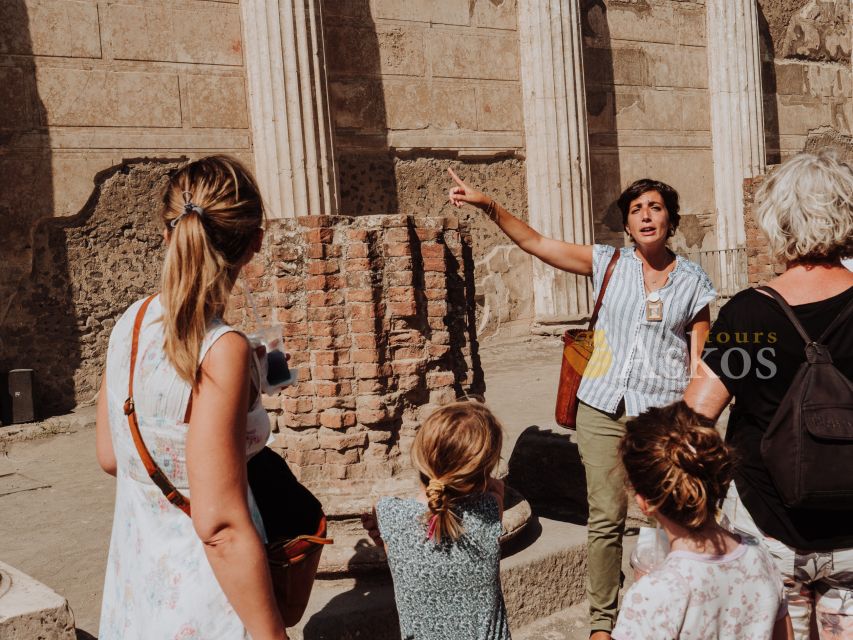
- Herculaneum first: See unusually well-preserved wood, wall paintings, mosaics, baths, and the ancient shoreline.
- Pompeii’s essential sights: Visit the Forum, Basilica, Lupanar, House of Faun, bakery, thermopolium, and plaster casts.
- A real archaeologist guide: Guides including Raphael, Roberta, Michele, Vito, and Gennaro are praised for clear explanations, humor, and a sharp eye for small details.
- Skip-the-line entry: Your tickets cover both archaeological sites, saving time at busy entrances.
- Shared minibus transport: Travel between Naples, Herculaneum, and Pompeii without managing local connections.
- A brisk but useful day: Expect about two hours at each site, plus a short lunch break and road transfers.
Why seeing both sites in one day works
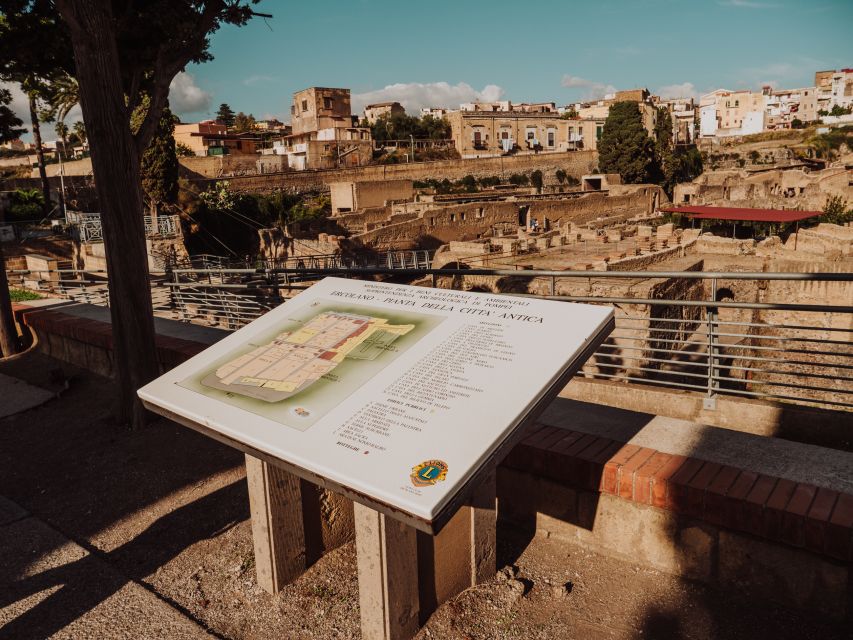
Pompeii and Herculaneum are often paired because Mount Vesuvius destroyed both towns in AD 79. Yet they feel quite different, and that contrast gives this excursion its real value.
Pompeii was a large Roman city with broad streets, public buildings, shops, villas, bakeries, and political spaces. Much of it was buried in ash and pumice, which left streets and walls visible but exposed many objects to heat, weather, and later damage.
Herculaneum was smaller and more residential. The landslide of mud that covered it created a thick seal. That helped preserve details Pompeii often lacks, including carbonized timber, household objects, painted rooms, and mosaics. You do not simply see two versions of the same ruin. You see two different towns, each shaped by the way Vesuvius buried it.
That is why I consider the pairing worthwhile, even though the schedule is tight. Herculaneum helps you understand domestic life and preservation. Pompeii gives you the scale of an entire Roman city.
More Naples & Pompeii trips worth a second look
- Naples: Naples Underground Entry Ticket and Guided Tour
★ 4.4 · 21,781 reviews - Pompeii: Entry Ticket and Guided Tour with an Archaeologist
★ 4.8 · 19,459 reviews - Pompeii: Entry Ticket with Optional Audio Guide
★ 4.2 · 12,360 reviews
Meeting at Starhotels Terminus
The day begins in front of the Starhotels Terminus entrance, opposite Naples Central Station. Look for the guide holding an ASKOS TOURS sign.
This is a practical meeting point if you are arriving by train or staying near the station. You do not need to find a distant coach terminal, and the return is to the same place. Still, arrive early. The driver waits only up to five minutes for late arrivals, which is not much protection if you are delayed by a train, a crowded station, or a wrong turn.
The shared minibus carries up to 20 participants. That is larger than a private tour but far more manageable than a full-size coach. The vehicle is described as modern and air-conditioned, though one person found the seating area a little snug. If you are tall or carrying extra items, that is worth keeping in mind.
Large bags and luggage are not allowed. Bring your passport or ID card, since it is listed among the required items. Keep your day bag small and easy to carry.
Herculaneum first, with two hours to look closely
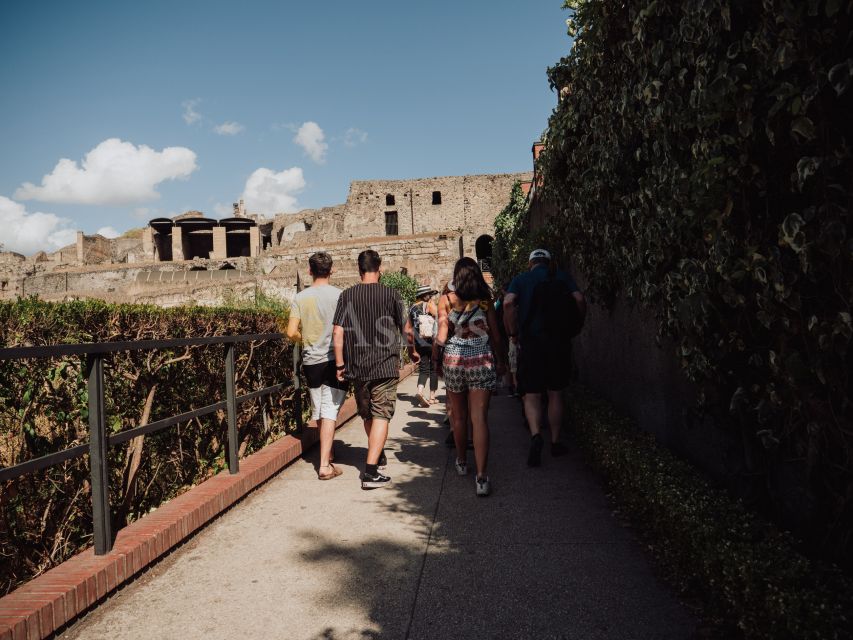
The first road transfer takes about 45 minutes from Naples to Ercolano. Your guide then leads a two-hour visit through the archaeological site.
Starting here is a smart choice. Herculaneum is compact enough to cover in a focused visit, and the preserved details reward careful explanation. You can see carbonized wooden objects that survived the eruption, painted walls, and mosaics that still show the taste and spending power of Roman households.
The route includes the Temple of the Augustali, a religious building connected with the imperial cult. You also visit the Thermal Baths, where the layout helps explain how bathing worked as both a practical routine and a social activity.
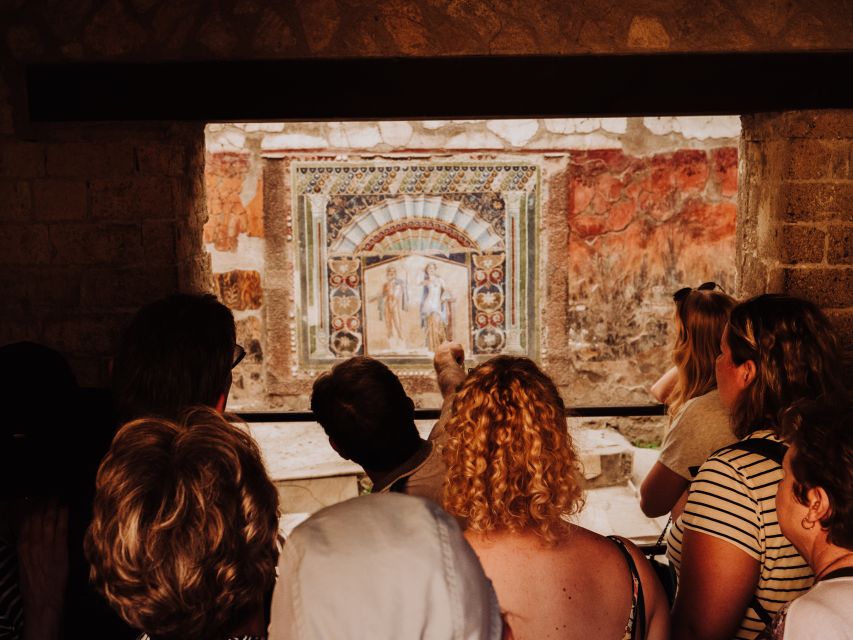
The Samnite House, the Gymnasium, and the House of the Dears add a domestic side to the visit. These places are useful because they move you beyond the usual picture of Rome as temples and emperors. Your guide can point out how rooms, decoration, public spaces, and household objects fit together.
One of the most powerful stops is the ancient beach. More than 300 skeletons were found there, giving a stark sense of the eruption’s human cost. It is an important moment, but not a light one, and you should be prepared for that.
The Forum is also on the route. Here, you get the civic side of Herculaneum, with the setting for commerce, administration, and public life. The site’s range is impressive, but the walk is not effortless. Uneven ancient surfaces, steps, and changes in level make comfortable shoes essential.
A two-hour visit cannot cover every building. That is not a flaw unique to this tour. Herculaneum itself rewards a longer visit if you want to read every room and inspect every object. The benefit here is that an archaeologist guide helps you spend those two hours on the parts that explain the site best.
The transfer and lunch break at Pompeii
After Herculaneum, the minibus takes about 30 minutes to Pompeii. There is a break of roughly 40 to 45 minutes before the guided walk begins.
Meals are not included. One practical detail matters here: the available meal option may cost around €30 per person, so bring your own food if you want to keep the day cheaper. The break is short, so do not plan an elaborate meal. You need enough time to eat, use the facilities, and be ready for the next entry.
This pause also gives your feet a rest. By this point, you have already spent two hours walking through Herculaneum, and Pompeii is the larger, more demanding site. Carry water and a light raincoat. The tour runs in wet weather as well as dry, and there is little point arriving at ancient sites without basic protection.
A different way to spend the day, same part of Italy:
- Pompeii: Small Group Tour with an Archaeologist
★ 4.8 · 12,264 reviews - From Naples: Pompeii Ruins & Mount Vesuvius Day Tour
★ 4.3 · 11,459 reviews - From Naples: Sorrento, Positano and Amalfi Full-Day Tour
★ 4.6 · 10,988 reviews - From Naples: Sorrento, Positano & Amalfi Coast – Small Group Tour
★ 5.0 · 8,643 reviews
Pompeii’s public city and private homes
The Pompeii visit lasts about two hours. You enter with a Pompei Express ticket and follow a route through the city’s main public buildings and private houses.
The Marina Gate provides a strong opening because it connects the excavated city with the road system that once brought people into Pompeii. From there, the Basilica and Forum show the civic heart of the town. These spaces were used for law, business, politics, religion, and public gathering.
The Forum Baths offer a look at Roman bathing and everyday routine. Then the Lupanar, or brothel, adds one of Pompeii’s most direct reminders that this was a lived-in town, not a frozen museum. Your guide’s role is especially useful here. Without context, small rooms and faded paintings can be easy to pass by. With an explanation, they become evidence of work, commerce, sex, food, and family life.
The Bakery and Termopolium Capuano shift attention to food and trade. A thermopolium was a place where prepared food and drink could be sold, and the surviving counter gives the stop a close-to-home quality. You can picture the practical business of feeding people in a busy Roman settlement.
The House of Faun is one of Pompeii’s major private residences. Its size and decoration show how wealthy households used architecture to display status. The House of the Tragic Poet offers another look at domestic decoration and storytelling through art.
The plaster casts are among the most famous and difficult sights in Pompeii. They record the forms of people caught in the eruption, making the disaster personal rather than distant. Your guide can help place them within the wider story of the town’s final hours.
Two hours is enough for the main points, but not enough to wander freely. One guide-led route may move past rooms you would like to inspect longer. That is the central compromise of this excursion: you get a clear introduction to both sites, but independent exploration must wait for another visit.
What the archaeologist guide adds
The strongest reason to book this tour is the guide, not simply the transport or the tickets.
An archaeologist can explain why a wall painting matters, what a building was used for, and how archaeologists interpret damage from the eruption. Several guides have received especially warm praise for being clear, patient, funny, and attentive to questions. Raphael is repeatedly singled out for his energy, detail, and humor. Roberta is praised for making the day fascinating and for answering questions carefully. Michele has worked at Herculaneum, which gives him a particularly useful connection to that site.
Other named guides include Vito, Gennaro, Juliano, Michael, and Alfredo. The exact guide depends on the date, so do not book on the assumption that one particular person will lead your group. The useful point is that the tour has a strong record of guides who can turn scattered ruins into a readable story.
A guide also helps with crowd movement. Pompeii can be busy, and it is easy to lose time looking for a famous house or public building. A good route gets you to the main sights without wasting your limited hours.
Some groups use headsets, allowing you to hear explanations while standing in a crowded street. This is not a detail to take for granted on every departure, but it has been part of the experience for some groups and is a welcome aid when the site is noisy.
Is the $168.79 price fair?
At $168.79 per person, this is not a bargain-basement outing. You are paying for a full seven-hour day, shared minibus transportation, parking and tolls, the Pompeii ticket, the €16 Herculaneum ticket, skip-the-line access, and a specialist guide.
The value is strongest if you are based in Naples and want both sites without piecing together trains, entry times, and local walks. You also avoid the risk of spending much of the day in ticket queues. The guide’s explanations are the part you cannot easily reproduce by buying tickets alone.
The value is weaker if you prefer a slow pace, already understand Roman archaeology, or want to spend half a day at Pompeii alone. The tour gives you the highlights, not a full archaeological study. Lunch is extra, and the short break may tempt you toward a costly meal unless you bring food.
I would call the price reasonable for a first visit, particularly for someone with only one day available from Naples. If you are staying near the sites and have plenty of time, independent visits may give you more hours and more control.
Walking, weather, and comfort
You need sturdy walking shoes. Pompeii and Herculaneum have uneven ancient paving, stairways, slopes, and changing surfaces. One of the clearest practical warnings is that people with mobility limits may find the day too taxing.
The tour is not suitable for wheelchair users or people with mobility impairments. Baby seats are available on request, but the walking conditions still matter for families with small children.
The excursion runs rain or shine. Pack a raincoat if rain is possible, and bring water and sun protection in hot weather. The sites offer little relief during long open-air stretches.
The driver waits only five minutes for late arrivals, so punctuality is essential. At the end, you return to Starhotels Terminus, which is useful for an onward train, but leave a sensible buffer if your departure is time-sensitive. Traffic can affect the road sections, even though the listed schedule includes the expected transfers.
Who should book this day trip?
This tour suits you if you want a guided introduction to both major eruption sites and prefer a simple start-to-finish plan from Naples. It is particularly useful for first-time visitors, shore excursion passengers, and anyone who values expert explanation over free time.
It also works well for people who want to compare preservation. Herculaneum’s wooden objects and painted rooms feel intimate. Pompeii’s streets, Forum, shops, and houses show a broader city in motion.
You should think twice if you dislike group schedules or need long periods for photography. A maximum of 20 people is fairly small, but it is still a group, and the guide must keep everyone moving.
This is also not the right pick for a relaxed sightseeing day. You spend around four hours walking at the sites, plus roughly two hours on the road and a brief meal break. The pace is purposeful rather than leisurely.
Should you book Pompeii and Herculaneum together?
I would book this tour if your Naples schedule allows one full day and you want the main story told well. The combination of two archaeological sites, skip-the-line entry, and a minibus return to the station removes much of the usual planning work.
Choose it for the archaeologist guide and the chance to see Herculaneum properly, not just for transport. Guides such as Raphael, Roberta, and Michele have the kind of site knowledge that helps you notice why a carbonized beam, painted wall, bath complex, or food counter matters.
Skip it if you need wheelchair access, dislike uneven ground, or want several hours of unstructured time at Pompeii. For most reasonably fit first-time visitors, though, this is an efficient and worthwhile way to meet both towns in one day.
FAQ
Where does the tour start?
Meet in front of the Starhotels Terminus entrance, opposite Naples Central Station. Look for the guide holding an ASKOS TOURS sign.
Where does the tour end?
The activity ends back at the Starhotels Terminus meeting point.
How long does the tour last?
The tour lasts seven hours, including minibus transfers, the visits to both archaeological sites, and the lunch break.
What language is the tour in?
The live guided tour is conducted in English.
Are entrance tickets included?
Yes. The package includes a Pompei Express entrance ticket and a Herculaneum entrance ticket, listed at €16 each. Skip-the-line entry is included for both sites.
Is lunch included?
No. Meals are not included. You have a break of about 40 to 45 minutes before the Pompeii visit.
Can I bring luggage?
No. Luggage and large bags are not allowed. Bring only a small day bag.
Is the tour suitable for people with limited mobility?
No. The tour is not recommended for people with limited mobility and is not suitable for wheelchair users. Expect uneven surfaces, slopes, stairs, and substantial walking.
Recently reviewed around Naples & Pompeii
- Pompeii Skip-the-line Tour with Archaeologist Guide★ 5.0 · 559 reviews
- Sharing Tour of Pompeii★ 5.0 · 487 reviews
- Skip the Line Guided Tour of Pompeii led by an Archaeologist★ 5.0 · 703 reviews
- Visit in Pompeii – Pompeii Private Tour with Ada★ 5.0 · 436 reviews
- Pompeii Private Tour with an Archaeologist and Skip The Line★ 5.0 · 391 reviews
- Private Day Tour to Vesuvius, Herculaneum & Pompeii with Pick Up★ 5.0 · 279 reviews
- Pompeii Vineyard Escape: Private Wine Tasting & Lunch★ 5.0 · 329 reviews
- Pompeii Guided Group Tour with Entry Ticket and Archaeologist★ 4.5 · 269 reviews
Pompeii & Vesuvius Tours, compared.

Entry Ticket and Guided Tour with an Archaeologist
Read our review →




Pompeii Small Group Tour with an Archaeologist
Read our review →
Pompeii, Amalfi Coast and Positano Day Trip from Rome
Read our review →Browse the lists this tour appears in