
Review · POMPEII & VESUVIUS TOURS
Herculaneum Small Group Tour and Ticket With an Archaeologist
Herculaneum is smaller than Pompeii, but its preserved wooden doors, furniture, mosaics, frescoes, and even food shops can make the ancient city feel remarkably close. This two-hour walking tour with an archaeologist gives you the useful stories behind those remains instead of leaving you to decode silent walls and Latin inscriptions.
I like the skip-the-line entry and the headsets, especially when the guide is explaining something in a busy courtyard. I also like the focused route through some of the site’s finest homes, baths, and public buildings. The main caution is time: two hours goes quickly, and a long-winded guide or a slow group may leave you less time for the museum or for exploring independently.
In This Review
- Key points to know before booking
- Why Herculaneum rewards a guided visit
- Starting at the Corso Resina ticket office
- House of the Deer and the terrace of M. Nonius Balbus
- The College of the Augustales and the House of the Telephus Relief
- Wooden partitions and the House of the Skeleton
- Central Baths and the House of the Black Hall
- Samnite design and the courtyard house
- The House of the Grand Portal and the final ten minutes
- How the group size and headsets affect the visit
- Is $53.81 a fair price?
- Who should book this Herculaneum tour?
- Should you book it?
- FAQ
- How long does the Herculaneum tour last?
- Where does the tour meet?
- Where does the tour finish?
- Is admission to Herculaneum included?
- How many people can join the group?
- Is the tour available in English?
Key points to know before booking
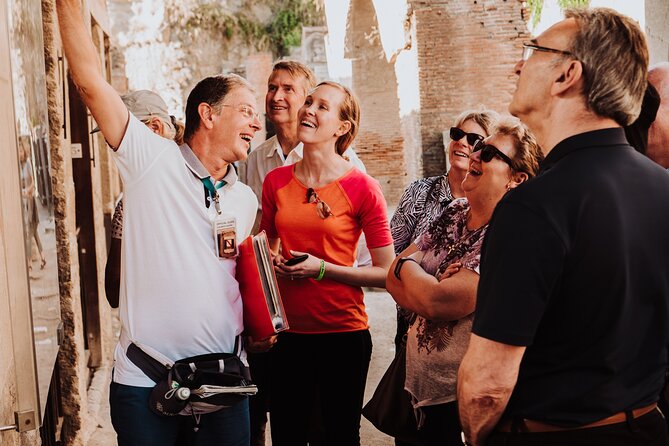
- Archaeologist-led interpretation: Guides such as Luciano Leone, Paulo, Julia, Michele, and others bring professional archaeological training and explain how the buildings, objects, and daily routines fit together.
- Eleven major stops: The route covers luxury houses, public baths, religious and civic buildings, and unusual features such as the preserved wooden partition in the House of the Wooden Partition.
- Maximum group of 20: This is not a private tour, but headsets help you hear the guide while moving through the ruins.
- About two hours: Expect a brisk overview rather than a complete study of every open building.
- $53.81 including entry: Since the adult Herculaneum ticket is listed at 16 euros, the price pays for the guide, assistance, headsets, and the convenience of reserved admission.
- The meeting point is outside the ruins: You meet at the ticket office on Corso Resina, then finish inside the archaeological park.
Why Herculaneum rewards a guided visit
The eruption of Mount Vesuvius in AD 79 buried Herculaneum under volcanic material. Unlike Pompeii, where ash and pumice often preserved outlines and wall paintings, Herculaneum benefited from a hot surge that sealed parts of the town and protected carbonized wood, doors, beams, and household objects.
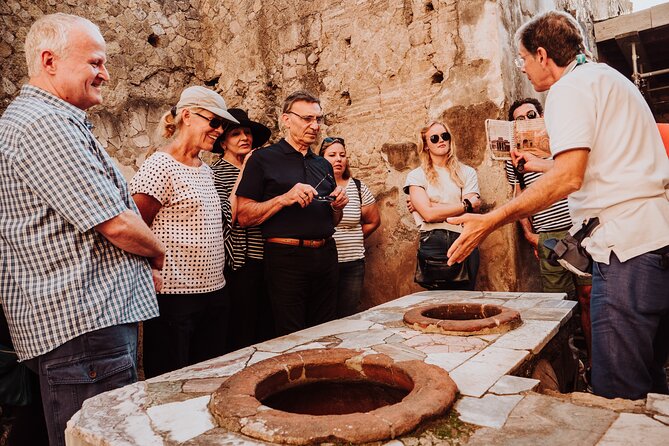
That difference matters once you are walking through the streets. You are not only looking at stone foundations. You may see a wooden screen, a carbonized door frame, a painted room, or a balcony that still gives a sense of how an ancient home was arranged.
A guide adds the missing connection between object and ordinary life. The best guides do not simply name a room. They explain how an atrium worked, why a bath complex had separate entrances, how a wealthy family displayed status, or what a funeral inscription tells you about civic power.
The archaeologist angle is the main reason to choose this experience instead of entering alone. Luciano Leone, in particular, is noted for using visual reconstructions and personal illustrations to show how the buildings may have looked before the eruption. Other guides, including Paulo, Julia, Antonella, Sergio, Diego, and Michele, are described as lively, clear, and deeply familiar with the site.
Your exact guide is not guaranteed, so the experience can vary in style. Still, the tour is built around professional archaeological guidance rather than a basic audio script.
More Naples & Pompeii trips worth a second look
- Naples: Naples Underground Entry Ticket and Guided Tour
★ 4.4 · 21,781 reviews - Pompeii: Entry Ticket and Guided Tour with an Archaeologist
★ 4.8 · 19,459 reviews - Pompeii: Entry Ticket with Optional Audio Guide
★ 4.2 · 12,360 reviews
Starting at the Corso Resina ticket office
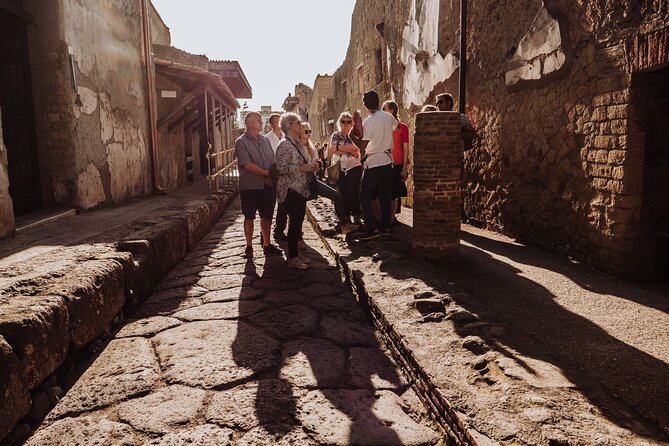
The meeting point is the Herculaneum ruins ticket office at Corso Resina 187 in Ercolano. This is outside the entrance, so allow enough time to find the office and identify the tour coordinator before the scheduled start.
The Circumvesuviana train station is on Corso Resina 1 and is about a 10-minute walk from the meeting point. That makes the tour fairly practical from Naples or other stops on the Circumvesuviana line. By car, you can use Via Pignalver, where there is an unguarded parking area very close to the meeting place.
The tour ends inside the Herculaneum archaeological area. That is useful because you can continue looking around after the guided portion, assuming the site remains open and you have enough energy. The entry ticket also gives access to the onsite museum, so plan to see it after the walk rather than treating the guided route as the entire visit.
You receive confirmation when booking. The operator may also use WhatsApp to send meeting instructions, and clear communication on the day is helpful if you are worried about finding the right person.
House of the Deer and the terrace of M. Nonius Balbus
The route begins with the House of the Deer, named for the marble statues of stags found in its peristyle. The name is easy to remember, but the larger point is the scale of the home. This was a luxurious residence, and the statues help you picture a landscaped inner space designed for display and leisure.
Your guide can help you read the house as a Roman home rather than a collection of disconnected rooms. Look for the relationship between open courtyards, decorated rooms, and the spaces used to receive visitors.
Next comes the terrace of M. Nonius Balbus. Balbus was a major benefactor who financed the restoration and construction of public buildings. After his death, the city honored him as a patron, and the long inscription on his funeral altar records those honors.
This stop is valuable because it shifts the story from private homes to public life. Herculaneum was not only a town of wealthy villas. It was also a community shaped by patrons, civic spending, religious honors, and local politics. Ten minutes can feel short here, so listen for the guide’s explanation of the inscription and Balbus’s role.
The College of the Augustales and the House of the Telephus Relief
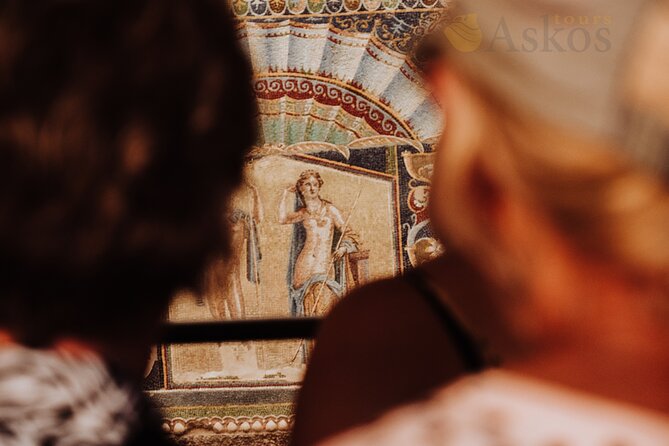
The College of the Augustales is thought to have been connected to the cult of Emperor Augustus. It may also have served as the headquarters of the local college or even as a civic meeting place.
The uncertainty is part of the interest. Archaeology often involves careful interpretation rather than absolute answers. A good guide will distinguish what is known from what scholars propose, helping you avoid the false certainty common in quick tours.
The House of the Telephus Relief may have belonged to Marcus Nonius Balbus, the same civic benefactor seen earlier. Its unusual feature is a private entrance to the Suburban Baths next door. That private access tells you something about status and convenience. A prominent resident could move directly from home to the bathing complex without using the main public route.
This is one of the moments when an archaeologist can make the ruins feel personal. A doorway is no longer just an architectural detail. It becomes evidence of who lived there, how they moved around town, and how public and private spaces overlapped.
A different way to spend the day, same part of Italy:
- Pompeii: Small Group Tour with an Archaeologist
★ 4.8 · 12,264 reviews - From Naples: Pompeii Ruins & Mount Vesuvius Day Tour
★ 4.3 · 11,459 reviews - From Naples: Sorrento, Positano and Amalfi Full-Day Tour
★ 4.6 · 10,988 reviews - From Naples: Sorrento, Positano & Amalfi Coast – Small Group Tour
★ 5.0 · 8,643 reviews
Wooden partitions and the House of the Skeleton
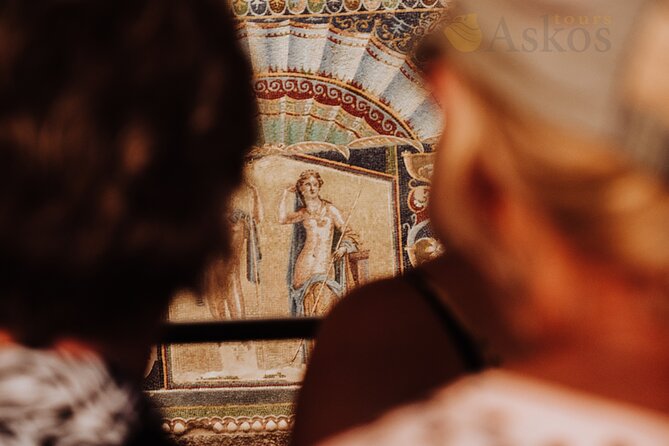
The House of the Wooden Partition contains one of Herculaneum’s most important surviving wooden features: an elegant carbonized partition. Wood is normally a fragile material, so its survival gives you a rare glimpse of interior design and household construction.
The partition also reminds you that Herculaneum was preserved in unusual conditions. Stone is expected to survive an ancient disaster. A wooden screen, door, or beam is not. Take a close look at the workmanship and placement, since this is exactly the sort of detail you could miss while walking alone.
The House of the Skeleton probably formed from three smaller buildings combined into one. Its name comes from human remains found in an upstairs room in 1831.
The stop can feel sombre, but it also shows how excavation changes over time. The building was not simply uncovered in one neat moment. Discoveries continued long after the first excavations, and the name reflects one particularly striking find.
There is some standing here, as at most of the site. If you have limited stamina, tell the guide early. One guide is specifically praised for checking that a visitor with hearing aids could follow the explanations, and the use of headsets helps, but the route still involves walking and little opportunity to sit.
Central Baths and the House of the Black Hall
The Central Baths were built around the beginning of the first century AD and had separate sections for men and women, each with its own entrance. Roman baths were not merely places to wash. They were social and civic spaces, and the layout shows how carefully these facilities were organized.
Your guide will likely point out the division between the two bathing areas and explain how the rooms worked together. This is one of the stops that helps you understand daily routines rather than grand political events.
The House of the Black Hall is one of Herculaneum’s more luxurious mansions. Its monumental entrance still preserves carbonized doorposts and a lintel, giving you a direct look at the wooden parts of an ancient doorway.
Inside, the dark decorative scheme and surviving architectural details offer a sharp contrast to the pale stone streets outside. This is a good place to slow your eyes down. Do not only look for the largest fresco. Notice how the entrance, rooms, wall decoration, and wooden fittings combined to signal wealth.
Samnite design and the courtyard house
Casa Sannitica has an arrangement associated with the Samnites, an ancient people who occupied the mountainous part of central Italy. Its atrium is bordered by a gallery with Ionic columns, and the rooms retain fresco decoration.
The name connects the house with an earlier cultural identity, but the building also shows how homes changed as Herculaneum developed. A guide can help you understand the difference between a label based on architectural style and a firm statement about the family who lived there.
Casa del Bel Cortile is one of the town’s more original houses. Instead of the standard atrium, it has a courtyard with a stairway and a stone balcony. That unusual plan is a reminder that Roman houses did not all follow one fixed design.
These two stops work well together. Casa Sannitica gives you a more traditional arrangement with columns and an atrium. Bel Cortile breaks the pattern. If you are interested in architecture, this part of the tour may be more rewarding than simply counting frescoes.
The House of the Grand Portal and the final ten minutes
The House of the Grand Portal sits in the center of the archaeological area. It includes columns, frescoes, and carbonized wooden remains, with several rooms to inspect.
The final stop brings together many of the themes introduced along the route: decorated domestic spaces, columned areas, wooden construction, and the remains of a town that was active and prosperous before disaster struck.
Because the itinerary gives roughly 10 minutes to each stop, the guide has to keep moving. That is useful if you want a strong overview of the main highlights, but it can feel rushed if you prefer long pauses for photographs or close study.
At the end, you are inside the ruins rather than back at the ticket office. Use that advantage. If the group has moved briskly, you can revisit a house that caught your attention. You can also visit the onsite museum, where recovered jewelry and furniture help fill in the parts of domestic life that the buildings alone cannot show.
How the group size and headsets affect the visit
The maximum group size is 20 people per guide. That is small enough for a more personal experience than a large coach tour, but it is not the same as having a private guide. Your position in the group can affect how easily you see a small fresco or architectural detail.
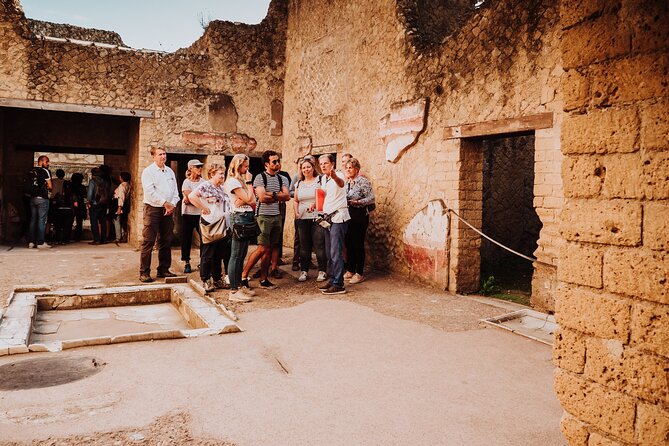
Headsets are included and are especially useful in courtyards, narrow streets, or areas where several groups are speaking at once. Guides have been praised for making sure everyone could see and hear, and the equipment helps maintain contact while the group is moving.
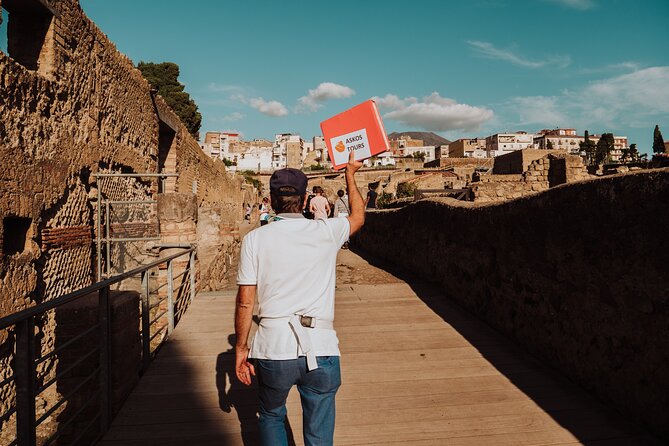
Pacing varies. Some guides move quickly so you can cover more ground. That can be a good thing at Herculaneum, where there is much to see and the tour is only two hours. One guide was criticized for running overtime and reducing time for other parts of the visit, so do not assume the scheduled duration will leave plenty of time for every open area.
You will spend much of the tour standing. Wear shoes suited to uneven archaeological paths, dress for the weather, and bring protection from rain or sun. The tour operates in all weather conditions.
Is $53.81 a fair price?
The adult entry ticket is listed at 16 euros, with a reduced 2-euro price for EU citizens aged 18 to 25. At $53.81 per person, the tour costs more than admission alone, but the difference covers a licensed guide with an archaeological background, assistance, skip-the-line access, and headsets.
I consider that fair value if Herculaneum is an important part of your Naples visit and you want context rather than a quick walk through. The site’s rooms can look deceptively simple until someone explains the social role of a bath, the status shown by a private entrance, or the importance of a carbonized wooden object.
The value is weaker if you prefer to read at your own pace, spend a long time photographing each room, or already have strong background knowledge of Roman domestic architecture. In that case, an audio guide or independent visit may give you more control.
For most first-time visitors, the guide is the main purchase. The ticket and line benefits are useful, but the real advantage is having someone explain the details before you walk past them.
Who should book this Herculaneum tour?
I would choose this tour if you have only a short window, want an English-speaking guide, or are visiting ancient sites with children or teenagers who need a clear story to stay engaged. The guides use family histories, engineering, civic life, and everyday routines to make the ruins easier to understand.
It also suits people who chose Herculaneum instead of Pompeii and want reassurance that the smaller site offers plenty to see. The preserved frescoes, tiled floors, wooden features, baths, and household remains create a visit with a different character from Pompeii.
It may be less suitable if anyone in your group struggles with prolonged standing or wants a slow, quiet archaeological study. Most people can participate, and service animals are allowed, but the route includes walking and limited seating.
Dogs are allowed in the archaeological park without breed or size restrictions, but they must be on a leash or muzzle, and you must carry bags for waste. In the Antiquarium, Boat Pavilion, and houses with mosaic floors, dogs must be carried or placed in an appropriate carrier.
Should you book it?
Book it if you want a guided overview with real archaeological context, especially on a first visit. The strongest guides, including Luciano Leone, Paulo, Julia, and Michele, turn architectural fragments into stories about status, family, religion, and daily life.
Skip it if you want complete freedom to linger or if your priority is spending a long time in the museum. If you book, arrive early at the Corso Resina ticket office, wear comfortable shoes, and keep time after the tour to explore inside the ruins.
The free-cancellation policy allows a full refund when you cancel at least 24 hours before the start time. Changes or cancellations inside that window are not accepted, and a minimum group size is required for the tour to operate.
FAQ
How long does the Herculaneum tour last?
The tour lasts approximately two hours.
Where does the tour meet?
You meet at the Herculaneum ruins ticket office at Corso Resina 187, 80056 Ercolano, Italy.
Where does the tour finish?
The tour ends inside the Herculaneum archaeological ruins.
Is admission to Herculaneum included?
Yes. The Herculaneum entry ticket is included. The listed adult ticket price is 16 euros, while EU citizens aged 18 to 25 pay 2 euros.
How many people can join the group?
The group has a maximum of 20 people per guide.
Is the tour available in English?
Yes. The experience is offered in English and includes headsets.
Recently reviewed around Naples & Pompeii
- Pompeii Skip-the-line Tour with Archaeologist Guide★ 5.0 · 559 reviews
- Sharing Tour of Pompeii★ 5.0 · 487 reviews
- Skip the Line Guided Tour of Pompeii led by an Archaeologist★ 5.0 · 703 reviews
- Visit in Pompeii – Pompeii Private Tour with Ada★ 5.0 · 436 reviews
- Pompeii Private Tour with an Archaeologist and Skip The Line★ 5.0 · 391 reviews
- Private Day Tour to Vesuvius, Herculaneum & Pompeii with Pick Up★ 5.0 · 279 reviews
- Pompeii Vineyard Escape: Private Wine Tasting & Lunch★ 5.0 · 329 reviews
- Pompeii Guided Group Tour with Entry Ticket and Archaeologist★ 4.5 · 269 reviews
Pompeii & Vesuvius Tours, compared.

Entry Ticket and Guided Tour with an Archaeologist
Read our review →




Pompeii Small Group Tour with an Archaeologist
Read our review →
Pompeii, Amalfi Coast and Positano Day Trip from Rome
Read our review →Browse the lists this tour appears in