
Review · POMPEII & VESUVIUS TOURS
Pompeii and Herculaneum Small Group Tour with an Archaeologist
Pompeii and Herculaneum tell two very different stories of the same disaster. Pompeii gives you streets, theaters, temples, and grand villas on a huge scale, while Herculaneum feels more intimate, with carbonized wood, vivid rooms, and unusually well-preserved houses. An archaeologist helps you read what you are seeing instead of simply following a map.
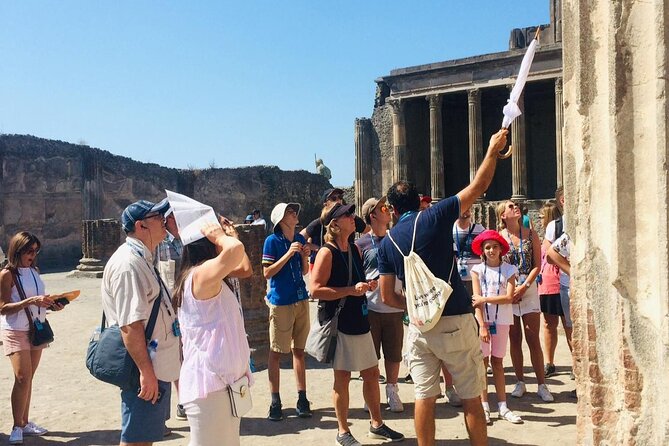
I like two things here: one ticket covers both sites, and the guide handles the awkward transfer between them. The small group, capped at 20, also makes it easier to hear explanations through the provided headsets. The catch is time. Two hours in Pompeii is enough for the major sights, but not enough to explore this enormous city at your own pace.
In This Review
- Key points to know before booking
- Why seeing both Pompeii and Herculaneum matters
- Starting from Pompeii, Naples, Sorrento, or Rome
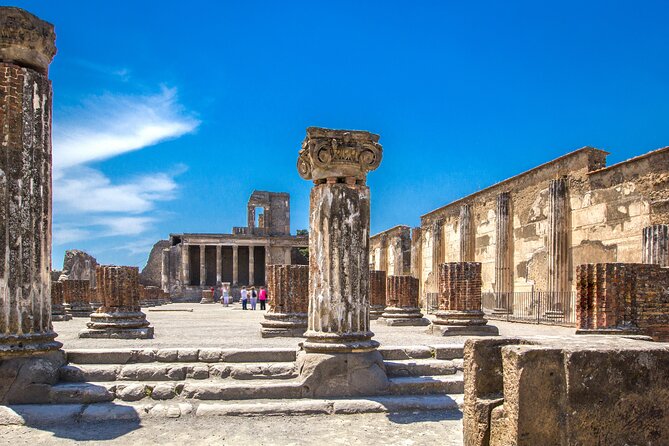
- Pompeii’s Forum, Basilica, and main streets
- Baths, brothel, villas, and theaters
- The lunch break and transfer to Herculaneum
- Herculaneum’s preserved houses and public buildings
- Skeleton House, baths, and grand interiors
- What the archaeologist adds
- Is $77.09 good value?
- Who should book this tour?
- Final verdict
- FAQ
- How long does the Pompeii and Herculaneum tour last?
- What is included in the price?
- Where does the tour meet?
- Is lunch included?
- Does the Pompeii departure include transportation back to Pompeii?
- Can most people take this tour?
Key points to know before booking
- Two archaeological sites in one day: See Pompeii’s broad urban ruins and Herculaneum’s tighter, better-preserved streets.
- Archaeologist-led sightseeing: Guides such as Michele, Diego, Michael, Paulo, and Antonio have led tours praised for clear explanations and lively storytelling.
- Transport depends on your departure point: Naples, Sorrento, and Rome departures use minibus transport. The Pompeii option uses the Circumvesuviana train to Herculaneum.
- Pompeii is the rushed half: The standard visit allows about two hours, enough for highlights but not a full exploration.
- Lunch is not included: Plan on a short break at your own expense, and consider bringing a snack or lunch.
- Good value for a guided overview: At $77.09 per person, the price includes entry to both sites, guiding, headsets, and selected transport.
Why seeing both Pompeii and Herculaneum matters
If you visit only Pompeii, you see the larger and more famous site. That is a strong day out by itself, but adding Herculaneum gives you a useful comparison.
Pompeii was a sizable city with long streets, public buildings, theaters, baths, shops, and imposing private homes. You get a sense of daily movement and city planning. Herculaneum is smaller, so the experience feels less like walking across an ancient town and more like entering a series of preserved homes.
The contrast is especially valuable when an archaeologist points out details you could easily miss. In Herculaneum, carbonized wooden doors, beams, partitions, and furniture fragments help show how much ordinary building material has disappeared at other Roman sites. Pompeii gives you the city. Herculaneum gives you more of the interior life.
The tour is therefore best understood as a focused introduction to two sites, not a complete archaeological study. You will see major landmarks, learn how Roman public and private life worked, and leave with a clear idea of why both places deserve separate visits.
Other Naples & Pompeii days travellers weigh against this one:
- Naples: Naples Underground Entry Ticket and Guided Tour
★ 4.4 · 21,781 reviews - Pompeii: Entry Ticket and Guided Tour with an Archaeologist
★ 4.8 · 19,459 reviews - Pompeii: Entry Ticket with Optional Audio Guide
★ 4.2 · 12,360 reviews
Starting from Pompeii, Naples, Sorrento, or Rome
You choose the departure option when booking, and the meeting point changes with it.
From Pompeii, meet at Porta Marina Superiore. You begin with the Pompeii visit, then travel with the guide by Circumvesuviana train to Ercolano Scavi station. The train ride takes about 30 minutes, followed by a walk of roughly 10 minutes to the ruins. The included ticket covers the one-way journey to Herculaneum.
From Naples, the meeting point is outside Starhotels Terminus. Round-trip minibus transport is included, making this the simplest version if you are staying in Naples. The minibus also handles the journey to Herculaneum.
From Sorrento, meet at Piazza Angelina Lauro. The package includes transport to and from Sorrento, although the exact operating plan can change in quieter periods. One recent tour arrangement required participants to make their own way to Pompeii by train instead of receiving the advertised pickup, with compensation provided. If you are booking in the low season, confirm the transport plan close to the date.
The Rome option includes train tickets between Rome and Naples, plus full-day transport services. This makes for a very long day, but it can work if you have limited time and want to reach both sites without arranging each connection yourself.
The listed duration is approximately six to 11 hours, depending on your departure point. The Rome version naturally takes longer. All participants receive headsets, an important detail in a group of up to 20 people, especially in noisy courtyards or along busy streets.
Pompeii’s Forum, Basilica, and main streets
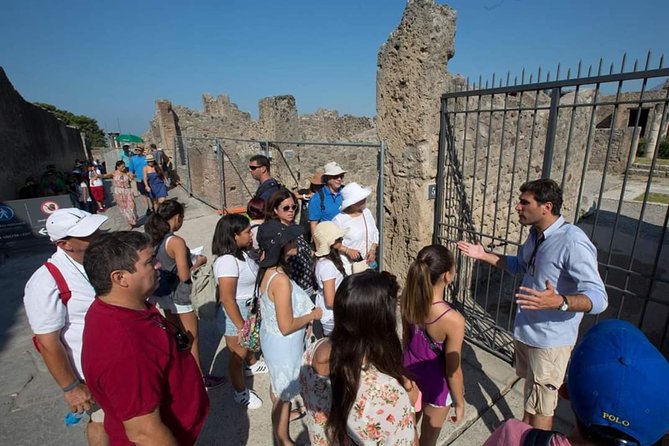
The Pompeii portion begins with the Basilica, an open portico used for business and public activity. It is not a church in the later Christian sense. Your guide can use this stop to explain how commerce, legal matters, and civic life operated in the city.
The Forum follows, Pompeii’s main public square. This is the place to get your bearings. From here, temples, civic buildings, and public spaces show how the city was organized around a central gathering point.
You then walk along one of Pompeii’s main streets. The road itself matters. Ancient paving stones, raised sidewalks, and the surrounding shop fronts help turn a collection of ruins into a functioning city. I find this kind of guided walk far more useful than staring at a site map and trying to guess what each building once did.
The route continues to the House of Menander, one of Pompeii’s grandest residences. Its architecture, decoration, and contents reflect the wealth of its owners. This is an early reminder that Pompeii was not simply a town of modest homes. It had a sharp social range, from working spaces to elaborate private compounds.
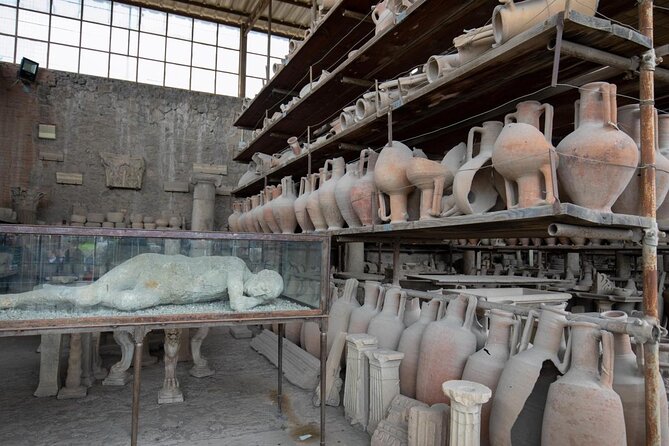
At the Granaries of the Forum, you see marble tables and stone fittings once used in fountains, along with casts of victims, including a dog and a tree. This can be a somber stop. The casts are powerful because they shift the eruption from a distant event into something personal and immediate.
Baths, brothel, villas, and theaters
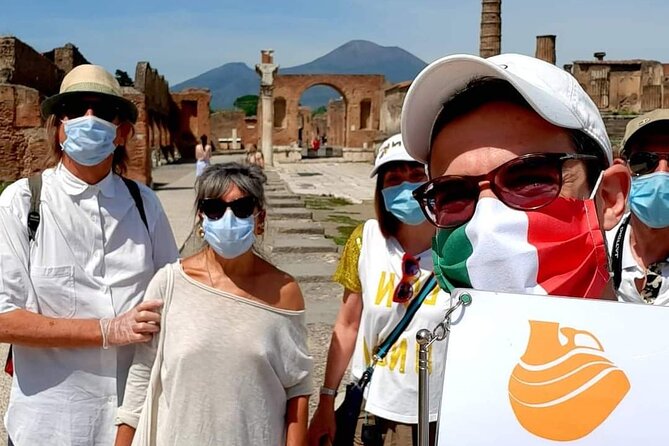
The Stabian Baths occupy a large area near several important streets and are considered the oldest thermal complex in Pompeii. A guide can explain the separation of bathing areas and the role baths played beyond washing. They were places for exercise, social contact, and routine public life.
The Lupanar, Pompeii’s best-known brothel, is a quick but memorable stop. Its small rooms and surviving paintings are often among the most discussed parts of the visit. The site can attract crowds, so having the guide keep the group moving helps, though it also means you may not get much quiet time here.
The House of the Faun is one of the largest and most impressive private residences in Pompeii. Its size, layout, and decoration offer a useful counterpoint to the smaller homes along the streets. It is also the kind of stop where an archaeologist’s explanation adds real value, since the important story is not just what remains, but how the rooms fit together and what that says about status.
The Odeon, or Teatro Piccolo, was a smaller theater designed for performances that needed a more contained setting. The Teatro Grande, by contrast, was Pompeii’s major theater. Together they show that entertainment was part of the city’s public life, not a rare luxury.
This sequence covers many of Pompeii’s headline sights: the Forum, major houses, baths, the brothel, theaters, and plaster casts. It is a smart route for a first visit, but the pace is brisk. Several stops are allotted only 10 to 15 minutes, and the entire Pompeii visit is generally about two hours.
That is the main tradeoff. You can learn a lot and see the essential areas, but you cannot properly wander through Pompeii in that time. If you already know you want to study mosaics, frescoes, the Antiquarium, or less-visited streets, plan a separate return visit.
A different way to spend the day, same part of Italy:
- Pompeii: Small Group Tour with an Archaeologist
★ 4.8 · 12,264 reviews - From Naples: Pompeii Ruins & Mount Vesuvius Day Tour
★ 4.3 · 11,459 reviews - From Naples: Sorrento, Positano and Amalfi Full-Day Tour
★ 4.6 · 10,988 reviews - From Naples: Sorrento, Positano & Amalfi Coast – Small Group Tour
★ 5.0 · 8,643 reviews
The lunch break and transfer to Herculaneum
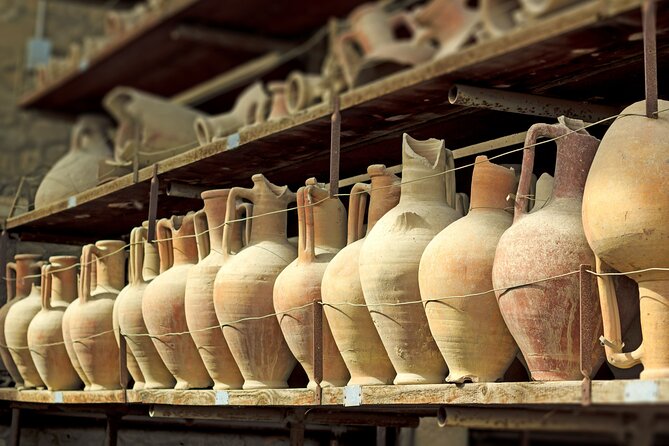
After Pompeii, there is a short lunch break before the second site. Food and drinks are not included, and the break may be around 50 minutes depending on the operating schedule.
The stop can be convenient, but it may feel out of place after a morning among ancient ruins. The usual meal area has been described as a mall with several food choices, including pizzerias. You can buy something there, but if you prefer to stay near the archaeological setting, bring your own lunch or snack.
A practical tip: carry water and a small snack, especially if you are using the train option from Pompeii. The walk from Ercolano Scavi station to the site is short, but the day is long and the next guided visit begins soon after arrival.
For the Naples, Sorrento, and Rome options, you travel by modern minibus directly to Herculaneum. For the Pompeii departure, you use the train with the guide. The different transport arrangements explain much of the price and duration variation between options.
Herculaneum’s preserved houses and public buildings
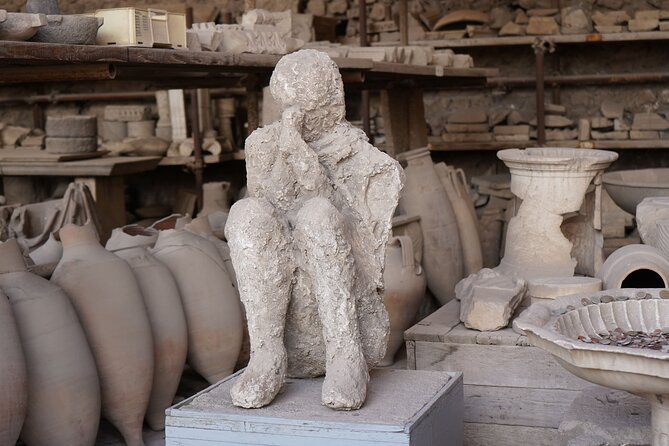
Herculaneum is smaller than Pompeii, and two hours feels more suitable here. You enter with the guide and begin among houses, baths, and public buildings that often preserve more delicate materials than Pompeii does.
The House of the Deer takes its name from marble deer statues found in its peristyle. It is a good example of the town’s more elegant residential architecture, with decorative elements that help you picture the home as a lived space rather than an empty shell.
At the Terrace of M. Nonius Balbus, you learn about one of the city’s major benefactors. Balbus funded or restored public buildings and received elaborate honors after his death. This stop connects private wealth with public influence, a theme that appears repeatedly in Roman cities.
The College of the Augustales is linked to the cult of Emperor Augustus and may also have served as a local civic headquarters. The building helps explain how imperial loyalty, religion, and local government could overlap.
The House of the Relief of Telephus is unusual because it had private access to the nearby Suburban Baths. Its possible connection with Marcus Nonius Balbus gives the guide another chance to discuss status and patronage, while the layout shows how elite homes could connect directly to leisure facilities.
The House of the Wooden Partition is important for its surviving elegant wooden screen. At Herculaneum, charred wood is one of the great surprises. The volcanic material that destroyed the town also sealed and preserved objects that would normally vanish.
Skeleton House, baths, and grand interiors
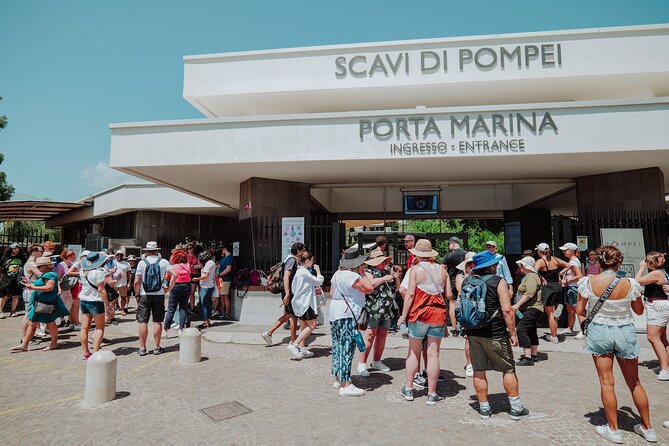
The House of the Skeleton probably formed from three smaller buildings joined together. Its name comes from human remains found in an upper room in the 19th century. Like the casts at Pompeii, this stop brings the human cost of the eruption into view, though in a less theatrical and more unsettling way.
The Central Baths were built around the beginning of the first century AD and were divided into men’s and women’s sections, each with its own entrance. The layout gives you a practical look at how Roman bathing facilities were planned and used.
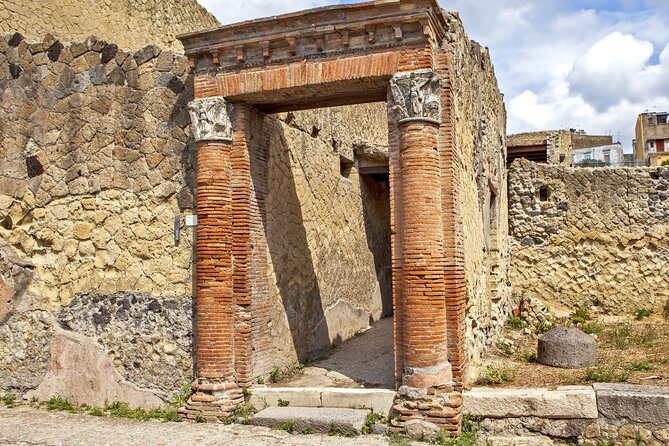
The House of the Black Salon is one of Herculaneum’s more luxurious mansions. Its monumental entrance still preserves carbonized doorposts and a lintel, a small detail with unusual impact. You can see the remains of a real building material rather than only a stone replacement.
The Samnite House has an atrium surrounded by a gallery with Ionic columns. Its frescoed rooms and distinctive arrangement reflect older Samnite traditions in the region. The House of the Beautiful Courtyard offers a different plan, with a courtyard, stairway, and stone balcony instead of the more typical atrium.
The final stop, the House of the Grand Portal, brings together several features found across Herculaneum: columns, frescoes, domestic rooms, and charred wooden remains. By this stage, the difference between the two cities should be clear. Pompeii gives you breadth. Herculaneum gives you preservation and close detail.
What the archaeologist adds
The strongest part of this experience is the guide’s interpretation. Past guides have included Michele, Diego, Michael, Paulo, Antonio, Alfredo, Amadeo, Tomas, Vince, Gianni, and Mario. The guide assigned to your date may differ, but the format is built around an archaeologist rather than a general escort.
That matters at sites where a wall may look plain until you understand its purpose. A guide can explain why the Forum mattered, how baths functioned, what a house layout says about status, and why carbonized wood at Herculaneum is so unusual.
The best guides also make room for questions. Michael has been especially noted for pointing out small details that are easy to miss, while Diego and Antonio have been praised for making daily Roman life easier to picture. Paulo, Michele, and Alfredo have also led tours described as organized, clear, and engaging.
The headsets help, but they are not perfect. One complaint described the guide moving so quickly that the audio connection was lost at times. Stay close to the group, especially when crossing open streets or moving between crowded rooms.
Is $77.09 good value?
At $77.09 per person, the price is reasonable if you want both admission and transport arranged for you. Adult entry alone is listed as €20 for Pompeii and €16 for Herculaneum, before counting a guide, headsets, minibus service, or Rome rail connections.
The value is strongest for people based in Naples or Sorrento. You avoid figuring out the transfer between sites and receive a structured route through places that can otherwise feel confusing. The Rome option is also useful if this is your only practical chance to see the ruins, though expect a very long day.
The value is weaker if you want long stretches of independent exploration. Pompeii is too large for two hours, and the guide’s route determines what you see. You are paying for efficiency and interpretation, not unlimited time.
Free cancellation is available until 24 hours before the start time. Most people can participate, but the experience is not recommended for visitors with visual impairments unless accompanied by a dedicated personal assistant.
Who should book this tour?
Book it if you want an informed first look at both cities, prefer not to manage local transport, and value explanations from an archaeologist. It works especially well for first-time visitors with only one day available from Naples or Sorrento.
It also suits anyone who finds large archaeological parks intimidating. The guide gives you a route, identifies the important buildings, and explains the details that a map cannot.
Think twice if Pompeii is your main passion. You will probably want more than two hours there, and a self-guided return visit would let you explore at a slower pace. Also think twice if a mall lunch feels like a poor match for your day. Bring food, or accept that the break is mainly practical.
If you start in Pompeii, note the ending carefully: the tour concludes at the Herculaneum ruins. The return journey to Pompeii is not part of that option, so you must arrange your own way back.
Final verdict
I would choose this tour for a well-organized overview of Pompeii and Herculaneum, especially when the alternative is handling tickets, trains, and site maps alone. The guide is the reason to book it. You get the most from the tour when you listen closely, ask questions, and accept that Pompeii will be a highlights visit rather than a complete exploration.
Bring water, comfortable shoes, and a snack. If you can spare another day, return to Pompeii independently. But for one packed day that puts both volcanic cities into context, this is a practical and worthwhile choice.
FAQ
How long does the Pompeii and Herculaneum tour last?
The experience lasts approximately six to 11 hours. The exact length depends on your selected departure point, with the Rome option taking longer because it includes train travel between Rome and Naples.
What is included in the price?
Admission to both Pompeii and Herculaneum is included, along with guided visits at both sites and headsets. Transport depends on the departure option. Naples and Sorrento options include round-trip minibus service, the Rome option includes train tickets between Rome and Naples, and the Pompeii option includes a one-way Circumvesuviana ticket to Herculaneum.
Where does the tour meet?
Pompeii departures meet at Porta Marina Superiore. Naples departures meet outside Starhotels Terminus. Sorrento departures meet at Piazza Angelina Lauro. Rome departures also meet at Starhotels Terminus in Naples after the included train connection.
Is lunch included?
No. The lunch break is at your own expense. A short stop is made between the two archaeological sites, and you may bring your own food or purchase lunch during the break.
Does the Pompeii departure include transportation back to Pompeii?
No. The Pompeii option includes the train journey from Pompeii to Herculaneum, but the tour ends at the Herculaneum ruins. You must arrange your own return to Pompeii.
Can most people take this tour?
Most people can participate, and the tour is near public transportation. It is not recommended for visually impaired visitors unless they are accompanied by a dedicated personal assistant. The group size is limited to 20 participants.
Recently reviewed around Naples & Pompeii
- Pompeii Skip-the-line Tour with Archaeologist Guide★ 5.0 · 559 reviews
- Skip the Line Guided Tour of Pompeii led by an Archaeologist★ 5.0 · 703 reviews
- Visit in Pompeii – Pompeii Private Tour with Ada★ 5.0 · 436 reviews
- Sharing Tour of Pompeii★ 5.0 · 487 reviews
- Pompeii Private Tour with an Archaeologist and Skip The Line★ 5.0 · 391 reviews
- Private Day Tour to Vesuvius, Herculaneum & Pompeii with Pick Up★ 5.0 · 279 reviews
- Pompeii Vineyard Escape: Private Wine Tasting & Lunch★ 5.0 · 329 reviews
- Pompeii Guided Group Tour with Entry Ticket and Archaeologist★ 4.5 · 269 reviews
Pompeii & Vesuvius Tours, compared.

Entry Ticket and Guided Tour with an Archaeologist
Read our review →




Pompeii Small Group Tour with an Archaeologist
Read our review →
Pompeii, Amalfi Coast and Positano Day Trip from Rome
Read our review →Browse the lists this tour appears in