
Review · POMPEII & VESUVIUS TOURS
Pompeii and Mount Vesuvius Small Group Tour
The most useful feature here is the pairing of Pompeii and Mount Vesuvius in one day. You see the city destroyed by the volcano, then climb the volcano itself. That connection gives the day a clear shape that independent visits do not always provide.
I like the archaeologist-led walk through Pompeii, especially when a guide such as Anna, Antonella, Teresa, Raffaela, or Benedetto brings current excavation work into the story. I also like the small minibus transfer to the mountain, which saves you from sorting out the uphill transport on your own.
The catch is the pace. Two hours at Pompeii can feel short, and the Vesuvius trail is a real uphill walk on loose volcanic ground. Bad weather can close the crater path, so you should book this as an active, weather-dependent day rather than a guaranteed view of the Bay of Naples.
In This Review
- Key points to know before booking
- Why combining Pompeii with Vesuvius works
- Meeting at Porta Marina Superiore
- Inside Pompeii, two hours with an archaeologist
- The Forum and the main street
- The Forum granaries
- The House of Menander
- The Stabian Baths
- The Lupanar
- The House of the Faun
- The theaters
- The break between ruins and volcano
- Riding up Vesuvius by minibus
- The climb to the crater
- What happens if Vesuvius closes
- Is $119.77 a fair price?
- Who should choose this day out?
- Should you book the Pompeii and Vesuvius tour?
- FAQ
- How long does the tour last?
- Where does the tour begin?
- Where does the tour end?
- Is admission included?
- Is food included?
- How large is the group?
- How difficult is the Vesuvius walk?
- What happens if Vesuvius is closed?
- Can children join the tour?
- What is the cancellation policy?
Key points to know before booking
- Pompeii comes alive with an archaeologist: Expect explanations of homes, baths, theaters, politics, art, and daily life rather than a bare walk among ruins.
- The Vesuvius climb is steep: The first 30 minutes from the entrance involve step walking, with the final approach rising sharply toward the crater.
- The group stays fairly small: Pompeii guidance allows up to 20 people, while the minibus carries up to 14.
- Bring lunch money and water: Food and drinks are not included, and the break may be brief.
- Weather can change the plan: If Vesuvius closes, the replacement visit is Herculaneum.
- Good shoes matter: Loose sand, steep sections, heat, wind, rain, and slippery surfaces can all affect the climb.
Why combining Pompeii with Vesuvius works
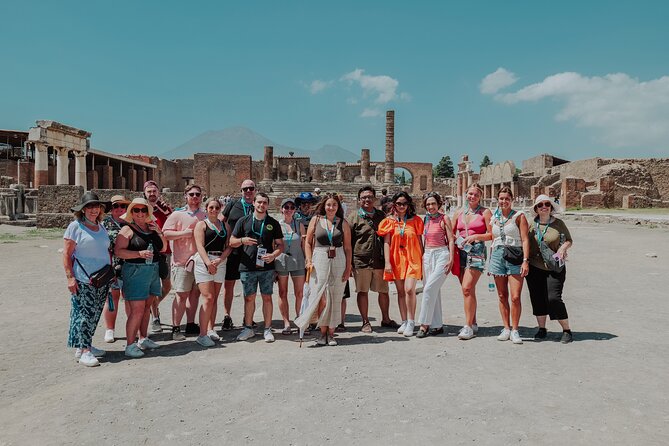
Pompeii and Vesuvius belong together. At the ruins, you see streets, homes, shops, baths, theaters, and public squares interrupted by the eruption of AD 79. Later, from the volcano, you look back across the Bay of Naples and understand the physical force behind the disaster.
That contrast is the strongest reason to choose this tour. Pompeii can otherwise become a maze of stone walls and half-seen rooms. Vesuvius can become a hike with scenery but little context. Put the two together, and each half explains the other.
The day lasts about eight hours, though some schedules have run closer to six hours and others longer depending on the order, traffic, weather, and group pace. You should keep the rest of your day free. This is not a quick morning outing.
The tour is offered in English. The main Pompeii walk lasts about two hours, followed by the volcano visit, transport, and a break for food. The order may change. Some groups climb Vesuvius first and visit Pompeii afterward, while others begin in the ruins.
Other Naples & Pompeii days travellers weigh against this one:
- Naples: Naples Underground Entry Ticket and Guided Tour
★ 4.4 · 21,781 reviews - Pompeii: Entry Ticket and Guided Tour with an Archaeologist
★ 4.8 · 19,459 reviews - Pompeii: Entry Ticket with Optional Audio Guide
★ 4.2 · 12,360 reviews
Meeting at Porta Marina Superiore
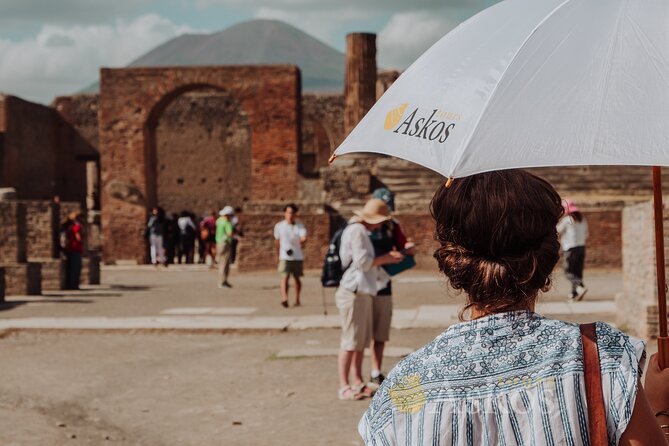
The meeting point is at Via Villa dei Misteri 2, by Pompeii’s main archaeological entrance, Porta Marina Superiore. Look for the Askos Tours sign. This detail matters because Pompeii has more than one entrance, and arriving at the wrong gate can waste valuable time.
The archaeological site is large, and the stone streets are uneven. Wear shoes with a firm sole. Sandals, smooth trainers, and fashion footwear are poor choices for both Pompeii and Vesuvius.
The group size is worth noting. The Pompeii guide may lead as many as 20 people, while the minibus portion is limited to 14. That means the first part may feel less intimate than the mountain transfer, where the smaller vehicle makes it easier to hear the guide and keep the group together.
Inside Pompeii, two hours with an archaeologist
The best part of the Pompeii visit is the interpretation. A map alone cannot explain why one street mattered, how a Roman house was arranged, or what a public bath reveals about everyday life.
Guides with archaeological experience have been especially effective here. Anna Sorrento, who has worked on Pompeii excavations, was praised for explaining active research and the site’s less obvious details. Benedetto has also worked on excavations for many years, while guides including Teresa, Raffaela, Daniela, Antonella, Giulia, and Yvonne have been singled out for clear and engaging presentations.
Guide quality can vary, of course. One complaint concerned faulty headsets, and another found the guide difficult to understand because of a strong dialect. If you are hard of hearing, stay near the guide and speak up early. In a crowded ruin, even a good explanation is wasted if you cannot hear it.
The Forum and the main street
The walk generally starts with the Forum, Pompeii’s central public square. This is where the city’s civic and religious life came together. Your guide can help you read the layout, rather than seeing it as a broad open space surrounded by broken columns.
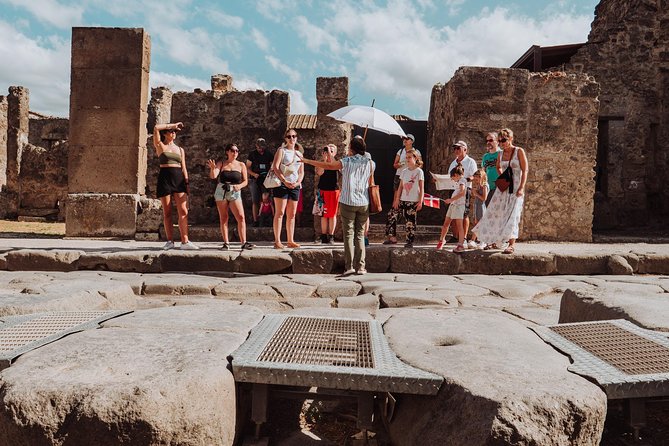
From here, you walk along one of the main streets. Raised sidewalks, worn paving stones, storefronts, and drainage features help show how Roman streets functioned. The ground is uneven, and walking through Pompeii takes more effort than the short distances on a city sidewalk suggest.
A different way to spend the day, same part of Italy:
- Pompeii: Small Group Tour with an Archaeologist
★ 4.8 · 12,264 reviews - From Naples: Pompeii Ruins & Mount Vesuvius Day Tour
★ 4.3 · 11,459 reviews - From Naples: Sorrento, Positano and Amalfi Full-Day Tour
★ 4.6 · 10,988 reviews - From Naples: Sorrento, Positano & Amalfi Coast – Small Group Tour
★ 5.0 · 8,643 reviews
The Forum granaries
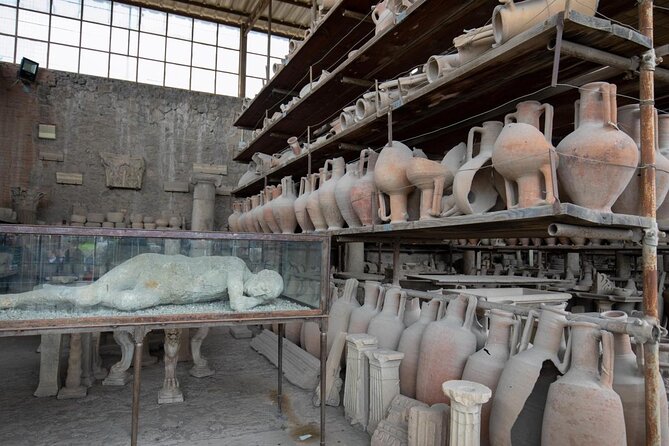
The granaries near the Forum hold some of the site’s most human remains. Alongside marble tables and stone fixtures are casts of eruption victims, including a dog and a tree.
This stop can be powerful, but it is not light sightseeing. The casts are not simply curiosities. They make the eruption personal and show how archaeology can preserve the final positions of people and animals caught in the disaster.
The House of Menander
The House of Menander is one of Pompeii’s grander residences. Its architecture, decoration, and contents help explain how wealthy Roman households were built around courtyards, display, privacy, and status.
Two hours is not enough to study every room. That is also the value of a guide: you get a reason to pause at selected houses instead of wandering through dozens of similar-looking walls without knowing what deserves your attention.
The Stabian Baths
The Stabian Baths are the oldest thermal complex in Pompeii. They occupy a broad area near several streets and crossroads, showing how bathing was not a private luxury for a single household but part of urban life.
This is an excellent place to ask practical questions. How were the rooms heated? Who used them? How did the bath fit into the working day? A well-prepared guide can turn the surviving walls into a picture of Roman routine.
The Lupanar
The Lupanar is Pompeii’s most famous brothel. Small rooms and painted images make it one of the site’s most talked-about stops, but the guide’s context is more useful than the novelty.
Crowds can gather here, and the rooms are tight. You may not linger long, especially when the site is busy. Still, it offers a direct glimpse into a part of Roman urban life that formal monuments tend to hide.
The House of the Faun
The House of the Faun was one of Pompeii’s largest private residences. Its size gives you a sense of the wealth gap within the city and the scale of elite domestic life.
The name comes from a small statue of a dancing faun. The building is impressive, but much of its impact comes from understanding how the rooms, courtyards, decoration, and entrances worked together to display power.
The theaters
The route also includes the Teatro Piccolo and Teatro Grande. The smaller theater gives a more intimate setting, while the larger theater was Pompeii’s principal performance space.
Theater ruins are easy to skim past. Pause to notice the seating arrangement and the relationship between the stage and audience. Your guide’s explanation is what turns these structures from empty stone into working public venues.
The break between ruins and volcano
Food and drinks are not included. Depending on the schedule, you may have roughly 10 to 15 minutes or closer to an hour for lunch. That difference is important.
If the break is short, buy a sandwich before the transfer. Cafes near the Pompeii entrance can provide basic food and drinks, but you should not count on a leisurely meal. Carry water, especially in hot weather.
Some people find the combined schedule slightly rushed because the Pompeii walk ends before they have seen every open section. That is unavoidable in a two-part tour. If Pompeii is your main goal, a full-day archaeological visit would give you more freedom. If you want the volcano as well, the trade-off is sensible.
Riding up Vesuvius by minibus
The minibus transfer is one of the tour’s practical strengths. Getting from Pompeii to the upper access point of Vesuvius involves winding mountain roads, and having transport arranged saves time and confusion.
The ride itself can be part of the lesson. Guides such as Mario have explained the volcano, earlier eruptions, the effect on Pompeii and Herculaneum, and the continuing risk to the populated area around Vesuvius.
Do not expect a luxury coach experience. One group found the bus lacking air conditioning, though that was not a problem in cooler conditions. The vehicle is mainly a useful link between the two sites.
The climb to the crater
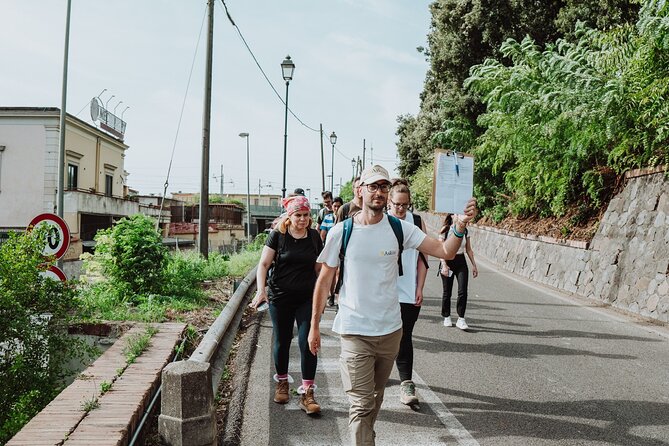
The Vesuvius walk is manageable for a reasonably fit person, but the description should not be softened. From the entrance, the first 30 minutes involve steep steps, and the final 500 meters are described as a very steep uphill walk.
Other accounts put the total walking distance at about 2.5 miles, including the trail around the caldera. The route includes loose volcanic sand and slippery surfaces. In summer heat, the climb can feel strenuous. Several people stopped before the top, so do not book this if you have serious walking or mobility problems.
Wear closed shoes with good grip. Add sunglasses, sunscreen, water, and a light jacket. The summit can be windy and chilly even after a hot climb. Rain makes the surface harder and can bring sudden closures.
Mario has received especially strong praise for his patient pace. He has stopped for breaks, explained the geology, and adjusted his speed for groups with mixed fitness levels. That matters more here than a fast walk. The goal is to reach the crater safely and understand what you are seeing.
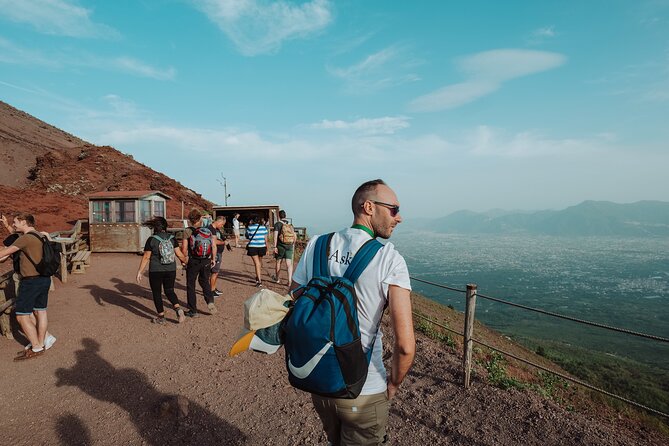
At the rim, the crater may give off a little steam. On a clear day, the view can stretch across Naples, Capri, Ischia, and the Sorrento coast. On a cloudy day, you may see almost nothing. One group reached the top in heavy fog and could not see the crater from a few feet away.
That is not a minor detail. Vesuvius is a weather-dependent experience. Strong wind, heavy rain, and fog can close the trail or erase the view. Park authorities control access, so a tour cannot guarantee a summit walk.
What happens if Vesuvius closes
If Vesuvius is inaccessible because of force majeure, the substitute is Herculaneum. This is a sensible alternative because it keeps the day focused on the eruption area rather than sending you back with half a tour.
Herculaneum is smaller and more compact than Pompeii, with unusually well-preserved details. It offers a different experience from the larger city, and a good guide can help you see how the two sites complete the story of the eruption.
You should clarify the refund arrangement before departure if the volcano closes. The supplied terms promise the alternative visit, but one complaint involved confusion over a refund after the Vesuvius portion was canceled. Another group received a partial refund after a last-minute guide cancellation. Policies and decisions can depend on the exact circumstances, so ask the guide or operator what will happen before the transfer begins.
Is $119.77 a fair price?
At $119.77 per person, this is not the cheapest way to enter Pompeii and Vesuvius. The value comes from combining admission, two specialist-led visits, minibus transport, and the hiking guide in one booking.
The Pompeii entrance fee and Vesuvius admission are included, as is transport from Pompeii to the volcano and back. You also avoid arranging the mountain connection yourself. For a first visit, those savings in time and planning can justify the price.
The limits are clear. Food is extra. The Pompeii group can reach 20 people. The day is fixed to the tour schedule, and two hours may leave you wanting more at the ruins.
I would consider the price fair for visitors who want both sites and prefer a guided day. If you are mainly interested in Pompeii, book a longer Pompeii-only visit instead. If you are comfortable planning public transport, walking independently, and reading site information, you can likely spend less, but you will take on the logistics.
Who should choose this day out?
This tour suits families with older children, history fans, geology fans, and anyone staying near Naples, Sorrento, or Pompeii who wants a structured day. Children under six are not allowed, and the climb is not suitable for people with significant mobility limitations.
It also works well for first-time visitors. The guides provide the framework that makes both sites easier to understand, and the minibus removes a difficult connection.
I would be cautious if you dislike fixed schedules or want to explore Pompeii slowly. I would also avoid the hottest part of summer unless you are comfortable walking uphill in intense heat. For the best chance of clear mountain views, choose a period with stable weather, though no season removes the risk of fog or closure.
Should you book the Pompeii and Vesuvius tour?
Book it if your priority is seeing the two major sights together without spending a day on transport planning. The archaeologist-led Pompeii visit is the main reason to choose this option, while the crater walk adds a memorable physical link to the eruption.
Skip it if you want a full day inside Pompeii, need an easy-access outing, or would be disappointed by a cloudy summit. Also keep your expectations realistic about the break, the group size, and the possibility of a substitute visit to Herculaneum.
My practical advice is simple: wear serious walking shoes, bring water and a jacket, pack a quick lunch, and leave the evening open. With those preparations, this is a strong-value day for seeing both the ancient city and the volcano that changed it forever.
FAQ
How long does the tour last?
The advertised duration is about eight hours. The exact day can vary with the order of the visits, traffic, weather, group pace, and any changes to the Vesuvius plan.
Where does the tour begin?
It begins at Via Villa dei Misteri 2 in Pompeii, at the archaeological entrance called Porta Marina Superiore. The guide will hold an Askos Tours sign.
Where does the tour end?
The listed end point is back at the Pompeii meeting point, Porta Marina Superiore.
Is admission included?
Yes. Pompeii admission and Mount Vesuvius admission are included in the tour price.
Is food included?
No. Food and drinks are not included. You should plan to buy a sandwich or other refreshments during the break.
How large is the group?
The Pompeii archaeologist guidance allows up to 20 people. The minibus transfer and Vesuvius portion allow up to 14 people.
How difficult is the Vesuvius walk?
You need a moderate fitness level. The first 30 minutes include steep steps, and the final 500 meters are very steep. The ground may be loose or slippery.
What happens if Vesuvius is closed?
If the volcano is inaccessible because of force majeure, the tour includes a visit to Herculaneum instead.
Can children join the tour?
Children under six are not allowed. The tour is also not recommended for people with mobility or walking impairments.
What is the cancellation policy?
You can cancel at least 24 hours before the local start time for a full refund. Cancellations or changes made less than 24 hours before the start time are not accepted for a refund.
Recently reviewed around Naples & Pompeii
- Pompeii Skip-the-line Tour with Archaeologist Guide★ 5.0 · 559 reviews
- Sharing Tour of Pompeii★ 5.0 · 487 reviews
- Skip the Line Guided Tour of Pompeii led by an Archaeologist★ 5.0 · 703 reviews
- Visit in Pompeii – Pompeii Private Tour with Ada★ 5.0 · 436 reviews
- Pompeii Private Tour with an Archaeologist and Skip The Line★ 5.0 · 391 reviews
- Private Day Tour to Vesuvius, Herculaneum & Pompeii with Pick Up★ 5.0 · 279 reviews
- Pompeii Vineyard Escape: Private Wine Tasting & Lunch★ 5.0 · 329 reviews
- Pompeii Guided Group Tour with Entry Ticket and Archaeologist★ 4.5 · 269 reviews
Pompeii & Vesuvius Tours, compared.

Entry Ticket and Guided Tour with an Archaeologist
Read our review →




Pompeii Small Group Tour with an Archaeologist
Read our review →
Pompeii, Amalfi Coast and Positano Day Trip from Rome
Read our review →Browse the lists this tour appears in