
Review · POMPEII & VESUVIUS TOURS
Pompeii: Exclusive Tour with Archaeologist and Entry Tickets
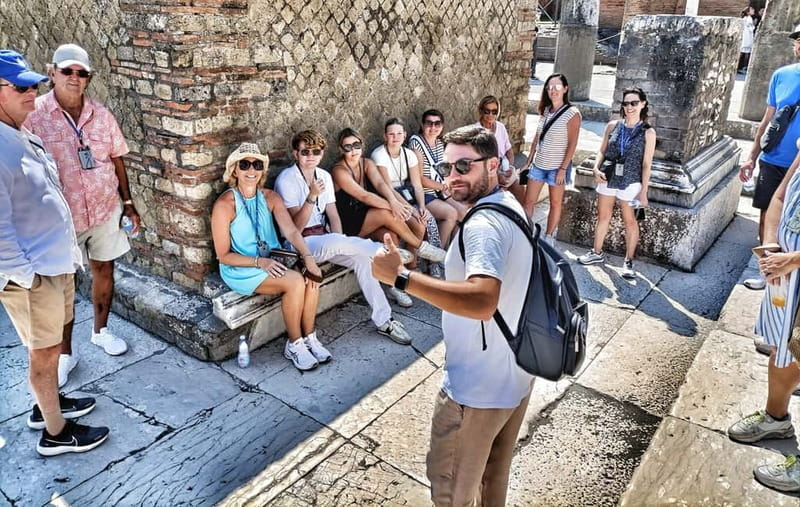
Pompeii makes the past feel startlingly close. With an archaeologist leading you through its streets, you see more than broken walls: you learn how the Forum worked, where Romans ate, how homes were decorated, and what the eruption left behind. The plaster casts near the Macellum give the visit its hardest emotional edge.
I like the small-group format and the way the tour uses headsets, since Pompeii is large, open, and often noisy. I also like the two-hour route: it gives you a clear introduction without swallowing your whole day, and your guide points out what to return to afterward.
The main drawback is time. Pompeii is enormous, and two hours can only cover selected areas. The site also involves uneven ancient roads, little shade, and plenty of walking, so this is not a good fit for wheelchair users or anyone with serious mobility limits.
In This Review
- Key points to know before you book
- Why an archaeologist changes the Pompeii visit
- Meeting at Porta Marina, the old gateway into Pompeii
- The Basilica and Forum: Pompeii’s public heart
- Temples of Jupiter and Apollo, religion in plain sight
- Forum Baths and the Macellum: daily life and difficult evidence
- House of the Tragic Poet and the art inside Roman homes
- The House of the Faun and Pompeii’s grandest domestic scale
- Thermopolium, bakery, and the city’s ordinary meals
- Lupanare and the Theatre District
- What two hours really gives you
- Practical advice for a smoother visit
- Who should book this Pompeii tour?
- Should you book it?
- FAQ
- Where does the Pompeii tour meet?
- How long does the tour last?
- Is Pompeii entry included?
- What languages are available?
- Can I book a private tour?
- Do I need to bring identification?
- Is the tour suitable for wheelchair users?
Key points to know before you book
- An archaeologist leads the walk: Guides including Antonio, Riccardo, Livio, Raffaelle, and Loredana have been praised for clear explanations, humor, and strong knowledge of Pompeii.
- You enter at Porta Marina: The meeting point is outside the entrance, directly in front of Pompei Scavi, Villa dei Misteri station.
- The route covers major Roman landmarks: Expect the Forum, Basilica, Temples of Jupiter and Apollo, baths, market, private houses, Lupanare, and the Large Theatre.
- Two hours is an introduction, not a full Pompeii visit: Plan to stay afterward if you want time for museums, farther districts, or a slower look at the houses.
- Entry and listening equipment are included: You receive skip-the-line admission, a Pompeii Express ticket, and a headset.
- Bring identification: Pompeii’s current ticket rules require the full names and ages of all participants, plus an ID or passport, with a photo accepted.
Why an archaeologist changes the Pompeii visit

You can walk into Pompeii alone and see an astonishing amount. You can also spend hours looking at walls, doorways, and paving stones without knowing why they matter. That is where this tour earns its place.
An archaeologist gives you a working map of the city. The Forum becomes more than a large open square. The temples reveal different parts of Roman religious life. A bakery or Thermopolium becomes evidence of ordinary meals and trade. A private house shows how status, family life, decoration, and social display fit together.
The strongest guides also connect archaeology with the continuing work at the site. Antonio has been praised for explaining how excavation continues and how archaeologists interpret what they find. Riccardo has been singled out for his grasp of archaeology, Latin, and Greek, while Livio is known for mixing useful detail with warmth and humor.
That variety matters because Pompeii needs a guide who can explain both the grand public buildings and the small clues. The best moments are often not the famous headline sites, but details you might walk past alone.
The tour is offered in English, Italian, French, and Spanish. You can select a shared small group or a private option. The private format costs more than the listed $50 shared experience, but it may suit families or groups who want to ask many questions and set a more personal pace.
More Naples & Pompeii trips worth a second look
- Naples: Naples Underground Entry Ticket and Guided Tour
★ 4.4 · 21,781 reviews - Pompeii: Entry Ticket and Guided Tour with an Archaeologist
★ 4.8 · 19,459 reviews - Pompeii: Entry Ticket with Optional Audio Guide
★ 4.2 · 12,360 reviews
Meeting at Porta Marina, the old gateway into Pompeii
The tour begins outside Pompeii’s Porta Marina entrance. This is just in front of Pompei Scavi, Villa dei Misteri station on the Circumvesuviana railway. Look for a guide holding a Pompei VIP sign.
This meeting point is convenient if you arrive by train, but check your route carefully. Pompeii has three train stations, and confusing them can leave you rushing. The station named in the meeting instructions is Pompei Scavi, Villa dei Misteri.
Porta Marina is an excellent place to begin. It was one of the original entrances to the Roman city, and walking through it gives the visit a clear sense of arrival. You are not starting with a modern visitor center or a long transfer. You are beginning at an ancient threshold.
The skip-the-line admission is useful here. It does not make the site quiet, but it removes one of the least rewarding parts of the day: waiting outside a major archaeological park when you could already be seeing the ruins.
The Basilica and Forum: Pompeii’s public heart
After entering, the route moves toward the Basilica and the Foro Civile di Pompei. These spaces formed the center of public life, where business, law, politics, religion, and daily transactions met.
The Basilica is especially useful for understanding Roman civic architecture. Your guide can help you picture the building as a place of legal and commercial activity instead of a roofless shell. Look at the surviving columns and the scale of the space, then listen for the explanation of how Pompeii’s public institutions functioned.
The Forum is one of the grandest parts of the walk. It is also one of the most exposed. On a hot day, the broad paved area can feel demanding, with little shade. Comfortable shoes, water, and a sensible start time matter.
One strength of this tour is pace. Past participants have praised guides such as Antonio and Monica for moving efficiently while leaving room for photographs. That balance is important. A guide who stops at every stone can bury you in detail, while a guide who rushes turns the Forum into a quick photo stop.
Temples of Jupiter and Apollo, religion in plain sight
The Temple of Jupiter and Temple of Apollo show how religion shaped the city center. They also help you see the mix of Roman and older local traditions that formed Pompeii before the eruption.
The Temple of Apollo is particularly atmospheric because of its position near the Forum. Columns, steps, and open space give you a strong sense of the city’s religious center, even when much of the original structure is gone.
At the Temple of Jupiter, the guide can explain the importance of the building’s placement and its link with Roman authority. These are not stops where you need a long lecture. A few clear points about ritual, public power, and the city’s layout make the remains much easier to read.
This is a good example of why the tour format works. You get context while standing in the place itself, then move on before the information becomes too heavy.
A different way to spend the day, same part of Italy:
- Pompeii: Small Group Tour with an Archaeologist
★ 4.8 · 12,264 reviews - From Naples: Pompeii Ruins & Mount Vesuvius Day Tour
★ 4.3 · 11,459 reviews - From Naples: Sorrento, Positano and Amalfi Full-Day Tour
★ 4.6 · 10,988 reviews - From Naples: Sorrento, Positano & Amalfi Coast – Small Group Tour
★ 5.0 · 8,643 reviews
Forum Baths and the Macellum: daily life and difficult evidence
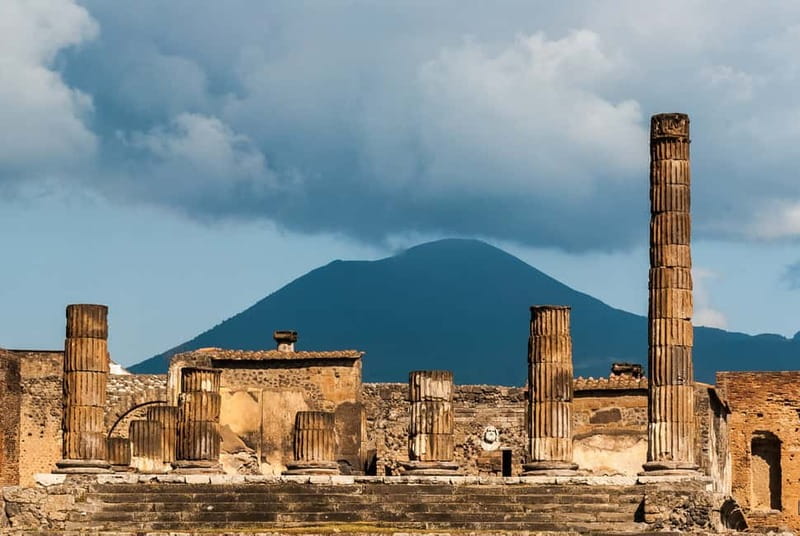
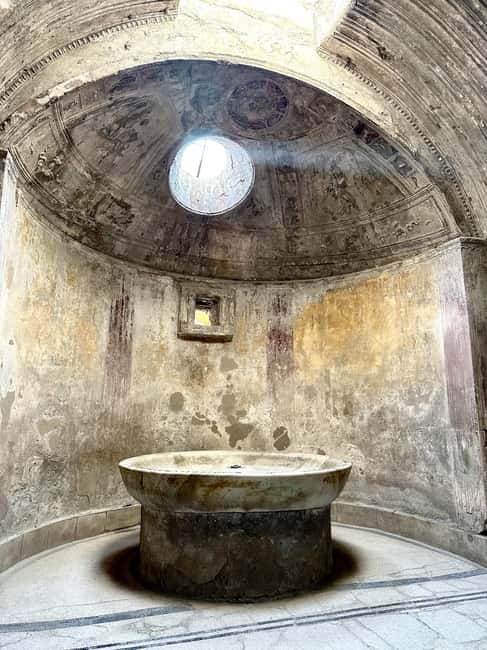
The Forum Baths offer a look at Roman bathing culture and the practical side of city life. Pompeii’s baths were not simply places to wash. They were part of the rhythm of urban society, and their rooms show how Roman builders handled heat, water, and public use.
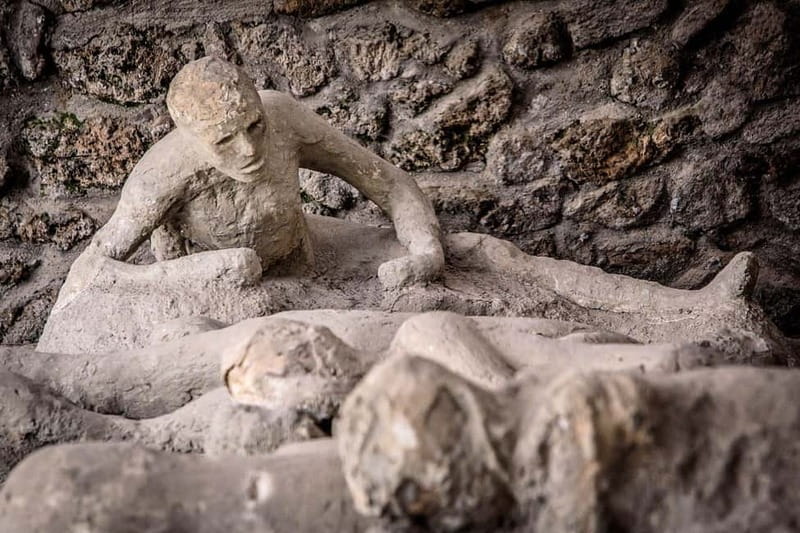
The Macellum was the city market. It is also connected with some of the site’s most disturbing plaster casts. These casts preserve the forms of people caught in the eruption, giving the disaster a human scale that statistics never can.
The visit handles an important balance. Pompeii is beautiful, but it is also a place of sudden death. The casts should be approached with care, not treated as a sensational photo stop. Your guide’s explanation can help you understand how they were made and why they matter.
This section can be emotionally heavy, especially for children. At the same time, it is one of the reasons Pompeii feels so different from a normal collection of ancient ruins. The city preserves both public grandeur and personal tragedy.
House of the Tragic Poet and the art inside Roman homes
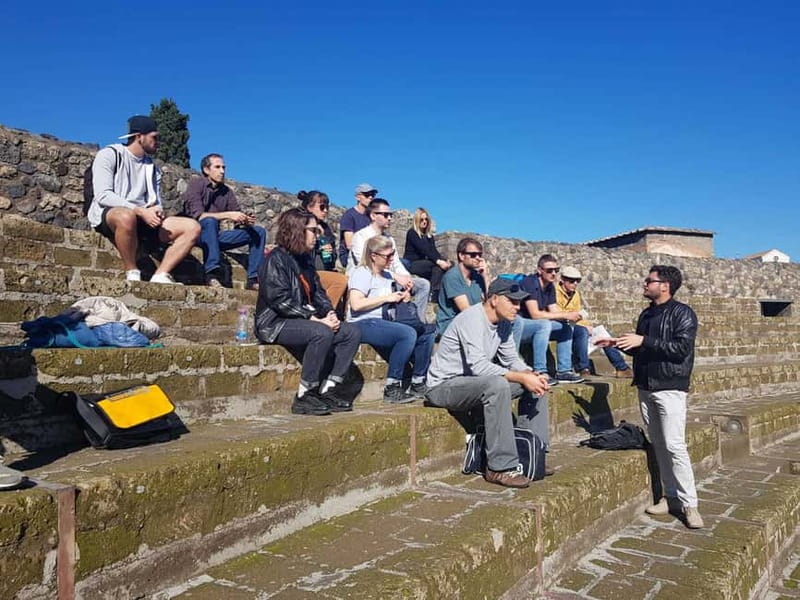
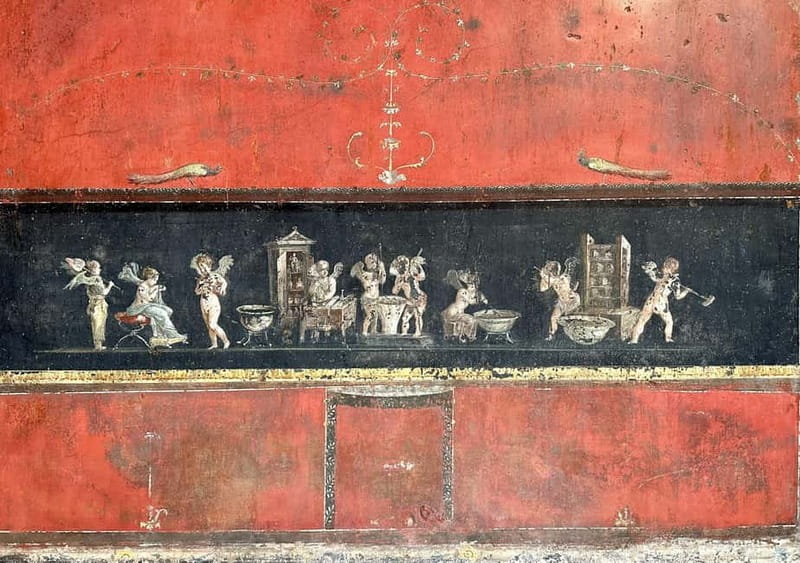
The House of the Tragic Poet gives the tour a change of scale. Instead of broad civic spaces, you enter the world of a private Roman home, where decoration helped communicate taste, education, wealth, and identity.
Pompeii’s houses are often easy to underestimate. From the street, an entrance may look plain. Inside, frescoes, mosaics, courtyards, and carefully arranged rooms reveal how much attention went into domestic design.
The House of the Tragic Poet is associated with attractive decorative details and gives your guide a chance to explain how Roman homes were organized. Pay attention to the relationship between public-facing rooms and more private areas. Even when you cannot see every room, the layout helps you picture the social life of the household.
The House of the Vettii is another major stop. Its frescoes and restored rooms give you a strong sense of Pompeian decoration. The colors and mythological scenes are impressive, but the guide’s interpretation adds the useful question: what were these images trying to say about the people who lived there?
You may want to return to these houses after the tour. Two hours does not allow for a slow study of every painting, mosaic, or doorway.
The House of the Faun and Pompeii’s grandest domestic scale
The House of the Faun is one of the largest and most famous homes in Pompeii. It helps explain the difference between a modest residence and an elite urban property.
Large courtyards, formal rooms, mosaics, and decoration point to wealth and social ambition. The house also gives you a chance to compare domestic life with the public buildings seen earlier. Pompeii was not made up only of temples and official squares. It was a living city with sharp differences in income and status.
This is where a guide’s ability to keep the story moving matters. You will see impressive art, but you also need help understanding how the house functioned. If you are visiting with children or teenagers, a clear explanation of daily life usually works better than a list of dates and names. Families have found the best guides engaging without making the material too serious.
Thermopolium, bakery, and the city’s ordinary meals
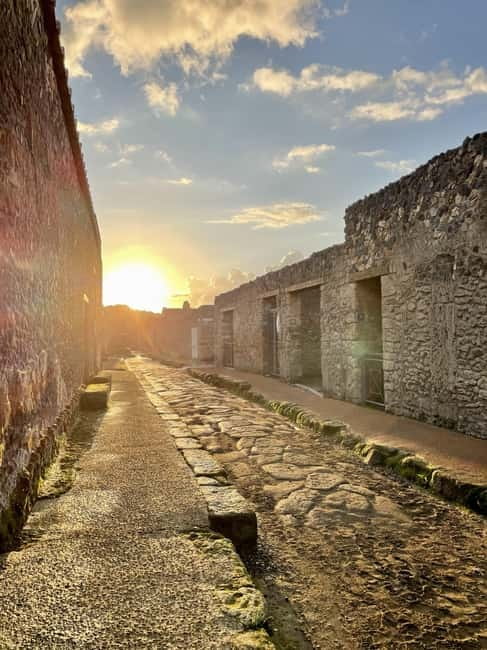
The Thermopolium taverns are among Pompeii’s most approachable sites. These were places where people could buy prepared food, and their counters make the ancient city feel practical and familiar.
The bakeries offer another glimpse of daily work. Ancient ovens and production spaces connect the ruins with the basic business of feeding a city. This part of the route is valuable because it shifts attention away from emperors, temples, and wealthy homeowners.
I especially like this kind of stop for first-time visitors. It reminds you that Pompeii was not a museum built to display art. It was a working town of shopkeepers, cooks, bakers, customers, families, and people heading about their day when Vesuvius erupted.
The exact order of the stops can vary with conditions inside the park. Crowds, access, and current archaeological work may affect what you see most closely. Your guide will point out what deserves a return visit after the group tour.
Lupanare and the Theatre District
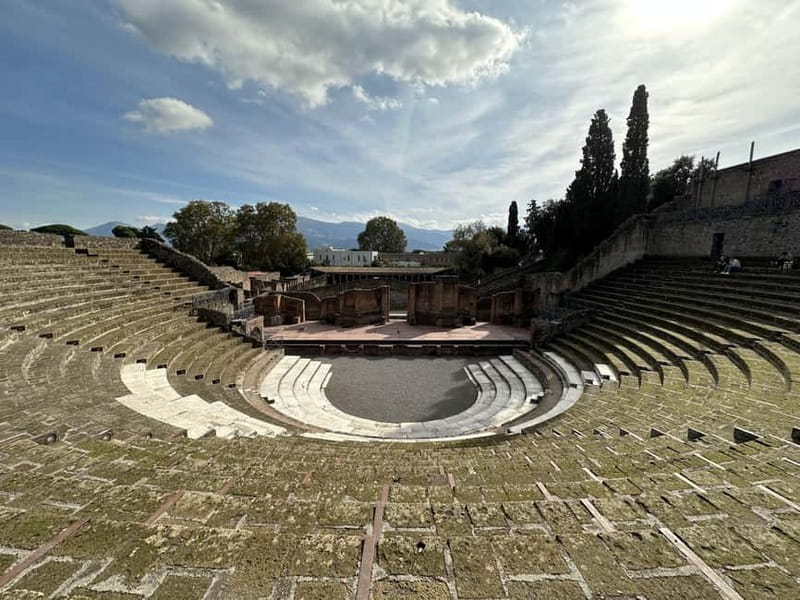
The Lupanare, Pompeii’s famous brothel, is a memorable and sometimes awkward stop. Its small rooms and surviving decorations offer a direct look at an aspect of Roman urban life that public monuments often leave out.
It can become crowded, so the headset is helpful. You may not have much time to linger, but your guide can explain the setting without reducing it to a cheap joke. This is one area where a good guide’s tone matters.
The Large Theatre brings the route back to public entertainment. Its scale shows how important performance was to Roman society, and its design helps you imagine how people gathered for spectacles.
The Theatre District is also a good final section for the guided route. After seeing politics, religion, commerce, homes, food, and death, you get one more look at how Pompeii’s people spent their free time.
What two hours really gives you
At $50 per person, the tour offers solid value if you want structure, entry, and expert interpretation in one package. You are paying not only for admission but also for a guide who selects key areas in a site too large for most short visits.
The price makes the most sense for first-time visitors, families, and anyone arriving by train with limited time. It also suits people who want to continue alone afterward. The two-hour introduction gives you a practical map and helps you decide where to spend the rest of the day.
It is less ideal if you already know Pompeii well or want to examine every house at a slow pace. You may prefer independent entry, a site map, and a full day on your own.
The private option is worth considering for a family group or people with a strong interest in archaeology. A shared group keeps the cost down, but a private visit gives you more room for questions and personal attention.
Several guides have been praised for clear English and friendly delivery. Riccardo, Antonio, Livio, Raffaelle, Rafael, Monica, Pierluigi, and Loredana are among the names associated with especially strong visits. Guide assignments can change, so book for the tour format rather than one promised individual.
Practical advice for a smoother visit
Wear comfortable shoes. Pompeii’s ancient roads are uneven, and you will be on your feet for two hours.
Bring water and an ID or passport. The current ticket system requires the full name and surname of every participant, along with ages, sent through the booking message system. A photo of the identification document is accepted, but you should still carry the required ID information with you.
The tour is not suitable for wheelchair users or people with mobility impairments. Electric wheelchairs are not allowed, and pets are not allowed. Swimwear, alcohol, and drugs are also prohibited.
There is no food, drink, or transportation included. You need to make your own way to Porta Marina, and you should eat or buy supplies before or after the visit rather than expect them as part of the tour.
Weather can affect comfort. Rain has not stopped the tour from being useful, but wet ancient paving can be slippery. In hot weather, the open Forum and long walking distances can be tiring. An evening departure may offer cooler conditions and fewer people, depending on the selected time.
Free cancellation is available up to 24 hours before the start, and you can reserve now and pay later. Starting times depend on availability.
Who should book this Pompeii tour?
I would choose this experience if you are visiting Pompeii for the first time and want the major sights explained without spending an entire day in a group. It is also a good match for families, since the route has enough variety to hold attention: temples, houses, food shops, theatres, and the plaster casts.
History fans will appreciate the archaeological context, especially when the guide explains excavation methods and how researchers interpret the remains. The tour also works well as the first part of a longer visit. Afterward, you can explore at your own pace and return to the houses or art that caught your eye.
I would hesitate only if you need step-free access, dislike walking, or want a slow, specialist study of Pompeii’s frescoes. Two hours goes quickly, and the site is too large for this route to cover everything.
Should you book it?
Book it if you value a strong introduction, quick entry, and a guide who can turn scattered ruins into a readable city. At $50, the combination of admission, headset, small group, and archaeologist-led explanation is a fair deal for a first visit.
Plan to remain inside after the guided portion if you can. The tour gives you the framework; your extra time lets you linger. That combination is the best way to experience Pompeii without feeling lost or rushed.
FAQ
Where does the Pompeii tour meet?
The meeting point is outside Pompeii’s Porta Marina entrance, in front of the Pompei Scavi, Villa dei Misteri Circumvesuviana train station. The guide holds a Pompei VIP sign.
How long does the tour last?
The guided experience lasts two hours. Starting times depend on availability.
Is Pompeii entry included?
Yes. Skip-the-line admission and Pompeii’s Express ticket are included.
What languages are available?
The live tour guide is available in English, Italian, French, and Spanish.
Can I book a private tour?
Yes. You can choose a shared small-group experience or a private booking.
Do I need to bring identification?
Yes. Pompeii requires the full name, surname, and age of every participant for ticketing. Bring a passport or ID card, and bring identification for children as well. A photo is accepted.
Is the tour suitable for wheelchair users?
No. The experience is not suitable for people with mobility impairments or wheelchair users. Electric wheelchairs are not allowed.
Recently reviewed around Naples & Pompeii
- Pompeii Skip-the-line Tour with Archaeologist Guide★ 5.0 · 559 reviews
- Sharing Tour of Pompeii★ 5.0 · 487 reviews
- Skip the Line Guided Tour of Pompeii led by an Archaeologist★ 5.0 · 703 reviews
- Visit in Pompeii – Pompeii Private Tour with Ada★ 5.0 · 436 reviews
- Pompeii Private Tour with an Archaeologist and Skip The Line★ 5.0 · 391 reviews
- Private Day Tour to Vesuvius, Herculaneum & Pompeii with Pick Up★ 5.0 · 279 reviews
- Pompeii Vineyard Escape: Private Wine Tasting & Lunch★ 5.0 · 329 reviews
- Pompeii Guided Group Tour with Entry Ticket and Archaeologist★ 4.5 · 269 reviews
Pompeii & Vesuvius Tours, compared.

Entry Ticket and Guided Tour with an Archaeologist
Read our review →




Pompeii Small Group Tour with an Archaeologist
Read our review →
Pompeii, Amalfi Coast and Positano Day Trip from Rome
Read our review →Browse the lists this tour appears in