
Review · POMPEII & VESUVIUS TOURS
Pompeii: Group Tour with an Archeologist Guide
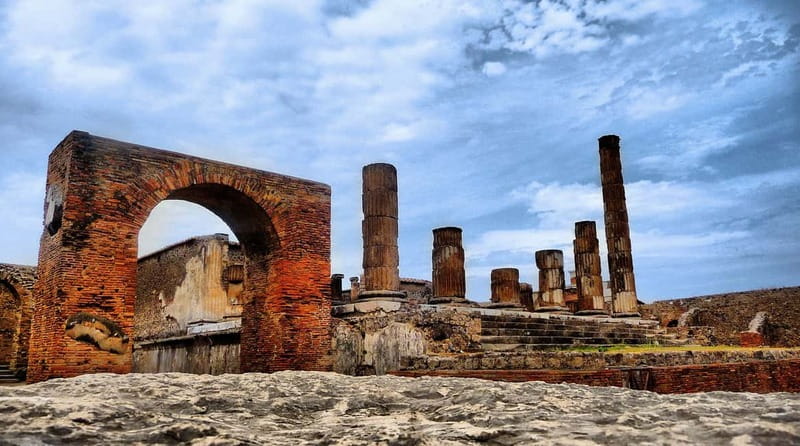
Pompeii is not a place to simply wander past old stones. Its streets, houses, shops, baths, and plaster casts make sense only when someone explains how the city worked. This two-hour guided visit puts an archeologist in front of you as you move through the most important western section of the ruins.
I like the direct route to the main sights, especially the Forum, theaters, baths, Lupanar, and famous houses. I also like the live storytelling. Guides such as Alfonso, Eraldo, Lena, Laura, Giuseppe, and Antonio have been praised for clear explanations, humor, and a good pace. The main drawback is that this can be a fairly large group, so the experience is less personal than a private tour.
In This Review
- Key points to know before you book
- Meeting at Tempio Travel by the Pompeii station
- Entering through Porta Marina
- The Basilica and Forum: Pompeii’s public center
- Baths, streets, and the Lupanar
- Theaters and the pleasure of named houses
- The Garden of the Fugitives and the plaster casts
- What the guide adds to Pompeii
- Is $50.11 a fair price?
- Timing, weather, and comfort
- Who should choose this Pompeii tour?
- Should you book the two-hour group tour?
- FAQ
- How long does the Pompeii guided tour last?
- Where does the tour begin?
- Does the tour include Pompeii admission?
- Which languages are available?
- What sights are included?
- Can I stay at Pompeii after the guided tour?
- Are headsets provided?
- What should I bring?
Key points to know before you book
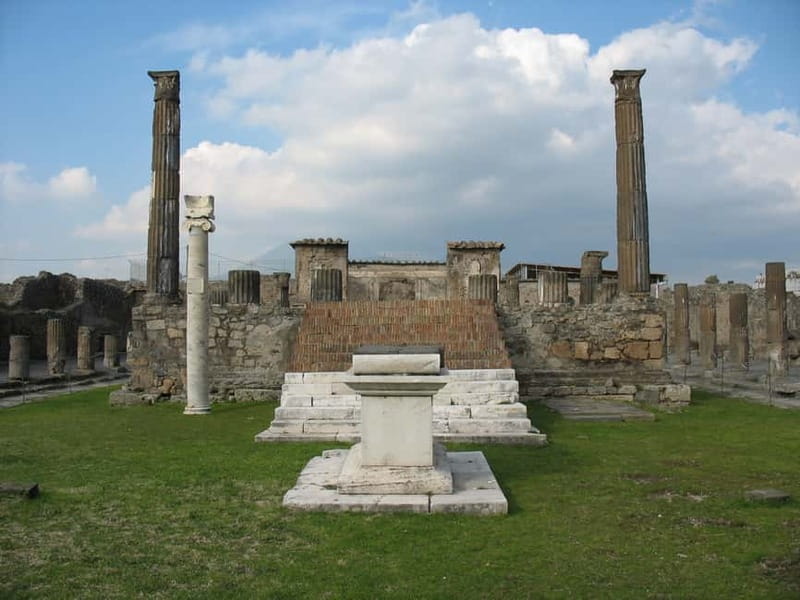
- The western section is the practical choice: You see many of Pompeii’s best-known buildings without trying to cover the entire enormous site.
- The guide gives the ruins a human scale: Frescoes, street layouts, brothels, baths, and homes become easier to understand with context.
- Skip-the-line entry saves useful time: You avoid spending part of a short visit waiting at the ticket line.
- The tour ends at the meeting point: You can remain in Pompeii afterward and explore independently.
- Whisper headsets help in a large group: They let you hear the guide while standing among other groups and visitors.
- Heat matters: Two hours is a sensible length, but bring comfortable shoes, water, and protection from the sun.
Meeting at Tempio Travel by the Pompeii station
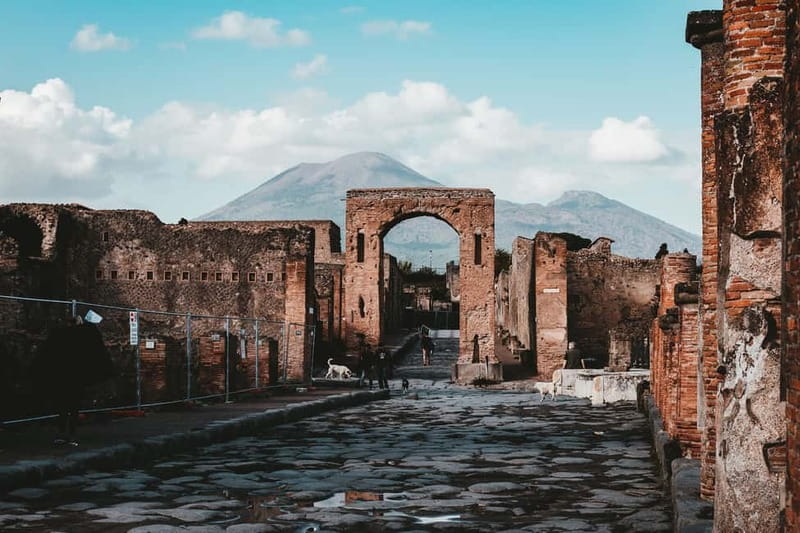
Your starting point is the Tempio Travel office on the first floor of the Circumvesuviana train station. Look for the building with the red Tempio Travel logo, and allow time to find the office before your scheduled start.
This detail is easy to miss when you are arriving by train. The office is not simply a vague meeting place near the ruins. You need to check in there first, then join the guide and group for the short move toward the archaeological entrance at Porta Marina.
The meeting arrangement is useful if you arrive by train, since the Circumvesuviana is a common way to reach modern Pompeii. It is less convenient if you are carrying large luggage, since large bags and luggage are not allowed on the tour. Hotel pickup and drop-off are not included.
Bring your passport or another accepted identification document, even if nobody asks to see it immediately. Comfortable shoes are essential. Pompeii involves uneven ancient paving, long stretches of walking, and very little shade.
More Naples & Pompeii trips worth a second look
- Naples: Naples Underground Entry Ticket and Guided Tour
★ 4.4 · 21,781 reviews - Pompeii: Entry Ticket and Guided Tour with an Archaeologist
★ 4.8 · 19,459 reviews - Pompeii: Entry Ticket with Optional Audio Guide
★ 4.2 · 12,360 reviews
Entering through Porta Marina
Porta Marina is the gateway into the archaeological area and the first point listed for the site visit. From here, the ruins quickly feel less like scattered remains and more like the edge of a once-working town.
The guide helps you read the approach: the roads, walls, entrances, and surviving public buildings are clues to how Pompeii connected to the sea and to the wider Roman world. That orientation is valuable because Pompeii can feel confusing at first. Several streets look alike, and the scale of the site makes it hard to know which direction matters.
The skip-the-line ticket is one of the tour’s strongest practical features. You still pass through the normal entrance and security procedures, but you avoid the regular ticket queue. With only two hours, that can make the difference between seeing one more major building and spending your limited time outside.
The Basilica and Forum: Pompeii’s public center
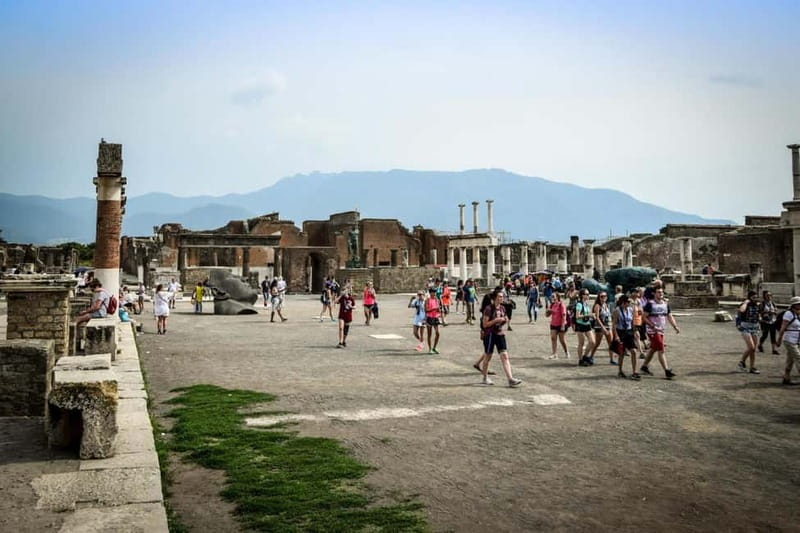
The Forum is the natural heart of this route. It was the city’s main public square, surrounded by important civic, religious, and commercial buildings. The Basilica nearby was used for legal and business activity, giving you a quick sense of how public life operated in Pompeii.
I find the Forum most rewarding when the guide explains its purpose instead of treating it as a photo stop. A wide open space surrounded by columns can look abstract on its own. With a guide, you can connect the architecture to government, trade, worship, and daily movement through the city.
This is also where the site’s scale becomes clear. Pompeii is not a single monument. It is a whole Roman town, with public spaces linked to private houses and ordinary streets. A two-hour tour cannot cover every block, but it can give you a firm map of the city’s main ideas.
The guide’s explanations are delivered through whisper headsets when the group is large. That may feel slightly less intimate than standing shoulder to shoulder with a guide, but it is helpful when several groups are gathered around the same ruins.
Baths, streets, and the Lupanar
The baths show how much public life took place outside the home. These were not only places to wash. They were social spaces, and their surviving rooms help you picture the routine of a Roman town.
The main street gives you another useful contrast. You see the paving, raised sidewalks, building fronts, and the physical layout that connected homes, shops, public buildings, and entertainment spaces. Pompeii becomes easier to understand when you walk its streets in sequence rather than view isolated ruins.
The Lupanar, or brothel, is one of the most talked-about stops. Its small rooms and surviving images offer a frank look at an aspect of Roman society that polite public monuments tend to hide. The stop can be brief, especially if the group is moving on a tight schedule, but it is memorable and helps round out the picture of everyday Pompeii.
A guide is particularly helpful here because the remains require interpretation. Without context, you might notice the rooms and decorations but miss how the building fit into the city’s social and commercial life.
A different way to spend the day, same part of Italy:
- Pompeii: Small Group Tour with an Archaeologist
★ 4.8 · 12,264 reviews - From Naples: Pompeii Ruins & Mount Vesuvius Day Tour
★ 4.3 · 11,459 reviews - From Naples: Sorrento, Positano and Amalfi Full-Day Tour
★ 4.6 · 10,988 reviews - From Naples: Sorrento, Positano & Amalfi Coast – Small Group Tour
★ 5.0 · 8,643 reviews
Theaters and the pleasure of named houses
Pompeii’s theaters bring the city’s entertainment world into view. The tour includes the theaters among the major monuments, giving you a look at spaces designed for performances and public gatherings.
The route also includes several famous houses. The House of the Tragic Poet, the House of the Golden Cupid, and other named homes reveal the private side of Pompeii. Their names can sound like a list of attractions, but the real value is in the surviving details: room layouts, decoration, courtyards, and frescoes.
The frescoes are among the most rewarding sights on this visit. Pompeii is famous not simply because it was buried, but because that burial preserved details of Roman domestic life that would normally have vanished. Painted walls give you a direct sense of taste, status, stories, and decoration inside private homes.
The House of the Tragic Poet is especially useful for understanding how a Roman house could combine daily life with art and symbolism. The House of the Golden Cupid adds another named setting to the route. Access and viewing conditions can vary across the archaeological site, so you should think of these houses as planned highlights rather than a promise that every room will be open in exactly the same way on every visit.
The Garden of the Fugitives and the plaster casts
The Garden of the Fugitives is one of the most sobering parts of Pompeii. It is connected with the city’s final hours and the people who tried to escape the eruption of Vesuvius in 79 AD.
The plaster casts of Pompeii’s citizens make the disaster painfully personal. They are not merely objects from an ancient excavation. They show the human cost of the eruption, and the guide’s explanation helps place them within the wider event.
This can be an emotional stop, particularly for children. One family found guide Lena patient and effective with children aged eight to twelve, balancing serious information with a lighter tone when appropriate. That is a good sign for families, though parents should still prepare younger children for the difficult subject matter.
The casts also explain why Pompeii remains so powerful. You are not only looking at walls and pavement. You are seeing traces of people caught in a sudden catastrophe, alongside the homes and public spaces they left behind.
What the guide adds to Pompeii

I would strongly favor a guide here, especially if this is your first visit. Pompeii is large, and it is easy to spend time looking at impressive ruins without understanding what you are seeing or why one building matters more than another.
The best guiding style for this site is clear and selective. Several guides associated with this experience, including Alfonso, Eraldo, Laura, Lena, Giuseppe, and Antonio, have been praised for explaining Roman life in an engaging way, answering questions, and keeping the group moving.
Alfonso has been singled out for attention to detail and for making the subject easy to follow. Giuseppe has been praised for passion about Pompeii and Roman history. Laura has been described as especially good at bringing first-century life into focus, while Eraldo has been noted for an engaging approach.
Guide quality can vary because you may not know which archeologist leads your departure. Still, the consistent strength of the experience is the use of a trained live guide rather than a printed map or a purely self-guided audio track.
The tour pace is generally designed to keep everyone together. That works well for a first overview, but it means you may not linger as long as you wish at a favorite fresco or house. The good news is that the tour ends back at the meeting point, and you can continue exploring Pompeii on your own afterward.
Is $50.11 a fair price?
At about $50.11 per person, this is not the cheapest way to enter Pompeii. You are paying for the ticket, a two-hour archeologist-led tour, and the convenience of avoiding the ticket line.
The value is strongest for first-time visitors, cruise passengers, families, and anyone working with a tight schedule. If you arrive without a plan, Pompeii can easily absorb several hours while leaving you unsure which sights you missed. A focused route makes the visit more manageable.
The price is less compelling if you already know the site well or prefer to set your own pace from the start. Independent visitors can spend longer in one house, return to a favorite street, or explore beyond the western section without waiting for a group.
One important detail is the first Sunday of each month. Entrance is free then, but tickets cannot be reserved ahead of time, so entry is not guaranteed. If you are visiting on that day, the paid tour’s usual ticket arrangement may not apply in the same way. Check availability and conditions before booking.
Free parking may be available if the parking area is open and spaces remain. Treat this as a useful extra, not a guaranteed part of your plan.
Timing, weather, and comfort

Pompeii is exposed, and hot weather can make even a well-paced two-hour route tiring. One couple found two hours about right in the heat, but you should still bring water, wear light clothing, and use sun protection.
There is little point in wearing stylish but hard shoes here. Choose sturdy, comfortable footwear that can handle uneven surfaces. An umbrella can help in strong sun, and rain protection matters on wet days. If rain arrives, roadside stalls outside the site may sell umbrellas, but it is better to bring your own raincoat or umbrella.
The whisper headset is useful in a group, though one person found the earpiece a little uncomfortable. That is a minor tradeoff for being able to hear the guide while standing several steps away.
The experience is not suitable for people with mobility impairments. Pompeii’s ancient roads and broad archaeological grounds demand steady walking, and the tour does not offer hotel transportation or special mobility support.
Who should choose this Pompeii tour?
I would choose this tour if you want the essential Pompeii story in two hours and do not want to spend your first half hour working out the site map. It suits visitors arriving by train, people on a cruise schedule, and families who benefit from a guide keeping the route moving.
It also works well if you plan to stay afterward. The guided portion gives you the major landmarks, then you can return to areas that caught your attention or find additional streets and houses at your own speed.
You may prefer an independent visit if you want a long, slow archaeological study or need a private guide. A group tour can be fairly large, and even an excellent guide cannot answer every question at length while keeping everyone together.
English and Italian tours are available. Cancellation is free up to 24 hours before the start, and you can reserve now and pay later, which helps if your Campania schedule is still shifting.
Should you book the two-hour group tour?
Book it if you want a clear first look at Pompeii, reliable entry arrangements, and an archeologist to explain the Forum, baths, houses, theaters, frescoes, and plaster casts. The guide is the main reason to choose it, and the chance to continue exploring after the tour adds useful value.
Skip it if you already know Pompeii well, dislike group pacing, or need a fully accessible route. For most first-time visitors, though, the two-hour length is sensible, the main sights are well chosen, and the cost is reasonable for the time saved and the added meaning.
FAQ
How long does the Pompeii guided tour last?
The guided tour lasts two hours. Check availability for the departure times offered on your chosen date.
Where does the tour begin?
Meet at the Tempio Travel office on the first floor of the Circumvesuviana train station in Pompeii. The activity ends back at the meeting point.
Does the tour include Pompeii admission?
Yes. Skip-the-line entrance tickets are included, except that entry conditions may differ on the first Sunday of the month, when admission is free but advance reservation is not available.
Which languages are available?
The live tour guide is available in English and Italian.
What sights are included?
The route includes Porta Marina, the Basilica, Forum, baths, Lupanar, main street, theaters, Garden of the Fugitives, House of the Tragic Poet, House of the Golden Cupid, frescoes, and plaster casts.
Can I stay at Pompeii after the guided tour?
Yes. The tour ends at the meeting point, and you can explore more of the archaeological site independently afterward.
Are headsets provided?
Whisper headsets are included for large groups. They help you hear the guide while moving through the ruins.
What should I bring?
Bring a passport or ID card and comfortable shoes. Food and drinks are not included, and large bags or luggage are not allowed.
Recently reviewed around Naples & Pompeii
- Pompeii Skip-the-line Tour with Archaeologist Guide★ 5.0 · 559 reviews
- Sharing Tour of Pompeii★ 5.0 · 487 reviews
- Skip the Line Guided Tour of Pompeii led by an Archaeologist★ 5.0 · 703 reviews
- Visit in Pompeii – Pompeii Private Tour with Ada★ 5.0 · 436 reviews
- Pompeii Private Tour with an Archaeologist and Skip The Line★ 5.0 · 391 reviews
- Private Day Tour to Vesuvius, Herculaneum & Pompeii with Pick Up★ 5.0 · 279 reviews
- Pompeii Vineyard Escape: Private Wine Tasting & Lunch★ 5.0 · 329 reviews
- Pompeii Guided Group Tour with Entry Ticket and Archaeologist★ 4.5 · 269 reviews
Pompeii & Vesuvius Tours, compared.

Entry Ticket and Guided Tour with an Archaeologist
Read our review →




Pompeii Small Group Tour with an Archaeologist
Read our review →
Pompeii, Amalfi Coast and Positano Day Trip from Rome
Read our review →Browse the lists this tour appears in