
Review · POMPEII & VESUVIUS TOURS
Pompeii: Guided Walking Tour with Entrance Ticket
Pompeii is not a scattered pile of ruins. It is a Roman town you can walk through, with streets, shops, public baths, homes, and a Forum still laid out beneath the shadow of Vesuvius. I like that this two-hour guided walk gives the city a clear shape instead of leaving you to guess what each broken wall once meant. I also like that the €20 entrance ticket and headsets are included in the $50 price.
The main thing to watch is the meeting-point organization. The guide should meet you at 10:50 a.m. in the garden of Hotel Vittoria, outside the CELLINI coral shop, but the entrance area can be confusing and some groups have started late. Give yourself extra time, keep your phone available, and do not expect two hours to cover all of Pompeii.
In This Review
- Key points to know before booking
- Why Pompeii works best with a guide
- Finding the group at Hotel Vittoria
- Entering Pompeii without the long ticket queue
- The Forum, where public Pompeii comes together
- Thermal Baths and the practical side of Roman life
- The Lupanare and Pompeii’s frank street life
- Streets, shops, wine signs, and homes
- A moving site, but not a quiet one
- What two hours can and cannot cover
- Who will get the most from this tour
- Should you book it?
- FAQ
- How much does the Pompeii guided walking tour cost?
- How long does the tour last?
- What time and where is the meeting point?
- How will I recognize the guide?
- Is the Pompeii entrance ticket included?
- Does the tour skip the ticket line?
- Which languages are available?
- Are headsets provided?
- What should I bring?
- Can I cancel the tour?
Key points to know before booking
- Pompeii’s working city plan: Follow ancient streets from the Forum to shops, baths, homes, and the Lupanare.
- A guide adds essential context: The ruins make much more sense when someone explains Roman customs, buildings, and the eruption.
- $50 includes the €20 site ticket: You also receive a professional guide and headsets.
- The 10:50 meeting point needs care: Look for the garden at Hotel Vittoria, outside CELLINI, and a guide holding a sign with your name.
- Two hours covers highlights, not the whole site: You can stay afterward to explore areas outside the guided route.
- Best for visitors who can walk comfortably: Uneven ancient streets and the size of the site make this unsuitable for wheelchair users and people with mobility impairments.
Why Pompeii works best with a guide
The odd thing about Pompeii is that the ruins are remarkably clear, yet they can still be hard to read. You see walls, columns, paving stones, doorways, and faded decoration, but the meaning of those pieces is not always obvious. A good guide turns the remains into a town with public spaces, private homes, work areas, and daily routines.
That matters here more than it does at many archaeological sites. Pompeii is not just one famous monument. It is a large Roman settlement, and the value comes from seeing how its parts fit together. The Forum was the civic center. The baths served practical and social needs. Shops opened onto the streets. Homes revealed status, taste, and family life.
The guide also provides the basic story of August 24, 79 A.D., when Mount Vesuvius erupted. The town was buried under volcanic ash and rock, preserving parts of the city for nearly two thousand years. The human story is moving, but the tour also helps you understand the slower work of excavation and preservation.
English, French, Spanish, and Italian tours are offered. The guide may be multilingual, and the requested language is not guaranteed if only one person books in that language. If language clarity matters greatly to you, contact the operator before booking rather than assuming you will have a guide speaking only your preferred language.
More Walking Tours in Naples
- Naples: Street Food Walking Tour with Local Guide
★ 4.8 · 4,256 reviews - Naples Spanish Quarters Walking Tour Street Art, Folklore & Sweet
★ 5.0 · 797 reviews - Naples: Old Town Guided Walking Tour
★ 4.8 · 553 reviews
Finding the group at Hotel Vittoria
The stated meeting point is at 10:50 a.m. in the garden of Hotel Vittoria, just outside the CELLINI coral shop on Via Mare, 80045 Pompei. The guide should carry a sign with the customer’s name.
This is close to the Pompeii archaeological area and has generally been easy to reach from the Pompeii Scavi station. Still, the entrance zone can be crowded and filled with tour groups. One practical problem is that a guide or representative may not always be immediately visible, and signage can be easy to miss.
I would arrive at least 20 minutes early. Stand near the garden and CELLINI rather than wandering around the entrance. If you cannot see the group, call or message the company at once. The operator has helped people who were delayed by trains, traffic, rental-car trouble, and a Circumvesuviana strike. In several cases, staff waited or gave instructions for joining the group.
That flexibility is useful, but do not treat it as permission to arrive late. Some departures have begun 30 to 45 minutes behind schedule because of confusion or missing participants. A late start can be uncomfortable in hot weather and may affect your train plans afterward.
Entering Pompeii without the long ticket queue
The ticket is included, with a stated value of €20, and the tour provides skip-the-ticket-line entry. That saves you the work of arranging admission at the entrance and gives the group a more direct start.
The phrase skip-the-ticket-line does not mean you will walk through every entrance without any delay. The group still needs to gather, match names and ticket types, and pass through site controls. Child-fare passengers must show a valid identification card or passport at the ticket office. Without proof of age, they may be asked to pay the full adult fare.
The $50 price is reasonable if you want a structured introduction. Subtracting the €20 admission leaves the guide, organization, and headsets as the main part of the cost. For a first visit, I think that is fair, especially because Pompeii is so large and its signs cannot explain every building in much detail.
If you already know Roman archaeology well and prefer to wander alone, the premium may feel less useful. But for most first-time visitors, the guide helps you spend two hours on the parts that best explain how the town worked.
The Forum, where public Pompeii comes together
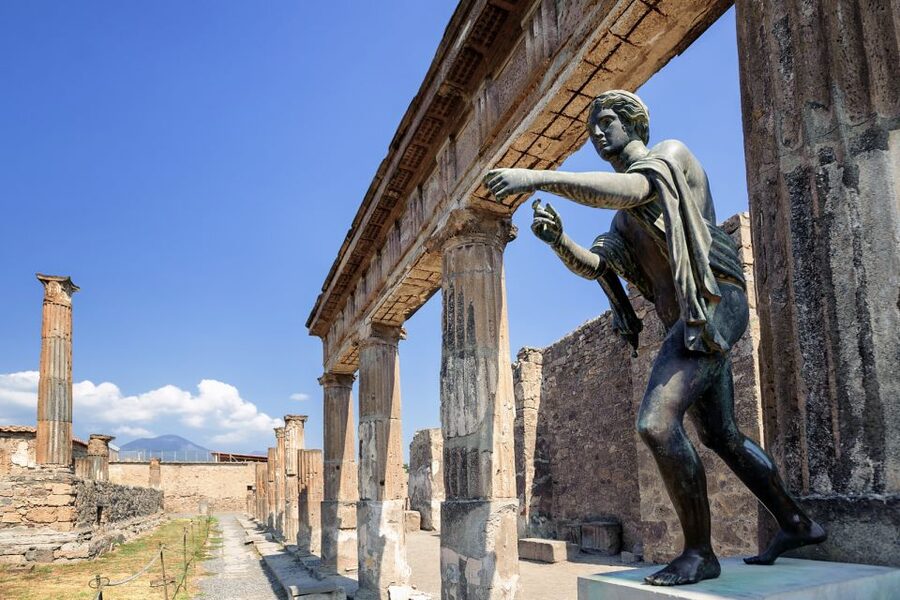
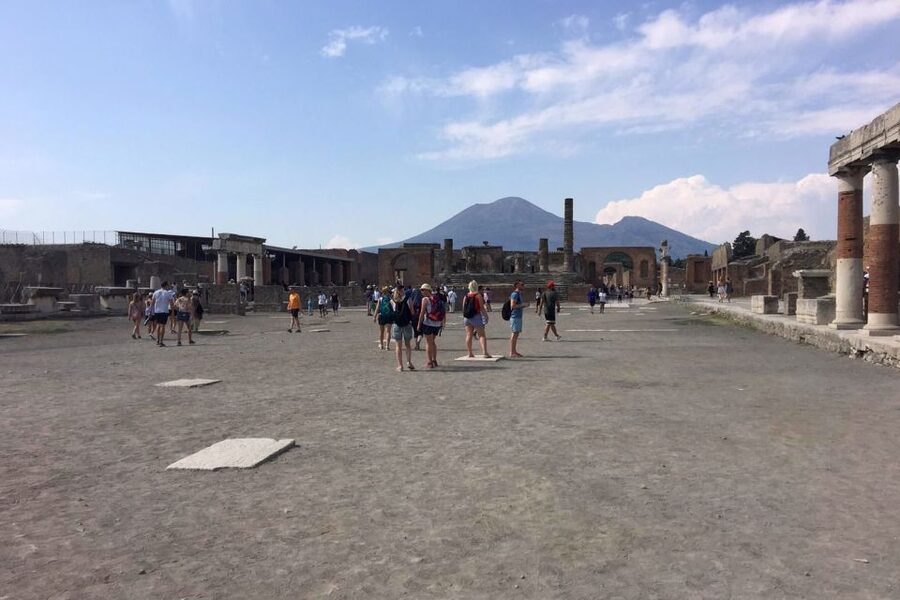
The Forum is one of the tour’s essential stops. This open civic space helps you understand Pompeii as a functioning town rather than a collection of private ruins.
Your guide can explain how public, religious, and commercial activity came together here. Even without a long lecture, the scale and layout make the Forum a strong starting point. You begin to see the difference between the city’s main public center and the narrower streets leading into residential and commercial areas.
This is also where the guide’s storytelling matters. Bare stones do not tell you how people used a space, who passed through it, or why certain buildings were important. Guides such as Elisa, Salvatore, Maria, Imma, Mattia, Francesca, and Miguel have been praised for making the walk lively, using humor and clear explanations to keep the history accessible to adults and children.
The exact guide is assigned by the operator, so you cannot count on a particular person. The repeated strength of this tour is the guide’s ability to explain the site while keeping the group moving.
More Naples & Pompeii walks with a guide:
- Naples: Panoramic Walking Tour with Funicular
★ 4.8 · 543 reviews - Naples Walking Tour with Underground Roman Ruins Ticket
★ 4.5 · 510 reviews - Herculaneum: 3D Walking Tour with Skip-the-Line Ticket
★ 4.3 · 313 reviews - Naples Panoramic Walking Tour: From the Hills to the Center
★ 5.0 · 298 reviews
Thermal Baths and the practical side of Roman life

The Thermal Baths offer a useful change from the grand public spaces. Here, you see how Romans spent time on ordinary routines such as washing, exercising, meeting friends, and maintaining social ties.
The baths were not simply places to get clean. They were part of town life, and the rooms and heating systems show the planning behind Roman public buildings. A guide can point out how the spaces were arranged and why the baths mattered to people of different social levels.
This stop is valuable because it moves the tour away from the most famous eruption story. Pompeii is often reduced to tragedy, but the baths remind you that residents had routines, habits, and social spaces before disaster struck.
The drawback is time. Two hours moves quickly, and the group cannot linger at every room or decoration. If you want to study construction details or take careful photographs, you may need to return on your own after the tour.
The Lupanare and Pompeii’s frank street life

The Lupanare is one of Pompeii’s most talked-about buildings. Its presence gives the guide a chance to explain an aspect of Roman society that is often handled too shyly or too sensationally.
Expect an adult subject and direct discussion. The guide may explain how the building functioned and place it within wider Roman social life. This is not a stop for visitors who want the tour to avoid sexual history, but it is part of the town’s evidence about work, commerce, and private behavior.
The site’s appeal is its honesty. Pompeii shows ancient life in a way that can feel surprisingly ordinary, including businesses that modern visitors might not expect to find in a preserved Roman city. A guide can separate what is clearly known from what is inferred, which helps keep the stop informative rather than theatrical.
Crowding can affect your view, and the Lupanare is not likely to be a place where you can take your time. Listen through the headset and stay close to the guide.
Streets, shops, wine signs, and homes
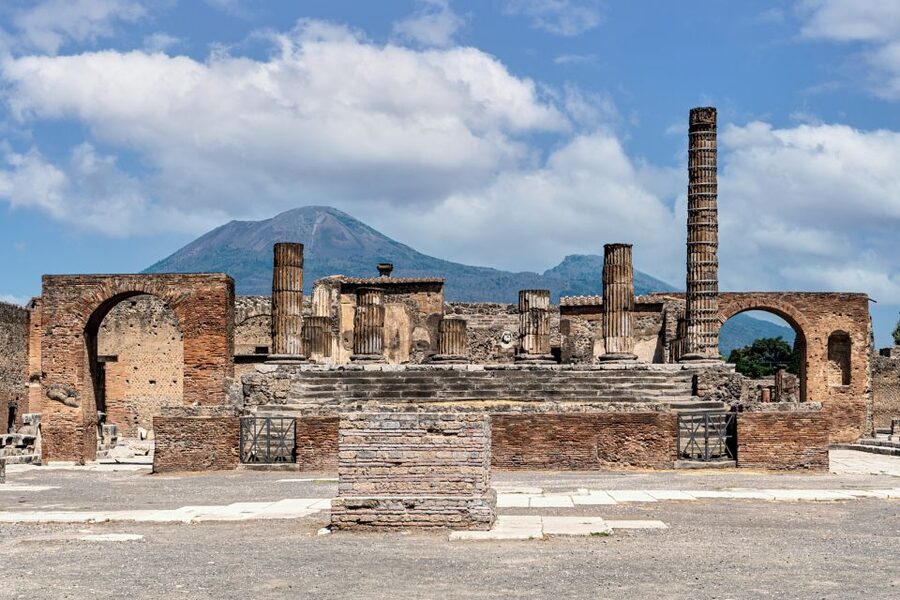
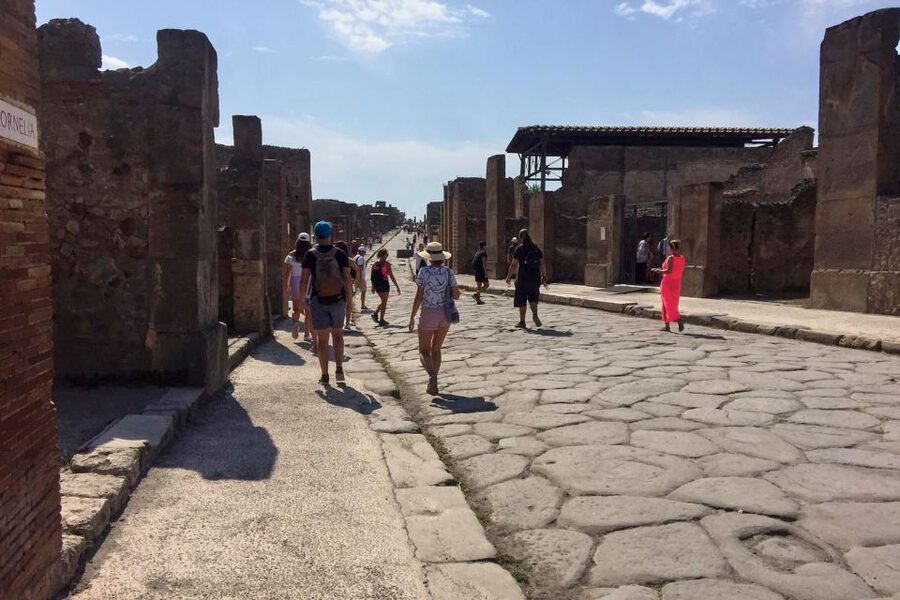
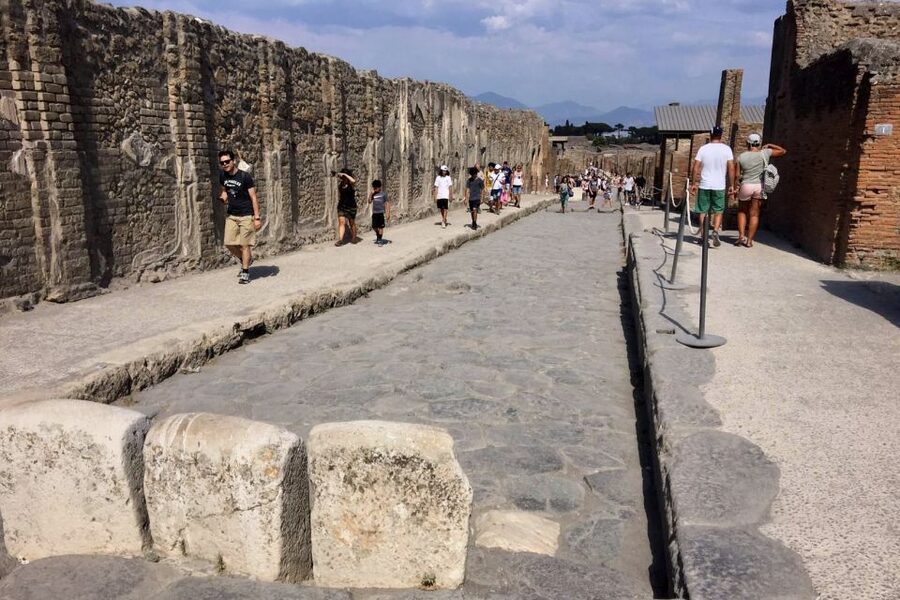
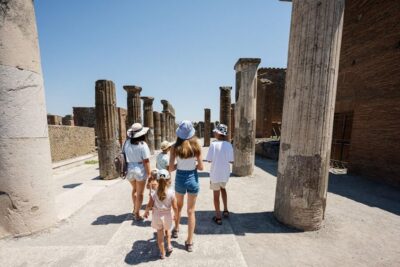
The streets may be the most rewarding part of the walk. Ancient paving, raised sidewalks, doorways, and storefronts give Pompeii a strong sense of place. You are not only looking at monuments. You are walking through the routes people used to shop, work, visit friends, and reach public buildings.
Some shops still display signs linked to goods such as produce and wine. These details are small, but they make the town easier to picture. A Forum can feel abstract. A shop opening onto a street feels immediate.
Domestic spaces add another layer. You may see the remains of homes and decorative artwork, along with protected objects and displays. Much of the portable material has been moved elsewhere for conservation or museum display, and the National Archaeological Museum in Naples is important if you want to see more of Pompeii’s artifacts. The excavation site still gives you the buildings, street plan, paintings, and setting that make those objects meaningful.
Your guide’s choices matter here. Several guides have been praised for including domestic, community, and public areas rather than rushing only to the most famous stops. That approach gives you a better sense of the different communities and social levels that made up Pompeii.
A moving site, but not a quiet one
Pompeii can be emotional. The volcanic destruction is always in the background, and the preserved remains make the event feel close. At the same time, the site is an active visitor attraction with groups, heat, uneven paths, and plenty of stopping for photographs.
The headsets are a real help. They allow you to hear the guide while walking or standing several steps away, and they reduce the need for everyone to crowd around one person. Most visitors should use them. One person found the headset uncomfortable and preferred an earplug-style design, so comfort may vary.
The guides generally mix facts with humor. That balance works well for a long walk, and it helps children stay involved. If you want a formal academic lecture, this may feel light in places. If you want a clear introduction with stories, context, and time for questions, the approach is more suitable.
Bring water, wear comfortable shoes, and dress for the forecast. The tour operates in all weather, and Pompeii can feel very hot under strong sun even when the air temperature seems mild. Rain can make the walking surfaces less pleasant, so weather-appropriate clothing is not just a suggestion.
What two hours can and cannot cover
Pompeii is huge. In two hours, you get a guided introduction to major public, commercial, and social areas, but you will not see every street or house.
That limit is both a weakness and a benefit. You may leave wishing for more time, especially after realizing that some areas were not part of the route. Yet a shorter first walk can prevent information overload. You learn the city’s basic structure, then decide what deserves a longer look.
At the end, you may be able to remain inside and explore uncovered areas on your own. Use that option if your schedule allows. The guided portion is best treated as a foundation, not a full archaeological study.
I would not schedule a tight train connection immediately after the planned finish. The advertised duration is two hours, but late starts have happened. If you are coming from Naples, check your route carefully and allow a buffer for the walk back to the station and any delay at the exit.
Who will get the most from this tour
This tour suits a first-time Pompeii visitor who wants the main story, a sensible route, and a human explanation of the ruins. Families can benefit from the guide’s humor and interactive style, while adults who know little about Roman culture will gain enough context to read the buildings.
It is also useful if you have only a short stay in Campania. The guide helps you focus on major highlights instead of spending the first hour trying to understand the map.
I would choose another arrangement if you use a wheelchair, have serious mobility limits, or cannot manage uneven walking surfaces. The experience takes place in a large archaeological area, and the tour is not suitable for wheelchair users or people with mobility impairments.
Language is another consideration. English, French, Spanish, and Italian are available, but a multilingual guide may lead the group and the requested language may not be guaranteed for a single participant. Ask before booking if that would affect your decision.
Should you book it?
I would book this tour for a first visit, especially at $50 when the €20 entrance ticket, professional guide, and headsets are included. The best part is not simply getting inside without the ticket queue. It is learning to see Pompeii as a lived-in Roman town, with public buildings, baths, shops, homes, and uncomfortable but revealing corners such as the Lupanare.
Book it if you value context and want a focused route through a very large site. Arrive early at Hotel Vittoria, prepare for heat or rain, and keep extra time after the meeting point in case the group is delayed. If you prefer complete independence or plan to spend a full day examining every street, buy your ticket and explore at your own pace instead.
FAQ
How much does the Pompeii guided walking tour cost?
The listed price is $50 per person. The Pompeii Archaeological Site entrance ticket, valued at €20, is included.
How long does the tour last?
The guided walking tour lasts two hours. Pompeii is much larger than the route covered in that time, so you may want to remain afterward and explore on your own.
What time and where is the meeting point?
The meeting time is 10:50 a.m. The meeting point is in the garden of Hotel Vittoria, outside the CELLINI coral shop on Via Mare, 80045 Pompei.
How will I recognize the guide?
The guide should have a sign with the customer’s name. Because the entrance area can be confusing, arrive early and contact the operator if you cannot find the group.
Is the Pompeii entrance ticket included?
Yes. Admission to the Pompeii Archaeological Site is included in the tour price.
Does the tour skip the ticket line?
Yes. The tour includes skip-the-ticket-line access, although you still need to meet the group and pass through normal site controls.
Which languages are available?
Live guides are available in English, French, Spanish, and Italian. The guide may be multilingual, and a requested language is not guaranteed if only one participant speaks that language.
Are headsets provided?
Yes. Headsets are included so you can hear the guide clearly while walking through the site.
What should I bring?
Bring comfortable shoes, weather-appropriate clothing, and a passport or identification card for children using the child fare.
Can I cancel the tour?
You can cancel up to 24 hours in advance for a full refund. Reserve now and pay later is also available.
Recently reviewed around Naples & Pompeii
- Pompeii Skip-the-line Tour with Archaeologist Guide★ 5.0 · 559 reviews
- Sharing Tour of Pompeii★ 5.0 · 487 reviews
- Skip the Line Guided Tour of Pompeii led by an Archaeologist★ 5.0 · 703 reviews
- Visit in Pompeii – Pompeii Private Tour with Ada★ 5.0 · 436 reviews
- Pompeii Private Tour with an Archaeologist and Skip The Line★ 5.0 · 391 reviews
- Private Day Tour to Vesuvius, Herculaneum & Pompeii with Pick Up★ 5.0 · 279 reviews
- Pompeii Vineyard Escape: Private Wine Tasting & Lunch★ 5.0 · 329 reviews
- Pompeii Guided Group Tour with Entry Ticket and Archaeologist★ 4.5 · 269 reviews
Pompeii & Vesuvius Tours, compared.

Entry Ticket and Guided Tour with an Archaeologist
Read our review →


Pompeii Small Group Tour with an Archaeologist
Read our review →
Pompeii, Amalfi Coast and Positano Day Trip from Rome
Read our review →Browse the lists this tour appears in