
Review · POMPEII & VESUVIUS TOURS
Herculaneum: Skip-the-Line Guided Tour with Archaeologist
Herculaneum can feel more personal than Pompeii. The smaller site preserves Roman homes, painted rooms, mosaics, carbonized wood, and even everyday building details with startling clarity. An archaeologist guide helps you read those remains instead of simply walking past them.
I like the skip-the-line entry, which saves useful time, and I like the way the guides connect the ruins to ordinary Roman life. Guides such as Luciano Leone, Diego, Teresa, and Anna are especially good at turning walls and floor plans into stories you can follow.
The main consideration is pace. Two hours is enough for the major sights, but not for every corner, and groups can reach about 15 to 20 people. A few visitors have also found that the headset becomes harder to hear when the guide walks too far ahead.
In This Review
- Key points at a glance
- Why Herculaneum feels different from Pompeii
- Meeting at the Via dei Papiri Ercolanesi ticket office
- What the two-hour route covers
- Casa dei Cervi and the homes of the wealthy
- House of Neptune and Amphitrite
- House of the Skeletons and the waterfront
- Casa dell’Albergo and Casa del Salone Nero
- The Temple of the Augustales
- Baths, Forum, and the Gymnasium
- Why an archaeologist guide changes the visit
- Is $53 good value?
- Timing, weather, and practical comfort
- Who should book this Herculaneum tour?
- FAQ
- Where does the Herculaneum tour meet?
- How long does the guided visit last?
- Is transportation from Naples included?
- What languages are available?
- What should I bring?
- Can wheelchair users or people with mobility impairments join?
- Should you book it?
Key points at a glance

- See Herculaneum’s best-preserved homes: The House of Neptune and Amphitrite, House of the Deer, House of the Black Room, and House of the Skeletons reveal elegant domestic life.
- Stand above the waterfront shelters: More than 300 people died there while trying to escape toward the sea, a sobering reminder of the eruption’s speed and force.
- Learn from an archaeologist: Guides use site knowledge, pictures, books, and clear comparisons with Pompeii to explain what you are seeing.
- Cover the main monuments in two hours: The route includes the baths, Forum, Temple of the Augustales, Gymnasium, and several important houses.
- Keep the rest of the day flexible: Your admission allows you to remain at Herculaneum and continue looking around at your own pace after the guided visit.
- Prepare for sun, rain, and uneven ground: Closed shoes, sunscreen, a hat, and a raincoat will make the visit easier.
Why Herculaneum feels different from Pompeii
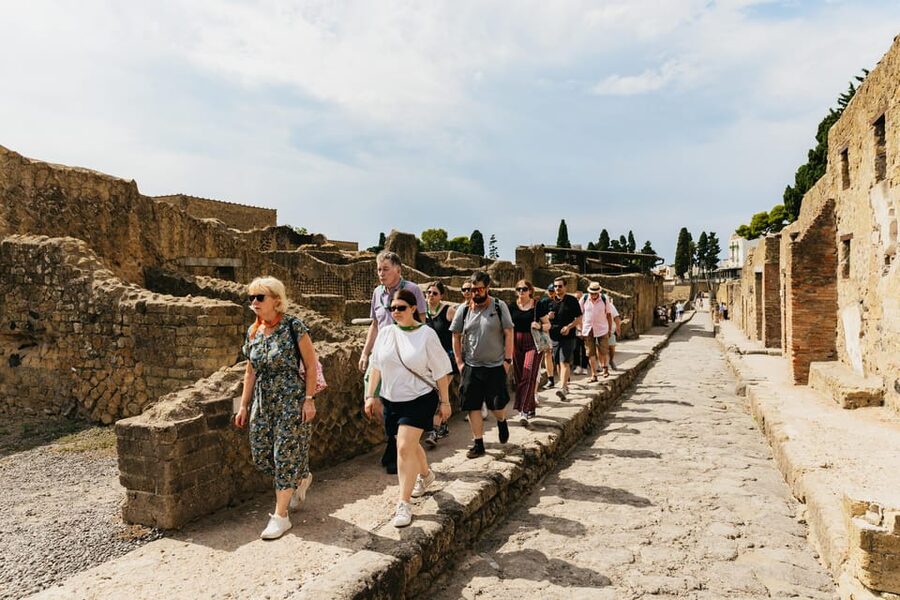
Herculaneum was a former port town where wealthy merchants and members of the nobility lived. The eruption of Mount Vesuvius ended that life almost 2,000 years ago, but the way the town was buried preserved details that make the site unusually vivid.
Pompeii is famous for its scale and broad streets. Herculaneum is more compact, yet its houses often retain more of their upper features, woodwork, wall paintings, mosaics, and household objects. That makes it a strong second stop if you have already seen Pompeii, and an excellent first stop if you want a shorter, more focused visit.
I especially value the contrast between grand public buildings and private homes. You can look at a large bath complex, then turn into a house and see how decoration, courtyards, rooms, and practical spaces fitted together.
The eruption story also feels different here. At the waterfront, the remains of more than 300 people lie in the shelters where they sought safety while trying to reach the ocean. This is one of the most affecting parts of the visit, and your guide can explain how quickly the disaster overtook the town.
More Naples & Pompeii trips worth a second look
- Mount Vesuvius: Skip-the-Line Ticket and Smart Digital Guide
★ 4.2 · 2,780 reviews - From Naples: Pompeii Skip-the-Line Entry Ticket and Tour
★ 4.4 · 2,753 reviews - Pompeii: Skip-the-Line Entrance Ticket with Audio Guide
★ 4.0 · 2,509 reviews
Meeting at the Via dei Papiri Ercolanesi ticket office
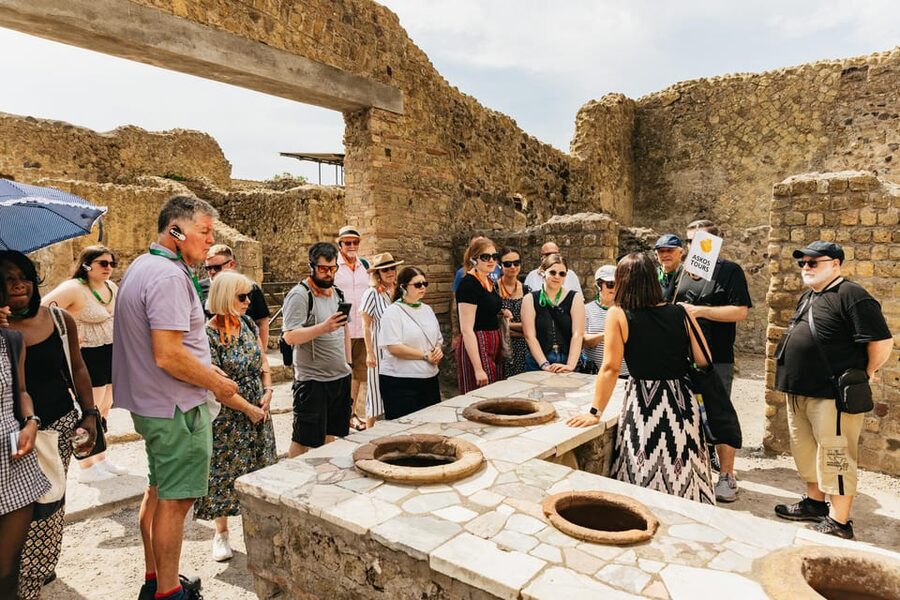
The meeting point is the ticket office at the Herculaneum ruins on Via dei Papiri Ercolanesi. Look for the guide holding an Askos Tours sign.
This detail matters because the booking map can be imprecise. One visitor found the marked location roughly 300 meters away from the actual meeting place, which was at the ticket booth inside the archaeological site area. I would trust the written meeting instructions and head for the ruins’ ticket office rather than relying only on the map pin or street view.
The tour includes admission, so you do not need to arrange a separate entrance ticket for the guided visit. Skip-the-line access is useful during busy periods, although it does not remove the need to arrive at the correct meeting point and find your guide.
Bring a passport or identity card. The site specifically asks for valid identification, and it is better to have it ready than to discover this at the entrance.
What the two-hour route covers
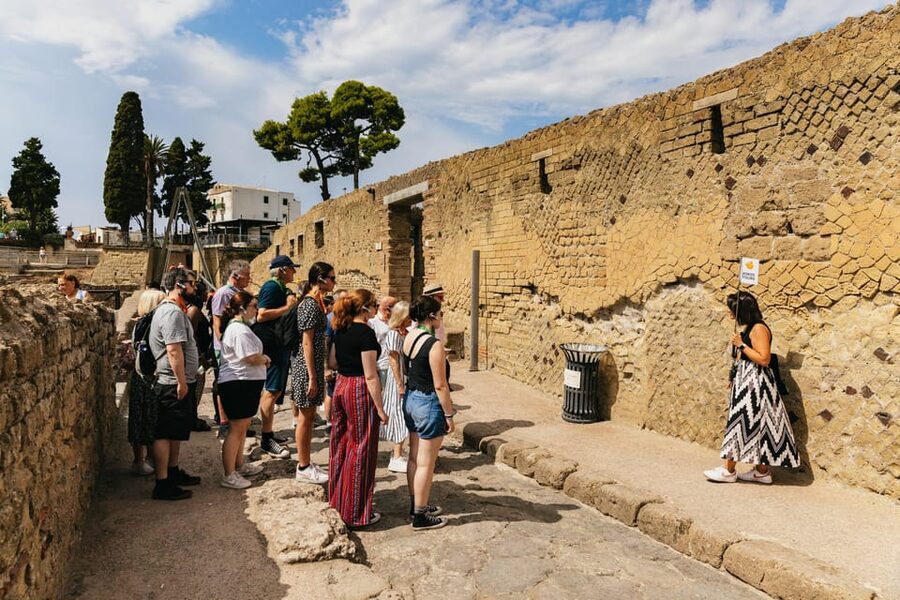
The route is designed to give you a strong overview without wandering aimlessly. You will visit the archaeological site for about two hours, moving through the main public areas and several of the most revealing houses.
That structure is a good fit for first-time visitors. Herculaneum rewards slow looking, but its streets can also feel confusing without a clear plan. A guide points out the features that are easy to miss, then leaves you with enough understanding to explore independently.
The tradeoff is that each stop receives a limited amount of time. If you want to examine every mosaic or read every sign, stay longer after the tour. Admission remains valid for the day, so the guided visit works well as an orientation rather than a complete substitute for independent exploration.
Casa dei Cervi and the homes of the wealthy
Casa dei Cervi, the House of the Deer, is one of the stops that helps explain Herculaneum’s prosperous side. The name comes from a deer sculpture, and the house is associated with the large, comfortable residences built for people with money and status.
This is where an archaeologist’s explanation adds real value. You are not just looking at a surviving wall. You are considering the size of the house, its decorative choices, and the lifestyle that required such space.
The home also helps balance the more tragic parts of Herculaneum. The site is not only a disaster memorial. It was a living town of merchants, wealthy families, workers, religious officials, and children, and the houses make that human scale easier to grasp.
A different way to spend the day, same part of Italy:
- Naples: Naples Underground Entry Ticket and Guided Tour
★ 4.4 · 21,781 reviews - Pompeii: Entry Ticket and Guided Tour with an Archaeologist
★ 4.8 · 19,459 reviews - Pompeii: Entry Ticket with Optional Audio Guide
★ 4.2 · 12,360 reviews - Pompeii: Small Group Tour with an Archaeologist
★ 4.8 · 12,264 reviews
House of Neptune and Amphitrite
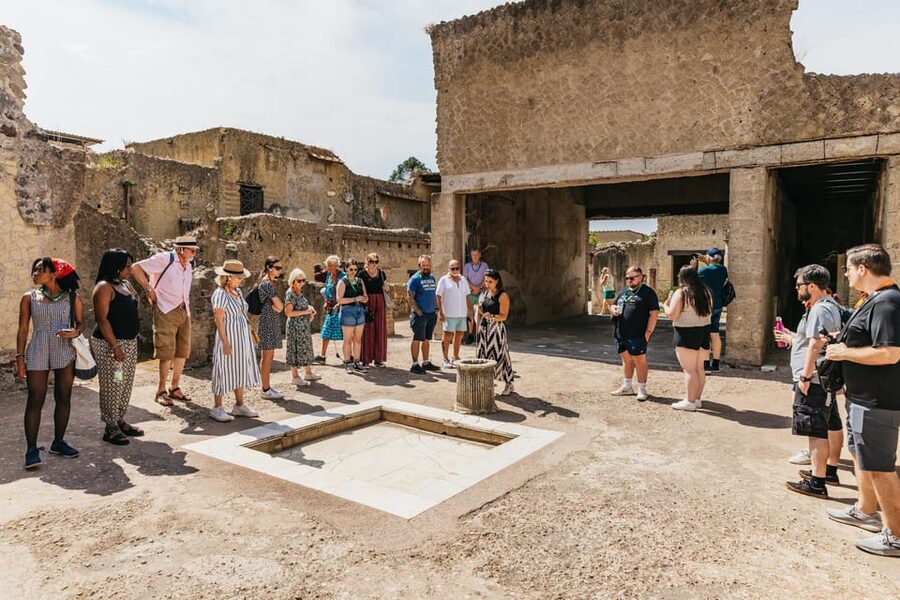
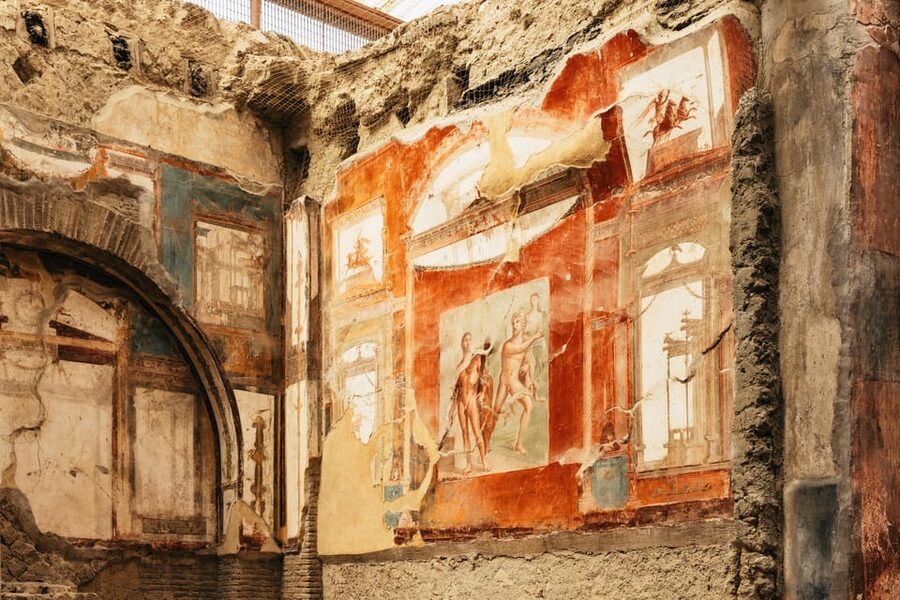
Casa di Nettuno ed Anfitrite is one of the tour’s visual highlights. Its name refers to Neptune and Amphitrite, and the house is known for its wall decoration, mosaics, and colorful architectural details.
Look closely at the surviving surfaces. Stone, marble, ceramics, painted plaster, and glass-like mosaic pieces survived the eruption in different ways, giving you an unusually close look at Roman taste and craft.
This stop can be crowded around the most attractive decorations, so listen carefully and stay close enough to hear the headset. Guides often pause here to explain how the mosaic composition worked and what the room may have been used for.
The house is also a good reminder that Roman interiors were not plain stone boxes. Color and pattern mattered. The remains may be incomplete, but the decorative ambition is still clear.
House of the Skeletons and the waterfront
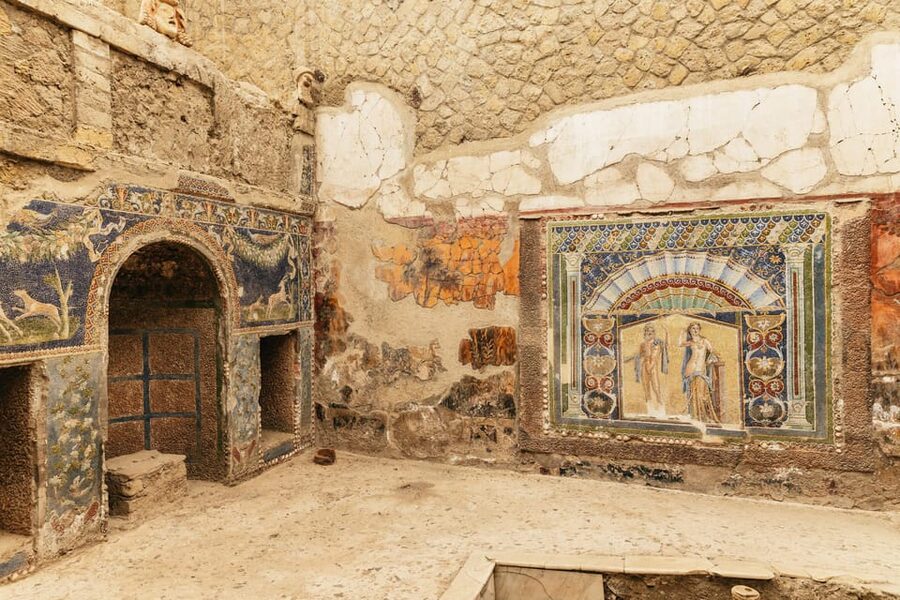
The House of the Skeletons brings the eruption into the domestic setting. Its name reflects the human remains found there, and the stop can feel more serious than the decorated houses nearby.
From there, the waterfront offers the starkest view of the disaster. More than 300 people died in the coastal shelters while attempting to escape toward the sea. You may find this area emotionally heavy, but it gives essential context to the rest of the site.
I appreciate that the tour does not treat the waterfront as a quick photo stop. The location helps you understand that Herculaneum was connected to the sea and that people sought escape there when the eruption became impossible to outrun.
This is also one reason to bring water and wear sensible shoes. The site is open and exposed, and the route includes uneven archaeological surfaces.
Casa dell’Albergo and Casa del Salone Nero
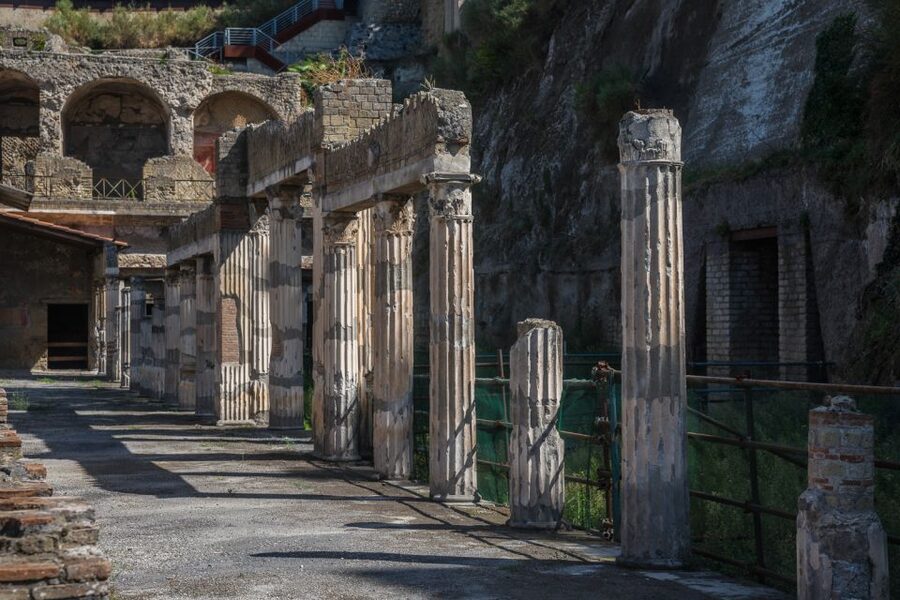
Casa dell’Albergo, or the House of the Inn, gives the route another look at domestic and commercial life. The name reflects the building’s later interpretation, but your guide can help separate what is clearly established from what is inferred from the remains.
Casa del Salone Nero, the House of the Black Room, is known for its dark-walled interior and refined decoration. It is a useful stop for seeing how room color and ornament could shape the mood of a Roman home.
These houses are valuable because they slow the story down. The eruption is dramatic, but the real reward is seeing how people arranged rooms, displayed decoration, and moved through their homes before the catastrophe.
A good guide also helps you compare these residences. One may feel open and grand, another more enclosed and theatrical. Those differences make the town feel occupied rather than frozen into a single picture.
The Temple of the Augustales
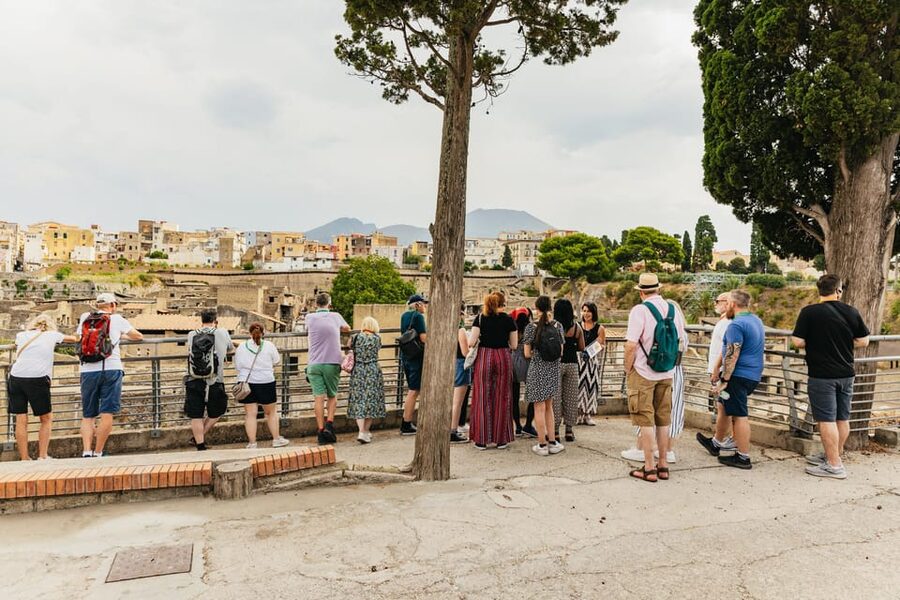
The Sacellum of the Augustales, also called the Temple of the Augustales, was linked to the worship of the emperor and the civic life of the town. It is one of the route’s most important religious and public stops.
This building helps explain how Herculaneum functioned as a community. Private homes show family life and wealth, while the Temple of the Augustales points to public duties, ceremony, and local identity.
Guides often use this place to explain the role of prominent local people and the ways Roman towns connected religion, politics, and status. You do not need to know Roman institutions in advance. A clear explanation makes the remains much easier to place.
Baths, Forum, and the Gymnasium
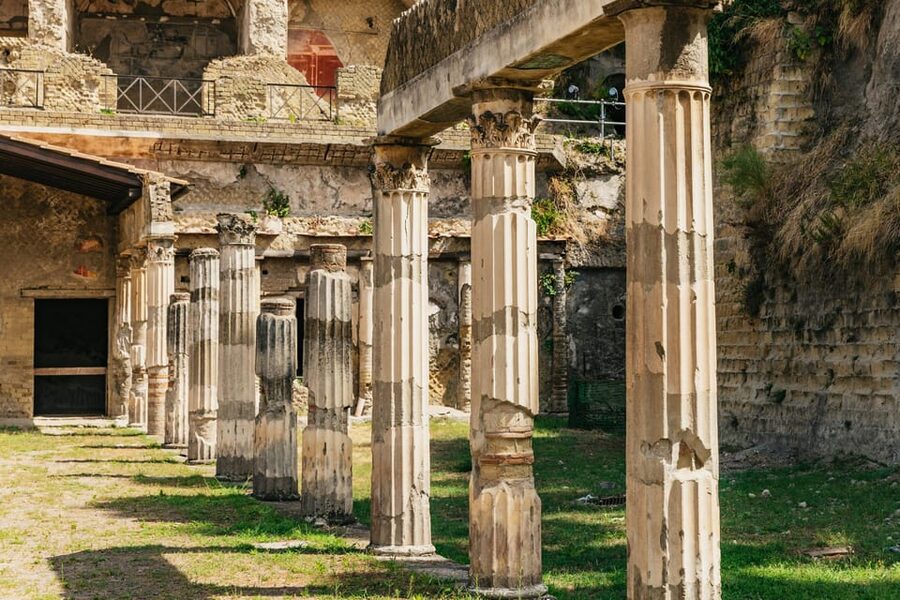
The thermal baths show how important public bathing was to Roman daily life. The complex is not merely an ancient swimming pool. It reflects a social system in which bathing, exercise, conversation, and routine public life came together.
The Forum was the town’s civic center. Even when only fragments survive, the space helps you understand how commerce, administration, and public movement were organized.
The Gymnasium adds another layer. One guide took the group into a tunnel leading toward the center of the gymnasium, where the swimming pool would have been. Access and conditions can vary, but when this area is open, it provides a useful look beneath the visible remains and shows how much of Herculaneum is still experienced at different levels.
These public buildings also keep the tour from becoming a parade of private houses. You see where people lived, but also where they bathed, gathered, worshipped, and conducted civic business.
Why an archaeologist guide changes the visit
The guide is the heart of this experience. The strongest guides do more than recite dates. Luciano Leone, Diego, Teresa, Anna, Alfredo, Angelo, Roberta, and others have been praised for clear explanations, humor, and a real command of the site.
Luciano is especially associated with visual storytelling. He has used books, binders, photographs, and images showing the ruins before and after the eruption. These tools can make a major difference when you are trying to picture a complete Roman street from a damaged wall or imagine a decorated room from a few surviving fragments.
Several guides also explain the difference between Herculaneum and Pompeii. That comparison is helpful because many people arrive expecting a smaller version of Pompeii. Herculaneum is not simply smaller. Its preservation, houses, waterfront, and compact route create a different kind of visit.
The language choices are broad: English, Italian, German, Spanish, and French. The tour also provides headsets, which are important when the group spreads out. Stay near the guide, especially at busy stops, because one person noted that the audio became difficult to follow when the guide marched too far ahead.
Is $53 good value?
At $53 per person, the price is reasonable if you want interpretation rather than just entry. Adult admission alone is listed as 16 euros, while European Union citizens aged 18 to 25 pay 2 euros. The remaining cost pays for the archaeologist, the guided route, the headsets, and the convenience of skip-the-line access.
For a short visit, that can be good value. You get a structured introduction in two hours and can continue exploring afterward without buying another ticket. If you are happy reading signs and finding your own way, a self-guided visit will cost less, especially for eligible young EU visitors.
I would choose the tour for a first visit, for anyone comparing Herculaneum with Pompeii, or for people who want the archaeological meaning explained on the spot. I would skip it only if you strongly prefer solitary wandering or plan to spend the whole day reading and examining each building at your own pace.
Timing, weather, and practical comfort
The site is vast and very exposed. Sunscreen and a hat are sensible in warm weather, while a raincoat matters because the tour operates rain or shine.
Closed-toe shoes are strongly recommended. Open sandals can be awkward on uneven ancient surfaces, and comfortable shoes will help you concentrate on the buildings rather than your feet.
Do not bring luggage or large bags. Food and drinks are not included, and transportation is not included either, so you need to arrange your own way to the ruins and handle refreshments separately.
Morning is the safer choice if you want time afterward. A late afternoon tour may cover the highlights well, but one visitor noted that a 2:30 p.m. start left little time to explore quietly before the site closed at 5 p.m. Check the available start times and choose based on how long you want to stay.
The tour is not suitable for wheelchair users or people with mobility impairments. Children must be accompanied by an adult, and unaccompanied minors are not accepted.
Who should book this Herculaneum tour?
I would recommend it to first-time visitors, history fans, families with older children, and anyone who found Pompeii hard to interpret alone. A guide can make the houses, baths, religious buildings, and waterfront connect into one story.
It also suits a family better than a completely unstructured visit, though younger children may lose interest during a full two-hour explanation. One eight-year-old handled the experience well with a particularly engaging guide, while an eleven-year-old began to tire after also spending an afternoon at Pompeii.
The tour works especially well as part of a Pompeii and Herculaneum pairing. Pompeii gives you a larger town and a different sense of scale. Herculaneum gives you preserved interiors, a more compact route, and a closer look at private life.
FAQ
Where does the Herculaneum tour meet?
Meet at the ticket office of the Herculaneum ruins on Via dei Papiri Ercolanesi. Your guide will hold an Askos Tours sign.
How long does the guided visit last?
The guided visit lasts two hours. Your admission allows you to continue exploring Herculaneum at your own pace afterward.
Is transportation from Naples included?
No. Transportation is not included, so you must arrange your own way to the Herculaneum ruins.
What languages are available?
The live tour guide is available in English, Italian, German, Spanish, and French.
What should I bring?
Bring a valid passport or identity card, comfortable closed-toe shoes, sunscreen, and a hat. A raincoat is also useful because the tour operates in wet weather.
Can wheelchair users or people with mobility impairments join?
No. The experience is not suitable for wheelchair users or people with mobility impairments. Large bags and luggage are also not allowed, and children must be accompanied by an adult.
Should you book it?
Book this tour if you want Herculaneum explained, not just seen. The archaeologist guides bring useful visual material, compare the site with Pompeii, and lead you to the major houses, baths, public buildings, and waterfront remains in a sensible order.
Choose an earlier start if you want extra time afterward. Stay close enough to hear the headset, wear proper shoes, and arrive at the ticket office rather than trusting an imperfect map pin. At $53, it is a fair choice for a focused introduction, especially when you value expert interpretation and skip-the-line entry.
Recently reviewed around Naples & Pompeii
- Pompeii Skip-the-line Tour with Archaeologist Guide★ 5.0 · 559 reviews
- Sharing Tour of Pompeii★ 5.0 · 487 reviews
- Skip the Line Guided Tour of Pompeii led by an Archaeologist★ 5.0 · 703 reviews
- Visit in Pompeii – Pompeii Private Tour with Ada★ 5.0 · 436 reviews
- Pompeii Private Tour with an Archaeologist and Skip The Line★ 5.0 · 391 reviews
- Private Day Tour to Vesuvius, Herculaneum & Pompeii with Pick Up★ 5.0 · 279 reviews
- Pompeii Vineyard Escape: Private Wine Tasting & Lunch★ 5.0 · 329 reviews
- Pompeii Guided Group Tour with Entry Ticket and Archaeologist★ 4.5 · 269 reviews
Pompeii & Vesuvius Tours, compared.
Entry Ticket and Guided Tour with an Archaeologist
Read our review →
Pompeii Small Group Tour with an Archaeologist
Read our review →
Pompeii, Amalfi Coast and Positano Day Trip from Rome
Read our review →Browse the lists this tour appears in