

Review · POMPEII & VESUVIUS TOURS
Pompeii: Skip-the-Line Entrance Ticket with Audio Guide
Pompeii is far larger than many first-time visitors expect. This is not a quick walk past a few ruins, but a broad ancient city where you can move from an amphitheater to painted homes, theaters, public spaces, and haunting casts of people and pets. The audio guide and map help turn a maze of streets into a visit you can shape around your own interests.
I like the easy location of the ticket office, just above the Pompei Scavi train station and only a short walk from the entrance. I also like the freedom to linger: you can spend a few hours seeing the main sights or keep exploring for much of the day. The main catch is that the audio guide is not perfect for everyone. Some people find it hard to match the commentary to the right buildings, and you must bring your own headphones.
In This Review
- Key points to know
- Why Pompeii Needs More Than a Quick Visit
- Collecting Your Ticket Beside Pompei Scavi Station
- What Skip-the-Line Entry Actually Saves
- Using the Audio Guide and Map Inside the Ruins
- The Amphitheater and Pompeii’s Public Life
- Frescoes, Homes, and Roman Banquets
- The Casts and the Human Cost of the Eruption
- How Long Should You Plan to Stay?
- Independent Audio Guide or Live Guide Upgrade?
- Who Will Get the Best Value?
- Final Verdict: Book It If You Want Flexible Pompeii
- FAQ
- Where do I collect the Pompeii ticket?
- How close is the ticket office to the entrance?
- Is skip-the-line entry included?
- Is an audio guide included?
- Which languages are available for the audio guide?
- Do I need to bring headphones?
- Do I need identification?
- Are children admitted free?
- Can I bring luggage into Pompeii?
- Can I cancel the booking?
Key points to know
- The ticket office is above Pompei Scavi station, at the first-floor Tempio Travel office on Via Villa dei Misteri.
- The map matters, since Pompeii is large and easy to wander through without a clear plan.
- The audio guide works best with your own headphones, which are not included.
- Arrive early for cooler weather and smaller crowds, especially since much of the site has little shade.
- A live guide may be available for an extra €10, with guides such as Alfonso-Marie and Astrid praised for lively explanations.
- Children aged 0 to 17 enter free, while European Community visitors aged 18 to 24 pay €2 with valid identification.
Why Pompeii Needs More Than a Quick Visit

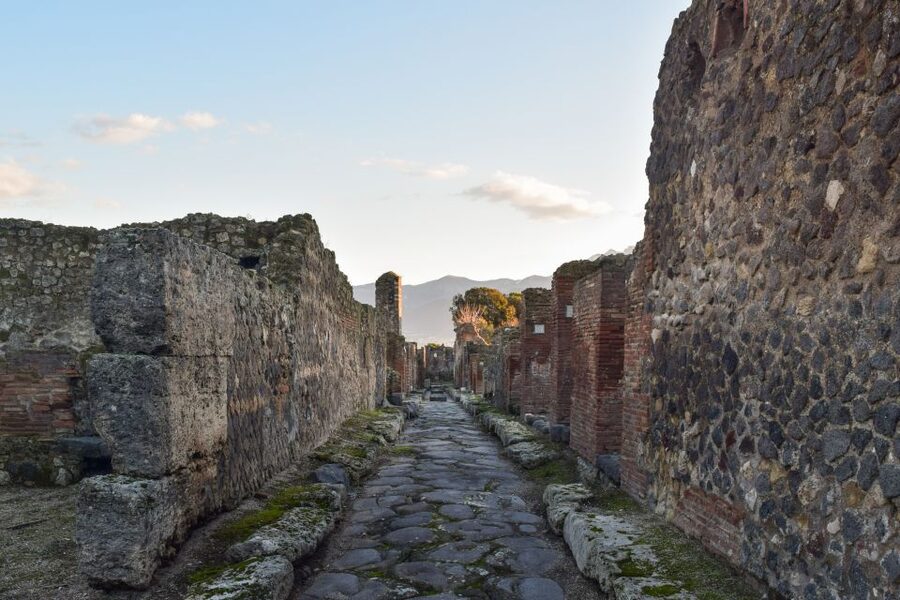
Pompeii gives you something most archaeological sites cannot: an entire Roman town laid out in streets, not just a single monument. You can see where people lived, ate, exercised, watched performances, and gathered for public life.
The city was buried after the eruption of Mount Vesuvius in AD 79. The preserved walls and frescoes do not simply show Roman decoration. They offer clues about daily life, social status, religion, food, entertainment, and private taste.
That scale is both the pleasure and the problem. You can easily spend three to four hours here and still miss large sections. One visit is not enough to see everything in a relaxed way, so the self-guided format is useful if you already know what matters most to you.
I would use the map before entering to mark a few priorities. Then I would let the rest of the visit unfold naturally. Pompeii rewards curiosity, but it can wear you down if you try to cover every street under the midday sun.
More Pompei Campania trips worth a second look
- Pompeii: Skip-the-line-Ticket and Guided Tour
★ 4.6 · 1,152 reviews - Pompeii: Guided Tour with Skip-the-Line Entry
★ 4.9 · 812 reviews - Pompeii: Skip-the-Line Entry Ticket with Digital Guide App
★ 4.1 · 770 reviews
Collecting Your Ticket Beside Pompei Scavi Station

Your first task is not to walk straight into the ruins. You must exchange your voucher at the Tempio Travel office on the first floor of the Circumvesuviana train station at Via Villa dei Misteri 1.
The office is very close to the Pompeii entrance, which makes the process fairly simple once you know where to go. Several people have been confused by the voucher exchange, especially when arriving at the station for the first time. Look for the activity provider’s office rather than joining the main ticket-office queue.
The ticket collection point is reported to be less than a minute from the entrance. Still, allow a little extra time. The office may not open until around 9 a.m., and arriving before opening can leave you waiting even when the archaeological site itself is ready for visitors.
Bring your passport, identity card, or driver’s license. Identification is particularly important if you qualify for the reduced European Community price for ages 18 to 24. The stated price for this experience is $39.97 per person, but children from 0 to 17 enter free and eligible European visitors aged 18 to 24 pay €2 with identification.
If free parking is available, you may be able to use the parking area at Osteria Nonna Cherubina on Via Andolfi 46. The wording matters: parking is only a possibility, depending on whether the provider is open and spaces are available. Do not build your whole transport plan around it.
What Skip-the-Line Entry Actually Saves
The ticket gives you skip-the-line access to Pompeii, so you avoid the ordinary ticket-office queue. That can be valuable during busy periods, especially when you have a train connection or a fixed day plan.
The benefit is not always a dramatic walk straight through the gate. There may still be a short wait to enter the archaeological area, and the site can be crowded even after you pass the ticket office. At around 9 a.m., the regular line may not be long, but early entry remains a smart choice because it helps with both crowds and heat.
Think of the ticket as a time-saving tool rather than a magic pass that removes every delay. Its best value comes when you want a simple arrival and do not want to work out the ticketing system at the station.
Using the Audio Guide and Map Inside the Ruins

The audio guide is available in English, French, German, Italian, and Spanish. It provides historical commentary while allowing you to choose which parts of the city deserve your time.
I like this arrangement for independent visitors. You are not tied to a group’s walking speed, and you can pause the commentary while studying a fresco or comparing the layout of one house with another. If you are revisiting Pompeii, the audio guide also helps you notice sections you missed the first time.
The map is just as important as the device. Pompeii covers a huge area, and its streets can feel confusing, particularly when several routes look similar. Use the map to keep track of where you are and to plan a sensible route between the main sights.
You must bring your own headphones. They are not included, and the audio guide may be supplied on a mobile phone or similar device. An aux-cable set of earphones can be useful, but make sure your headphones match the equipment you receive.
There is one practical weakness: the audio commentary may not always make it obvious which building or feature it describes. If you listen while walking, pause often and check the map. Otherwise, you may hear an interesting explanation without knowing exactly which doorway or room it refers to.
One person found the audio guide awkward to work out, while another considered it one of the better audio guides used during an Italian trip. That difference makes sense. The guide can be very useful, but it works best when you take control of the process rather than simply pressing play and walking.
A different way to spend the day, same part of Italy:
- Pompeii: Entry Ticket and Guided Tour with an Archaeologist
★ 4.8 · 19,459 reviews - Pompeii: Small Group Tour with an Archaeologist
★ 4.8 · 12,264 reviews - Naples: Pompeii and Mt. Vesuvius with Lunch and Wine Tasting
★ 4.5 · 2,454 reviews - Pompeii: Small-Group Tour of Pompeii and Herculaneum
★ 4.8 · 867 reviews
The Amphitheater and Pompeii’s Public Life
The Roman amphitheater is one of the essential stops. It shows the scale of public entertainment in Pompeii and helps you picture how the city gathered for spectacles.
The small theater offers a different sense of Roman leisure. Its more compact setting makes it easier to imagine performances and music in a more intimate space. Together, the two theaters show that entertainment was not an afterthought in Roman life. It was part of the city’s regular rhythm.
The public gym, or palaestra area, adds another piece to the picture. Pompeii was not only a collection of private homes and painted walls. It had organized public spaces where residents exercised, met, and took part in civic life.
The audio guide is most useful in these areas because it can connect the stones to their original purpose. Without explanation, a theater may look like rows of weathered masonry. With context, you begin to see the people, routines, and social rules that once filled it.
Frescoes, Homes, and Roman Banquets
The private houses are where Pompeii becomes especially personal. You can enter spaces connected with cooking, entertaining, worship, and family life, then look closely at the remains of wall decoration and floor plans.
The centuries-old frescoes are among the site’s strongest sights. Their survival is astonishing, but the real value comes from studying what they show. Mythological scenes, decorative patterns, and domestic rooms offer a sense of how Roman homeowners used art to signal taste and status.
The houses also help explain how Romans lived day to day. You may see rooms arranged for formal banquets, spaces built around courtyards, and evidence of the practical side of city life. Pompeii is powerful because it preserves ordinary routines alongside grand public buildings.
Do not rush these interiors. The best moments often come from looking at a small room, a patch of paint, or a worn threshold and then using the audio commentary to understand its purpose. A live guide can do this more naturally, but the audio format lets you stay as long as you want.
The Casts and the Human Cost of the Eruption
The casts of citizens and pets are among Pompeii’s most moving sights. They make the disaster personal in a way that walls and streets cannot.
These forms were created from voids left in the hardened volcanic material. They preserve the positions and outlines of people who died during the eruption. Seeing them can be difficult, particularly when you realize that pets and ordinary residents are represented alongside the city’s buildings.
The experience is not just about disaster. It also shows why Pompeii matters as an archaeological site. The preserved details connect a major historical event with individual lives, homes, and routines.
Give yourself time here. You do not need a long explanation to understand the emotional weight, but the audio guide can provide useful context without forcing you to stay with a group.
How Long Should You Plan to Stay?
The activity is sold as a one-day experience, so you have flexibility rather than a short fixed tour. In practice, plan on at least three hours if you want to see several major areas without racing.
A visit of three and a half hours can cover a lot, but it will not include every corner. You could spend much longer exploring because the site is so large. The right length depends on your energy, the weather, and how closely you want to study the houses and frescoes.
The site has very little shade, and only one café is available inside according to the practical information provided by visitors. Bring plenty of water, use sunscreen, and wear shoes that can handle long walks over uneven ancient streets.
There are places to rest outside the entrance after your visit. That can be welcome after several hours in the heat, but do not count on the café as your main food and drink plan.
Independent Audio Guide or Live Guide Upgrade?
The included audio guide suits you if you prefer to set your own pace, skip rooms that do not interest you, and return to a favorite building. It is also a good choice if your group has different interests or energy levels.
A live guide is better if you want the city explained in a clear route with the major highlights selected for you. Several guides have made a strong impression, including Alfonso-Marie, whose energetic style and two-hour tour were singled out as memorable, and Astrid, who handled a mixed-language group with warmth and imagination.
A live tour may sometimes be available for an extra €10 per person. This is not guaranteed as part of the basic booking, so ask at the office when you arrive. Some people found the upgrade worth paying for because Pompeii can feel like a maze, while others preferred the freedom of the self-guided format.
My advice is simple: choose the audio guide if you enjoy wandering and reading a map. Choose the live guide if this is your only visit and you want someone to explain how the pieces fit together.
Who Will Get the Best Value?
This experience suits independent visitors who are arriving by train, want a straightforward entry arrangement, and do not want to join a full coach excursion from Naples. It also works well for repeat visitors who already know some of the site and want to explore at their own speed.
Families may appreciate the flexible format and free entry for children aged 0 to 17, though the heat and long distances can be tiring. Teenagers may prefer choosing their own stops rather than following a long lecture.
First-time visitors should think honestly about how much guidance they want. Pompeii is not a small, simple ruin. If you are likely to feel lost or frustrated by a map, ask about the live-guide upgrade.
The $39.97 price makes the most sense when skipping the ticket-office queue and having the audio guide saves you time and planning effort. If the queue is short and you are comfortable arranging entry yourself, the premium may feel less compelling. The value rises when you visit at a busy time, have limited hours, or want commentary in one of the five listed languages.
Final Verdict: Book It If You Want Flexible Pompeii
I would book this experience if you want to reach Pompeii by train, avoid sorting out the main ticket queue, and explore without a fixed group route. The station-side office, map, audio guide, and one-day flexibility create a practical setup for a major archaeological site.
Bring water, sunscreen, identification, and your own headphones. Arrive around opening time, confirm where to collect the device, and consider the €10 live-guide upgrade if you want a stronger sense of direction.
Skip it only if you want a fully led tour from the start or if you dislike voucher exchanges and self-guided navigation. For everyone else, it offers a useful balance of structure and freedom, with enough time to see Pompeii as a real city rather than a quick collection of ruins.
FAQ
Where do I collect the Pompeii ticket?
Exchange your voucher at the Tempio Travel office on the first floor of the Circumvesuviana train station at Via Villa dei Misteri 1, 80045 Pompei.
How close is the ticket office to the entrance?
The office is very close to the Pompeii entrance, reportedly less than a minute away on foot.
Is skip-the-line entry included?
Yes. The activity includes skip-the-line entry to Pompeii, although you may still encounter a short wait at the entrance.
Is an audio guide included?
Yes. An audio guide and map are included in the experience.
Which languages are available for the audio guide?
The audio guide is available in English, French, German, Italian, and Spanish.
Do I need to bring headphones?
Yes. Headphones are not included, so bring your own.
Do I need identification?
Bring a passport, identity card, or driver’s license. Identification is also required for eligible European Community visitors aged 18 to 24 paying the €2 price.
Are children admitted free?
Children aged 0 to 17 go free according to the stated admission information.
Can I bring luggage into Pompeii?
No. Luggage and large bags are not allowed.
Can I cancel the booking?
Yes. You can cancel up to 24 hours in advance for a full refund. The booking also offers a reserve-now, pay-later option.
More Audio Tours in Pompei Campania
- Rome: Colosseum & Forum with Audio Guide App -Optional Arena
★ 4.2 · 24,770 reviews - Rome: Pantheon Fast-Track Ticket and Official Audio Guide
★ 4.3 · 21,008 reviews - Pompeii: Entry Ticket with Optional Audio Guide
★ 4.2 · 12,360 reviews - Venice: La Fenice Opera House Entry Ticket with Audio Guide
★ 4.6 · 11,742 reviews
Recently reviewed around Pompei Campania
- Pompeii 3hours Villa of Mysteries tour with an Archaeologist★ 4.8 · 486 reviews
- Pompeii: Small-Group Tour of Pompeii and Herculaneum★ 4.8 · 867 reviews
- Pompeii: Skip-the-line-Ticket and Guided Tour★ 4.6 · 1,152 reviews
- Pompeii: Skip-the-Line Entry & Audioguide★ 3.8 · 225 reviews
- Pompeii: Guided Tour with Skip-the-Line Entry★ 4.9 · 812 reviews
- Pompeii: Tour with Archaeologist Guide & Skip-the-Line Entry★ 4.5 · 478 reviews
- Pompeii: Afternoon to Sunset Guided Tour with Ticket★ 4.9 · 484 reviews
- Pompeii: Skip-the-Line Entry Ticket with Digital Guide App★ 4.1 · 770 reviews
Pompeii & Vesuvius Tours, compared.

Entry Ticket and Guided Tour with an Archaeologist
Read our review →



Pompeii Small Group Tour with an Archaeologist
Read our review →
Pompeii, Amalfi Coast and Positano Day Trip from Rome
Read our review →Browse the lists this tour appears in