
Review · POMPEII & VESUVIUS TOURS
Pompeii 2h Small-Group Tour with Expert Archaeologist
Pompeii rewards a guide who can turn broken walls and faded paint into a picture of daily Roman life. This two-hour walk takes you from the theaters and Stabian Baths to the House of the Faun, the Forum, and the Basilica, with an English-speaking guide leading the way.
I like the efficient route through major sights and the way guides such as Luca, Roberta, Manuela, and Patrizia have made the ruins engaging for adults and children. I also like the practical pace: two hours gives you a useful first look, then you can continue on your own if you still have energy.
The main caution is the group size. Although the experience is sold as small-group, the maximum is 30, and one booking became a group of about 20 when party numbers changed. Two hours also means a brisk visit, not a full exploration of Pompeii.
In This Review
- Key points to know before you book
- Why two hours can work at Pompeii
- Starting at Piazza Esedra
- Pompeii’s theaters: Odeon and Teatro Grande
- House of Menander and the Roman private home
- The Stabian Baths and Lupanar
- Via dell’Abbondanza and the city street experience
- House of the Faun and the scale of Pompeii
- The Forum and Basilica
- The guides and the quality of the storytelling
- Price, group size, and what you receive
- Families, heat, and walking comfort
- Who should book this Pompeii tour
- Final verdict: a useful first chapter, not the whole book
- FAQ
- How long does the Pompeii tour last?
- What language is the tour offered in?
- What is the price?
- Is Pompeii admission included?
- Is Pompeii free on the first Sunday of the month?
- Do children under 18 need to pay admission?
- Where does the tour start?
- Where does the tour end?
- How large can the group be?
- Can I cancel for a full refund?
Key points to know before you book
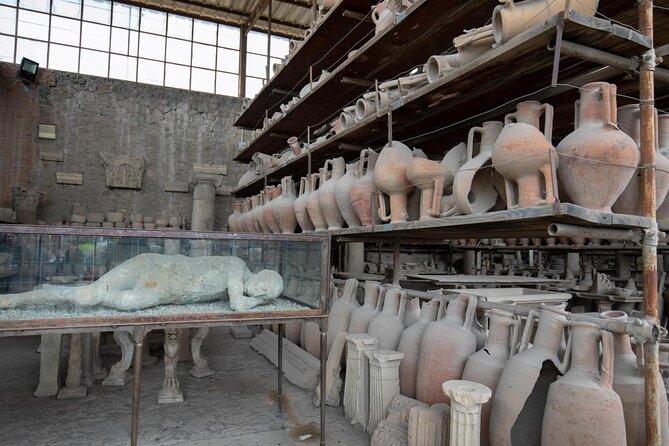
- Major sights in a short visit: See Pompeii’s theaters, baths, villas, brothel, Forum, and Basilica in about two hours.
- Guides make the difference: Luca, Roberta, Manuela, Patrizia, and several other guides receive praise for clear explanations, humor, and strong storytelling.
- Good for a first visit: The route helps you find major buildings that are easy to miss in Pompeii’s enormous archaeological park.
- Family-friendly in practice, but not every guide handles children equally well: Several guides kept children aged 7 to 13 interested, but one family reported a poor experience.
- Expect a walking tour in open conditions: Heat, shade, rain, uneven ground, and the size of the site all affect comfort.
- Good value at $32.67: Admission is included, and the price buys you a guided introduction rather than just access to the ruins.
Why two hours can work at Pompeii
Pompeii is not a compact monument. It is a whole Roman city, with streets, homes, shops, public buildings, gardens, theaters, and baths spread across a wide archaeological park. If you wander in without a plan, you can easily spend time finding your way and still miss the places you most hoped to see.
This tour solves that problem with a focused circuit. You get a guided look at the city’s best-known areas, including several places that carry a lot of visual and historical weight. The route is not designed to show every corner. It is designed to give you a clear introduction without consuming an entire day.
I see the two-hour length as a strength for several types of visitors. It works well if you are making a short stop in Pompeii, connecting the visit with Naples or the Amalfi Coast, or traveling with children who may tire before the site is fully explored. It also gives you a useful framework for returning to selected areas afterward.
The tradeoff is simple: you will not see all of Pompeii. The listed stops include time estimates ranging from 10 to 15 minutes, so expect short explanations and movement between sites. If you want quiet time inside each house or detailed study of every fresco, plan to continue independently after the tour.
More Naples & Pompeii trips worth a second look
- 2 hours Pompeii Tour with Local Historian – Ticket Included
★ 5.0 · 335 reviews - Pompeii: 2 Hour Private Tour with an Archeologist Guide
★ 5.0 · 214 reviews - Lucca: 2-Hour City Center Walking Tour
★ 4.7 · 1,314 reviews
Starting at Piazza Esedra
The meeting point is Ristorante Suisse at Piazza Esedra, 10/13, in Pompei. The activity ends back at the same meeting point, which gives you a clear start and finish rather than leaving you to find your way out of the archaeological park.
The location is near public transportation, and one account places the train station within about a five-minute walk. That makes the tour practical for a day trip. Still, I would allow time to locate the restaurant and gather your group, especially if you are arriving by train.
Confirmation is provided when you book. The tour is offered in English and uses a mobile ticket. The minimum is six people, while the maximum is 30. That range matters. You could find yourself in a small group of four or nine, but you should not assume a very intimate experience every time.
One group of four paid for a small-group experience but ended up with a larger group of about 20 after two members could not join. The guide, Enzo, was praised, but the use of headsets made it harder for one person to hear. If close contact with the guide is important to you, ask about the expected group size or consider the private upgrade.
Pompeii’s theaters: Odeon and Teatro Grande
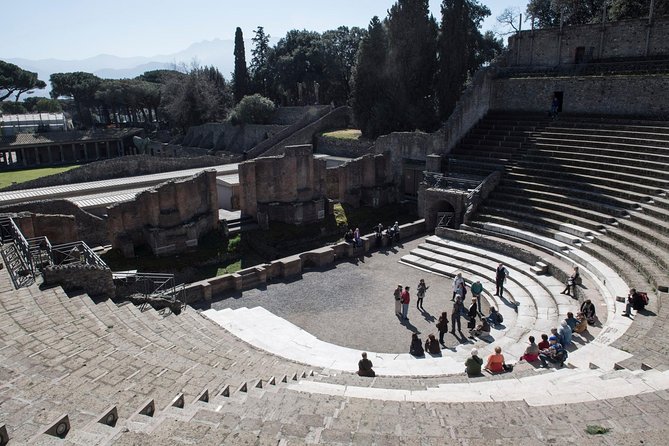
The first formal stops are the Odeon, also called the Teatro Piccolo, and Teatro Grande. These two theaters show that Pompeii was not only a place of homes and shops. Public entertainment was part of city life, and the buildings give you a sense of how Romans gathered for performances.
The Odeon receives about 10 minutes. Its smaller scale makes it a quick but useful stop, especially when your guide explains how it fit alongside the larger theater. Teatro Grande receives around 15 minutes and is described as the most important theater in Pompeii.
These stops are visually easier to understand than some wall remains because the shape of the seating and performance spaces still reads clearly. Your guide can help you picture how the structures functioned, rather than leaving you to look at stone tiers without context.
The limitation is time. You may get the basic layout and purpose, but not a long discussion of theater design, performance, or the site’s later excavation. I would treat these as strong introduction points, not a full theater study.
House of Menander and the Roman private home
The House of Menander receives about 15 minutes and is one of the most important residential stops on the route. It is known as one of Pompeii’s richest homes in terms of architecture, decoration, and contents.
This is where the tour’s human scale becomes useful. Public monuments can tell you how a city worked, but a large house helps you think about status, domestic space, decoration, and private life. The name comes from Menander, the Greek playwright, linking the home to the cultural world reflected in its decoration.
A guide can also help you distinguish between what you see in place and what belongs to the wider story of the house. In Pompeii, surviving walls and rooms do not always explain their own function. A short explanation can make a courtyard, painted surface, or grand entrance much easier to read.
Because the tour moves on after 15 minutes, you will not linger over every room. If this becomes your favorite stop, note where it is and return after the group portion ends.
A different way to spend the day, same part of Italy:
- Naples: Naples Underground Entry Ticket and Guided Tour
★ 4.4 · 21,781 reviews - Pompeii: Entry Ticket and Guided Tour with an Archaeologist
★ 4.8 · 19,459 reviews - Pompeii: Entry Ticket with Optional Audio Guide
★ 4.2 · 12,360 reviews - Pompeii: Small Group Tour with an Archaeologist
★ 4.8 · 12,264 reviews
The Stabian Baths and Lupanar
The Stabian Baths occupy a large area between the Brothel lane, the Holconius crossroads, and Via Stabiana. They are described as Pompeii’s oldest thermal complex, and the stop lasts about 15 minutes.
The baths are valuable because they show shared urban life. A Roman bath complex was not just a place to wash. It was part of the city’s social and public routine. The scale of the Stabian Baths helps you see how much space and planning went into facilities used by the wider community.
The Lupanar follows with about 10 minutes. It is Pompeii’s best-known brothel, and it is a memorable stop because of its small rooms and surviving erotic imagery. The subject is adult, so families may want to prepare younger children for a brief explanation rather than treating it as a surprise.
This part of the route can draw a crowd. A strong guide helps you focus on what the building reveals about Roman society without reducing it to a joke or a sensational stop. The short time keeps the visit moving, though it also limits deeper discussion.
Via dell’Abbondanza and the city street experience
Via dell’Abbondanza appears between the listed stops and connects several major parts of the visit. This street helps tie the buildings together. Pompeii makes more sense when you see how houses, shops, public buildings, and crossings related to one another.
You can expect uneven ancient paving and a fair amount of walking. A moderate level of physical fitness is recommended, and the open-air setting can be hot. One guide, Barbara, was especially attentive to shade and rest breaks, while another adapted the route during severe rain and wind by finding covered places for explanations.
That flexibility matters more here than at a short indoor museum visit. Conditions can change quickly, and Pompeii offers limited relief from strong sun or bad weather. Wear practical shoes, bring water, and be ready for a tour that continues in the elements.
House of the Faun and the scale of Pompeii
The House of the Faun receives about 10 minutes. It was one of the largest and most impressive private residences in Pompeii, so it gives you another look at wealth and domestic architecture after the House of Menander.
Its importance comes from scale. Even a short stop can show how far the homes of elite families were removed from ordinary living spaces. The name refers to the famous faun statue associated with the house, though the supplied tour details do not promise that every feature will be open or visible on the day of your visit.
This is a good example of why the guide helps. On your own, a large ruin can be impressive but hard to organize in your mind. A clear explanation of who used the house and why its size mattered gives the remains a human point of reference.
The 10-minute allocation is brief. You may want to return later if you are particularly interested in Roman homes, mosaics, or decorative art.
The Forum and Basilica
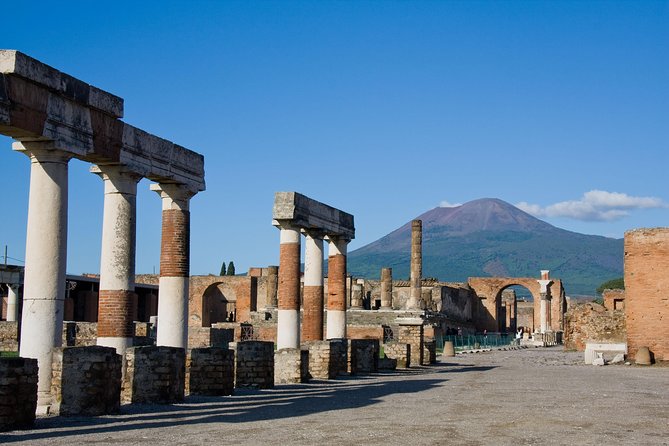
The Forum receives about 15 minutes and forms the civic heart of the route. This was Pompeii’s ancient main square, the place where public, commercial, and civic activity came together.
The open space can look simple at first. Your guide’s job is to help you read its position and surrounding buildings, so you understand why it mattered. This is one of the places where a guide can prevent the visit from becoming a sequence of disconnected ruins.
The final listed stop is the Basilica, with about 15 minutes. It was an open portico that provided shelter for merchants and other activities. The building adds another piece to the civic picture, showing how business and public life operated around the Forum.
Ending near these major public spaces gives the route a sensible shape. You move from entertainment and private homes to the city’s central institutions. Afterward, you return to Piazza Esedra with a better sense of how Pompeii fit together.
The guides and the quality of the storytelling
The strongest part of this experience is the human guide. Luca is repeatedly praised for passion, humor, and storytelling, with one group wishing the tour had lasted longer. Roberta is praised for archaeology, crowd awareness, warmth, and her ability to work well with a 10-year-old. Manuela is described as both entertaining and educational, including with teenagers and school-age children.
Patrizia receives praise for patience with children aged 7, 10, and 13. Other guides, including Barbara, Enzo, Mafilda, and Clare, are also described positively for clear explanations, pacing, kindness, and the ability to adjust to heat or weather.
You cannot choose every guide in advance from the information provided, so do not book on the assumption that you will receive a particular person. The overall rating is 5 out of 5 from 385 reviews, with 99 percent recommending the experience, but the individual experience can still vary.
One serious complaint described a guide who did not engage children and made an inappropriate remark about bringing them to Pompeii. That is not the dominant pattern, but it is important if you are booking specifically for a family. The experience is marketed as family-friendly, and many children clearly enjoyed it, yet the guide’s attitude matters greatly.
Price, group size, and what you receive
At $32.67 per person, this is a fairly modest price for a guided introduction to one of Italy’s largest archaeological sites. Admission is included, so you are paying for both access and the explanation that helps you use your two hours well.
The value is strongest if you are short on time or uncertain how to plan Pompeii. The route covers major highlights, and the guide keeps you from spending your limited visit searching for the theaters, baths, houses, Forum, and Basilica.
The value is less clear if you prefer to read signs and walk at your own speed. Pompeii’s information is available in both English and Italian, and self-guided audio tours are available in several languages. Independent entry may suit you better if you want to stop for long periods, avoid a set pace, or focus on a narrow interest.
Admission is free on the first Sunday of each month. It is also free for people under 18, who must show valid identification or a passport on the day of the tour. Those details may affect the price calculation for your group, so check how the booking handles eligible visitors before paying.
Families, heat, and walking comfort
I would consider this a good family option for children who can manage a two-hour walking tour. Several guides have kept children between 7 and 13 interested, and one family found Manuela especially good with two teenagers. Two hours is also short enough to avoid the fatigue that can set in during a full-day archaeological visit.
You should still set expectations. Pompeii is not a theme park, and parts of the explanation may be more interesting to adults than to children. One family with children aged 6 and 8 had a poor experience because the guide did not make the subject engaging.
Heat is a serious practical concern. A guide may stop in shade and adjust the pace, but you should bring water and prepare for exposed walking. Another group faced hail, sideways rain, and wind, and the guide found covered places for explanations, but bad weather can still affect what you see and how comfortable you feel.
Who should book this Pompeii tour
Book it if you want a clear first look at Pompeii, have only two hours, or are uneasy about finding the major sights alone. It is also a sensible choice for families, provided you accept that the experience depends on the assigned guide.
I especially recommend it for first-time visitors arriving by train and fitting Pompeii into a larger southern Italy schedule. The meeting point near public transportation and the return to the same location make the plan simple.
Choose independent entry instead if you want to explore slowly, take extensive photographs, or spend a long time in a particular house. Choose the private upgrade if personal questions, a flexible pace, and closer contact with the guide matter more than keeping the price low.
Final verdict: a useful first chapter, not the whole book
This tour offers good value for a fast, guided introduction to Pompeii. The route covers the city’s key public buildings, striking private homes, baths, brothel, streets, and central square, while strong guides such as Luca, Roberta, Manuela, and Patrizia can make the ruins much easier to understand.
Its limits are clear: two hours is brief, the group may be larger than expected, and guide quality is not identical every time. I would book it when time is tight and structure matters. If Pompeii is a major reason for your Italy trip, use the tour as your orientation, then keep exploring on your own.
FAQ
How long does the Pompeii tour last?
The tour lasts approximately two hours.
What language is the tour offered in?
The tour is offered in English.
What is the price?
The listed price is $32.67 per person.
Is Pompeii admission included?
Yes, the itinerary states that admission tickets are included.
Is Pompeii free on the first Sunday of the month?
Yes. Pompeii admission is free on the first Sunday of each month.
Do children under 18 need to pay admission?
Admission is free for people under 18, but they must show a valid ID or passport on the day of the tour.
Where does the tour start?
The tour starts at Ristorante Suisse, Piazza Esedra, 10/13, 80045 Pompei, Italy.
Where does the tour end?
The activity ends back at the meeting point.
How large can the group be?
The tour requires at least six participants and can include up to 30 travelers.
Can I cancel for a full refund?
Yes. You can cancel at least 24 hours before the experience start time for a full refund. Cancellations or changes made less than 24 hours before the start time are not accepted for a refund.
Recently reviewed around Naples & Pompeii
- Pompeii Skip-the-line Tour with Archaeologist Guide★ 5.0 · 559 reviews
- Sharing Tour of Pompeii★ 5.0 · 487 reviews
- Skip the Line Guided Tour of Pompeii led by an Archaeologist★ 5.0 · 703 reviews
- Visit in Pompeii – Pompeii Private Tour with Ada★ 5.0 · 436 reviews
- Pompeii Private Tour with an Archaeologist and Skip The Line★ 5.0 · 391 reviews
- Private Day Tour to Vesuvius, Herculaneum & Pompeii with Pick Up★ 5.0 · 279 reviews
- Pompeii Vineyard Escape: Private Wine Tasting & Lunch★ 5.0 · 329 reviews
- Pompeii Guided Group Tour with Entry Ticket and Archaeologist★ 4.5 · 269 reviews
Pompeii & Vesuvius Tours, compared.

Entry Ticket and Guided Tour with an Archaeologist
Read our review →




Pompeii Small Group Tour with an Archaeologist
Read our review →
Pompeii, Amalfi Coast and Positano Day Trip from Rome
Read our review →Browse the lists this tour appears in