
Review · POMPEII & VESUVIUS TOURS
Pompeii Private Tour with an Archaeologist and Skip The Line – 3 hours
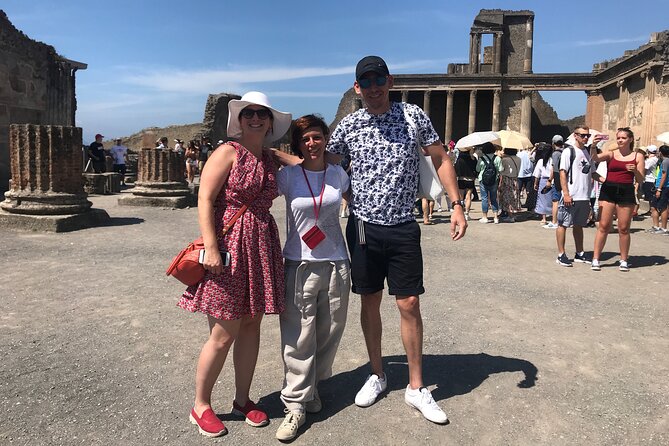
Pompeii is much easier to understand with an archaeologist beside you. In three hours, this private walk connects theaters, baths, temples, shops, homes, and the Forum into a picture of daily Roman life, instead of leaving you to puzzle over a huge field of ruins.
I like the one-group format, which lets you ask questions and adjust the pace. I also like the range of stops, from the tiny Odeon and gladiators’ barracks to a fast-food counter, laundry, market, and the famous Cave Canem mosaic.
The main catch is the price and ticket arrangement. The listed cost is $302.32 for a group of up to one person, while adult Pompeii admission is an extra €19 per person. You must request skip-the-line help in advance and buy the entrance ticket separately.
In This Review
- Key points to know before you book
- Why an archaeologist changes the Pompeii visit
- Starting at Porta Marina Superiore
- The Odeon and Teatro Grande
- Granai del Foro and the Stabian Baths
- The Forum, Basilica, and Temple of Jupiter
- Gladiators, the Lupanar, and the Temple of Venus
- Casa del Poeta Tragico and the Cave Canem mosaic
- Macellum and the Edificio di Eumachia
- Casa del Menandro and the art of Roman homes
- The Thermopolium and Stephanus’s laundry
- Three hours, private attention, and the price
- Who will get the most from this tour
- Practical details that affect your day
- Should you book the Pompeii private archaeologist tour?
- FAQ
- Is the Pompeii entrance ticket included?
- Is skip-the-line entry included?
- How long does the private tour last?
- Where does the tour start?
- Is transportation included?
- Can I cancel for a full refund?
Key points to know before you book
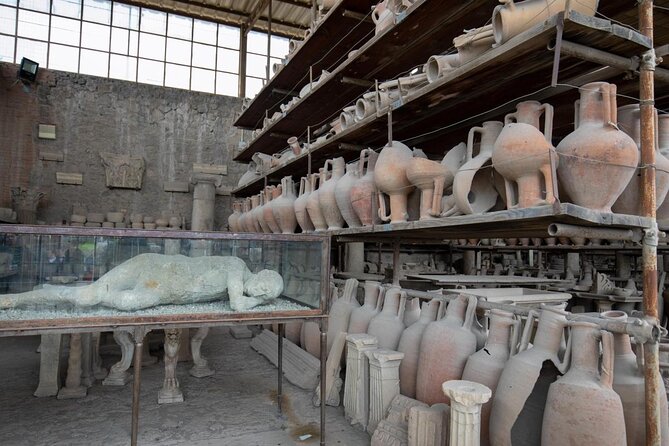
- A private archaeologist-led walk: Guides may include Luisa, Amedeo, Eliana, Roberto, Maria, Luciana, or Mariagrazia.
- A strong three-hour route: The tour covers major public buildings and revealing everyday places.
- Tickets cost extra: Adult admission is listed at €19 per person, with free entry for those under 18.
- Skip-the-line access needs advance notice: The operator provides a link to buy tickets and asks you to request this service ahead of time.
- Expect uneven walking: Pompeii has steps, slippery surfaces, and a lot of walking, so good balance and comfortable shoes matter.
- Flexible personal attention: Guides can answer questions, adjust the pace, and help with mobility needs.
Why an archaeologist changes the Pompeii visit
Pompeii is not a tidy open-air museum. It is a large ancient city with streets, houses, public buildings, temples, shops, and gaps where excavations are still incomplete. Without context, you can spend hours looking at walls and mosaics without seeing how the pieces fit together.
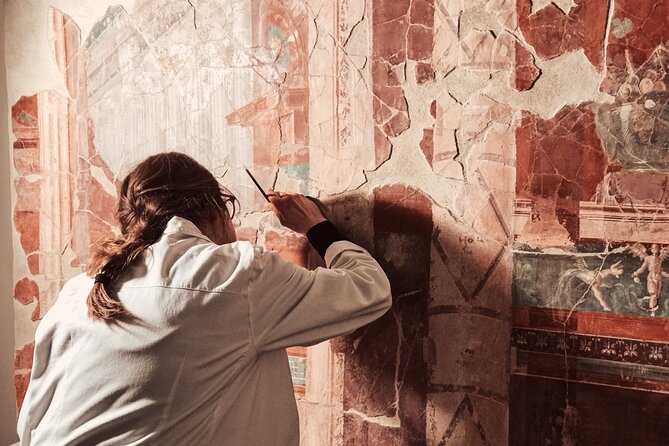
A trained archaeologist gives you that missing framework. You learn what a building was used for, how its design worked, and what it suggests about the people who lived in Pompeii before the eruption of Mount Vesuvius in AD 79. The strongest guides on this tour, including Luisa, Amedeo, Eliana, and Roberto, are praised for combining facts with stories about ordinary life.
That personal approach matters in a private group. You can stop to ask why a building was laid out in a certain way, how a bath complex operated, or what a shop tells us about Roman habits. A large group tour often has to keep moving. Here, the guide can spend more time on your interests.
I also like that the guides pay attention to comfort. Luisa has been praised for finding shaded spots during hot weather, while Mariagrazia has adjusted the pace for mobility needs. Roberto and Amedeo have also been described as patient and helpful with visitors dealing with physical limitations.
More Naples & Pompeii trips worth a second look
- Herculaneum: Skip-the-Line Guided Tour with Archaeologist
★ 4.8 · 3,439 reviews - Mount Vesuvius: Skip-the-Line Ticket and Smart Digital Guide
★ 4.2 · 2,780 reviews - From Naples: Pompeii Skip-the-Line Entry Ticket and Tour
★ 4.4 · 2,753 reviews
Starting at Porta Marina Superiore
The meeting point is at Hortus Pompei, Restaurant & Garden Bar, near Porta Marina Superiore at Piazza Esedra. This is a practical starting place because the route enters Pompeii from one of the main access points and then moves through the city rather than circling around one small area.
You should arrive ready to walk. The first five minutes are listed for Pompeii Archaeological Park itself, but the real value begins as the guide orients you to the site and leads you toward the theaters. The tour is planned to end at Porta Marina Inferiore, although the meeting-point information also says the activity ends back at the meeting point. Since those details do not match perfectly, confirm the exact finishing point before the day of your visit.
The park is exposed, and the route includes uneven ancient paving, steps, and slippery surfaces. One account specifically warns that good balance is needed. Wear sturdy shoes, and do not treat this as a casual stroll through a smooth city museum.
The Odeon and Teatro Grande
The first major stop is the Odeon, or Small Theater. Its compact size helps you picture a more intimate performance space, and a five-minute visit works well as a quick introduction to Pompeii’s public entertainment.
The Teatro Grande, or Large Theater, receives about 15 minutes. This is one of the route’s more important public spaces because it shows how much room Pompeii set aside for performances and communal life. Your guide can help you read the theater as a working part of the city, not just as an attractive ruin.
I would not expect every stop to receive equal attention. The listed times are approximate, and the three-hour limit means the guide has to keep a firm pace. That is a strength if you want a well-shaped overview, but a drawback if you hope to study every building at length.
The route also passes along Pompeii’s main street. This is where the city begins to feel like a real neighborhood. Look at the paving, entrances, shop fronts, and changes in building scale. The street ties the separate monuments together and shows how public and private life sat side by side.
Granai del Foro and the Stabian Baths
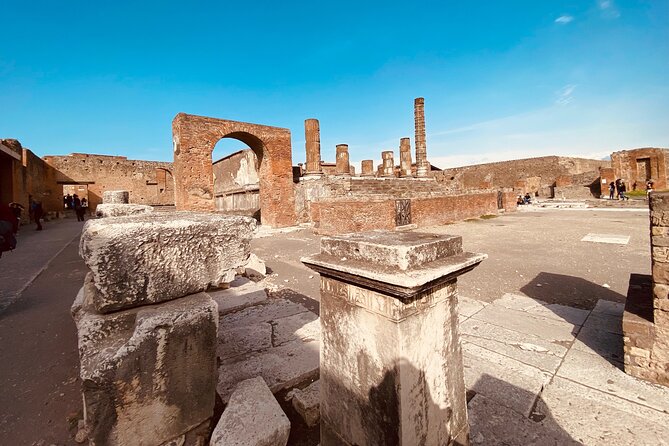
The Granai del Foro, described as an archaeological deposit, receives 15 minutes. This stop offers a useful reminder that Pompeii is also a working archaeological site. Objects and building fragments are not simply decorative pieces. They help researchers reconstruct what happened in the city and how people used its spaces.
The Stabian Baths receive another 15 minutes. These are described as Pompeii’s first baths, and they give the tour a chance to explain Roman bathing as a social activity as well as a practical one. The importance of this stop is not only the architecture. It is the chance to understand how public facilities shaped the rhythm of urban life.
A guide is especially helpful here because bath complexes can be hard to read from their remains. You may see rooms, walls, and fragments of decoration, but the guide can explain how the areas related to one another. Ask questions if you want more detail, since the private format allows for that.
A different way to spend the day, same part of Italy:
- Naples: Naples Underground Entry Ticket and Guided Tour
★ 4.4 · 21,781 reviews - Pompeii: Entry Ticket and Guided Tour with an Archaeologist
★ 4.8 · 19,459 reviews - Pompeii: Entry Ticket with Optional Audio Guide
★ 4.2 · 12,360 reviews - Pompeii: Small Group Tour with an Archaeologist
★ 4.8 · 12,264 reviews
The Forum, Basilica, and Temple of Jupiter
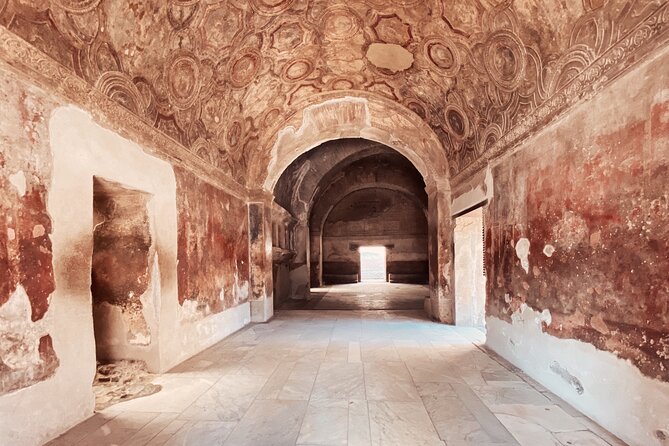
The Forum is one of the essential stops, with about 15 minutes allotted. This was Pompeii’s main civic center, and the open space helps you understand the city’s public structure. Your guide can place the surrounding buildings in context and explain why the Forum mattered to politics, religion, business, and public gatherings.
Nearby, Pompeii’s Basilica is presented as the Court of Justice. It is another 15-minute stop and shows how legal and commercial activity occupied a central place in Roman city life. The building’s scale and position make more sense once you see it as a public institution rather than an empty shell.
The route also includes the Temple of Jupiter. Even without a listed time, it is an important visual part of the Forum area. The temple helps explain the religious focus of the city and the way sacred buildings helped define the civic center.
This is one place where a private guide offers real value. The Forum contains many major structures close together, and it is easy to mix up their functions. A good explanation turns a cluster of columns and foundations into a readable city plan.
Gladiators, the Lupanar, and the Temple of Venus
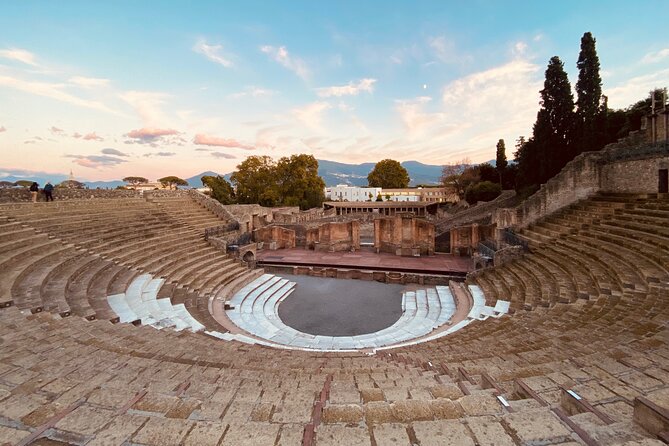
The Quadriporticus of the theaters is identified here as the gladiators’ barracks. The stop lasts about 15 minutes. Its position near the theaters makes sense, and the guide can connect the entertainment buildings with the people who performed in them.
The Lupanar, or brothel, is given 15 minutes. This is one of Pompeii’s most famous stops, but it is best treated as part of the larger picture of city life rather than as a sensational detour. The rooms, paintings, and layout offer evidence about commerce, privacy, and the kinds of services available in an ancient urban center.
The Temple of Venus is also included in the route. It adds another religious landmark and helps show how worship was woven into the city’s physical design. Together, these stops move from performance and public spectacle to private commerce and religious practice.
Crowds can gather around the most famous buildings. Guides such as Roberto and Amedeo have been praised for finding better viewing positions and steering groups around congestion when possible. That cannot guarantee an empty site, but a local guide can make the route less frustrating.
Casa del Poeta Tragico and the Cave Canem mosaic
Casa del Poeta Tragico receives five minutes, a short stop focused on the Cave Canem mosaic. The Latin phrase means beware of the dog, and the mosaic is one of Pompeii’s memorable examples of a home using decoration to communicate with visitors.
Although five minutes is not long, the stop works as a sharp glimpse into domestic life. A house entrance could carry a message about status, household rules, or the mood its owner wanted to create. Your guide can explain how a small detail like this fits into the wider picture of Pompeian homes.
If this is a particular interest for you, say so at the start. The tour is private, and the guide can often spend more time on domestic decoration or household customs if that fits your group’s priorities.
Macellum and the Edificio di Eumachia
The Macellum, or meat and fish market, receives about 10 minutes. Markets are among the most useful places for understanding daily life because they connect the city to food, work, trade, and routine errands. This stop balances the grand temples and theaters with a more ordinary side of Pompeii.
The Edificio di Eumachia follows with five minutes and is described as a wool market. It adds another working trade to the route. Together, the Macellum and Eumachia building help you see Pompeii as a commercial city, not only a place of monuments.
The short timing means you will get an explanation and a look around rather than a long study session. Still, these stops are well chosen. They make the visit feel more human and give meaning to the shops and public spaces you pass elsewhere.
Casa del Menandro and the art of Roman homes
Casa del Menandro receives the longest stop, about 20 minutes. That makes sense, since the house is included for its frescoes and mosaics. Domestic buildings can be among Pompeii’s most rewarding sights because they reveal how wealthy residents organized rooms, decoration, and movement through the home.
A guide can help you notice details that are easy to miss when walking alone. Instead of seeing painted walls as isolated decoration, you can consider how art, architecture, and social status worked together. The extra time also gives you room to ask about the people who lived in the house and the meaning of its name.
This is likely to be one of the tour’s best stops for anyone interested in art or architecture. It is also a good place to slow down briefly before moving back into the commercial and working parts of the city.
The Thermopolium and Stephanus’s laundry
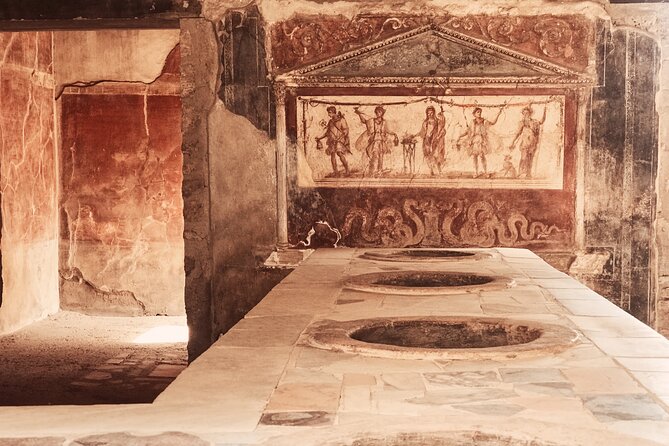
The Termopolio di Vetuzio Placido is described as a takeaway shop and ancient fast-food counter, with about 15 minutes scheduled. This is one of the route’s most relatable stops. It shows that Pompeii had businesses serving people who wanted food away from home, much as cities do now.
The stop can help you picture how different classes used the city’s commercial spaces. Not every resident cooked in a large private kitchen, and small food shops were part of the urban routine. The guide’s storytelling is especially valuable here because the building’s function becomes clear only when you connect its features with everyday habits.
The Fullonica di Stephanus, or laundry, receives another 15 minutes. It brings the working city into focus. Clothing care was a real trade, and a laundry gives you a look at labor, business, and the practical services that kept Pompeii running.
The itinerary ends with another temple stop listed without a number. The tour’s precise final sequence may vary with access and crowd conditions, so ask your guide how much time remains if you have a particular building you want to see.
Three hours, private attention, and the price
The tour costs $302.32 for a group of up to one person as listed. That wording is unusual, so check the price for your actual party before booking. A private tour becomes better value when shared by several people, but this particular price display does not clearly state a larger group limit.
Adult entrance is extra at €19 per person, and the tour operator does not include meals, drinks, or private transportation. The operator provides a link for advance ticket purchase and says skip-the-line service is available on request in advance. This is the single most important cost detail to settle before you go.
At first glance, the total can look high compared with entering Pompeii alone. I think the value depends on your priorities. If you want only to wander, the private guide may feel expensive. If you have three hours, want a clear route, and care about how the ruins fit together, the guide can save time and prevent you from missing the city’s meaning.
The three-hour format is also a useful compromise. Pompeii can be tiring, especially in heat, and a focused visit may suit you better than trying to cover every open area in one day. On the other hand, you will not see everything in the archaeological park during this route.
Who will get the most from this tour
I would choose this tour if you are visiting Pompeii for the first time and want a strong introduction without joining a large group. It suits couples, families, and small groups who like asking questions or who have different interests.
It is also a good choice for people interested in Roman daily life. The route does not stop only at the Forum and temples. It includes a market, wool business, food shop, laundry, private house, baths, theaters, and brothel. That mix gives you a more complete sense of the city.
Families may appreciate the variety. The Cave Canem mosaic, gladiators’ barracks, theater, and fast-food counter can give younger visitors concrete details to remember. Still, the uneven surfaces and amount of walking may be hard for very young children or anyone who tires quickly.
If mobility is a concern, tell the operator and guide in advance. The tour includes steps and slippery surfaces, but the guides have shown a willingness to adjust pace and route. Do not assume every part of Pompeii will be easy to access.
Practical details that affect your day
Confirmation is provided at booking, and the tour is offered in English. Mobile tickets are supported, and the experience is private, so only your group participates.
Public transportation is nearby, and private transportation is not included. You are responsible for reaching the meeting point at Hortus Pompei near Porta Marina Superiore. Since the written details give different information about the ending point, ask for a clear meeting and finish plan before arrival.
Free cancellation is available up to 24 hours before the start time. Changes or cancellations inside that window are not accepted for a refund. The tour also requires good weather, with a different date or full refund offered if poor weather cancels it.
The tour is generally suitable for most people, and service animals are allowed. Plan for sun, uneven paving, and a steady three-hour walk. Bring water and take advantage of any shaded pause your guide offers.
Should you book the Pompeii private archaeologist tour?
Book it if you want Pompeii explained, not just photographed. The route covers the essential civic monuments and adds the everyday places that make the ancient city feel lived in. Guides such as Luisa, Amedeo, Eliana, Roberto, and Mariagrazia have earned strong praise for clear explanations, warmth, humor, patience, and care with different walking abilities.
I would hesitate only if you are watching every euro, want a slow full-day exploration, or dislike prearranging entrance tickets. Confirm the adult admission cost, request skip-the-line help in advance, verify the price for your group size, and clarify the final meeting point.
For a first visit, the private format and archaeologist’s perspective make the higher cost easier to justify. Just treat the ticket as a separate purchase and arrive ready for real ancient streets, not a smooth museum floor.
FAQ
Is the Pompeii entrance ticket included?
No. Adult admission is listed at €19 per person. Entry is free for visitors under 18. The operator provides a link to buy entrance tickets in advance.
Is skip-the-line entry included?
Skip-the-line assistance is available on request in advance. You should make that request before the tour and follow the provided ticket instructions.
How long does the private tour last?
The tour lasts approximately three hours.
Where does the tour start?
The meeting point is Hortus Pompei, Restaurant & Garden Bar, at Via Villa dei Misteri, Piazza Porta Marina Superiore 1, Piazza Esedra 1, Pompeii.
Is transportation included?
No. Private transportation, meals, food, and drinks are not included. Public transportation is available nearby.
Can I cancel for a full refund?
Yes, if you cancel at least 24 hours before the experience start time. Cancellations or changes made less than 24 hours in advance are not refunded or accepted. If poor weather cancels the tour, you are offered another date or a full refund.
Recently reviewed around Naples & Pompeii
- Pompeii Skip-the-line Tour with Archaeologist Guide★ 5.0 · 559 reviews
- Sharing Tour of Pompeii★ 5.0 · 487 reviews
- Skip the Line Guided Tour of Pompeii led by an Archaeologist★ 5.0 · 703 reviews
- Visit in Pompeii – Pompeii Private Tour with Ada★ 5.0 · 436 reviews
- Pompeii Private Tour with an Archaeologist and Skip The Line★ 5.0 · 391 reviews
- Private Day Tour to Vesuvius, Herculaneum & Pompeii with Pick Up★ 5.0 · 279 reviews
- Pompeii Vineyard Escape: Private Wine Tasting & Lunch★ 5.0 · 329 reviews
- Pompeii Guided Group Tour with Entry Ticket and Archaeologist★ 4.5 · 269 reviews
Pompeii & Vesuvius Tours, compared.

Entry Ticket and Guided Tour with an Archaeologist
Read our review →




Pompeii Small Group Tour with an Archaeologist
Read our review →
Pompeii, Amalfi Coast and Positano Day Trip from Rome
Read our review →Browse the lists this tour appears in